Modal
Auxilliary Words
express meanings with can, may, and must
Lesson
Outline
What are modals?
Modal: Can
Modal: May
Modal: Must
Practice using modals
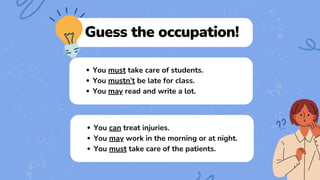
Guess the occupation!
You must take care of students.
You mustn’t be late for class.
You may read and write a lot.
You can treat injuries.
You may work in the morning or at night.
You must take care of the patients.
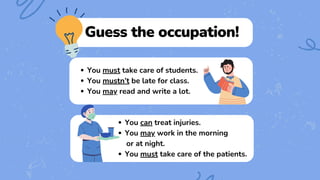
Guess the occupation!
You must take care of students.
You mustn’t be late for class.
You may read and write a lot.
You can treat injuries.
You may work in the morning
or at night.
You must take care of the patients.
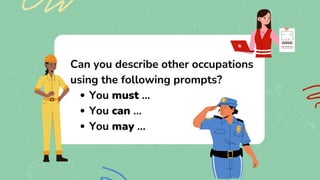
Can you describe other occupations
using the following prompts?
You must ...
You can ...
You may ...
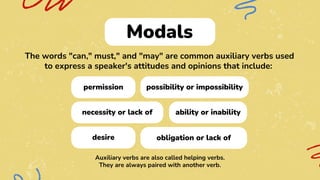
possibility or impossibility
obligation or lack of
permission
ability or inability
desire
necessity or lack of
Modals
The words "can," must," and "may" are common auxiliary verbs used
to express a speaker's attitudes and opinions that include:
Auxiliary verbs are also called helping verbs.
They are always paired with another verb.
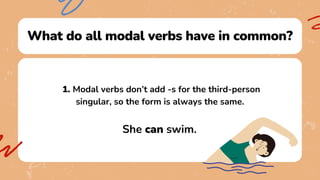
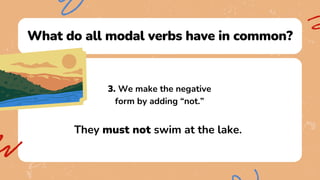
What do all modal verbs have in common?
1. Modal verbs don’t add -s for the third-person
singular, so the form is always the same.
She can swim.
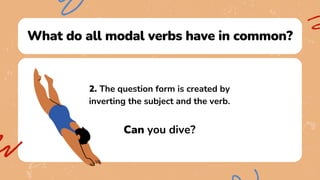
What do all modal verbs have in common?
2. The question form is created by
inverting the subject and the verb.
Can you dive?
What do all modal verbs have in common?
3. We make the negative
form by adding “not.”
They must not swim at the lake.
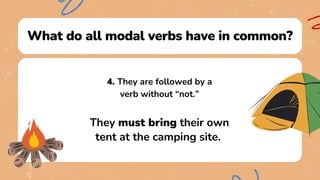
What do all modal verbs have in common?
4. They are followed by a
verb without “not.”
They must bring their own
tent at the camping site.
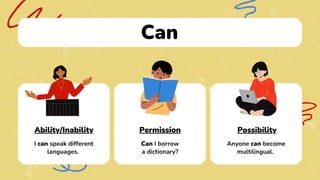
Can
Ability/Inability
I can speak different
languages.
Permission
Can I borrow
a dictionary?
Possibility
Anyone can become
multilingual.
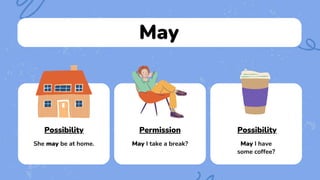
May
Possibility
She may be at home.
Permission
May I take a break?
Possibility
May I have
some coffee?
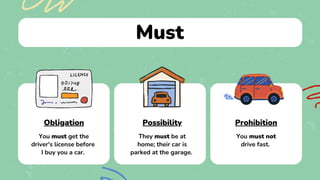
Must
Obligation
You must get the
driver's license before
I buy you a car.
Possibility Prohibition
They must be at
home; their car is
parked at the garage.
You mu
st not
drive fast.
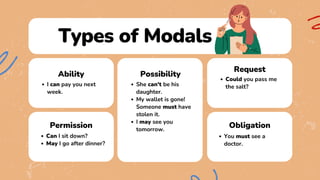
Types of Modals
Permission
Can I sit down?
May I go after dinner?
Ability
I can pay you next
week.
Possibility
She can't be his
daughter.
My wallet is gone!
Someone must have
stolen it.
I may see you
tomorrow.
Obligation
You must see a
doctor.
Request
Could you pass me
the salt?
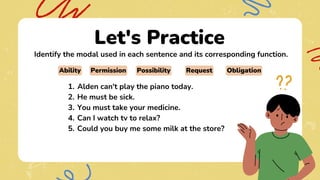
Let's Practice
Identify the modal used in each sentence and its corresponding function.
Alden can't play the piano today.
1.
He must be sick.
2.
You must take your medicine.
3.
Can I watch tv to relax?
4.
Could you buy me some milk at the store?
5.
Ability Permission Possibility Obligation
Request
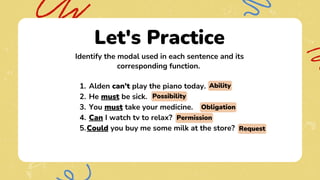
Alden can't play the piano today.
1.
He must be sick.
2.
You must take your medicine.
3.
Can I watch tv to relax?
4.
Could you buy me some milk at the store?
5.
Ability
Permission
Possibility
Obligation
Request
Let's Practice
Identify the modal used in each sentence and its
corresponding function.
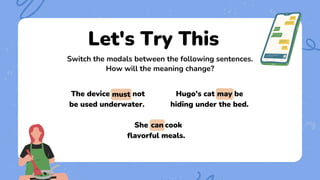
Let's Try This
Switch the modals between the following sentences.
How will the meaning change?
The device must not
be used underwater.
She can cook
flavorful meals.
Hugo's cat may be
hiding under the bed.
can
may
must
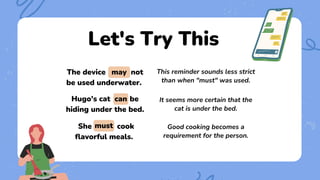
Let's Try This
This reminder sounds less strict
than when "must" was used.
The device not
be used underwater.
may
can
Hugo's cat be
hiding under the bed.
She cook
flavorful meals.
must
It seems more certain that the
cat is under the bed.
Good cooking becomes a
requirement for the person.
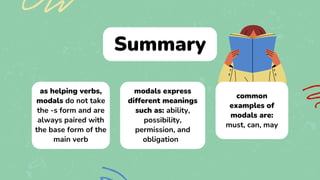
Summary
as helping verbs,
modals do not take
the -s form and are
always paired with
the base form of the
main verb
modals express
different meanings
such as: ability,
possibility,
permission, and
obligation
common
examples of
modals are:
must, can, may
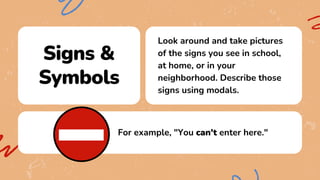
Signs &
Symbols
Look around and take pictures
of the signs you see in school,
at home, or in your
neighborhood. Describe those
signs using modals.
For example, "You can't enter here."

Modal Auxiliary Words Presentation.pdf..

  • 1.
  • 2.
    Lesson Outline What are modals? Modal:Can Modal: May Modal: Must Practice using modals
  • 3.
    Guess the occupation! Youmust take care of students. You mustn’t be late for class. You may read and write a lot. You can treat injuries. You may work in the morning or at night. You must take care of the patients.
  • 4.
    Guess the occupation! Youmust take care of students. You mustn’t be late for class. You may read and write a lot. You can treat injuries. You may work in the morning or at night. You must take care of the patients.
  • 5.
    Can you describeother occupations using the following prompts? You must ... You can ... You may ...
  • 6.
    possibility or impossibility obligationor lack of permission ability or inability desire necessity or lack of Modals The words "can," must," and "may" are common auxiliary verbs used to express a speaker's attitudes and opinions that include: Auxiliary verbs are also called helping verbs. They are always paired with another verb.
  • 7.
    What do allmodal verbs have in common? 1. Modal verbs don’t add -s for the third-person singular, so the form is always the same. She can swim.
  • 8.
    What do allmodal verbs have in common? 2. The question form is created by inverting the subject and the verb. Can you dive?
  • 9.
    What do allmodal verbs have in common? 3. We make the negative form by adding “not.” They must not swim at the lake.
  • 10.
    What do allmodal verbs have in common? 4. They are followed by a verb without “not.” They must bring their own tent at the camping site.
  • 11.
    Can Ability/Inability I can speakdifferent languages. Permission Can I borrow a dictionary? Possibility Anyone can become multilingual.
  • 12.
    May Possibility She may beat home. Permission May I take a break? Possibility May I have some coffee?
  • 13.
    Must Obligation You must getthe driver's license before I buy you a car. Possibility Prohibition They must be at home; their car is parked at the garage. You mu st not drive fast.
  • 14.
    Types of Modals Permission CanI sit down? May I go after dinner? Ability I can pay you next week. Possibility She can't be his daughter. My wallet is gone! Someone must have stolen it. I may see you tomorrow. Obligation You must see a doctor. Request Could you pass me the salt?
  • 15.
    Let's Practice Identify themodal used in each sentence and its corresponding function. Alden can't play the piano today. 1. He must be sick. 2. You must take your medicine. 3. Can I watch tv to relax? 4. Could you buy me some milk at the store? 5. Ability Permission Possibility Obligation Request
  • 16.
    Alden can't playthe piano today. 1. He must be sick. 2. You must take your medicine. 3. Can I watch tv to relax? 4. Could you buy me some milk at the store? 5. Ability Permission Possibility Obligation Request Let's Practice Identify the modal used in each sentence and its corresponding function.
  • 17.
    Let's Try This Switchthe modals between the following sentences. How will the meaning change? The device must not be used underwater. She can cook flavorful meals. Hugo's cat may be hiding under the bed. can may must
  • 18.
    Let's Try This Thisreminder sounds less strict than when "must" was used. The device not be used underwater. may can Hugo's cat be hiding under the bed. She cook flavorful meals. must It seems more certain that the cat is under the bed. Good cooking becomes a requirement for the person.
  • 19.
    Summary as helping verbs, modalsdo not take the -s form and are always paired with the base form of the main verb modals express different meanings such as: ability, possibility, permission, and obligation common examples of modals are: must, can, may
  • 20.
    Signs & Symbols Look aroundand take pictures of the signs you see in school, at home, or in your neighborhood. Describe those signs using modals. For example, "You can't enter here."