Page 1
Mobile Cloud
| Page 2
What is a mobile cloud
computing?
computing?
| Page 3
Motivation
– Mobile devices (e.g., smartphone, tablet pcs, etc) are increasingly
becoming an essential part of human life,
– Dream of “Information at your fingertips anywhere anytime”,
– Mobile devices still lack in resources compared to a conventional
information processing device such as PCs and laptops
Motivation
Soultion
› Mobile Cloud Computing (MCC)
| Page 4
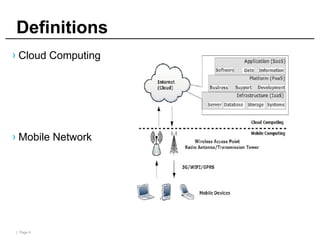
Definitions
› Mobile Network
› Cloud Computing
| Page 5
Where is the MCC?
› Mobile Cloud Computing (MCC) at
its simplest, refers to an infrastructure
where both the data storage and the
data processing happen outside of the
mobile device. Mobile cloud
applications move the computing
power and data storage away from
mobile phones and into the cloud,
bringing applications and mobile
computing to not just smartphone
users but a much broader range of
mobile subscribers”
Definition
| Page 6
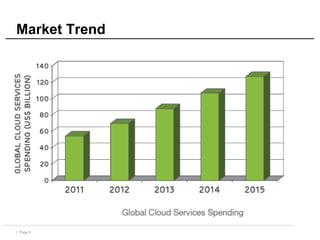
Market Trend
| Page 7
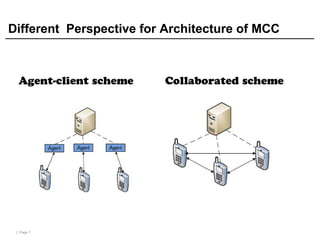
Different Perspective for Architecture of MCC
Agent-client scheme Collaborated scheme
| Page 8
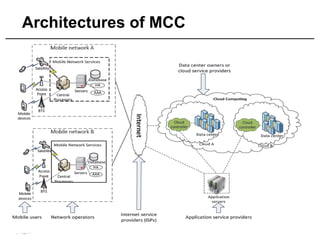
Architectures of MCC
| Page 9
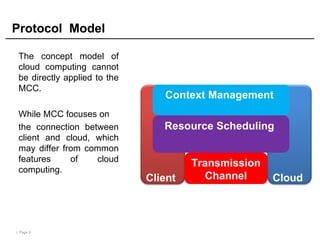
Protocol Model
The concept model of
cloud computing cannot
be directly applied to the
MCC.
While MCC focuses on
the connection between
client and cloud, which
may differ from common
features of cloud
computing.
Client Cloud
Transmission
Channel
Resource Scheduling
Context Management
| Page 10
Resource Scheduling
› Resource scheduling components address the schedule of
resource, such as computing resource
computing resource and storage
storage
resource
resource.
› Assign the appropriate pricing mechanism to
maximize the revenue of mobile cloud computing
systems and provide incentives for mobile users,
› Considering different cases, e.g., resource may be
stable but applications may transmit to other places.
| Page 11
Context Management
› Context Enabled features of mobile device allow us to ascertain additional
information from the computing device itself without the need for explicit user input.
› Two major classes of contexts:
– Social Context,
– Spatial context
| Page 12
Two major approaches
› Application partition and offloading technology play an important role for the
implementation of elastic applications.
› Application partition decompose complex workload to atomic ones, thus can be
processed concurrently.
› Offloading application can free burden of mobile devices.
| Page 13
Advantageous of MCC
Improving reliability
Extending battery lifetime
Improving data storage
capacity and processing
power
| Page 14
How MCC Can Extend Battery Lifetime?
Challenges:
› Battery is one of the main
concerns for mobile devices,
› Traditional approaches need to
changes the structure of
mobile devices.
› The additional cost for the end
mobile users is not appealing in
wireless networks.
MCC’s solution:
› Computation offloading
technique:
– Immigrate the large computations
and complex processing from
resource-limited devices (i.e.,
mobile devices) to resourceful
machines (i.e., servers in clouds).
› This avoids taking a long
application execution time on
mobile devices which results in
large amount of power
consumption.
| Page 15
How MCC Can Improve Storage
Capacity?
Challenges
› Users need more and more
capacity for saving the
essential information on
mobile devices,
› Need to change the device,
› More capacity, more weight
MCC’s solution
› MCC is developed to enable
mobile users to store/access
the large data on the cloud
through wireless networks,
› Examples of existing
services:
– Amazon Simple Storage
Service (Amazon S3),
– Image Exchange,
– Flickr, ShoZu.
| Page 16
How MCC Can Improve Reliability?
Challenges
› Users need reliable backup
for their information,
› Lack of data security
model for both service
providers and users in
existing mobile users,
MCC’s solution
› Storing data or running
applications on clouds is an
effective way to improve the
reliability since the data and
application are stored and backed
up on a number of computers.
| Page 17
Other advantageous of MCC
› Dynamic provisioning,
› Scalability,
› Multi-tenancy,
› Ease of integration.
| Page 18
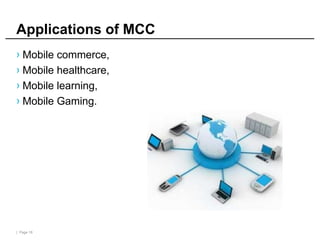
Applications of MCC
› Mobile commerce,
› Mobile healthcare,
› Mobile learning,
› Mobile Gaming.
| Page 19
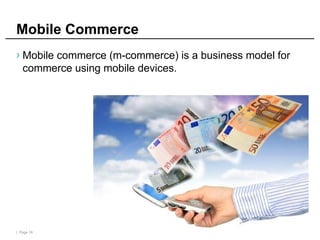
Mobile Commerce
› Mobile commerce (m-commerce) is a business model for
commerce using mobile devices.
| Page 20
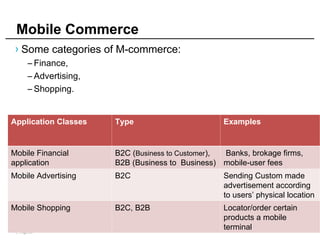
Mobile Commerce
› Some categories of M-commerce:
– Finance,
– Advertising,
– Shopping.
Application Classes Type Examples
Mobile Financial
application
B2C (Business to Customer),
B2B (Business to Business)
Banks, brokage firms,
mobile-user fees
Mobile Advertising B2C Sending Custom made
advertisement according
to users’ physical location
Mobile Shopping B2C, B2B Locator/order certain
products a mobile
terminal
| Page 21
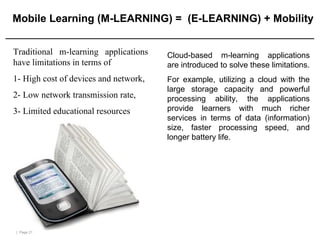
Mobile Learning (M-LEARNING) = (E-LEARNING) + Mobility
Traditional m-learning applications
have limitations in terms of
1- High cost of devices and network,
2- Low network transmission rate,
3- Limited educational resources
Cloud-based m-learning applications
are introduced to solve these limitations.
For example, utilizing a cloud with the
large storage capacity and powerful
processing ability, the applications
provide learners with much richer
services in terms of data (information)
size, faster processing speed, and
longer battery life.
| Page 22
Mobile-healthcare
› Comprehensive health monitoring services,
› Intelligent emergency management system
› Health-aware mobile devices detect pulse-
rate,
› Pervasive access to healthcare information,
› Pervasive lifestyle incentive.
| Page 23
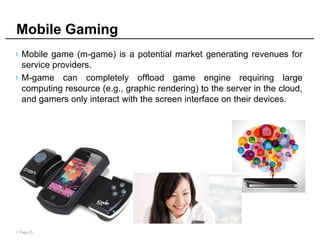
Mobile Gaming
› Mobile game (m-game) is a potential market generating revenues for
service providers.
› M-game can completely offload game engine requiring large
computing resource (e.g., graphic rendering) to the server in the cloud,
and gamers only interact with the screen interface on their devices.
| Page 24
Other applications on MCC
› Keyword based searching
› Voice based searching
› Tag- Based searching
| Page 25
ISSUES AND APPROACHES OF MCC
Due to the integration of
two different fields, i.e.,
cloud computing and
mobile networks,
MCC has to face many
technical challenges.
| Page 26
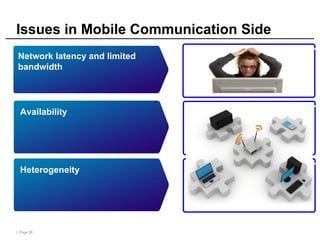
Issues in Mobile Communication Side
Availability
Heterogeneity
Network latency and limited
bandwidth
| Page 27
Low Bandwidth Solutions
Availability
Data distribution policy which determines
when and how much portions of available
bandwidth are shared among users from
which networks (e.g., WiFi and WiMAX).
E. Jung, etal “User-profile-driven
collaborative bandwidth sharing on
mobile phones” in MCS, no. 2,
2010.
Share the limited bandwidth among mobile
users who are located in the same area (e.g.,
a workplace, a station, and a stadium) and
involved in the same content (e.g., a video
file).
X. Jin, etal, “Cloud Assisted P2P
Media Streaming for Bandwidth
Constrained Mobile Subscribers,”
(ICPADS), pp. 800, January 2011.
| Page 28
Availability Solutions
• Finding stable neighbour
• WiFi multi-hop networking system
› G. Huerta “A virtual cloud computing provider for mobile
devices,” in MCS, 2010.
› L. Zhang,, “WiFace: a secure geosocial networking
system using WiFi-based multi-hop MANET,” in MSC,
2010.
| Page 29
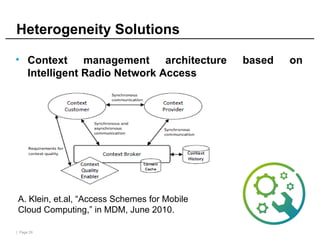
Heterogeneity Solutions
• Context management architecture based on
Intelligent Radio Network Access
A. Klein, et.al, “Access Schemes for Mobile
Cloud Computing,” in MDM, June 2010.
| Page 30
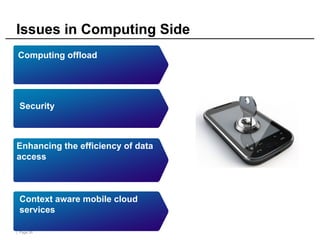
Issues in Computing Side
Availability
Context aware mobile cloud
services
Computing offload
Security
Enhancing the efficiency of data
access
| Page 31
Issue and Solutions in Computing Offload
›Offloading in the statistic environment is not
always the efficient way to save energy
–For small calculation and depending on the transmission
technology;
–Tradeoff between communication and computation cost.
G. Chen, et.al, “Studying energy trade offs in offloading computation/compilation in Java-
enabled mobile devices,” IEEE Transactions on Parallel and Distributed Systems, …2004.
| Page 32
Issue and Solutions in Computing
Offload
› For the dynamic environment, offloading encounter new problems as
› Changing connection statues and bandwidth,
› Data may reach not to the end users.
Changes Priority
level
Description
Client side
power level
1 Power can be divided into sufficient and
insufficient power levels, which will depend on
the particular situation.
Connection
status
2 The connection status can be faded,
disconnected from the mobile network, or re-
connected to the mobile network
Bandwidth 3 The bandwidth varies from time to time, and
depends on several factors, such as the
network traffic condition, etc.
| Page 33
Issues in Computing Side
› Security
– Security for mobile users,
› Security for mobile applications,
› Privacy
– Security of data on cloud
› Integrity
› Authentication,
| Page 34
Issues in Computing Side
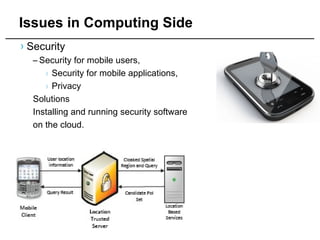
› Security
– Security for mobile users,
› Security for mobile applications,
› Privacy
Solutions
Installing and running security software
on the cloud.
| Page 35
Issues in Computing Side
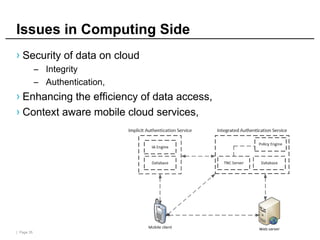
› Security of data on cloud
– Integrity
– Authentication,
› Enhancing the efficiency of data access,
› Context aware mobile cloud services,
| Page 36
Open Issues
Open Issues
| Page 37
Main Issue
› How to combine the two technology
How to combine the two technology
seamlessly?
seamlessly?
–The main aim of MCC is to provide PC_like
The main aim of MCC is to provide PC_like
services to mobile devices,
– How can the services from PC’s platforms be
How can the services from PC’s platforms be
transplanted to mobile devices?
| Page 38
Low bandwidth
› Mobility of users
› Increasing the demand of mobile users,
– More Bandwidth is required to offer MCC.
› Solutions
– 4G networks (based on LTE)
– Femto cells
– Cognitive radios
| Page 39
Low bandwidth: 4G Solutions
› Increases bandwidth for subscribers up to 100 Mbit/s (for “LTE
Advanced” standard) and 128 Mbit/s (for “Wireless MAN-
Advanced” standard);
› Wider mobile coverage area,
› Quicker and reliable handoff,
› Varied services,
› Quality of service guarantee in LTE and Wi-Fi;
› Coexistence with other networks (HSPA+, GSM, WiMax)
| Page 40
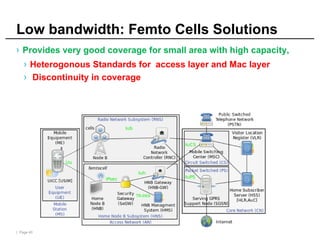
Low bandwidth: Femto Cells Solutions
› Provides very good coverage for small area with high capacity,
› Heterogonous Standards for access layer and Mac layer
› Discontinuity in coverage
| Page 41
Low Bandwidth: Cognitive Radios Solutions
› Cognitive radio can be expected as a solution to achieve
more spectrum utilization in mobile communication
environnent and increase the bandwidth efficiency.
– Cost
– Complexity
– Heterogeneity
– No- Interface
– None standard protocols
| Page 42
Handover (HO) in MCC
› Due to mobility of users, MCC encounters HO of users
during the services
– Internetworking HO
– Intranetworking HO
› Latency
› Disconnection
› No protocol for HO between networks in MCC
| Page 43
Pricing Mechanism
› Using services in MCC involves with
– Mobile service provider (MSP)
– Cloud service provider (CSP).
› MSPs and CSPs have different services management, customers
management, methods of payment and prices.
| Page 44
Service Convergence
Service Convergence
› The development and competition of cloud
service providers can lead to the fact that in the
near future these services will be differentiated
according to the types, cost, availability and
quality.
› A single cloud is not enough to meet mobile
user’s demands.
› The new scheme is needed in which the
mobile users can utilize multiple cloud in a
unified fashion
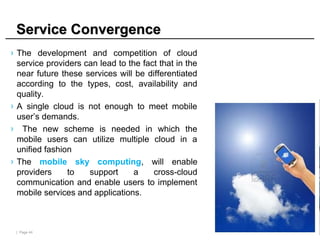
› The mobile sky computing, will enable
providers to support a cross-cloud
communication and enable users to implement
mobile services and applications.
| Page 45
References
References
[1] Hoang T. Dinh, etal, “A survey of Mobile Cloud Computing: architecture,
applications, and approaches”, Wireless communications and Mobile Computing
– Wiley, 2012.
[2] M. Satyanarayanan, “Mobile computing: the next decade,” in MCS, June
2010.
[3] Le Guan, etal. “A survey of research on mobile cloud computing”, IEEE/ACIS,
2010.
[4] H. Qui, etal. “Research on mobile cloud computing: review, trend and
perspective”, IEEE 2012.
[5] M. H. Tang, et.al “A dynamic mechanism for handling mobile computing
environmental changes,” in InfoScale, no. 7, pp. 1-9, May 2006.
| Page 46
Thank you

08_Mobile-Cloud-Introduction.pdf

  • 1.
  • 2.
    | Page 2 Whatis a mobile cloud What is a mobile cloud computing? computing?
  • 3.
    | Page 3 Motivation –Mobile devices (e.g., smartphone, tablet pcs, etc) are increasingly becoming an essential part of human life, – Dream of “Information at your fingertips anywhere anytime”, – Mobile devices still lack in resources compared to a conventional information processing device such as PCs and laptops Motivation Soultion › Mobile Cloud Computing (MCC)
  • 4.
    | Page 4 Definitions ›Mobile Network › Cloud Computing
  • 5.
    | Page 5 Whereis the MCC? › Mobile Cloud Computing (MCC) at its simplest, refers to an infrastructure where both the data storage and the data processing happen outside of the mobile device. Mobile cloud applications move the computing power and data storage away from mobile phones and into the cloud, bringing applications and mobile computing to not just smartphone users but a much broader range of mobile subscribers” Definition
  • 6.
  • 7.
    | Page 7 DifferentPerspective for Architecture of MCC Agent-client scheme Collaborated scheme
  • 8.
  • 9.
    | Page 9 ProtocolModel The concept model of cloud computing cannot be directly applied to the MCC. While MCC focuses on the connection between client and cloud, which may differ from common features of cloud computing. Client Cloud Transmission Channel Resource Scheduling Context Management
  • 10.
    | Page 10 ResourceScheduling › Resource scheduling components address the schedule of resource, such as computing resource computing resource and storage storage resource resource. › Assign the appropriate pricing mechanism to maximize the revenue of mobile cloud computing systems and provide incentives for mobile users, › Considering different cases, e.g., resource may be stable but applications may transmit to other places.
  • 11.
    | Page 11 ContextManagement › Context Enabled features of mobile device allow us to ascertain additional information from the computing device itself without the need for explicit user input. › Two major classes of contexts: – Social Context, – Spatial context
  • 12.
    | Page 12 Twomajor approaches › Application partition and offloading technology play an important role for the implementation of elastic applications. › Application partition decompose complex workload to atomic ones, thus can be processed concurrently. › Offloading application can free burden of mobile devices.
  • 13.
    | Page 13 Advantageousof MCC Improving reliability Extending battery lifetime Improving data storage capacity and processing power
  • 14.
    | Page 14 HowMCC Can Extend Battery Lifetime? Challenges: › Battery is one of the main concerns for mobile devices, › Traditional approaches need to changes the structure of mobile devices. › The additional cost for the end mobile users is not appealing in wireless networks. MCC’s solution: › Computation offloading technique: – Immigrate the large computations and complex processing from resource-limited devices (i.e., mobile devices) to resourceful machines (i.e., servers in clouds). › This avoids taking a long application execution time on mobile devices which results in large amount of power consumption.
  • 15.
    | Page 15 HowMCC Can Improve Storage Capacity? Challenges › Users need more and more capacity for saving the essential information on mobile devices, › Need to change the device, › More capacity, more weight MCC’s solution › MCC is developed to enable mobile users to store/access the large data on the cloud through wireless networks, › Examples of existing services: – Amazon Simple Storage Service (Amazon S3), – Image Exchange, – Flickr, ShoZu.
  • 16.
    | Page 16 HowMCC Can Improve Reliability? Challenges › Users need reliable backup for their information, › Lack of data security model for both service providers and users in existing mobile users, MCC’s solution › Storing data or running applications on clouds is an effective way to improve the reliability since the data and application are stored and backed up on a number of computers.
  • 17.
    | Page 17 Otheradvantageous of MCC › Dynamic provisioning, › Scalability, › Multi-tenancy, › Ease of integration.
  • 18.
    | Page 18 Applicationsof MCC › Mobile commerce, › Mobile healthcare, › Mobile learning, › Mobile Gaming.
  • 19.
    | Page 19 MobileCommerce › Mobile commerce (m-commerce) is a business model for commerce using mobile devices.
  • 20.
    | Page 20 MobileCommerce › Some categories of M-commerce: – Finance, – Advertising, – Shopping. Application Classes Type Examples Mobile Financial application B2C (Business to Customer), B2B (Business to Business) Banks, brokage firms, mobile-user fees Mobile Advertising B2C Sending Custom made advertisement according to users’ physical location Mobile Shopping B2C, B2B Locator/order certain products a mobile terminal
  • 21.
    | Page 21 MobileLearning (M-LEARNING) = (E-LEARNING) + Mobility Traditional m-learning applications have limitations in terms of 1- High cost of devices and network, 2- Low network transmission rate, 3- Limited educational resources Cloud-based m-learning applications are introduced to solve these limitations. For example, utilizing a cloud with the large storage capacity and powerful processing ability, the applications provide learners with much richer services in terms of data (information) size, faster processing speed, and longer battery life.
  • 22.
    | Page 22 Mobile-healthcare ›Comprehensive health monitoring services, › Intelligent emergency management system › Health-aware mobile devices detect pulse- rate, › Pervasive access to healthcare information, › Pervasive lifestyle incentive.
  • 23.
    | Page 23 MobileGaming › Mobile game (m-game) is a potential market generating revenues for service providers. › M-game can completely offload game engine requiring large computing resource (e.g., graphic rendering) to the server in the cloud, and gamers only interact with the screen interface on their devices.
  • 24.
    | Page 24 Otherapplications on MCC › Keyword based searching › Voice based searching › Tag- Based searching
  • 25.
    | Page 25 ISSUESAND APPROACHES OF MCC Due to the integration of two different fields, i.e., cloud computing and mobile networks, MCC has to face many technical challenges.
  • 26.
    | Page 26 Issuesin Mobile Communication Side Availability Heterogeneity Network latency and limited bandwidth
  • 27.
    | Page 27 LowBandwidth Solutions Availability Data distribution policy which determines when and how much portions of available bandwidth are shared among users from which networks (e.g., WiFi and WiMAX). E. Jung, etal “User-profile-driven collaborative bandwidth sharing on mobile phones” in MCS, no. 2, 2010. Share the limited bandwidth among mobile users who are located in the same area (e.g., a workplace, a station, and a stadium) and involved in the same content (e.g., a video file). X. Jin, etal, “Cloud Assisted P2P Media Streaming for Bandwidth Constrained Mobile Subscribers,” (ICPADS), pp. 800, January 2011.
  • 28.
    | Page 28 AvailabilitySolutions • Finding stable neighbour • WiFi multi-hop networking system › G. Huerta “A virtual cloud computing provider for mobile devices,” in MCS, 2010. › L. Zhang,, “WiFace: a secure geosocial networking system using WiFi-based multi-hop MANET,” in MSC, 2010.
  • 29.
    | Page 29 HeterogeneitySolutions • Context management architecture based on Intelligent Radio Network Access A. Klein, et.al, “Access Schemes for Mobile Cloud Computing,” in MDM, June 2010.
  • 30.
    | Page 30 Issuesin Computing Side Availability Context aware mobile cloud services Computing offload Security Enhancing the efficiency of data access
  • 31.
    | Page 31 Issueand Solutions in Computing Offload ›Offloading in the statistic environment is not always the efficient way to save energy –For small calculation and depending on the transmission technology; –Tradeoff between communication and computation cost. G. Chen, et.al, “Studying energy trade offs in offloading computation/compilation in Java- enabled mobile devices,” IEEE Transactions on Parallel and Distributed Systems, …2004.
  • 32.
    | Page 32 Issueand Solutions in Computing Offload › For the dynamic environment, offloading encounter new problems as › Changing connection statues and bandwidth, › Data may reach not to the end users. Changes Priority level Description Client side power level 1 Power can be divided into sufficient and insufficient power levels, which will depend on the particular situation. Connection status 2 The connection status can be faded, disconnected from the mobile network, or re- connected to the mobile network Bandwidth 3 The bandwidth varies from time to time, and depends on several factors, such as the network traffic condition, etc.
  • 33.
    | Page 33 Issuesin Computing Side › Security – Security for mobile users, › Security for mobile applications, › Privacy – Security of data on cloud › Integrity › Authentication,
  • 34.
    | Page 34 Issuesin Computing Side › Security – Security for mobile users, › Security for mobile applications, › Privacy Solutions Installing and running security software on the cloud.
  • 35.
    | Page 35 Issuesin Computing Side › Security of data on cloud – Integrity – Authentication, › Enhancing the efficiency of data access, › Context aware mobile cloud services,
  • 36.
    | Page 36 OpenIssues Open Issues
  • 37.
    | Page 37 MainIssue › How to combine the two technology How to combine the two technology seamlessly? seamlessly? –The main aim of MCC is to provide PC_like The main aim of MCC is to provide PC_like services to mobile devices, services to mobile devices, – How can the services from PC’s platforms be How can the services from PC’s platforms be transplanted to mobile devices? transplanted to mobile devices?
  • 38.
    | Page 38 Lowbandwidth › Mobility of users › Increasing the demand of mobile users, – More Bandwidth is required to offer MCC. › Solutions – 4G networks (based on LTE) – Femto cells – Cognitive radios
  • 39.
    | Page 39 Lowbandwidth: 4G Solutions › Increases bandwidth for subscribers up to 100 Mbit/s (for “LTE Advanced” standard) and 128 Mbit/s (for “Wireless MAN- Advanced” standard); › Wider mobile coverage area, › Quicker and reliable handoff, › Varied services, › Quality of service guarantee in LTE and Wi-Fi; › Coexistence with other networks (HSPA+, GSM, WiMax)
  • 40.
    | Page 40 Lowbandwidth: Femto Cells Solutions › Provides very good coverage for small area with high capacity, › Heterogonous Standards for access layer and Mac layer › Discontinuity in coverage
  • 41.
    | Page 41 LowBandwidth: Cognitive Radios Solutions › Cognitive radio can be expected as a solution to achieve more spectrum utilization in mobile communication environnent and increase the bandwidth efficiency. – Cost – Complexity – Heterogeneity – No- Interface – None standard protocols
  • 42.
    | Page 42 Handover(HO) in MCC Handover (HO) in MCC › Due to mobility of users, MCC encounters HO of users during the services – Internetworking HO – Intranetworking HO › Latency › Disconnection › No protocol for HO between networks in MCC
  • 43.
    | Page 43 PricingMechanism › Using services in MCC involves with – Mobile service provider (MSP) – Cloud service provider (CSP). › MSPs and CSPs have different services management, customers management, methods of payment and prices.
  • 44.
    | Page 44 ServiceConvergence Service Convergence › The development and competition of cloud service providers can lead to the fact that in the near future these services will be differentiated according to the types, cost, availability and quality. › A single cloud is not enough to meet mobile user’s demands. › The new scheme is needed in which the mobile users can utilize multiple cloud in a unified fashion › The mobile sky computing, will enable providers to support a cross-cloud communication and enable users to implement mobile services and applications.
  • 45.
    | Page 45 References References [1]Hoang T. Dinh, etal, “A survey of Mobile Cloud Computing: architecture, applications, and approaches”, Wireless communications and Mobile Computing – Wiley, 2012. [2] M. Satyanarayanan, “Mobile computing: the next decade,” in MCS, June 2010. [3] Le Guan, etal. “A survey of research on mobile cloud computing”, IEEE/ACIS, 2010. [4] H. Qui, etal. “Research on mobile cloud computing: review, trend and perspective”, IEEE 2012. [5] M. H. Tang, et.al “A dynamic mechanism for handling mobile computing environmental changes,” in InfoScale, no. 7, pp. 1-9, May 2006.
  • 46.