MOBILITY IN
SPIROCHETES
CONTENT:
• INTRODUCTION
• MOTILITY IN DIFFERENT SPIROCHETES
• SUMMARY
INTRODUCTION:
• What does mobility means?
The ability of bacteria to move independently using metabolic energy is called as mobility. Most rod-shaped
bacteria can move using their own power, which allows colonization of new environments and discovery of
new resources for survival.
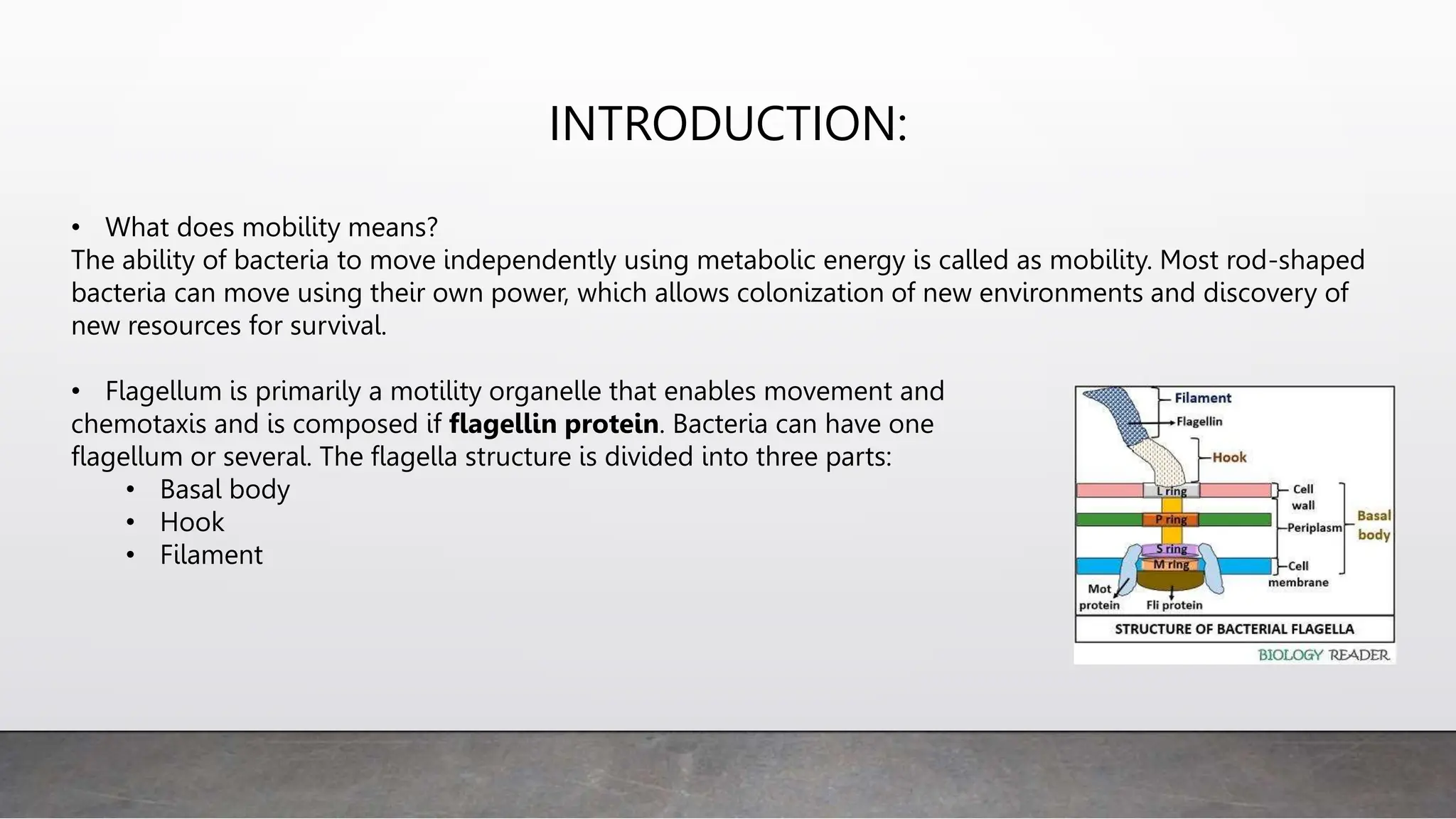
• Flagellum is primarily a motility organelle that enables movement and
chemotaxis and is composed if flagellin protein. Bacteria can have one
flagellum or several. The flagella structure is divided into three parts:
• Basal body
• Hook
• Filament
WHAT ARE SPIROCHETES AND CLASSIFICATION
• Spirochetes are gram negative bacteria, having a unique structure, and as a result their motility is
different from that of other bacteria. They can be observed under Dark microscopy by staining
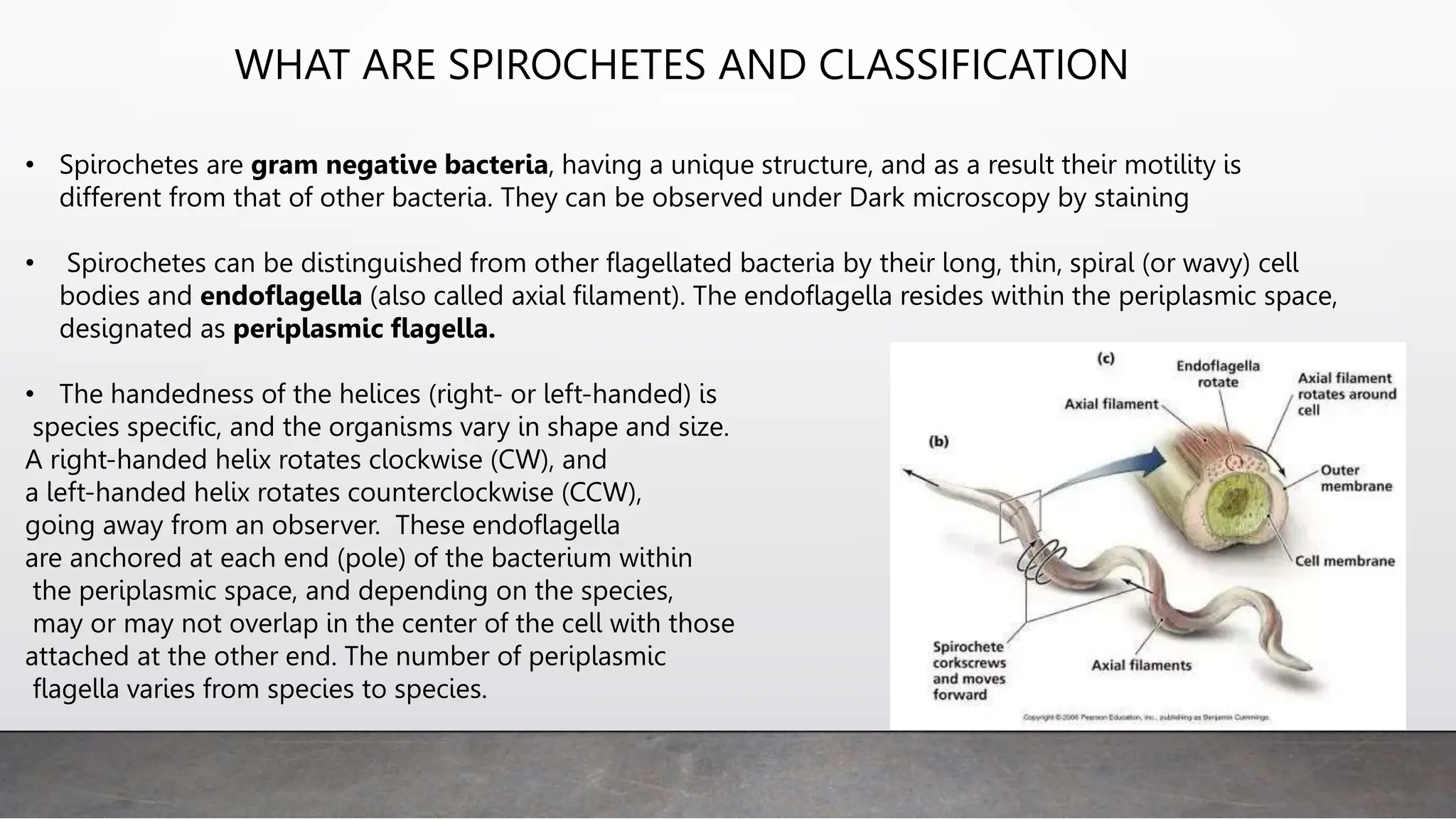
• Spirochetes can be distinguished from other flagellated bacteria by their long, thin, spiral (or wavy) cell
bodies and endoflagella (also called axial filament). The endoflagella resides within the periplasmic space,
designated as periplasmic flagella.
• The handedness of the helices (right- or left-handed) is
species specific, and the organisms vary in shape and size.
A right-handed helix rotates clockwise (CW), and
a left-handed helix rotates counterclockwise (CCW),
going away from an observer. These endoflagella
are anchored at each end (pole) of the bacterium within
the periplasmic space, and depending on the species,
may or may not overlap in the center of the cell with those
attached at the other end. The number of periplasmic
flagella varies from species to species.
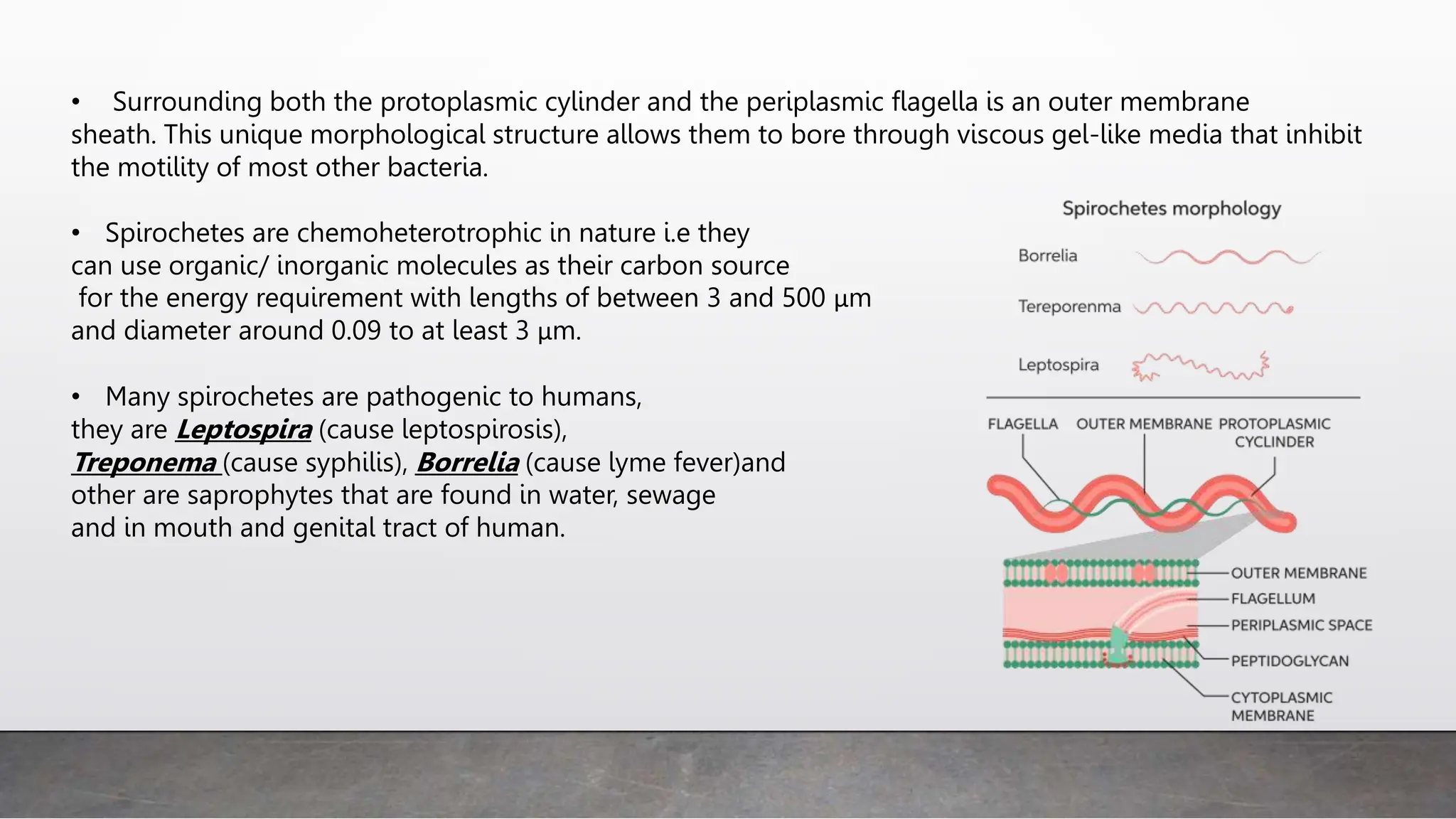
• Surrounding both the protoplasmic cylinder and the periplasmic flagella is an outer membrane
sheath. This unique morphological structure allows them to bore through viscous gel-like media that inhibit
the motility of most other bacteria.
• Spirochetes are chemoheterotrophic in nature i.e they
can use organic/ inorganic molecules as their carbon source
for the energy requirement with lengths of between 3 and 500 μm
and diameter around 0.09 to at least 3 μm.
• Many spirochetes are pathogenic to humans,
they are Leptospira (cause leptospirosis),
Treponema (cause syphilis), Borrelia (cause lyme fever)and
other are saprophytes that are found in water, sewage
and in mouth and genital tract of human.
MOTILITY IN DIFFERENT SPIROCHETES:
• Although the spirochetes are structurally similar, the swimming motion of Leptospira and borrelia appears to be
quite different, models have been developed to explain these differences.
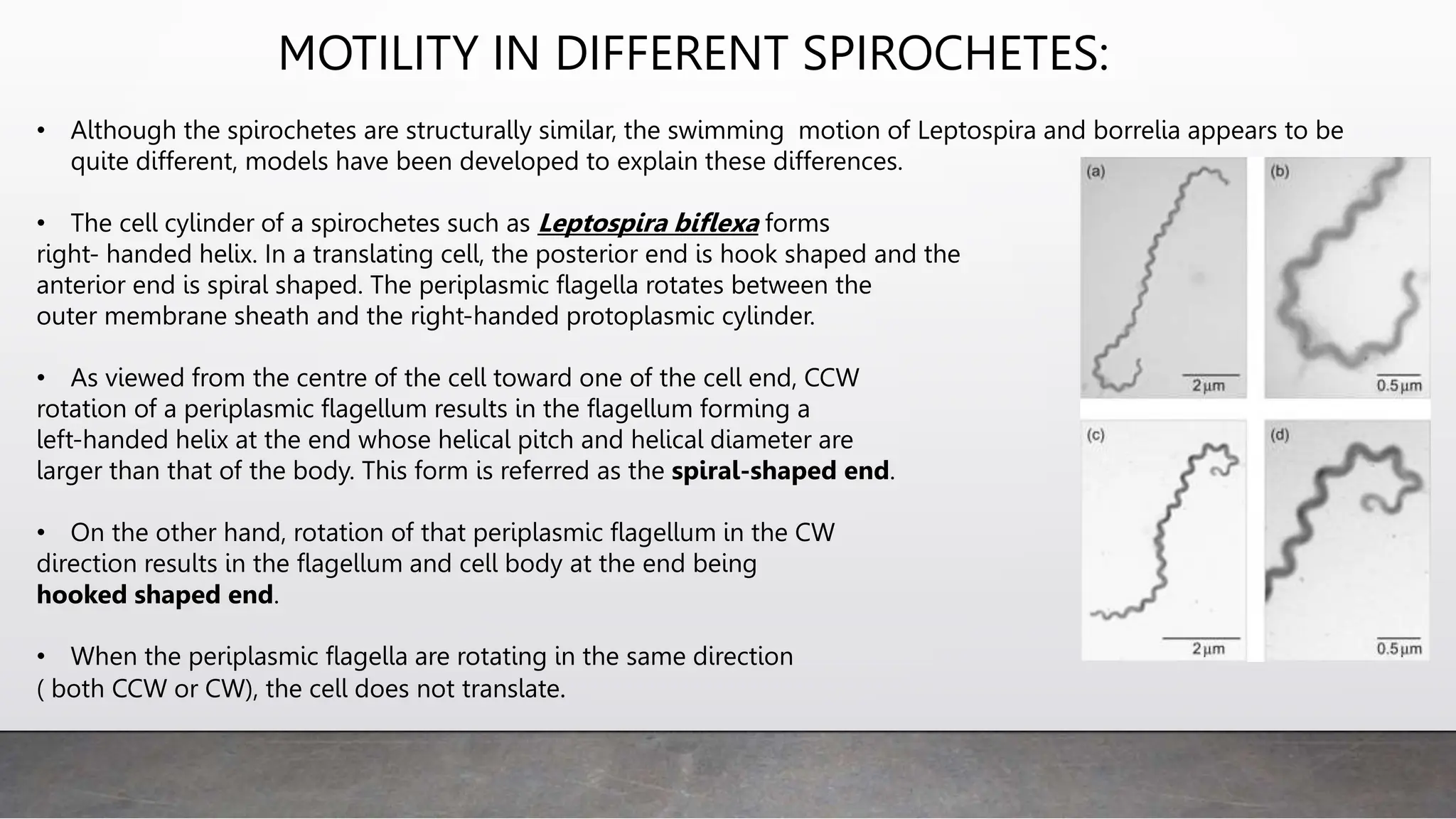
• The cell cylinder of a spirochetes such as Leptospira biflexa forms
right- handed helix. In a translating cell, the posterior end is hook shaped and the
anterior end is spiral shaped. The periplasmic flagella rotates between the
outer membrane sheath and the right-handed protoplasmic cylinder.
• As viewed from the centre of the cell toward one of the cell end, CCW
rotation of a periplasmic flagellum results in the flagellum forming a
left-handed helix at the end whose helical pitch and helical diameter are
larger than that of the body. This form is referred as the spiral-shaped end.
• On the other hand, rotation of that periplasmic flagellum in the CW
direction results in the flagellum and cell body at the end being
hooked shaped end.
• When the periplasmic flagella are rotating in the same direction
( both CCW or CW), the cell does not translate.
DIFFERENT MODELS OF ROTATION OF SPIROCHETES:
1. In the model for rotation of Leptospira, where only one periplasmic flagellum extends from each end of
the cell along the center axis of the helix, but flagella do not overlap. The forward thrust of such results
from two rotations. The first, the periplasmic flagella rotate CCW. Second, the torque of the rotating
flagellum produces a CW counterrotation of right-handed helical cell body. Thus two modes of movement
are proposed.
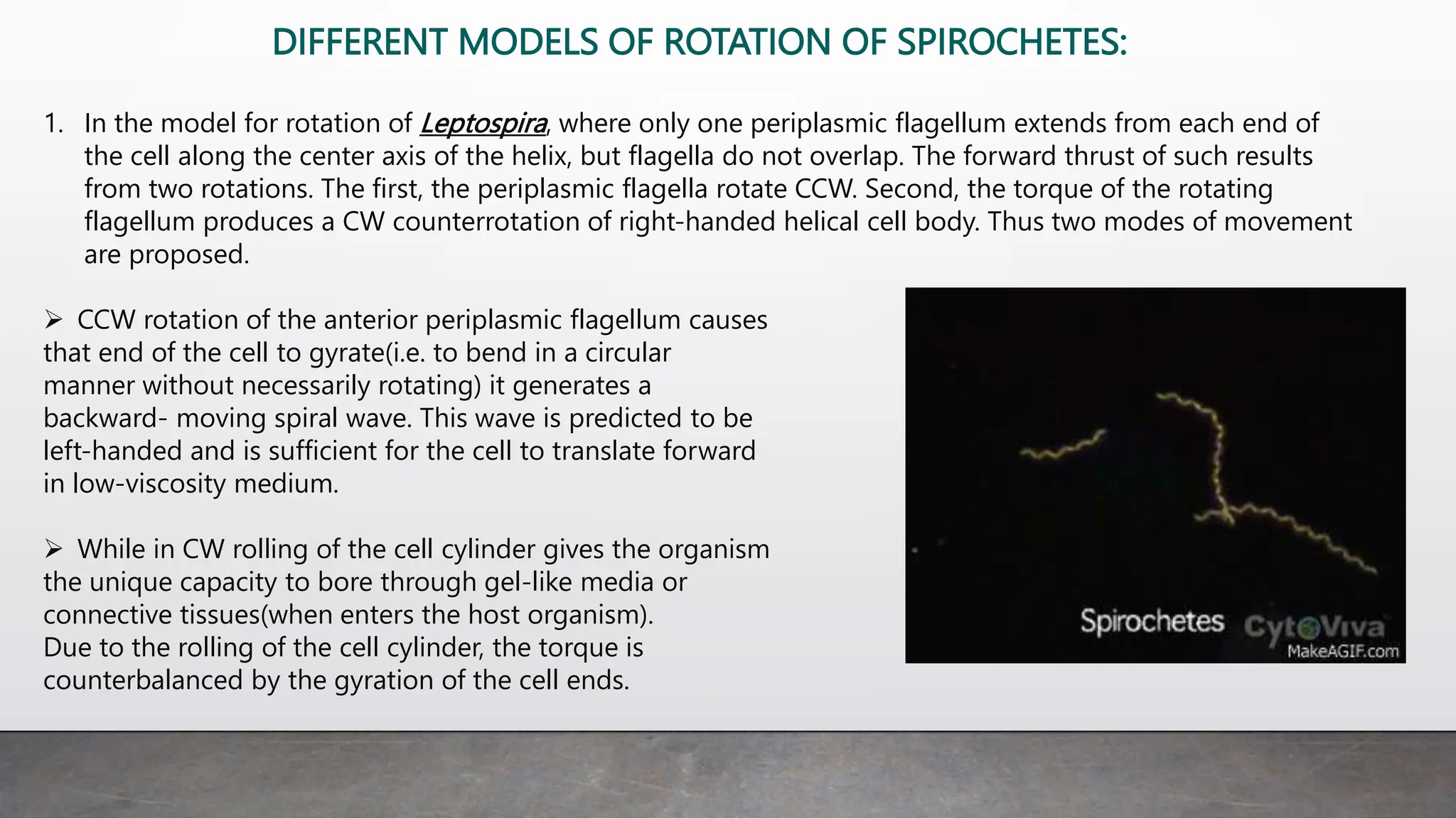
 CCW rotation of the anterior periplasmic flagellum causes
that end of the cell to gyrate(i.e. to bend in a circular
manner without necessarily rotating) it generates a
backward- moving spiral wave. This wave is predicted to be
left-handed and is sufficient for the cell to translate forward
in low-viscosity medium.
 While in CW rolling of the cell cylinder gives the organism
the unique capacity to bore through gel-like media or
connective tissues(when enters the host organism).
Due to the rolling of the cell cylinder, the torque is
counterbalanced by the gyration of the cell ends.
2. The model of motility for Treponema is that similar to the Leptospira. This spirochete has a right-handed
cell cylinder with four to eight short, nonoverlapping periplasmic flagella attached subterminally at each
end. As with Leptospira, these structures cause the cell ends to be left- handed or irregular in shape.
However CCW gyration of the bent shaped ends does not yield sufficient thrust to cause the cell to move
in a low-viscosity medium. But because of the cell is helical and right-handed, Treponema can translate in
highly viscous gel-like medium such as 1% methylcellulose. The CW counterrotation of the cell cylinder is
considered to cause cell movement.
3. In Borrelia differs from other spirochetes in that it has a flat-wave morphology (nonhelical; planner wave).
Cell swim with the flat waves being propagated from the anterior end of the translating cell to the
posterior. These flat waves are reminiscent of eukaryotic cell motility and flagella. In Borrelia there are
between 7 and 11 periplasmic flagella attached near each end and they overlap in the center. Nonmotile
mutants are rod shaped, indicating that the periplasmic flagella dictate the shape of the entire cell.
• The flagellar filaments of most species of spirochetes contain three proteins (FlaB1, FlaB2, and FlaB3) and
are attached subterminally at each end of the cell cylinder and within the periplasmic sheath that contains
the sheath protein FlaA. A separate gene encodes each of these proteins.
• Periplasmic flagella consist of one to two FlaA proteins and three to four FlaB proteins. Borrelia is an
exception in that it has one FlaA protein and only one FlaB protein.
• Exclusive of chemotaxis genes, at least 36 motility genes have been identified in Borrelia and Treponema.
• The motility genes of spirochetes appear to be very tightly clustered. Only 8 motility operons are present
in Borrelia and 9 or 10 in Treponema.
• In Borrelia there is a large motility gene cluster of 21kb.
SUMMARY:
• Flagella is the basic unit of movement in organisms and is divided into 3 parts.
• The periplasmic cylinder consists of a cytoplasm, a cytoplasmic membrane, and a peptidoglycan layer,
which is covered by outer membrane. Motility of spirochetes is much more different that the other motile
organisms due to their structure and the endoflagella resides within the periplasmic space, designated as
periplasmic flagella.
• The motility of the spirochetes are different in few aspects and that is the periplasmic flagella present in
the subclasses of the spirochetes(based on number present) and the rotation of the helix(left- or right-
handed).
REFFERENCE:
• MICROBIAL PHYSIOLOGY, 4TH EDITION
BY: ALBERT G. MOAT,
JOHN W. FORSTER,
MICHEAL P. SPECTOR
QUESTIONS?
THANK YOU

Mobility in different spirochetes bacteria .pptx

  • 1.
  • 2.
    CONTENT: • INTRODUCTION • MOTILITYIN DIFFERENT SPIROCHETES • SUMMARY
  • 3.
    INTRODUCTION: • What doesmobility means? The ability of bacteria to move independently using metabolic energy is called as mobility. Most rod-shaped bacteria can move using their own power, which allows colonization of new environments and discovery of new resources for survival. • Flagellum is primarily a motility organelle that enables movement and chemotaxis and is composed if flagellin protein. Bacteria can have one flagellum or several. The flagella structure is divided into three parts: • Basal body • Hook • Filament
  • 4.
    WHAT ARE SPIROCHETESAND CLASSIFICATION • Spirochetes are gram negative bacteria, having a unique structure, and as a result their motility is different from that of other bacteria. They can be observed under Dark microscopy by staining • Spirochetes can be distinguished from other flagellated bacteria by their long, thin, spiral (or wavy) cell bodies and endoflagella (also called axial filament). The endoflagella resides within the periplasmic space, designated as periplasmic flagella. • The handedness of the helices (right- or left-handed) is species specific, and the organisms vary in shape and size. A right-handed helix rotates clockwise (CW), and a left-handed helix rotates counterclockwise (CCW), going away from an observer. These endoflagella are anchored at each end (pole) of the bacterium within the periplasmic space, and depending on the species, may or may not overlap in the center of the cell with those attached at the other end. The number of periplasmic flagella varies from species to species.
  • 5.
    • Surrounding boththe protoplasmic cylinder and the periplasmic flagella is an outer membrane sheath. This unique morphological structure allows them to bore through viscous gel-like media that inhibit the motility of most other bacteria. • Spirochetes are chemoheterotrophic in nature i.e they can use organic/ inorganic molecules as their carbon source for the energy requirement with lengths of between 3 and 500 μm and diameter around 0.09 to at least 3 μm. • Many spirochetes are pathogenic to humans, they are Leptospira (cause leptospirosis), Treponema (cause syphilis), Borrelia (cause lyme fever)and other are saprophytes that are found in water, sewage and in mouth and genital tract of human.
  • 6.
    MOTILITY IN DIFFERENTSPIROCHETES: • Although the spirochetes are structurally similar, the swimming motion of Leptospira and borrelia appears to be quite different, models have been developed to explain these differences. • The cell cylinder of a spirochetes such as Leptospira biflexa forms right- handed helix. In a translating cell, the posterior end is hook shaped and the anterior end is spiral shaped. The periplasmic flagella rotates between the outer membrane sheath and the right-handed protoplasmic cylinder. • As viewed from the centre of the cell toward one of the cell end, CCW rotation of a periplasmic flagellum results in the flagellum forming a left-handed helix at the end whose helical pitch and helical diameter are larger than that of the body. This form is referred as the spiral-shaped end. • On the other hand, rotation of that periplasmic flagellum in the CW direction results in the flagellum and cell body at the end being hooked shaped end. • When the periplasmic flagella are rotating in the same direction ( both CCW or CW), the cell does not translate.
  • 7.
    DIFFERENT MODELS OFROTATION OF SPIROCHETES: 1. In the model for rotation of Leptospira, where only one periplasmic flagellum extends from each end of the cell along the center axis of the helix, but flagella do not overlap. The forward thrust of such results from two rotations. The first, the periplasmic flagella rotate CCW. Second, the torque of the rotating flagellum produces a CW counterrotation of right-handed helical cell body. Thus two modes of movement are proposed.  CCW rotation of the anterior periplasmic flagellum causes that end of the cell to gyrate(i.e. to bend in a circular manner without necessarily rotating) it generates a backward- moving spiral wave. This wave is predicted to be left-handed and is sufficient for the cell to translate forward in low-viscosity medium.  While in CW rolling of the cell cylinder gives the organism the unique capacity to bore through gel-like media or connective tissues(when enters the host organism). Due to the rolling of the cell cylinder, the torque is counterbalanced by the gyration of the cell ends.
  • 8.
    2. The modelof motility for Treponema is that similar to the Leptospira. This spirochete has a right-handed cell cylinder with four to eight short, nonoverlapping periplasmic flagella attached subterminally at each end. As with Leptospira, these structures cause the cell ends to be left- handed or irregular in shape. However CCW gyration of the bent shaped ends does not yield sufficient thrust to cause the cell to move in a low-viscosity medium. But because of the cell is helical and right-handed, Treponema can translate in highly viscous gel-like medium such as 1% methylcellulose. The CW counterrotation of the cell cylinder is considered to cause cell movement. 3. In Borrelia differs from other spirochetes in that it has a flat-wave morphology (nonhelical; planner wave). Cell swim with the flat waves being propagated from the anterior end of the translating cell to the posterior. These flat waves are reminiscent of eukaryotic cell motility and flagella. In Borrelia there are between 7 and 11 periplasmic flagella attached near each end and they overlap in the center. Nonmotile mutants are rod shaped, indicating that the periplasmic flagella dictate the shape of the entire cell.
  • 9.
    • The flagellarfilaments of most species of spirochetes contain three proteins (FlaB1, FlaB2, and FlaB3) and are attached subterminally at each end of the cell cylinder and within the periplasmic sheath that contains the sheath protein FlaA. A separate gene encodes each of these proteins. • Periplasmic flagella consist of one to two FlaA proteins and three to four FlaB proteins. Borrelia is an exception in that it has one FlaA protein and only one FlaB protein. • Exclusive of chemotaxis genes, at least 36 motility genes have been identified in Borrelia and Treponema. • The motility genes of spirochetes appear to be very tightly clustered. Only 8 motility operons are present in Borrelia and 9 or 10 in Treponema. • In Borrelia there is a large motility gene cluster of 21kb.
  • 10.
    SUMMARY: • Flagella isthe basic unit of movement in organisms and is divided into 3 parts. • The periplasmic cylinder consists of a cytoplasm, a cytoplasmic membrane, and a peptidoglycan layer, which is covered by outer membrane. Motility of spirochetes is much more different that the other motile organisms due to their structure and the endoflagella resides within the periplasmic space, designated as periplasmic flagella. • The motility of the spirochetes are different in few aspects and that is the periplasmic flagella present in the subclasses of the spirochetes(based on number present) and the rotation of the helix(left- or right- handed).
  • 11.
    REFFERENCE: • MICROBIAL PHYSIOLOGY,4TH EDITION BY: ALBERT G. MOAT, JOHN W. FORSTER, MICHEAL P. SPECTOR
  • 12.
  • 13.