Mobile phone development
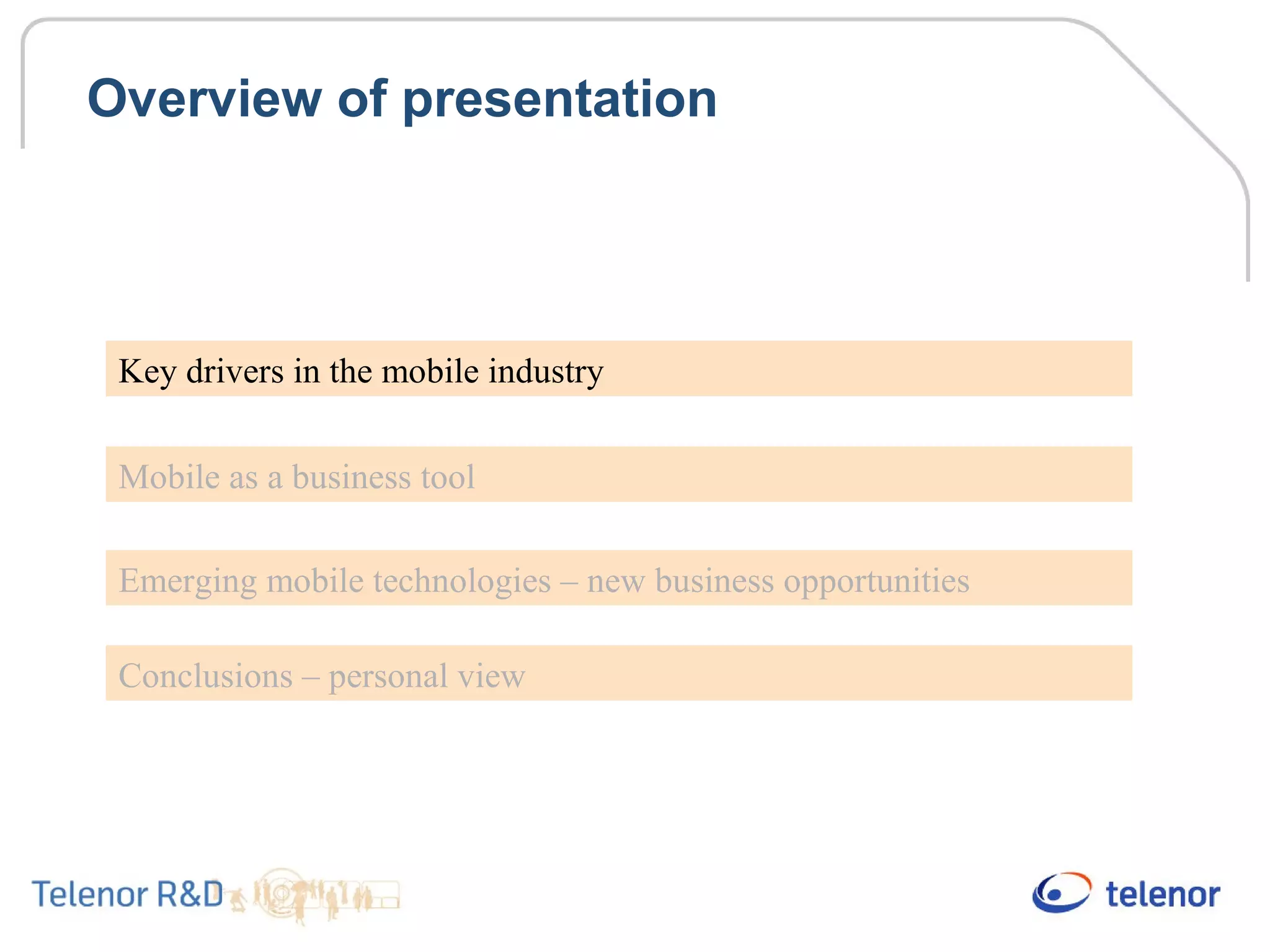
Overview of presentation
Key drivers in the mobile industry
Mobile as a business tool
Emerging mobile technologies
Conclusions – personal view
3G Concept phone (2000)
Overview of presentation
Key drivers in the mobile industry
Mobile as a business tool
Emerging mobile technologies – new business opportunities
Conclusions – personal view
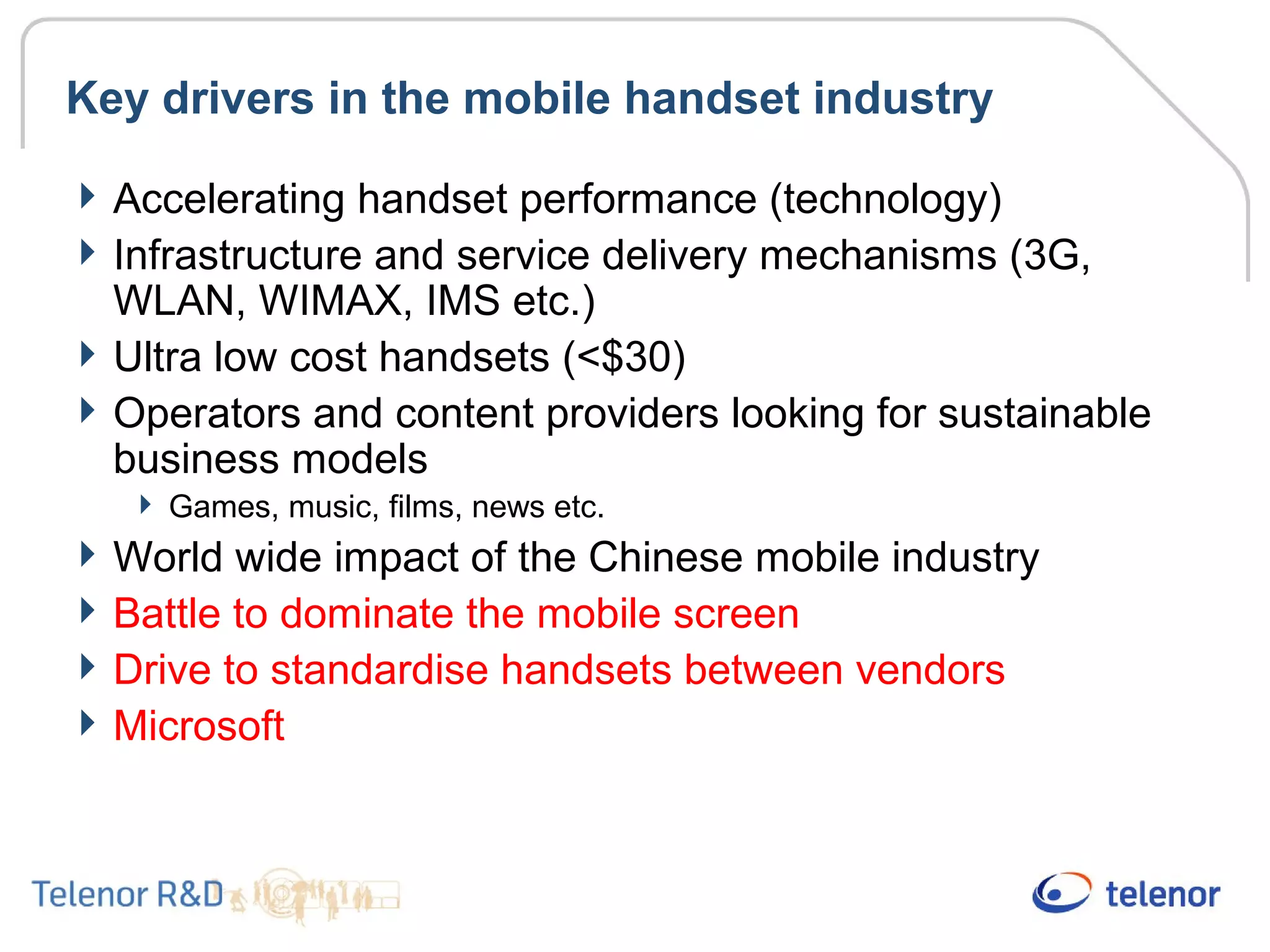
Key drivers in the mobile handset industry
Accelerating handset performance (technology)
Infrastructure and service delivery mechanisms (3G,
WLAN, WIMAX, IMS etc.)
Ultra low cost handsets (<$30)
Operators and content providers looking for sustainable
business models
 Games, music, films, news etc.
World wide impact of the Chinese mobile industry
Battle to dominate the mobile screen
Drive to standardise handsets between vendors
Microsoft
The mobile “real estate”
 High price for hot property – who will
dominate the mobile screen?
 Manufacturers?
 Operators?
 International media players?
 Regional players?
 Microsoft?
 “I decide” – personalised content
 The screen is the key
 User loyalty comes through positive
experiences
 Usability, simplicity, utility,
attractiveness and reliability
 All actors have a need to promote
themselves, the question is how do we
share this space?
 How can content providers benefit from
the mobile experience?
Example: Mobile newspaper experience
 Large number of of Norwegian newspapers
have mobile internet pages
 Operators have the default mobile portal
 The user must actively find the newspaper portal
 Challenging for newspapers to position
themselves on the mobile screen
1. Battle to get a premium position on the
operator mobile internet portal – collaborate
with operators
2. Try to become the default start-up page for
mobile internet
3. Advertise heavily for you mobile internet portal
Telenor portal:
Operator attempt for standardisation
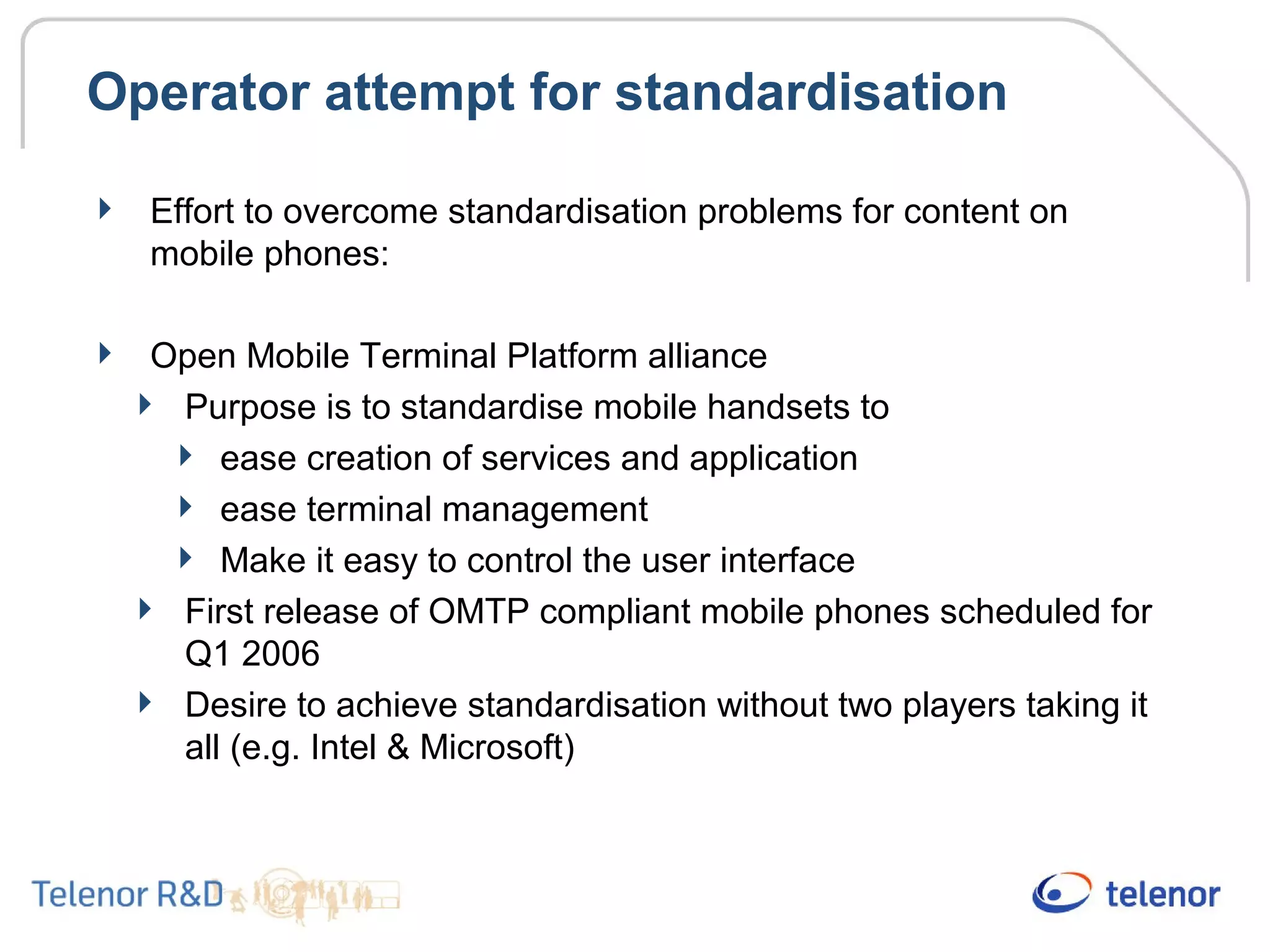
 Effort to overcome standardisation problems for content on
mobile phones:
 Open Mobile Terminal Platform alliance
 Purpose is to standardise mobile handsets to
 ease creation of services and application
 ease terminal management
 Make it easy to control the user interface
 First release of OMTP compliant mobile phones scheduled for
Q1 2006
 Desire to achieve standardisation without two players taking it
all (e.g. Intel & Microsoft)
OMTP
To what extent will the handsets be standardised?
Not a desire to reduce innovation and the possibility
for manufacturers to differentiate themselves
Introduce classes of terminals (C0 – C3) with a
minimum set of performance criteria for each class
Eg. Reduce the variety of screen sizes / resolutions
etc
Agree on codecs (picture, video, voice formats)
Will help ensure that services will work end-to-end
and on terminals from different manufacturers
Will ease software development for third parties
Microsoft
 “We are going to invest and invest and invest to get the most
popular software platform because we believe in these [kinds of
mobile and wireless] scenarios” – Bill Gates, MS developers conference 2003
 A force to be reckoned with
Won all battles so far (Windows, IE, MS Office, Windows
Media player(?), Exchange (?))
 Main strength is the link between the pc / servers and the handset
(Active Sync, Exchange)
 Nokia licensing of Active Sync
Potential body blow to Microsoft argues analysts
But it is not only about the sync protocol – more important
is the consistency of data structures on both sides of the
wireless / wired link.
Microsoft main assets
Exchange server today, Live Communication Server 2005 tomorrow
Real time collaboration tool
Presence information as an integrated part of the office
tools (including MS Office)
Mobile handset (Smartphones) fully integrated into the
corporate environment
Telecommunications services fully integrated into the
traditional mail server
In the future corporate environment you will not be able to choose
your own handset, you will be given a MS phone…
All about the software, not the hardware
Overview of presentation
Key drivers in the mobile industry
Mobile as a business tool
Emerging mobile technologies – new business opportunities
Conclusions – personal view
Mobile email to yourphone
 Mobile email: Thepossibilitytoofferafullemailexperience
onmobilehandsets.
 Not‘wap’ orbrowserbasedsolutions
 Notonlymail, butalsocontactsandcalendar
 MobileemailintheSMEsegmentsexpectedtobea
considerabledriverformobiledatatrafficintheshortand
longterm
 Potentiallythekillerapplicationfor3Gtowardthebusiness
segment?
 Operatorfriendlycommercialsolutionsareavailablefrom
severalvendors
 Solutionprovidersrecognisetheimportanceoftheoperator
customerbaseandbranding
 Mobileemailcanbesupportedonawiderangeofhandsets
 Majorcarriershavealreadylaunchedmobileemailsolutions
(Vodafone, O2, TMobile, Telenor)
 Aservicewellsuitedfortheentire businesssegment
 FromSoHotocorporate
Mobile email solutions are complex
Requires installation of client software on your handset
Requires operator to install connection centre servers
Requires installation of software inside the corporate
firewall
But:
Useful tool that enables you to stay always connected
and updated
Increases staff flexibility and efficiency
Reduces need for use of data cards with PCs
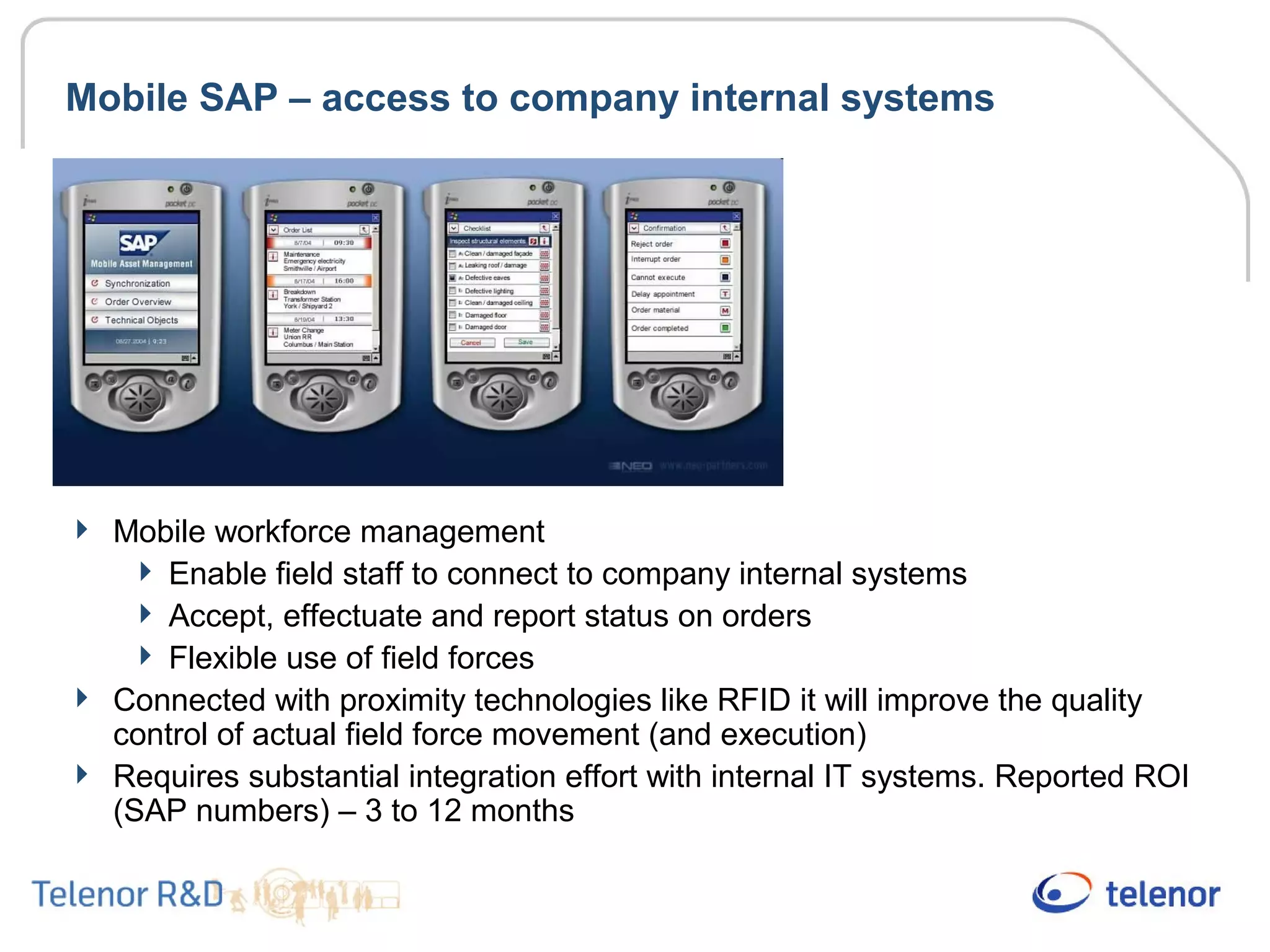
Mobile SAP – access to company internal systems
 Mobile workforce management
 Enable field staff to connect to company internal systems
 Accept, effectuate and report status on orders
 Flexible use of field forces
 Connected with proximity technologies like RFID it will improve the quality
control of actual field force movement (and execution)
 Requires substantial integration effort with internal IT systems. Reported ROI
(SAP numbers) – 3 to 12 months
Overview of presentation
Key drivers in the mobile industry
Mobile as a business tool
Emerging mobile technologies – new business opportunities
Conclusions – personal view
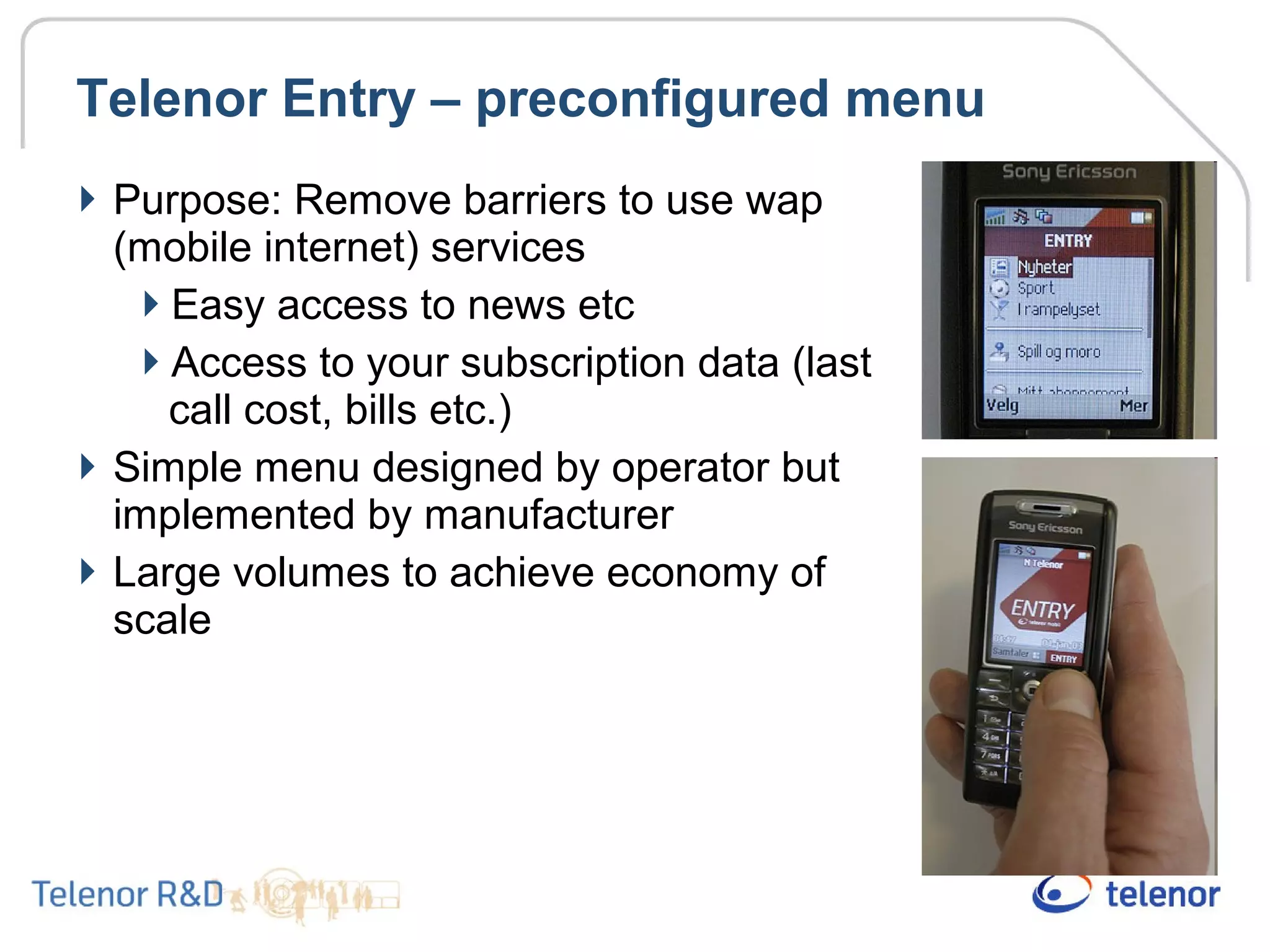
Telenor Entry – preconfigured menu
Purpose: Remove barriers to use wap
(mobile internet) services
Easy access to news etc
Access to your subscription data (last
call cost, bills etc.)
Simple menu designed by operator but
implemented by manufacturer
Large volumes to achieve economy of
scale
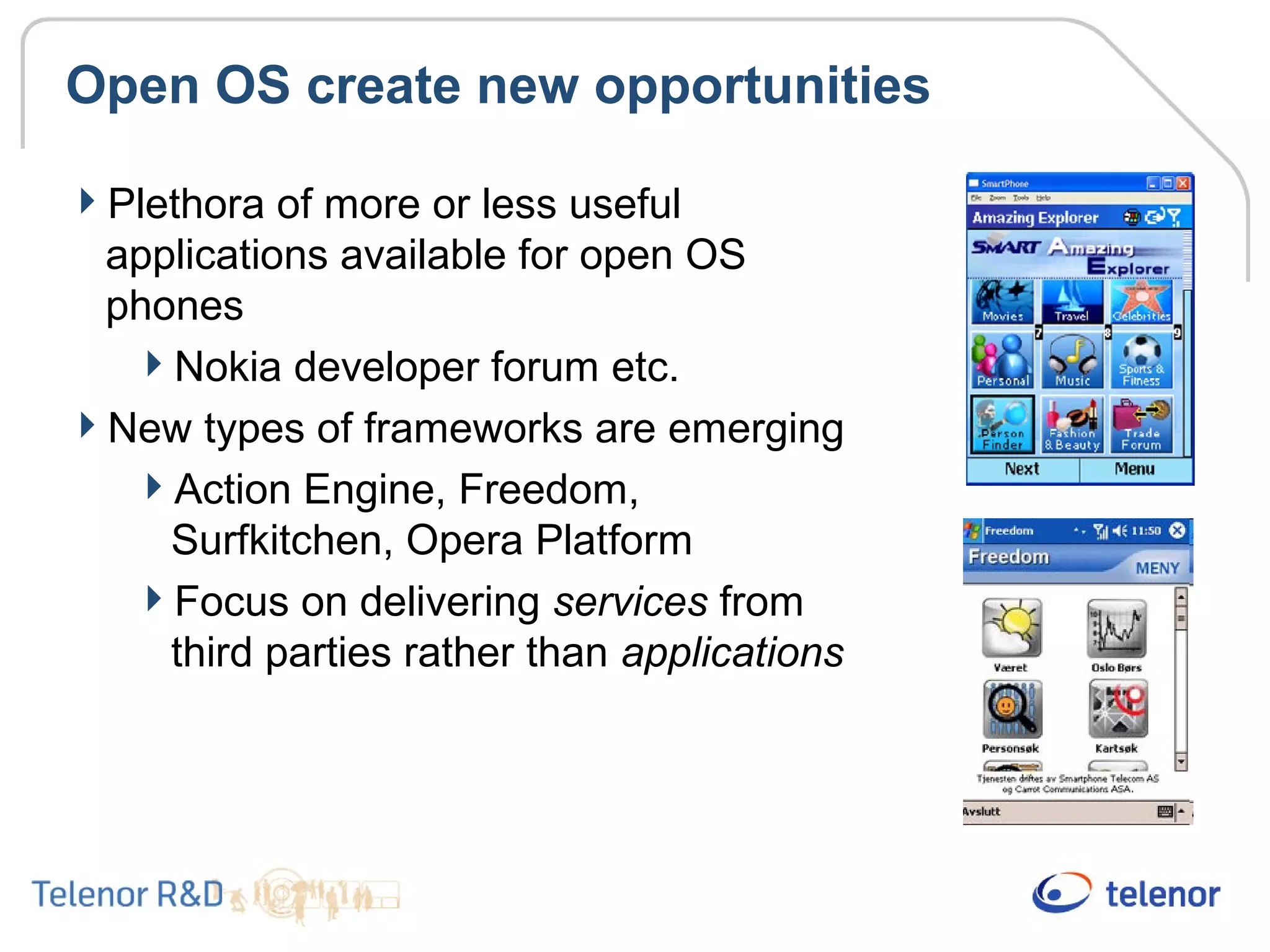
Open OS create new opportunities
Plethora of more or less useful
applications available for open OS
phones
Nokia developer forum etc.
New types of frameworks are emerging
Action Engine, Freedom,
Surfkitchen, Opera Platform
Focus on delivering services from
third parties rather than applications
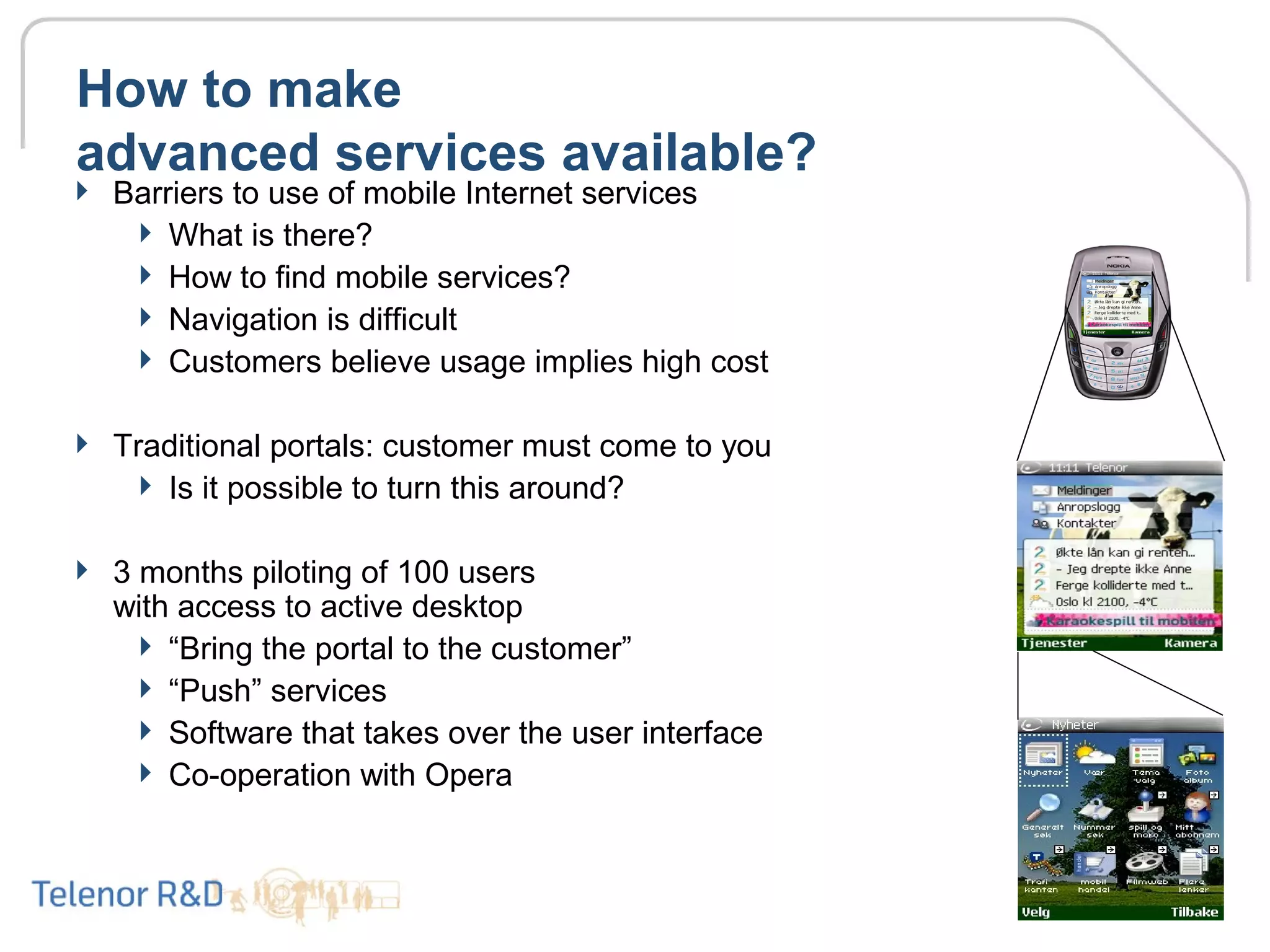
How to make
advanced services available?
 Barriers to use of mobile Internet services
 What is there?
 How to find mobile services?
 Navigation is difficult
 Customers believe usage implies high cost
 Traditional portals: customer must come to you
 Is it possible to turn this around?
 3 months piloting of 100 users
with access to active desktop
 “Bring the portal to the customer”
 “Push” services
 Software that takes over the user interface
 Co-operation with Opera
The opportunity to bring content and services closer
to the customers` attention
 An active desktop is taking over the home screen of the
phone and presenting a new front-page and service menu:
 Content teasers (news, weather and advertisement
banners) on the front-page
 News pushed to the end user every 45 minutes
 Immediate access to pre stored and updated content
through clicking on teasers
 Upload of Photos and Contact List to web portal
 Reversed MMS news / blogging
 Combining useful phone applications and online content
in an operator service menu
 Restaurant guide, concerts, TV listings etc.
 The “content provider phone” is fully possible
Users prefer active desktop and push
services
 Active desktop creates a need for daily update of news and
entertainment
 Users wish to personalise their news categories
 The active desktop is preferred to the phone manufacturers’ frontpage
 Active desktop is seen as a simpler and more accessible concept than
WAP
 From 12% active WAP users before pilot to 75% active WAP users
after the pilot
 Users missed active desktop after conclusion of pilot
Client based portal
 Client based solution
 Software which takes over the user interface of the
phone
 Pro:
You can define the look and feel of the idle screen
You can communicate effortlessly with external
servers to retrieve and distribute information
You can provide secondary functions (backup,
uploads, mail etc)
 Con:
It only works on specific handsets
The user is online at all times (battery issue)
Cost of data traffic
Handsets are unstable
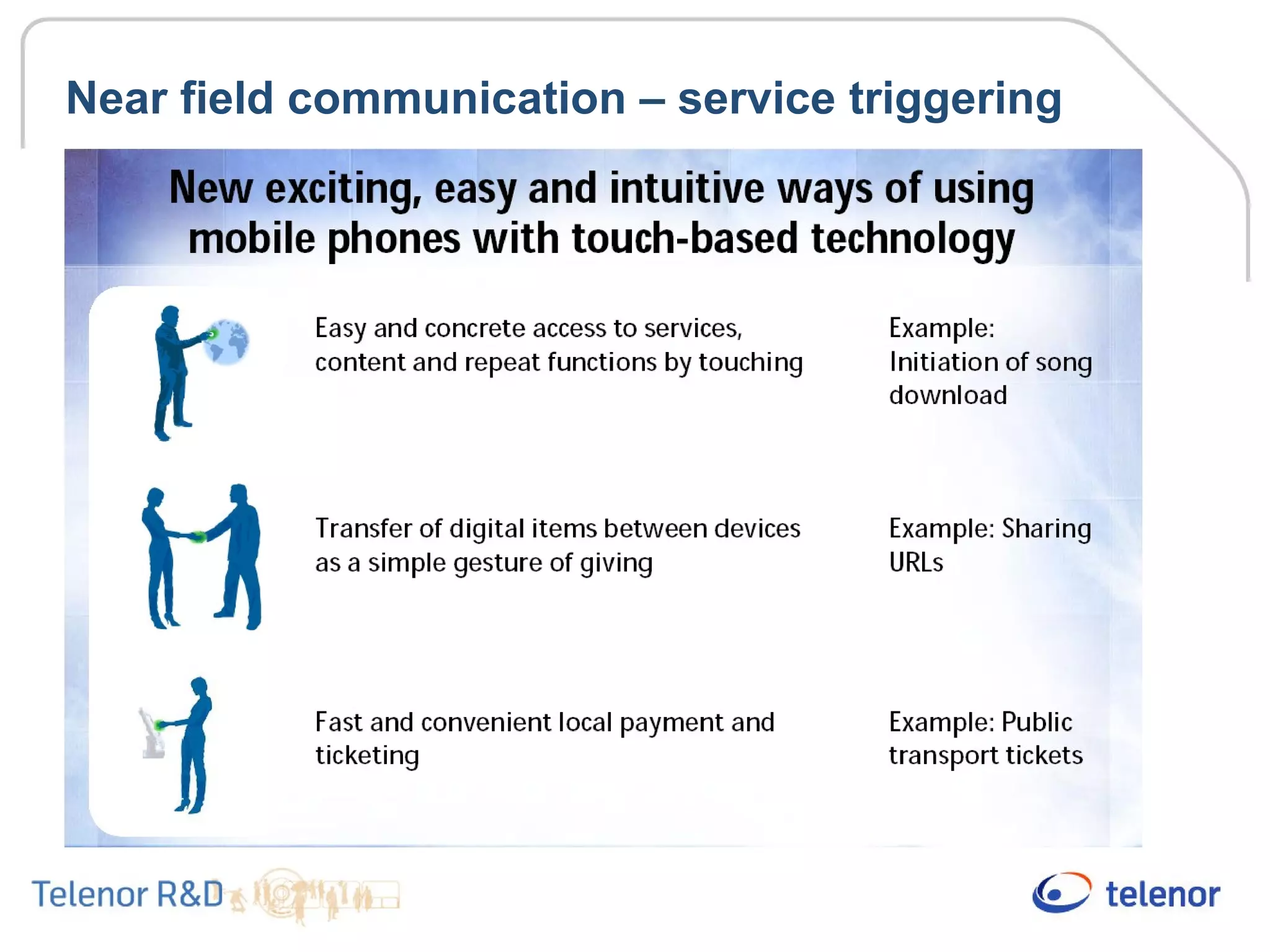
Near field communication – service triggering
Look for opportunities in new concepts.
Near field communication – service triggering
Deloppgave 1
Studer hva tjenestetilbydere tilbyr av mobile tjenester
og konsepter til bedriftsmarkedet
For hvem?
Hva?
Sammenlign de forskjellige tilbyderene
Hver gruppe presenterer sine resultater 7 oktober
Deloppgave 2
Velg en tjenestetilbyder og gå i dybden på hva den
leverer
Studer en av deres kunder
Velg en brukergruppe
Hvordan bruker de tjenestene?
Hvordan passer det med hvordan de jobber?
Hva kunne de ha tenkt seg
Hva vurdere dere som mulig å levere.
Ta hensyn da til hvem som skal levere, drifte etc
Prosjektoppgaven skal inneholde både deloppgave 1 og
2
Overview of presentation
Key drivers in the mobile industry
Mobile as a business tool
Emerging mobile technologies – new business opportunities
Conclusions – personal view
Some trends
Diverse portfolio of handsets
Made to measure and mainstream handsets
Hardware commodity
Software and connectivity the differentiating factor
Proximity technologies for service initiation will become
important
Payment, identification and authorisation
Increased utility focus
Increased mobile – pc communication
Some thoughts for the future
Personal forecast
Windows will win the corporate / business segment
where access to company data is essential
Symbian (Nokia) will be pushed down and dominate
the advanced handset market (at least in Europe)
Significant growth in low cost handsets (< $30)
production for emerging markets
Manufacturers will continue to distribute mass market
devices based on proprietary OS for the foreseeable
future due to licensing costs
Handsets will gradually become OMTP compliant with
increased standardisation across manufacturerers

Mobile phone development ifi

  • 1.
  • 2.
    Overview of presentation Keydrivers in the mobile industry Mobile as a business tool Emerging mobile technologies Conclusions – personal view 3G Concept phone (2000)
  • 3.
    Overview of presentation Keydrivers in the mobile industry Mobile as a business tool Emerging mobile technologies – new business opportunities Conclusions – personal view
  • 4.
    Key drivers inthe mobile handset industry Accelerating handset performance (technology) Infrastructure and service delivery mechanisms (3G, WLAN, WIMAX, IMS etc.) Ultra low cost handsets (<$30) Operators and content providers looking for sustainable business models  Games, music, films, news etc. World wide impact of the Chinese mobile industry Battle to dominate the mobile screen Drive to standardise handsets between vendors Microsoft
  • 5.
    The mobile “realestate”  High price for hot property – who will dominate the mobile screen?  Manufacturers?  Operators?  International media players?  Regional players?  Microsoft?  “I decide” – personalised content  The screen is the key  User loyalty comes through positive experiences  Usability, simplicity, utility, attractiveness and reliability  All actors have a need to promote themselves, the question is how do we share this space?  How can content providers benefit from the mobile experience?
  • 6.
    Example: Mobile newspaperexperience  Large number of of Norwegian newspapers have mobile internet pages  Operators have the default mobile portal  The user must actively find the newspaper portal  Challenging for newspapers to position themselves on the mobile screen 1. Battle to get a premium position on the operator mobile internet portal – collaborate with operators 2. Try to become the default start-up page for mobile internet 3. Advertise heavily for you mobile internet portal Telenor portal:
  • 7.
    Operator attempt forstandardisation  Effort to overcome standardisation problems for content on mobile phones:  Open Mobile Terminal Platform alliance  Purpose is to standardise mobile handsets to  ease creation of services and application  ease terminal management  Make it easy to control the user interface  First release of OMTP compliant mobile phones scheduled for Q1 2006  Desire to achieve standardisation without two players taking it all (e.g. Intel & Microsoft)
  • 8.
    OMTP To what extentwill the handsets be standardised? Not a desire to reduce innovation and the possibility for manufacturers to differentiate themselves Introduce classes of terminals (C0 – C3) with a minimum set of performance criteria for each class Eg. Reduce the variety of screen sizes / resolutions etc Agree on codecs (picture, video, voice formats) Will help ensure that services will work end-to-end and on terminals from different manufacturers Will ease software development for third parties
  • 9.
    Microsoft  “We aregoing to invest and invest and invest to get the most popular software platform because we believe in these [kinds of mobile and wireless] scenarios” – Bill Gates, MS developers conference 2003  A force to be reckoned with Won all battles so far (Windows, IE, MS Office, Windows Media player(?), Exchange (?))  Main strength is the link between the pc / servers and the handset (Active Sync, Exchange)  Nokia licensing of Active Sync Potential body blow to Microsoft argues analysts But it is not only about the sync protocol – more important is the consistency of data structures on both sides of the wireless / wired link.
  • 10.
    Microsoft main assets Exchangeserver today, Live Communication Server 2005 tomorrow Real time collaboration tool Presence information as an integrated part of the office tools (including MS Office) Mobile handset (Smartphones) fully integrated into the corporate environment Telecommunications services fully integrated into the traditional mail server In the future corporate environment you will not be able to choose your own handset, you will be given a MS phone… All about the software, not the hardware
  • 11.
    Overview of presentation Keydrivers in the mobile industry Mobile as a business tool Emerging mobile technologies – new business opportunities Conclusions – personal view
  • 12.
    Mobile email toyourphone  Mobile email: Thepossibilitytoofferafullemailexperience onmobilehandsets.  Not‘wap’ orbrowserbasedsolutions  Notonlymail, butalsocontactsandcalendar  MobileemailintheSMEsegmentsexpectedtobea considerabledriverformobiledatatrafficintheshortand longterm  Potentiallythekillerapplicationfor3Gtowardthebusiness segment?  Operatorfriendlycommercialsolutionsareavailablefrom severalvendors  Solutionprovidersrecognisetheimportanceoftheoperator customerbaseandbranding  Mobileemailcanbesupportedonawiderangeofhandsets  Majorcarriershavealreadylaunchedmobileemailsolutions (Vodafone, O2, TMobile, Telenor)  Aservicewellsuitedfortheentire businesssegment  FromSoHotocorporate
  • 13.
    Mobile email solutionsare complex Requires installation of client software on your handset Requires operator to install connection centre servers Requires installation of software inside the corporate firewall But: Useful tool that enables you to stay always connected and updated Increases staff flexibility and efficiency Reduces need for use of data cards with PCs
  • 14.
    Mobile SAP –access to company internal systems  Mobile workforce management  Enable field staff to connect to company internal systems  Accept, effectuate and report status on orders  Flexible use of field forces  Connected with proximity technologies like RFID it will improve the quality control of actual field force movement (and execution)  Requires substantial integration effort with internal IT systems. Reported ROI (SAP numbers) – 3 to 12 months
  • 15.
    Overview of presentation Keydrivers in the mobile industry Mobile as a business tool Emerging mobile technologies – new business opportunities Conclusions – personal view
  • 16.
    Telenor Entry –preconfigured menu Purpose: Remove barriers to use wap (mobile internet) services Easy access to news etc Access to your subscription data (last call cost, bills etc.) Simple menu designed by operator but implemented by manufacturer Large volumes to achieve economy of scale
  • 17.
    Open OS createnew opportunities Plethora of more or less useful applications available for open OS phones Nokia developer forum etc. New types of frameworks are emerging Action Engine, Freedom, Surfkitchen, Opera Platform Focus on delivering services from third parties rather than applications
  • 18.
    How to make advancedservices available?  Barriers to use of mobile Internet services  What is there?  How to find mobile services?  Navigation is difficult  Customers believe usage implies high cost  Traditional portals: customer must come to you  Is it possible to turn this around?  3 months piloting of 100 users with access to active desktop  “Bring the portal to the customer”  “Push” services  Software that takes over the user interface  Co-operation with Opera
  • 19.
    The opportunity tobring content and services closer to the customers` attention  An active desktop is taking over the home screen of the phone and presenting a new front-page and service menu:  Content teasers (news, weather and advertisement banners) on the front-page  News pushed to the end user every 45 minutes  Immediate access to pre stored and updated content through clicking on teasers  Upload of Photos and Contact List to web portal  Reversed MMS news / blogging  Combining useful phone applications and online content in an operator service menu  Restaurant guide, concerts, TV listings etc.  The “content provider phone” is fully possible
  • 20.
    Users prefer activedesktop and push services  Active desktop creates a need for daily update of news and entertainment  Users wish to personalise their news categories  The active desktop is preferred to the phone manufacturers’ frontpage  Active desktop is seen as a simpler and more accessible concept than WAP  From 12% active WAP users before pilot to 75% active WAP users after the pilot  Users missed active desktop after conclusion of pilot
  • 21.
    Client based portal Client based solution  Software which takes over the user interface of the phone  Pro: You can define the look and feel of the idle screen You can communicate effortlessly with external servers to retrieve and distribute information You can provide secondary functions (backup, uploads, mail etc)  Con: It only works on specific handsets The user is online at all times (battery issue) Cost of data traffic Handsets are unstable
  • 23.
    Near field communication– service triggering
  • 24.
    Look for opportunitiesin new concepts.
  • 25.
    Near field communication– service triggering
  • 26.
    Deloppgave 1 Studer hvatjenestetilbydere tilbyr av mobile tjenester og konsepter til bedriftsmarkedet For hvem? Hva? Sammenlign de forskjellige tilbyderene Hver gruppe presenterer sine resultater 7 oktober
  • 27.
    Deloppgave 2 Velg entjenestetilbyder og gå i dybden på hva den leverer Studer en av deres kunder Velg en brukergruppe Hvordan bruker de tjenestene? Hvordan passer det med hvordan de jobber? Hva kunne de ha tenkt seg Hva vurdere dere som mulig å levere. Ta hensyn da til hvem som skal levere, drifte etc Prosjektoppgaven skal inneholde både deloppgave 1 og 2
  • 28.
    Overview of presentation Keydrivers in the mobile industry Mobile as a business tool Emerging mobile technologies – new business opportunities Conclusions – personal view
  • 29.
    Some trends Diverse portfolioof handsets Made to measure and mainstream handsets Hardware commodity Software and connectivity the differentiating factor Proximity technologies for service initiation will become important Payment, identification and authorisation Increased utility focus Increased mobile – pc communication
  • 30.
    Some thoughts forthe future Personal forecast Windows will win the corporate / business segment where access to company data is essential Symbian (Nokia) will be pushed down and dominate the advanced handset market (at least in Europe) Significant growth in low cost handsets (< $30) production for emerging markets Manufacturers will continue to distribute mass market devices based on proprietary OS for the foreseeable future due to licensing costs Handsets will gradually become OMTP compliant with increased standardisation across manufacturerers

Editor's Notes

  • #3 &amp;lt;number&amp;gt;
  • #4 &amp;lt;number&amp;gt;
  • #6 &amp;lt;number&amp;gt; Eiendommen som er til salgs.
  • #7 &amp;lt;number&amp;gt;
  • #8 &amp;lt;number&amp;gt;
  • #9 &amp;lt;number&amp;gt;
  • #10 &amp;lt;number&amp;gt;
  • #11 &amp;lt;number&amp;gt;
  • #12 &amp;lt;number&amp;gt;
  • #13 &amp;lt;number&amp;gt;
  • #14 &amp;lt;number&amp;gt;
  • #16 &amp;lt;number&amp;gt;
  • #17 &amp;lt;number&amp;gt;
  • #18 &amp;lt;number&amp;gt;
  • #19 &amp;lt;number&amp;gt;
  • #20 &amp;lt;number&amp;gt;
  • #21 &amp;lt;number&amp;gt; Noen brukere følte de ble ”nyhetsavhengige”
  • #22 &amp;lt;number&amp;gt;
  • #29 &amp;lt;number&amp;gt;
  • #30 &amp;lt;number&amp;gt;
  • #31 &amp;lt;number&amp;gt;