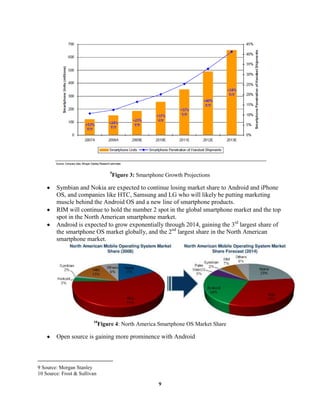
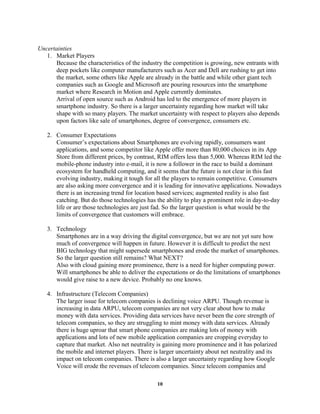
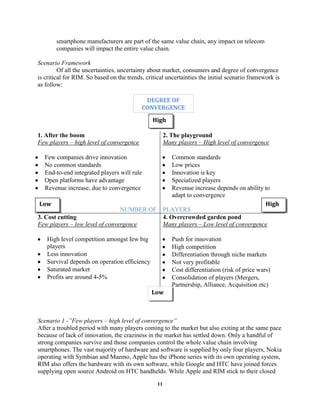
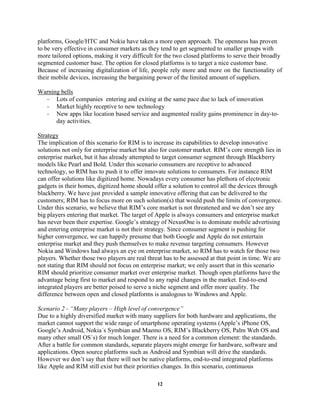

MASTERS IN TELECOM & DIGITAL BUSINESSMarch 24th 2010Industry Analysis ModelsBlackberry – Scenario AnalysisProfessor: Remzi GozubuyukDeepak AgarwalAnoud Hussein AlotaibiGustavo Andres AlvaradoCarol EidMurali ErraguntalaRafael GomezBing Van Der Lande<br />Contents TOC \o \"
1-3\"
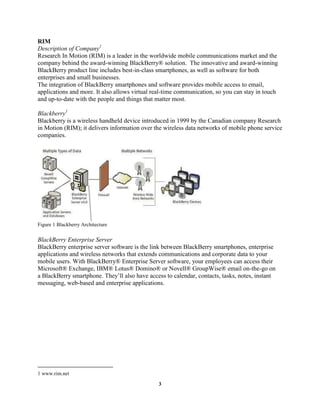
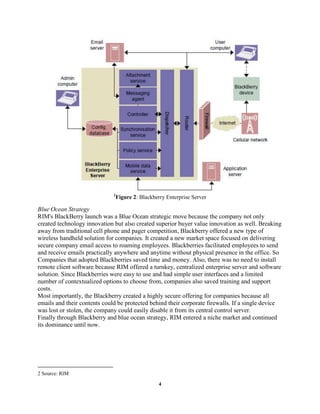
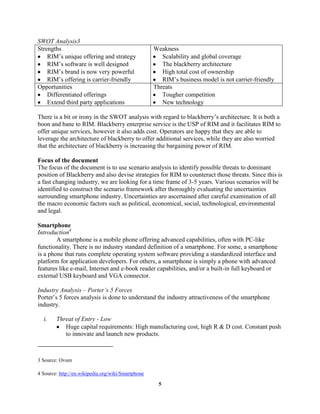
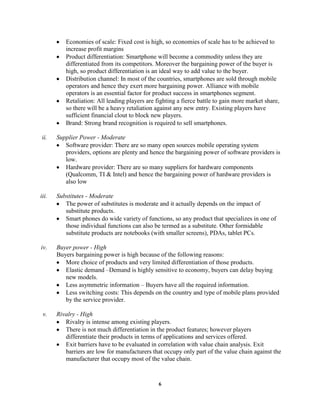
 \h \z \u RIM PAGEREF _Toc257185439 \h 3Description of Company PAGEREF _Toc257185440 \h 3Blackberry PAGEREF _Toc257185441 \h 3BlackBerry Enterprise Server PAGEREF _Toc257185442 \h 3Blue Ocean Strategy PAGEREF _Toc257185443 \h 4SWOT Analysis PAGEREF _Toc257185444 \h 5Focus of the document PAGEREF _Toc257185445 \h 5Smartphone PAGEREF _Toc257185446 \h 5Introduction PAGEREF _Toc257185447 \h 5Industry Analysis – Porter’s 5 Forces PAGEREF _Toc257185448 \h 5Scenario Analysis PAGEREF _Toc257185455 \h 7Stakeholders PAGEREF _Toc257185456 \h 7Basic Trends PAGEREF _Toc257185457 \h 7Uncertainties PAGEREF _Toc257185458 \h 10Scenario Framework PAGEREF _Toc257185459 \h 11Conclusion PAGEREF _Toc257185460 \h 14<br />RIM <br />Description of Company<br />Research In Motion (RIM) is a leader in the worldwide mobile communications market and the company behind the award-winning BlackBerry® solution.  The innovative and award-winning BlackBerry product line includes best-in-class smartphones, as well as software for both enterprises and small businesses.<br />The integration of BlackBerry smartphones and software provides mobile access to email, applications and more. It also allows virtual real-time communication, so you can stay in touch and up-to-date with the people and things that matter most.<br />Blackberry1<br />Blackberry is a wireless handheld device introduced in 1999 by the Canadian company Research in Motion (RIM); it delivers information over the wireless data networks of mobile phone service companies.<br />Figure  SEQ Figure \* ARABIC 1 Blackberry Architecture<br />BlackBerry Enterprise Server<br />BlackBerry enterprise server software is the link between BlackBerry smartphones, enterprise applications and wireless networks that extends communications and corporate data to your mobile users. With BlackBerry® Enterprise Server software, your employees can access their Microsoft® Exchange, IBM® Lotus® Domino® or Novell® GroupWise® email on-the-go on a BlackBerry smartphone. They’ll also have access to calendar, contacts, tasks, notes, instant messaging, web-based and enterprise applications.<br />Figure  SEQ Figure \* ARABIC 2: Blackberry Enterprise Server<br />Blue Ocean Strategy<br />RIM's BlackBerry launch was a Blue Ocean strategic move because the company not only created technology innovation but also created superior buyer value innovation as well. Breaking away from traditional cell phone and pager competition, Blackberry offered a new type of wireless handheld solution for companies. It created a new market space focused on delivering secure company email access to roaming employees. Blackberries facilitated employees to send and receive emails practically anywhere and anytime without physical presence in the office. So Companies that adopted Blackberries saved time and money. Also, there was no need to install remote client software because RIM offered a turnkey, centralized enterprise server and software solution. Since Blackberries were easy to use and had simple user interfaces and a limited number of contextualized options to choose from, companies also saved training and support costs.<br />Most importantly, the Blackberry created a highly secure offering for companies because all emails and their contents could be protected behind their corporate firewalls. If a single device was lost or stolen, the company could easily disable it from its central control server.<br />Finally through Blackberry and blue ocean strategy, RIM entered a niche market and continued its dominance until now. <br />SWOT Analysis<br />StrengthsRIM’s unique offering and strategyRIM’s software is well designedRIM’s brand is now very powerfulRIM’s offering is carrier-friendlyWeaknessScalability and global coverageThe blackberry architectureHigh total cost of ownershipRIM’s business model is not carrier-friendlyOpportunitiesDifferentiated offeringsExtend third party applicationsThreatsTougher competitionNew technologyThere is a bit or irony in the SWOT analysis with regard to blackberry’s architecture. It is both a boon and bane to RIM. Blackberry enterprise service is the USP of RIM and it facilitates RIM to offer unique services, however it also adds cost. Operators are happy that they are able to leverage the architecture of blackberry to offer additional services, while they are also worried that the architecture of blackberry is increasing the bargaining power of RIM. <br />Focus of the document<br />The focus of the document is to use scenario analysis to identify possible threats to dominant position of Blackberry and also devise strategies for RIM to counteract those threats. Since this is a fast changing industry, we are looking for a time frame of 3-5 years. Various scenarios will be identified to construct the scenario framework after thoroughly evaluating the uncertainties surrounding smartphone industry. Uncertainties are ascertained after careful examination of all the macro economic factors such as political, economical, social, technological, environmental and legal.<br />Smartphone<br />Introduction<br />A smartphone is a mobile phone offering advanced capabilities, often with PC-like functionality. There is no industry standard definition of a smartphone. For some, a smartphone is a phone that runs complete operating system software providing a standardized interface and platform for application developers. For others, a smartphone is simply a phone with advanced features like e-mail, Internet and e-book reader capabilities, and/or a built-in full keyboard or external USB keyboard and VGA connector. <br />Industry Analysis – Porter’s 5 Forces<br />Porter’s 5 forces analysis is done to understand the industry attractiveness of the smartphone industry.<br />Threat of Entry - Low<br />Huge capital requirements: High manufacturing cost, high R & D cost. Constant push to innovate and launch new products.
Economies of scale: Fixed cost is high, so economies of scale has to be achieved to increase profit margins
Product differentiation: Smartphone will become a commodity unless they are differentiated from its competitors. Moreover the bargaining power of the buyer is high, so product differentiation is an ideal way to add value to the buyer.
Distribution channel: In most of the countries, smartphones are sold through mobile operators and hence they exert more bargaining power. Alliance with mobile operators is an essential factor for product success in smartphones segment.
Retaliation: All leading players are fighting a fierce battle to gain more market share, so there will be a heavy retaliation against any new entry. Existing players have sufficient financial clout to block new players.
Brand: Strong brand recognition is required to sell smartphones.Supplier Power - Moderate<br />Software provider: There are so many open sources mobile operating system providers, options are plenty and hence the bargaining power of software providers is low.
Hardware provider: There are so many suppliers for hardware components (Qualcomm, TI & Intel) and hence the bargaining power of hardware providers is also lowSubstitutes - Moderate<br />The power of substitutes is moderate and it actually depends on the impact of substitute products.<br />Smart phones do wide variety of functions, so any product that specializes in one of those individual functions can also be termed as a substitute. Other formidable substitute products are notebooks (with smaller screens), PDAs, tablet PCs.<br />Buyer power - High<br />Buyers bargaining power is high because of the following reasons:<br />More choice of products and very limited differentiation of those products.
Elastic demand –Demand is highly sensitive to economy, buyers can delay buying new models.
Less asymmetric information – Buyers have all the required information.
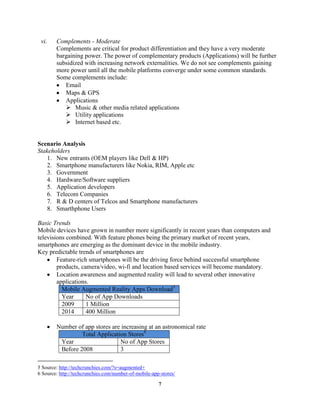
Less switching costs: This depends on the country and type of mobile plans provided by the service provider.Rivalry - High<br />Rivalry is intense among existing players. <br />There is not much differentiation in the product features; however players differentiate their products in terms of applications and services offered.<br />Exit barriers have to be evaluated in correlation with value chain analysis. Exit barriers are low for manufacturers that occupy only part of the value chain against the manufacturer that occupy most of the value chain.<br />Complements - Moderate<br />Complements are critical for product differentiation and they have a very moderate bargaining power. The power of complementary products (Applications) will be further subsidized with increasing network externalities. We do not see complements gaining more power until all the mobile platforms converge under some common standards.<br />Some complements include:<br />Email
Maps & GPS
Applications
Music & other media related applications
Utility applications
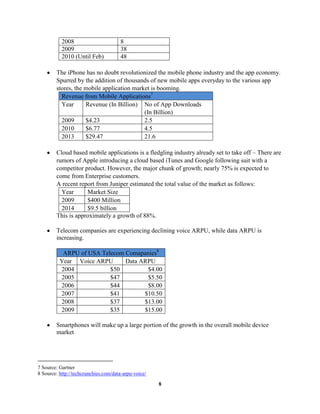
Internet based etc.Scenario Analysis<br />Stakeholders<br />New entrants (OEM players like Dell & HP)

Blackberry - Scenario Analysis

  • 1.
    MASTERS IN TELECOM& DIGITAL BUSINESSMarch 24th 2010Industry Analysis ModelsBlackberry – Scenario AnalysisProfessor: Remzi GozubuyukDeepak AgarwalAnoud Hussein AlotaibiGustavo Andres AlvaradoCarol EidMurali ErraguntalaRafael GomezBing Van Der Lande<br />Contents TOC \o \" 1-3\" \h \z \u RIM PAGEREF _Toc257185439 \h 3Description of Company PAGEREF _Toc257185440 \h 3Blackberry PAGEREF _Toc257185441 \h 3BlackBerry Enterprise Server PAGEREF _Toc257185442 \h 3Blue Ocean Strategy PAGEREF _Toc257185443 \h 4SWOT Analysis PAGEREF _Toc257185444 \h 5Focus of the document PAGEREF _Toc257185445 \h 5Smartphone PAGEREF _Toc257185446 \h 5Introduction PAGEREF _Toc257185447 \h 5Industry Analysis – Porter’s 5 Forces PAGEREF _Toc257185448 \h 5Scenario Analysis PAGEREF _Toc257185455 \h 7Stakeholders PAGEREF _Toc257185456 \h 7Basic Trends PAGEREF _Toc257185457 \h 7Uncertainties PAGEREF _Toc257185458 \h 10Scenario Framework PAGEREF _Toc257185459 \h 11Conclusion PAGEREF _Toc257185460 \h 14<br />RIM <br />Description of Company<br />Research In Motion (RIM) is a leader in the worldwide mobile communications market and the company behind the award-winning BlackBerry® solution.  The innovative and award-winning BlackBerry product line includes best-in-class smartphones, as well as software for both enterprises and small businesses.<br />The integration of BlackBerry smartphones and software provides mobile access to email, applications and more. It also allows virtual real-time communication, so you can stay in touch and up-to-date with the people and things that matter most.<br />Blackberry1<br />Blackberry is a wireless handheld device introduced in 1999 by the Canadian company Research in Motion (RIM); it delivers information over the wireless data networks of mobile phone service companies.<br />Figure SEQ Figure \* ARABIC 1 Blackberry Architecture<br />BlackBerry Enterprise Server<br />BlackBerry enterprise server software is the link between BlackBerry smartphones, enterprise applications and wireless networks that extends communications and corporate data to your mobile users. With BlackBerry® Enterprise Server software, your employees can access their Microsoft® Exchange, IBM® Lotus® Domino® or Novell® GroupWise® email on-the-go on a BlackBerry smartphone. They’ll also have access to calendar, contacts, tasks, notes, instant messaging, web-based and enterprise applications.<br />Figure SEQ Figure \* ARABIC 2: Blackberry Enterprise Server<br />Blue Ocean Strategy<br />RIM's BlackBerry launch was a Blue Ocean strategic move because the company not only created technology innovation but also created superior buyer value innovation as well. Breaking away from traditional cell phone and pager competition, Blackberry offered a new type of wireless handheld solution for companies. It created a new market space focused on delivering secure company email access to roaming employees. Blackberries facilitated employees to send and receive emails practically anywhere and anytime without physical presence in the office. So Companies that adopted Blackberries saved time and money. Also, there was no need to install remote client software because RIM offered a turnkey, centralized enterprise server and software solution. Since Blackberries were easy to use and had simple user interfaces and a limited number of contextualized options to choose from, companies also saved training and support costs.<br />Most importantly, the Blackberry created a highly secure offering for companies because all emails and their contents could be protected behind their corporate firewalls. If a single device was lost or stolen, the company could easily disable it from its central control server.<br />Finally through Blackberry and blue ocean strategy, RIM entered a niche market and continued its dominance until now. <br />SWOT Analysis<br />StrengthsRIM’s unique offering and strategyRIM’s software is well designedRIM’s brand is now very powerfulRIM’s offering is carrier-friendlyWeaknessScalability and global coverageThe blackberry architectureHigh total cost of ownershipRIM’s business model is not carrier-friendlyOpportunitiesDifferentiated offeringsExtend third party applicationsThreatsTougher competitionNew technologyThere is a bit or irony in the SWOT analysis with regard to blackberry’s architecture. It is both a boon and bane to RIM. Blackberry enterprise service is the USP of RIM and it facilitates RIM to offer unique services, however it also adds cost. Operators are happy that they are able to leverage the architecture of blackberry to offer additional services, while they are also worried that the architecture of blackberry is increasing the bargaining power of RIM. <br />Focus of the document<br />The focus of the document is to use scenario analysis to identify possible threats to dominant position of Blackberry and also devise strategies for RIM to counteract those threats. Since this is a fast changing industry, we are looking for a time frame of 3-5 years. Various scenarios will be identified to construct the scenario framework after thoroughly evaluating the uncertainties surrounding smartphone industry. Uncertainties are ascertained after careful examination of all the macro economic factors such as political, economical, social, technological, environmental and legal.<br />Smartphone<br />Introduction<br />A smartphone is a mobile phone offering advanced capabilities, often with PC-like functionality. There is no industry standard definition of a smartphone. For some, a smartphone is a phone that runs complete operating system software providing a standardized interface and platform for application developers. For others, a smartphone is simply a phone with advanced features like e-mail, Internet and e-book reader capabilities, and/or a built-in full keyboard or external USB keyboard and VGA connector. <br />Industry Analysis – Porter’s 5 Forces<br />Porter’s 5 forces analysis is done to understand the industry attractiveness of the smartphone industry.<br />Threat of Entry - Low<br />Huge capital requirements: High manufacturing cost, high R & D cost. Constant push to innovate and launch new products.
  • 2.
    Economies of scale:Fixed cost is high, so economies of scale has to be achieved to increase profit margins
  • 3.
    Product differentiation: Smartphonewill become a commodity unless they are differentiated from its competitors. Moreover the bargaining power of the buyer is high, so product differentiation is an ideal way to add value to the buyer.
  • 4.
    Distribution channel: Inmost of the countries, smartphones are sold through mobile operators and hence they exert more bargaining power. Alliance with mobile operators is an essential factor for product success in smartphones segment.
  • 5.
    Retaliation: All leadingplayers are fighting a fierce battle to gain more market share, so there will be a heavy retaliation against any new entry. Existing players have sufficient financial clout to block new players.
  • 6.
    Brand: Strong brandrecognition is required to sell smartphones.Supplier Power - Moderate<br />Software provider: There are so many open sources mobile operating system providers, options are plenty and hence the bargaining power of software providers is low.
  • 7.
    Hardware provider: Thereare so many suppliers for hardware components (Qualcomm, TI & Intel) and hence the bargaining power of hardware providers is also lowSubstitutes - Moderate<br />The power of substitutes is moderate and it actually depends on the impact of substitute products.<br />Smart phones do wide variety of functions, so any product that specializes in one of those individual functions can also be termed as a substitute. Other formidable substitute products are notebooks (with smaller screens), PDAs, tablet PCs.<br />Buyer power - High<br />Buyers bargaining power is high because of the following reasons:<br />More choice of products and very limited differentiation of those products.
  • 8.
    Elastic demand –Demandis highly sensitive to economy, buyers can delay buying new models.
  • 9.
    Less asymmetric information– Buyers have all the required information.
  • 10.
    Less switching costs:This depends on the country and type of mobile plans provided by the service provider.Rivalry - High<br />Rivalry is intense among existing players. <br />There is not much differentiation in the product features; however players differentiate their products in terms of applications and services offered.<br />Exit barriers have to be evaluated in correlation with value chain analysis. Exit barriers are low for manufacturers that occupy only part of the value chain against the manufacturer that occupy most of the value chain.<br />Complements - Moderate<br />Complements are critical for product differentiation and they have a very moderate bargaining power. The power of complementary products (Applications) will be further subsidized with increasing network externalities. We do not see complements gaining more power until all the mobile platforms converge under some common standards.<br />Some complements include:<br />Email
  • 11.
  • 12.
  • 13.
    Music & othermedia related applications
  • 14.
  • 15.
    Internet based etc.ScenarioAnalysis<br />Stakeholders<br />New entrants (OEM players like Dell & HP)