Mobile Money Savings
Groups in Lima, Peru
Daniel Boey, Piero Ortiz, Muhammad KR Harahap
Finance for the World’s Poorest, Fall 2020
We want to establish Mobile Money RoSCAs
in a peri-urban district in Lima, Peru, reaching
30,000 people/1,500 groups in 3 years.
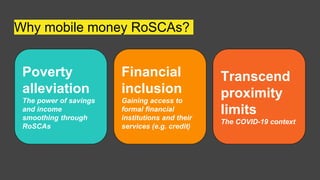
Why mobile money RoSCAs?
Poverty
alleviation
The power of savings
and income
smoothing through
RoSCAs
Financial
inclusion
Gaining access to
formal financial
institutions and their
services (e.g. credit)
Transcend
proximity
limits
The COVID-19 context
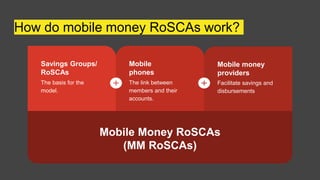
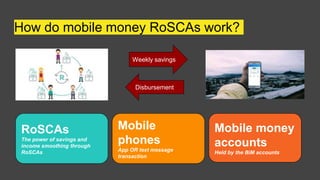
How do mobile money RoSCAs work?
Vestibulum
congue tempus
Lorem ipsum dolor sit
amet, consectetur
adipiscing elit, sed do
eiusmod tempor.
Vestibulum
congue tempus
Lorem ipsum dolor sit
amet, consectetur
adipiscing elit, sed do
eiusmod tempor.
Vestibulum
congue tempus
Lorem ipsum dolor sit
amet, consectetur
adipiscing elit, sed do
eiusmod tempor.
Vestibulum congue tempus
Lorem ipsum dolor sit amet, consectetur adipiscing elit, sed do
eiusmod tempor. Ipsum dolor sit amet elit, sed do eiusmod tempor.
Savings Groups/
RoSCAs
The basis for the
model.
Mobile
phones
The link between
members and their
accounts.
Mobile money
providers
Facilitate savings and
disbursements
Mobile Money RoSCAs
(MM RoSCAs)
How do mobile money RoSCAs work?
Weekly savings
Disbursement
RoSCAs
The power of savings and
income smoothing through
RoSCAs
Mobile
phones
App OR text message
transaction
Mobile money
accounts
Held by the BiM accounts
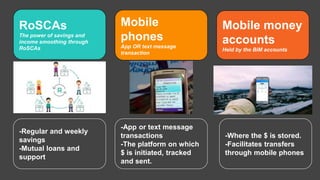
Esusu
RoSCAs
The power of savings and
income smoothing through
RoSCAs
Mobile
phones
App OR text message
transaction
Mobile money
accounts
Held by the BiM accounts
-Regular and weekly
savings
-Mutual loans and
support
-App or text message
transactions
-The platform on which
$ is initiated, tracked
and sent.
-Where the $ is stored.
-Facilitates transfers
through mobile phones
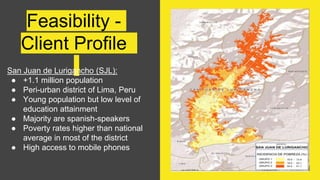
Feasibility -
Client Profile
San Juan de Lurigancho (SJL):
● +1.1 million population
● Peri-urban district of Lima, Peru
● Young population but low level of
education attainment
● Majority are spanish-speakers
● Poverty rates higher than national
average in most of the district
● High access to mobile phones
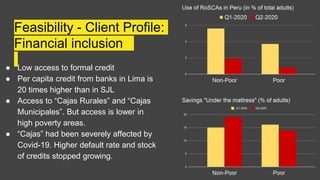
Feasibility - Client Profile:
Financial inclusion
● Low access to formal credit
● Per capita credit from banks in Lima is
20 times higher than in SJL
● Access to “Cajas Rurales” and “Cajas
Municipales”. But access is lower in
high poverty areas.
● “Cajas” had been severely affected by
Covid-19. Higher default rate and stock
of credits stopped growing.
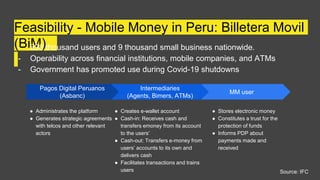
Feasibility - Mobile Money in Peru: Billetera Movil
(BiM)
- 898 thousand users and 9 thousand small business nationwide.
- Operability across financial institutions, mobile companies, and ATMs
- Government has promoted use during Covid-19 shutdowns
MM user
● Stores electronic money
● Constitutes a trust for the
protection of funds
● Informs PDP about
payments made and
received
Pagos Digital Peruanos
(Asbanc)
● Administrates the platform
● Generates strategic agreements
with telcos and other relevant
actors
Intermediaries
(Agents, Bimers, ATMs)
● Creates e-wallet account
● Cash-in: Receives cash and
transfers emoney from its account
to the users’
● Cash-out: Transfers e-money from
users’ accounts to its own and
delivers cash
● Facilitates transactions and trains
users Source: IFC
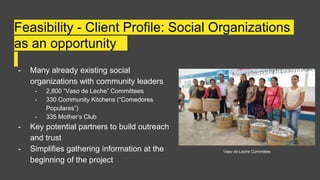
Feasibility - Client Profile: Social Organizations
as an opportunity
- Many already existing social
organizations with community leaders
- 2,800 “Vaso de Leche” Committees
- 330 Community Kitchens (“Comedores
Populares”)
- 335 Mother’s Club
- Key potential partners to build outreach
and trust
- Simplifies gathering information at the
beginning of the project
Vaso de Leche Committee
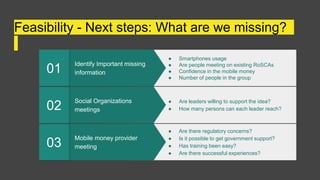
Feasibility - Next steps: What are we missing?
Mobile money provider
meeting
03
● Are there regulatory concerns?
● Is it possible to get government support?
● Has training been easy?
● Are there successful experiences?
Social Organizations
meetings
02
● Are leaders willing to support the idea?
● How many persons can each leader reach?
Identify Important missing
information
01
● Smartphones usage
● Are people meeting on existing RoSCAs
● Confidence in the mobile money
● Number of people in the group
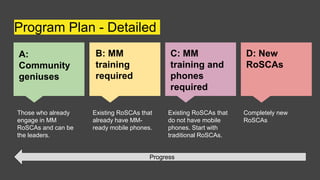
Program Plan - Detailed
A:
Community
geniuses
B: MM
training
required
C: MM
training and
phones
required
D: New
RoSCAs
Those who already
engage in MM
RoSCAs and can be
the leaders.
Existing RoSCAs that
already have MM-
ready mobile phones.
Existing RoSCAs that
do not have mobile
phones. Start with
traditional RoSCAs.
Completely new
RoSCAs
Progress
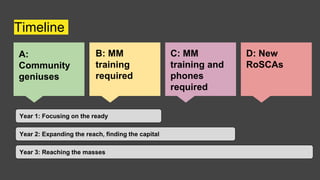
Timeline
A:
Community
geniuses
B: MM
training
required
C: MM
training and
phones
required
D: New
RoSCAs
Year 1: Focusing on the ready
Year 2: Expanding the reach, finding the capital
Year 3: Reaching the masses
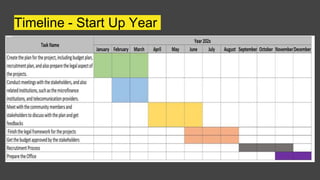
Timeline - Start Up Year
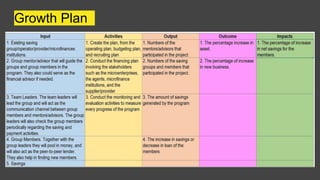
Growth Plan
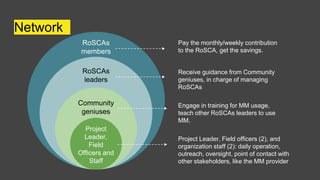
Network
Project Leader, Field officers (2), and
organization staff (2): daily operation,
outreach, oversight, point of contact with
other stakeholders, like the MM provider
Engage in training for MM usage,
teach other RoSCAs leaders to use
MM.
Receive guidance from Community
geniuses, in charge of managing
RoSCAs
Pay the monthly/weekly contribution
to the RoSCA, get the savings.
RoSCAs
members
RoSCAs
leaders
Community
geniuses
Project
Leader,
Field
Officers and
Staff
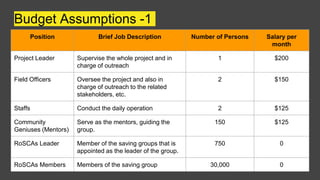
Budget Assumptions -1
Position Brief Job Description Number of Persons Salary per
month
Project Leader Supervise the whole project and in
charge of outreach
1 $200
Field Officers Oversee the project and also in
charge of outreach to the related
stakeholders, etc.
2 $150
Staffs Conduct the daily operation 2 $125
Community
Geniuses (Mentors)
Serve as the mentors, guiding the
group.
150 $125
RoSCAs Leader Member of the saving groups that is
appointed as the leader of the group.
750 0
RoSCAs Members Members of the saving group 30,000 0
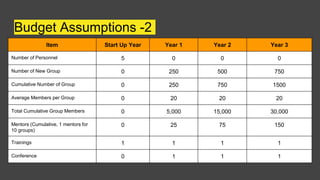
Budget Assumptions -2
Item Start Up Year Year 1 Year 2 Year 3
Number of Personnel 5 0 0 0
Number of New Group 0 250 500 750
Cumulative Number of Group 0 250 750 1500
Average Members per Group 0 20 20 20
Total Cumulative Group Members 0 5,000 15,000 30,000
Mentors (Cumulative, 1 mentors for
10 groups)
0 25 75 150
Trainings 1 1 1 1
Conference 0 1 1 1
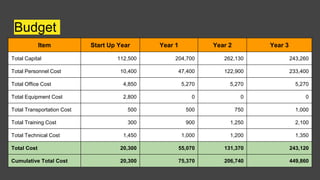
Budget
Item Start Up Year Year 1 Year 2 Year 3
Total Capital 112,500 204,700 262,130 243,260
Total Personnel Cost 10,400 47,400 122,900 233,400
Total Office Cost 4,850 5,270 5,270 5,270
Total Equipment Cost 2,800 0 0 0
Total Transportation Cost 500 500 750 1,000
Total Training Cost 300 900 1,250 2,100
Total Technical Cost 1,450 1,000 1,200 1,350
Total Cost 20,300 55,070 131,370 243,120
Cumulative Total Cost 20,300 75,370 206,740 449,860
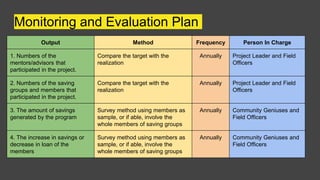
Monitoring and Evaluation Plan
Output Method Frequency Person In Charge
1. Numbers of the
mentors/advisors that
participated in the project.
Compare the target with the
realization
Annually Project Leader and Field
Officers
2. Numbers of the saving
groups and members that
participated in the project.
Compare the target with the
realization
Annually Project Leader and Field
Officers
3. The amount of savings
generated by the program
Survey method using members as
sample, or if able, involve the
whole members of saving groups
Annually Community Geniuses and
Field Officers
4. The increase in savings or
decrease in loan of the
members
Survey method using members as
sample, or if able, involve the
whole members of saving groups
Annually Community Geniuses and
Field Officers
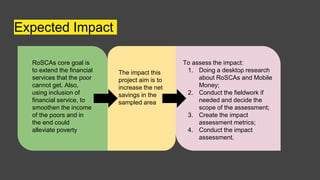
Expected Impact
RoSCAs core goal is
to extend the financial
services that the poor
cannot get. Also,
using inclusion of
financial service, to
smoothen the income
of the poors and in
the end could
alleviate poverty
To assess the impact:
1. Doing a desktop research
about RoSCAs and Mobile
Money;
2. Conduct the fieldwork if
needed and decide the
scope of the assessment;
3. Create the impact
assessment metrics;
4. Conduct the impact
assessment.
The impact this
project aim is to
increase the net
savings in the
sampled area
Thank you.
Daniel Boey, Piero Ortiz, Muhammad KR Harahap
Finance for the World’s Poorest, Fall 2020

Mobile money savings groups

  • 1.
    Mobile Money Savings Groupsin Lima, Peru Daniel Boey, Piero Ortiz, Muhammad KR Harahap Finance for the World’s Poorest, Fall 2020
  • 2.
    We want toestablish Mobile Money RoSCAs in a peri-urban district in Lima, Peru, reaching 30,000 people/1,500 groups in 3 years.
  • 3.
    Why mobile moneyRoSCAs? Poverty alleviation The power of savings and income smoothing through RoSCAs Financial inclusion Gaining access to formal financial institutions and their services (e.g. credit) Transcend proximity limits The COVID-19 context
  • 4.
    How do mobilemoney RoSCAs work? Vestibulum congue tempus Lorem ipsum dolor sit amet, consectetur adipiscing elit, sed do eiusmod tempor. Vestibulum congue tempus Lorem ipsum dolor sit amet, consectetur adipiscing elit, sed do eiusmod tempor. Vestibulum congue tempus Lorem ipsum dolor sit amet, consectetur adipiscing elit, sed do eiusmod tempor. Vestibulum congue tempus Lorem ipsum dolor sit amet, consectetur adipiscing elit, sed do eiusmod tempor. Ipsum dolor sit amet elit, sed do eiusmod tempor. Savings Groups/ RoSCAs The basis for the model. Mobile phones The link between members and their accounts. Mobile money providers Facilitate savings and disbursements Mobile Money RoSCAs (MM RoSCAs)
  • 5.
    How do mobilemoney RoSCAs work? Weekly savings Disbursement RoSCAs The power of savings and income smoothing through RoSCAs Mobile phones App OR text message transaction Mobile money accounts Held by the BiM accounts
  • 6.
    Esusu RoSCAs The power ofsavings and income smoothing through RoSCAs Mobile phones App OR text message transaction Mobile money accounts Held by the BiM accounts -Regular and weekly savings -Mutual loans and support -App or text message transactions -The platform on which $ is initiated, tracked and sent. -Where the $ is stored. -Facilitates transfers through mobile phones
  • 7.
    Feasibility - Client Profile SanJuan de Lurigancho (SJL): ● +1.1 million population ● Peri-urban district of Lima, Peru ● Young population but low level of education attainment ● Majority are spanish-speakers ● Poverty rates higher than national average in most of the district ● High access to mobile phones
  • 8.
    Feasibility - ClientProfile: Financial inclusion ● Low access to formal credit ● Per capita credit from banks in Lima is 20 times higher than in SJL ● Access to “Cajas Rurales” and “Cajas Municipales”. But access is lower in high poverty areas. ● “Cajas” had been severely affected by Covid-19. Higher default rate and stock of credits stopped growing.
  • 9.
    Feasibility - MobileMoney in Peru: Billetera Movil (BiM) - 898 thousand users and 9 thousand small business nationwide. - Operability across financial institutions, mobile companies, and ATMs - Government has promoted use during Covid-19 shutdowns MM user ● Stores electronic money ● Constitutes a trust for the protection of funds ● Informs PDP about payments made and received Pagos Digital Peruanos (Asbanc) ● Administrates the platform ● Generates strategic agreements with telcos and other relevant actors Intermediaries (Agents, Bimers, ATMs) ● Creates e-wallet account ● Cash-in: Receives cash and transfers emoney from its account to the users’ ● Cash-out: Transfers e-money from users’ accounts to its own and delivers cash ● Facilitates transactions and trains users Source: IFC
  • 10.
    Feasibility - ClientProfile: Social Organizations as an opportunity - Many already existing social organizations with community leaders - 2,800 “Vaso de Leche” Committees - 330 Community Kitchens (“Comedores Populares”) - 335 Mother’s Club - Key potential partners to build outreach and trust - Simplifies gathering information at the beginning of the project Vaso de Leche Committee
  • 11.
    Feasibility - Nextsteps: What are we missing? Mobile money provider meeting 03 ● Are there regulatory concerns? ● Is it possible to get government support? ● Has training been easy? ● Are there successful experiences? Social Organizations meetings 02 ● Are leaders willing to support the idea? ● How many persons can each leader reach? Identify Important missing information 01 ● Smartphones usage ● Are people meeting on existing RoSCAs ● Confidence in the mobile money ● Number of people in the group
  • 12.
    Program Plan -Detailed A: Community geniuses B: MM training required C: MM training and phones required D: New RoSCAs Those who already engage in MM RoSCAs and can be the leaders. Existing RoSCAs that already have MM- ready mobile phones. Existing RoSCAs that do not have mobile phones. Start with traditional RoSCAs. Completely new RoSCAs Progress
  • 13.
    Timeline A: Community geniuses B: MM training required C: MM trainingand phones required D: New RoSCAs Year 1: Focusing on the ready Year 2: Expanding the reach, finding the capital Year 3: Reaching the masses
  • 14.
  • 15.
  • 16.
    Network Project Leader, Fieldofficers (2), and organization staff (2): daily operation, outreach, oversight, point of contact with other stakeholders, like the MM provider Engage in training for MM usage, teach other RoSCAs leaders to use MM. Receive guidance from Community geniuses, in charge of managing RoSCAs Pay the monthly/weekly contribution to the RoSCA, get the savings. RoSCAs members RoSCAs leaders Community geniuses Project Leader, Field Officers and Staff
  • 17.
    Budget Assumptions -1 PositionBrief Job Description Number of Persons Salary per month Project Leader Supervise the whole project and in charge of outreach 1 $200 Field Officers Oversee the project and also in charge of outreach to the related stakeholders, etc. 2 $150 Staffs Conduct the daily operation 2 $125 Community Geniuses (Mentors) Serve as the mentors, guiding the group. 150 $125 RoSCAs Leader Member of the saving groups that is appointed as the leader of the group. 750 0 RoSCAs Members Members of the saving group 30,000 0
  • 18.
    Budget Assumptions -2 ItemStart Up Year Year 1 Year 2 Year 3 Number of Personnel 5 0 0 0 Number of New Group 0 250 500 750 Cumulative Number of Group 0 250 750 1500 Average Members per Group 0 20 20 20 Total Cumulative Group Members 0 5,000 15,000 30,000 Mentors (Cumulative, 1 mentors for 10 groups) 0 25 75 150 Trainings 1 1 1 1 Conference 0 1 1 1
  • 19.
    Budget Item Start UpYear Year 1 Year 2 Year 3 Total Capital 112,500 204,700 262,130 243,260 Total Personnel Cost 10,400 47,400 122,900 233,400 Total Office Cost 4,850 5,270 5,270 5,270 Total Equipment Cost 2,800 0 0 0 Total Transportation Cost 500 500 750 1,000 Total Training Cost 300 900 1,250 2,100 Total Technical Cost 1,450 1,000 1,200 1,350 Total Cost 20,300 55,070 131,370 243,120 Cumulative Total Cost 20,300 75,370 206,740 449,860
  • 20.
    Monitoring and EvaluationPlan Output Method Frequency Person In Charge 1. Numbers of the mentors/advisors that participated in the project. Compare the target with the realization Annually Project Leader and Field Officers 2. Numbers of the saving groups and members that participated in the project. Compare the target with the realization Annually Project Leader and Field Officers 3. The amount of savings generated by the program Survey method using members as sample, or if able, involve the whole members of saving groups Annually Community Geniuses and Field Officers 4. The increase in savings or decrease in loan of the members Survey method using members as sample, or if able, involve the whole members of saving groups Annually Community Geniuses and Field Officers
  • 21.
    Expected Impact RoSCAs coregoal is to extend the financial services that the poor cannot get. Also, using inclusion of financial service, to smoothen the income of the poors and in the end could alleviate poverty To assess the impact: 1. Doing a desktop research about RoSCAs and Mobile Money; 2. Conduct the fieldwork if needed and decide the scope of the assessment; 3. Create the impact assessment metrics; 4. Conduct the impact assessment. The impact this project aim is to increase the net savings in the sampled area
  • 22.
    Thank you. Daniel Boey,Piero Ortiz, Muhammad KR Harahap Finance for the World’s Poorest, Fall 2020

Editor's Notes