Mobile learning changing notion on ‘contact’ education Dick Ng’ambi Centre for Educational Technology University of Cape Town
Outline Introduction Challenges Notion of ‘contact’ education Mobile Learning Projects SMS Collaborative Questioning Not so fun projects Research Questions / Discussion
Introduction Project seeks to use  prevalent mobile technologies  in our resource-poor context to support teaching and learning in higher education curricula   Research Stimulation Fund (UCT): 2003-2004 Support from the Andrew W. Mellon Foundation grant -  Digital Cornerstones - : 2005-2007
CET urgency to ensure that all  students have fair and equal access  to a new world order   driven by a commitment to  educational and social inclusion  no matter what a student’s educational background, mother tongue or previous exposure to computers might have been   believes that a transformed higher education requires  participation in a new communicative order  as a necessary outcome of a graduate education.
Key national challenge … to redress past inequalities and to transform the higher education system to serve a new social order, to meet pressing national needs, and to respond to  new realities and opportunities ” (White Paper: 1.1). (Department of Education South Africa, 2001)
Key national dream Every South African manager, teacher and learner in the general and further education and training bands will be ICT capable (that is,  use ICTs confidently and creatively  to help develop the skills and knowledge they need as lifelong learners to achieve personal goals and to be full participants in the global community) by 2013 (Department of Education South Africa, 2004:p. 17)
Educational Context Educational disparities - manifested along  racial lines  due to the political, economic and social policies of the pre-1994 era  Contrast: In the UK, participation in higher education has increased since the 1940s but participation of higher  socio-economic groups  still exceeds that of lower socio-economic groups (DFES report, 2004).
Performance indicator (PI) increase  the demographic representation among graduates and  reduce  the demographic difference between student intake and graduate throughput WHILE Ensuring quality of educational provision Without funding until throughput
Contextual Challenges Students’ Academic Unpreparedness Low attention space Diverse student population Different learning preferences / styles Socio-Cultural effects Multilingualism Class sizes Personalised attention difficulty Demand for meaningful feedback
‘Contact’ notion Contact is a convergence of: Distance, space and time Education is independent of: Distance, space and time “ Contact Education” attempts to coverge D, S and T for creating an experience that is independent of D, S and T.
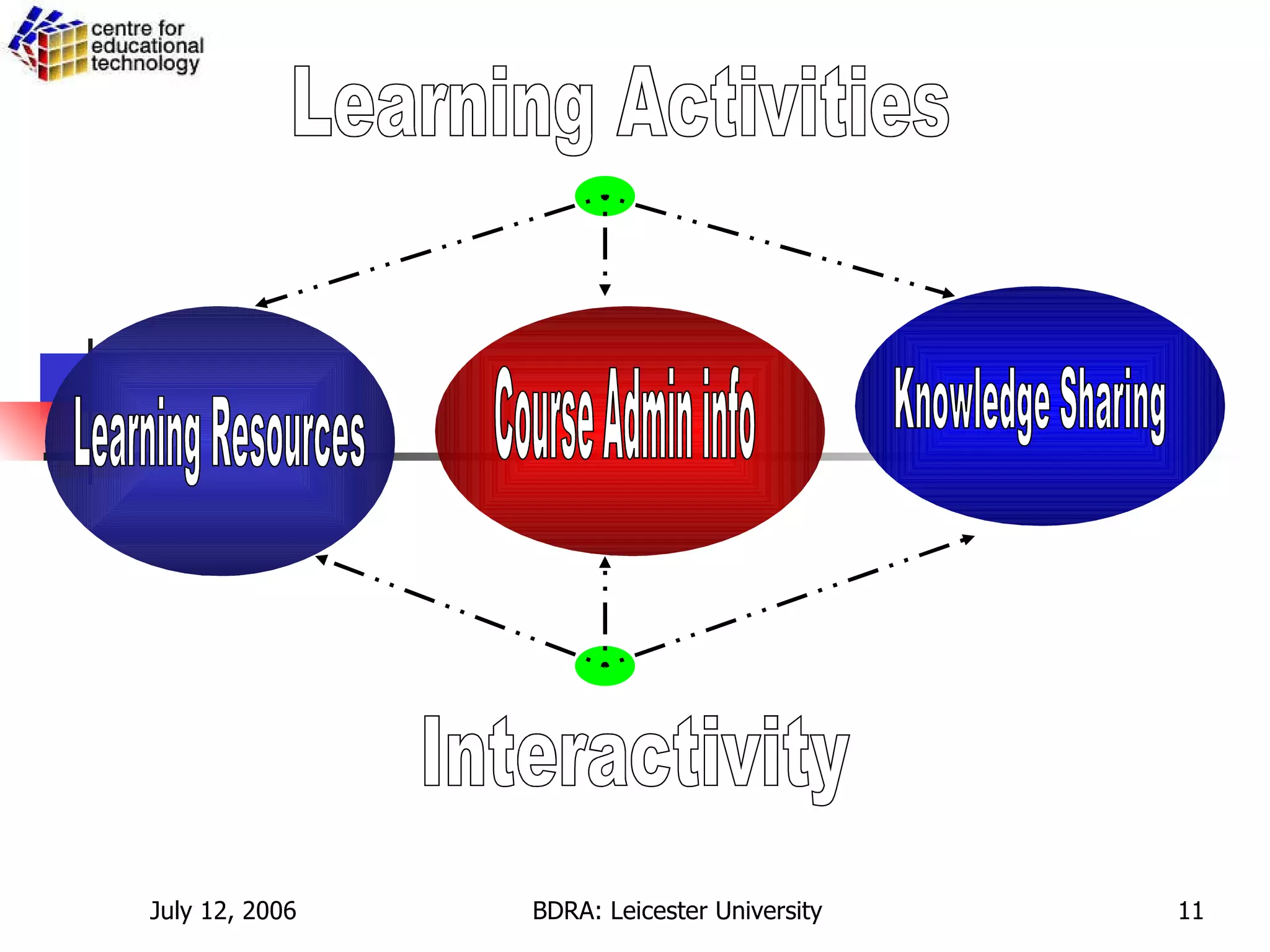
Learning Resources Course Admin info Knowledge Sharing Learning Activities Interactivity
Learning from students
Teaching vs ‘learning style’ “… I always used to get quite panicked, ‘cause you go to a lecture, and you come out of there, and it’s all this new stuff and you have to go and read up to kind-of get onto the next level. And just as you’ve got there you next go to the next lecture and, there’s a whole lot of new stuff, so you feel like you’re constantly quite out of breath ‘cause you’re just not getting there.”
Not enough contact “… if we are paying close to US$ X fees a year, which is a lot of money, and we… if you look at the amount of time that we actually spend in class with the lecturer, it’s not relative, it’s not relative to what we’re paying.”
Fallacy of physical spaces “… we need a full-time job, to actually be able to pay your fees to do a degree. So all of us are finishing work at 5, and you don’t get to the lecturers. So it seems almost ludicrous in a way to be paying those fees when you’re not sitting in a class.”
Time misalignment “… I mean things like weekends are the, basically the only time that you do have to study, because you’re working during the week, …I’d go to my lecture on a Monday, I’d try and work in the evening… And then you don’t have access to your supervisor anyway; ‘cause that is the only time that you’ve actually got.”
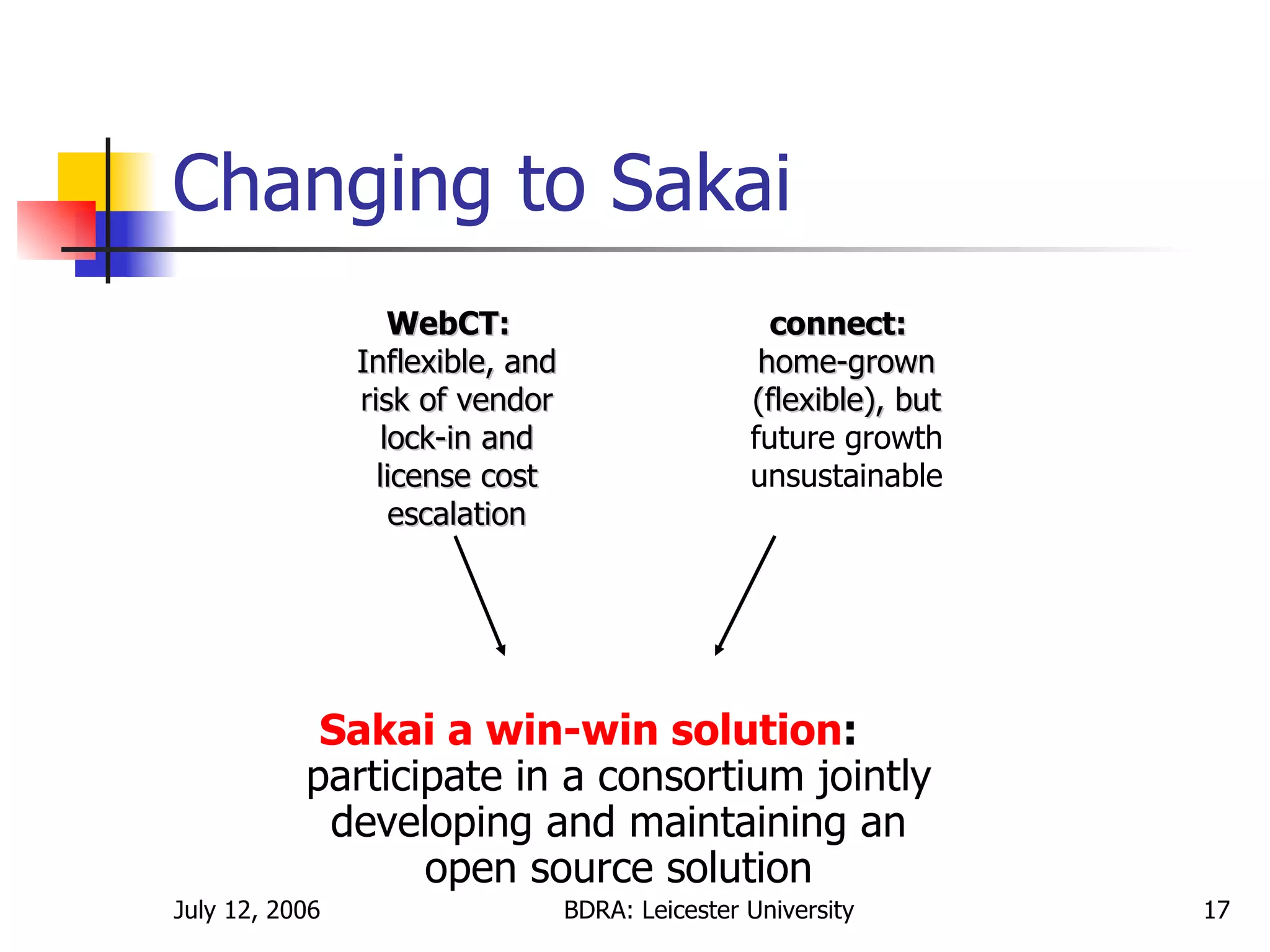
Changing to Sakai Sakai a win-win solution :  participate in a consortium jointly developing and maintaining an open source solution WebCT: Inflexible, and risk of vendor lock-in and license cost escalation connect: home-grown (flexible), but future growth unsustainable
Mobile Learning Projects
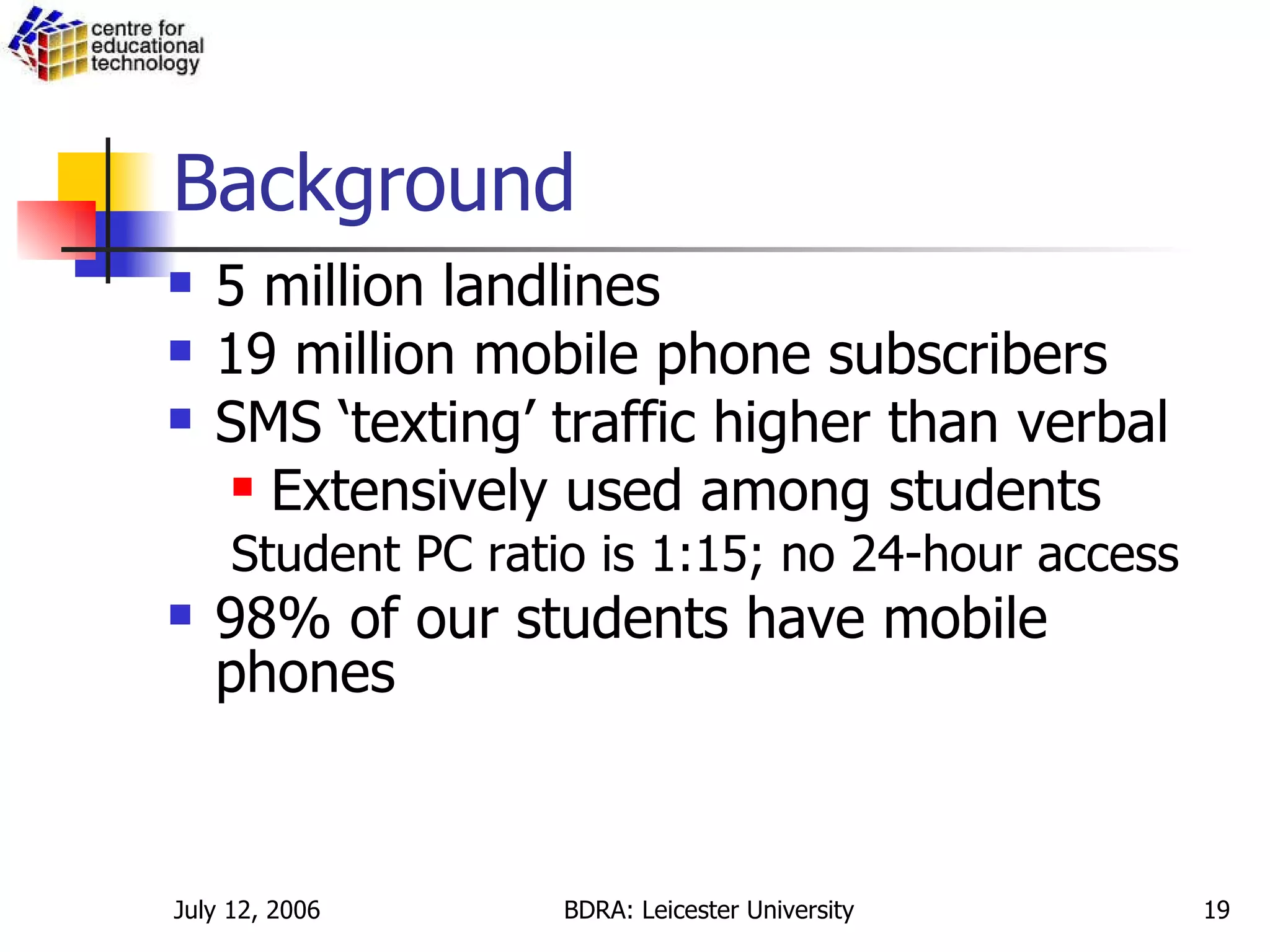
Background 5 million landlines 19 million mobile phone subscribers SMS ‘texting’ traffic higher than verbal Extensively used among students Student PC ratio is 1:15; no 24-hour access 98% of our students have mobile phones
Mobile learning … learning on the move and learning in any location enabled by wireless technologies … computing to come to education instead of education going to the computer [education in right context] Focus of mobility is on a learner and supportive learning environment
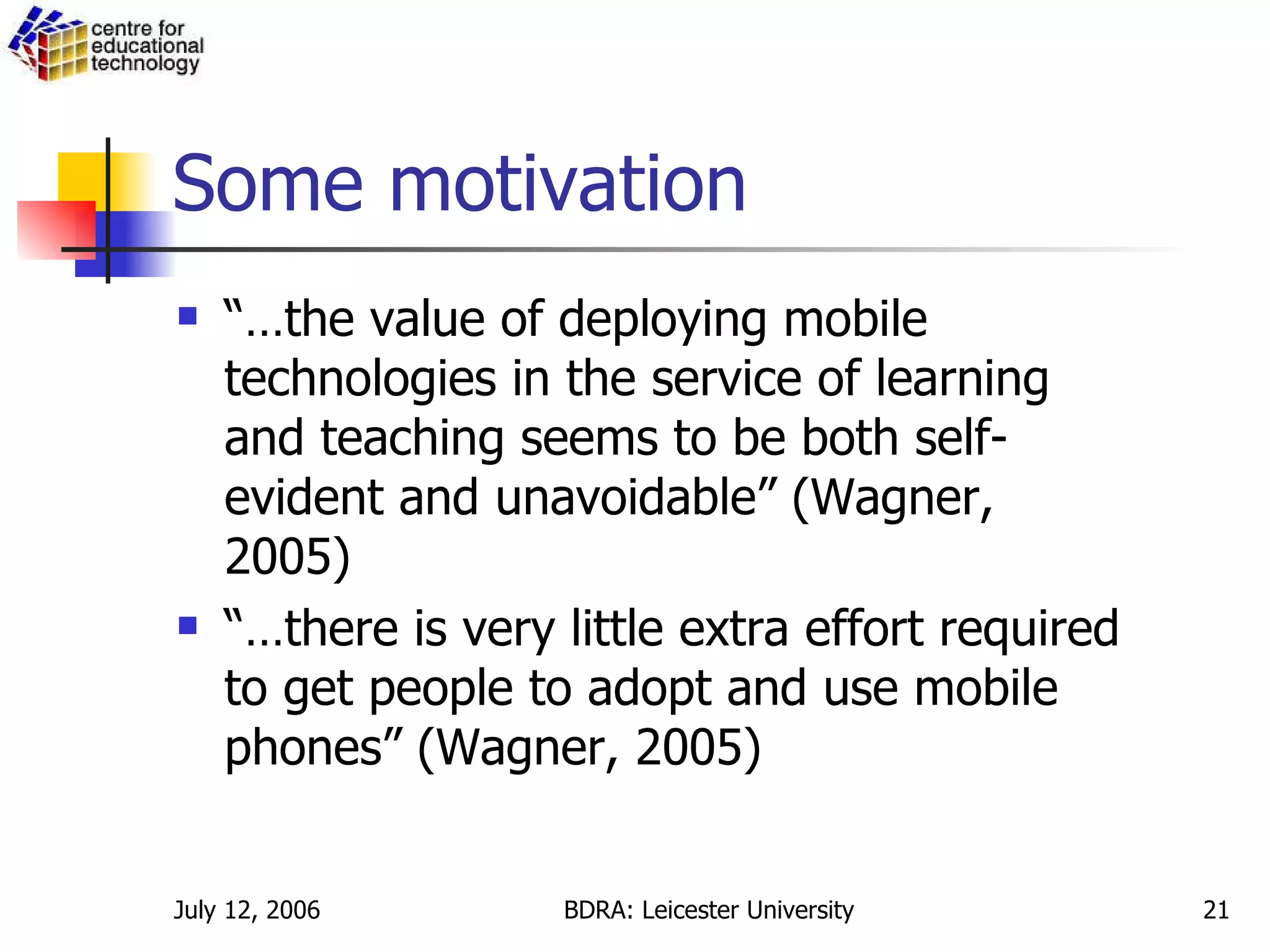
Some motivation “… the value of deploying mobile technologies in the service of learning and teaching seems to be both self-evident and unavoidable” (Wagner, 2005) “… there is very little extra effort required to get people to adopt and use mobile phones” (Wagner, 2005)
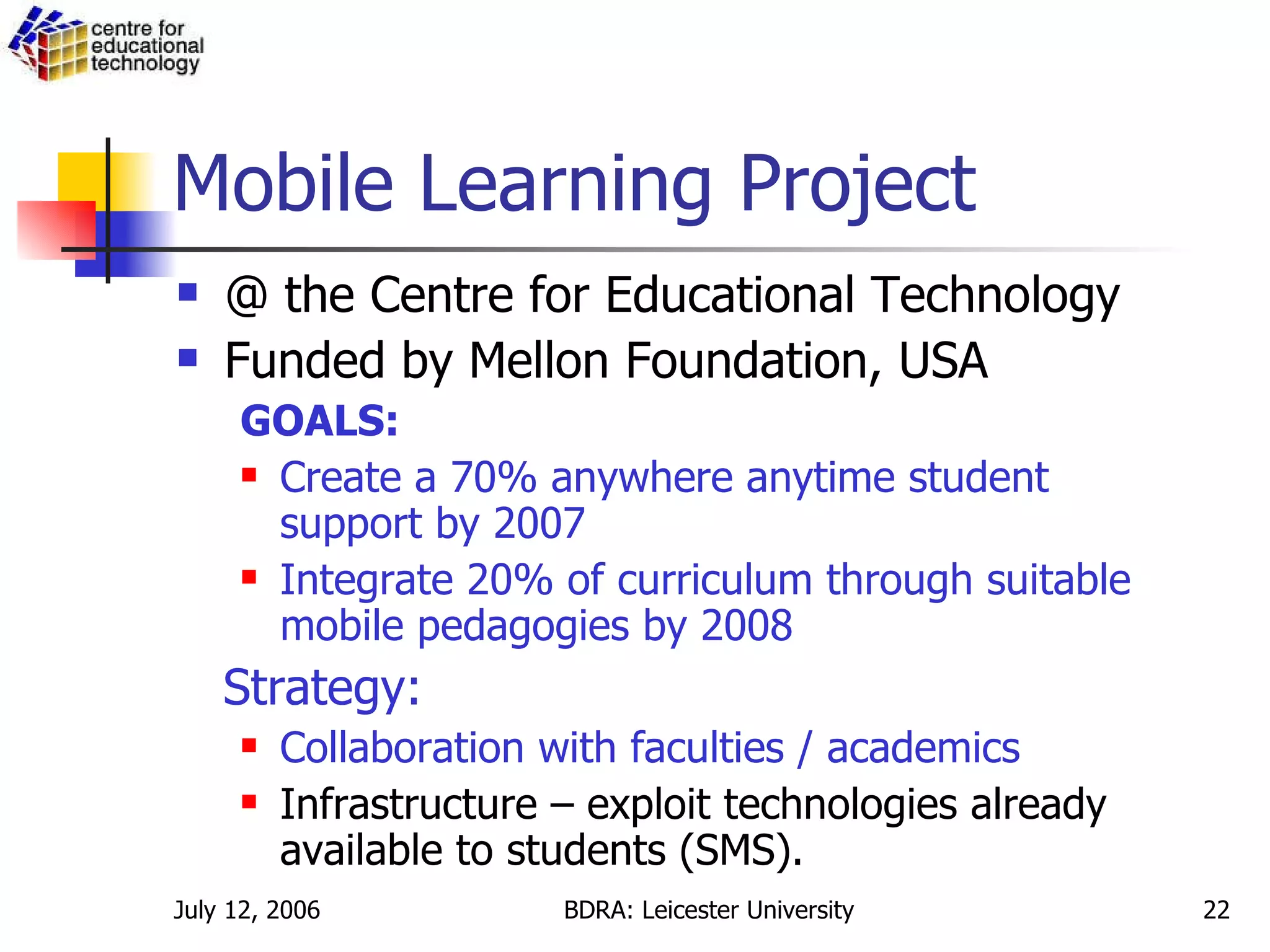
Mobile Learning Project @ the Centre for Educational Technology Funded by Mellon Foundation, USA GOALS: Create a 70% anywhere anytime student support by 2007 Integrate 20% of curriculum through suitable mobile pedagogies by 2008 Strategy: Collaboration with faculties / academics   Infrastructure – exploit technologies already available to students (SMS).
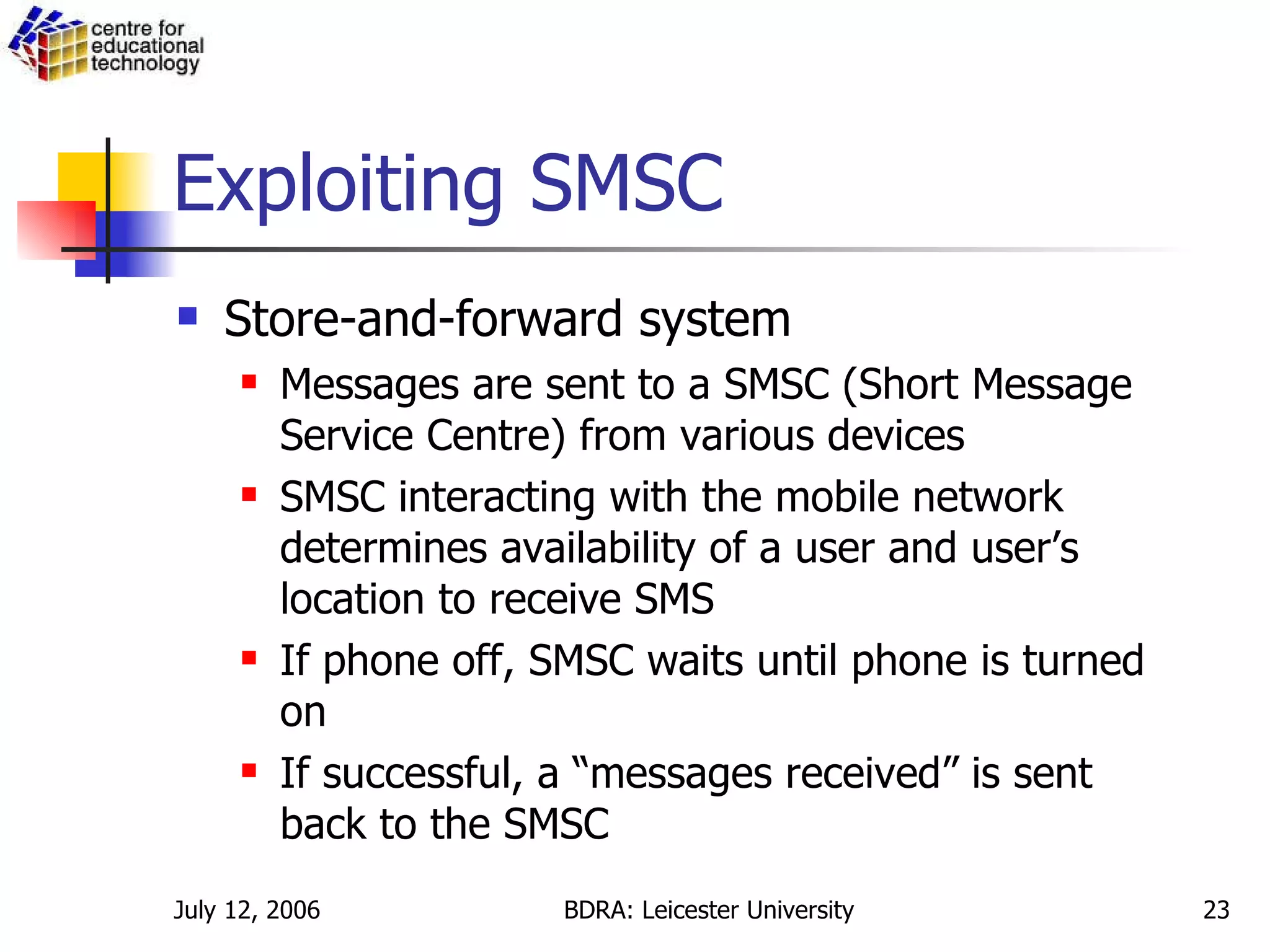
Exploiting SMSC Store-and-forward system Messages are sent to a SMSC (Short Message Service Centre) from various devices SMSC interacting with the mobile network determines availability of a user and user’s location to receive SMS If phone off, SMSC waits until phone is turned on If successful, a “messages received” is sent back to the SMSC
SMS usage stats SMS sent global 1Q04: 135 billion Global monthly SMS: 36/user 18.7 million users of mobile phones in RSA (June 2004) Estimate 19 million (2006) [1 in every 3] “ It seems reasonable to assume that majority of professionals in the country have, or have access to a cellular phone. With this in mind, the most obvious and effective way to provide notifications is to use the cellular networks (SMS)” Halse and Wells (Rhodes University, South Africa).
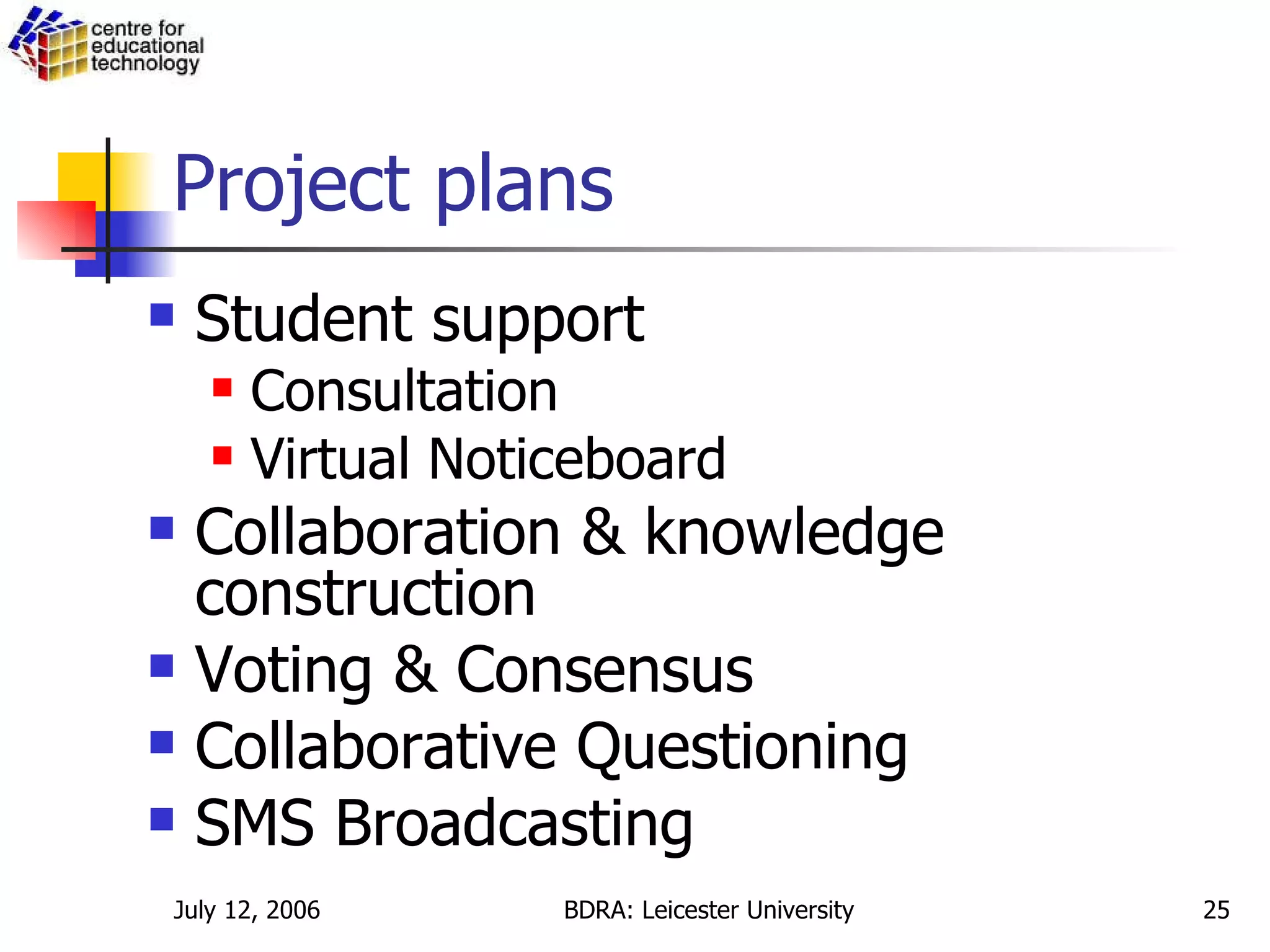
Project plans Student support Consultation Virtual Noticeboard Collaboration & knowledge construction Voting & Consensus Collaborative Questioning  SMS Broadcasting
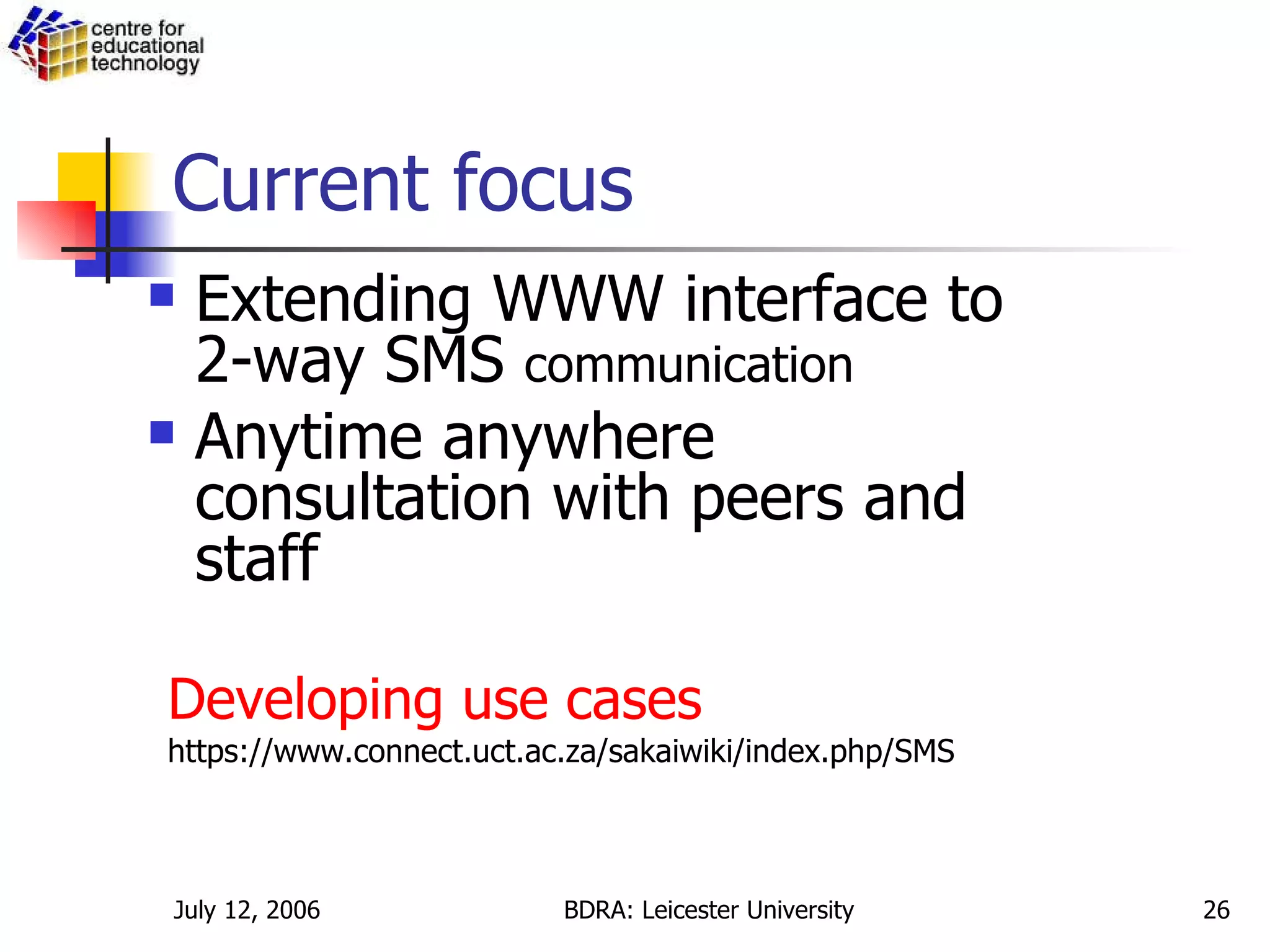
Current focus Extending WWW interface to 2-way SMS  communication Anytime anywhere consultation with peers and staff Developing use cases   https://www.connect.uct.ac.za/sakaiwiki/index.php/SMS
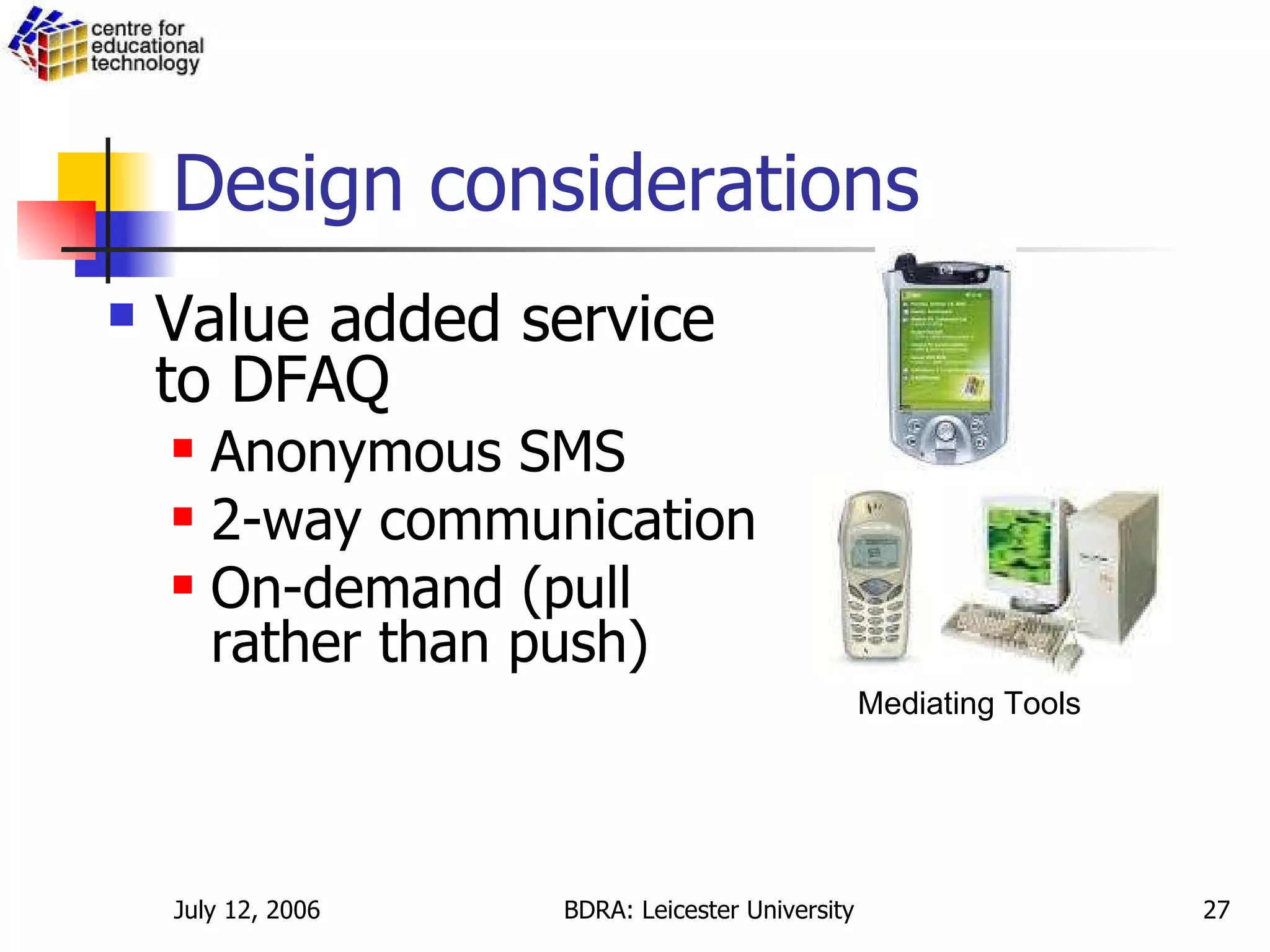
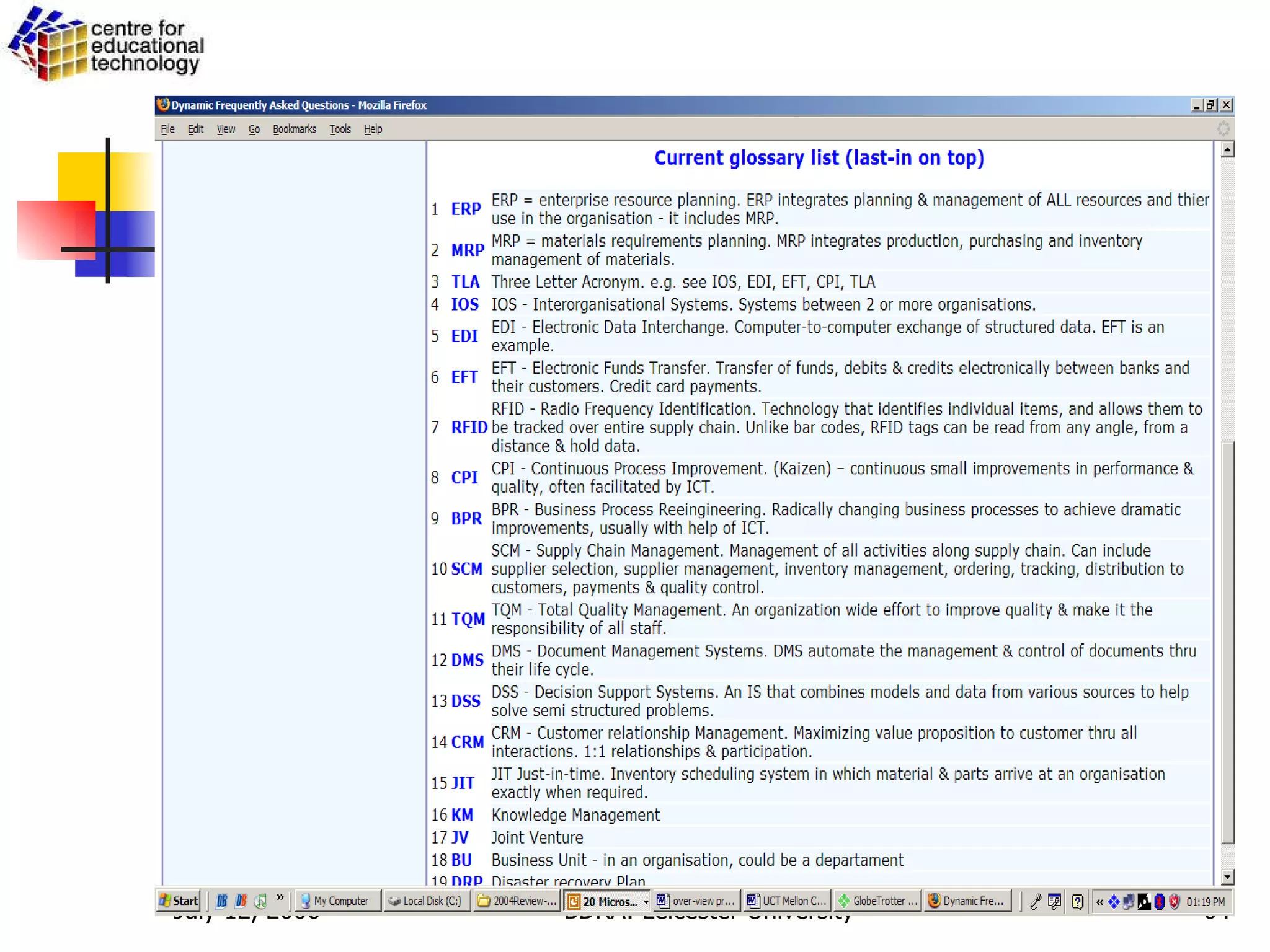
Design considerations Value added service to DFAQ Anonymous SMS 2-way communication On-demand (pull rather than push) Mediating Tools
Communicative competence A group of subway “free riders” exchange SMS messages about location of fare police Young men avoid facing rejection in person by using SMS to ask for dates People get out of relationships without confrontation via SMS: “U R dumped” or “I H8 U”.
London: October 15, 2005 A teenager is being treated for  text messaging and email addiction  in what is believed to be the first case of its kind in Scotland. He was sending about 700 texts a week and resigned from his job after bosses found out he had sent 8,000 messages in one month. He told BBC, “I like it, it’s like a game of ping-pong, as you send one and get one back.”
Mobile-phobic issues new technologies have implications for  changing forms and practices of literacy Rather than thinking in terms of  old skills being expressed through new media , and of trying to  ‘squeeze’ new technologies into familiar ways  of doing things Need to attend to the  reality of new and emerging literacies  and new modes of human practice and ways of experiencing the world (Green & Bigum, 1993; Synder 1996, 1997).
SMS a “ D iscourse” D iscourse are  human practices  which bring together and combine such things as beliefs, actions, values, world views, goals and purposes, standards, ways of dressing and gesturing, ways of behaving appropriately, as well as ways of speaking, reading and writing. (Lankshear et al., 2000: 29)
SMS a “ d iscourse” d iscourse refer to the  language “bits” with Discourses . Every Discourse is mediated by ways of using language – written, spoken, gestural – that make sense within that Discourse. (Lankshear et al., 2000: 29)
Handling discourse Learning how to handle the reading and writing components of a Discourse requires being  immersed in social practices  where participants  ‘not only read texts of this type in this way but also talk about such texts in certain ways, hold certain attitudes and values about them, and socially interact over them in certain ways   (Lankshear et al., 2000: 29)
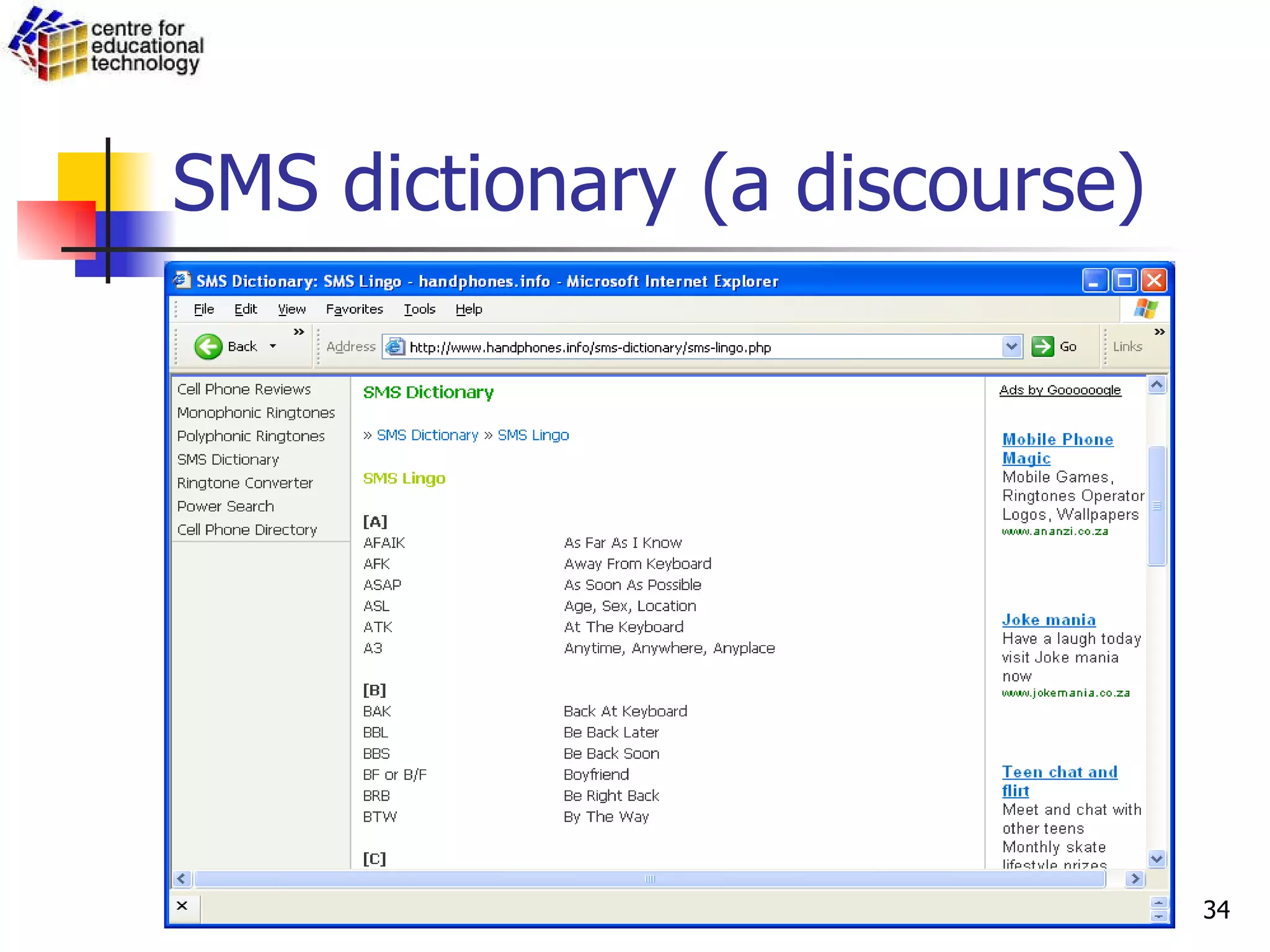
SMS dictionary (a discourse)
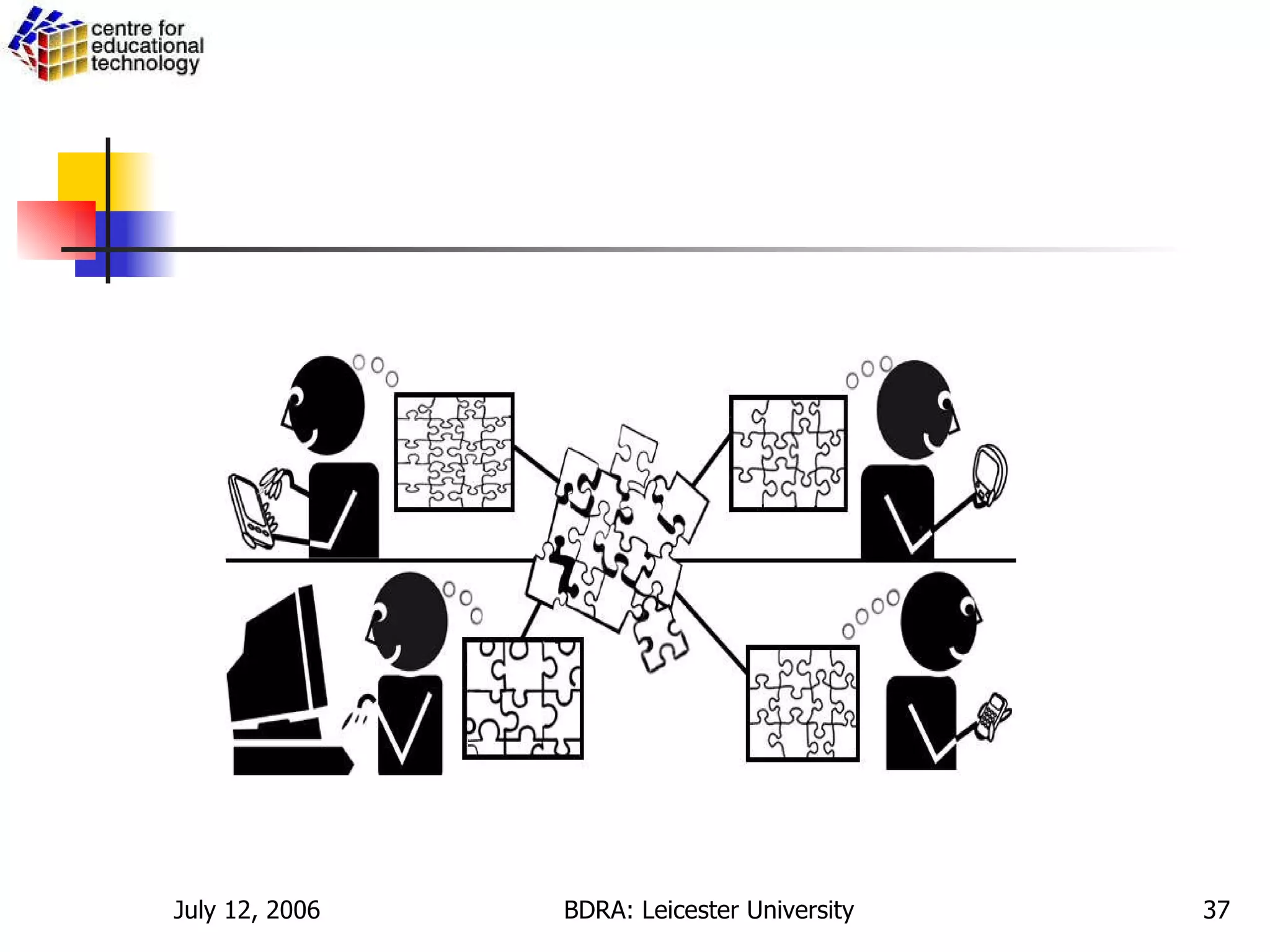
SMS Mediated Scaffolding
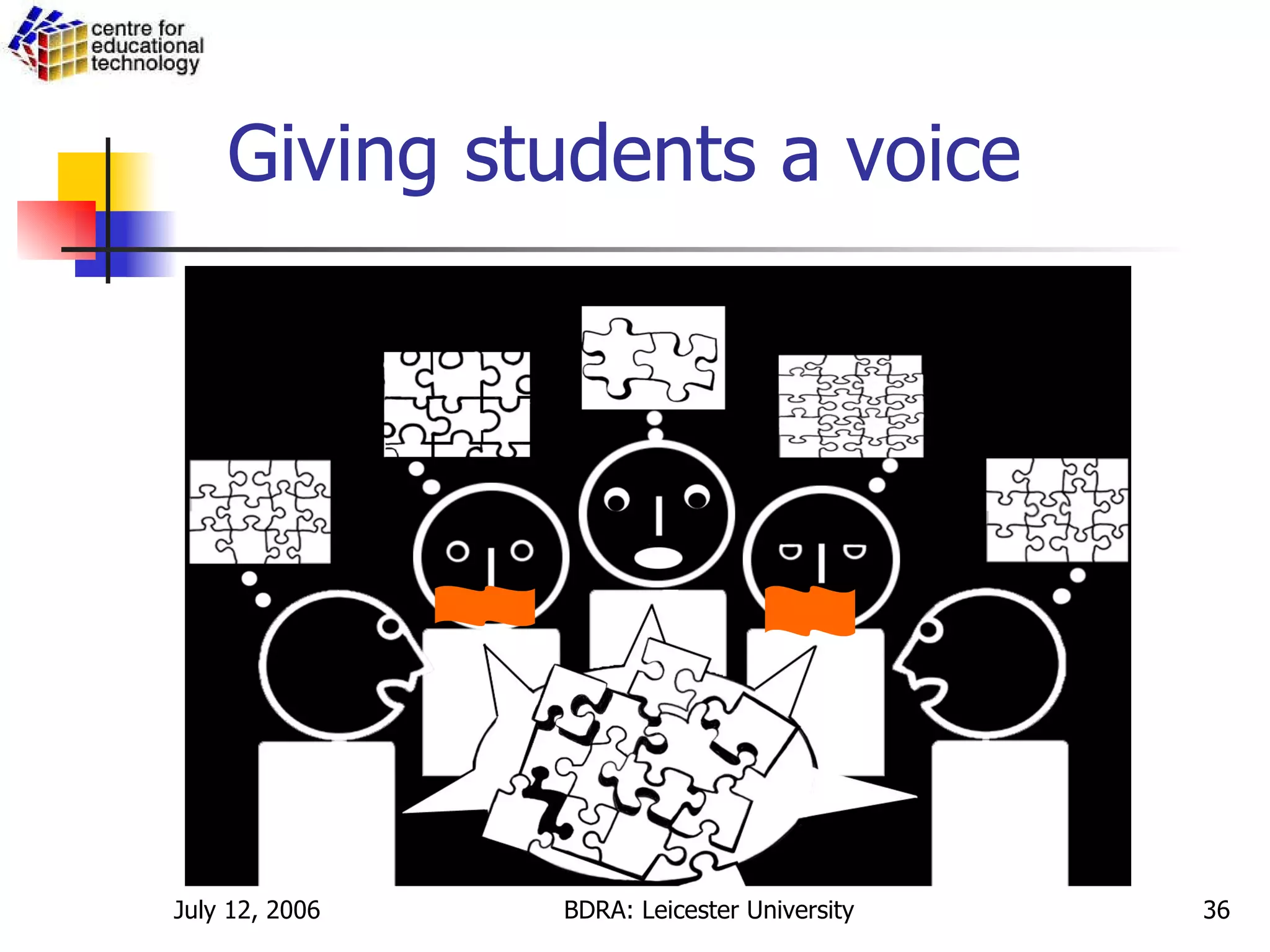
Giving students a voice
 
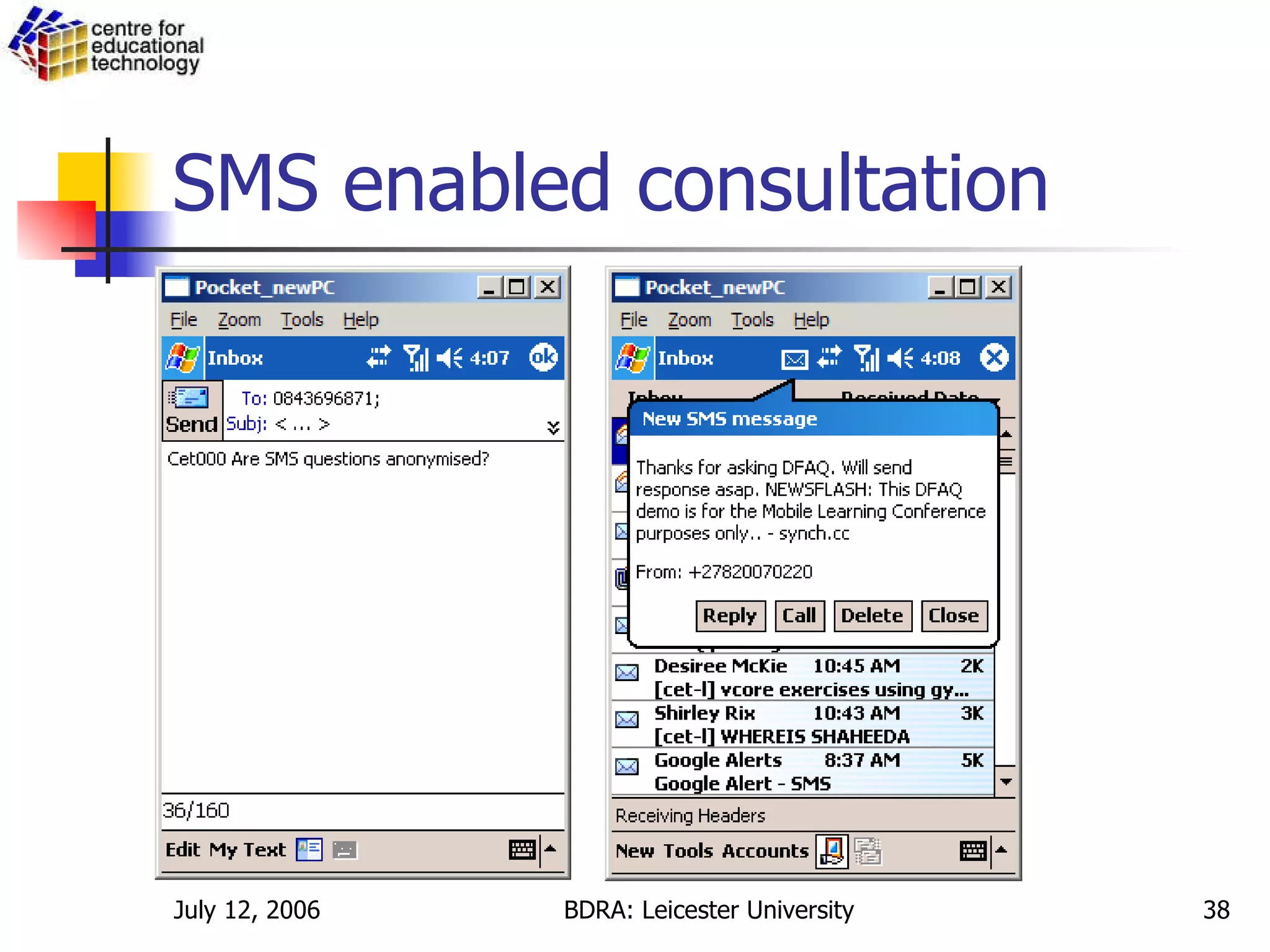
SMS enabled consultation
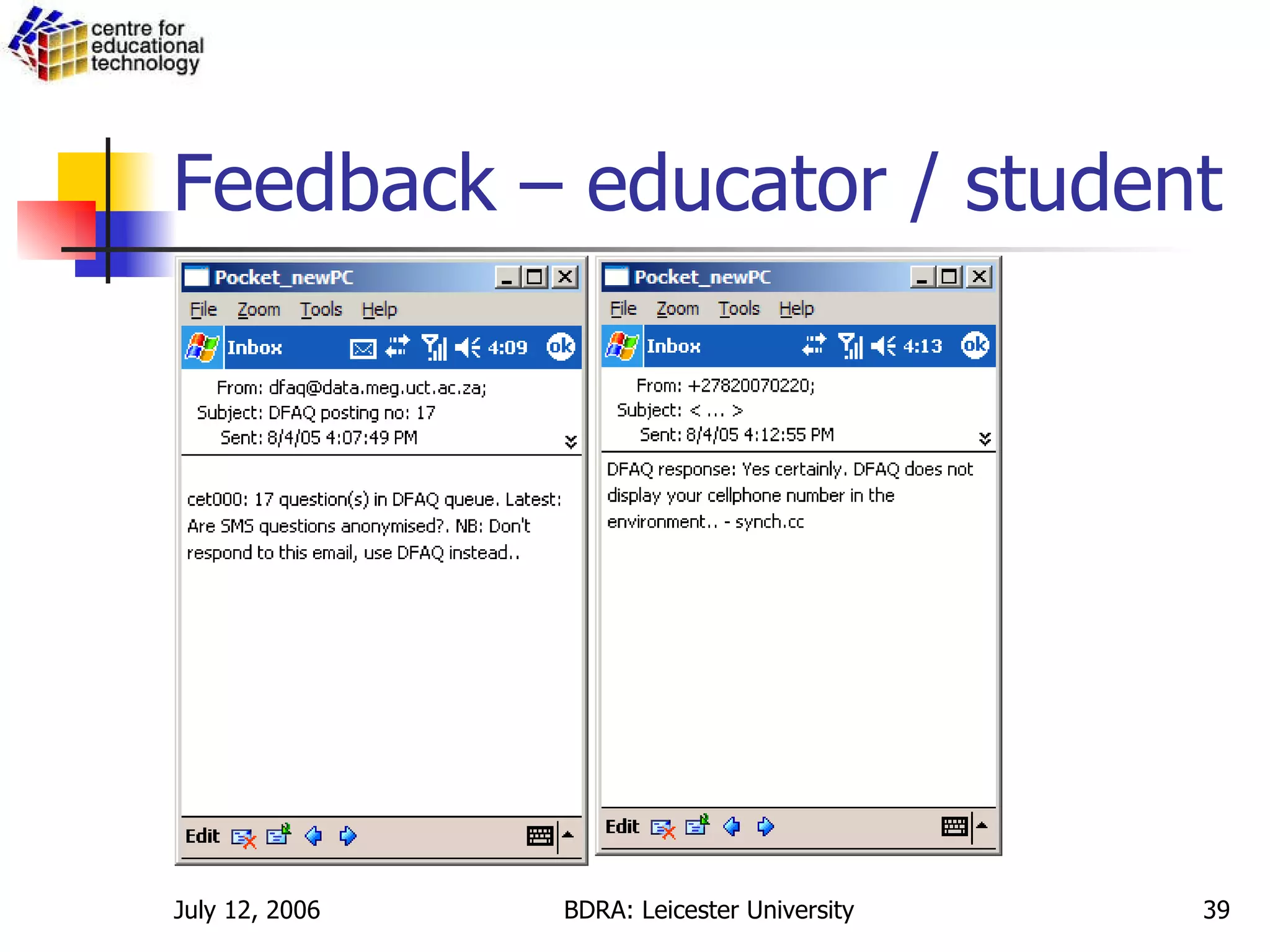
Feedback – educator / student
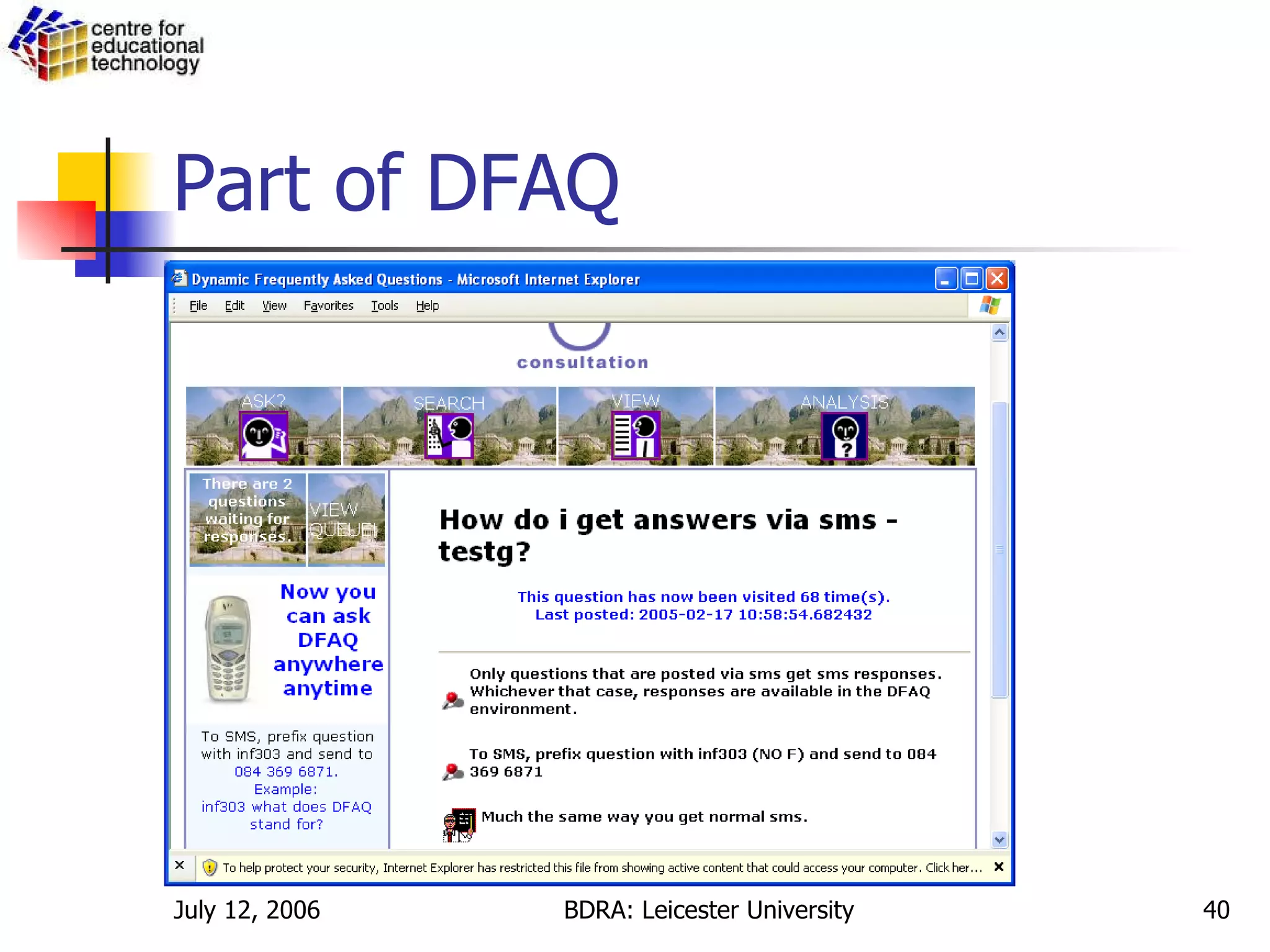
Part of DFAQ
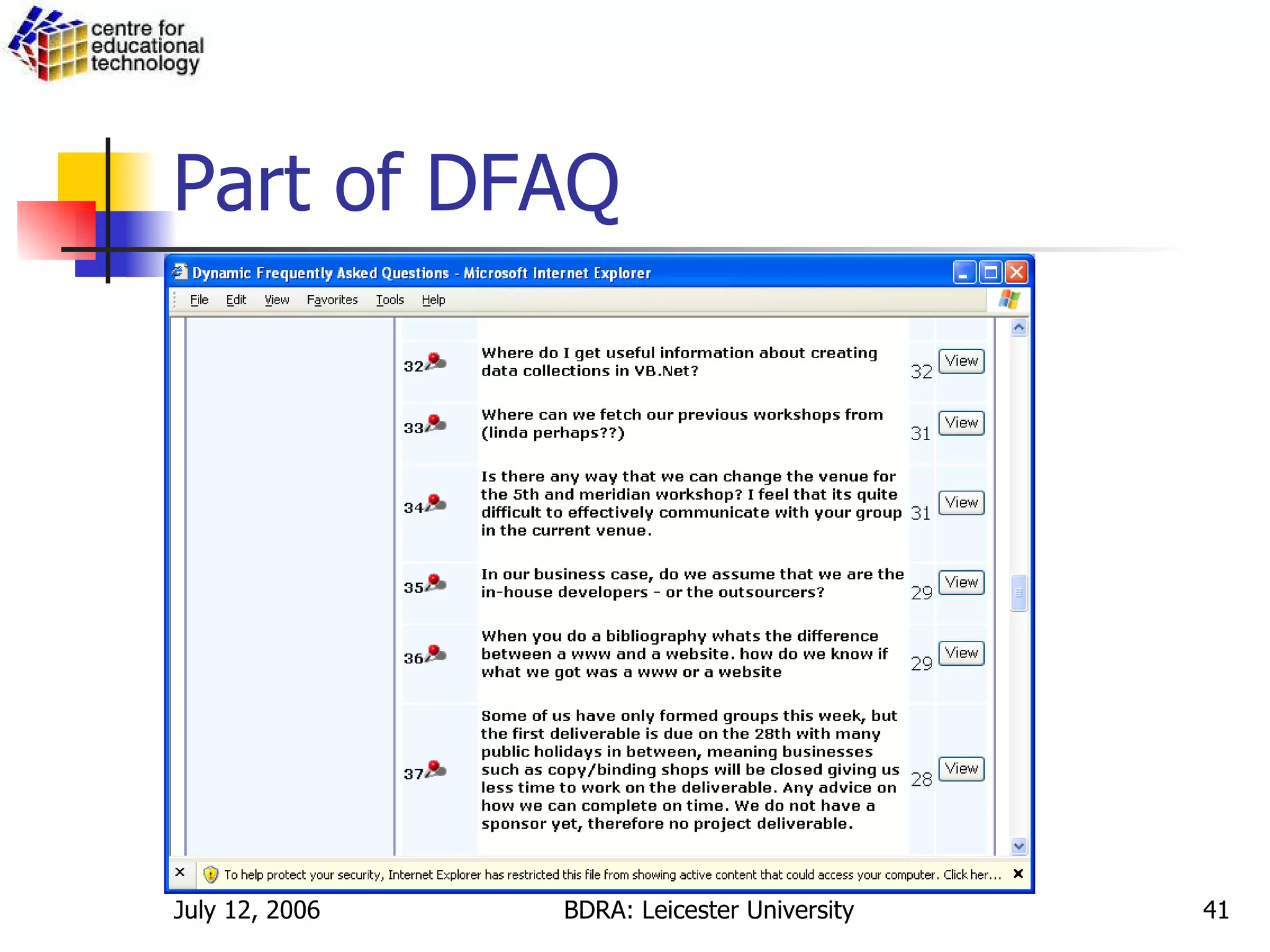
Part of DFAQ
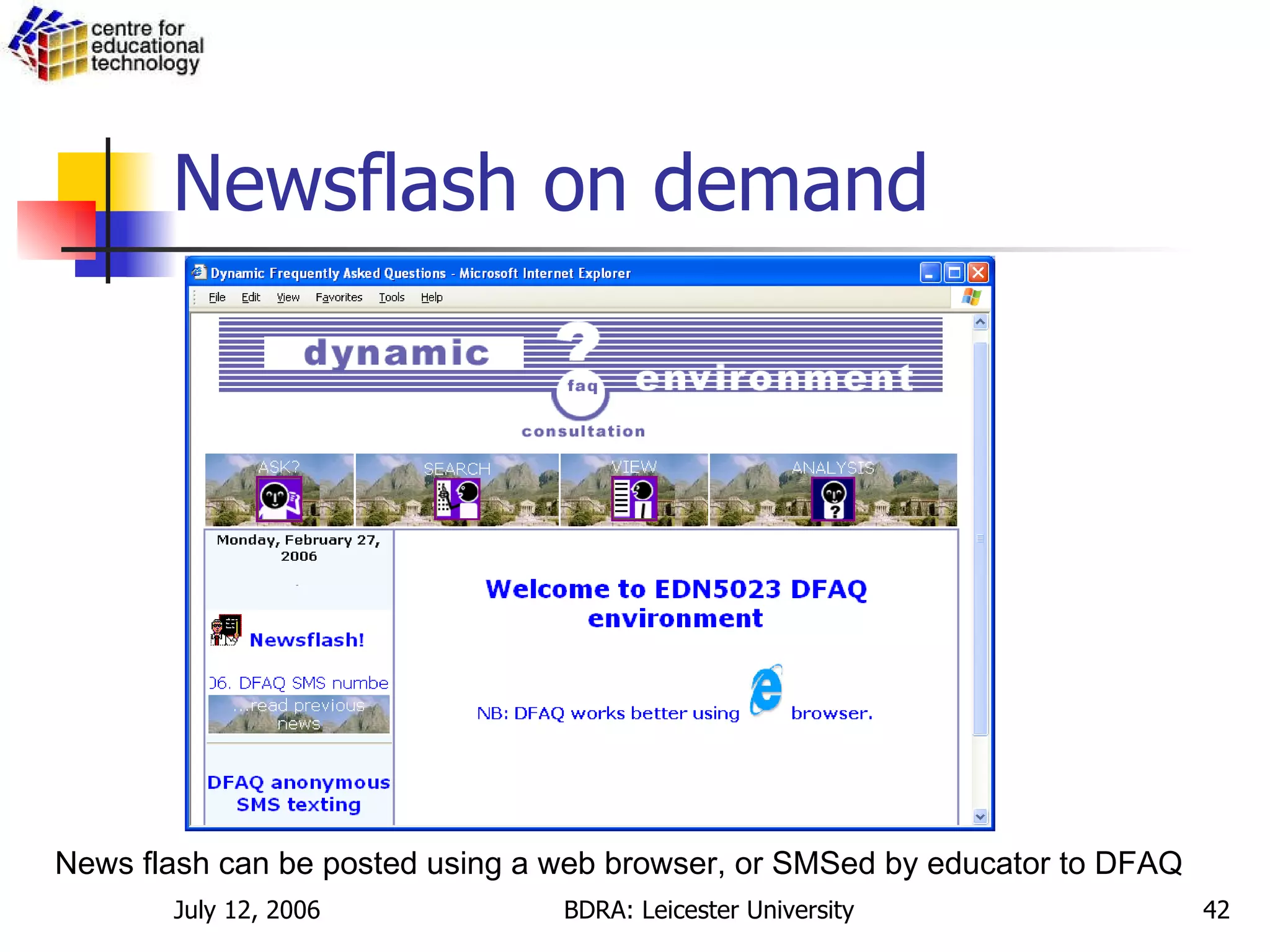
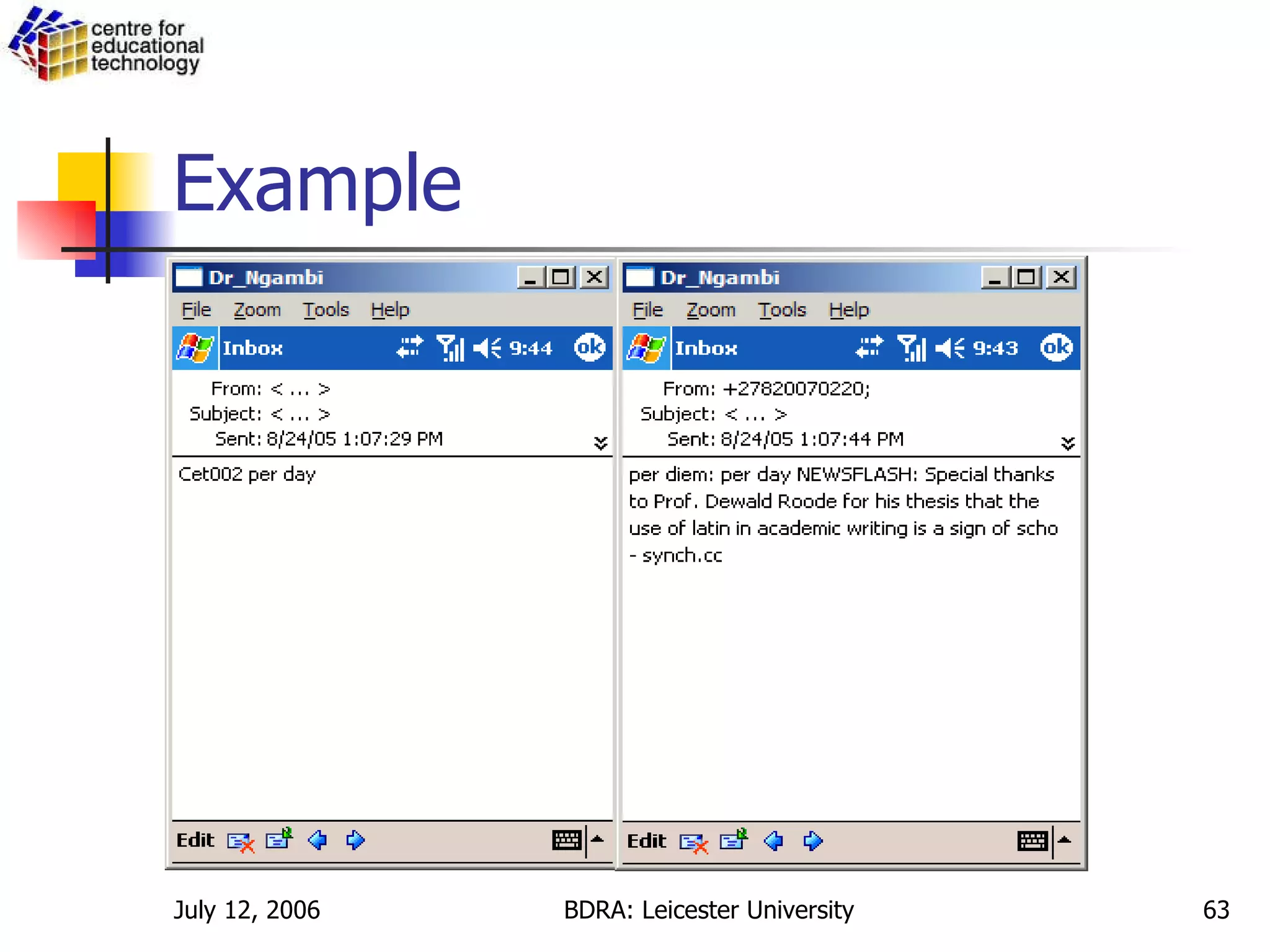
Newsflash on demand News flash can be posted using a web browser, or SMSed by educator to DFAQ
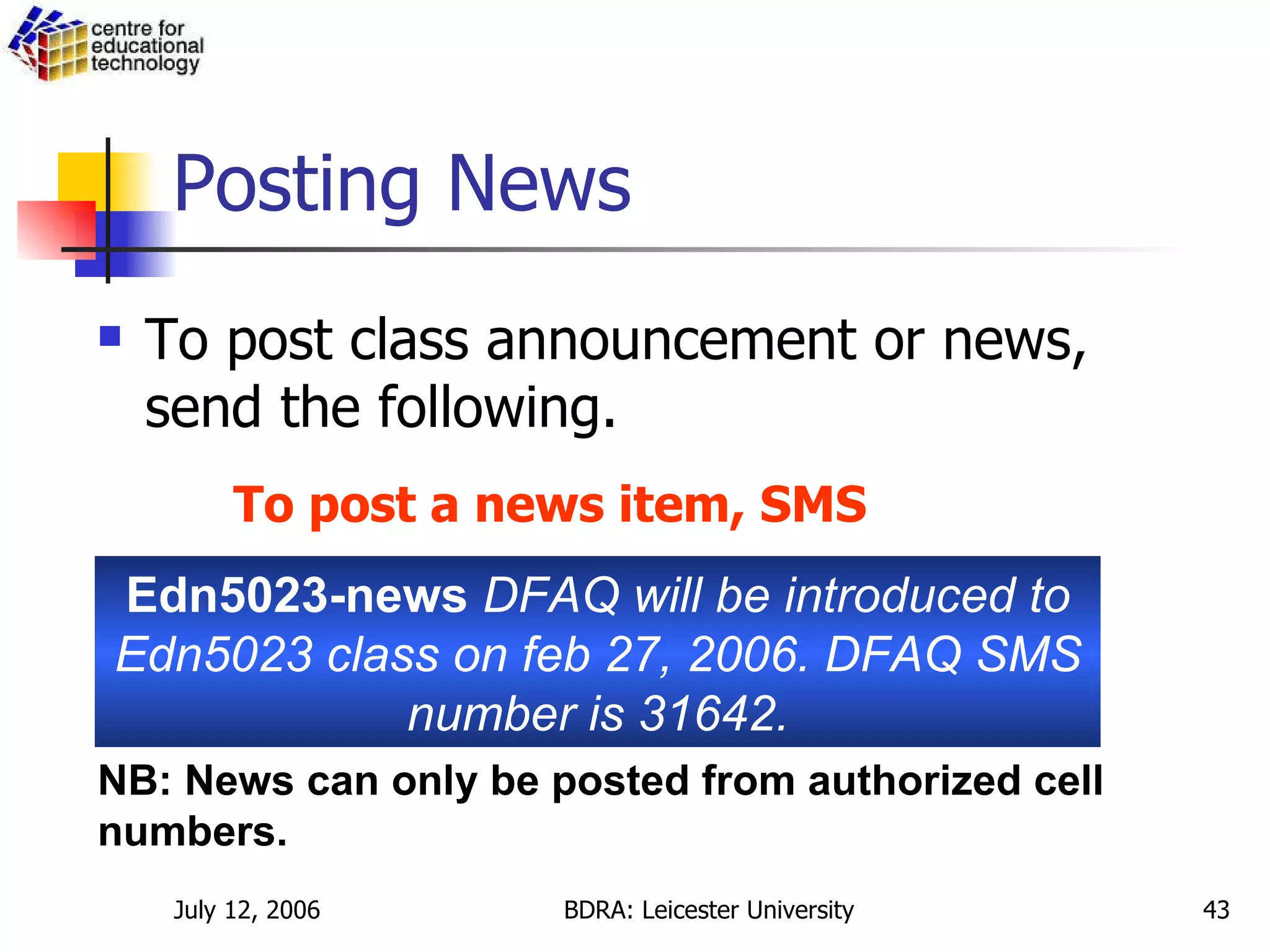
Posting News To post class announcement or news, send the following.  Edn5023-news  DFAQ will be introduced to Edn5023 class on feb 27, 2006. DFAQ SMS number is 31642. NB: News can only be posted from authorized cell numbers.   To post a news item, SMS
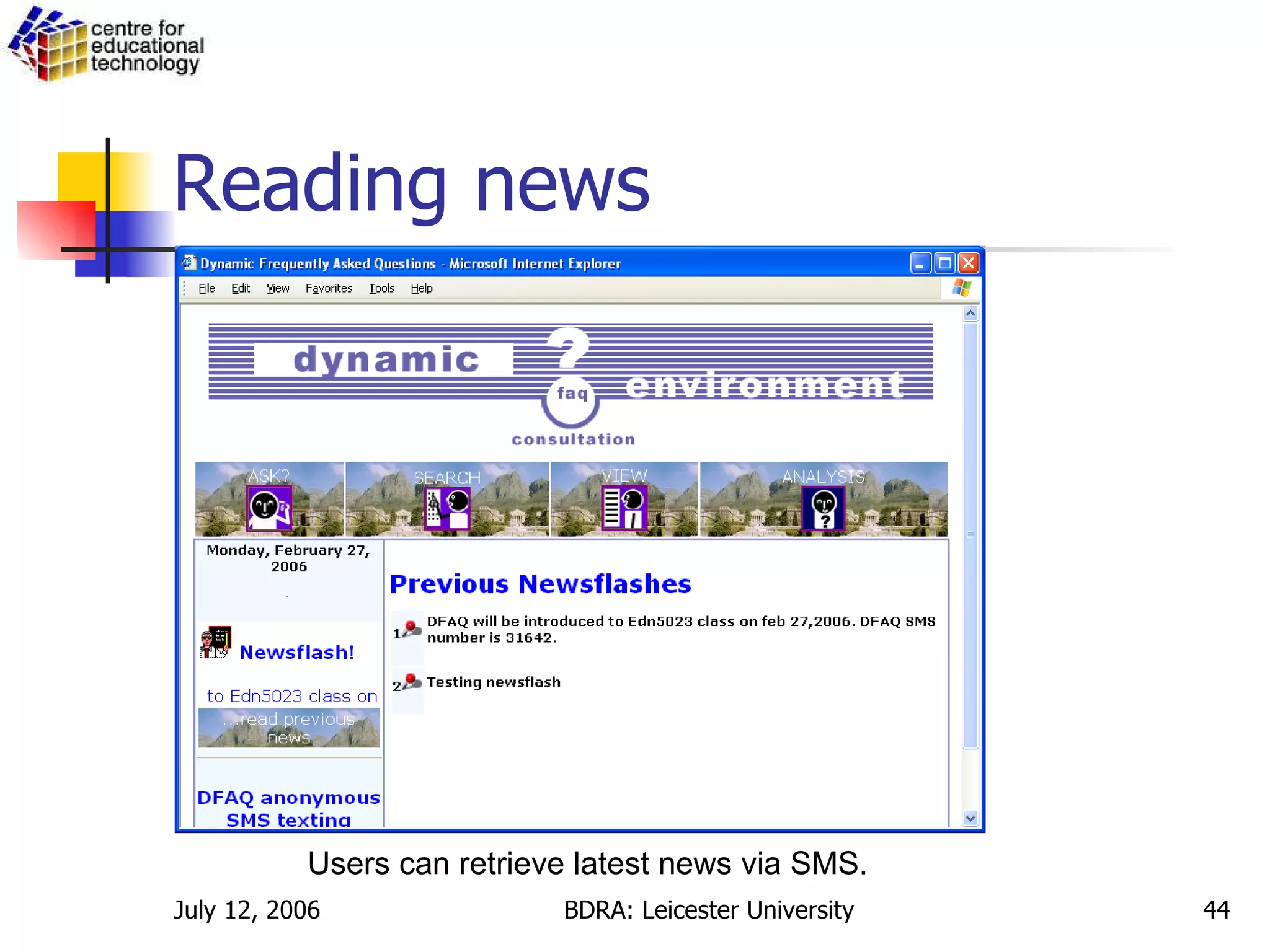
Reading news Users can retrieve latest news via SMS.
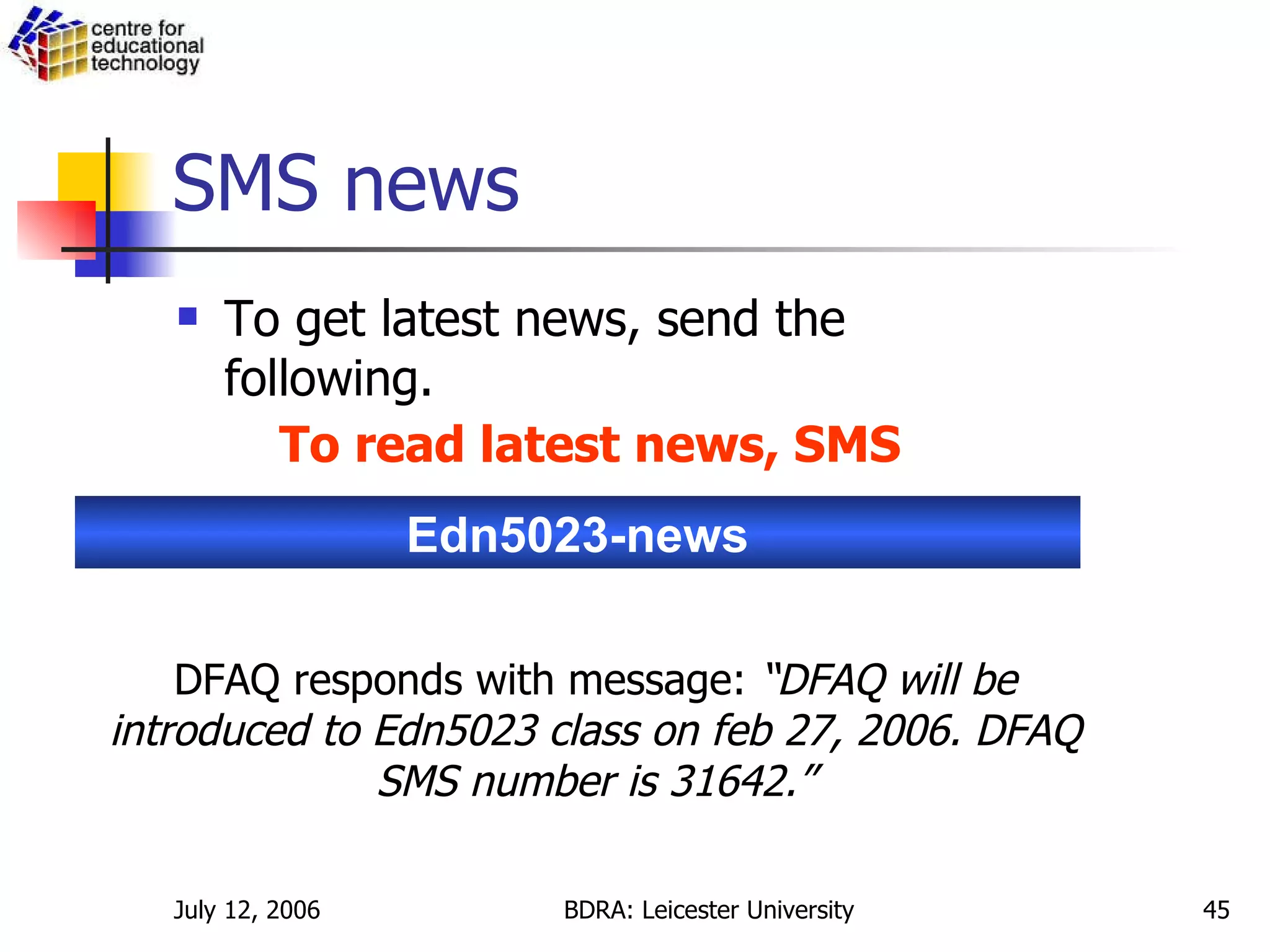
SMS news To get latest news, send the following.  Edn5023-news To read latest news, SMS DFAQ responds with message:  “DFAQ will be introduced to Edn5023 class on feb 27, 2006. DFAQ SMS number is 31642.”
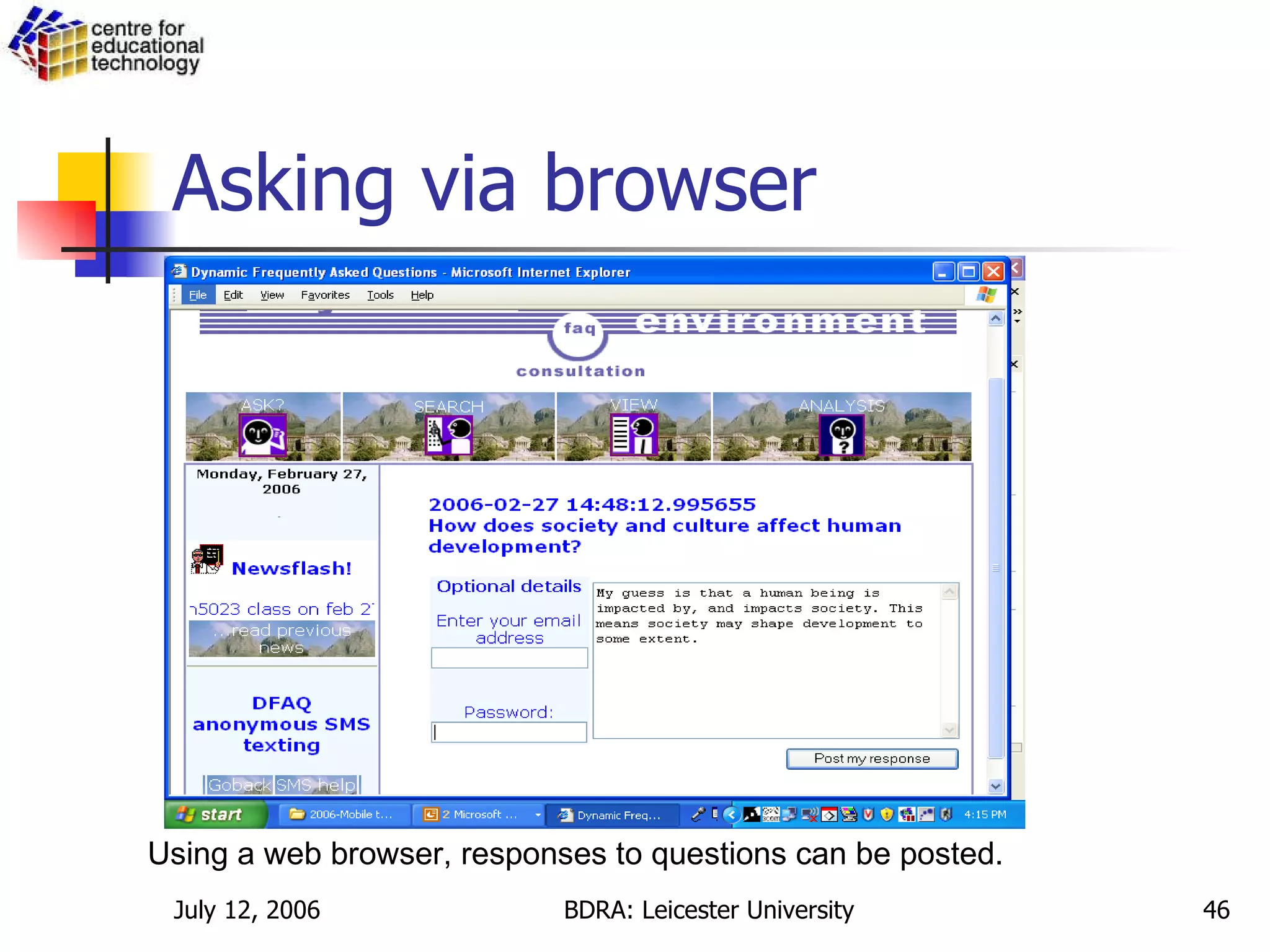
Asking via browser Using a web browser, responses to questions can be posted.
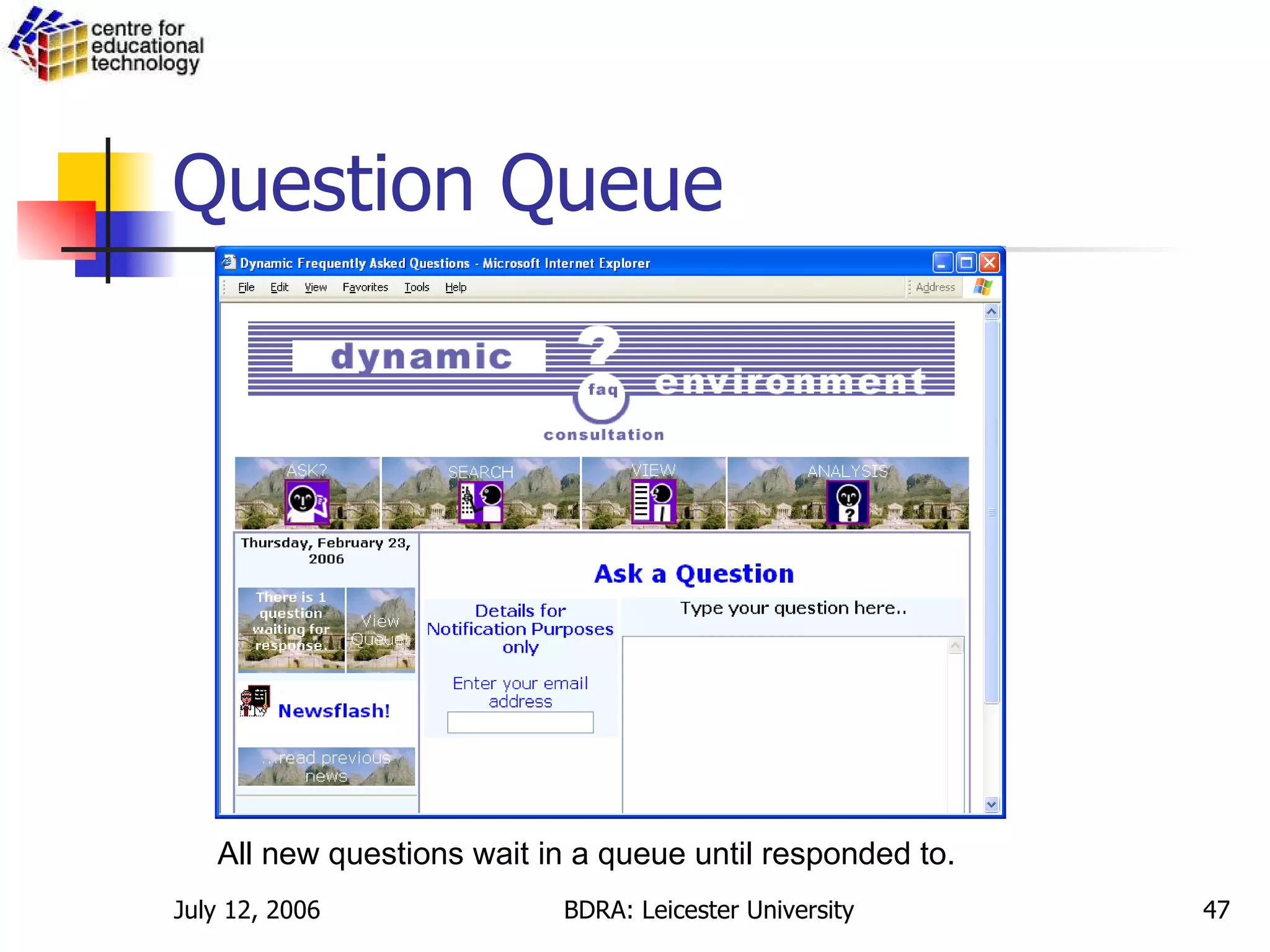
Question Queue All new questions wait in a queue until responded to.
SMSing Questions To use SMS to post a question, prefix question with course code followed by a question Edn5023  How does society and culture affect human development? To ask a question, SMS Every question is assigned a reference number. E.g. 16
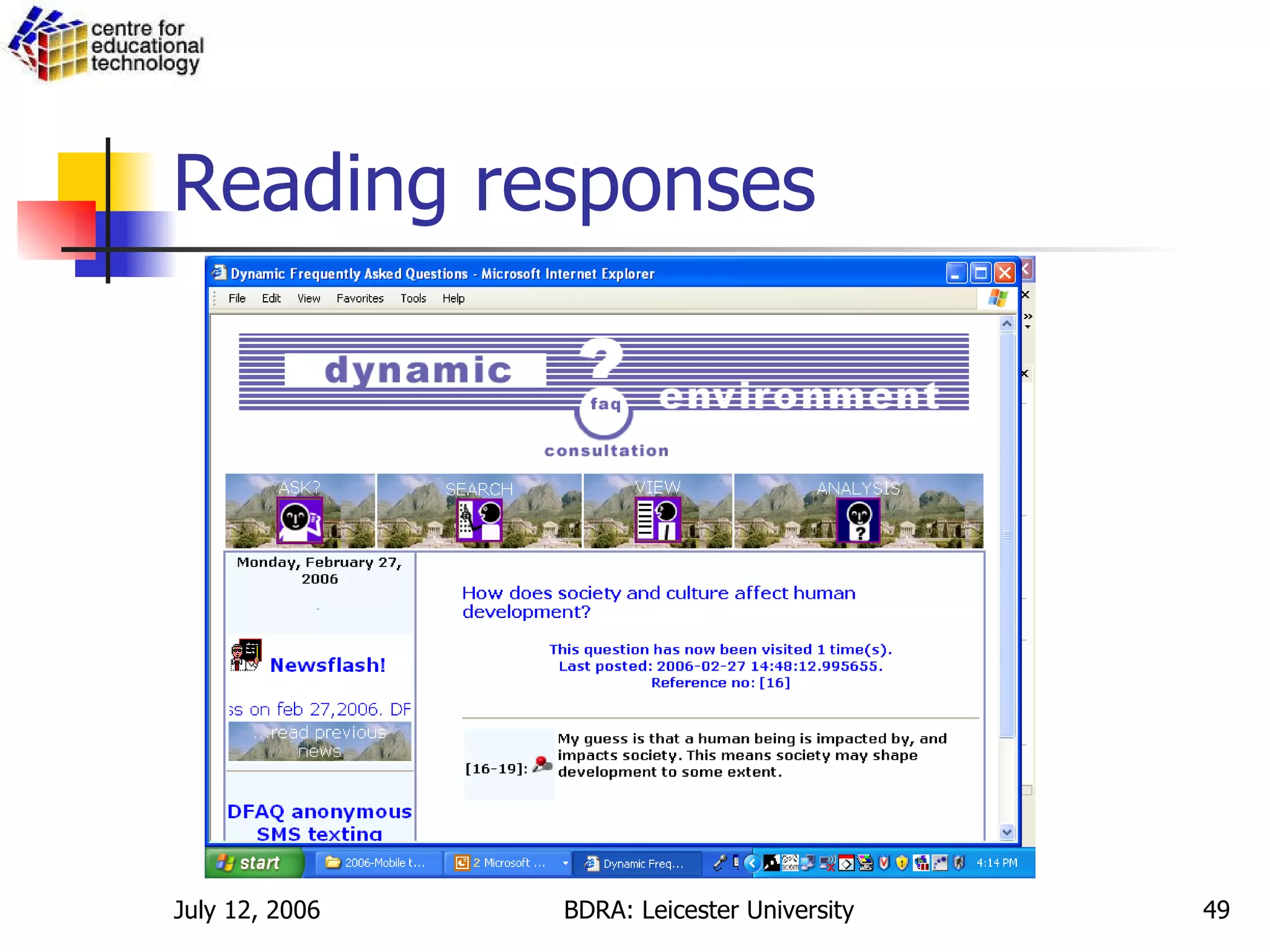
Reading responses
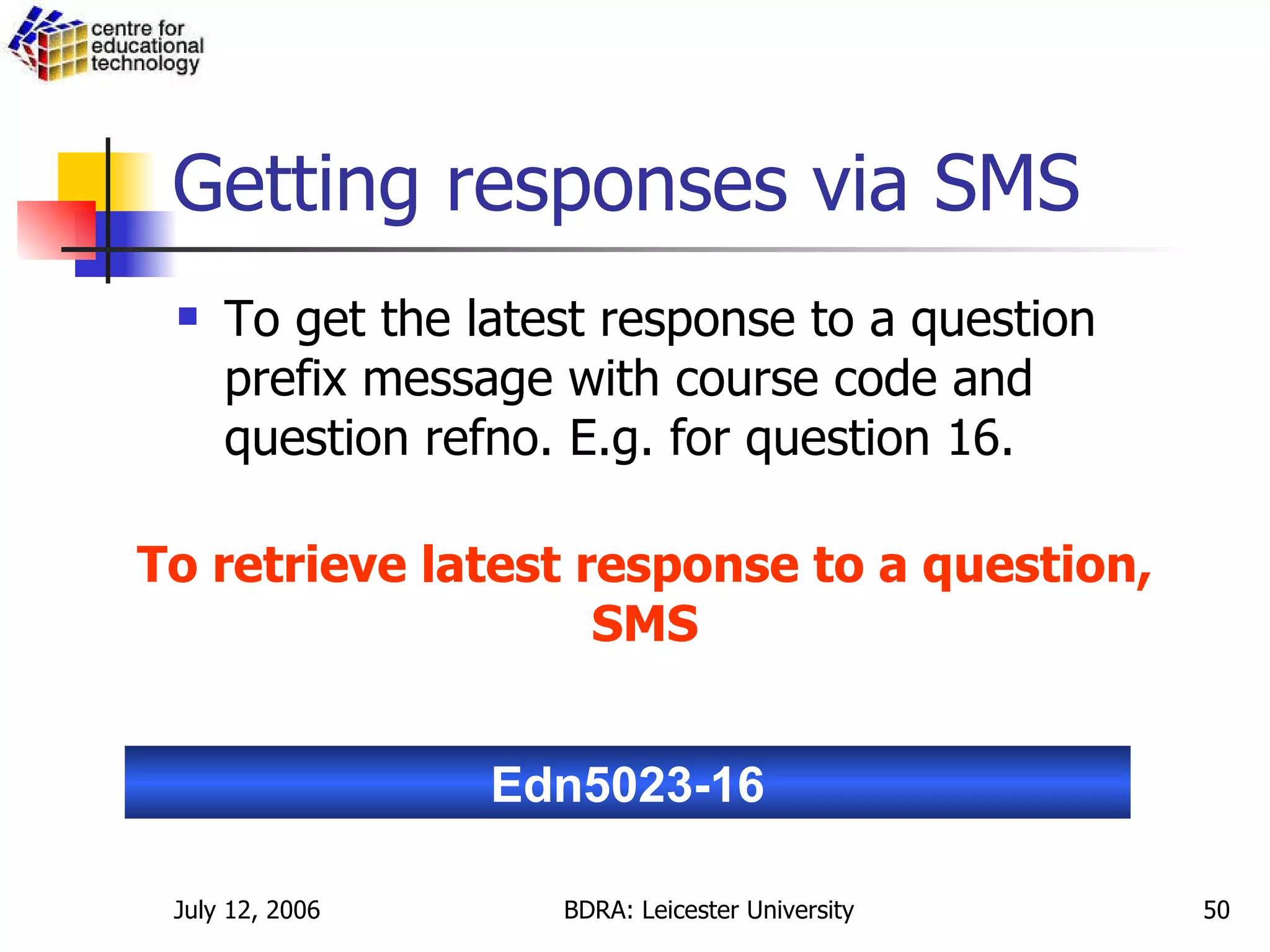
Getting responses via SMS To get the latest response to a question prefix message with course code and question refno. E.g. for question 16. Edn5023-16 To retrieve latest response to a question, SMS
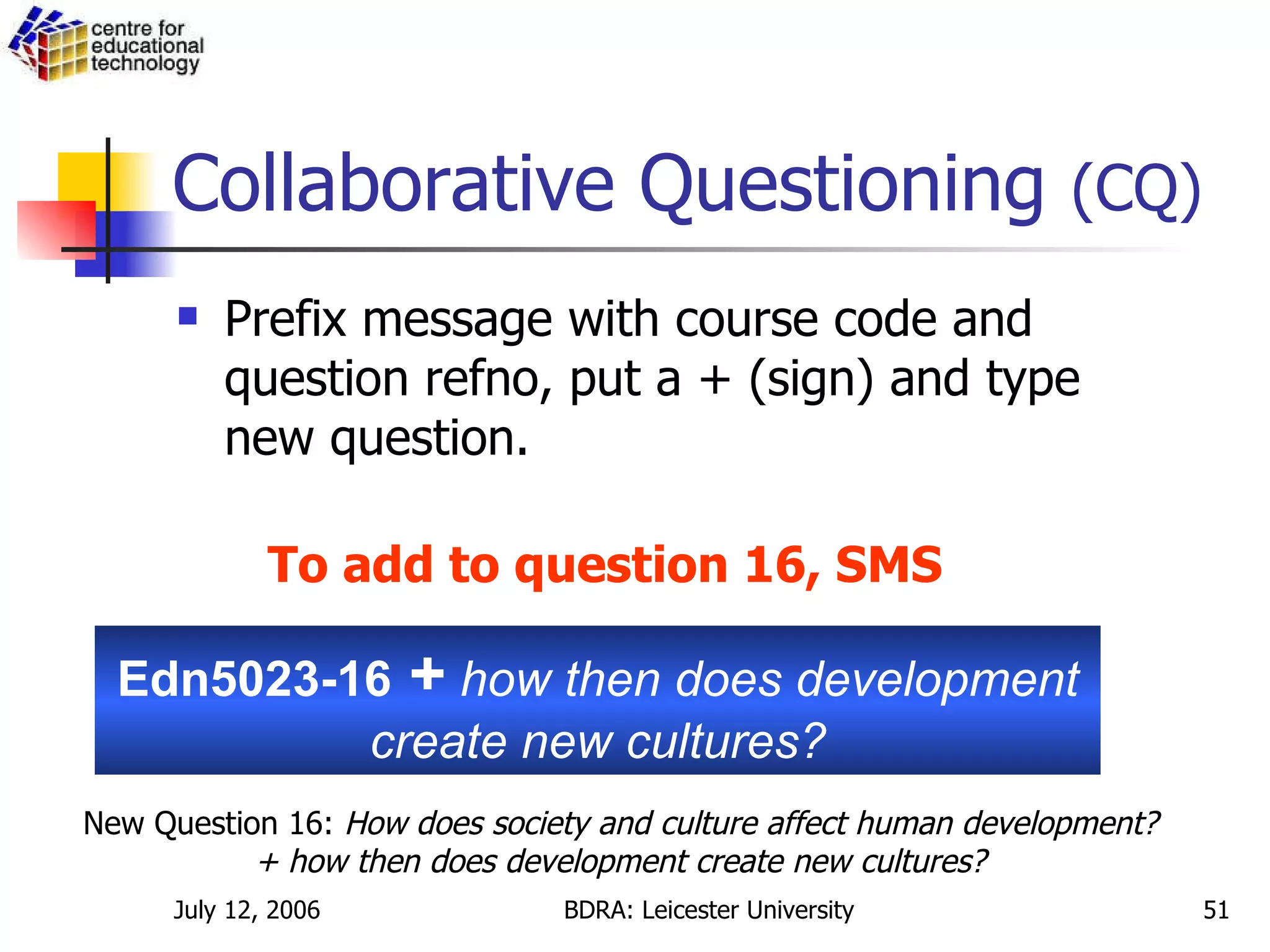
Collaborative Questioning  (CQ) Prefix message with course code and question refno, put a + (sign) and type new question. Edn5023-16  +   how then does development create new cultures? To add to question 16, SMS New Question 16:  How does society and culture affect human development? + how then does development create new cultures?
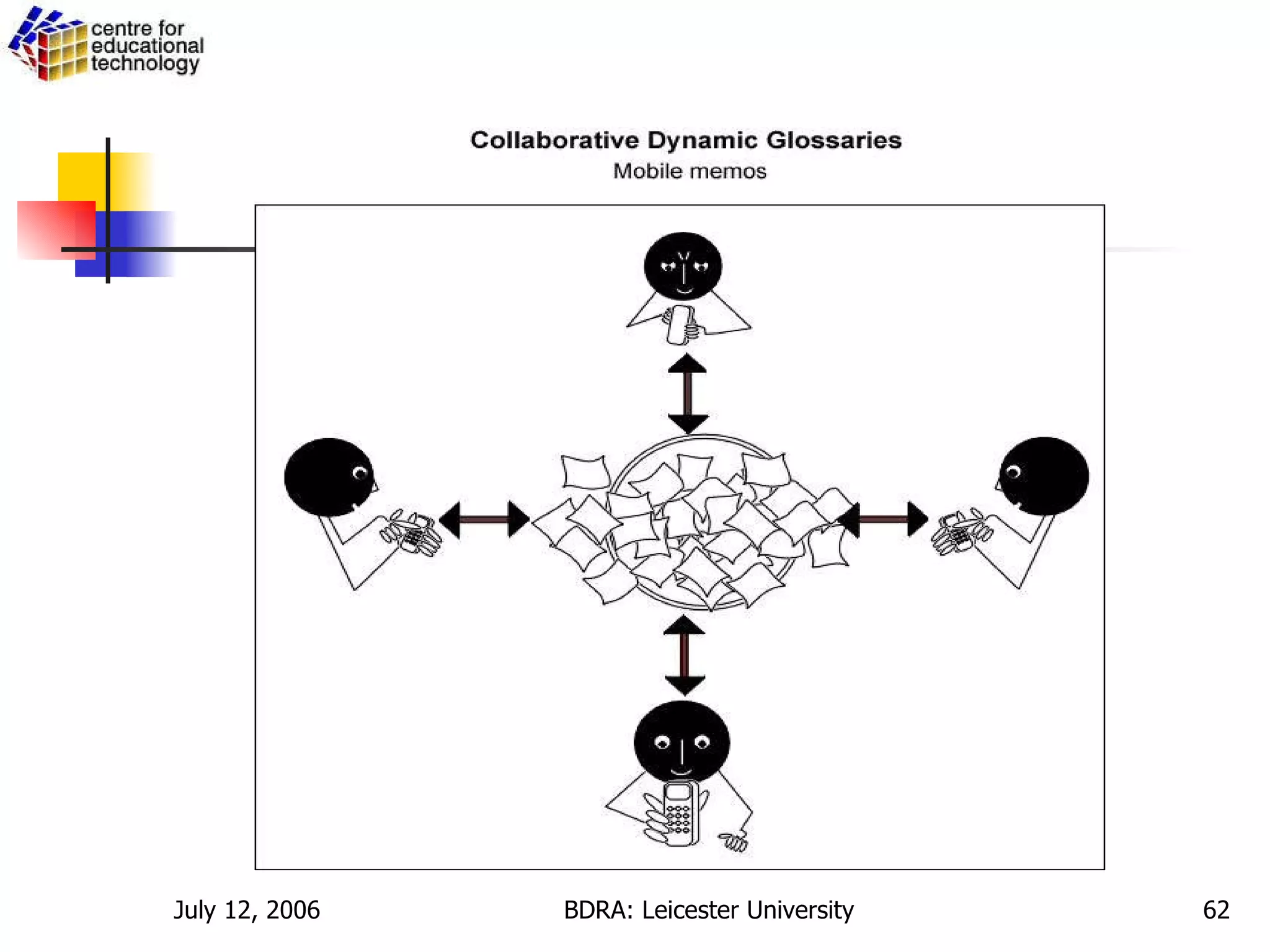
Definition (CQ) In collaborative questioning a  group  of learners collaborate to formulate  a  single question by interjecting  and adding to an initial question. Additions to questions may also arise from responses.
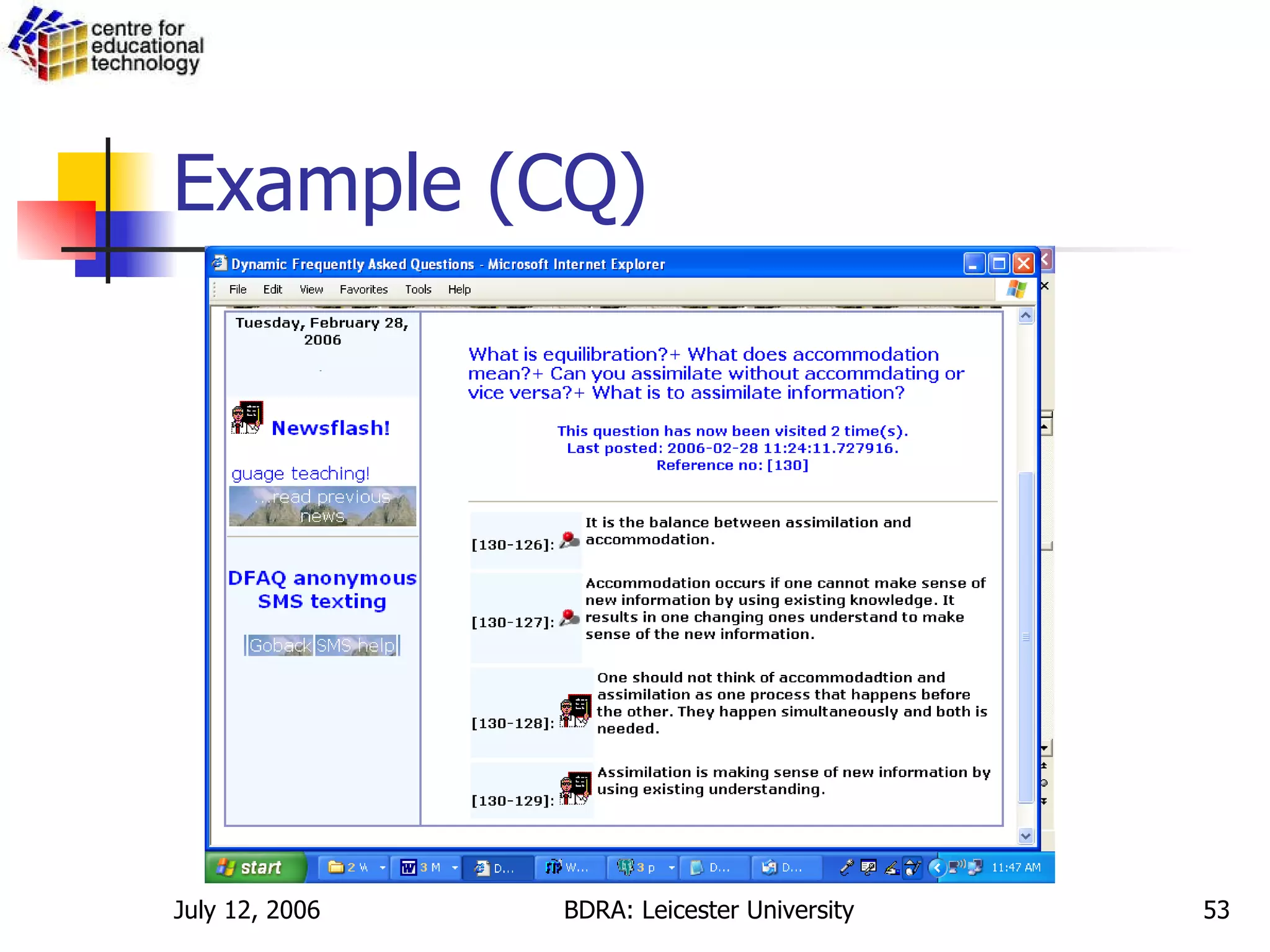
Example (CQ)
Observation (CQ) Collaborative questioning provides  access to peers’ questions  and gives learners an opportunity to  interject and add to questions  they may not have thought of asking themselves and to  extend a questioning engagement  based on responses received.
Responding via SMS Prefix message with course code and question refno, and allows SMS responses to be posted. Edn5023-16   Just look at how SMS has created a new culture of texting and socialization.  To respond to question 16, SMS
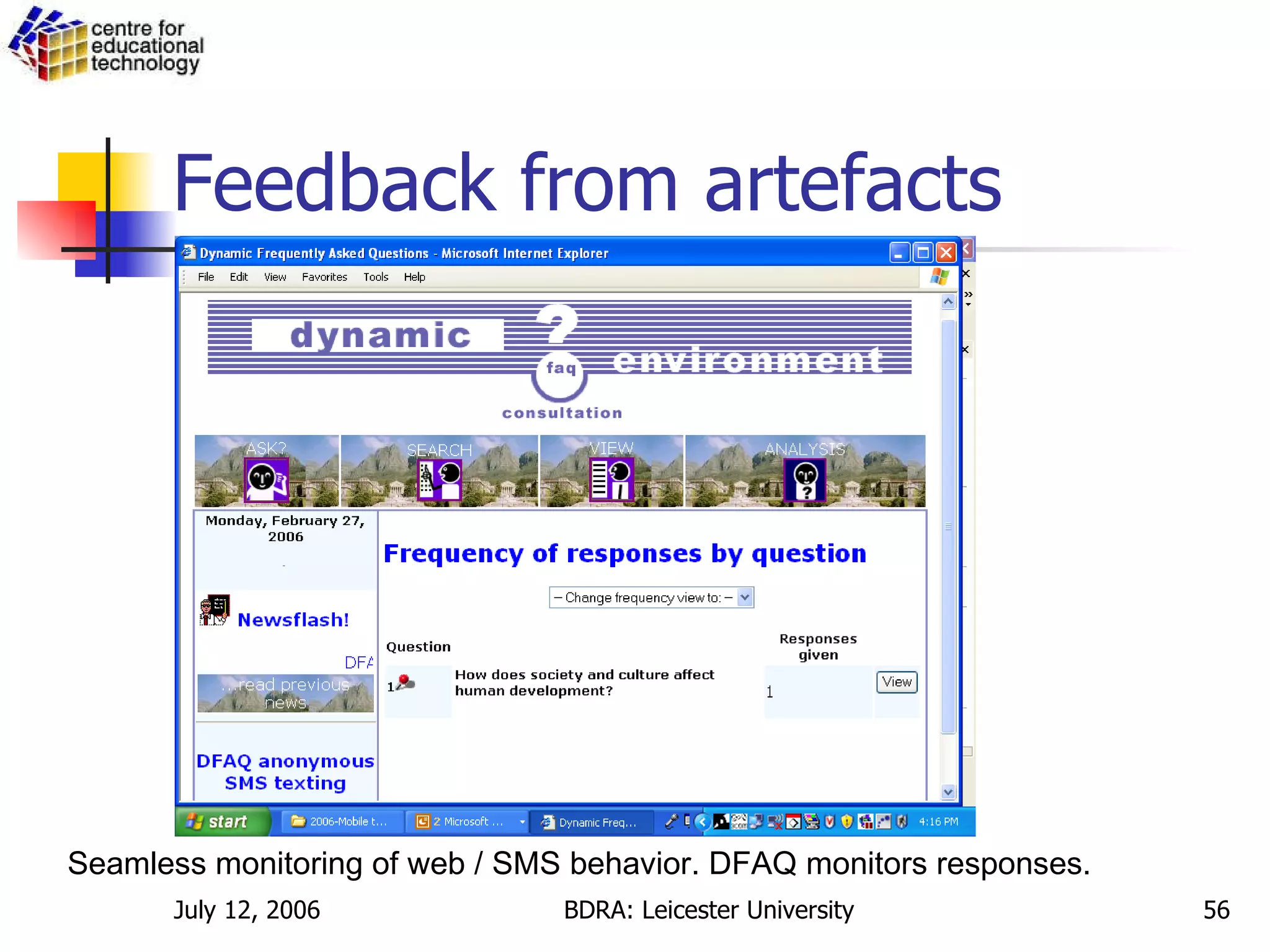
Feedback from artefacts Seamless monitoring of web / SMS behavior. DFAQ monitors responses.
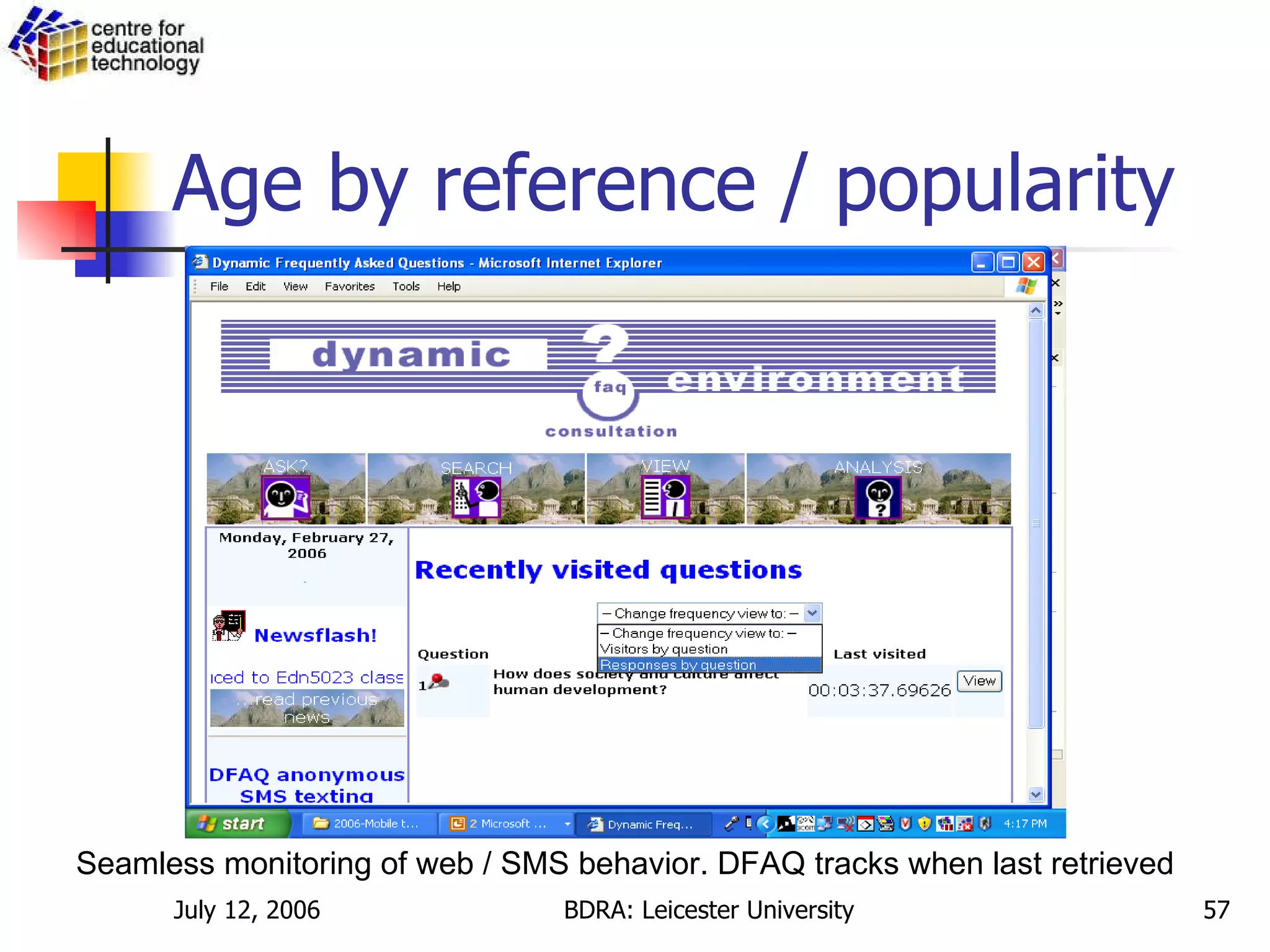
Age by reference / popularity Seamless monitoring of web / SMS behavior. DFAQ tracks when last retrieved
Applications
Applications 2 To teach critical reading skills (Cognitive Development Course - Education) To teach questioning skills (Project Management Course – Information Systems) To teach how organisations learn from peers (Organisational Psychology)
Applications 2 To teach Xhosa (Multilingual Education Group) To allow students to confidentially share information on discrimination and harassment  To provide feedback to academics/HOD on students/staff concerns and learning/working frustrations
Other mobile projects
 
Example
 
Not so fun projects SMS broadcasting (notifications) in Health Sciences and Humanities Community building (SMS birthday broadcasting to a class) in a 1 st  year Commerce Degree
Thank you Dr. Dick Ng’ambi Centre for Educational Technology University of Cape Town, South Africa [email_address] Contact details:

Mobile learning changing notion on ‘contact’ education

  • 1.
    Mobile learning changingnotion on ‘contact’ education Dick Ng’ambi Centre for Educational Technology University of Cape Town
  • 2.
    Outline Introduction ChallengesNotion of ‘contact’ education Mobile Learning Projects SMS Collaborative Questioning Not so fun projects Research Questions / Discussion
  • 3.
    Introduction Project seeksto use prevalent mobile technologies in our resource-poor context to support teaching and learning in higher education curricula Research Stimulation Fund (UCT): 2003-2004 Support from the Andrew W. Mellon Foundation grant - Digital Cornerstones - : 2005-2007
  • 4.
    CET urgency toensure that all students have fair and equal access to a new world order driven by a commitment to educational and social inclusion no matter what a student’s educational background, mother tongue or previous exposure to computers might have been believes that a transformed higher education requires participation in a new communicative order as a necessary outcome of a graduate education.
  • 5.
    Key national challenge… to redress past inequalities and to transform the higher education system to serve a new social order, to meet pressing national needs, and to respond to new realities and opportunities ” (White Paper: 1.1). (Department of Education South Africa, 2001)
  • 6.
    Key national dreamEvery South African manager, teacher and learner in the general and further education and training bands will be ICT capable (that is, use ICTs confidently and creatively to help develop the skills and knowledge they need as lifelong learners to achieve personal goals and to be full participants in the global community) by 2013 (Department of Education South Africa, 2004:p. 17)
  • 7.
    Educational Context Educationaldisparities - manifested along racial lines due to the political, economic and social policies of the pre-1994 era Contrast: In the UK, participation in higher education has increased since the 1940s but participation of higher socio-economic groups still exceeds that of lower socio-economic groups (DFES report, 2004).
  • 8.
    Performance indicator (PI)increase the demographic representation among graduates and reduce the demographic difference between student intake and graduate throughput WHILE Ensuring quality of educational provision Without funding until throughput
  • 9.
    Contextual Challenges Students’Academic Unpreparedness Low attention space Diverse student population Different learning preferences / styles Socio-Cultural effects Multilingualism Class sizes Personalised attention difficulty Demand for meaningful feedback
  • 10.
    ‘Contact’ notion Contactis a convergence of: Distance, space and time Education is independent of: Distance, space and time “ Contact Education” attempts to coverge D, S and T for creating an experience that is independent of D, S and T.
  • 11.
    Learning Resources CourseAdmin info Knowledge Sharing Learning Activities Interactivity
  • 12.
  • 13.
    Teaching vs ‘learningstyle’ “… I always used to get quite panicked, ‘cause you go to a lecture, and you come out of there, and it’s all this new stuff and you have to go and read up to kind-of get onto the next level. And just as you’ve got there you next go to the next lecture and, there’s a whole lot of new stuff, so you feel like you’re constantly quite out of breath ‘cause you’re just not getting there.”
  • 14.
    Not enough contact“… if we are paying close to US$ X fees a year, which is a lot of money, and we… if you look at the amount of time that we actually spend in class with the lecturer, it’s not relative, it’s not relative to what we’re paying.”
  • 15.
    Fallacy of physicalspaces “… we need a full-time job, to actually be able to pay your fees to do a degree. So all of us are finishing work at 5, and you don’t get to the lecturers. So it seems almost ludicrous in a way to be paying those fees when you’re not sitting in a class.”
  • 16.
    Time misalignment “…I mean things like weekends are the, basically the only time that you do have to study, because you’re working during the week, …I’d go to my lecture on a Monday, I’d try and work in the evening… And then you don’t have access to your supervisor anyway; ‘cause that is the only time that you’ve actually got.”
  • 17.
    Changing to SakaiSakai a win-win solution : participate in a consortium jointly developing and maintaining an open source solution WebCT: Inflexible, and risk of vendor lock-in and license cost escalation connect: home-grown (flexible), but future growth unsustainable
  • 18.
  • 19.
    Background 5 millionlandlines 19 million mobile phone subscribers SMS ‘texting’ traffic higher than verbal Extensively used among students Student PC ratio is 1:15; no 24-hour access 98% of our students have mobile phones
  • 20.
    Mobile learning …learning on the move and learning in any location enabled by wireless technologies … computing to come to education instead of education going to the computer [education in right context] Focus of mobility is on a learner and supportive learning environment
  • 21.
    Some motivation “…the value of deploying mobile technologies in the service of learning and teaching seems to be both self-evident and unavoidable” (Wagner, 2005) “… there is very little extra effort required to get people to adopt and use mobile phones” (Wagner, 2005)
  • 22.
    Mobile Learning Project@ the Centre for Educational Technology Funded by Mellon Foundation, USA GOALS: Create a 70% anywhere anytime student support by 2007 Integrate 20% of curriculum through suitable mobile pedagogies by 2008 Strategy: Collaboration with faculties / academics Infrastructure – exploit technologies already available to students (SMS).
  • 23.
    Exploiting SMSC Store-and-forwardsystem Messages are sent to a SMSC (Short Message Service Centre) from various devices SMSC interacting with the mobile network determines availability of a user and user’s location to receive SMS If phone off, SMSC waits until phone is turned on If successful, a “messages received” is sent back to the SMSC
  • 24.
    SMS usage statsSMS sent global 1Q04: 135 billion Global monthly SMS: 36/user 18.7 million users of mobile phones in RSA (June 2004) Estimate 19 million (2006) [1 in every 3] “ It seems reasonable to assume that majority of professionals in the country have, or have access to a cellular phone. With this in mind, the most obvious and effective way to provide notifications is to use the cellular networks (SMS)” Halse and Wells (Rhodes University, South Africa).
  • 25.
    Project plans Studentsupport Consultation Virtual Noticeboard Collaboration & knowledge construction Voting & Consensus Collaborative Questioning SMS Broadcasting
  • 26.
    Current focus ExtendingWWW interface to 2-way SMS communication Anytime anywhere consultation with peers and staff Developing use cases https://www.connect.uct.ac.za/sakaiwiki/index.php/SMS
  • 27.
    Design considerations Valueadded service to DFAQ Anonymous SMS 2-way communication On-demand (pull rather than push) Mediating Tools
  • 28.
    Communicative competence Agroup of subway “free riders” exchange SMS messages about location of fare police Young men avoid facing rejection in person by using SMS to ask for dates People get out of relationships without confrontation via SMS: “U R dumped” or “I H8 U”.
  • 29.
    London: October 15,2005 A teenager is being treated for text messaging and email addiction in what is believed to be the first case of its kind in Scotland. He was sending about 700 texts a week and resigned from his job after bosses found out he had sent 8,000 messages in one month. He told BBC, “I like it, it’s like a game of ping-pong, as you send one and get one back.”
  • 30.
    Mobile-phobic issues newtechnologies have implications for changing forms and practices of literacy Rather than thinking in terms of old skills being expressed through new media , and of trying to ‘squeeze’ new technologies into familiar ways of doing things Need to attend to the reality of new and emerging literacies and new modes of human practice and ways of experiencing the world (Green & Bigum, 1993; Synder 1996, 1997).
  • 31.
    SMS a “D iscourse” D iscourse are human practices which bring together and combine such things as beliefs, actions, values, world views, goals and purposes, standards, ways of dressing and gesturing, ways of behaving appropriately, as well as ways of speaking, reading and writing. (Lankshear et al., 2000: 29)
  • 32.
    SMS a “d iscourse” d iscourse refer to the language “bits” with Discourses . Every Discourse is mediated by ways of using language – written, spoken, gestural – that make sense within that Discourse. (Lankshear et al., 2000: 29)
  • 33.
    Handling discourse Learninghow to handle the reading and writing components of a Discourse requires being immersed in social practices where participants ‘not only read texts of this type in this way but also talk about such texts in certain ways, hold certain attitudes and values about them, and socially interact over them in certain ways (Lankshear et al., 2000: 29)
  • 34.
  • 35.
  • 36.
  • 37.
  • 38.
  • 39.
  • 40.
  • 41.
  • 42.
    Newsflash on demandNews flash can be posted using a web browser, or SMSed by educator to DFAQ
  • 43.
    Posting News Topost class announcement or news, send the following. Edn5023-news DFAQ will be introduced to Edn5023 class on feb 27, 2006. DFAQ SMS number is 31642. NB: News can only be posted from authorized cell numbers. To post a news item, SMS
  • 44.
    Reading news Userscan retrieve latest news via SMS.
  • 45.
    SMS news Toget latest news, send the following. Edn5023-news To read latest news, SMS DFAQ responds with message: “DFAQ will be introduced to Edn5023 class on feb 27, 2006. DFAQ SMS number is 31642.”
  • 46.
    Asking via browserUsing a web browser, responses to questions can be posted.
  • 47.
    Question Queue Allnew questions wait in a queue until responded to.
  • 48.
    SMSing Questions Touse SMS to post a question, prefix question with course code followed by a question Edn5023 How does society and culture affect human development? To ask a question, SMS Every question is assigned a reference number. E.g. 16
  • 49.
  • 50.
    Getting responses viaSMS To get the latest response to a question prefix message with course code and question refno. E.g. for question 16. Edn5023-16 To retrieve latest response to a question, SMS
  • 51.
    Collaborative Questioning (CQ) Prefix message with course code and question refno, put a + (sign) and type new question. Edn5023-16 + how then does development create new cultures? To add to question 16, SMS New Question 16: How does society and culture affect human development? + how then does development create new cultures?
  • 52.
    Definition (CQ) Incollaborative questioning a group of learners collaborate to formulate a single question by interjecting and adding to an initial question. Additions to questions may also arise from responses.
  • 53.
  • 54.
    Observation (CQ) Collaborativequestioning provides access to peers’ questions and gives learners an opportunity to interject and add to questions they may not have thought of asking themselves and to extend a questioning engagement based on responses received.
  • 55.
    Responding via SMSPrefix message with course code and question refno, and allows SMS responses to be posted. Edn5023-16 Just look at how SMS has created a new culture of texting and socialization. To respond to question 16, SMS
  • 56.
    Feedback from artefactsSeamless monitoring of web / SMS behavior. DFAQ monitors responses.
  • 57.
    Age by reference/ popularity Seamless monitoring of web / SMS behavior. DFAQ tracks when last retrieved
  • 58.
  • 59.
    Applications 2 Toteach critical reading skills (Cognitive Development Course - Education) To teach questioning skills (Project Management Course – Information Systems) To teach how organisations learn from peers (Organisational Psychology)
  • 60.
    Applications 2 Toteach Xhosa (Multilingual Education Group) To allow students to confidentially share information on discrimination and harassment To provide feedback to academics/HOD on students/staff concerns and learning/working frustrations
  • 61.
  • 62.
  • 63.
  • 64.
  • 65.
    Not so funprojects SMS broadcasting (notifications) in Health Sciences and Humanities Community building (SMS birthday broadcasting to a class) in a 1 st year Commerce Degree
  • 66.
    Thank you Dr.Dick Ng’ambi Centre for Educational Technology University of Cape Town, South Africa [email_address] Contact details: