

POWER-AWARE OPERATOR
PLACEMENT AND
BROADCASTING OF
CONTINUOUS QUERY RESULTS
Panickos Neophytou, Mohamed Sharaf,
PanosChrysanthis, AlexandrosLabrinidis

MobiDE 2010 – June 6, 2010
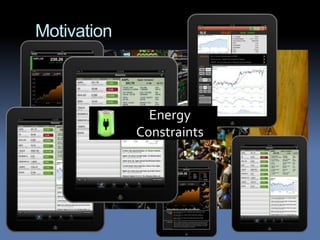
Motivation


               Energy
             Constraints
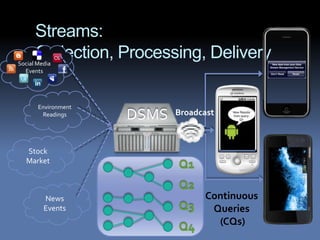
Streams:
      Collection, Processing, Delivery
Social Media
  Events


       Environment
        Readings     DSMS   Broadcast


   Stock
   Market
                            Q1
                            Q2
         News                     Continuous
         Events             Q3     Queries
                                    (CQs)
                            Q4
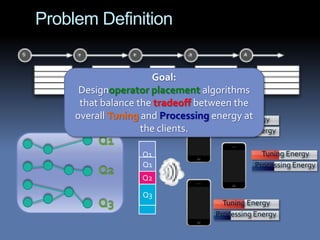
Problem Definition


                      Goal:
      Designoperator placement algorithms
      that balance the tradeoff between the
     overall Tuning and Processing energy at
                                      Tuning Energy
                    the clients.    Processing Energy
          Q1
                    Q1                            Tuning Energy
                    Q1                          Processing Energy
          Q2        Q2
                    Q2

                     Q3
                     Q3
          Q3                            Tuning Energy
                                      Processing Energy
Roadmap

 Motivation/Introduction
 System Model
  Stream Processing Model
  Broadcast Access Model
 Operator Placement Algorithms
 Experiments
 Conclusion
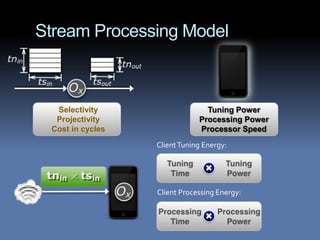
Stream Processing Model


  Selectivity                   Tuning Power
  Projectivity                Processing Power
 Cost in cycles               Processor Speed
                  Client Tuning Energy:


                  Client Processing Energy:
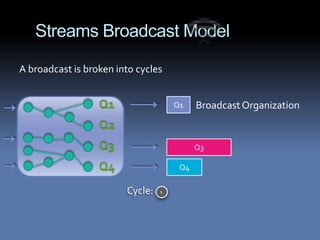
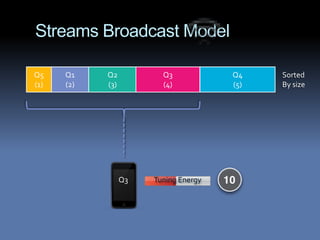
Streams Broadcast Model
A broadcast is broken into cycles


                  Q1                Q1    Broadcast Organization
                  Q2
                  Q3                      Q3

                  Q4                 Q4


                        Cycle:
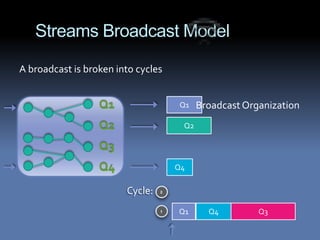
Streams Broadcast Model
A broadcast is broken into cycles


                  Q1                Q1    Broadcast Organization
                  Q2                 Q2

                  Q3
                  Q4                Q4


                        Cycle:
                                    Q1      Q4         Q3
Streams Broadcast Model

Q5    Q1    Q2           Q3            Q4    Sorted
(1)   (2)   (3)          (4)           (5)   By size


                  Q3   Tuning Energy
Roadmap

 Motivation/Introduction
 System Model
  Stream Processing Model
  Broadcast Access Model
 Operator Placement Algorithms
 Experiments
 Conclusion
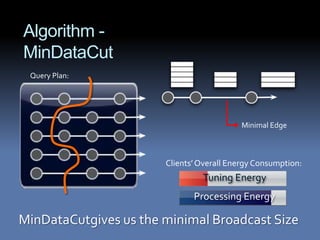
Algorithm -
MinDataCut
 Query Plan:


                                           Minimal Edge


                       Clients’ Overall Energy Consumption:
                                Tuning Energy
                              Processing Energy

MinDataCutgives us the minimal Broadcast Size
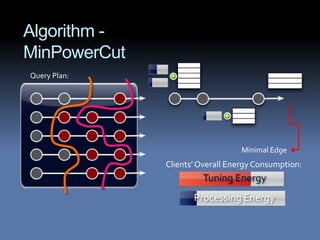
Algorithm -
MinPowerCut
Query Plan:


                                  Minimal Edge
              Clients’ Overall Energy Consumption:
                       Tuning Energy
                     Processing Energy
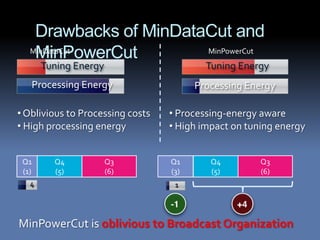
Drawbacks of MinDataCut and
    MinPowerCut
   MinDataCut           MinPowerCut
       Tuning Energy                      Tuning Energy
   Processing Energy                    Processing Energy

• Oblivious to Processing costs   • Processing-energy aware
• High processing energy          • High impact on tuning energy


 Q1      Q4            Q3         Q1       Q4         Q3
 (1)     (5)           (6)        (3)      (5)        (6)
   4                               1


MinPowerCut is oblivious to Broadcast Organization
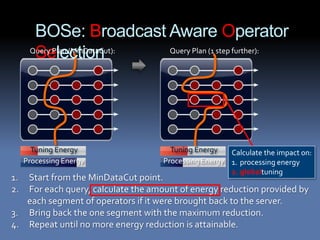
BOSe: Broadcast Aware Operator
       Selection
      Query Plan (MinDataCut): Query Plan (1 step further):


       Tuning Energy                  Tuning Energy   Calculate the impact on:
     Processing Energy              Processing Energy 1. processing energy
                                                      2. globaltuning
1. Start from the MinDataCut point.
2. For each query, calculate the amount of energy reduction provided by
   each segment of operators if it were brought back to the server.
3. Bring back the one segment with the maximum reduction.
4. Repeat until no more energy reduction is attainable.
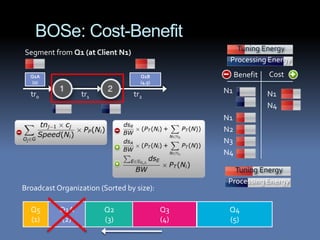
BOSe: Cost-Benefit
Segment from Q1 (at Client N1)                      Tuning Energy
                                                  Processing Energy
  Q1A                              Q1B                Benefit   Cost
   (2)                             (4.5)

  tr0            tr1             tr2             N1             N1
                                                                N4
                                                 N1
                                                 N2
                                                 N3
                                                 N4

                                                    Tuning Energy
                                                  Processing Energy
Broadcast Organization (Sorted by size):

  Q5       Q1A          Q2                 Q3     Q4
  (1)      (2)          (3)                (4)    (5)
Roadmap

 Motivation/Introduction
 System Model
  Stream Processing Model
  Broadcast Access Model
 Operator Placement Algorithms
 Experiments
 Conclusion
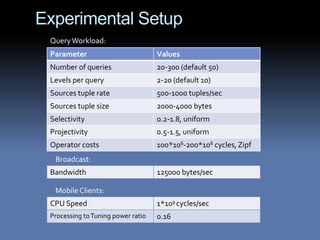
Experimental Setup
 Query Workload:
 Parameter                          Values
 Number of queries                  20-300 (default 50)
 Levels per query                   2-20 (default 10)
 Sources tuple rate                 500-1000 tuples/sec
 Sources tuple size                 2000-4000 bytes
 Selectivity                        0.2-1.8, uniform
 Projectivity                       0.5-1.5, uniform
 Operator costs                     100*106-200*106 cycles, Zipf
  Broadcast:
 Bandwidth                          125000 bytes/sec

  Mobile Clients:
 CPU Speed                          1*109 cycles/sec
 Processing to Tuning power ratio   0.16
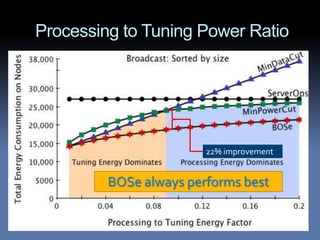
Processing to Tuning Power Ratio


                        22% improvement


         BOSe always performs best
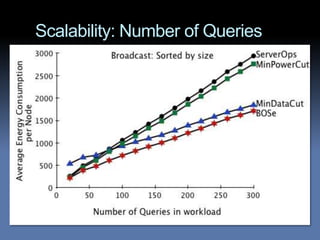
Scalability: Number of Queries
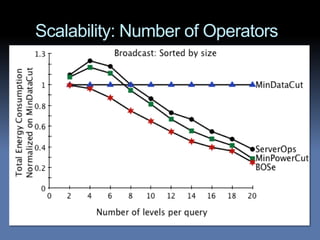
Scalability: Number of Operators
per Query
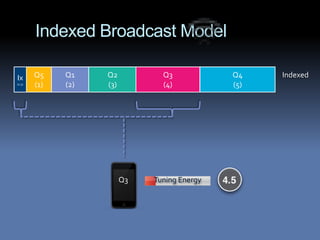
Indexed Broadcast Model

Ix      Q5    Q1    Q2           Q3            Q4    Indexed
(0.5)
        (1)   (2)   (3)          (4)           (5)


                          Q3   Tuning Energy
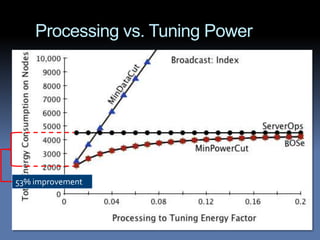
Processing vs. Tuning Power


53% improvement
Conclusions

 3 power-aware operator placement
  algorithms for broadcasting CQ results
 BOSe algorithm improves by 53% over
  centralized processing
 Future:
  Support sharing of operators
  Support sharing of queries
  Study the tradeoff between Energy and
   Response Time
Thank you – Questions?

 Advanced Data Management
 Technologies Laboratory
  http://db.cs.pitt.edu
 Part of AQSIOS project:
  NSF GRANT IIS-0534531
  NSF career award IIS-0746696

Mobide2010

  • 1.
    POWER-AWARE OPERATOR PLACEMENT AND BROADCASTINGOF CONTINUOUS QUERY RESULTS Panickos Neophytou, Mohamed Sharaf, PanosChrysanthis, AlexandrosLabrinidis MobiDE 2010 – June 6, 2010
  • 2.
    Motivation Energy Constraints
  • 3.
    Streams: Collection, Processing, Delivery Social Media Events Environment Readings DSMS Broadcast Stock Market Q1 Q2 News Continuous Events Q3 Queries (CQs) Q4
  • 4.
    Problem Definition Goal: Designoperator placement algorithms that balance the tradeoff between the overall Tuning and Processing energy at Tuning Energy the clients. Processing Energy Q1 Q1 Tuning Energy Q1 Processing Energy Q2 Q2 Q2 Q3 Q3 Q3 Tuning Energy Processing Energy
  • 5.
    Roadmap  Motivation/Introduction  SystemModel  Stream Processing Model  Broadcast Access Model  Operator Placement Algorithms  Experiments  Conclusion
  • 6.
    Stream Processing Model Selectivity Tuning Power Projectivity Processing Power Cost in cycles Processor Speed Client Tuning Energy: Client Processing Energy:
  • 7.
    Streams Broadcast Model Abroadcast is broken into cycles Q1 Q1 Broadcast Organization Q2 Q3 Q3 Q4 Q4 Cycle:
  • 8.
    Streams Broadcast Model Abroadcast is broken into cycles Q1 Q1 Broadcast Organization Q2 Q2 Q3 Q4 Q4 Cycle: Q1 Q4 Q3
  • 9.
    Streams Broadcast Model Q5 Q1 Q2 Q3 Q4 Sorted (1) (2) (3) (4) (5) By size Q3 Tuning Energy
  • 10.
    Roadmap  Motivation/Introduction  SystemModel  Stream Processing Model  Broadcast Access Model  Operator Placement Algorithms  Experiments  Conclusion
  • 11.
    Algorithm - MinDataCut QueryPlan: Minimal Edge Clients’ Overall Energy Consumption: Tuning Energy Processing Energy MinDataCutgives us the minimal Broadcast Size
  • 12.
    Algorithm - MinPowerCut Query Plan: Minimal Edge Clients’ Overall Energy Consumption: Tuning Energy Processing Energy
  • 13.
    Drawbacks of MinDataCutand MinPowerCut MinDataCut MinPowerCut Tuning Energy Tuning Energy Processing Energy Processing Energy • Oblivious to Processing costs • Processing-energy aware • High processing energy • High impact on tuning energy Q1 Q4 Q3 Q1 Q4 Q3 (1) (5) (6) (3) (5) (6) 4 1 MinPowerCut is oblivious to Broadcast Organization
  • 14.
    BOSe: Broadcast AwareOperator Selection Query Plan (MinDataCut): Query Plan (1 step further): Tuning Energy Tuning Energy Calculate the impact on: Processing Energy Processing Energy 1. processing energy 2. globaltuning 1. Start from the MinDataCut point. 2. For each query, calculate the amount of energy reduction provided by each segment of operators if it were brought back to the server. 3. Bring back the one segment with the maximum reduction. 4. Repeat until no more energy reduction is attainable.
  • 15.
    BOSe: Cost-Benefit Segment fromQ1 (at Client N1) Tuning Energy Processing Energy Q1A Q1B Benefit Cost (2) (4.5) tr0 tr1 tr2 N1 N1 N4 N1 N2 N3 N4 Tuning Energy Processing Energy Broadcast Organization (Sorted by size): Q5 Q1A Q2 Q3 Q4 (1) (2) (3) (4) (5)
  • 16.
    Roadmap  Motivation/Introduction  SystemModel  Stream Processing Model  Broadcast Access Model  Operator Placement Algorithms  Experiments  Conclusion
  • 17.
    Experimental Setup QueryWorkload: Parameter Values Number of queries 20-300 (default 50) Levels per query 2-20 (default 10) Sources tuple rate 500-1000 tuples/sec Sources tuple size 2000-4000 bytes Selectivity 0.2-1.8, uniform Projectivity 0.5-1.5, uniform Operator costs 100*106-200*106 cycles, Zipf Broadcast: Bandwidth 125000 bytes/sec Mobile Clients: CPU Speed 1*109 cycles/sec Processing to Tuning power ratio 0.16
  • 18.
    Processing to TuningPower Ratio 22% improvement BOSe always performs best
  • 19.
  • 20.
    Scalability: Number ofOperators per Query
  • 21.
    Indexed Broadcast Model Ix Q5 Q1 Q2 Q3 Q4 Indexed (0.5) (1) (2) (3) (4) (5) Q3 Tuning Energy
  • 22.
    Processing vs. TuningPower 53% improvement
  • 23.
    Conclusions  3 power-awareoperator placement algorithms for broadcasting CQ results  BOSe algorithm improves by 53% over centralized processing  Future:  Support sharing of operators  Support sharing of queries  Study the tradeoff between Energy and Response Time
  • 24.
    Thank you –Questions?  Advanced Data Management Technologies Laboratory  http://db.cs.pitt.edu  Part of AQSIOS project:  NSF GRANT IIS-0534531  NSF career award IIS-0746696

Editor's Notes

  • #4 “in general it could support more users and more kinds of applications blablabla”We want to disseminate the results with the least amount of energyEmphasize the
  • #5 Use the query plan diagram.Show that it can shrink the broadcast etc…
  • #10 FOCUS on one client.
  • #12 Color the circles.Show Large,Small,Large for Q1. instead of tr*ts…Show the bars of processing and tuning energies
  • #13 Change the multiplication to blueEmphasize the plus of the processing powers.Add the sliders to show larger broadcast but smaller processing.
  • #14 MPC is a local optimization
  • #15 Make the steps of the algorithm clear.Looking at each query using a cost-benefit evaluation which like PMC considers processing but also the impact on the broadcast overall the client population.
  • #16 A concrete exampleProcessing to the leftTuning to the right.Energy bars to show how they compare.
  • #18 DSMSBroadcastClients
  • #19 Remove the second small graph.
  • #20 Make larger graphs…. Animate to make it bigger.
  • #22 FOCUS on one client.
  • #23 Add animation to make it small