MNC/ TNC
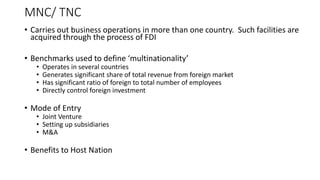
• Carries out business operations in more than one country. Such facilities are
acquired through the process of FDI
• Benchmarks used to define ‘multinationality’
• Operates in several countries
• Generates significant share of total revenue from foreign market
• Has significant ratio of foreign to total number of employees
• Directly control foreign investment
• Mode of Entry
• Joint Venture
• Setting up subsidiaries
• M&A
• Benefits to Host Nation
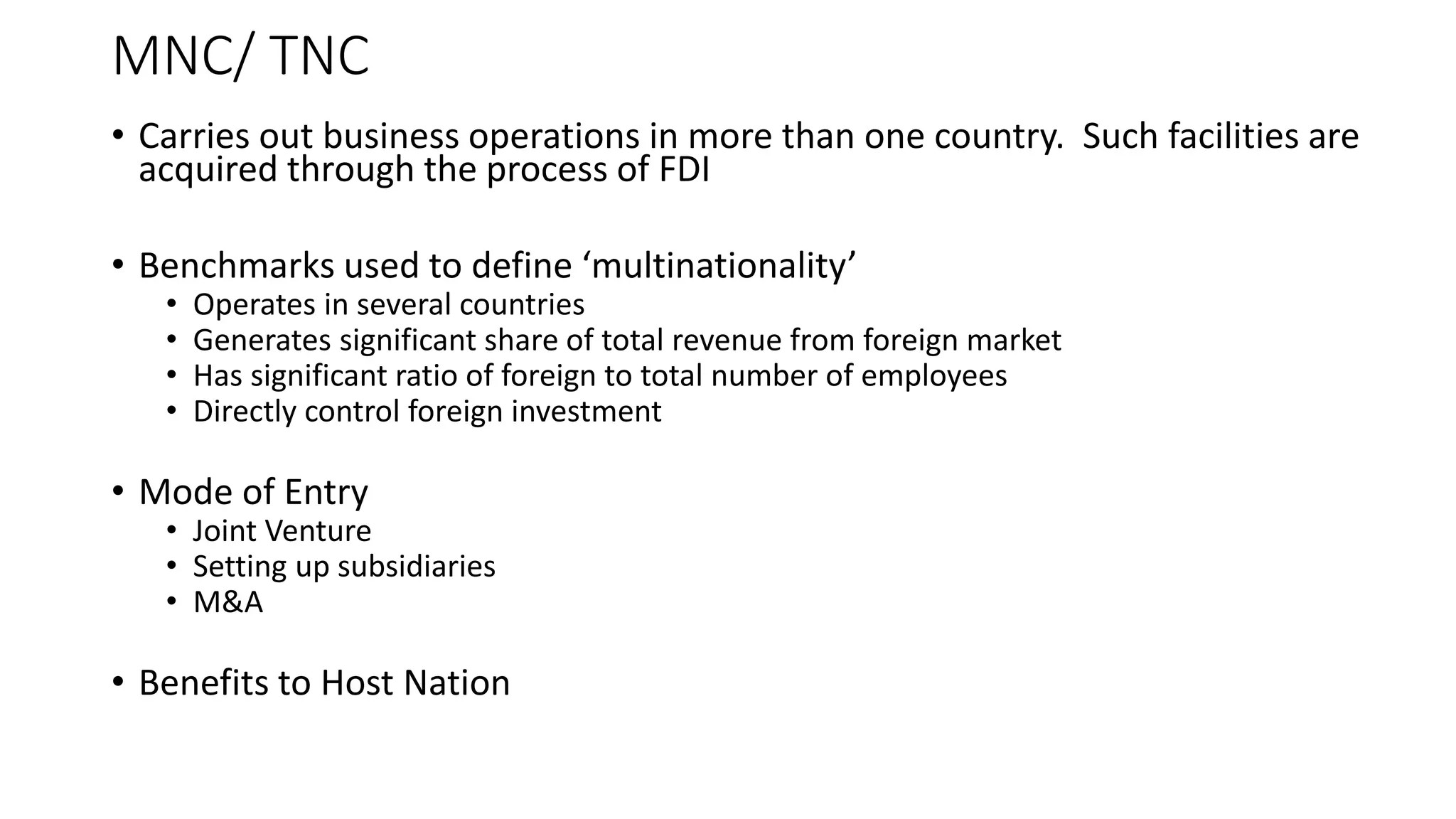
International Code of Conduct on transnational
Corporations (UNCTC)
• Brought out in 1980 by the UN but never approved.
• UNCTC covered a range of MNC duties in the host state such as –
1. Respect the national sovereignty and observance of domestic laws, regulations and
administrative practices
2. Adherence to economic goals and development objectives, policies and priorities
3. Adherence to socio-cultural objectives and values
4. Respect for human rights and fundamental freedom
5. Non- interference in internal political affairs and intergovernmental relations
6. Abstention from corrupt practices
7. Apply good practices in relation to payment of taxes
8. Abstention from involvement in anti-competitive practices
9. Consumer and environmental protection
10. Disclose relevant information to host country governments
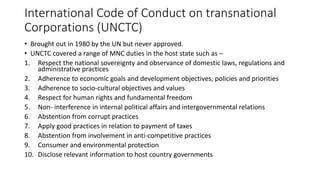
Corporate Social Responsibility
• Gained increased significance in recent years
• CSR is a voluntary, corporate-driven initiative to promote self-regulation as a
substitute for regulation at national or international level.
• CSR is a self-regulating business model that helps a company be socially
accountable to itself, its stakeholders, and the public.
• By practicing CSR, companies can be conscious of the kind of impact they are
having on all aspects of society, including economic, social, and
environmental.
• The 1992 Earth Summit in Rio de Janeiro explicitly endorsed voluntary
approaches and is considered modern CSR’s birth
• ILO’s Tripartite Declaration of Principles concerning multinational enterprises
and social policy and OECD;s guidelines for multinational enterprises are two
most prominent sources of CSR standards
Companies Act 2013
• Section 135 rw schedule VII

MNC_code of conduct.pptx

  • 1.
    MNC/ TNC • Carriesout business operations in more than one country. Such facilities are acquired through the process of FDI • Benchmarks used to define ‘multinationality’ • Operates in several countries • Generates significant share of total revenue from foreign market • Has significant ratio of foreign to total number of employees • Directly control foreign investment • Mode of Entry • Joint Venture • Setting up subsidiaries • M&A • Benefits to Host Nation
  • 2.
    International Code ofConduct on transnational Corporations (UNCTC) • Brought out in 1980 by the UN but never approved. • UNCTC covered a range of MNC duties in the host state such as – 1. Respect the national sovereignty and observance of domestic laws, regulations and administrative practices 2. Adherence to economic goals and development objectives, policies and priorities 3. Adherence to socio-cultural objectives and values 4. Respect for human rights and fundamental freedom 5. Non- interference in internal political affairs and intergovernmental relations 6. Abstention from corrupt practices 7. Apply good practices in relation to payment of taxes 8. Abstention from involvement in anti-competitive practices 9. Consumer and environmental protection 10. Disclose relevant information to host country governments
  • 3.
    Corporate Social Responsibility •Gained increased significance in recent years • CSR is a voluntary, corporate-driven initiative to promote self-regulation as a substitute for regulation at national or international level. • CSR is a self-regulating business model that helps a company be socially accountable to itself, its stakeholders, and the public. • By practicing CSR, companies can be conscious of the kind of impact they are having on all aspects of society, including economic, social, and environmental. • The 1992 Earth Summit in Rio de Janeiro explicitly endorsed voluntary approaches and is considered modern CSR’s birth • ILO’s Tripartite Declaration of Principles concerning multinational enterprises and social policy and OECD;s guidelines for multinational enterprises are two most prominent sources of CSR standards
  • 4.
    Companies Act 2013 •Section 135 rw schedule VII