)
)
)
)
)
)
)
)
)
)
)
)
)
)
)
)
)
)
MATHEMATICS in the
MODERN WORLD
INTRODUCTION:
INSTRUCTOR: RHEA C. GATON
)
)
)
)
)
)
)
)
)
)
)
)
)
)
)
)
)
)
MIDTERM:
SECTION 1. NATURE OF
MATHEMATICS
CHAPTER 1. MATHEMATICS IN
OUR WORLD
 Patterns in Nature and the
Regularities in the World
 Some Examples of Patterns in
Nature
 Fibonacci Sequence
 Importance of Mathematics
 Nature of Mathematics
COURSE OUTLINE
CHAPTER 2. THE LANGUAGE OF
MATHEMATICS
 The Language, Symbols, Syntax and
Rules of Mathematics
 Mathematical Language
(Expression/Sentence)
 Operations on Mathematical
Expressions
CHAPTER 3. PROBLEM SOLVING AND
REASONING
 Inductive And Deductive Reasoning
 Intuition, Proof And Certainty
 Polya’s 4-Steps In Problem Solving
)
)
)
)
)
)
)
)
)
)
)
)
)
)
)
)
)
)
FINAL
SECTION 2.
MATHEMATICS AS A
TOOL
CHAPTER 1. DATA
MANAGEMENT
 Descriptive Statistics
 Measures of Central
Tendency
 Normal Distribution
 Hypothesis Testing
 Regression and
correlation
CHAPTER 2. LOGIC
 Logic Statements and
Quantifiers
 Truth Tables,
Equivalent
Statements and
Tautologies
 Conditional,
Biconditional, Related
Statements
 Symbolic Arguments
 Arguments and Euler
Diagrams
)
)
)
)
)
)
)
)
)
)
)
)
)
)
)
)
)
)
CRITERIA FOR GRADING
A. Midterm Grade B. Tentative Final Grade
Quizzes/assignments - - 20% Quizzes/Assignments - - - - - -20%
Attendance - - - - - - - - -10% Attendance - - - - - - - - - - - - 10%
Class Participation - - - - 20% Class Participation - - - - - - - 20%
Output Presentation - - - 20% Output Presentation - - - - - - 20%
Midterm Exam - - - - - - - 30% Final Exam - - - - - - - - - - - - 30%
T o t a l 100% T o t a l 100%
C. Final Grade = (MTG + 2TFG)/3
)
)
)
)
)
)
)
)
)
)
)
)
)
)
)
)
)
)
1. Satisfactory attendance
2. Active participation in class
3. Submit assignments and exercises
4. Satisfactory results of quizzes
5. Pass midterm and final examinations
OTHER REQUIREMENTS
)
)
)
)
)
)
)
)
)
)
)
)
)
)
)
)
)
)
CRITERIA Points
21-25 16-20 11-15 0-10
LEVEL OF
ENGAGEME
NT IN
CLASS
Student proactively
contributes to class by offering
ideas and/or asks questions
more than once per class
and/or works consistently on
group activity the entire time.
Student proactively
contributes to class by
offering ideas and/or asks
questions once per class
and/or works on group
activity for most of the
allotted time.
Student rarely contributes to
class by offering ideas and
asking questions and/or works
on group activity only some of
the allotted time.
Student never contributes to
class by offering ideas and
asking questions and/or has
trouble staying on task during
group activity time.
LISTENING
SKILLS
Student listens when other
talks both in group and in
class; incorporates or builds
off the ideas of others.
Student listens when others
talk, both in groups and in
class.
Student does not listens
occasionally when others talk,
both in groups and in class.
Student rarely listens when
others talk, both in groups
and in class; sometimes
interrupts when others speak
BEHAVIOR
Student almost never displays
disruptive behaviour during
class.
Student rarely displays
disruptive behaviour during
class.
Student occasionally displays
disruptive behaviour during
class.
Student almost always
displays disruptive behaviour
during class.
PREPARATI
ON
Student is almost always
prepared for class with
assignments and required
class materials.
Student is usually prepared
for class with assignments
and required class materials.
Student is rarely prepared for
class with assignments and
required class materials
Student is almost never
prepared for class with
assignments and required
class materials.
T O T A L
CLASS PARTICIPATION RUBRIC
)
)
)
)
)
)
)
)
)
)
)
)
)
)
)
)
)
)
CLASSROOM POLICIES
DO’S:
1.Students must follow the university policies.
2.Students must follow classroom policies, rules and regulations
3.Students must listen to the professor while presenting and
explaining the topics.
4.Students are allowed to give group sharing of idea to their
classmates in group activities.
5.Students are required to submit excuse letter sign by the parent
and class adviser.
6.Students are required to maintain the cleanliness and orderliness
in the classroom.
7.Students are required to put- off the lights, ceiling fans and air-
)
)
)
)
)
)
)
)
)
)
)
)
)
)
)
)
)
)
DON’T’S
1.Students are not allowed to disturbed his/her classmates
while listening to the class session.
2.Students are not allowed to make any unnecessary
behavior and attitude inside the classroom.
3.Students are not allowed to forge the signature of the
professor.
4.Students are not allowed to cheat during the
examination.
5.Students are not allowed to make any form of bullying
inside the classroom or even inside the school campus.
)
)
)
)
)
)
)
)
)
)
)
)
)
)
)
)
)
)
NATURE OF MATHEMATICS
Chapter 1: MATHEMATICS
IN OUR WORLD
Patterns in Nature
and the Regularities
in the World
)
)
)
)
)
)
)
)
)
)
)
)
)
)
)
)
)
)
• WHAT IS MATHEMATICS?
• Mathematics is the study of numbers, shapes, and patterns.
• Mathematics, the science of structure, order, and relation that
has evolved from counting, measuring, and describing the
shapes of objects.
• Mathematics helps us make sense of these patterns and
occurrences
• WHERE IS MATHEMATICS?
• Many patterns and occurrences exist in nature, in our world, in
our lives.
• Mathematics is everywhere. It is in the objects we create, in the
works of art we admire. Although we may not notice it,
mathematics is also present in the nature that surrounds us, in
its landscapes and species of plants and animals, including the
human species.
• WHAT ROLE DOES MATHEMATICS PLAY IN OUR WORLD?
• Mathematics is a tool to quantify, organize, and control our
world, predict phenomena, and make life easier.
)
)
)
)
)
)
)
)
)
)
)
)
)
)
)
)
)
)
Patterns and counting are correlative. Counting happens
when there is pattern. When there is counting, there is logic.
Consequently, pattern in nature goes with logic or logical
set-up. There are reasons behind a certain pattern. That’s
why, oftentimes, some people develop an understanding of
patterns, relationships, and functions and use them to
represent and explain real-world phenomena. Most people
say that mathematics is the science behind patterns.
Mathematics exists everywhere as patterns do in nature. Not
only do patterns take many forms within.
erns In Nature And The Regularities In The W
)
)
)
)
)
)
)
)
)
)
)
)
)
)
)
)
)
)
The most basic pattern is the sequence of the dates in
the calendar such as 1 to 30 being used month after
month;
the seven (7) days in a week i.e.
the twelve (12) months i.e.
and the regular holidays in a year ie.
These are celebrated in the same sequence every year.
All these phenomena create a repetition of names or
events called regularity.
)
)
)
)
)
)
)
)
)
)
)
)
)
)
)
)
)
)
In this world, a regularity (Collins, 2018), is the fact
that the same thing always happens in the same
circumstances.
While a pattern is a discernible regularity in the world
or in a man-made design. As such, the elements of a
pattern repeat in a predictable manner.
Patterns in nature (wikipedia) are visible regularities
of form found in the natural world.
Regularity in the world states the fact that the same
thing always happens in the same circumstances.
)
)
)
)
)
)
)
)
)
)
)
)
)
)
)
)
)
)
According to Ian Stewart (1995), we live
in a universe of patterns. Every night the
stars move in circles across the sky. The
seasons cycle at yearly intervals. By
using mathematics to organize and
systematize our ideas about patterns,
we have discovered a great secret:
nature’s patterns are not just there to be
)
)
)
)
)
)
)
)
)
)
)
)
)
)
)
)
)
)
SOME EXAMPLES OF
PATTERNS IN NATURE
Symmetry (wikipedia) means agreement in
dimensions, due proportion and arrangement. In
everyday language, it refers to a sense of
harmonious and beautiful proportion and
balance.
)
)
)
)
)
)
)
)
)
)
)
)
)
)
)
)
)
)
A SPIRAL is a curve which
emanates from a point,
moving farther away as it
revolves around the point.
Cutaway of a nautilus shell
shows the chambers
arranged in an
approximately logarithmic
)
)
)
)
)
)
)
)
)
)
)
)
)
)
)
)
)
)
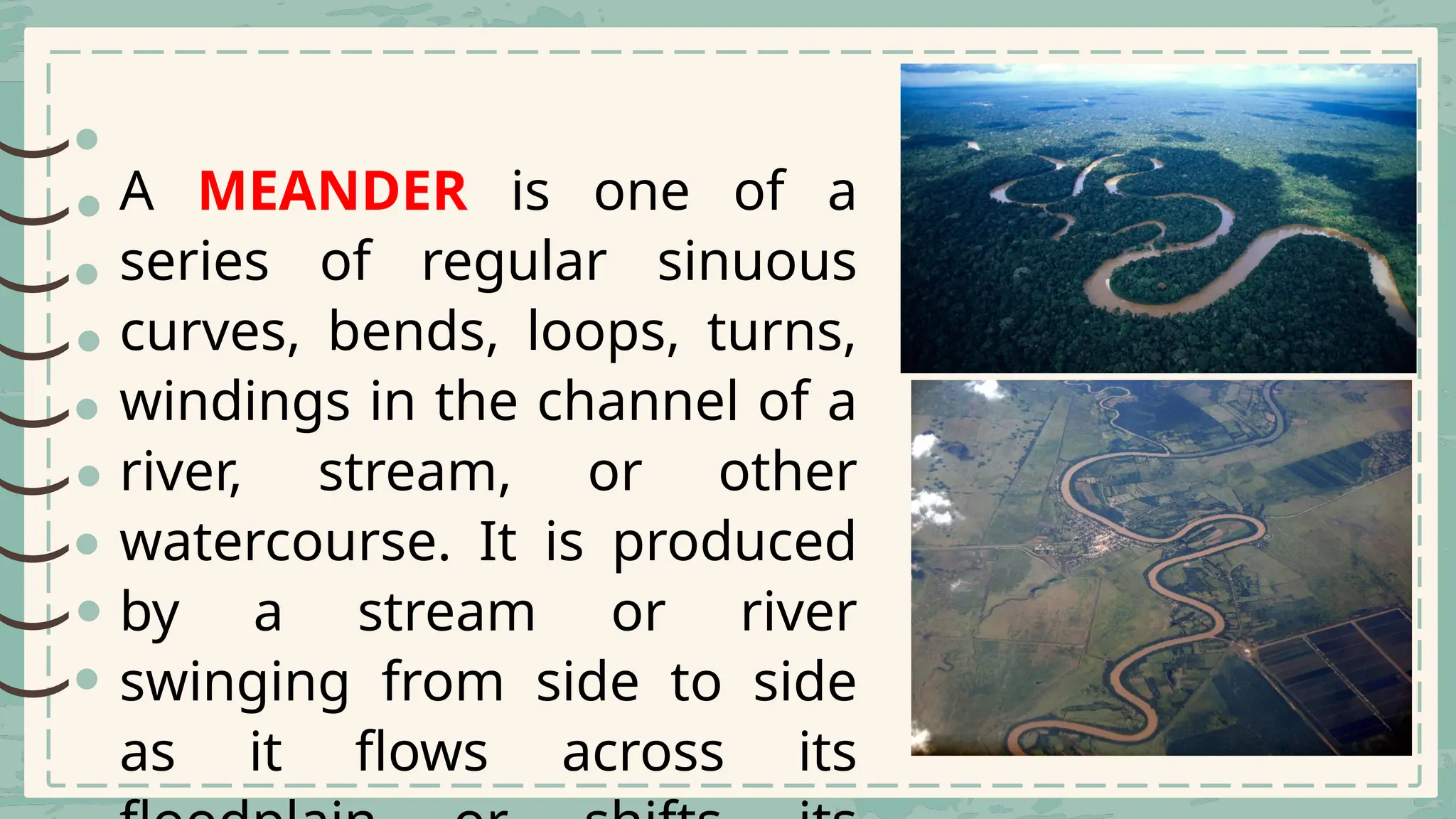
A MEANDER is one of a
series of regular sinuous
curves, bends, loops, turns,
windings in the channel of a
river, stream, or other
watercourse. It is produced
by a stream or river
swinging from side to side
as it flows across its
)
)
)
)
)
)
)
)
)
)
)
)
)
)
)
)
)
)
A WAVE is a disturbance that transfers energy
through matter or space, with little or no
associated mass transport. Waves consist of
oscillations or vibrations of a physical medium or
a field, around relatively fixed locations. Surface
)
)
)
)
)
)
)
)
)
)
)
)
)
)
)
)
)
)
FOAM is a substance
formed by trapping
pockets of gas in a liquid
or solid. A bath sponge
and the head on a glass of
beer are examples of
foams. In most foams, the
volume of gas is large,
with thin films of liquid or
)
)
)
)
)
)
)
)
)
)
)
)
)
)
)
)
)
)
A TESSELLATION of a flat
surface is the tiling of a
plane using one or more
geometric shapes, called
tiles, with no overlaps and
no gaps. In mathematics,
tessellations can be
generalized to higher
dimensions and a variety of
)
)
)
)
)
)
)
)
)
)
)
)
)
)
)
)
)
)
A FRACTURE OR CRACK is
the separation of an object
or material into two or
more pieces under the
action of stress. The
fracture of a solid usually
occurs due to the
development of certain
displacement discontinuity
)
)
)
)
)
)
)
)
)
)
)
)
)
)
)
)
)
)
STRIPES are made by a series of
bands or strips, often of the same
width and color along the length.
)
)
)
)
)
)
)
)
)
)
)
)
)
)
)
)
)
)
A FRACTAL is a never-
ending pattern. Fractals
are infinitely complex
patterns that are self-
similar across different
scales. They are created by
repeating a simple process
over and over in an
ongoing feedback loop.
For instance: trees, rivers,
)
)
)
)
)
)
)
)
)
)
)
)
)
)
)
)
)
)
AFFINE TRANSFORMATIONS
These are the processes of
rotation, reflection and
scaling. Many plant forms
utilize these processes to
generate their structure.
What is happening in
Cauliflower head is perhaps
not so obvious but in the
case of a fern the rotating
pattern is very evident. Each
)
)
)
)
)
)
)
)
)
)
)
)
)
)
)
)
)
)
FIBONACCI SEQUENCE
Another one in this world that involves pattern is the
Fibonacci number (Grist, 2011) These numbers are
nature’s numbering system. They appear everywhere
in nature, from the leaf arrangement in plants, to the
pattern of the florets of a flower, the bracts of a
pinecone, or the scales of a pineapple.
)
)
)
)
)
)
)
)
)
)
)
)
)
)
)
)
)
)
FIBONACCI SEQUENCE
In Mathematics,
(wikipedia), the Fibonacci
numbers are the numbers
in the following integer
sequence, called the
Fibonacci sequence, and
characterized by the fact
that every number after
the first two is the sum of
the two preceding ones:
1,1,2,3,5,8,13,21,34,5
5,89, 144,
)
)
)
)
)
)
)
)
)
)
)
)
)
)
)
)
)
)
The sequence F of Fibonacci numbers is defined by
the recurrence relation:
𝑭𝒏=𝑭𝒏− 𝟏+ 𝑭𝒏−𝟐
With seed values:
The first 6 Fibonacci numbers for
0 1 1 2 3 5 8
)
)
)
)
)
)
)
)
)
)
)
)
)
)
)
)
)
)
LEONARDO FIBONACCI came up
with the sequence when
calculating the ideal expansion
pairs of rabbits over the course of
one year.
GEORGE DVORSKY (2013)
highlighted that the famous
Fibonacci sequence has captivated
mathematicians, artists, designers,
and scientists for centuries. Also
known as the Golden Ratio, its
ubiquity and astounding
)
)
)
)
)
)
)
)
)
)
)
)
)
)
)
)
)
)
1.SEED HEADS
The head of a flower is also subject, to Fibonaccian
processes. Typically, seeds are produced at the center,
and then migrate towards the outside to fill all the
space. Sunflowers provide a great example of these
HERE ARE SOME
EXAMPLES:
)
)
)
)
)
)
)
)
)
)
)
)
)
)
)
)
)
)
2. PINE CONES
Similarly, the seed pods on
a pinecone are arranged in
a spiral pattern. Each cone
consists of a pair of spirals,
each one spiraling upwards
in opposing directions. The
number of steps will
almost always match a pair
)
)
)
)
)
)
)
)
)
)
)
)
)
)
)
)
)
)
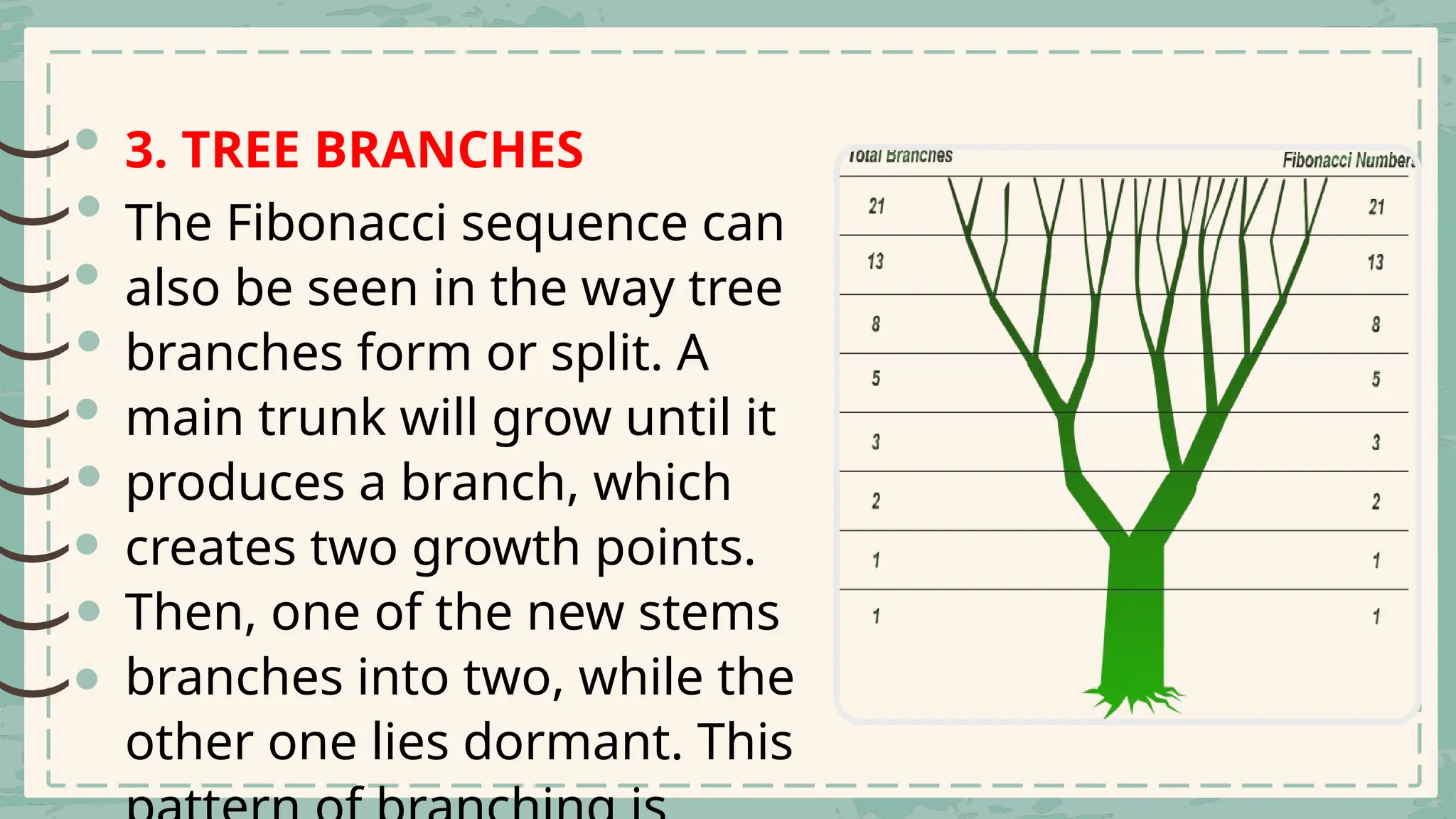
3. TREE BRANCHES
The Fibonacci sequence can
also be seen in the way tree
branches form or split. A
main trunk will grow until it
produces a branch, which
creates two growth points.
Then, one of the new stems
branches into two, while the
other one lies dormant. This
)
)
)
)
)
)
)
)
)
)
)
)
)
)
)
)
)
)
4. SHELLS
The unique properties of the
Golden Rectangle provide
another example. This
shape, a rectangle in which
the ratio of the sides a/b is
equal to the golden mean
(phi), can result in a nesting
process that can be
repeated into infinity and
which takes on the form of a
)
)
)
)
)
)
)
)
)
)
)
)
)
)
)
)
)
)
5. SPIRAL GALAXIES AND HURRICANE
Not surprisingly, spiral galaxies also follow the familiar
Fibonacci pattern. The Milky Way has several spiral arms,
each of them a logarithmic spiral of about 12 degrees. As
an interesting aside, spiral galaxies appear to defy
)
)
)
)
)
)
)
)
)
)
)
)
)
)
)
)
)
)
Importance of
Mathematics in Life
According to Katie Kim (2015), Math is a
subject that makes students either sump for
joy or rip their hair out. However, math is
inescapable as you become an adult in the
real world. Before you decide to doze off in
math class, consider this list of reasons why
learning math is important to you and the
world.
)
)
)
)
)
)
)
)
)
)
)
)
)
)
)
)
)
)
1. RESTAURANT
TIPPING
2. CALCULATING
BILLS
3. NETFLIX FILM
VIEWING
4. COMPUTING
TEST SCORES
Importance of
Mathematics in Life
6. DOING EXERCISE
7. HANDLING
MONEY
8. MAKING
COUNTDOWNS
9. BAKING AND
COOKING
10.SURFING
)
)
)
)
)
)
)
)
)
)
)
)
)
)
)
)
)
)
NATURE OF MATHEMATICS
It is important to further discuss the nature of
mathematics, what it is, how it is expressed,
represented and used.
According to the American Association for the
Advancement of Science (1990), Mathematics
relies on both logic and creativity, and it is
pursued both for a variety of practical purposes
and for its intrinsic interest. For some people, and
not only professional mathematicians, the essence
)
)
)
)
)
)
)
)
)
)
)
)
)
)
)
)
)
)
1.PATTERNS AND RELATIONSHIPS
Mathematics is the science of patterns and relationships.
As a theoretical discipline, mathematics explores the possible
relationships among abstractions without concern for
whether those abstractions have counterparts in the real
world. The abstractions or ideas can be anything from strings
of numbers to geometric figures to sets of equations.
2.MATHEMATICS, SCIENCE AND TECHNOLOGY
Mathematics is abstract. Its function goes along well with
Science and Technology. It finds useful applications in
business, industry, music, historical scholarship, politics,
sports, medicine, agriculture, engineering, and the social and
)
)
)
)
)
)
)
)
)
)
)
)
)
)
)
)
)
)
3.MATHEMATICAL INQUIRY
Normally, people are confronted with
problems. In order to live at peace, these
problems must be solved. Mathematics is used
to express ideas or to solve problems.
)
)
)
)
)
)
)
)
)
)
)
)
)
)
)
)
)
)
4. ABSTRACTION AND SYMBOLIC
REPRESENTATION
Mathematical thinking often begins with
the process of abstraction-that is, noticing a
similarity between two or more objects or
events. Aspects that they have in common,
whether concrete or hypothetical, can be
represented by symbols such as numbers,
letters, other marks, diagrams, geometrical
)
)
)
)
)
)
)
)
)
)
)
)
)
)
)
)
)
)
5. MANIPULATING MATHEMATICAL STATEMENTS
After abstractions have been made and symbolic
representations of them have been selected, those
symbols can be combined and recombined in various
ways according to precisely defined rules. Typically,
strings of symbols are combined into statements that
express ideas or propositions. For example, the
symbol A for the area of any square may be used with
the symbol s for the length of the square's side to
form the proposition A = s This equation specifies how
the area is related to the side-and also implies that it
)
)
)
)
)
)
)
)
)
)
)
)
)
)
)
)
)
)
6. APPLICATION
Mathematical processes can lead to a kind of
model of a thing, from which insights can be gained
about the thing itself. For example, if 2 cups of water
are added to 3 cups of water and the abstract
mathematical operation 2+3 = 5 is used to calculate
the total, the correct answer is 5 cups of water.
However, if 2 cups of sugar are added to 3 cups of
hot tea and the same operation is used, 5 is an
incorrect answer, for such an addition actually
results in only slightly more than 4 cups of very
sweet tea. Sometimes common sense is enough to
)
)
)
)
)
)
)
)
)
)
)
)
)
)
)
)
)
)
THE ROLE OF MATHEMATICS IN SOME DISCIPLINES
Mathematics is offered in any college course. It is
found in every curriculum because its theories and
applications are needed in any workplace. That's why
students can't stay away from attending math classes.
There has to be mathematics in the real world. This
subject always brings life to any person or professional.
Every second of the day needs mathematical knowledge
and skills to perform academic activities and office
routines. If ordinary people have to use math, then
much more for students to know and master it so they
will succeed in class in the school.
As posted by Angel Rathnabai (2014), Mathematics is
)
)
)
)
)
)
)
)
)
)
)
)
)
)
)
)
)
)
HERE ARE SOME MAIN DISCIPLINES IN WHICH THE ROLE OF
MATHEMATICS IS WIDELY ACCEPTED:
1. MATHEMATICS IN PHYSICAL SCIENCES
In Physics, every rule and principle take the mathematical
form ultimately. Mathematics gives a final shape to the rules
of physics. The units of measurement are employed to
substances in physics a frequently as in mathematics. The
Chare's law of expansion of gases is base upon mathematical
calculations. The concept is involved in Fluid Dynamics,
Computational Fluid Dynamics, Physical Oceanography.
2. MATHEMATICS IN CHEMISTRY
Math is extremely important in physical chemistry
)
)
)
)
)
)
)
)
)
)
)
)
)
)
)
)
)
)
3. MATHEMATICS IN BIOLOGICAL SCIENCES
Mathematical neuron- physiology, development of computer
software for special biological and medical problems, mathematical
theory of epidemics, use of mathematical programming and
reliability theory in biosciences and mathematical problems in
biomechanics, bioengineering and bioelectronics.
4. MATHEMATICS IN ENGINEERING AND TECHNOLOGY
It is considered to be the foundation of engineering.
Engineering deals with surveying, levelling, designing, estimating,
construction etc., By the application of geometric principles to
design and constructions, the durability of things constructed can
be increased. With its help, results can often be verified in
engineering.
5. MATHEMATICS AND AGRICULTURE
Agriculture as a science depends extensively on mathematics. It
)
)
)
)
)
)
)
)
)
)
)
)
)
)
)
)
)
)
6. MATHEMATICS AND ECONOMICS
social sciences are also beginning to draw heavily upon mathematics.
Mathematical language and methods are used frequently in describing
economic phenomena. The whole economic situation is regarded as a game
between consumers, distributors, and producers, each group trying to
optimize its profits.
7. MATHEMATICS AND PSYCHOLOGY
The great educationist Herbart said, "It is not only possible, but
necessary that mathematics be applied to psychology". Now, experimental
psychology has become highly mathematical due to its concern with such
factors as intelligence quotient, standard deviation, mean, median, mode,
correlation coefficients and probable errors. Statistical analysis is the only
reliable method of attacking social and psychological phenomena.
8. MATHEMATICS AND ACTUARIAL SCIENCE, INSURANCE AND FINANCE
For example, if an organization embarks on a large project, an actuary
may analyze the project, assess the financial risks involved, model the future
financial outcomes and advise the organization on the decisions to be made.
Much of their work is on pensions, ensuring funds stay solvent long into the
)
)
)
)
)
)
)
)
)
)
)
)
)
)
)
)
)
)
9. MATHEMATICS AND ARCHAEOLOGY
Archaeologists use a variety of mathematical and
statistical techniques to present the data from
archaeological surveys and try to distinguish patterns
in their results that shed light on past human behavior.
Statistical measures are used during excavation to
monitor which pits are most successful and decide on
further excavation.
10. MATHEMATICS AND LOGIC
Pascal says, "Logic has borrowed the rules of
geometry; the method of avoiding error is sought by
everyone. The symbols and methods used in the
)
)
)
)
)
)
)
)
)
)
)
)
)
)
)
)
)
)
11. MATHEMATICS IN MUSIC
Leibnitz, the great mathematician said, "Music
is a hidden exercise in arithmetic of a mind
unconscious of dealing with numbers".
Pythogoras said "Where harmony is, there are
numbers".
12. MATHEMATICS IN ARTS
"Mathematics and art are just two different
languages that can be used to express the same
ideas." It is considered that the universe is
written in the language of mathematics, and its
)
)
)
)
)
)
)
)
)
)
)
)
)
)
)
)
)
)
13. MATHEMATICS IN PHILOSOPHY
Mathematics occupies a central place between
natural philosophy and mental philosophy. It was
in their search of distinction between fact and
fiction that Plato and other thinkers came under
the influence of mathematics.
14. MATHEMATICS IN SOCIAL NETWORKS
Graph theory, text analysis, multidimensional
scaling and cluster analysis and a variety of
special models are some mathematical
)
)
)
)
)
)
)
)
)
)
)
)
)
)
)
)
)
)
15. MATHEMATICS IN POLITICAL SCIENCE
In Mathematical Political Science, we analyze past
election results to see changes in voting patterns and the
influence of various factors on voting behavior, on switching
of votes among political parties and mathematical models
for conflict resolution.
16. MATHEMATICS IN LINGUISTICS
The concepts of structure and transformation are as
important for linguistic as they are for mathematics.
17. MATHEMATICS IN MANAGEMENT
Mathematics in management is a great challenge to
imaginative minds. It is not meant for the routine thinkers.
Different mathematical models are being used to discuss
management problems of hospitals, public health, pollution,
)
)
)
)
)
)
)
)
)
)
)
)
)
)
)
)
)
)
18. MATHEMATICS IN COMPUTERS
An important area of applications of mathematics is in the
development of formal mathematical theories related to the
development of computer science. Now most applications of
mathematics to science and technology today are via
computers. The foundation of computer science is based only
on mathematics.
19. MATHEMATICS IN GEOGRAPHY
Geography is nothing but a scientific and mathematical
description of our earth in its universe. The dimension and
magnitude of earth, its situation and position in the universe
the formation of days and nights, lunar and solar eclipses,
latitude and longitude, maximum and minimum rainfall, etc.
)
)
)
)
)
)
)
)
)
)
)
)
)
)
)
)
)
)
APPRECIATING MATHEMATICS AS A HUMAN
ENDEAVOR
In order to appreciate mathematics much better,
every person should have the thorough
understanding of the discipline as a human
endeavor. Mathematics brings impact to the life a
learner, worker, or an ordinary man in society. The
influences of mathematics affect anyone for a
lifetime.
Mathematics works in the life of all professionals.
Mathematics is appreciated as human endeavor
because all professionals and ordinary people apply
)
)
)
)
)
)
)
)
)
)
)
)
)
)
)
)
)
)
• ACCOUNTANTS assist businesses by working on their taxes
and planning for upcoming years. They work with tax
codes and forms, use formulas for calculating interest, and
spend a considerable amount of energy organizing
paperwork.
• AGRICULTURISTS determine the proper amounts of
fertilizers, pesticides, and water to produce bountiful
amounts of foods.
• ARCHITECTS design buildings for structural integrity and
beauty. They must know how to calculate loads for finding
acceptable materials in design which involve calculus.
• BIOLOGISTS study nature to act in concert with it since we
are very closely tied to nature. They use proportions to
count animals as well as use statistics/probability.
)
)
)
)
)
)
)
)
)
)
)
)
)
)
)
)
)
)
• COMPUTER PROGRAMMERS create complicated sets of
instructions called programs/software to help us use
computers to solve problems.
• ENGINEERS (Chemical, Civil, Electrical, Industrial, Material) build
products/structures/systems like automobiles, buildings,
computers, machines, and planes, to name just a few examples.
• GEOLOGISTS use mathematical models to find oil and study
earthquakes.
• LAWYERS argue cases using complicated lines of reason. That
skill is nurtured by high level math courses. They also spend a
lot of time researching cases, which means learning relevant
codes, laws and ordinances.
• MANAGERS maintain schedules, regulate worker performance,
and analyze productivity.
)
)
)
)
)
)
)
)
)
)
)
)
)
)
)
)
)
)
• METEOROLOGISTS forecast the weather for agriculturists, pilots,
vacationers, and those who are marine-dependent.
• MILITARY PERSONNEL carry out a variety of tasks ranging from aircraft
maintenance to following detailed procedures. Tacticians utilize a branch
of mathematics called linear programming
• NURSES carry out the detailed instructions doctors given them. They
adjust intravenous drip rates, take vitals, dispense medicine, and even
assist in operations.
• POLITICIANS help solve the social problems of our time by making
complicated decisions within the confines of the law, public opinion.
• SALESPEOPLE typically work on commission and operate under a buy
low, sell high profit model.
• TECHNICIANS repair and maintain the technical gadgets we depend on
like computers, televisions, DVDs, cars, refrigerators. They always read
measuring devices, referring to manuals, and diagnosing system
problema.
• TRADESMEN (carpenters, electricians, mechanics, and plumbers)
)
)
)
)
)
)
)
)
)
)
)
)
)
)
)
)
)
)
HOW CAN MATH BE SO UNIVERSAL?
According to Annenberg Learner (2017) First, human
beings didn't invent math concepts; we discovered
them. Math can help us to shop wisely, buy the right
insurance, remodel a home within a budget,
understand population growth, or even bet on the
horse with the best chance of winning the race.
When you put money in a savings account, the bank
pays you interest according to what you deposit. In
effect, the bank is paying you for the privilege of
"borrowing your money. The same is true for the
interest you pay on a loan you take from the bank or the
money you "borrow" from a credit card.
)
)
)
)
)
)
)
)
)
)
)
)
)
)
)
)
)
)
What does math have to do with home decorating? Most home
decorators need to work within a budget. But in order to figure out
what you'll spend, you first have to know what you need.
Understanding some basic geometry can help you stick to your
budget.
Not all people are chefs, but we are all eaters. Most of us need
to learn how to follow a recipe at some point. To create dishes with
good flavor, consistency, and texture, the various ingredients must
have a kind of relationship to one another. For instance, to make
cookies that both look and taste like cookies, you need to make sure
you use the right amount of each ingredient.
Mathematics is the only language shared by all human beings
regardless of culture, religion, or gender, country you are in. Adding
up the cost of a basket full of groceries involves the same math
process regardless of whether the total is expressed in dollars
rubles, or yen. With this universal language, all of us, no matter
)
)
)
)
)
)
)
)
)
)
)
)
)
)
)
)
)
)

MMW-CHAPTER-1-final.pptx major Elementary Education

  • 1.
    ) ) ) ) ) ) ) ) ) ) ) ) ) ) ) ) ) ) MATHEMATICS in the MODERNWORLD INTRODUCTION: INSTRUCTOR: RHEA C. GATON
  • 2.
    ) ) ) ) ) ) ) ) ) ) ) ) ) ) ) ) ) ) MIDTERM: SECTION 1. NATUREOF MATHEMATICS CHAPTER 1. MATHEMATICS IN OUR WORLD  Patterns in Nature and the Regularities in the World  Some Examples of Patterns in Nature  Fibonacci Sequence  Importance of Mathematics  Nature of Mathematics COURSE OUTLINE CHAPTER 2. THE LANGUAGE OF MATHEMATICS  The Language, Symbols, Syntax and Rules of Mathematics  Mathematical Language (Expression/Sentence)  Operations on Mathematical Expressions CHAPTER 3. PROBLEM SOLVING AND REASONING  Inductive And Deductive Reasoning  Intuition, Proof And Certainty  Polya’s 4-Steps In Problem Solving
  • 3.
    ) ) ) ) ) ) ) ) ) ) ) ) ) ) ) ) ) ) FINAL SECTION 2. MATHEMATICS ASA TOOL CHAPTER 1. DATA MANAGEMENT  Descriptive Statistics  Measures of Central Tendency  Normal Distribution  Hypothesis Testing  Regression and correlation CHAPTER 2. LOGIC  Logic Statements and Quantifiers  Truth Tables, Equivalent Statements and Tautologies  Conditional, Biconditional, Related Statements  Symbolic Arguments  Arguments and Euler Diagrams
  • 4.
    ) ) ) ) ) ) ) ) ) ) ) ) ) ) ) ) ) ) CRITERIA FOR GRADING A.Midterm Grade B. Tentative Final Grade Quizzes/assignments - - 20% Quizzes/Assignments - - - - - -20% Attendance - - - - - - - - -10% Attendance - - - - - - - - - - - - 10% Class Participation - - - - 20% Class Participation - - - - - - - 20% Output Presentation - - - 20% Output Presentation - - - - - - 20% Midterm Exam - - - - - - - 30% Final Exam - - - - - - - - - - - - 30% T o t a l 100% T o t a l 100% C. Final Grade = (MTG + 2TFG)/3
  • 5.
    ) ) ) ) ) ) ) ) ) ) ) ) ) ) ) ) ) ) 1. Satisfactory attendance 2.Active participation in class 3. Submit assignments and exercises 4. Satisfactory results of quizzes 5. Pass midterm and final examinations OTHER REQUIREMENTS
  • 6.
    ) ) ) ) ) ) ) ) ) ) ) ) ) ) ) ) ) ) CRITERIA Points 21-25 16-2011-15 0-10 LEVEL OF ENGAGEME NT IN CLASS Student proactively contributes to class by offering ideas and/or asks questions more than once per class and/or works consistently on group activity the entire time. Student proactively contributes to class by offering ideas and/or asks questions once per class and/or works on group activity for most of the allotted time. Student rarely contributes to class by offering ideas and asking questions and/or works on group activity only some of the allotted time. Student never contributes to class by offering ideas and asking questions and/or has trouble staying on task during group activity time. LISTENING SKILLS Student listens when other talks both in group and in class; incorporates or builds off the ideas of others. Student listens when others talk, both in groups and in class. Student does not listens occasionally when others talk, both in groups and in class. Student rarely listens when others talk, both in groups and in class; sometimes interrupts when others speak BEHAVIOR Student almost never displays disruptive behaviour during class. Student rarely displays disruptive behaviour during class. Student occasionally displays disruptive behaviour during class. Student almost always displays disruptive behaviour during class. PREPARATI ON Student is almost always prepared for class with assignments and required class materials. Student is usually prepared for class with assignments and required class materials. Student is rarely prepared for class with assignments and required class materials Student is almost never prepared for class with assignments and required class materials. T O T A L CLASS PARTICIPATION RUBRIC
  • 7.
    ) ) ) ) ) ) ) ) ) ) ) ) ) ) ) ) ) ) CLASSROOM POLICIES DO’S: 1.Students mustfollow the university policies. 2.Students must follow classroom policies, rules and regulations 3.Students must listen to the professor while presenting and explaining the topics. 4.Students are allowed to give group sharing of idea to their classmates in group activities. 5.Students are required to submit excuse letter sign by the parent and class adviser. 6.Students are required to maintain the cleanliness and orderliness in the classroom. 7.Students are required to put- off the lights, ceiling fans and air-
  • 8.
    ) ) ) ) ) ) ) ) ) ) ) ) ) ) ) ) ) ) DON’T’S 1.Students are notallowed to disturbed his/her classmates while listening to the class session. 2.Students are not allowed to make any unnecessary behavior and attitude inside the classroom. 3.Students are not allowed to forge the signature of the professor. 4.Students are not allowed to cheat during the examination. 5.Students are not allowed to make any form of bullying inside the classroom or even inside the school campus.
  • 9.
    ) ) ) ) ) ) ) ) ) ) ) ) ) ) ) ) ) ) NATURE OF MATHEMATICS Chapter1: MATHEMATICS IN OUR WORLD Patterns in Nature and the Regularities in the World
  • 10.
    ) ) ) ) ) ) ) ) ) ) ) ) ) ) ) ) ) ) • WHAT ISMATHEMATICS? • Mathematics is the study of numbers, shapes, and patterns. • Mathematics, the science of structure, order, and relation that has evolved from counting, measuring, and describing the shapes of objects. • Mathematics helps us make sense of these patterns and occurrences • WHERE IS MATHEMATICS? • Many patterns and occurrences exist in nature, in our world, in our lives. • Mathematics is everywhere. It is in the objects we create, in the works of art we admire. Although we may not notice it, mathematics is also present in the nature that surrounds us, in its landscapes and species of plants and animals, including the human species. • WHAT ROLE DOES MATHEMATICS PLAY IN OUR WORLD? • Mathematics is a tool to quantify, organize, and control our world, predict phenomena, and make life easier.
  • 11.
    ) ) ) ) ) ) ) ) ) ) ) ) ) ) ) ) ) ) Patterns and countingare correlative. Counting happens when there is pattern. When there is counting, there is logic. Consequently, pattern in nature goes with logic or logical set-up. There are reasons behind a certain pattern. That’s why, oftentimes, some people develop an understanding of patterns, relationships, and functions and use them to represent and explain real-world phenomena. Most people say that mathematics is the science behind patterns. Mathematics exists everywhere as patterns do in nature. Not only do patterns take many forms within. erns In Nature And The Regularities In The W
  • 12.
    ) ) ) ) ) ) ) ) ) ) ) ) ) ) ) ) ) ) The most basicpattern is the sequence of the dates in the calendar such as 1 to 30 being used month after month; the seven (7) days in a week i.e. the twelve (12) months i.e. and the regular holidays in a year ie. These are celebrated in the same sequence every year. All these phenomena create a repetition of names or events called regularity.
  • 13.
    ) ) ) ) ) ) ) ) ) ) ) ) ) ) ) ) ) ) In this world,a regularity (Collins, 2018), is the fact that the same thing always happens in the same circumstances. While a pattern is a discernible regularity in the world or in a man-made design. As such, the elements of a pattern repeat in a predictable manner. Patterns in nature (wikipedia) are visible regularities of form found in the natural world. Regularity in the world states the fact that the same thing always happens in the same circumstances.
  • 14.
    ) ) ) ) ) ) ) ) ) ) ) ) ) ) ) ) ) ) According to IanStewart (1995), we live in a universe of patterns. Every night the stars move in circles across the sky. The seasons cycle at yearly intervals. By using mathematics to organize and systematize our ideas about patterns, we have discovered a great secret: nature’s patterns are not just there to be
  • 15.
    ) ) ) ) ) ) ) ) ) ) ) ) ) ) ) ) ) ) SOME EXAMPLES OF PATTERNSIN NATURE Symmetry (wikipedia) means agreement in dimensions, due proportion and arrangement. In everyday language, it refers to a sense of harmonious and beautiful proportion and balance.
  • 16.
    ) ) ) ) ) ) ) ) ) ) ) ) ) ) ) ) ) ) A SPIRAL isa curve which emanates from a point, moving farther away as it revolves around the point. Cutaway of a nautilus shell shows the chambers arranged in an approximately logarithmic
  • 17.
    ) ) ) ) ) ) ) ) ) ) ) ) ) ) ) ) ) ) A MEANDER isone of a series of regular sinuous curves, bends, loops, turns, windings in the channel of a river, stream, or other watercourse. It is produced by a stream or river swinging from side to side as it flows across its
  • 18.
    ) ) ) ) ) ) ) ) ) ) ) ) ) ) ) ) ) ) A WAVE isa disturbance that transfers energy through matter or space, with little or no associated mass transport. Waves consist of oscillations or vibrations of a physical medium or a field, around relatively fixed locations. Surface
  • 19.
    ) ) ) ) ) ) ) ) ) ) ) ) ) ) ) ) ) ) FOAM is asubstance formed by trapping pockets of gas in a liquid or solid. A bath sponge and the head on a glass of beer are examples of foams. In most foams, the volume of gas is large, with thin films of liquid or
  • 20.
    ) ) ) ) ) ) ) ) ) ) ) ) ) ) ) ) ) ) A TESSELLATION ofa flat surface is the tiling of a plane using one or more geometric shapes, called tiles, with no overlaps and no gaps. In mathematics, tessellations can be generalized to higher dimensions and a variety of
  • 21.
    ) ) ) ) ) ) ) ) ) ) ) ) ) ) ) ) ) ) A FRACTURE ORCRACK is the separation of an object or material into two or more pieces under the action of stress. The fracture of a solid usually occurs due to the development of certain displacement discontinuity
  • 22.
    ) ) ) ) ) ) ) ) ) ) ) ) ) ) ) ) ) ) STRIPES are madeby a series of bands or strips, often of the same width and color along the length.
  • 23.
    ) ) ) ) ) ) ) ) ) ) ) ) ) ) ) ) ) ) A FRACTAL isa never- ending pattern. Fractals are infinitely complex patterns that are self- similar across different scales. They are created by repeating a simple process over and over in an ongoing feedback loop. For instance: trees, rivers,
  • 24.
    ) ) ) ) ) ) ) ) ) ) ) ) ) ) ) ) ) ) AFFINE TRANSFORMATIONS These arethe processes of rotation, reflection and scaling. Many plant forms utilize these processes to generate their structure. What is happening in Cauliflower head is perhaps not so obvious but in the case of a fern the rotating pattern is very evident. Each
  • 25.
    ) ) ) ) ) ) ) ) ) ) ) ) ) ) ) ) ) ) FIBONACCI SEQUENCE Another onein this world that involves pattern is the Fibonacci number (Grist, 2011) These numbers are nature’s numbering system. They appear everywhere in nature, from the leaf arrangement in plants, to the pattern of the florets of a flower, the bracts of a pinecone, or the scales of a pineapple.
  • 26.
    ) ) ) ) ) ) ) ) ) ) ) ) ) ) ) ) ) ) FIBONACCI SEQUENCE In Mathematics, (wikipedia),the Fibonacci numbers are the numbers in the following integer sequence, called the Fibonacci sequence, and characterized by the fact that every number after the first two is the sum of the two preceding ones: 1,1,2,3,5,8,13,21,34,5 5,89, 144,
  • 27.
    ) ) ) ) ) ) ) ) ) ) ) ) ) ) ) ) ) ) The sequence Fof Fibonacci numbers is defined by the recurrence relation: 𝑭𝒏=𝑭𝒏− 𝟏+ 𝑭𝒏−𝟐 With seed values: The first 6 Fibonacci numbers for 0 1 1 2 3 5 8
  • 28.
    ) ) ) ) ) ) ) ) ) ) ) ) ) ) ) ) ) ) LEONARDO FIBONACCI cameup with the sequence when calculating the ideal expansion pairs of rabbits over the course of one year. GEORGE DVORSKY (2013) highlighted that the famous Fibonacci sequence has captivated mathematicians, artists, designers, and scientists for centuries. Also known as the Golden Ratio, its ubiquity and astounding
  • 29.
    ) ) ) ) ) ) ) ) ) ) ) ) ) ) ) ) ) ) 1.SEED HEADS The headof a flower is also subject, to Fibonaccian processes. Typically, seeds are produced at the center, and then migrate towards the outside to fill all the space. Sunflowers provide a great example of these HERE ARE SOME EXAMPLES:
  • 30.
    ) ) ) ) ) ) ) ) ) ) ) ) ) ) ) ) ) ) 2. PINE CONES Similarly,the seed pods on a pinecone are arranged in a spiral pattern. Each cone consists of a pair of spirals, each one spiraling upwards in opposing directions. The number of steps will almost always match a pair
  • 31.
    ) ) ) ) ) ) ) ) ) ) ) ) ) ) ) ) ) ) 3. TREE BRANCHES TheFibonacci sequence can also be seen in the way tree branches form or split. A main trunk will grow until it produces a branch, which creates two growth points. Then, one of the new stems branches into two, while the other one lies dormant. This
  • 32.
    ) ) ) ) ) ) ) ) ) ) ) ) ) ) ) ) ) ) 4. SHELLS The uniqueproperties of the Golden Rectangle provide another example. This shape, a rectangle in which the ratio of the sides a/b is equal to the golden mean (phi), can result in a nesting process that can be repeated into infinity and which takes on the form of a
  • 33.
    ) ) ) ) ) ) ) ) ) ) ) ) ) ) ) ) ) ) 5. SPIRAL GALAXIESAND HURRICANE Not surprisingly, spiral galaxies also follow the familiar Fibonacci pattern. The Milky Way has several spiral arms, each of them a logarithmic spiral of about 12 degrees. As an interesting aside, spiral galaxies appear to defy
  • 34.
    ) ) ) ) ) ) ) ) ) ) ) ) ) ) ) ) ) ) Importance of Mathematics inLife According to Katie Kim (2015), Math is a subject that makes students either sump for joy or rip their hair out. However, math is inescapable as you become an adult in the real world. Before you decide to doze off in math class, consider this list of reasons why learning math is important to you and the world.
  • 35.
    ) ) ) ) ) ) ) ) ) ) ) ) ) ) ) ) ) ) 1. RESTAURANT TIPPING 2. CALCULATING BILLS 3.NETFLIX FILM VIEWING 4. COMPUTING TEST SCORES Importance of Mathematics in Life 6. DOING EXERCISE 7. HANDLING MONEY 8. MAKING COUNTDOWNS 9. BAKING AND COOKING 10.SURFING
  • 36.
    ) ) ) ) ) ) ) ) ) ) ) ) ) ) ) ) ) ) NATURE OF MATHEMATICS Itis important to further discuss the nature of mathematics, what it is, how it is expressed, represented and used. According to the American Association for the Advancement of Science (1990), Mathematics relies on both logic and creativity, and it is pursued both for a variety of practical purposes and for its intrinsic interest. For some people, and not only professional mathematicians, the essence
  • 37.
    ) ) ) ) ) ) ) ) ) ) ) ) ) ) ) ) ) ) 1.PATTERNS AND RELATIONSHIPS Mathematicsis the science of patterns and relationships. As a theoretical discipline, mathematics explores the possible relationships among abstractions without concern for whether those abstractions have counterparts in the real world. The abstractions or ideas can be anything from strings of numbers to geometric figures to sets of equations. 2.MATHEMATICS, SCIENCE AND TECHNOLOGY Mathematics is abstract. Its function goes along well with Science and Technology. It finds useful applications in business, industry, music, historical scholarship, politics, sports, medicine, agriculture, engineering, and the social and
  • 38.
    ) ) ) ) ) ) ) ) ) ) ) ) ) ) ) ) ) ) 3.MATHEMATICAL INQUIRY Normally, peopleare confronted with problems. In order to live at peace, these problems must be solved. Mathematics is used to express ideas or to solve problems.
  • 39.
    ) ) ) ) ) ) ) ) ) ) ) ) ) ) ) ) ) ) 4. ABSTRACTION ANDSYMBOLIC REPRESENTATION Mathematical thinking often begins with the process of abstraction-that is, noticing a similarity between two or more objects or events. Aspects that they have in common, whether concrete or hypothetical, can be represented by symbols such as numbers, letters, other marks, diagrams, geometrical
  • 40.
    ) ) ) ) ) ) ) ) ) ) ) ) ) ) ) ) ) ) 5. MANIPULATING MATHEMATICALSTATEMENTS After abstractions have been made and symbolic representations of them have been selected, those symbols can be combined and recombined in various ways according to precisely defined rules. Typically, strings of symbols are combined into statements that express ideas or propositions. For example, the symbol A for the area of any square may be used with the symbol s for the length of the square's side to form the proposition A = s This equation specifies how the area is related to the side-and also implies that it
  • 41.
    ) ) ) ) ) ) ) ) ) ) ) ) ) ) ) ) ) ) 6. APPLICATION Mathematical processescan lead to a kind of model of a thing, from which insights can be gained about the thing itself. For example, if 2 cups of water are added to 3 cups of water and the abstract mathematical operation 2+3 = 5 is used to calculate the total, the correct answer is 5 cups of water. However, if 2 cups of sugar are added to 3 cups of hot tea and the same operation is used, 5 is an incorrect answer, for such an addition actually results in only slightly more than 4 cups of very sweet tea. Sometimes common sense is enough to
  • 42.
    ) ) ) ) ) ) ) ) ) ) ) ) ) ) ) ) ) ) THE ROLE OFMATHEMATICS IN SOME DISCIPLINES Mathematics is offered in any college course. It is found in every curriculum because its theories and applications are needed in any workplace. That's why students can't stay away from attending math classes. There has to be mathematics in the real world. This subject always brings life to any person or professional. Every second of the day needs mathematical knowledge and skills to perform academic activities and office routines. If ordinary people have to use math, then much more for students to know and master it so they will succeed in class in the school. As posted by Angel Rathnabai (2014), Mathematics is
  • 43.
    ) ) ) ) ) ) ) ) ) ) ) ) ) ) ) ) ) ) HERE ARE SOMEMAIN DISCIPLINES IN WHICH THE ROLE OF MATHEMATICS IS WIDELY ACCEPTED: 1. MATHEMATICS IN PHYSICAL SCIENCES In Physics, every rule and principle take the mathematical form ultimately. Mathematics gives a final shape to the rules of physics. The units of measurement are employed to substances in physics a frequently as in mathematics. The Chare's law of expansion of gases is base upon mathematical calculations. The concept is involved in Fluid Dynamics, Computational Fluid Dynamics, Physical Oceanography. 2. MATHEMATICS IN CHEMISTRY Math is extremely important in physical chemistry
  • 44.
    ) ) ) ) ) ) ) ) ) ) ) ) ) ) ) ) ) ) 3. MATHEMATICS INBIOLOGICAL SCIENCES Mathematical neuron- physiology, development of computer software for special biological and medical problems, mathematical theory of epidemics, use of mathematical programming and reliability theory in biosciences and mathematical problems in biomechanics, bioengineering and bioelectronics. 4. MATHEMATICS IN ENGINEERING AND TECHNOLOGY It is considered to be the foundation of engineering. Engineering deals with surveying, levelling, designing, estimating, construction etc., By the application of geometric principles to design and constructions, the durability of things constructed can be increased. With its help, results can often be verified in engineering. 5. MATHEMATICS AND AGRICULTURE Agriculture as a science depends extensively on mathematics. It
  • 45.
    ) ) ) ) ) ) ) ) ) ) ) ) ) ) ) ) ) ) 6. MATHEMATICS ANDECONOMICS social sciences are also beginning to draw heavily upon mathematics. Mathematical language and methods are used frequently in describing economic phenomena. The whole economic situation is regarded as a game between consumers, distributors, and producers, each group trying to optimize its profits. 7. MATHEMATICS AND PSYCHOLOGY The great educationist Herbart said, "It is not only possible, but necessary that mathematics be applied to psychology". Now, experimental psychology has become highly mathematical due to its concern with such factors as intelligence quotient, standard deviation, mean, median, mode, correlation coefficients and probable errors. Statistical analysis is the only reliable method of attacking social and psychological phenomena. 8. MATHEMATICS AND ACTUARIAL SCIENCE, INSURANCE AND FINANCE For example, if an organization embarks on a large project, an actuary may analyze the project, assess the financial risks involved, model the future financial outcomes and advise the organization on the decisions to be made. Much of their work is on pensions, ensuring funds stay solvent long into the
  • 46.
    ) ) ) ) ) ) ) ) ) ) ) ) ) ) ) ) ) ) 9. MATHEMATICS ANDARCHAEOLOGY Archaeologists use a variety of mathematical and statistical techniques to present the data from archaeological surveys and try to distinguish patterns in their results that shed light on past human behavior. Statistical measures are used during excavation to monitor which pits are most successful and decide on further excavation. 10. MATHEMATICS AND LOGIC Pascal says, "Logic has borrowed the rules of geometry; the method of avoiding error is sought by everyone. The symbols and methods used in the
  • 47.
    ) ) ) ) ) ) ) ) ) ) ) ) ) ) ) ) ) ) 11. MATHEMATICS INMUSIC Leibnitz, the great mathematician said, "Music is a hidden exercise in arithmetic of a mind unconscious of dealing with numbers". Pythogoras said "Where harmony is, there are numbers". 12. MATHEMATICS IN ARTS "Mathematics and art are just two different languages that can be used to express the same ideas." It is considered that the universe is written in the language of mathematics, and its
  • 48.
    ) ) ) ) ) ) ) ) ) ) ) ) ) ) ) ) ) ) 13. MATHEMATICS INPHILOSOPHY Mathematics occupies a central place between natural philosophy and mental philosophy. It was in their search of distinction between fact and fiction that Plato and other thinkers came under the influence of mathematics. 14. MATHEMATICS IN SOCIAL NETWORKS Graph theory, text analysis, multidimensional scaling and cluster analysis and a variety of special models are some mathematical
  • 49.
    ) ) ) ) ) ) ) ) ) ) ) ) ) ) ) ) ) ) 15. MATHEMATICS INPOLITICAL SCIENCE In Mathematical Political Science, we analyze past election results to see changes in voting patterns and the influence of various factors on voting behavior, on switching of votes among political parties and mathematical models for conflict resolution. 16. MATHEMATICS IN LINGUISTICS The concepts of structure and transformation are as important for linguistic as they are for mathematics. 17. MATHEMATICS IN MANAGEMENT Mathematics in management is a great challenge to imaginative minds. It is not meant for the routine thinkers. Different mathematical models are being used to discuss management problems of hospitals, public health, pollution,
  • 50.
    ) ) ) ) ) ) ) ) ) ) ) ) ) ) ) ) ) ) 18. MATHEMATICS INCOMPUTERS An important area of applications of mathematics is in the development of formal mathematical theories related to the development of computer science. Now most applications of mathematics to science and technology today are via computers. The foundation of computer science is based only on mathematics. 19. MATHEMATICS IN GEOGRAPHY Geography is nothing but a scientific and mathematical description of our earth in its universe. The dimension and magnitude of earth, its situation and position in the universe the formation of days and nights, lunar and solar eclipses, latitude and longitude, maximum and minimum rainfall, etc.
  • 51.
    ) ) ) ) ) ) ) ) ) ) ) ) ) ) ) ) ) ) APPRECIATING MATHEMATICS ASA HUMAN ENDEAVOR In order to appreciate mathematics much better, every person should have the thorough understanding of the discipline as a human endeavor. Mathematics brings impact to the life a learner, worker, or an ordinary man in society. The influences of mathematics affect anyone for a lifetime. Mathematics works in the life of all professionals. Mathematics is appreciated as human endeavor because all professionals and ordinary people apply
  • 52.
    ) ) ) ) ) ) ) ) ) ) ) ) ) ) ) ) ) ) • ACCOUNTANTS assistbusinesses by working on their taxes and planning for upcoming years. They work with tax codes and forms, use formulas for calculating interest, and spend a considerable amount of energy organizing paperwork. • AGRICULTURISTS determine the proper amounts of fertilizers, pesticides, and water to produce bountiful amounts of foods. • ARCHITECTS design buildings for structural integrity and beauty. They must know how to calculate loads for finding acceptable materials in design which involve calculus. • BIOLOGISTS study nature to act in concert with it since we are very closely tied to nature. They use proportions to count animals as well as use statistics/probability.
  • 53.
    ) ) ) ) ) ) ) ) ) ) ) ) ) ) ) ) ) ) • COMPUTER PROGRAMMERScreate complicated sets of instructions called programs/software to help us use computers to solve problems. • ENGINEERS (Chemical, Civil, Electrical, Industrial, Material) build products/structures/systems like automobiles, buildings, computers, machines, and planes, to name just a few examples. • GEOLOGISTS use mathematical models to find oil and study earthquakes. • LAWYERS argue cases using complicated lines of reason. That skill is nurtured by high level math courses. They also spend a lot of time researching cases, which means learning relevant codes, laws and ordinances. • MANAGERS maintain schedules, regulate worker performance, and analyze productivity.
  • 54.
    ) ) ) ) ) ) ) ) ) ) ) ) ) ) ) ) ) ) • METEOROLOGISTS forecastthe weather for agriculturists, pilots, vacationers, and those who are marine-dependent. • MILITARY PERSONNEL carry out a variety of tasks ranging from aircraft maintenance to following detailed procedures. Tacticians utilize a branch of mathematics called linear programming • NURSES carry out the detailed instructions doctors given them. They adjust intravenous drip rates, take vitals, dispense medicine, and even assist in operations. • POLITICIANS help solve the social problems of our time by making complicated decisions within the confines of the law, public opinion. • SALESPEOPLE typically work on commission and operate under a buy low, sell high profit model. • TECHNICIANS repair and maintain the technical gadgets we depend on like computers, televisions, DVDs, cars, refrigerators. They always read measuring devices, referring to manuals, and diagnosing system problema. • TRADESMEN (carpenters, electricians, mechanics, and plumbers)
  • 55.
    ) ) ) ) ) ) ) ) ) ) ) ) ) ) ) ) ) ) HOW CAN MATHBE SO UNIVERSAL? According to Annenberg Learner (2017) First, human beings didn't invent math concepts; we discovered them. Math can help us to shop wisely, buy the right insurance, remodel a home within a budget, understand population growth, or even bet on the horse with the best chance of winning the race. When you put money in a savings account, the bank pays you interest according to what you deposit. In effect, the bank is paying you for the privilege of "borrowing your money. The same is true for the interest you pay on a loan you take from the bank or the money you "borrow" from a credit card.
  • 56.
    ) ) ) ) ) ) ) ) ) ) ) ) ) ) ) ) ) ) What does mathhave to do with home decorating? Most home decorators need to work within a budget. But in order to figure out what you'll spend, you first have to know what you need. Understanding some basic geometry can help you stick to your budget. Not all people are chefs, but we are all eaters. Most of us need to learn how to follow a recipe at some point. To create dishes with good flavor, consistency, and texture, the various ingredients must have a kind of relationship to one another. For instance, to make cookies that both look and taste like cookies, you need to make sure you use the right amount of each ingredient. Mathematics is the only language shared by all human beings regardless of culture, religion, or gender, country you are in. Adding up the cost of a basket full of groceries involves the same math process regardless of whether the total is expressed in dollars rubles, or yen. With this universal language, all of us, no matter
  • 57.