Magento 2 Overview 
Alan Kent 
Magento Chief Architect
MAGENTO 2 TIMELINE 
& GOALS
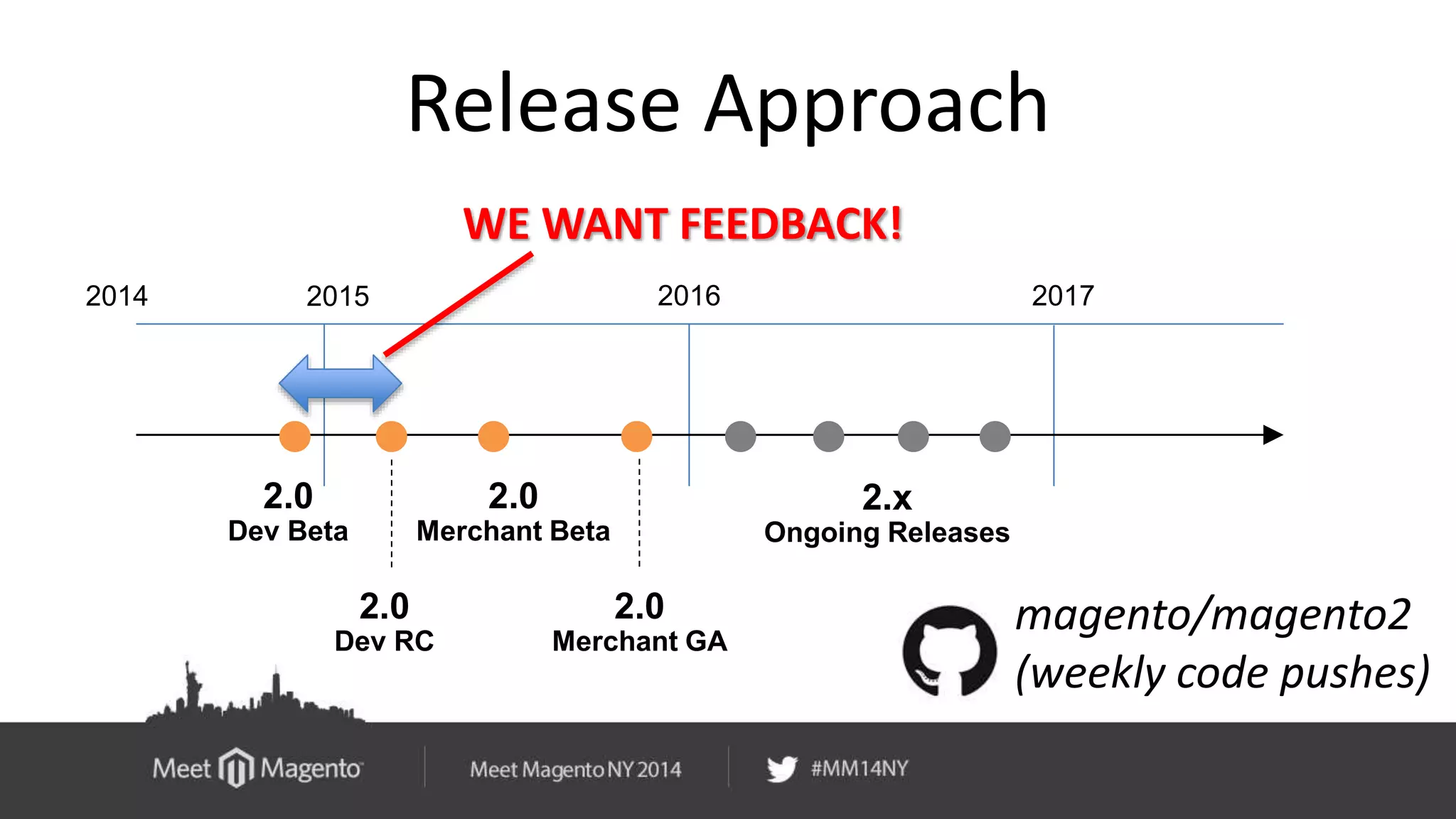
Release Approach 
2014 2015 2016 2017 
2.0 
Dev Beta 
2.0 
Merchant Beta 
2.0 
Merchant GA 
2.x 
Ongoing Releases 
2.0 
Dev RC 
WE WANT FEEDBACK! 
magento/magento2 
(weekly code pushes)
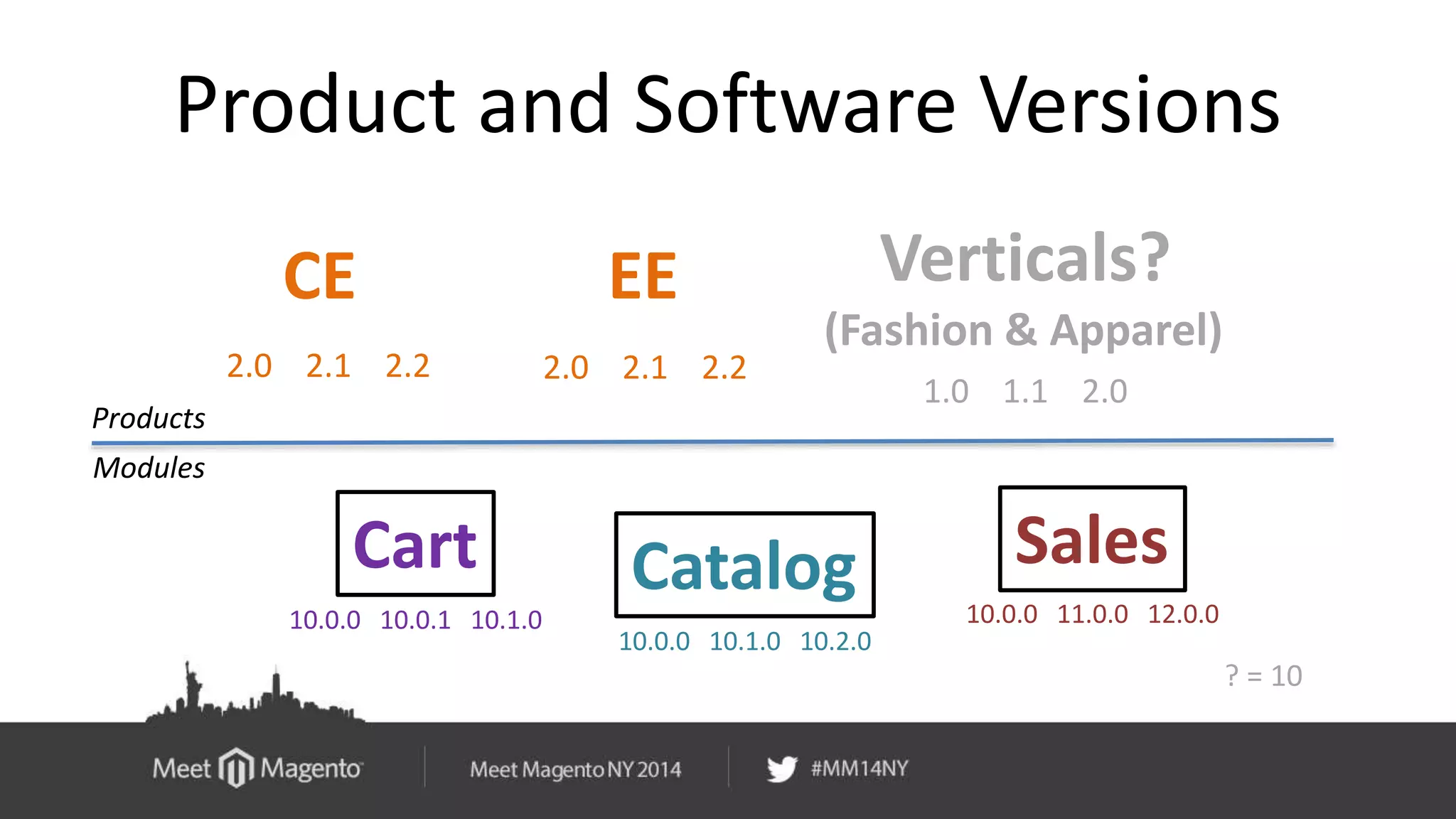
Product and Software Versions 
CE EE Verticals? 
(Fashion & Apparel) 
2.0 2.1 2.2 2.0 2.1 2.2 
1.0 1.1 2.0 
Modules 
Cart Catalog Sales 
10.0.0 10.0.1 10.1.0 
10.0.0 10.1.0 10.2.0 
10.0.0 11.0.0 12.0.0 
? = 10 
Products
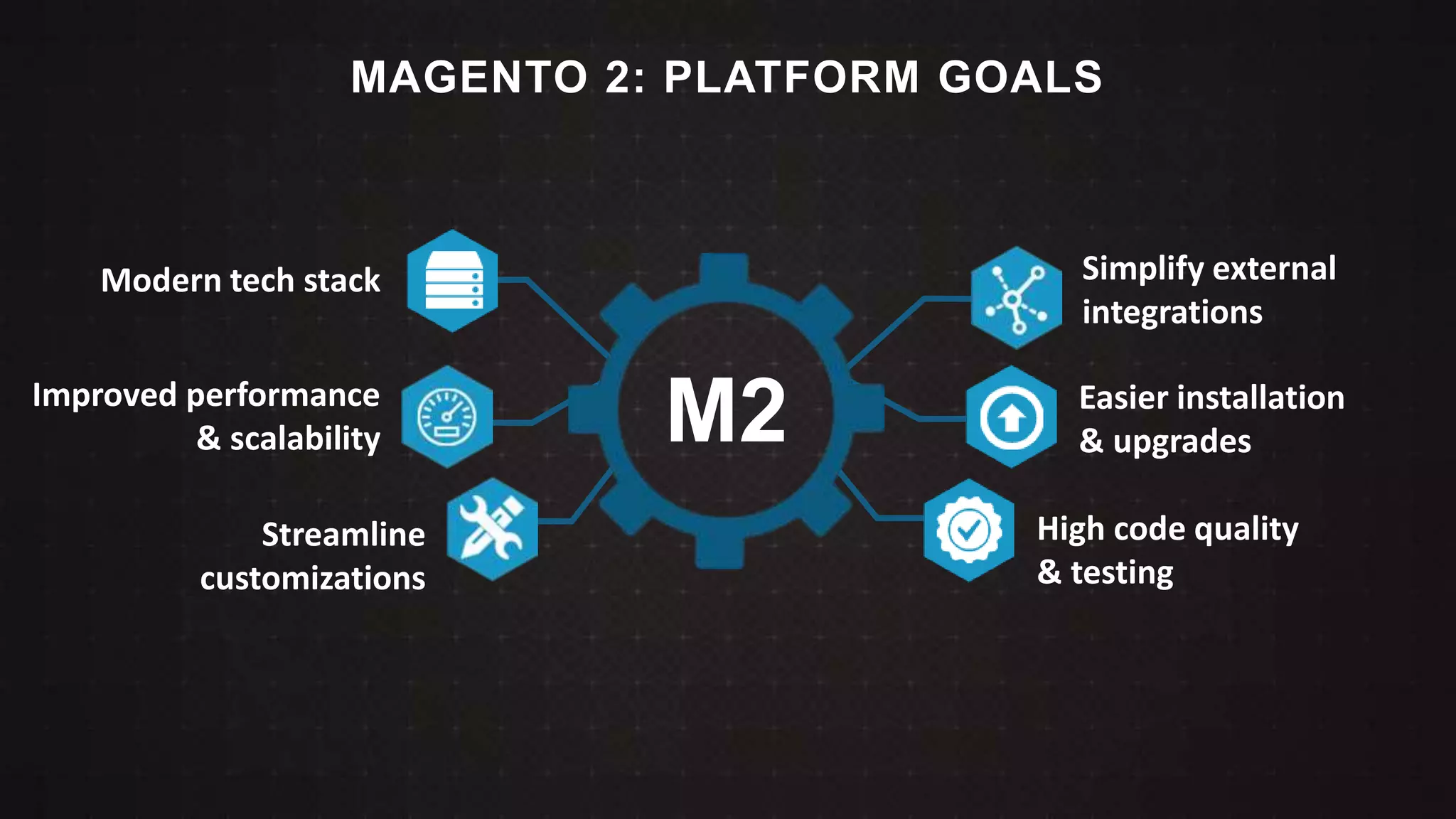
MAGENTO 2: PLATFORM GOALS 
M2 
Modern tech stack 
Improved performance 
& scalability 
Streamline 
customizations 
Simplify external 
integrations 
Easier installation 
& upgrades 
High code quality 
& testing
MODERN TECH STACK
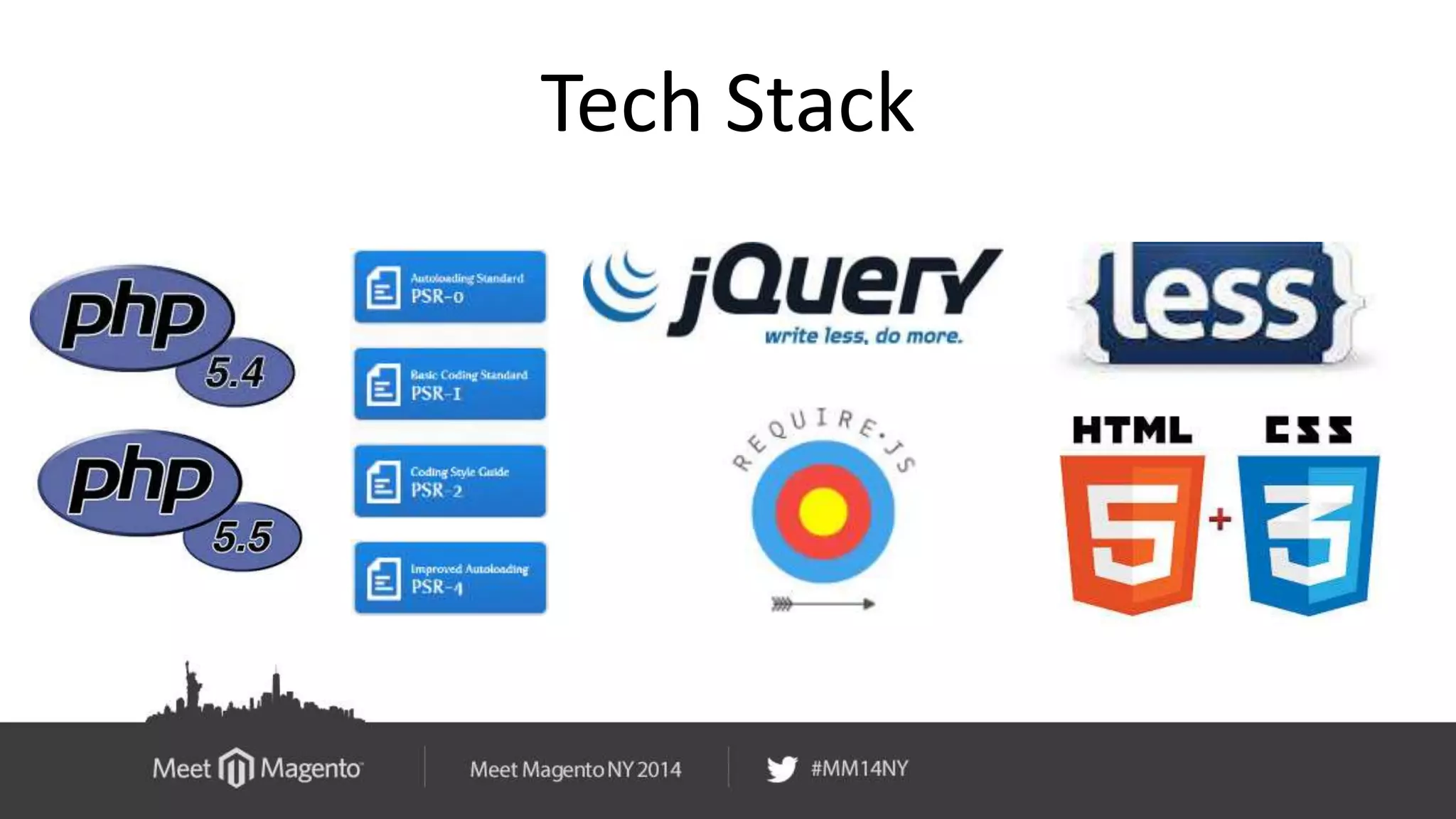
Tech Stack
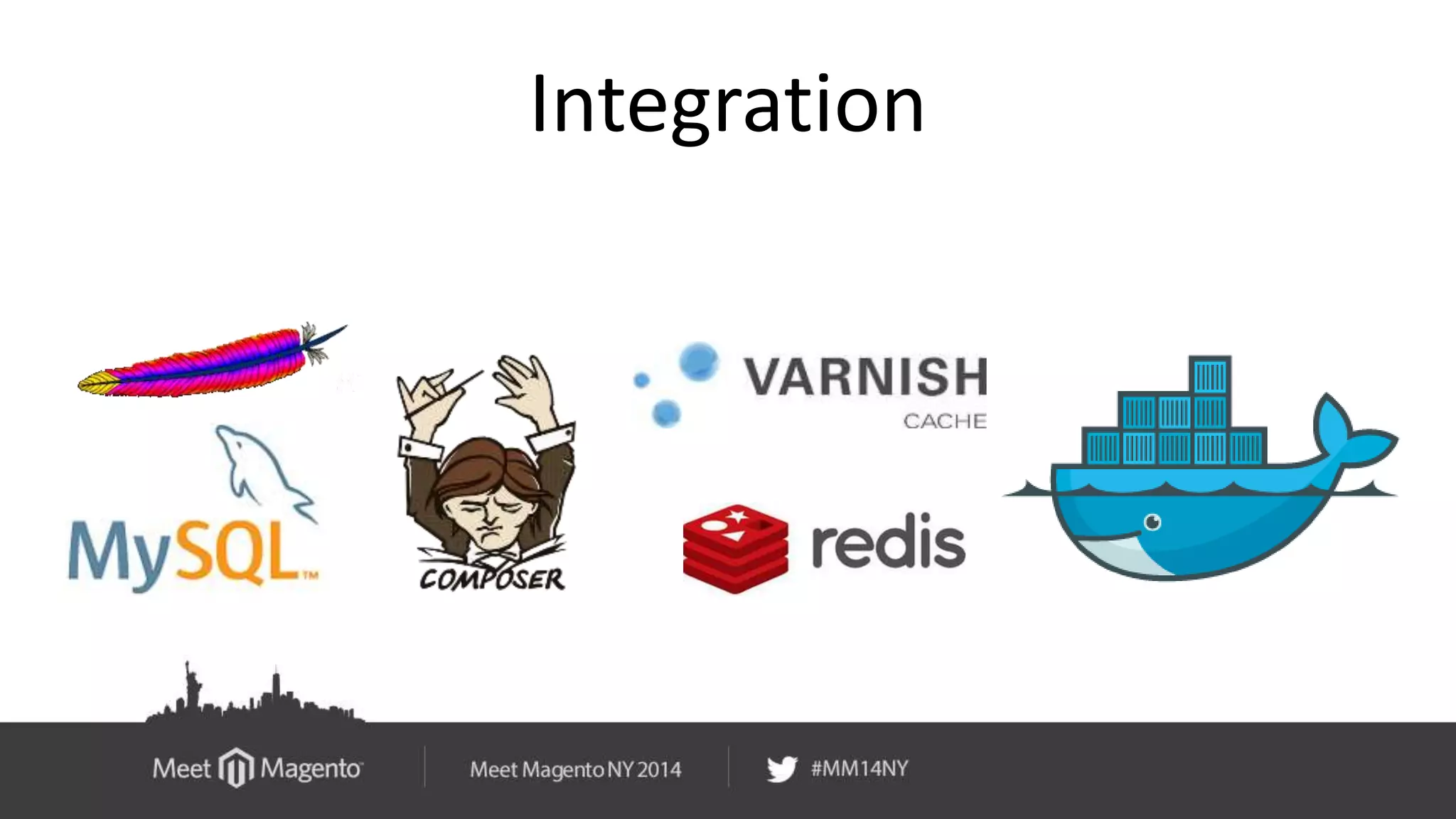
Integration
IMPROVED PERFORMANCE & 
SCALABILITY
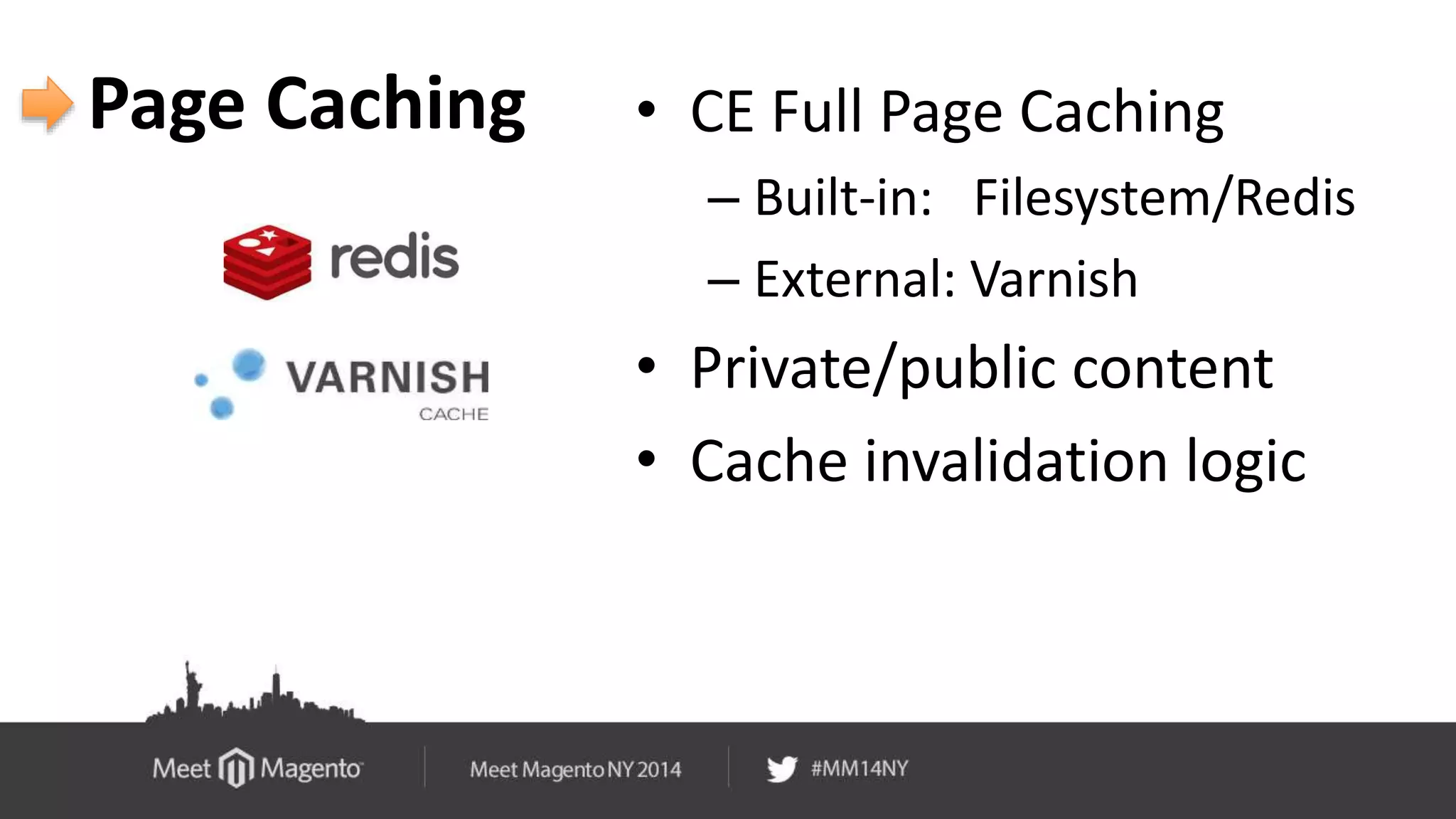
Page Caching • CE Full Page Caching 
– Built-in: Filesystem/Redis 
– External: Varnish 
• Private/public content 
• Cache invalidation logic
Page Caching 
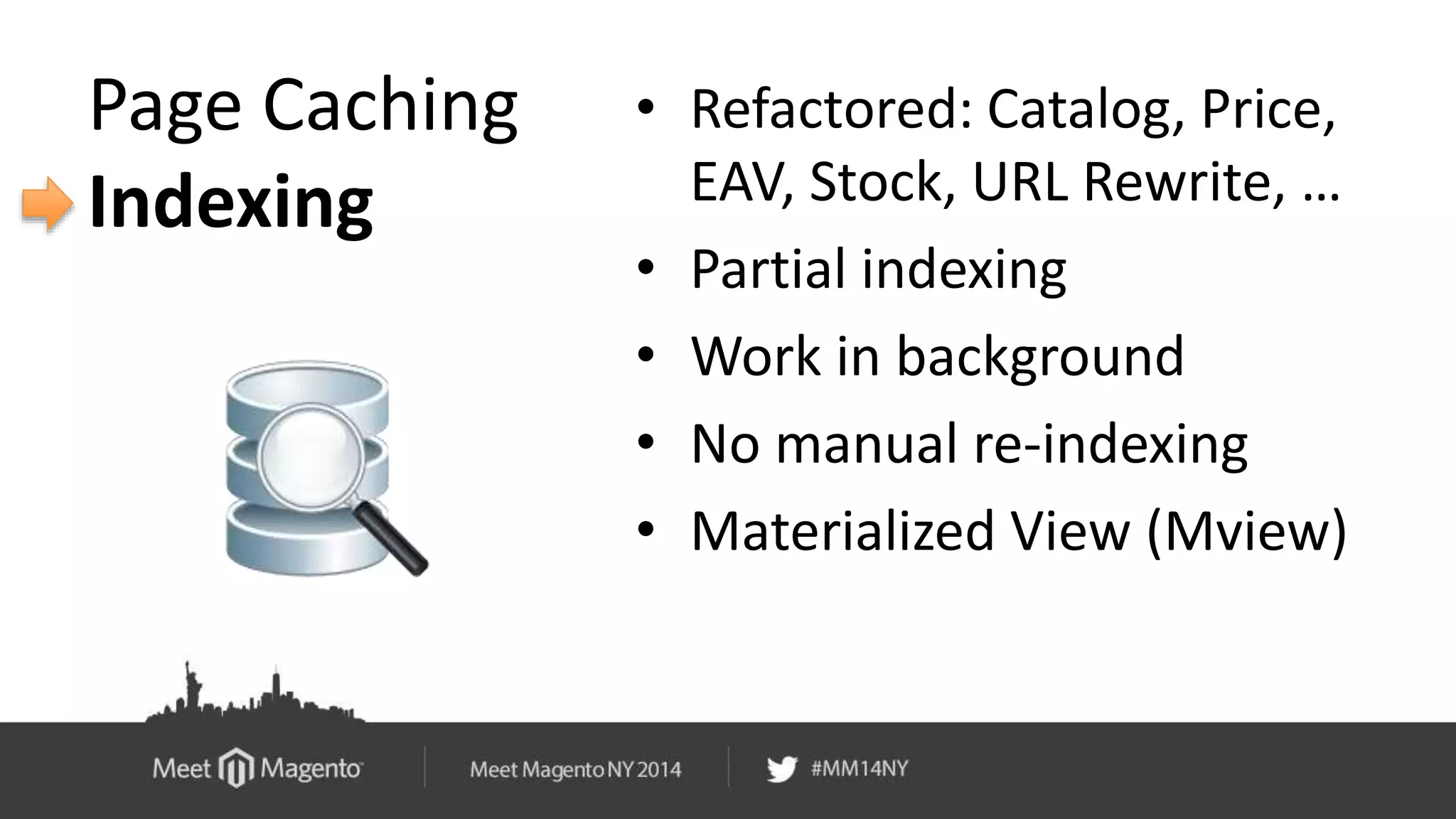
Indexing 
• Refactored: Catalog, Price, 
EAV, Stock, URL Rewrite, … 
• Partial indexing 
• Work in background 
• No manual re-indexing 
• Materialized View (Mview)
Page Caching 
Indexing 
Perf Toolkit 
• Standard toolkit for 
measuring performance 
• Benchmarking key flows 
• M2 performance analysis 
kicking off in earnest
Page Caching 
Indexing 
Perf Toolkit 
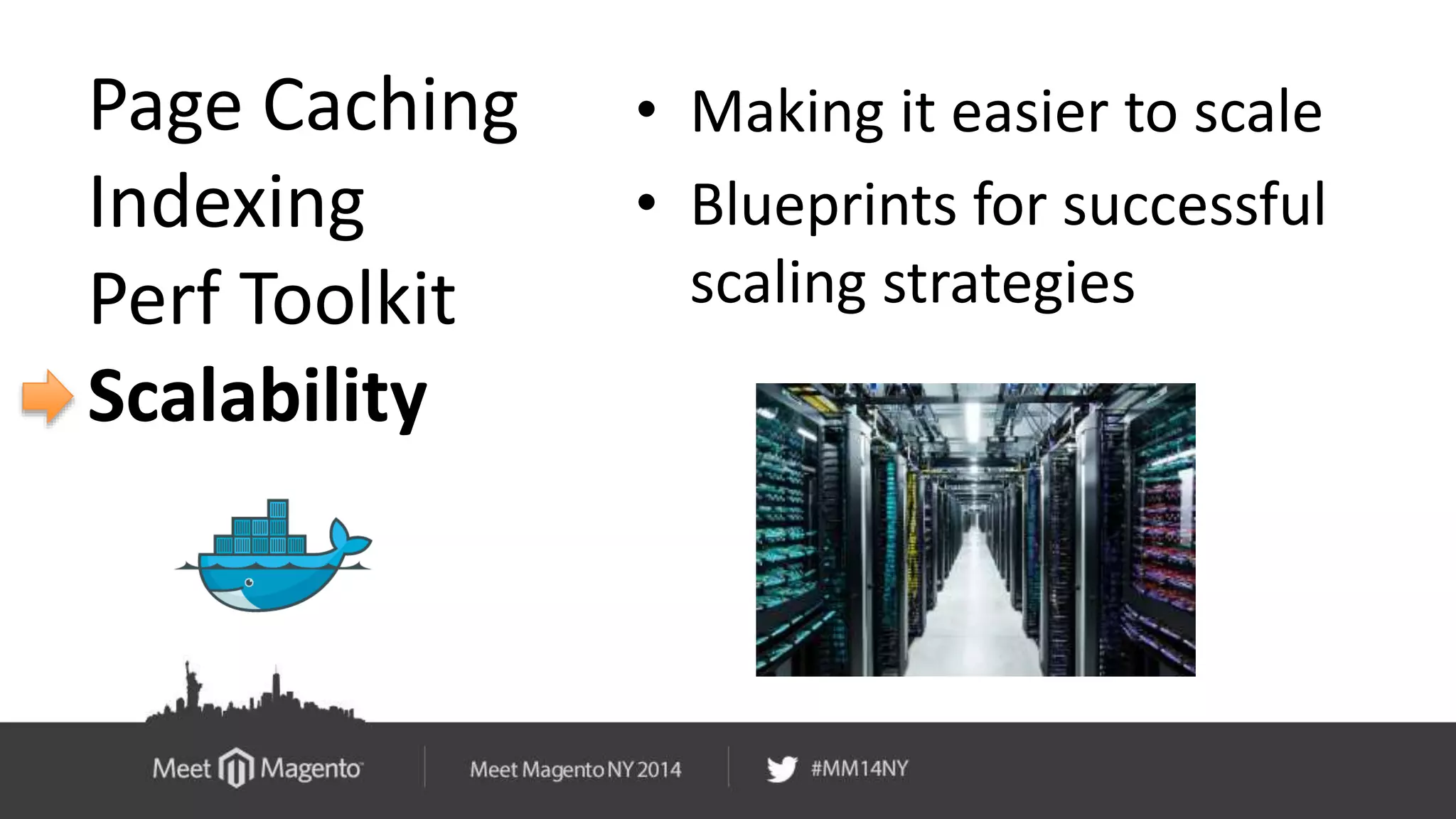
Scalability 
• Making it easier to scale 
• Blueprints for successful 
scaling strategies
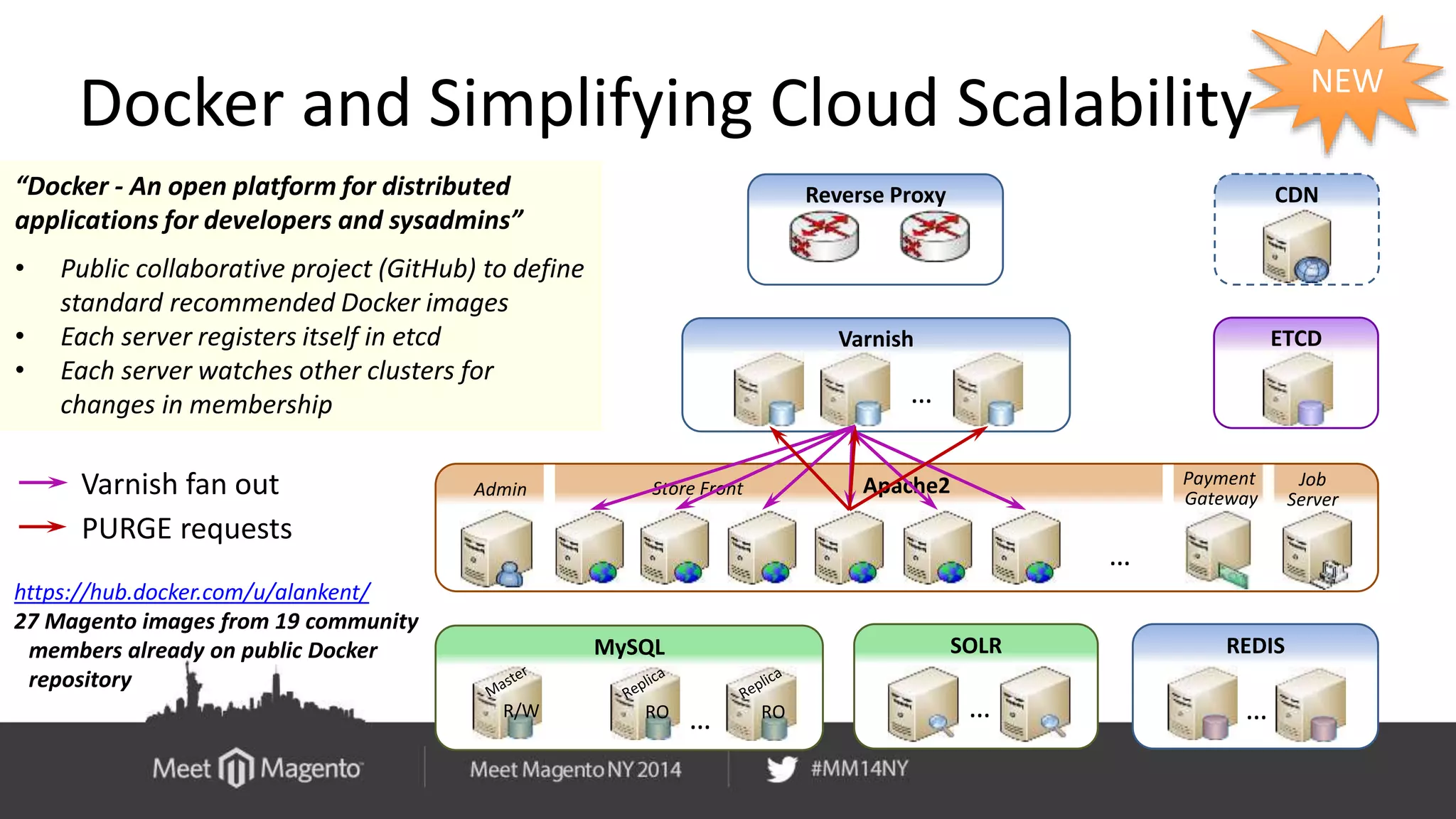
Docker and Simplifying Cloud Scalability 
“Docker - An open platform for distributed 
applications for developers and sysadmins” 
• Public collaborative project (GitHub) to define 
standard recommended Docker images 
• Each server registers itself in etcd 
• Each server watches other clusters for 
changes in membership 
CDN 
Reverse Proxy 
Varnish 
… 
Admin Store Front Apache2 
Job 
… 
MySQL SOLR REDIS 
… … … 
R/W RO RO 
Server 
Payment 
Gateway 
ETCD 
Varnish fan out 
PURGE requests 
NEW 
https://hub.docker.com/u/alankent/ 
27 Magento images from 19 community 
members already on public Docker 
repository
STREAMLINE CUSTOMIZATIONS
Dependency Injection 
• Encourages loose code coupling
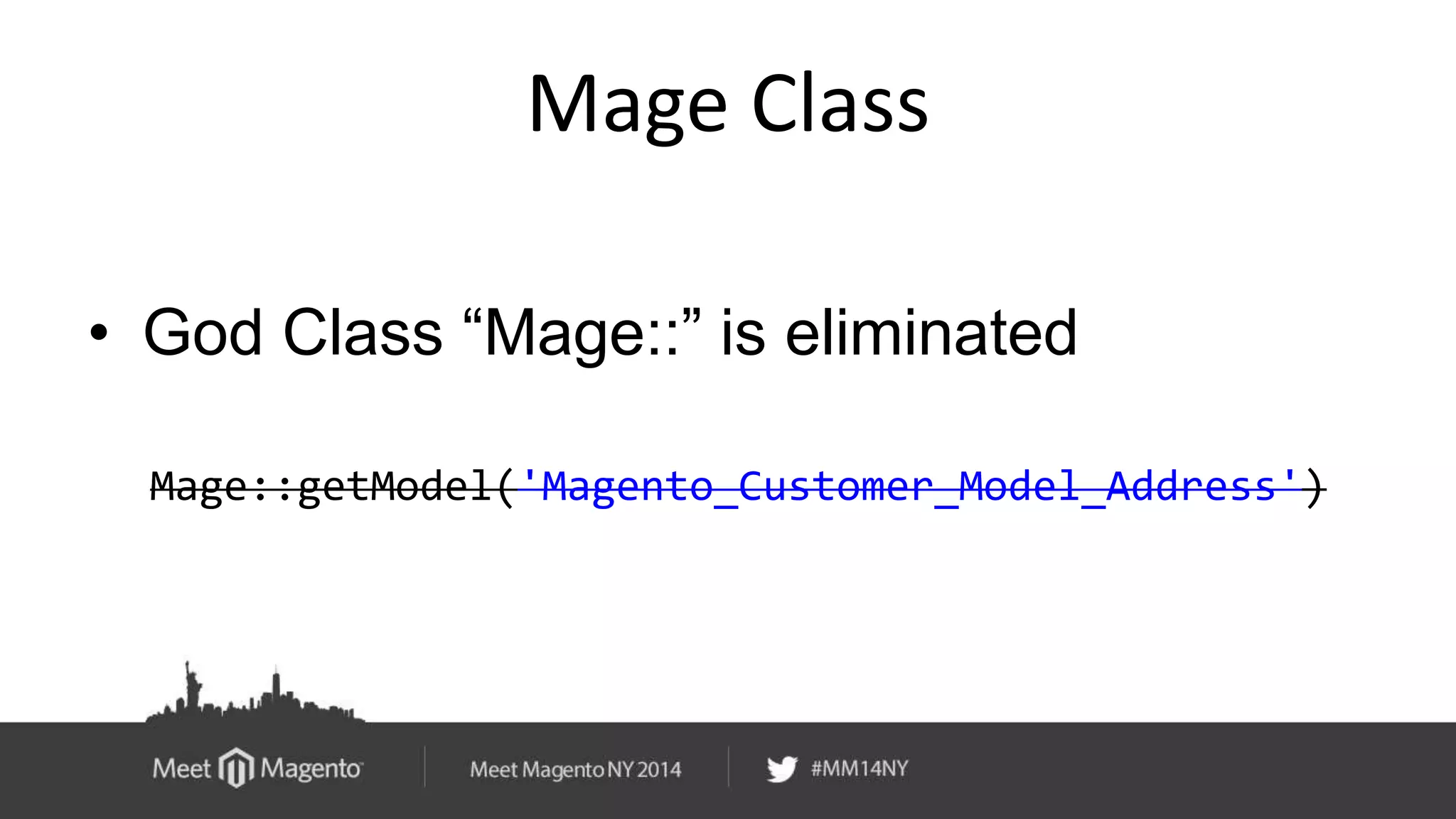
Mage Class 
• God Class “Mage::” is eliminated 
Mage::getModel('Magento_Customer_Model_Address')
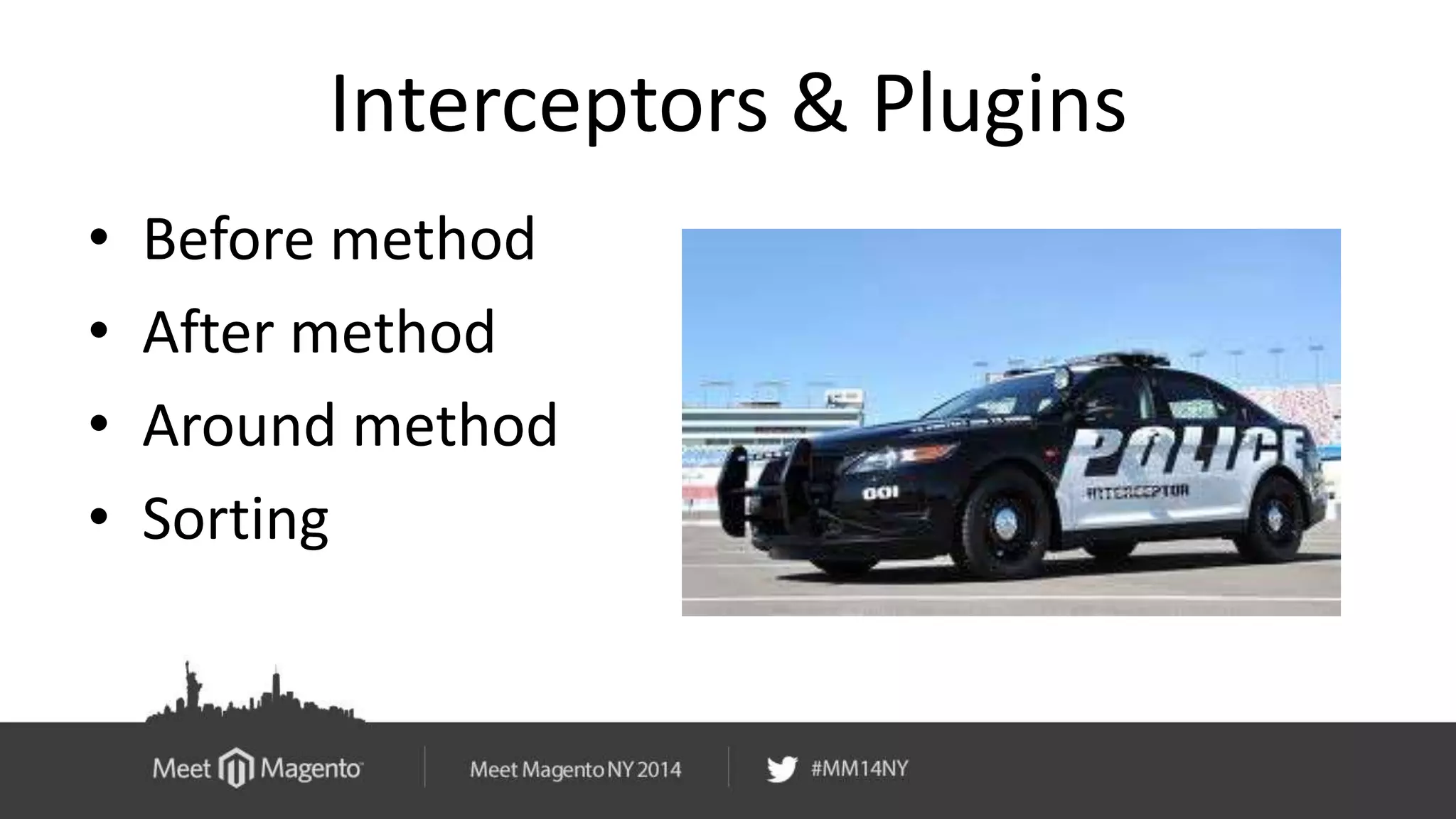
Interceptors & Plugins 
• Before method 
• After method 
• Around method 
• Sorting
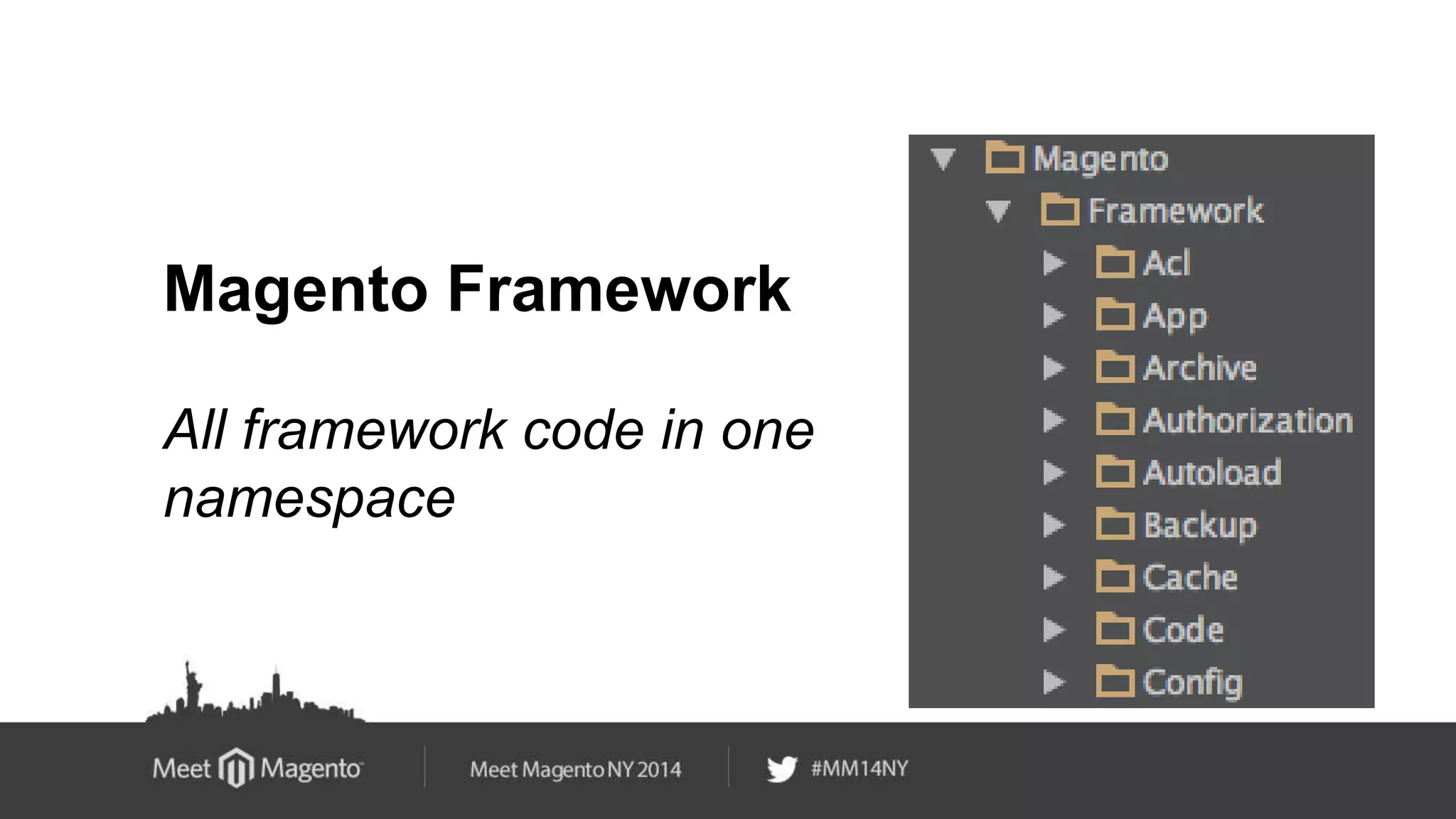
Magento Framework 
All framework code in one 
namespace
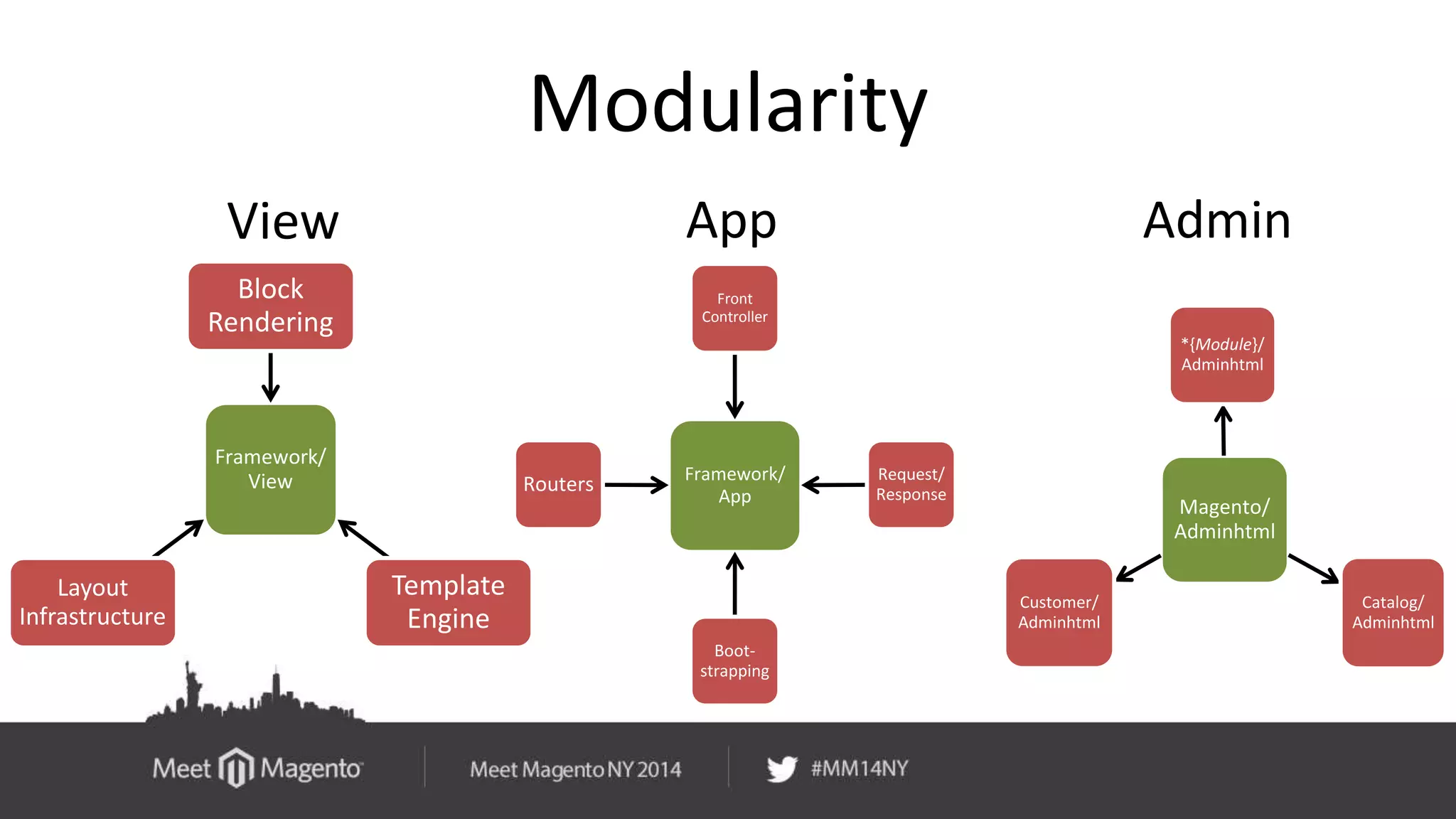
Modularity 
Block 
Rendering 
Framework/ 
View 
Template 
Engine 
Layout 
Infrastructure 
View 
Front 
Controller 
Framework/ 
App 
Request/ 
Response 
Boot-strapping 
Routers 
App 
*{Module}/ 
Adminhtml 
Magento/ 
Adminhtml 
Catalog/ 
Adminhtml 
Customer/ 
Adminhtml 
Admin
Modularity 
• Product: optional product types 
• Catalog: new modules, delete from code 
• Sales: extracted Recurring Payment 
• Shipping: carrier, decoupled shipping methods 
• Checkout: extracted Term&Conditions, multishipping 
• Payments: offline payment, decoupling payment methods
Price Logic 
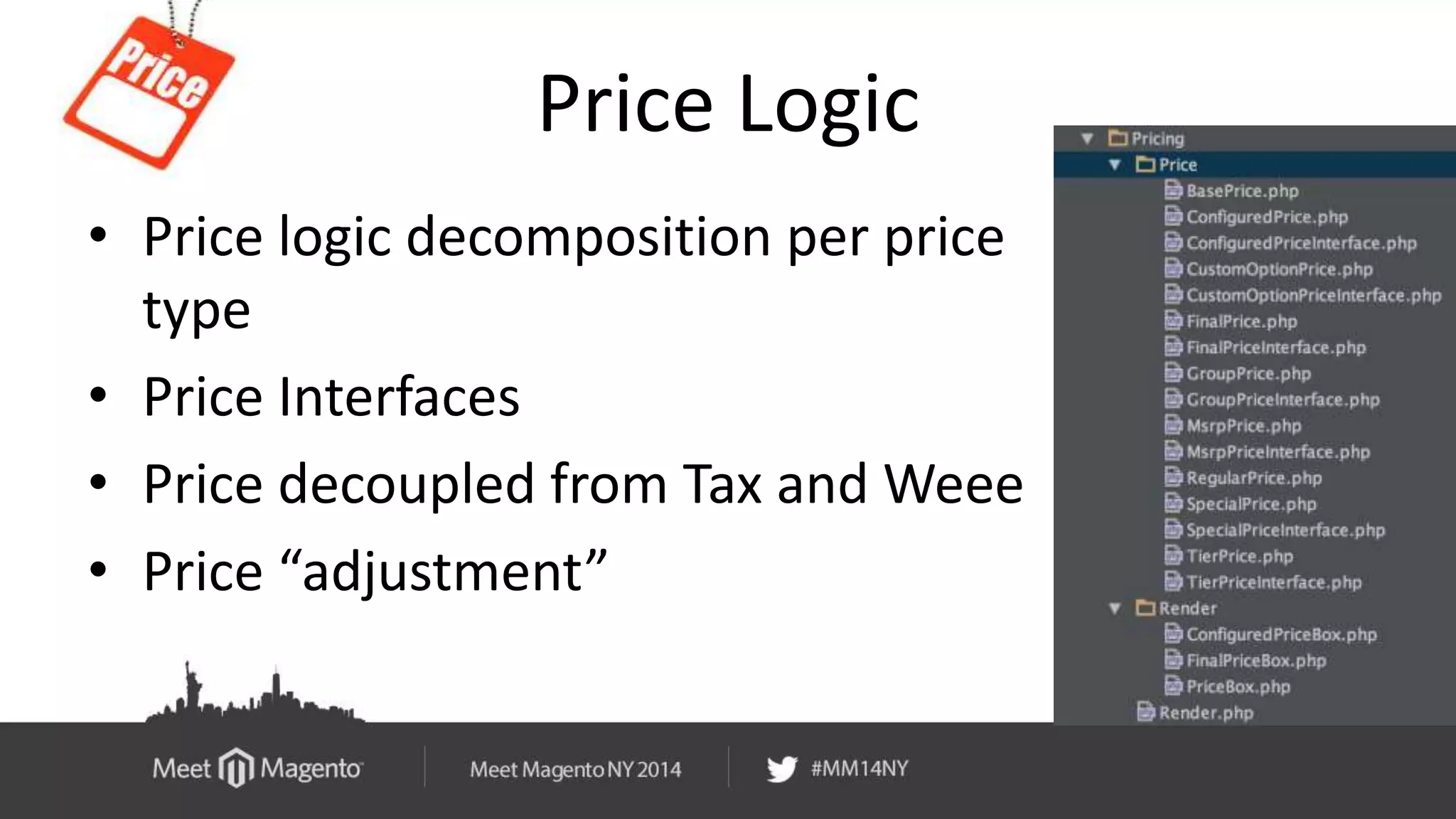
• Price logic decomposition per price 
type 
• Price Interfaces 
• Price decoupled from Tax and Weee 
• Price “adjustment”
i18n 
• Global function __() 
• Phrase 
• RendererInterface 
• Composite, Inline, Placeholder, Translate 
• [Module]/i18n
Layouts 
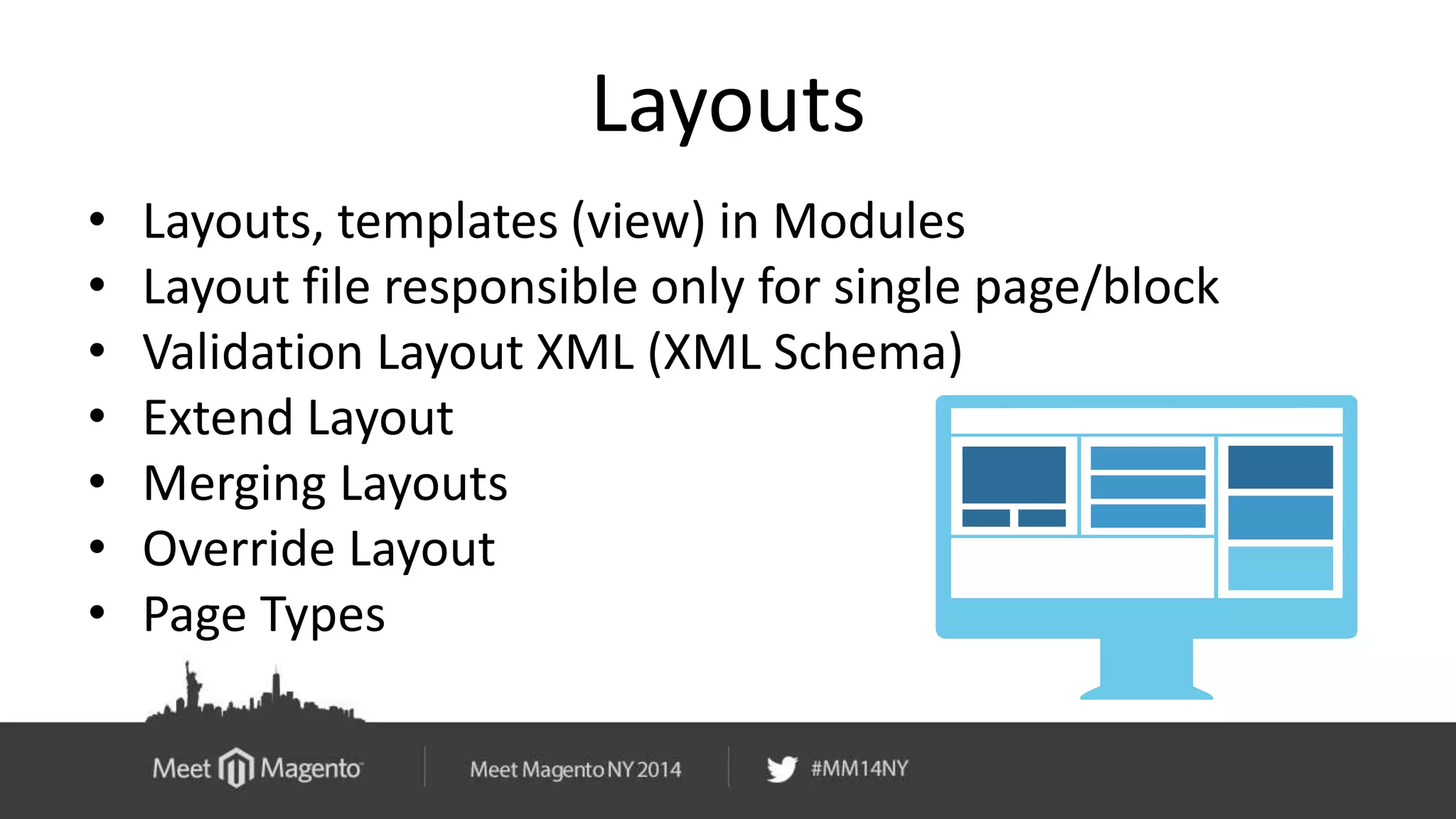
• Layouts, templates (view) in Modules 
• Layout file responsible only for single page/block 
• Validation Layout XML (XML Schema) 
• Extend Layout 
• Merging Layouts 
• Override Layout 
• Page Types
Magento UI Library 
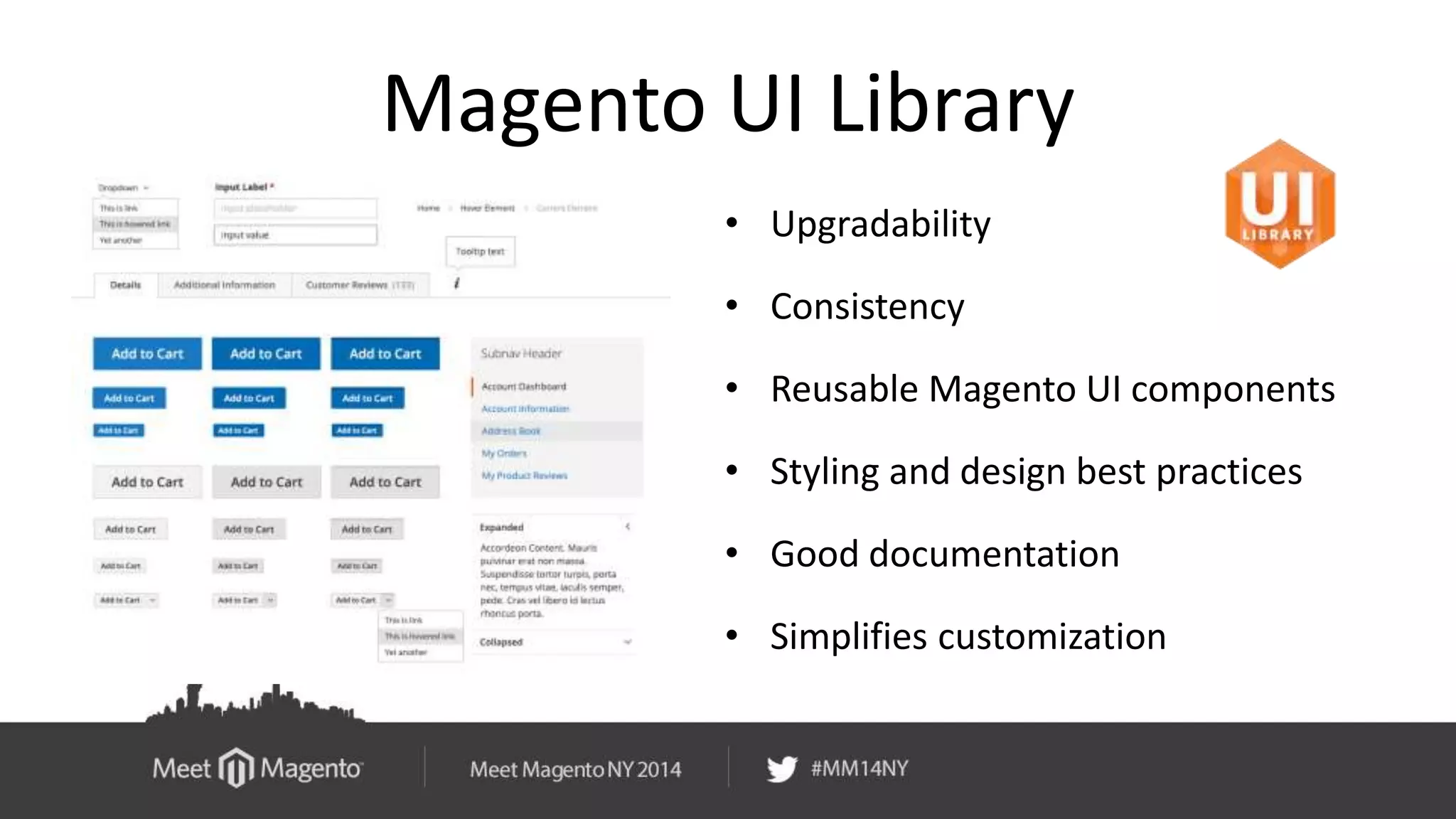
• Upgradability 
• Consistency 
• Reusable Magento UI components 
• Styling and design best practices 
• Good documentation 
• Simplifies customization
Blank Theme 
Mobile First Responsive Design
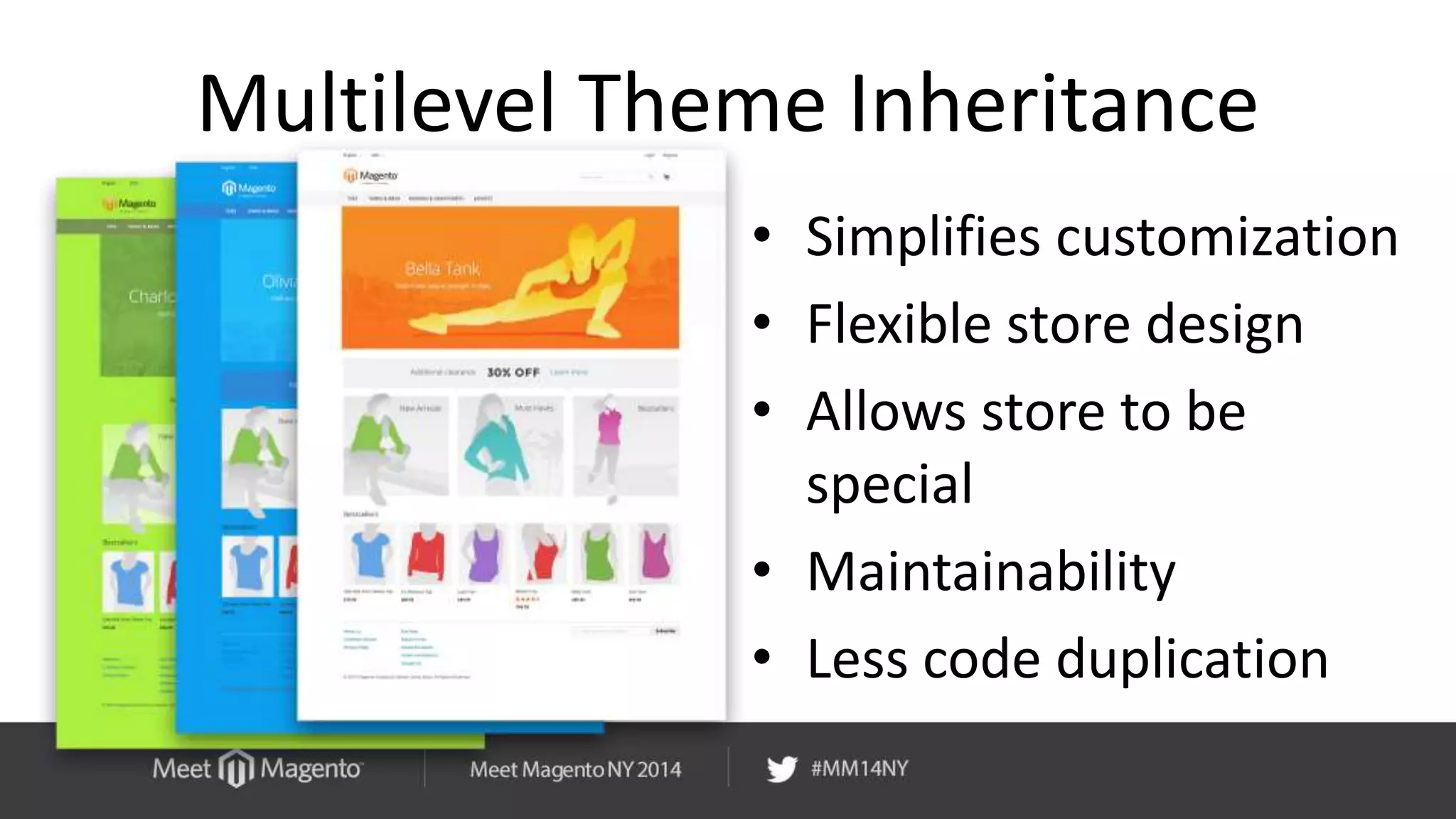
Multilevel Theme Inheritance 
• Simplifies customization 
• Flexible store design 
• Allows store to be 
special 
• Maintainability 
• Less code duplication
SIMPLIFY EXTERNAL 
INTEGRATIONS
Service Layer and Web API 
• Consistent, versioned PHP & Web Service API 
• REST & SOAP 
• Evolution strategy 
– Super-glued: No restriction of what is called 
– Tightly coupled: Restricts calls to “stable” API 
– Loosely coupled: Restricts access to interface based 
API (allows service replacement)
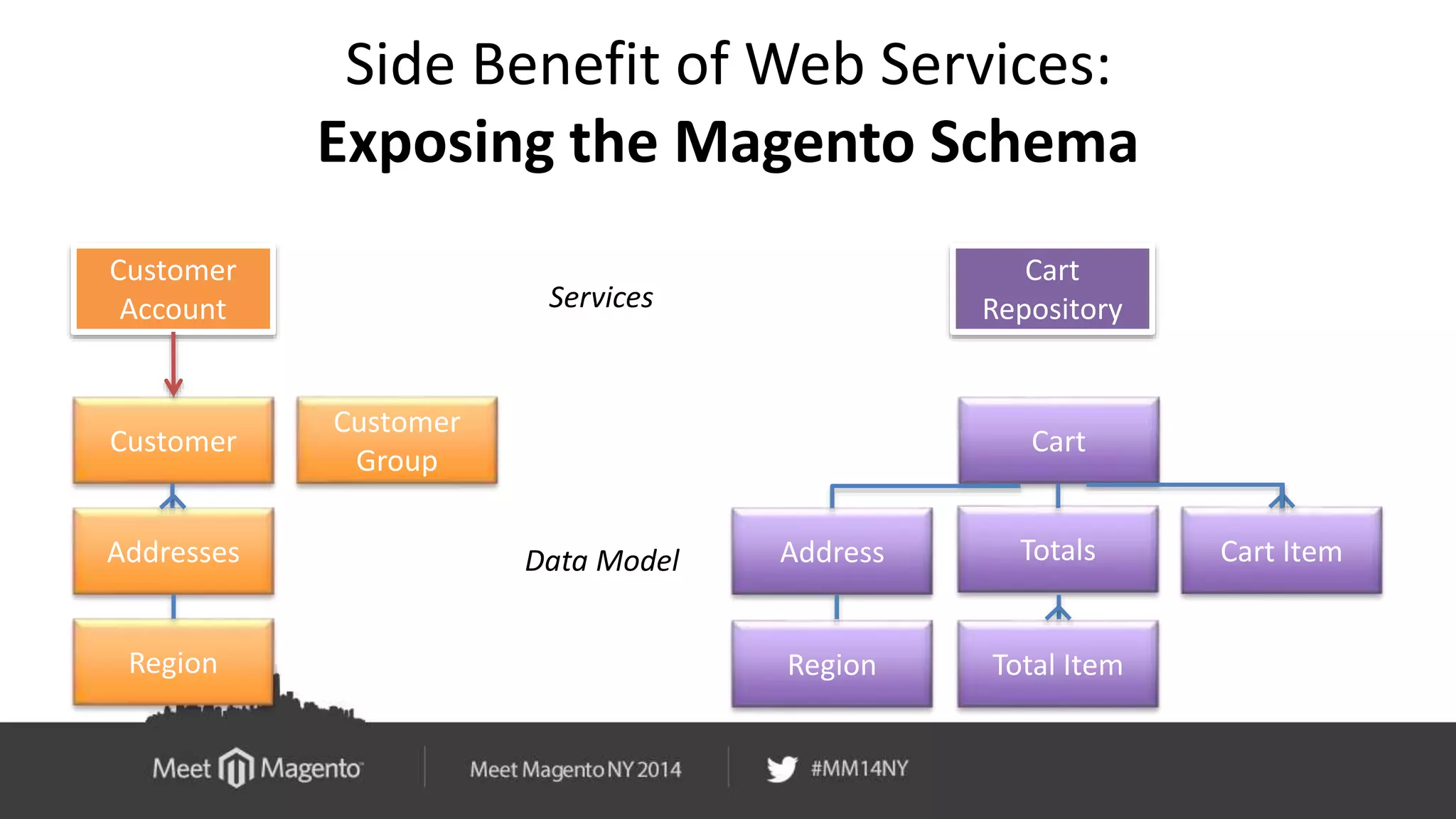
Side Benefit of Web Services: 
Exposing the Magento Schema 
Customer 
Account Services 
Customer 
Addresses 
Region 
Customer 
Group 
Cart 
Repository 
Cart 
Address Totals 
Data Model Cart Item 
Region Total Item
EASIER INSTALLATION & 
UPGRADES
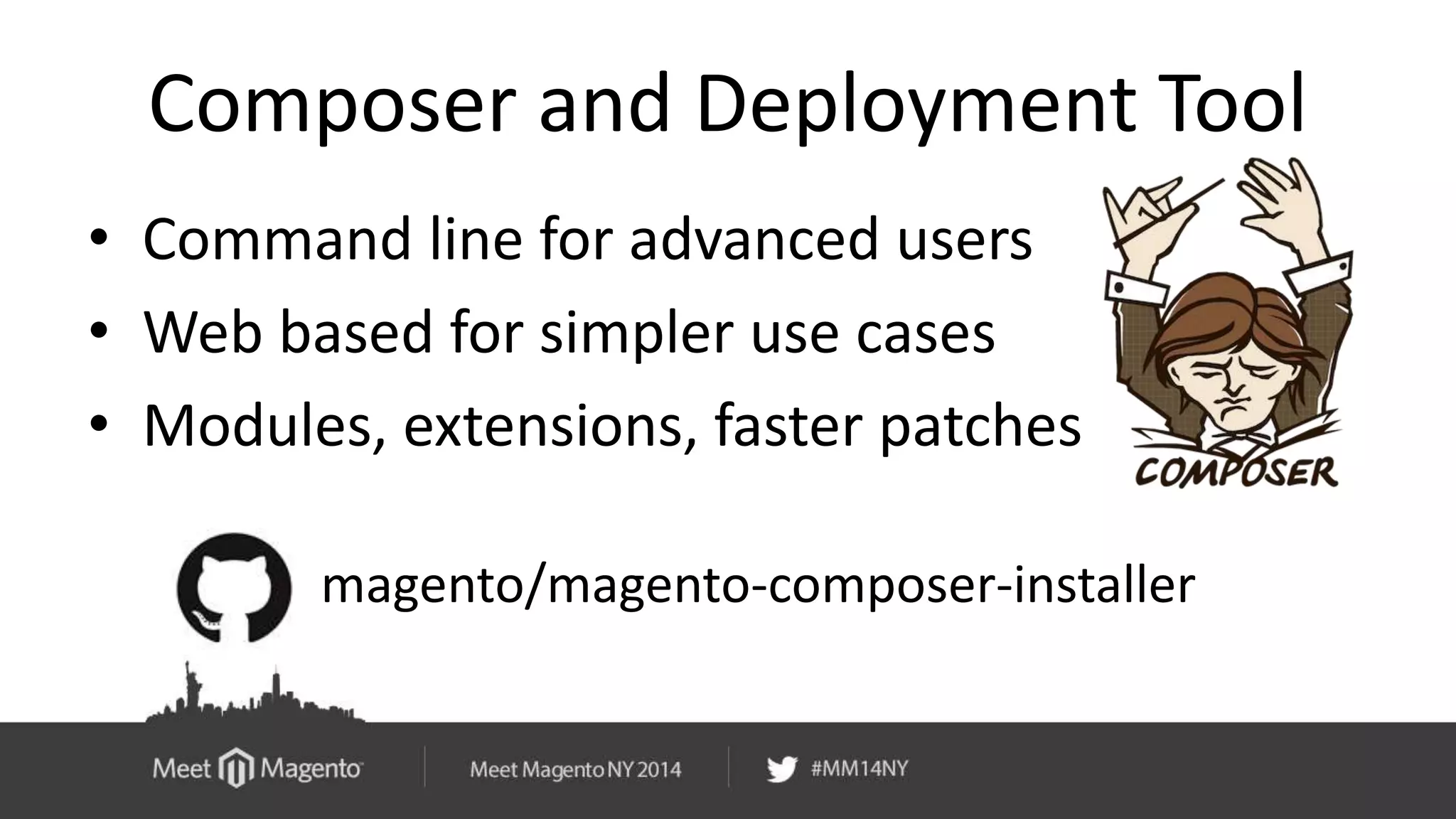
Composer and Deployment Tool 
• Command line for advanced users 
• Web based for simpler use cases 
• Modules, extensions, faster patches 
magento/magento-composer-installer
HIGH CODE QUALITY & TESTING
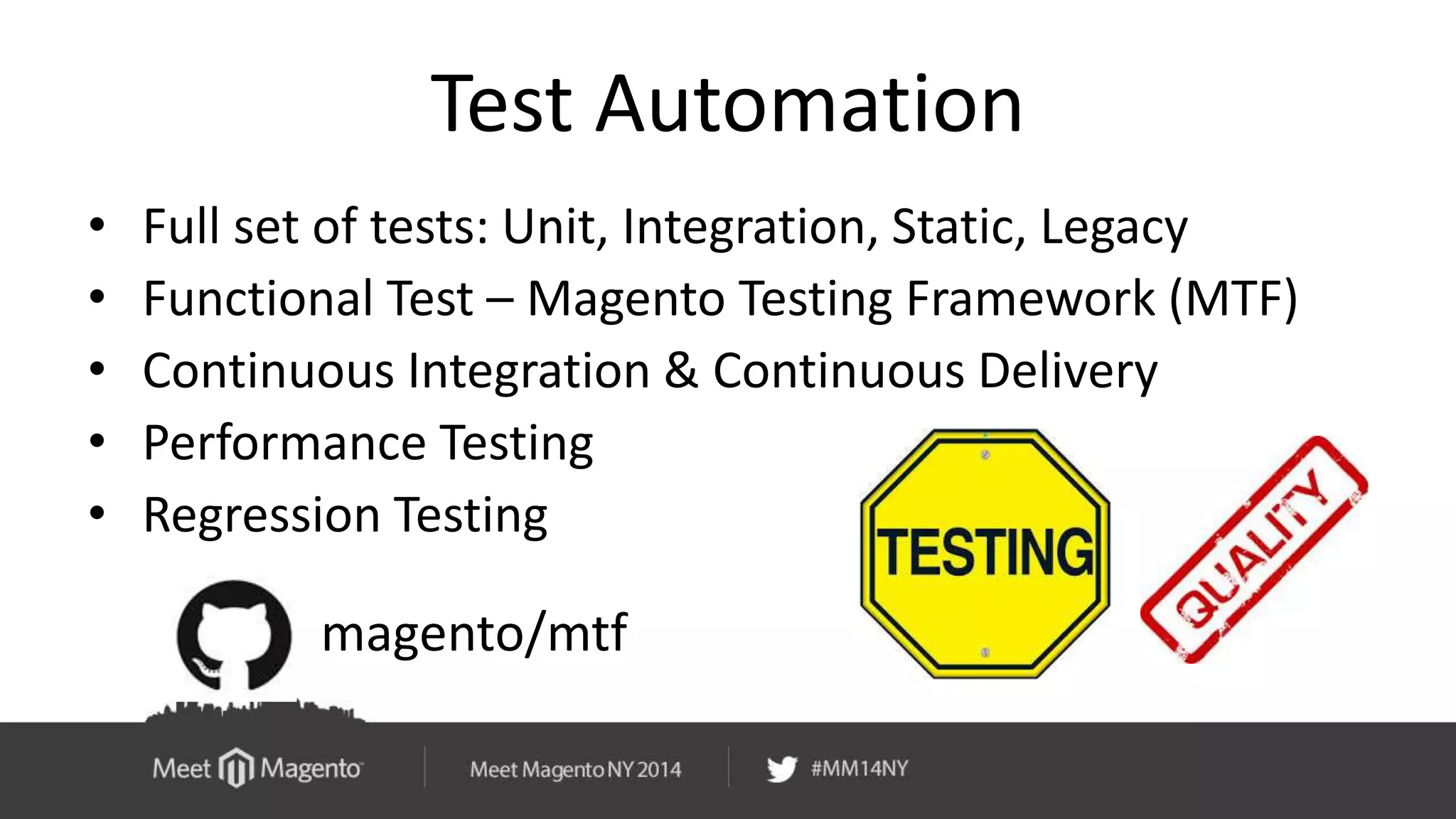
Test Automation 
• Full set of tests: Unit, Integration, Static, Legacy 
• Functional Test – Magento Testing Framework (MTF) 
• Continuous Integration & Continuous Delivery 
• Performance Testing 
• Regression Testing 
magento/mtf
CONCLUSIONS
In a Nutshell 
• On track time-wise 
• Upgrade of tech stack 
• Decoupling and cleaning up the code base 
• Controlling cross module dependencies better 
• Marching towards full test automation
Thank You! 
@akent99 
https://github.com/alankent 
http://alankent.wordpress.com/ 
https://registry.hub.docker.com/repos/alankent/

Magento 2 overview. Alan Kent

  • 1.
    Magento 2 Overview Alan Kent Magento Chief Architect
  • 2.
  • 3.
    Release Approach 20142015 2016 2017 2.0 Dev Beta 2.0 Merchant Beta 2.0 Merchant GA 2.x Ongoing Releases 2.0 Dev RC WE WANT FEEDBACK! magento/magento2 (weekly code pushes)
  • 4.
    Product and SoftwareVersions CE EE Verticals? (Fashion & Apparel) 2.0 2.1 2.2 2.0 2.1 2.2 1.0 1.1 2.0 Modules Cart Catalog Sales 10.0.0 10.0.1 10.1.0 10.0.0 10.1.0 10.2.0 10.0.0 11.0.0 12.0.0 ? = 10 Products
  • 5.
    MAGENTO 2: PLATFORMGOALS M2 Modern tech stack Improved performance & scalability Streamline customizations Simplify external integrations Easier installation & upgrades High code quality & testing
  • 6.
  • 7.
  • 8.
  • 9.
  • 10.
    Page Caching •CE Full Page Caching – Built-in: Filesystem/Redis – External: Varnish • Private/public content • Cache invalidation logic
  • 11.
    Page Caching Indexing • Refactored: Catalog, Price, EAV, Stock, URL Rewrite, … • Partial indexing • Work in background • No manual re-indexing • Materialized View (Mview)
  • 12.
    Page Caching Indexing Perf Toolkit • Standard toolkit for measuring performance • Benchmarking key flows • M2 performance analysis kicking off in earnest
  • 13.
    Page Caching Indexing Perf Toolkit Scalability • Making it easier to scale • Blueprints for successful scaling strategies
  • 14.
    Docker and SimplifyingCloud Scalability “Docker - An open platform for distributed applications for developers and sysadmins” • Public collaborative project (GitHub) to define standard recommended Docker images • Each server registers itself in etcd • Each server watches other clusters for changes in membership CDN Reverse Proxy Varnish … Admin Store Front Apache2 Job … MySQL SOLR REDIS … … … R/W RO RO Server Payment Gateway ETCD Varnish fan out PURGE requests NEW https://hub.docker.com/u/alankent/ 27 Magento images from 19 community members already on public Docker repository
  • 15.
  • 16.
    Dependency Injection •Encourages loose code coupling
  • 17.
    Mage Class •God Class “Mage::” is eliminated Mage::getModel('Magento_Customer_Model_Address')
  • 18.
    Interceptors & Plugins • Before method • After method • Around method • Sorting
  • 19.
    Magento Framework Allframework code in one namespace
  • 20.
    Modularity Block Rendering Framework/ View Template Engine Layout Infrastructure View Front Controller Framework/ App Request/ Response Boot-strapping Routers App *{Module}/ Adminhtml Magento/ Adminhtml Catalog/ Adminhtml Customer/ Adminhtml Admin
  • 21.
    Modularity • Product:optional product types • Catalog: new modules, delete from code • Sales: extracted Recurring Payment • Shipping: carrier, decoupled shipping methods • Checkout: extracted Term&Conditions, multishipping • Payments: offline payment, decoupling payment methods
  • 22.
    Price Logic •Price logic decomposition per price type • Price Interfaces • Price decoupled from Tax and Weee • Price “adjustment”
  • 23.
    i18n • Globalfunction __() • Phrase • RendererInterface • Composite, Inline, Placeholder, Translate • [Module]/i18n
  • 24.
    Layouts • Layouts,templates (view) in Modules • Layout file responsible only for single page/block • Validation Layout XML (XML Schema) • Extend Layout • Merging Layouts • Override Layout • Page Types
  • 25.
    Magento UI Library • Upgradability • Consistency • Reusable Magento UI components • Styling and design best practices • Good documentation • Simplifies customization
  • 26.
    Blank Theme MobileFirst Responsive Design
  • 27.
    Multilevel Theme Inheritance • Simplifies customization • Flexible store design • Allows store to be special • Maintainability • Less code duplication
  • 28.
  • 29.
    Service Layer andWeb API • Consistent, versioned PHP & Web Service API • REST & SOAP • Evolution strategy – Super-glued: No restriction of what is called – Tightly coupled: Restricts calls to “stable” API – Loosely coupled: Restricts access to interface based API (allows service replacement)
  • 30.
    Side Benefit ofWeb Services: Exposing the Magento Schema Customer Account Services Customer Addresses Region Customer Group Cart Repository Cart Address Totals Data Model Cart Item Region Total Item
  • 31.
  • 32.
    Composer and DeploymentTool • Command line for advanced users • Web based for simpler use cases • Modules, extensions, faster patches magento/magento-composer-installer
  • 33.
  • 34.
    Test Automation •Full set of tests: Unit, Integration, Static, Legacy • Functional Test – Magento Testing Framework (MTF) • Continuous Integration & Continuous Delivery • Performance Testing • Regression Testing magento/mtf
  • 35.
  • 36.
    In a Nutshell • On track time-wise • Upgrade of tech stack • Decoupling and cleaning up the code base • Controlling cross module dependencies better • Marching towards full test automation
  • 37.
    Thank You! @akent99 https://github.com/alankent http://alankent.wordpress.com/ https://registry.hub.docker.com/repos/alankent/

Editor's Notes

  • #3  A lot has changed in terms of web development since the release of Magento 1. We will start by ensuring Magento 2 is built using the latest technologies and standards, to allow developers to take advantage of the latest development standards and features We have heard loud and clear that performance and scalability are needed to allow merchants to continue to grow on Magento. Magento 2 will also offer customers better performance and scalability. And, developers will be able to measure this improvement using a new benchmarking framework we will make available
  • #7  A lot has changed in terms of web development since the release of Magento 1. We will start by ensuring Magento 2 is built using the latest technologies and standards, to allow developers to take advantage of the latest development standards and features We have heard loud and clear that performance and scalability are needed to allow merchants to continue to grow on Magento. Magento 2 will also offer customers better performance and scalability. And, developers will be able to measure this improvement using a new benchmarking framework we will make available
  • #10  A lot has changed in terms of web development since the release of Magento 1. We will start by ensuring Magento 2 is built using the latest technologies and standards, to allow developers to take advantage of the latest development standards and features We have heard loud and clear that performance and scalability are needed to allow merchants to continue to grow on Magento. Magento 2 will also offer customers better performance and scalability. And, developers will be able to measure this improvement using a new benchmarking framework we will make available
  • #16  Magento is valued for being easily customized. We are going to make customizations even easier by making the code more modular and allowing developers to make finer grain changes that don’t impact other areas of the code. Frontend development is also going to be more efficient because we are separating business logic from the presentation layer, reducing the need to cut, copy and paste code by 80%, and adding a CSS preprocessor. This will speed and simplify coding, and open Magento Frontend development up to a wider group of developers, giving merchants greater choice. Magento 2 enhances our APIs so it will be easier to extend core functionality. APIs are progressing in two important ways. First, API coverage is increasing to cover more actions (See if we can quantify this), so you can do more via APIs. Second, the new APIs will be more efficient, so that you need to make fewer calls to get the information you need.
  • #26 A lot of efforts we have focused to build the Magento UI Library, which represents by itself the extensive list of reusable UI components, with styling and design best practices from Magento UI team. Why it matters? First, it makes the customization process easier, since you can find the well described, extendable, ready to be used to create custom themes of any complexity Apply them consistenly across the entire store front. Previously, it took <20> lines of code to change the button’s color, while now it just very simple action. For the business side, it gives the ability to easier upgrade to the newest Magento versions, since you don’t need to write a lot of your own code. And we know that Magento Developers wanted us to provide extensive documentation of magento capabilities, so here you have it.
  • #28 We know that each merchant has a need to update the store design to the holidays, seasons or by a lot of other reasons. But once you’ve created the amazing design once, you want to reuse those best-practices for all other design changes and improve it. So in Magento2 we have improved multilevel theme inheritance, Which makes you store special by allowing to change everything on your store front. Gives you amazing design flexibility, so now your marketing and design departments can enjoy a full variety of your store designs. For developers who makes this magic, we focused on simplification of this customizations. So usage of theme inheritance in your store, gives you better maintainability and reduces the code duplication.
  • #29  Magento is valued for being easily customized. We are going to make customizations even easier by making the code more modular and allowing developers to make finer grain changes that don’t impact other areas of the code. Frontend development is also going to be more efficient because we are separating business logic from the presentation layer, reducing the need to cut, copy and paste code by 80%, and adding a CSS preprocessor. This will speed and simplify coding, and open Magento Frontend development up to a wider group of developers, giving merchants greater choice. Magento 2 enhances our APIs so it will be easier to extend core functionality. APIs are progressing in two important ways. First, API coverage is increasing to cover more actions (See if we can quantify this), so you can do more via APIs. Second, the new APIs will be more efficient, so that you need to make fewer calls to get the information you need.
  • #32  We are also going to improve the way you set up, upgrade, and extend Magento. A standalone installer will make it straightforward and faster to install a new Magneto instance, and scripts will highlight potential code conflicts BEFORE you upgrade to the next version or add a new extension. And, we are actively working to make the upgrade to Magento 2 easier by allowing you to import your existing customer records, product catalog, and config settings to Magento 2. Finally, we are committed to maintaining a high quality platform with this new release, and will be providing you with a full testing framework to help speed your development and QA process. We will also be providing you with significantly more documentation than ever before to help you ramp up quickly.
  • #34  We are also going to improve the way you set up, upgrade, and extend Magento. A standalone installer will make it straightforward and faster to install a new Magneto instance, and scripts will highlight potential code conflicts BEFORE you upgrade to the next version or add a new extension. And, we are actively working to make the upgrade to Magento 2 easier by allowing you to import your existing customer records, product catalog, and config settings to Magento 2. Finally, we are committed to maintaining a high quality platform with this new release, and will be providing you with a full testing framework to help speed your development and QA process. We will also be providing you with significantly more documentation than ever before to help you ramp up quickly.
  • #36  A lot has changed in terms of web development since the release of Magento 1. We will start by ensuring Magento 2 is built using the latest technologies and standards, to allow developers to take advantage of the latest development standards and features We have heard loud and clear that performance and scalability are needed to allow merchants to continue to grow on Magento. Magento 2 will also offer customers better performance and scalability. And, developers will be able to measure this improvement using a new benchmarking framework we will make available