

+

Best Practices & Lesson
Learned in Mobile Learning
A perspective from school leaders in the US
+

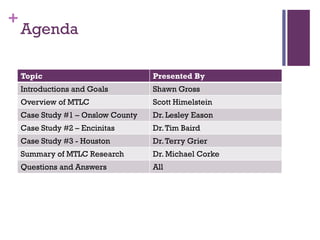
Agenda
Topic

Presented By

Introductions and Goals

Shawn Gross

Overview of MTLC

Scott Himelstein

Case Study #1 – Onslow County

Dr. Lesley Eason

Case Study #2 – Encinitas

Dr. Tim Baird

Case Study #3 - Houston

Dr. Terry Grier

Summary of MTLC Research

Dr. Michael Corke

Questions and Answers

All
+

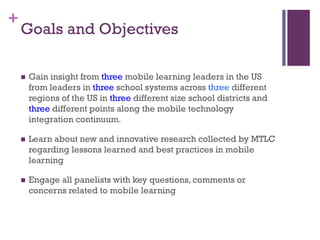
Goals and Objectives


Gain insight from three mobile learning leaders in the US
from leaders in three school systems across three different
regions of the US in three different size school districts and
three different points along the mobile technology
integration continuum.



Learn about new and innovative research collected by MTLC
regarding lessons learned and best practices in mobile
learning



Engage all panelists with key questions, comments or
concerns related to mobile learning
+

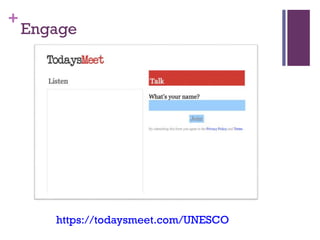
Engage

https://todaysmeet.com/UNESCO
+

Introduction to Panel

Dr. Lesley Eason

Dr. Terry Grier

Dr. Tim Baird

Scott Himelstein

Dr. Michael
Corke
+

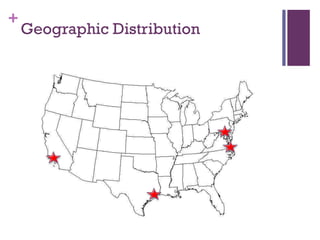
Geographic Distribution
+

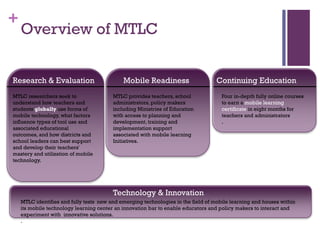
Overview of MTLC

Research & Evaluation
MTLC researchers seek to
understand how teachers and
students globally use forms of
mobile technology, what factors
influence types of tool use and
associated educational
outcomes, and how districts and
school leaders can best support
and develop their teachers'
mastery and utilization of mobile
technology.

Mobile Readiness
MTLC provides teachers, school
administrators, policy makers
including Ministries of Education
with access to planning and
development, training and
implementation support
associated with mobile learning
Initiatives.

Continuing Education
Four in-depth fully online courses
to earn a mobile learning
certificate in eight months for
teachers and administrators
.

Technology & Innovation
MTLC identifies and fully tests new and emerging technologies in the field of mobile learning and houses within
its mobile technology learning center an innovation bar to enable educators and policy makers to interact and
experiment with innovative solutions.
.
+
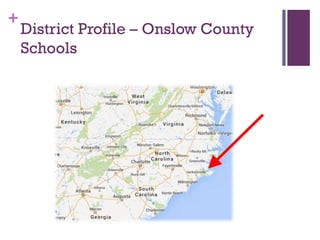
Case Study #1 – Onslow County Schools

Jacksonville, North
+

District Profile – Onslow County
Schools


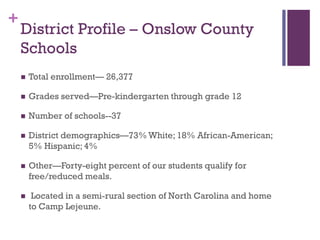
Total enrollment— 26,377



Grades served—Pre-kindergarten through grade 12



Number of schools--37



District demographics—73% White; 18% African-American;
5% Hispanic; 4%



Other—Forty-eight percent of our students qualify for
free/reduced meals.



Located in a semi-rural section of North Carolina and home
to Camp Lejeune.
+

District Profile – Onslow County
Schools
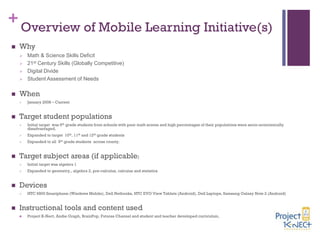
+ Overview of Mobile Learning Initiative(s)


Why







When




Math & Science Skills Deficit
21st Century Skills (Globally Competitive)
Digital Divide
Student Assessment of Needs

January 2008 – Current

Target student populations



Expanded to target 10th, 11th and 12th grade students





Initial target was 9th grade students from schools with poor math scores and high percentages of their populations were socio-economically
disadvantaged.
Expanded to all 9th grade students across county.

Target subject areas (if applicable)




Initial target was algebra 1



Expanded to geometry,, algebra 2, pre-calculus, calculus and statistics

Devices




HTC 6800 Smartphone (Windows Mobile), Dell Netbooks, HTC EVO View Tablets (Android), Dell Laptops, Samsung Galaxy Note 2 (Android)

Instructional tools and content used


Project K-Nect, Andie Graph, BrainPop, Futures Channel and student and teacher developed curriculum,
+

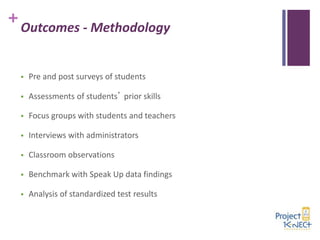
Outcomes - Methodology



Pre and post surveys of students



Assessments of students’ prior skills



Focus groups with students and teachers



Interviews with administrators



Classroom observations



Benchmark with Speak Up data findings



Analysis of standardized test results
+

Outcomes - Findings
“The smart phone is like a teacher
in my pocket.”

Project K-Nect Student
“I can’t go back to the way I taught before
Project K-Nect.”
Project K-Nect Teacher
+

Outcomes - Findings


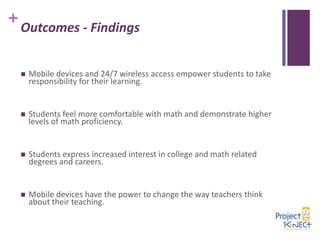
Mobile devices and 24/7 wireless access empower students to take
responsibility for their learning.



Students feel more comfortable with math and demonstrate higher
levels of math proficiency.



Students express increased interest in college and math related
degrees and careers.



Mobile devices have the power to change the way teachers think
about their teaching.
+ Outcomes - Empower students to take responsibility for
learning
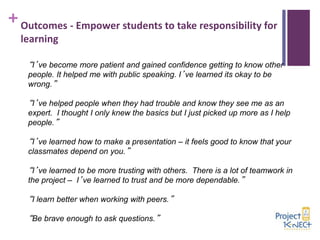
“I’ve become more patient and gained confidence getting to know other
people. It helped me with public speaking. I’ve learned its okay to be
wrong.”
“I’ve helped people when they had trouble and know they see me as an
expert. I thought I only knew the basics but I just picked up more as I help
people.”

“I’ve learned how to make a presentation – it feels good to know that your
classmates depend on you.”
“I’ve learned to be more trusting with others. There is a lot of teamwork in
the project – I’ve learned to trust and be more dependable.”
“I learn better when working with peers.”

“Be brave enough to ask questions.”
+

Increased comfort and success with
math
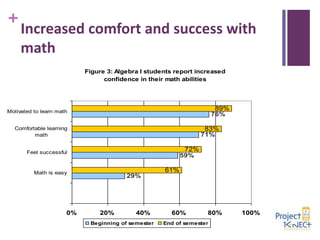
Figure 3: Algebra I students report increased
confidence in their math abilities

89%
76%

Motivated to learn math

83%
71%

Comfortable learning
math

72%
59%

Feel successful

61%

Math is easy

0%

29%

20%

40%

Beginning of semester

60%

80%

End of semester

100%
+

Increased comfort and success with
math
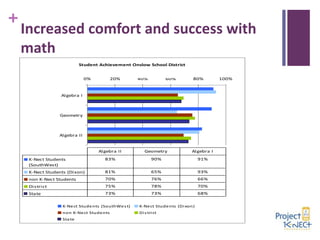
Student Achievement Onslow School District
2008-2009 School Year
0%

20%

40%

60%

80%

Al gebra I

Geometry

Al gebra II

Al gebra II

Geometry

Al gebra I

K-Nect Students
(SouthWest)

83%

90%

91%

K-Nect Students (Di xon)

81%

65%

93%

non K-Nect Students

70%

76%

66%

Di stri ct

75%

78%

70%

State

73%

73%

68%

K-Ne ct Stude nts (SouthWe s t)

K-Ne ct Stude nts (Di xon)

non K-Ne ct Stude nts

Di s tri ct

Sta te

100%
+

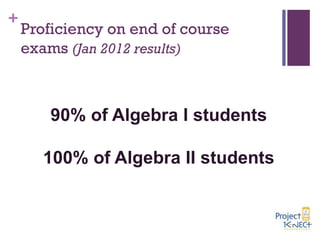
Proficiency on end of course
exams (Jan 2012 results)

90% of Algebra I students
100% of Algebra II students
+

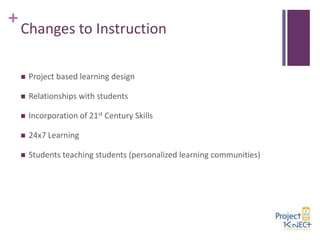
Changes to Instruction


Project based learning design



Relationships with students



Incorporation of 21st Century Skills



24x7 Learning



Students teaching students (personalized learning communities)
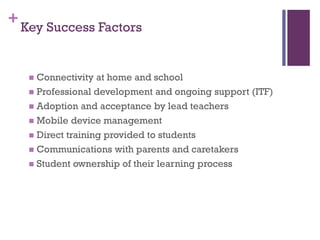
+ Key Success Factors
Connectivity at home and school
 Professional development and ongoing support (ITF)
 Adoption and acceptance by lead teachers
 Mobile device management
 Direct training provided to students
 Communications with parents and caretakers
 Student ownership of their learning process

+
Case Study #2 – Encinitas Union School
District

San Diego, California
+

District Profile – Encinitas


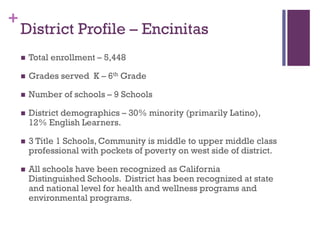
Total enrollment – 5,448



Grades served K – 6th Grade



Number of schools – 9 Schools



District demographics – 30% minority (primarily Latino),
12% English Learners.



3 Title 1 Schools, Community is middle to upper middle class
professional with pockets of poverty on west side of district.



All schools have been recognized as California
Distinguished Schools. District has been recognized at state
and national level for health and wellness programs and
environmental programs.
+ Overview of Mobile Learning Initiative(s)


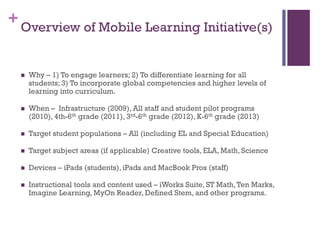
Why – 1) To engage learners; 2) To differentiate learning for all
students; 3) To incorporate global competencies and higher levels of
learning into curriculum.



When – Infrastructure (2009), All staff and student pilot programs
(2010), 4th-6th grade (2011), 3rd-6th grade (2012), K-6th grade (2013)



Target student populations – All (including EL and Special Education)



Target subject areas (if applicable) Creative tools, ELA, Math, Science



Devices – iPads (students), iPads and MacBook Pros (staff)



Instructional tools and content used – iWorks Suite, ST Math, Ten Marks,
Imagine Learning, MyOn Reader, Defined Stem, and other programs.
+ Outcomes (Quantitative and Qualitative)


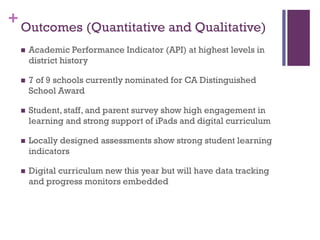
Academic Performance Indicator (API) at highest levels in
district history



7 of 9 schools currently nominated for CA Distinguished
School Award



Student, staff, and parent survey show high engagement in
learning and strong support of iPads and digital curriculum



Locally designed assessments show strong student learning
indicators



Digital curriculum new this year but will have data tracking
and progress monitors embedded
+ Key Success Factors


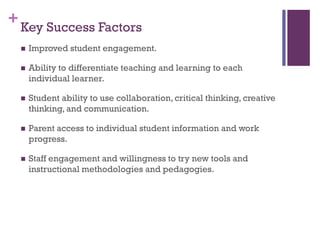
Improved student engagement.



Ability to differentiate teaching and learning to each
individual learner.



Student ability to use collaboration, critical thinking, creative
thinking, and communication.



Parent access to individual student information and work
progress.



Staff engagement and willingness to try new tools and
instructional methodologies and pedagogies.
+
Case Study #3 – Houston Independent
School District

Houston, Texas
+

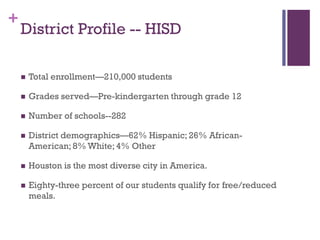
District Profile -- HISD


Total enrollment—210,000 students



Grades served—Pre-kindergarten through grade 12



Number of schools--282



District demographics—62% Hispanic; 26% AfricanAmerican; 8% White; 4% Other



Houston is the most diverse city in America.



Eighty-three percent of our students qualify for free/reduced
meals.
+ Overview of Mobile Learning Initiative(s)


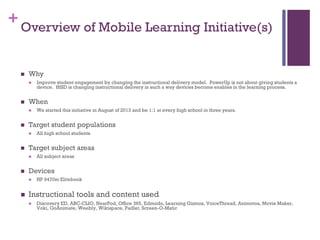
Why




When




All subject areas

Devices




All high school students

Target subject areas




We started this initiative in August of 2013 and be 1:1 at every high school in three years.

Target student populations




Improve student engagement by changing the instructional delivery model. PowerUp is not about giving students a
device. HISD is changing instructional delivery in such a way devices become enables in the learning process.

HP 9470m Elitebook

Instructional tools and content used


Discovery ED, ABC-CLIO, NearPod, Office 365, Edmodo, Learning Gizmos, VoiceThread, Animotoa, Movie Maker,
Voki, GoAnimate, Weebly, Wikispace, Padlet, Screen-O-Matic
+ Outcomes (Quantitative and Qualitative)
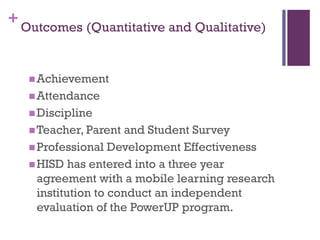
 Achievement
 Attendance
 Discipline

 Teacher, Parent

and Student Survey
 Professional Development Effectiveness
 HISD has entered into a three year
agreement with a mobile learning research
institution to conduct an independent
evaluation of the PowerUP program.
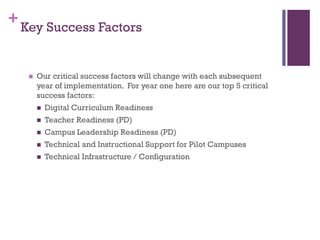
+ Key Success Factors


Our critical success factors will change with each subsequent
year of implementation. For year one here are our top 5 critical
success factors:


Digital Curriculum Readiness



Teacher Readiness (PD)



Campus Leadership Readiness (PD)



Technical and Instructional Support for Pilot Campuses



Technical Infrastructure / Configuration
+

MTLC Research Overview
+

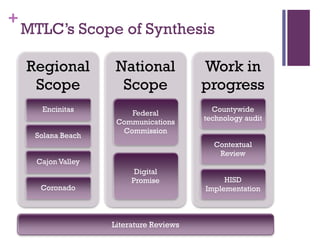
MTLC’s Scope of Synthesis
Regional
Scope

National
Scope

Work in
progress

Encinitas

Federal
Communications
Commission

Countywide
technology audit

Solana Beach

Contextual
Review

Cajon Valley
Coronado

Digital
Promise

Literature Reviews

HISD
Implementation
+

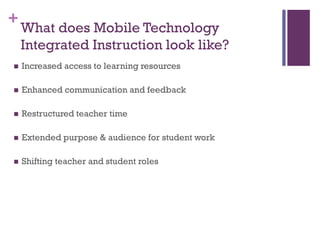
What does Mobile Technology
Integrated Instruction look like?



Increased access to learning resources



Enhanced communication and feedback



Restructured teacher time



Extended purpose & audience for student work



Shifting teacher and student roles
+

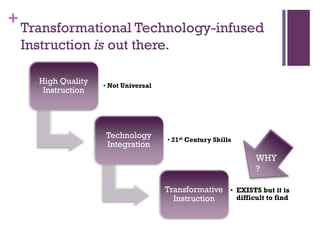
Transformational Technology-infused
Instruction is out there.
High Quality
Instruction

• Not Universal

Technology
Integration

• 21st Century Skills

WHY
?
Transformative • EXISTS but it is
difficult to find
Instruction
+

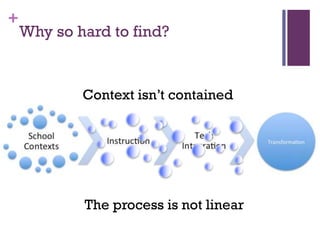
Why so hard to find?

Context isn’t contained

The process is not linear
+

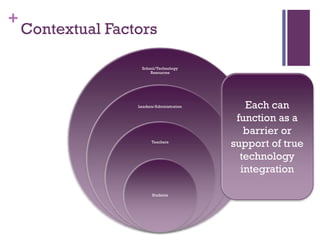
Contextual Factors
School/Technology
Resources

Leaders/Administration

Teachers

Students

Each can
function as a
barrier or
support of true
technology
integration
+

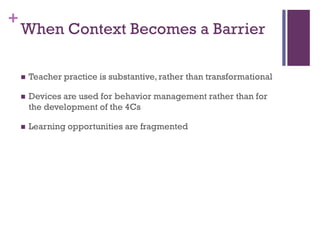
When Context Becomes a Barrier


Teacher practice is substantive, rather than transformational



Devices are used for behavior management rather than for
the development of the 4Cs



Learning opportunities are fragmented
+

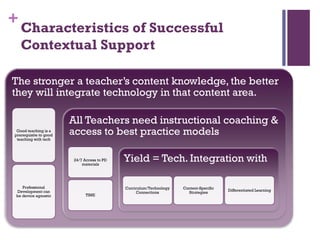
Characteristics of Successful
Contextual Support

The stronger a teacher’s content knowledge, the better
they will integrate technology in that content area.

Good teaching is a
prerequisite to good
teaching with tech

All Teachers need instructional coaching &
access to best practice models
24/7 Access to PD
materials

Professional
Development can
be device agnostic

TIME

Yield = Tech. Integration with
Curriculum/Technology
Connections

Content-Specific
Strategies

Differentiated Learning
+


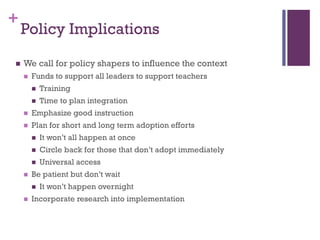
Policy Implications
We call for policy shapers to influence the context


Funds to support all leaders to support teachers


Training



Time to plan integration



Emphasize good instruction



Plan for short and long term adoption efforts



Circle back for those that don’t adopt immediately




It won’t all happen at once
Universal access

Be patient but don’t wait




It won’t happen overnight

Incorporate research into implementation
+

Engage

https://todaysmeet.com/UNESCO
+

Contact Details


shawngross@sandiego.edu



shimelstein@sandiego.edu



mcorke@sandiego.edu



hisdsuperintendent@houstonisd.org



lesley.eason@onslow.k12.nc.us



timothy.baird@eusd.net
+

Links

MLW14 UNESCO - US Panel on Best Practices and Lessons Learned

  • 1.
    + Best Practices &Lesson Learned in Mobile Learning A perspective from school leaders in the US
  • 2.
    + Agenda Topic Presented By Introductions andGoals Shawn Gross Overview of MTLC Scott Himelstein Case Study #1 – Onslow County Dr. Lesley Eason Case Study #2 – Encinitas Dr. Tim Baird Case Study #3 - Houston Dr. Terry Grier Summary of MTLC Research Dr. Michael Corke Questions and Answers All
  • 3.
    + Goals and Objectives  Gaininsight from three mobile learning leaders in the US from leaders in three school systems across three different regions of the US in three different size school districts and three different points along the mobile technology integration continuum.  Learn about new and innovative research collected by MTLC regarding lessons learned and best practices in mobile learning  Engage all panelists with key questions, comments or concerns related to mobile learning
  • 4.
  • 5.
    + Introduction to Panel Dr.Lesley Eason Dr. Terry Grier Dr. Tim Baird Scott Himelstein Dr. Michael Corke
  • 6.
  • 7.
    + Overview of MTLC Research& Evaluation MTLC researchers seek to understand how teachers and students globally use forms of mobile technology, what factors influence types of tool use and associated educational outcomes, and how districts and school leaders can best support and develop their teachers' mastery and utilization of mobile technology. Mobile Readiness MTLC provides teachers, school administrators, policy makers including Ministries of Education with access to planning and development, training and implementation support associated with mobile learning Initiatives. Continuing Education Four in-depth fully online courses to earn a mobile learning certificate in eight months for teachers and administrators . Technology & Innovation MTLC identifies and fully tests new and emerging technologies in the field of mobile learning and houses within its mobile technology learning center an innovation bar to enable educators and policy makers to interact and experiment with innovative solutions. .
  • 8.
    + Case Study #1– Onslow County Schools Jacksonville, North
  • 9.
    + District Profile –Onslow County Schools  Total enrollment— 26,377  Grades served—Pre-kindergarten through grade 12  Number of schools--37  District demographics—73% White; 18% African-American; 5% Hispanic; 4%  Other—Forty-eight percent of our students qualify for free/reduced meals.  Located in a semi-rural section of North Carolina and home to Camp Lejeune.
  • 10.
    + District Profile –Onslow County Schools
  • 11.
    + Overview ofMobile Learning Initiative(s)  Why      When   Math & Science Skills Deficit 21st Century Skills (Globally Competitive) Digital Divide Student Assessment of Needs January 2008 – Current Target student populations   Expanded to target 10th, 11th and 12th grade students   Initial target was 9th grade students from schools with poor math scores and high percentages of their populations were socio-economically disadvantaged. Expanded to all 9th grade students across county. Target subject areas (if applicable)   Initial target was algebra 1  Expanded to geometry,, algebra 2, pre-calculus, calculus and statistics Devices   HTC 6800 Smartphone (Windows Mobile), Dell Netbooks, HTC EVO View Tablets (Android), Dell Laptops, Samsung Galaxy Note 2 (Android) Instructional tools and content used  Project K-Nect, Andie Graph, BrainPop, Futures Channel and student and teacher developed curriculum,
  • 12.
    + Outcomes - Methodology  Preand post surveys of students  Assessments of students’ prior skills  Focus groups with students and teachers  Interviews with administrators  Classroom observations  Benchmark with Speak Up data findings  Analysis of standardized test results
  • 13.
    + Outcomes - Findings “Thesmart phone is like a teacher in my pocket.” Project K-Nect Student “I can’t go back to the way I taught before Project K-Nect.” Project K-Nect Teacher
  • 14.
    + Outcomes - Findings  Mobiledevices and 24/7 wireless access empower students to take responsibility for their learning.  Students feel more comfortable with math and demonstrate higher levels of math proficiency.  Students express increased interest in college and math related degrees and careers.  Mobile devices have the power to change the way teachers think about their teaching.
  • 15.
    + Outcomes -Empower students to take responsibility for learning “I’ve become more patient and gained confidence getting to know other people. It helped me with public speaking. I’ve learned its okay to be wrong.” “I’ve helped people when they had trouble and know they see me as an expert. I thought I only knew the basics but I just picked up more as I help people.” “I’ve learned how to make a presentation – it feels good to know that your classmates depend on you.” “I’ve learned to be more trusting with others. There is a lot of teamwork in the project – I’ve learned to trust and be more dependable.” “I learn better when working with peers.” “Be brave enough to ask questions.”
  • 16.
    + Increased comfort andsuccess with math Figure 3: Algebra I students report increased confidence in their math abilities 89% 76% Motivated to learn math 83% 71% Comfortable learning math 72% 59% Feel successful 61% Math is easy 0% 29% 20% 40% Beginning of semester 60% 80% End of semester 100%
  • 17.
    + Increased comfort andsuccess with math Student Achievement Onslow School District 2008-2009 School Year 0% 20% 40% 60% 80% Al gebra I Geometry Al gebra II Al gebra II Geometry Al gebra I K-Nect Students (SouthWest) 83% 90% 91% K-Nect Students (Di xon) 81% 65% 93% non K-Nect Students 70% 76% 66% Di stri ct 75% 78% 70% State 73% 73% 68% K-Ne ct Stude nts (SouthWe s t) K-Ne ct Stude nts (Di xon) non K-Ne ct Stude nts Di s tri ct Sta te 100%
  • 18.
    + Proficiency on endof course exams (Jan 2012 results) 90% of Algebra I students 100% of Algebra II students
  • 19.
    + Changes to Instruction  Projectbased learning design  Relationships with students  Incorporation of 21st Century Skills  24x7 Learning  Students teaching students (personalized learning communities)
  • 20.
    + Key SuccessFactors Connectivity at home and school  Professional development and ongoing support (ITF)  Adoption and acceptance by lead teachers  Mobile device management  Direct training provided to students  Communications with parents and caretakers  Student ownership of their learning process 
  • 21.
    + Case Study #2– Encinitas Union School District San Diego, California
  • 22.
    + District Profile –Encinitas  Total enrollment – 5,448  Grades served K – 6th Grade  Number of schools – 9 Schools  District demographics – 30% minority (primarily Latino), 12% English Learners.  3 Title 1 Schools, Community is middle to upper middle class professional with pockets of poverty on west side of district.  All schools have been recognized as California Distinguished Schools. District has been recognized at state and national level for health and wellness programs and environmental programs.
  • 23.
    + Overview ofMobile Learning Initiative(s)  Why – 1) To engage learners; 2) To differentiate learning for all students; 3) To incorporate global competencies and higher levels of learning into curriculum.  When – Infrastructure (2009), All staff and student pilot programs (2010), 4th-6th grade (2011), 3rd-6th grade (2012), K-6th grade (2013)  Target student populations – All (including EL and Special Education)  Target subject areas (if applicable) Creative tools, ELA, Math, Science  Devices – iPads (students), iPads and MacBook Pros (staff)  Instructional tools and content used – iWorks Suite, ST Math, Ten Marks, Imagine Learning, MyOn Reader, Defined Stem, and other programs.
  • 24.
    + Outcomes (Quantitativeand Qualitative)  Academic Performance Indicator (API) at highest levels in district history  7 of 9 schools currently nominated for CA Distinguished School Award  Student, staff, and parent survey show high engagement in learning and strong support of iPads and digital curriculum  Locally designed assessments show strong student learning indicators  Digital curriculum new this year but will have data tracking and progress monitors embedded
  • 25.
    + Key SuccessFactors  Improved student engagement.  Ability to differentiate teaching and learning to each individual learner.  Student ability to use collaboration, critical thinking, creative thinking, and communication.  Parent access to individual student information and work progress.  Staff engagement and willingness to try new tools and instructional methodologies and pedagogies.
  • 26.
    + Case Study #3– Houston Independent School District Houston, Texas
  • 27.
    + District Profile --HISD  Total enrollment—210,000 students  Grades served—Pre-kindergarten through grade 12  Number of schools--282  District demographics—62% Hispanic; 26% AfricanAmerican; 8% White; 4% Other  Houston is the most diverse city in America.  Eighty-three percent of our students qualify for free/reduced meals.
  • 28.
    + Overview ofMobile Learning Initiative(s)  Why   When   All subject areas Devices   All high school students Target subject areas   We started this initiative in August of 2013 and be 1:1 at every high school in three years. Target student populations   Improve student engagement by changing the instructional delivery model. PowerUp is not about giving students a device. HISD is changing instructional delivery in such a way devices become enables in the learning process. HP 9470m Elitebook Instructional tools and content used  Discovery ED, ABC-CLIO, NearPod, Office 365, Edmodo, Learning Gizmos, VoiceThread, Animotoa, Movie Maker, Voki, GoAnimate, Weebly, Wikispace, Padlet, Screen-O-Matic
  • 29.
    + Outcomes (Quantitativeand Qualitative)  Achievement  Attendance  Discipline  Teacher, Parent and Student Survey  Professional Development Effectiveness  HISD has entered into a three year agreement with a mobile learning research institution to conduct an independent evaluation of the PowerUP program.
  • 30.
    + Key SuccessFactors  Our critical success factors will change with each subsequent year of implementation. For year one here are our top 5 critical success factors:  Digital Curriculum Readiness  Teacher Readiness (PD)  Campus Leadership Readiness (PD)  Technical and Instructional Support for Pilot Campuses  Technical Infrastructure / Configuration
  • 31.
  • 32.
    + MTLC’s Scope ofSynthesis Regional Scope National Scope Work in progress Encinitas Federal Communications Commission Countywide technology audit Solana Beach Contextual Review Cajon Valley Coronado Digital Promise Literature Reviews HISD Implementation
  • 33.
    + What does MobileTechnology Integrated Instruction look like?  Increased access to learning resources  Enhanced communication and feedback  Restructured teacher time  Extended purpose & audience for student work  Shifting teacher and student roles
  • 34.
    + Transformational Technology-infused Instruction isout there. High Quality Instruction • Not Universal Technology Integration • 21st Century Skills WHY ? Transformative • EXISTS but it is difficult to find Instruction
  • 35.
    + Why so hardto find? Context isn’t contained The process is not linear
  • 36.
  • 37.
    + When Context Becomesa Barrier  Teacher practice is substantive, rather than transformational  Devices are used for behavior management rather than for the development of the 4Cs  Learning opportunities are fragmented
  • 38.
    + Characteristics of Successful ContextualSupport The stronger a teacher’s content knowledge, the better they will integrate technology in that content area. Good teaching is a prerequisite to good teaching with tech All Teachers need instructional coaching & access to best practice models 24/7 Access to PD materials Professional Development can be device agnostic TIME Yield = Tech. Integration with Curriculum/Technology Connections Content-Specific Strategies Differentiated Learning
  • 39.
    +  Policy Implications We callfor policy shapers to influence the context  Funds to support all leaders to support teachers  Training  Time to plan integration  Emphasize good instruction  Plan for short and long term adoption efforts   Circle back for those that don’t adopt immediately   It won’t all happen at once Universal access Be patient but don’t wait   It won’t happen overnight Incorporate research into implementation
  • 40.
  • 41.
  • 42.