This document discusses an experiment that examined the effects of orderly vs. disorderly room environments on human behavior and decision-making. In three experiments, participants placed in orderly rooms tended to make healthier food choices, donate more money to charity, and prefer conventional options, while those in disorderly rooms demonstrated more creativity. The findings suggest that physical surroundings can influence behaviors and preferences in meaningful ways. Maintaining orderliness may promote healthy, generous, and conventional behaviors, while some disorder could foster creativity.
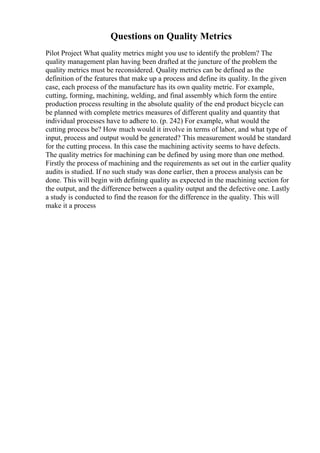
![Have you ever wondered how big our drainage system is and what s the capacity of
the system [2]? The](https://image.slidesharecdn.com/mlaformatessayheading-240206160745-d3a37ea0/85/Mla-Format-Essay-Heading-pdf-5-320.jpg)
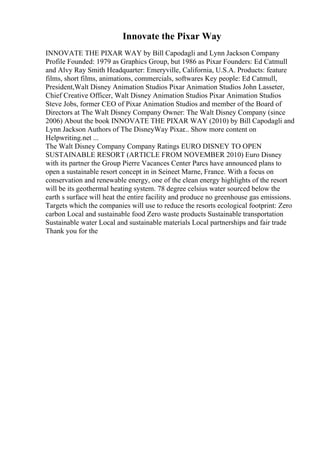
![The Role of Money in Society Depicted in Robert Louis...
The love of money is the root of all evil, a statement that has proved itself true
through the centuries. Loving money traps us, as human beings. It is not a bad
thing to enjoy what money can do; however, the love of money is a wasted effort
that can put all in grave peril. It is at our advantage that we have the ability to choose
whether we want to fall into that trap. Unfortunately, that choice is difficult since
society associates one s character with wealth and financial management. The
mishaps, deaths, and hardships that occur from the beginning of the tale are the
result of deliberate deception for personal gain. In Treasure Island, greed sends the
characters on a voyage. Robert Louis Stevenson makes a social commentary on...
Show more content on Helpwriting.net ...
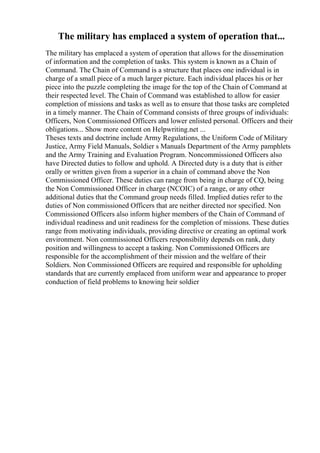
The Squire s poor judgment is based on Silver s ability to count. At each stratum of
society, there is the misconception of correlating money and character. Jim s mother
risked her life and that of her only son to get her dues. [I] m an honest woman, she
proclaims and intends to prove this proclamation by taking only what is owed
(Stevenson 17). It is astonishing how her perception of value is skewed. She sits
counting money in the face of imminent danger. She values money over the safety
of herself and her son. It is when danger is at the door that Jim is able to pull her
back from the brink of death and disaster. According to Stevenson, society values
success. Silver embodies that success. He owns a well managed bar that is freshly
painted and cleanly swept which gives the impression of a respectable
establishment. Silver is cordial, solicitous, and jovial in tone. Jim did not
recognize Silver as a buccaneer upon the first encounter because he did not fit the
part. Silver says, never denied myself o nothing heart desires, because he
understood the purpose of money (46); money is a medium used to acquire
necessities and fancies but is of no real value unused. Silver is still ruthless and
cutthroat, but he is successful. Silver has a good bank account and a wife. Money
does not replace companionship and of all the buccaneers, Silver is the only one with
a wife and he even professes that she is trustworthy.](https://image.slidesharecdn.com/mlaformatessayheading-240206160745-d3a37ea0/85/Mla-Format-Essay-Heading-pdf-13-320.jpg)
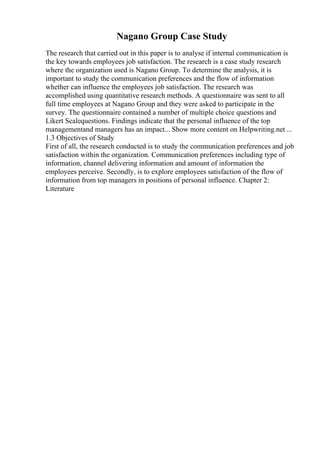

![Honor In The Odysseus
In the Disney movie Mulan, a young heroine, Mulan, disguises herself as a man to
fight for her country and restore honor to her family. She, similar to Odysseus, must
save her country from invaders, The Huns for Mulan and the suitors for Odysseus.
Both protagonists face many trials that test their loyalty and honor. And both prevail,
becoming great, respected leaders of their people. Honor as well as loyalty are
significant characteristics of a respected person. The Odyssey, written by Homer in
the eighth century BCE, is a common story with multiple retellings that focuses on
the journey of Odysseusand his son Telemachus. Odysseus is a war hero of the
Trojan War, and the tale focuses on the conflicts he faces while journeying home. In
this story, Odysseus shows how honor and loyalty play a pivotal role in defining the
success of a leader, and how the absence of these traits leads to anarchy and turmoil
within a ruler s domain.
The necessity of honor and loyalty in a ruler are seen during the Odysseus absence
in his kingdom of Ithaka. During the 16th year that Odysseus is missing, suitors
come from all over the land to win the hand of Odysseus wife, Penelope, presuming
Odysseus is dead. Because Odysseus is absent, the country is having a turn for the
worse with the arrival of the suitors. The suitors take over the royal residence, [the
suitors] use our house as if it were a house to plunder (Homer 9). Without a ruler
governing the people, there lies no punishment for](https://image.slidesharecdn.com/mlaformatessayheading-240206160745-d3a37ea0/85/Mla-Format-Essay-Heading-pdf-44-320.jpg)