Exam pattern
Section A consists of 2 (two) compulsory questions worth of 50
marks.
Section B consists of 4 (four) questions. You are to choose 2 (two)
questions out of 4 (four) worth of 50 marks.
Exam duration 3 hrs (Writing time), CLOSED book exam and total 100
marks.
You MUST get 50   marks from your final exam in order to pass.

   You need:
      Student Card – No Student ID = No Exam: No argument!!
      3-4 pens
      To turn your phone off – it goes off - the examiner goes off!!
      Your enthusiasm, your knowledge
      You do not need – panic, stress, worry
                                                                 1
Exam Techniques
Start a new question on a fresh page and write the
question number. Your answers must show the
question numbers clearly.
Please write legibly and only on one side of a page.
Use only a Blue or a Black pen.
Use Titles and Sub titles and underline them.
Avoid writing essay type.
You may write in short paragraphs.
Use examples as much as possible, you may use
tables, drawings, pictures wherever necessary.


                                                   2
Exam Techniques
Good handwriting and presentation may score high!

Find the key words in the question & note and
answer the question on the page

Highlight the key words in your answer

Do not worry if the person next to you is writing in a
3rd book – it might be rubbish!?!?


                                                     3
Exam Techniques

You should look to maximise your marks
  Look for the key words
     And, List and describe, Provide an example
       • All these elements need to be answered
       • If you miss the AND you are not fully answering the
        question
  Provide a brief example that you are familiar
  with
     Keep the examples simple
  Provide a definition for all the questions
     Even if the question does not ask for it
                                                           4
REVISION SLIDES


                  5
Focus areas?

          All chapters!


  Do remember that you should not come
  to the exam hall without studying the
            following topics!


                                              6
                                          6
Marketing (KL001)
   Lesson 1: The role of Marketing in
               Business

Prescribed Text Book:
Principles of Marketing
12th/13th  Edition,    (2010),  Pearson
Education
Global Edition
Authors: Philip Kotler & Gary Armstrong


                                        7
Customer driven marketing
strategy

To design a winning marketing strategy, the company
must first decide who it will serve. It does this by dividing
the market into segments of customers (market
segmentation) and selecting which segments it will
cultivate (target marketing). Next, the company must
decide how it will serve targeted customers (how it will
differentiate and position itself in the marketplace).


                                                            8
Marketing Management
Orientations /
Philosophies
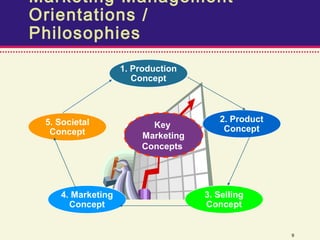
                   1. Production
                      Concept


 5. Societal                           2. Product
                          Key           Concept
  Concept               Marketing
                        Concepts


    4. Marketing                    3. Selling
      Concept                       Concept


                                                    9
Marketing Management
     Orientations /
     Philosophies
1. The production concept
   Consumers will favor those products that are widely available and
   low in cost. Eg: tissue paper, sandals
2. Product concept
   Consumers will favor those products that offer the most quality,
   performance, and innovative features. Eg: Printers, Computers
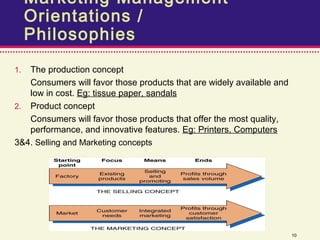
3&4. Selling and Marketing concepts


                                                                       10
Societal Marketing
Concept

    It is an enlargement of the marketing concept

  Organisations should determine the needs, wants and
  interests of target markets and deliver the desired
  satisfaction more effectively and efficiently than
  competitors in a way that maintains or improves the
  customer’s and society’s well-being.


                                                        11
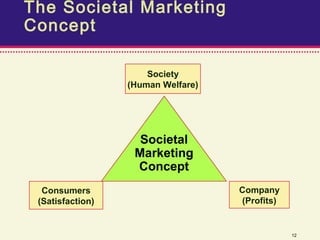
The Societal Marketing
Concept

                      Society
                  (Human Welfare)


                    Societal
                   Marketing
                   Concept
  Consumers                         Company
 (Satisfaction)                     (Profits)


                                                12
13
Developing the Marketing Mix
  The marketing mix is the set of controllable
  variables; product, price, place and promotion
  (Four Ps) that the company uses to meet the target
  markets needs and wants.
  Organisations that include service components
  use the extended marketing mix.


                                                       14
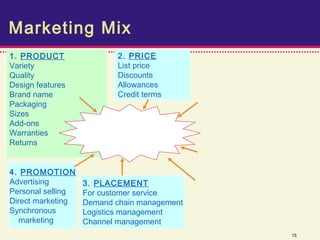
Marketing Mix
1. PRODUCT                 2. PRICE
Variety                    List price
Quality                    Discounts
Design features            Allowances
Brand name                 Credit terms
Packaging
Sizes
Add-ons
                    TARGET CUSTOMERS
Warranties
                  INTENDED POSITIONING
Returns


4. PROMOTION
Advertising        3. PLACEMENT
Personal selling   For customer service
Direct marketing   Demand chain management
Synchronous        Logistics management
   marketing       Channel management
                                             15
16
Marketing (KL001)


Lesson 7: Market Segmentation, Targeting and
                 Positioning


                                               17
Market segmentation

 Market segmentation
 •   dividing a market into distinct groups of buyers
     with different needs, characteristics or behaviour
     who might require separate products or marketing
     mixes.


                                                          18
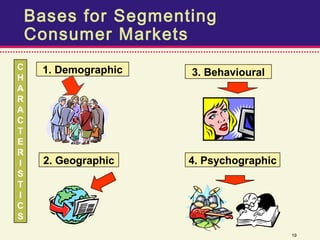
Bases for Segmenting
    Consumer Markets
C    1. Demographic
H
                      3. Behavioural
A
R
A
C
T
E
R
I     2. Geographic   4. Psychographic
S
T
I
C
S
                                         19
20
Marketing (KL001)


Lesson 4: Information Management and
         Marketing Research


                                   21
Marketing Research
   Marketing Research: The function that links the consumer,
   customer and public to the marketer through information used
   to:
       identify and define marketing opportunities and problems
       generate, refine and evaluate marketing actions
       monitor marketing performance
       improve understanding of the marketing process
(p. 208, Kotler, Brown, Adam, Armstrong)


                                                              22
Data Collection Methods
Surveys – usually a printed or web-based self-administered set of
questions requiring written (or electronically entered) responses.
   Closed and open questions
   Completion methods (self, third party or personally administered)
   Survey delivery (mail out, personal, location-based or Internet)
Interviews - group or one to one involving human interaction as the
researcher collects data from questions asked directly to the research
participants.
   Focus groups
   One to one interviews
Observation – the researcher watches the consumers behaving in a
natural environment or in a controlled lab setting
   People meters
   Checkout scanners
Experiments – two or more groups subjected to an experiment where one
critical factor is changed between each group. The aim is to understand
causal relationships.
   Field experiments


                                                                       23
Marketing (KL001)


Lesson 8: Products: Goods, Services and
              Experiences


                                     24
Product Mix Decisions

  A product mix is the set of all product lines and
  items that a particular seller offers for sale
  The product mix can be described as having
  breadth, length, depth and consistency
    Breadth is the number of different product lines
    Length is the total number of items the company
    carries
    Depth is the number of versions offered of each
    product in the line
    Consistency is how closely the various product
    lines are in end use, production requirements, and
    distribution channels.


                                                         25
26
Marketing (KL001)


Lesson 5: Consumer Buying Behaviour


                                  27
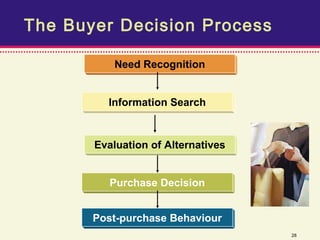
The Buyer Decision Process

           Need Recognition


         Information Search


       Evaluation of Alternatives


          Purchase Decision


       Post-purchase Behaviour
                                    28
29
Marketing (KL001)


      Lesson 14: IMC:
Direct and Online Marketing


                              30
What Is Online Marketing?

  Online marketing entails interaction with known
  customers and others in the marketing channel,
  on a one-to-one basis, often in real time, to
  maintain value-laden relationships and to
  generate a measurable response and/or
  transactions using electronic network tools and
  technologies.


                                                    31
Direct and Online
Database

Direct and online database marketing entails development
and maintenance of electronic databases to interact with
past, present and/or potential customers and others in
the marketing channel, on a one-to-one basis, often in real
time, and where the databases are used to maintain value-
laden relationships and to generate a measurable
response and/or transactions through the integrated use
of electronic network tools and technologies


                                                         32
How are direct and online
marketing databases
used?

Marketing organisations use their databases in a
  number of ways:

1. Identifying prospects
2. Deciding which customers should receive a
   particular offer
3. Deepening customer loyalty
4. Reactivating customers
5. Data mining


                                                   33
How Are Databases
Used?


1. Identifying prospects

     Many companies generate sales leads by
     advertising their products or offers. Ads generally
     have a response feature, such as a business reply
     card or toll-free phone number. The database is
     built from these responses


                                                           34
How Are Databases
 Used?

2. Deciding which customers should receive a particular
   offer

      Companies identify the profile of an ideal customer for an
      offer. Then they search their databases for individuals most
      closely resembling the ideal type. By tracking individual
      responses, the company can improve its targeting precision
      over time


                                                               35
How Are Databases
Used?

3. Deepening customer loyalty

     Companies can build customers’ interest and
     enthusiasm by remembering their preferences and
     by sending appropriate information, gifts, or other
     materials


                                                           36
How Are Databases
Used?

4. Reactivating customers

     The database can help a company make attractive
     offers of product replacements, upgrades, or
     complementary products just when customers
     might be ready to act


                                                       37
How Are Databases
Used?

5. Data mining

     Companies maintain many databases in what today
     are large data warehouses. Data mining entails
     checking databases for patterns and trends that are
     hypothesised to exist, or in order to find new
     connections between data item. Modern software
     enables open-ended queries that involve systematic
     searches for relationships and patterns within and
     between databases.


                                                           38
Good luck to you...

Be cool to appear for the exam
Make sure you are appearing for the exam and don’t be
absent
Be on time, the exam invigilator will not wait for you and 3
hours may not be enough..


      You need to have a good rest before the exam
      Bring some sweets to keep you energetic


                                                          39

Mktg summer revision slides 2011

  • 1.
    Exam pattern Section Aconsists of 2 (two) compulsory questions worth of 50 marks. Section B consists of 4 (four) questions. You are to choose 2 (two) questions out of 4 (four) worth of 50 marks. Exam duration 3 hrs (Writing time), CLOSED book exam and total 100 marks. You MUST get 50 marks from your final exam in order to pass. You need: Student Card – No Student ID = No Exam: No argument!! 3-4 pens To turn your phone off – it goes off - the examiner goes off!! Your enthusiasm, your knowledge You do not need – panic, stress, worry 1
  • 2.
    Exam Techniques Start anew question on a fresh page and write the question number. Your answers must show the question numbers clearly. Please write legibly and only on one side of a page. Use only a Blue or a Black pen. Use Titles and Sub titles and underline them. Avoid writing essay type. You may write in short paragraphs. Use examples as much as possible, you may use tables, drawings, pictures wherever necessary. 2
  • 3.
    Exam Techniques Good handwritingand presentation may score high! Find the key words in the question & note and answer the question on the page Highlight the key words in your answer Do not worry if the person next to you is writing in a 3rd book – it might be rubbish!?!? 3
  • 4.
    Exam Techniques You shouldlook to maximise your marks Look for the key words And, List and describe, Provide an example • All these elements need to be answered • If you miss the AND you are not fully answering the question Provide a brief example that you are familiar with Keep the examples simple Provide a definition for all the questions Even if the question does not ask for it 4
  • 5.
  • 6.
    Focus areas? All chapters! Do remember that you should not come to the exam hall without studying the following topics! 6 6
  • 7.
    Marketing (KL001) Lesson 1: The role of Marketing in Business Prescribed Text Book: Principles of Marketing 12th/13th Edition, (2010), Pearson Education Global Edition Authors: Philip Kotler & Gary Armstrong 7
  • 8.
    Customer driven marketing strategy Todesign a winning marketing strategy, the company must first decide who it will serve. It does this by dividing the market into segments of customers (market segmentation) and selecting which segments it will cultivate (target marketing). Next, the company must decide how it will serve targeted customers (how it will differentiate and position itself in the marketplace). 8
  • 9.
    Marketing Management Orientations / Philosophies 1. Production Concept 5. Societal 2. Product Key Concept Concept Marketing Concepts 4. Marketing 3. Selling Concept Concept 9
  • 10.
    Marketing Management Orientations / Philosophies 1. The production concept Consumers will favor those products that are widely available and low in cost. Eg: tissue paper, sandals 2. Product concept Consumers will favor those products that offer the most quality, performance, and innovative features. Eg: Printers, Computers 3&4. Selling and Marketing concepts 10
  • 11.
    Societal Marketing Concept It is an enlargement of the marketing concept Organisations should determine the needs, wants and interests of target markets and deliver the desired satisfaction more effectively and efficiently than competitors in a way that maintains or improves the customer’s and society’s well-being. 11
  • 12.
    The Societal Marketing Concept Society (Human Welfare) Societal Marketing Concept Consumers Company (Satisfaction) (Profits) 12
  • 13.
  • 14.
    Developing the MarketingMix The marketing mix is the set of controllable variables; product, price, place and promotion (Four Ps) that the company uses to meet the target markets needs and wants. Organisations that include service components use the extended marketing mix. 14
  • 15.
    Marketing Mix 1. PRODUCT 2. PRICE Variety List price Quality Discounts Design features Allowances Brand name Credit terms Packaging Sizes Add-ons TARGET CUSTOMERS Warranties INTENDED POSITIONING Returns 4. PROMOTION Advertising 3. PLACEMENT Personal selling For customer service Direct marketing Demand chain management Synchronous Logistics management marketing Channel management 15
  • 16.
  • 17.
    Marketing (KL001) Lesson 7:Market Segmentation, Targeting and Positioning 17
  • 18.
    Market segmentation Marketsegmentation • dividing a market into distinct groups of buyers with different needs, characteristics or behaviour who might require separate products or marketing mixes. 18
  • 19.
    Bases for Segmenting Consumer Markets C 1. Demographic H 3. Behavioural A R A C T E R I 2. Geographic 4. Psychographic S T I C S 19
  • 20.
  • 21.
    Marketing (KL001) Lesson 4:Information Management and Marketing Research 21
  • 22.
    Marketing Research Marketing Research: The function that links the consumer, customer and public to the marketer through information used to: identify and define marketing opportunities and problems generate, refine and evaluate marketing actions monitor marketing performance improve understanding of the marketing process (p. 208, Kotler, Brown, Adam, Armstrong) 22
  • 23.
    Data Collection Methods Surveys– usually a printed or web-based self-administered set of questions requiring written (or electronically entered) responses. Closed and open questions Completion methods (self, third party or personally administered) Survey delivery (mail out, personal, location-based or Internet) Interviews - group or one to one involving human interaction as the researcher collects data from questions asked directly to the research participants. Focus groups One to one interviews Observation – the researcher watches the consumers behaving in a natural environment or in a controlled lab setting People meters Checkout scanners Experiments – two or more groups subjected to an experiment where one critical factor is changed between each group. The aim is to understand causal relationships. Field experiments 23
  • 24.
    Marketing (KL001) Lesson 8:Products: Goods, Services and Experiences 24
  • 25.
    Product Mix Decisions A product mix is the set of all product lines and items that a particular seller offers for sale The product mix can be described as having breadth, length, depth and consistency Breadth is the number of different product lines Length is the total number of items the company carries Depth is the number of versions offered of each product in the line Consistency is how closely the various product lines are in end use, production requirements, and distribution channels. 25
  • 26.
  • 27.
    Marketing (KL001) Lesson 5:Consumer Buying Behaviour 27
  • 28.
    The Buyer DecisionProcess Need Recognition Information Search Evaluation of Alternatives Purchase Decision Post-purchase Behaviour 28
  • 29.
  • 30.
    Marketing (KL001) Lesson 14: IMC: Direct and Online Marketing 30
  • 31.
    What Is OnlineMarketing? Online marketing entails interaction with known customers and others in the marketing channel, on a one-to-one basis, often in real time, to maintain value-laden relationships and to generate a measurable response and/or transactions using electronic network tools and technologies. 31
  • 32.
    Direct and Online Database Directand online database marketing entails development and maintenance of electronic databases to interact with past, present and/or potential customers and others in the marketing channel, on a one-to-one basis, often in real time, and where the databases are used to maintain value- laden relationships and to generate a measurable response and/or transactions through the integrated use of electronic network tools and technologies 32
  • 33.
    How are directand online marketing databases used? Marketing organisations use their databases in a number of ways: 1. Identifying prospects 2. Deciding which customers should receive a particular offer 3. Deepening customer loyalty 4. Reactivating customers 5. Data mining 33
  • 34.
    How Are Databases Used? 1.Identifying prospects Many companies generate sales leads by advertising their products or offers. Ads generally have a response feature, such as a business reply card or toll-free phone number. The database is built from these responses 34
  • 35.
    How Are Databases Used? 2. Deciding which customers should receive a particular offer Companies identify the profile of an ideal customer for an offer. Then they search their databases for individuals most closely resembling the ideal type. By tracking individual responses, the company can improve its targeting precision over time 35
  • 36.
    How Are Databases Used? 3.Deepening customer loyalty Companies can build customers’ interest and enthusiasm by remembering their preferences and by sending appropriate information, gifts, or other materials 36
  • 37.
    How Are Databases Used? 4.Reactivating customers The database can help a company make attractive offers of product replacements, upgrades, or complementary products just when customers might be ready to act 37
  • 38.
    How Are Databases Used? 5.Data mining Companies maintain many databases in what today are large data warehouses. Data mining entails checking databases for patterns and trends that are hypothesised to exist, or in order to find new connections between data item. Modern software enables open-ended queries that involve systematic searches for relationships and patterns within and between databases. 38
  • 39.
    Good luck toyou... Be cool to appear for the exam Make sure you are appearing for the exam and don’t be absent Be on time, the exam invigilator will not wait for you and 3 hours may not be enough.. You need to have a good rest before the exam Bring some sweets to keep you energetic 39

Editor's Notes

  • #10 Marketing management philosophies pp 18-22 There are several concepts that reflect different philosophies about the role of marketing activities. The marketing concept and the societal marketing concept are the only concepts that reflect the notion of each party benefiting from the exchange process. The production concept : Companies dominated by this concept focus their efforts on improving production efficiencies in order to obtain economies of scale. The philosophy driving this concept is that ‘consumers will favour products that are available and highly affordable’ (p 17). The product concept: Companies dominated by this concept focus their efforts on research and development in order to produce improved and/or innovative products. The philosophy underlying this concept is that ‘consumers favour products that offer the most quality, performance and features’ (P 17). The selling concept: Companies dominated by this concept focus their efforts on the sales process in order to sell large quantities of the product. The philosophy underlying this concept is that ‘consumers will not buy enough of the organisation’s products unless the organisation undertakes a large scale selling and promotion effort’ (pp 17-18). The marketing concept: Companies dominated by this concept are following an approach to marketing that is based upon the satisfaction of both parties to the exchange – customer value within the capabilities of the company. The philosophy underlying this concept is that ‘achieving organisational goals depend son determining the needs and want of target markets and delivering the desired satisfactions more effectively and efficiently than the competitors’ (pp 18-19). The key idea in this concept is balance between customer satisfaction and profits. This concept is explored in self-check question 1. The societal marketing concept: Companies dominated by this concept are following the marketing orientation. The key difference is that the interests of society are also factored into the equation (pp 18-21).
  • #12 Societal Marketing p22 Organisations should determine the needs, wants and interests of target markets and deliver the desired satisfaction more effectively and efficiently than competitors in a way that maintains or improves the customer’s and society’s well-being.
  • #13 The societal marketing concept Figure 1.7 p 22 The philosophy underlying this concept is that companies should aim to follow the marketing concept but in ‘a way that maintains or improves the consumer’s and societies well-being’ (p 22). This concept is explored in self-check question 2.
  • #15 p. 105 The extended marketing mix is explained on the next slide.
  • #16 The extended marketing mix ( Figure. 3.16, p. 107) includes the traditional Four Ps, as well as people, process and physical evidence. An effective marketing program blends all marketing mix elements into a coordinated program designed to achieve the company’s marketing objectives by delivering value to the consumers. The Marketing Mix Product In the contemporary mix, Product is the term for the ‘goods and service’ offering sold by the company. Placement Refers to the demand chain stretching back from the end-consumer through making and distributing to suppliers. Price Students will know about list and discount prices as many will have shopped in discount malls. The manipulation of price in the marketing channel through allowances, credit, and payment arrangements may be new to them. Promotion Promotion covers what many students will identify as ‘real marketing’. While the role of promotion is important, remind them of the dangers of too much emphasis on a single component of the mix. Point out the changes from mass marketing to one-to-one marketing. People Particularly with services, people interacting with people describes the situation and the importance of relationships. Process Process is important, particularly in delivering such as financial services. Hence the importance of ‘service quality’. Physical evidence How can one judge a service such as childcare, or a toothpaste that promises reduced tooth decay over a 20-year period. What evidence is used to judge the product?
  • #19 Three Major Steps in Target Marketing p 217 Three major steps in target marketing include: Market segmentation: ‘Dividing a market into direct groups of buyers who might require separate products or marketing mixes; the process of classifying customers into groups with different needs, characteristics or behaviour’. Market targeting: ‘Evaluating each market segment’s attractiveness and selecting one of more segments to enter’. Market positioning: ‘Arranging for a product to occupy a clear, distinctive and desirable place relative to competing products in the minds of target consumer; formulating competitive positing for a product and creating a detailed marketing mix’.
  • #20 Bases for Segmenting Consumer Markets p 219 There is no single way to segment a market, different variables need to be tried to find the best and most meaningful way to view the market structure. Table 7.1 outlines the major variables that might be used in segmenting consumer markets. We begin with geographic and demographic segmentation and continue on the next slide with behavioural and psychographic segmentation.
  • #23 Marketing Research pp. 213–214 Managers cannot always wait for information to arrive in bits and pieces from the marketing intelligence system, nor does the marketing intelligence system alert them to every problem, nor tell them everything they need to know about the marketplace. They often require formal studies of specific situations. We define marketing research as ‘the function that links the consumer, customer and public to the marketer through information. It is used to identify and define marketing opportunities and problems; to generate, refine and evaluate marketing actions; to monitor marketing performance; and to improve understanding of the marketing process’ (p. 208). As a process, marketing research involves the systematic design, collection, analysis and reporting of data relevant to a specific marketing situation facing an organisation. Marketing organisations either initiate, or themselves undertake, marketing research studies across many issues and in response to many information needs ranging from analyses of sales and market shares to studies of social values and policies. Every marketer needs research. An organisation can undertake marketing research in its own research department, or outsource any or all of the research projects. Large organisations sometimes outsource special projects. Even small businesses are able to find low-cost alternatives.
  • #26 P280 Example of product mix: Avon sells four major product lines: cosmetics, jewellery, fashion and household items. The four dimensions of breadth, length, depth and consistency provide the ‘handles’ for defining the company’s product strategy. The company can increase its business in four ways: Add new product lines 2. lengthen its existing product lines 3. Add more product versions to each product and deepen the product mix 4. Pursue line consistency International product decisions (p281) Companies need to decide whether to standardise their product offerings or to respond to their markets’ differences. Cultural differences may result in different preferences. For example, different symbolic meanings and interpretation of a packages colour, name and labels. Legal requirements for products and packaging also vary in different countries.
  • #29 Figure 5.7 The Buyer Decision Process p 169 and pp 169-171 Figure 5.7 shows the consumer as passing though five stages: need recognition, information search, evaluation of alternatives, purchase decision and post-purchase behaviour. Clearly the buying process starts long before actual purchase and continues long after. Marketers need to focus on the entire process. The buying process starts with need recognition – with the buyer recognising a problem or need. A buyer senses a difference between his actual state and some desired state. The need can be triggered by internal stimuli when one of the person’s normal needs – hunger, thirst, sex – rises to a level high enough to become a drive. A need can also be triggered by external stimuli. Information search: ‘The stage of the buyer decision process in which the consumer is aroused to search for more information; the consumer may simply have heightened attention or may go into active information search’ (p169). If the consumer’s drive is strong and a satisfying product is near at hand, the consumer is likely to buy it then. If not, the consumer may store the need in memory or undertake an information search related to the need. Alternative evaluation: ‘The stage of the buyer decision process in which the consumer uses information to evaluate alternative brands in the choice set’. How does the consumer choose among the alternative brands? The marketer needs to know about alternative evaluation. Unfortunately consumers do not use simply and single evaluation processes, instead several processes are at work. Purchase decision: ‘The stage of the buyer decision process in which the consumer actually buys the product’. Post-purchase behaviour: ‘The stage of the buyer decision process in which consumers take further action after the purchase, based on their satisfaction or dissatisfaction’. What determines whether the buyer is satisfied or dissatisfied with a purchase? This depends on the product’s performance compared to the expectations of the product. Consumers base their expectations on information they receive from sellers, friends and other sources. Almost all major purchases result in cognitive dissonance ‘discomfort caused by post-purchase conflict’.

  • #32 What Is Online Marketing? Pp 504-505 Online marketing is an extension to direct marketing. Internet (Net) : ‘The world’s largest public computer network which connects many other computers and computer networks’. Online marketing : ‘The three-fold role of the Internet in commerce and government as a new media (communication) knowledge media (the organisation learning about customers an employees, plus customer and employees learning bout the organisation), and marketing channel (online transactions)’. Interconnected microprocessors have penetrated our world: private wide area networks (WAN) in business-to-business activity, as well as mobile phones and short messaging services (SMS) , and the yet-to- develop wireless application protocol (WAP) and mobile commerce (m-commerce). In this world, consumers are more knowledgeable and increasingly selective about whom they will accept communication from, no matte the means employed. They are also turning more readily to peer-to-peer communication. Marketing organisations have turned to the Net either to grow their revenue or for productivity reasons. Other aims of using the Web include: wanting to gain a global presence; establishing and maintaining a competitive edge; shortening or eradicating components of supply chains; making cost savings; and gaining a research advantage. It was envisaged that business would use the Web mainly for consumer marketing. Use of the Web in business-to-business/government marketing has so far outstripped its use in consumer marketing. There are other roles for the Web, and its use in consumer marketing has grown. Some countries such as the US and Korea have embraced shopping online, whereas in other countries it hasn’t become as popular, like in Japan. Net usage in Australasia is similar to that of the US, but the adoption level of the Net for transactions is much lower in Australia. Due to interactivity in real time, online marketing fits more closely with direct response marking that with the mass marketing paradigm of old.
  • #33 Direct and online database use pp 512-514-- Databases lie at the heart of modern marketing science and practice, particularly when marketing organisations adopt a direct and online strategy. Marketing practitioners use databases to record customer information, demographic information and historical transaction data that enable lifetime monitoring of the lifetime value of the customer to the company. What is Direct and Online Database Marketing pp 512-514 ‘ Direct marketing is an interactive system of marketing which uses one or more advertising media to effect a measurable response and/or transaction at any location. Online marketing, is on one hand a form of one-to-one communication, while on the other hand it is also a step beyond mere marketing communication because online fulfilment may also be possible’.   a)    One-to-one dialogue: When using database technology the intention is to engage in One-to-One dialogue an elicit a desired, measurable response in target groups and individuals. A list differs as it ‘is simply names, addresses and contact numbers, and can be hired for direct mailing purposes’. Those on the list that are contacted and agree, may become part of the database. b)    Forms of databases: Databases may take one of three forms: . 1.    Hierarchical databases have been in use the longest; they permit access to customer transaction data using account numbers, but may not allow easy extraction of data relevant to market segmentation. 2.    Network databases are similar, but with multiple access points to the data held. This makes them more flexible in use, but they are more expensive to maintain and more complex to use. 3.    Relational databases are now more commonly used in marketing – the data is entered via the Net/Web and accessed by marketing management via company intranets/extranets. Data is stored in two-dimensional tables of rows and columns, where each row represents the attribute, and columns represent eh same attribute for all records. The tables are linked by common keys and can easily be reconfigured. They are easily accessed and manipulated.
  • #34 How are direct and online databases used? pp 514-515 While business-to-business marketers are heavy users of direct and online marketing databases, consumer products marketers also use these databases. This is particularly true of service organisations. FMCG marketers and their retailing intermediaries increasingly use customer databases for purposes such as loyalty programs. Marketing organisations use their databases in a number of ways.
  • #35 How Are Databases Used? P 514 1. Identifying prospects. Ads generally have a response feature, such as a business reply card or toll-free phone number. The database is built from these responses. The company sorts through the database to identify the best prospects, then reaches them by mail, phone or personal call in an attempt to convert them to customers.
  • #36 How Are Databases Used? P 514   Deciding which customers should receive a particular offer. Companies identify the profile of an ideal customer for an offer. They then search the database for individuals most resembling the ideal type. By tracking individual responses, the company can improve its targeting precision over time. Following a sale, it can set up an automatic sequence of activities: one week later sent a thank-you note; five weeks later send a new offer; ten weeks later, phone the customer and offer a special discount.
  • #37 How Are Databases Used? P 512-513 3. Deepening customer loyalty. Companies can build customers’ interest and enthusiasm by remembering their preferences and sending appropriate information, gifts or other materials.
  • #38 How Are Databases Used? p515 4. Reactivating customer purchases. The database can help company to make attractive offers of product replacements, upgrades or complementary products just when customers might be ready to act.
  • #39 How Are Databases Used? P 515 Data mining. Companies maintain many databases in what today are large data warehouses. Data mining ‘entails checking databases for patterns and trends that are hypothesised to exist, or in order to find new connections between data items’. Four types of relationship might be searched for: Associations: eg the association between sales of two product categories. Classes: eg if males 25-39 buy beer and nappies, examination of gender (as a class) might mean that the connection between data in different fields can be more easily made. Clusters: eg the examination of demographics and supermarket location would be undertaken because this is a logical relationship; mining this data cluster would identify market segments among other things. Sequences : eg in anticipation of finding patterns and trends, a supermarket might predict the incidence of cooked chicken being purchased based on purchases of snack foods.