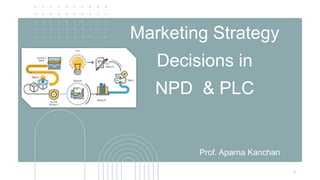
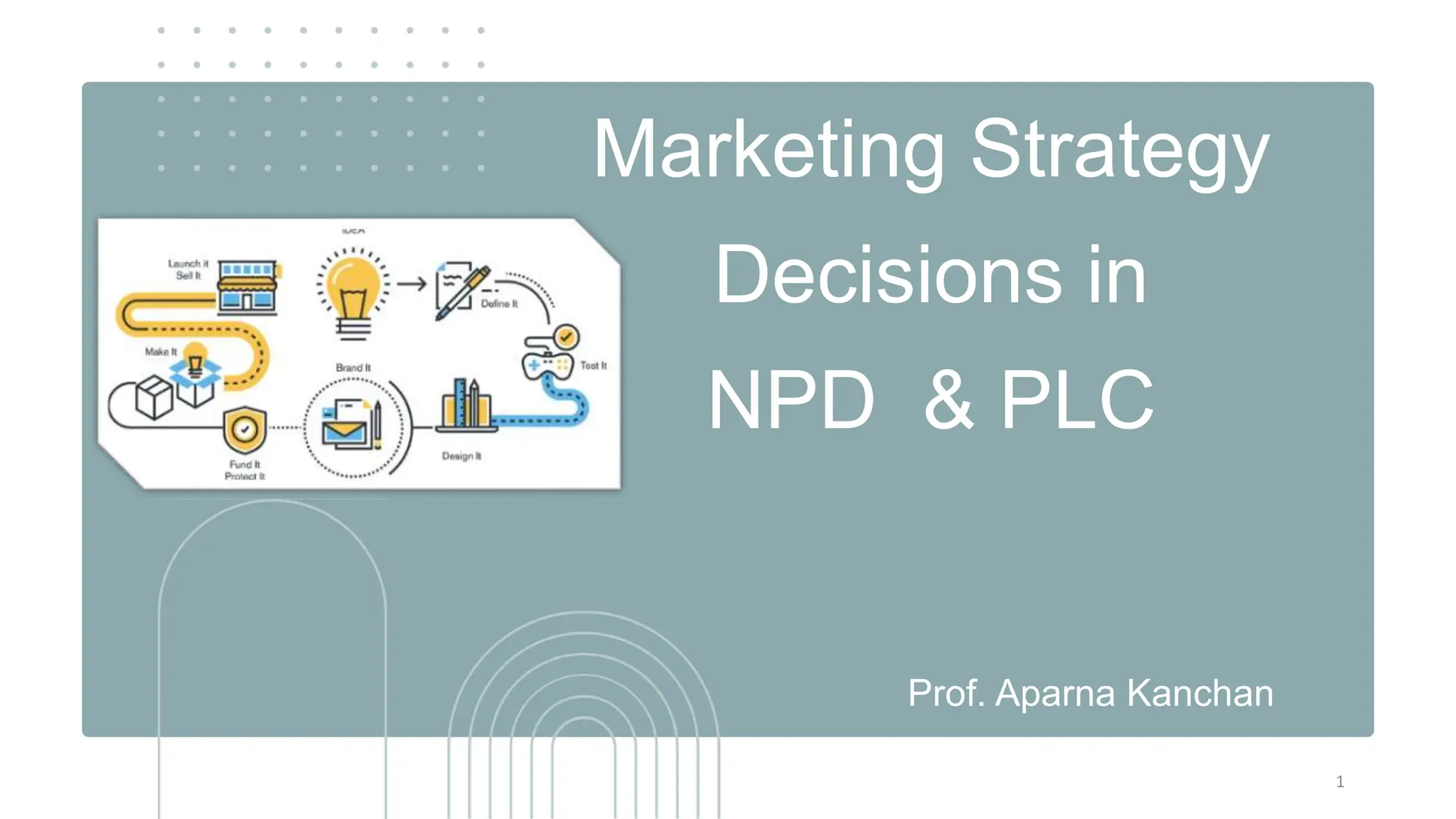
Marketing Strategy
Decisions in
NPD & PLC
Prof. Aparna Kanchan
1
2
What is a New
Product?
Customer Perspective:
Any product a consumer treats as an
addition to the available choices could
be considered as a new product.
Firms Perspective:
New product are those that are new to
the company and may include major
modifications to the existing products,
duplications of competitors product,
product acquisition or innovative original
products.
4
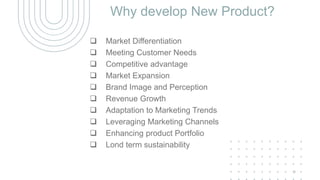
Why develop New Product?
 Market Differentiation
 Meeting Customer Needs
 Competitive advantage
 Market Expansion
 Brand Image and Perception
 Revenue Growth
 Adaptation to Marketing Trends
 Leveraging Marketing Channels
 Enhancing product Portfolio
 Lond term sustainability
5
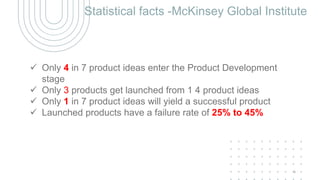
Statistical facts -McKinsey Global Institute
 Only 4 in 7 product ideas enter the Product Development
stage
 Only 3 products get launched from 1 4 product ideas
 Only 1 in 7 product ideas will yield a successful product
 Launched products have a failure rate of 25% to 45%
6
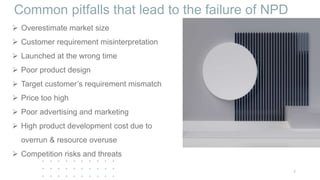
Common pitfalls that lead to the failure of NPD
 Overestimate market size
 Customer requirement misinterpretation
 Launched at the wrong time
 Poor product design
 Target customer’s requirement mismatch
 Price too high
 Poor advertising and marketing
 High product development cost due to
overrun & resource overuse
 Competition risks and threats
7
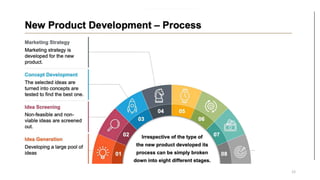
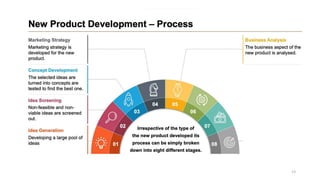
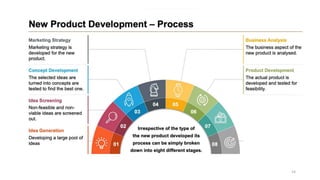
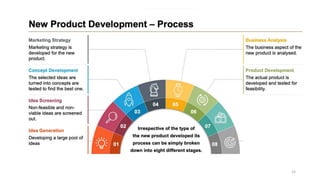
“New Product
Development
Process.”
9
10
11
12
13
14
15
16
17
18
19
20
21
22
23
24
25
26
27
28
29
30
31
32
33
34
35
36
37
38
39
“New Product
Development
Process.”
Drivers of Success in NPD
( Research)
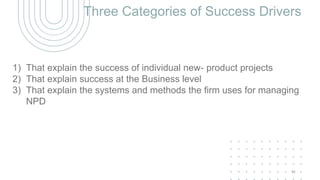
Three Categories of Success Drivers
1) That explain the success of individual new- product projects
2) That explain success at the Business level
3) That explain the systems and methods the firm uses for managing
NPD
41
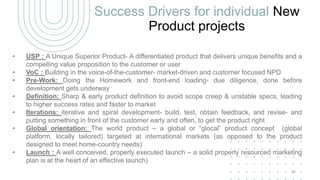
Success Drivers for individual New
Product projects
• USP : A Unique Superior Product- A differentiated product that delivers unique benefits and a
compelling value proposition to the customer or user
• VoC : Building in the voice-of-the-customer- market-driven and customer focused NPD
• Pre-Work: Doing the Homework and front-end loading- due diligence, done before
development gets underway
• Definition: Sharp & early product definition to avoid scope creep & unstable specs, leading
to higher success rates and faster to market
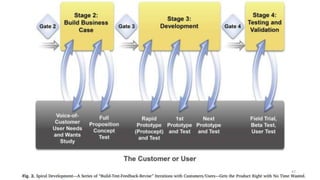
• Iterations: iterative and spiral development- build, test, obtain feedback, and revise- and
putting something in front of the customer early and often, to get the product right
• Global orientation: The world product – a global or “glocal” product concept (global
platform, locally tailored) targeted at international markets (as opposed to the product
designed to meet home-country needs)
• Launch : A well conceived, properly executed launch – a solid properly resourced marketing
plan is at the heart of an effective launch)
42
Success Drivers for Business
Organizational & Strategic factors
• Innovation Strategy: A product innovation & technology strategy to focus the business on the
best strategic arenas and provide direction for ideation, product roadmaps and resource allocation
• Focus: Doing fewer development projects (relative to resources available), better projects and
getting the right mix of projects by adopting systematic portfolio management
• Leveraging core competencies: Step-out development projects, which take the business into
new and unfamiliar markets and technologies, lead to higher failure rates
• Targeting attractive markets: Certain elements of market attractiveness- market size , growth,
and the competitive situation-useful as project selection criteria
• Resource available: Innovation resources, both quantity ( people, money) and quality ( the right
people) in place
• Teams: Effective cross –functional teams to reduce time-to-market
• Climate: The right climate and culture-one that supports and fosters innovation activities- one of
the stronger discriminators between successful innovating firms and the rest
• Leadership: Top Management supporting and leading the innovation effector at every opportunity
43
Success Drivers
The right systems, processes & methodologies
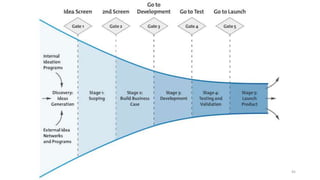
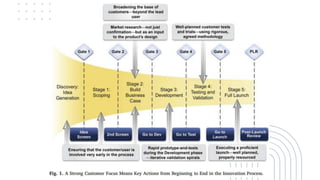
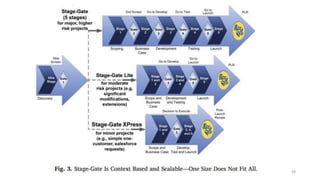
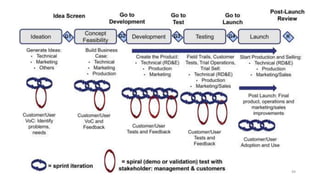
• Gating Systems: A multi-stage, gate disciplined idea-to-launch system, such as
Stage-Gate (as opposed to an ad hoc approach or no system at all ), now used
by most top performing B2B firms in NPD
• Accelerating development: Many good ways to accelerate development
projects, but not at the expense of quality of execution
• Agile: Agile methods from the software development would built into traditional
gating systems to yield agility, adaptive response to changing requirements, and
faster to market
• Generating breakthrough ideas: Effective ideation to feed the innovation
funnel
• Execution: Quality of execution of certain key tasks in the innovation process,
from idea to launch
44
45
47
48
49
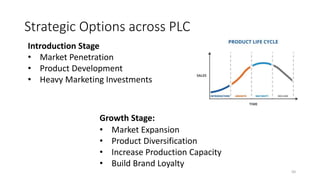
Strategic Options across PLC
Introduction Stage
• Market Penetration
• Product Development
• Heavy Marketing Investments
Growth Stage:
• Market Expansion
• Product Diversification
• Increase Production Capacity
• Build Brand Loyalty
50
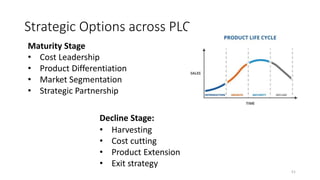
Strategic Options across PLC
Maturity Stage
• Cost Leadership
• Product Differentiation
• Market Segmentation
• Strategic Partnership
Decline Stage:
• Harvesting
• Cost cutting
• Product Extension
• Exit strategy
51
• Market Research
• Target Audience Identification
• Unique Value Proposition
• Product Development
• Pricing Strategy
• Distribution Channels
• Marketing & Promotion
• Launch timing
Strategic decisions in bringing successful product introductions
• Customer Feedback &
Iteration
• Target Audience Identification
• Scalability Planning
• Cross Functional
Collaboration
• Post Launch support
• Monitoring and Analytics
54
Challenges associated with bringing New Products
• Market Uncertainty
• Competition
• Resource Constraints
• Regulatory Compliance
• Technology risks
• Consumer Acceptance
• Timing and Speed to Market
• Supply chain issues
• Marketing and
Communication
• Scaling Challenges
• Feedback Management
• Adaptability
55
THANK- YOU
56

Mktg. New Product Development Strategy .pptx

  • 1.
    Marketing Strategy Decisions in NPD& PLC Prof. Aparna Kanchan 1
  • 2.
  • 3.
    What is aNew Product? Customer Perspective: Any product a consumer treats as an addition to the available choices could be considered as a new product. Firms Perspective: New product are those that are new to the company and may include major modifications to the existing products, duplications of competitors product, product acquisition or innovative original products.
  • 4.
  • 5.
    Why develop NewProduct?  Market Differentiation  Meeting Customer Needs  Competitive advantage  Market Expansion  Brand Image and Perception  Revenue Growth  Adaptation to Marketing Trends  Leveraging Marketing Channels  Enhancing product Portfolio  Lond term sustainability 5
  • 6.
    Statistical facts -McKinseyGlobal Institute  Only 4 in 7 product ideas enter the Product Development stage  Only 3 products get launched from 1 4 product ideas  Only 1 in 7 product ideas will yield a successful product  Launched products have a failure rate of 25% to 45% 6
  • 7.
    Common pitfalls thatlead to the failure of NPD  Overestimate market size  Customer requirement misinterpretation  Launched at the wrong time  Poor product design  Target customer’s requirement mismatch  Price too high  Poor advertising and marketing  High product development cost due to overrun & resource overuse  Competition risks and threats 7
  • 8.
  • 9.
  • 10.
  • 11.
  • 12.
  • 13.
  • 14.
  • 15.
  • 16.
  • 17.
  • 18.
  • 19.
  • 20.
  • 21.
  • 22.
  • 23.
  • 24.
  • 25.
  • 26.
  • 27.
  • 28.
  • 29.
  • 30.
  • 31.
  • 32.
  • 33.
  • 34.
  • 35.
  • 36.
  • 37.
  • 38.
  • 39.
  • 40.
  • 41.
    Three Categories ofSuccess Drivers 1) That explain the success of individual new- product projects 2) That explain success at the Business level 3) That explain the systems and methods the firm uses for managing NPD 41
  • 42.
    Success Drivers forindividual New Product projects • USP : A Unique Superior Product- A differentiated product that delivers unique benefits and a compelling value proposition to the customer or user • VoC : Building in the voice-of-the-customer- market-driven and customer focused NPD • Pre-Work: Doing the Homework and front-end loading- due diligence, done before development gets underway • Definition: Sharp & early product definition to avoid scope creep & unstable specs, leading to higher success rates and faster to market • Iterations: iterative and spiral development- build, test, obtain feedback, and revise- and putting something in front of the customer early and often, to get the product right • Global orientation: The world product – a global or “glocal” product concept (global platform, locally tailored) targeted at international markets (as opposed to the product designed to meet home-country needs) • Launch : A well conceived, properly executed launch – a solid properly resourced marketing plan is at the heart of an effective launch) 42
  • 43.
    Success Drivers forBusiness Organizational & Strategic factors • Innovation Strategy: A product innovation & technology strategy to focus the business on the best strategic arenas and provide direction for ideation, product roadmaps and resource allocation • Focus: Doing fewer development projects (relative to resources available), better projects and getting the right mix of projects by adopting systematic portfolio management • Leveraging core competencies: Step-out development projects, which take the business into new and unfamiliar markets and technologies, lead to higher failure rates • Targeting attractive markets: Certain elements of market attractiveness- market size , growth, and the competitive situation-useful as project selection criteria • Resource available: Innovation resources, both quantity ( people, money) and quality ( the right people) in place • Teams: Effective cross –functional teams to reduce time-to-market • Climate: The right climate and culture-one that supports and fosters innovation activities- one of the stronger discriminators between successful innovating firms and the rest • Leadership: Top Management supporting and leading the innovation effector at every opportunity 43
  • 44.
    Success Drivers The rightsystems, processes & methodologies • Gating Systems: A multi-stage, gate disciplined idea-to-launch system, such as Stage-Gate (as opposed to an ad hoc approach or no system at all ), now used by most top performing B2B firms in NPD • Accelerating development: Many good ways to accelerate development projects, but not at the expense of quality of execution • Agile: Agile methods from the software development would built into traditional gating systems to yield agility, adaptive response to changing requirements, and faster to market • Generating breakthrough ideas: Effective ideation to feed the innovation funnel • Execution: Quality of execution of certain key tasks in the innovation process, from idea to launch 44
  • 45.
  • 47.
  • 48.
  • 49.
  • 50.
    Strategic Options acrossPLC Introduction Stage • Market Penetration • Product Development • Heavy Marketing Investments Growth Stage: • Market Expansion • Product Diversification • Increase Production Capacity • Build Brand Loyalty 50
  • 51.
    Strategic Options acrossPLC Maturity Stage • Cost Leadership • Product Differentiation • Market Segmentation • Strategic Partnership Decline Stage: • Harvesting • Cost cutting • Product Extension • Exit strategy 51
  • 52.
    • Market Research •Target Audience Identification • Unique Value Proposition • Product Development • Pricing Strategy • Distribution Channels • Marketing & Promotion • Launch timing Strategic decisions in bringing successful product introductions • Customer Feedback & Iteration • Target Audience Identification • Scalability Planning • Cross Functional Collaboration • Post Launch support • Monitoring and Analytics 54
  • 53.
    Challenges associated withbringing New Products • Market Uncertainty • Competition • Resource Constraints • Regulatory Compliance • Technology risks • Consumer Acceptance • Timing and Speed to Market • Supply chain issues • Marketing and Communication • Scaling Challenges • Feedback Management • Adaptability 55
  • 54.