Mixed Integer Nonlinear Programming The Ima
Volumes In Mathematics And Its Applications
2012th Edition Leyffer download
https://ebookbell.com/product/mixed-integer-nonlinear-
programming-the-ima-volumes-in-mathematics-and-its-
applications-2012th-edition-leyffer-23633022
Explore and download more ebooks at ebookbell.com
Here are some recommended products that we believe you will be
interested in. You can click the link to download.
Mixed Integer Nonlinear Programming Sven Leyffer Jon Lee
https://ebookbell.com/product/mixed-integer-nonlinear-programming-
sven-leyffer-jon-lee-5471324
Convexification And Global Optimization In Continuous And Mixedinteger
Nonlinear Programming Theory Algorithms Software And Applications
Nonconvex Optimization And Its Applications 65 2002th Edition M
Tawarmalani
https://ebookbell.com/product/convexification-and-global-optimization-
in-continuous-and-mixedinteger-nonlinear-programming-theory-
algorithms-software-and-applications-nonconvex-optimization-and-its-
applications-65-2002th-edition-m-tawarmalani-55934730
Relaxation And Decomposition Methods For Mixed Integer Nonlinear
Programming International Series Of Numerical Mathematics 1st Edition
Ivo Nowak
https://ebookbell.com/product/relaxation-and-decomposition-methods-
for-mixed-integer-nonlinear-programming-international-series-of-
numerical-mathematics-1st-edition-ivo-nowak-2229682
Convexification And Global Optimization In Continuous And Mixedinteger
Nonlinear Programming Theory Algorithms Software And Applications 1st
Edition Mohit Tawarmalani
https://ebookbell.com/product/convexification-and-global-optimization-
in-continuous-and-mixedinteger-nonlinear-programming-theory-
algorithms-software-and-applications-1st-edition-mohit-
tawarmalani-4199546
Fast Numerical Methods For Mixedinteger Nonlinear Modelpredictive
Control 2011th Edition Christian Kirches
https://ebookbell.com/product/fast-numerical-methods-for-mixedinteger-
nonlinear-modelpredictive-control-2011th-edition-christian-
kirches-2484888
Mixedinteger Representations In Control Design Mathematical
Foundations And Applications 1st Edition Ionela Prodan
https://ebookbell.com/product/mixedinteger-representations-in-control-
design-mathematical-foundations-and-applications-1st-edition-ionela-
prodan-5355252
Chemical Production Scheduling Mixedinteger Programming Models And
Methods Christos T Maravelias
https://ebookbell.com/product/chemical-production-scheduling-
mixedinteger-programming-models-and-methods-christos-t-
maravelias-46124836
Multilevel Mixedinteger Optimization Parametric Programming Approach
Styliani Avraamidou Efstratios Pistikopoulos
https://ebookbell.com/product/multilevel-mixedinteger-optimization-
parametric-programming-approach-styliani-avraamidou-efstratios-
pistikopoulos-50339422
Production Planning By Mixed Integer Programming 1st Edition Yves
Pochet
https://ebookbell.com/product/production-planning-by-mixed-integer-
programming-1st-edition-yves-pochet-4128948
For further volumes:
The IMA Volumes in Mathematics
and its Applications
Volume 154
http://www.springer.com/series/811
Institute for Mathematics and
its Applications (IMA)
The Institute for Mathematics and its Applications was estab-
lished by a grant from the National Science Foundation to the University
of Minnesota in 1982. The primary mission of the IMA is to foster research
of a truly interdisciplinary nature, establishing links between mathematics
of the highest caliber and important scientific and technological problems
from other disciplines and industries. To this end, the IMA organizes a wide
variety of programs, ranging from short intense workshops in areas of ex-
ceptional interest and opportunity to extensive thematic programs lasting
a year. IMA Volumes are used to communicate results of these programs
that we believe are of particular value to the broader scientific community.
The full list of IMA books can be found at the Web site of the Institute
for Mathematics and its Applications:
http://www.ima.umn.edu/springer/volumes.html.
Presentation materials from the IMA talks are available at
http://www.ima.umn.edu/talks/.
Video library is at
http://www.ima.umn.edu/videos/.
Fadil Santosa, Director of the IMA
* * * * * * * * * *
IMA ANNUAL PROGRAMS
1982–1983 Statistical and Continuum Approaches to Phase Transition
1983–1984 Mathematical Models for the Economics of Decentralized
Resource Allocation
1984–1985 Continuum Physics and Partial Differential Equations
1985–1986 Stochastic Differential Equations and Their Applications
1986–1987 Scientific Computation
1987–1988 Applied Combinatorics
1988–1989 Nonlinear Waves
1989–1990 Dynamical Systems and Their Applications
1990–1991 Phase Transitions and Free Boundaries
1991–1992 Applied Linear Algebra
Continued at the back
Jon Lee • Sven Leyffer
Mixed Integer Nonlinear
Programming
Editors
Printed on acid-free paper
Springer is part of Springer Science+Business Media (www.springer.com)
Jon Lee
University of Michigan
Ann Arbor, Michigan 48109
USA
Editors
Sven Leyffer
Mathematics and Computer Science
Argonne National Laboratory
Argonne, Illinois 60439
USA
Industrial and Operations Engineering
1205 Beal Avenue
ISSN
Springer New York Dordrecht Heidelberg London
ISBN 978-1-4614-1926-6
DOI 10.1007/978-1-4614-1927-3
e-ISBN 978-1-4614-1927-3
¤ Springer Science+Business Media, LLC 2012
0940-6573
Library of Congress Control Number: 2011942482
All rights reserved. This work may not be translated or copied in whole or in part without the written
permission of the publisher (Springer Science+Business Media, LLC, 233 Spring Street, New York,
NY 10013, USA), except for brief excerpts in connection with reviews or scholarly analysis. Use in
connection with any form of information storage and retrieval, electronic adaptation, computer
software, or by similar or dissimilar methodology now known or hereafter developed is forbidden.
The use in this publication of trade names, trademarks, service marks, and similar terms, even if they
are not identified as such, is not to be taken as an expression of opinion as to whether or not they are
subject to proprietary rights.
Mathematics Subject Classification (2010): 05C25, 20B25, 49J15, 49M15, 49M37, 49N90, 65K05,
90C10, 90C11, 90C22, 90C25, 90C26, 90C27, 90C30, 90C35, 90C51, 90C55, 90C57, 90C60,
90C90, 93C95
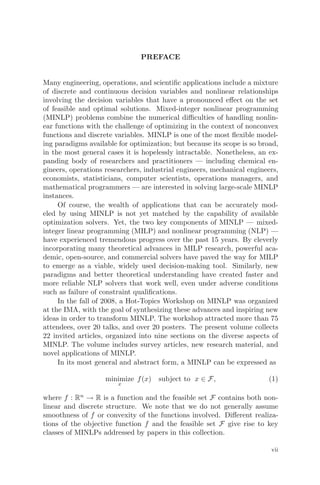
FOREWORD
This IMA Volume in Mathematics and its Applications
MIXED INTEGER NONLINEAR PROGRAMMING
contains expository and research papers based on a highly successful IMA
Hot Topics Workshop “Mixed-Integer Nonlinear Optimization: Algorith-
mic Advances and Applications”. We are grateful to all the participants
for making this occasion a very productive and stimulating one.
We would like to thank Jon Lee (Industrial and Operations Engineer-
ing, University of Michigan) and Sven Leyffer (Mathematics and Computer
Science, Argonne National Laboratory) for their superb role as program or-
ganizers and editors of this volume.
We take this opportunity to thank the National Science Foundation
for its support of the IMA.
Series Editors
Fadil Santosa, Director of the IMA
Markus Keel, Deputy Director of the IMA
v
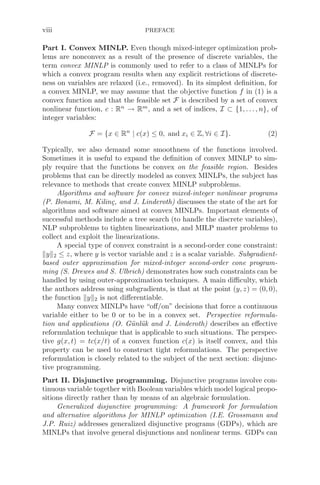
PREFACE
Many engineering, operations, and scientific applications include a mixture
of discrete and continuous decision variables and nonlinear relationships
involving the decision variables that have a pronounced effect on the set
of feasible and optimal solutions. Mixed-integer nonlinear programming
(MINLP) problems combine the numerical difficulties of handling nonlin-
ear functions with the challenge of optimizing in the context of nonconvex
functions and discrete variables. MINLP is one of the most flexible model-
ing paradigms available for optimization; but because its scope is so broad,
in the most general cases it is hopelessly intractable. Nonetheless, an ex-
panding body of researchers and practitioners — including chemical en-
gineers, operations researchers, industrial engineers, mechanical engineers,
economists, statisticians, computer scientists, operations managers, and
mathematical programmers — are interested in solving large-scale MINLP
instances.
Of course, the wealth of applications that can be accurately mod-
eled by using MINLP is not yet matched by the capability of available
optimization solvers. Yet, the two key components of MINLP — mixed-
integer linear programming (MILP) and nonlinear programming (NLP) —
have experienced tremendous progress over the past 15 years. By cleverly
incorporating many theoretical advances in MILP research, powerful aca-
demic, open-source, and commercial solvers have paved the way for MILP
to emerge as a viable, widely used decision-making tool. Similarly, new
paradigms and better theoretical understanding have created faster and
more reliable NLP solvers that work well, even under adverse conditions
such as failure of constraint qualifications.
In the fall of 2008, a Hot-Topics Workshop on MINLP was organized
at the IMA, with the goal of synthesizing these advances and inspiring new
ideas in order to transform MINLP. The workshop attracted more than 75
attendees, over 20 talks, and over 20 posters. The present volume collects
22 invited articles, organized into nine sections on the diverse aspects of
MINLP. The volume includes survey articles, new research material, and
novel applications of MINLP.
In its most general and abstract form, a MINLP can be expressed as
minimize
x
f(x) subject to x ∈ F, (1)
where f : Rn
→ R is a function and the feasible set F contains both non-
linear and discrete structure. We note that we do not generally assume
smoothness of f or convexity of the functions involved. Different realiza-
tions of the objective function f and the feasible set F give rise to key
classes of MINLPs addressed by papers in this collection.
vii
viii PREFACE
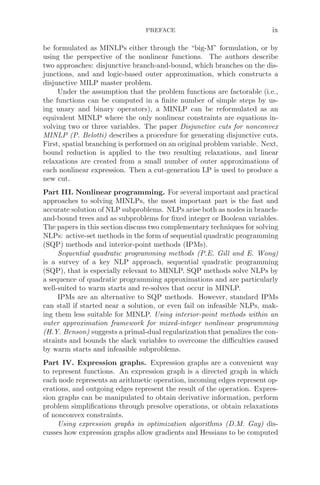
Part I. Convex MINLP. Even though mixed-integer optimization prob-
lems are nonconvex as a result of the presence of discrete variables, the
term convex MINLP is commonly used to refer to a class of MINLPs for
which a convex program results when any explicit restrictions of discrete-
ness on variables are relaxed (i.e., removed). In its simplest definition, for
a convex MINLP, we may assume that the objective function f in (1) is a
convex function and that the feasible set F is described by a set of convex
nonlinear function, c : Rn
→ Rm
, and a set of indices, I ⊂ {1, . . ., n}, of
integer variables:
F = {x ∈ Rn
| c(x) ≤ 0, and xi ∈ Z, ∀i ∈ I}. (2)
Typically, we also demand some smoothness of the functions involved.
Sometimes it is useful to expand the definition of convex MINLP to sim-
ply require that the functions be convex on the feasible region. Besides
problems that can be directly modeled as convex MINLPs, the subject has
relevance to methods that create convex MINLP subproblems.
Algorithms and software for convex mixed-integer nonlinear programs
(P. Bonami, M. Kilinç, and J. Linderoth) discusses the state of the art for
algorithms and software aimed at convex MINLPs. Important elements of
successful methods include a tree search (to handle the discrete variables),
NLP subproblems to tighten linearizations, and MILP master problems to
collect and exploit the linearizations.
A special type of convex constraint is a second-order cone constraint:
y2 ≤ z, where y is vector variable and z is a scalar variable. Subgradient-
based outer approximation for mixed-integer second-order cone program-
ming (S. Drewes and S. Ulbrich) demonstrates how such constraints can be
handled by using outer-approximation techniques. A main difficulty, which
the authors address using subgradients, is that at the point (y, z) = (0, 0),
the function y2 is not differentiable.
Many convex MINLPs have “off/on” decisions that force a continuous
variable either to be 0 or to be in a convex set. Perspective reformula-
tion and applications (O. Günlük and J. Linderoth) describes an effective
reformulation technique that is applicable to such situations. The perspec-
tive g(x, t) = tc(x/t) of a convex function c(x) is itself convex, and this
property can be used to construct tight reformulations. The perspective
reformulation is closely related to the subject of the next section: disjunc-
tive programming.
Part II. Disjunctive programming. Disjunctive programs involve con-
tinuous variable together with Boolean variables which model logical propo-
sitions directly rather than by means of an algebraic formulation.
Generalized disjunctive programming: A framework for formulation
and alternative algorithms for MINLP optimization (I.E. Grossmann and
J.P. Ruiz) addresses generalized disjunctive programs (GDPs), which are
MINLPs that involve general disjunctions and nonlinear terms. GDPs can
PREFACE ix
be formulated as MINLPs either through the “big-M” formulation, or by
using the perspective of the nonlinear functions. The authors describe
two approaches: disjunctive branch-and-bound, which branches on the dis-
junctions, and and logic-based outer approximation, which constructs a
disjunctive MILP master problem.
Under the assumption that the problem functions are factorable (i.e.,
the functions can be computed in a finite number of simple steps by us-
ing unary and binary operators), a MINLP can be reformulated as an
equivalent MINLP where the only nonlinear constraints are equations in-
volving two or three variables. The paper Disjunctive cuts for nonconvex
MINLP (P. Belotti) describes a procedure for generating disjunctive cuts.
First, spatial branching is performed on an original problem variable. Next,
bound reduction is applied to the two resulting relaxations, and linear
relaxations are created from a small number of outer approximations of
each nonlinear expression. Then a cut-generation LP is used to produce a
new cut.
Part III. Nonlinear programming. For several important and practical
approaches to solving MINLPs, the most important part is the fast and
accurate solution of NLP subproblems. NLPs arise both as nodes in branch-
and-bound trees and as subproblems for fixed integer or Boolean variables.
The papers in this section discuss two complementary techniques for solving
NLPs: active-set methods in the form of sequential quadratic programming
(SQP) methods and interior-point methods (IPMs).
Sequential quadratic programming methods (P.E. Gill and E. Wong)
is a survey of a key NLP approach, sequential quadratic programming
(SQP), that is especially relevant to MINLP. SQP methods solve NLPs by
a sequence of quadratic programming approximations and are particularly
well-suited to warm starts and re-solves that occur in MINLP.
IPMs are an alternative to SQP methods. However, standard IPMs
can stall if started near a solution, or even fail on infeasible NLPs, mak-
ing them less suitable for MINLP. Using interior-point methods within an
outer approximation framework for mixed-integer nonlinear programming
(H.Y. Benson) suggests a primal-dual regularization that penalizes the con-
straints and bounds the slack variables to overcome the difficulties caused
by warm starts and infeasible subproblems.
Part IV. Expression graphs. Expression graphs are a convenient way
to represent functions. An expression graph is a directed graph in which
each node represents an arithmetic operation, incoming edges represent op-
erations, and outgoing edges represent the result of the operation. Expres-
sion graphs can be manipulated to obtain derivative information, perform
problem simplifications through presolve operations, or obtain relaxations
of nonconvex constraints.
Using expression graphs in optimization algorithms (D.M. Gay) dis-
cusses how expression graphs allow gradients and Hessians to be computed
x PREFACE
efficiently by exploiting group partial separability. In addition, the author
describes how expression graphs can be used to tighten bounds on variables
to provide tighter outer approximations of nonconvex expressions, detect
convexity (e.g., for quadratic constraints), and propagate constraints.
Symmetry arises in many MINLP formulations and can mean that
a problem or subproblem may have many symmetric optima or near op-
tima, resulting in large search trees and inefficient pruning. Symmetry in
mathematical programming (L. Liberti) describes how the symmetry group
of a MINLP can be detected by parsing the expression graph. Once the
symmetry group is known, we can add symmetry-breaking constraints or
employ special branching schemes such as orbital branching that mitigate
the adverse effects of symmetry.
Part V. Convexification and linearization. A popular and classical
approach for handling nonconvex functions is to approximate them by using
piecewise-linear functions. This approach requires the addition of binary
variables that model the piecewise approximation. The advantage of such
an approach is that advanced MILP techniques can be applied. The disad-
vantage of the approach is that the approximations are not exact and that
it suffers from the curse of dimensionality.
Using piecewise linear functions for solving MINLPs (B. Geißler, A.
Martin, A. Morsi, and L. Schewe) details how to carry out piecewise-linear
approximation for MINLP. The authors review two formulations of piece-
wise linearization: the convex combination technique and the incremental
technique. They introduce a piecewise-polyhedral outer-approximation al-
gorithm based on rigorous error estimates, and they demonstrate compu-
tational success on water network and gas network problems.
A global-optimization algorithm for mixed-integer nonlinear programs
having separable nonconvexity (C. D’Ambrosio, J. Lee, and A. Wächter)
introduces a method for MINLPs that have all of their nonconvexity in
separable form. The approach aims to retain and exploit existing convexity
in the formulation.
Global optimization of mixed-integer signomial programming problems
(A. Lundell and T. Westerlund) describes a global optimization algorithm
for MINLPs containing signomial functions. The method obtains a convex
relaxation through reformulations, by using single-variable transformations
in concert with piecewise-linear approximations of the inverse transforma-
tions.
Part VI. Mixed-integer quadratically-constrained optimization.
In seeking a more structured setting than general MINLP, but with consid-
erably more modeling power than is afforded by MILP, one naturally con-
siders mixed-integer models with quadratic functions, namely, MIQCPs.
Such models are NP-hard, but they have enough structure that can be
exploited in order to gain computational advantages over treating such
problems as general MINLPs.
PREFACE xi
The MILP road to MIQCP (S. Burer and A. Saxena) surveys re-
sults in mixed-integer quadratically constrained programming. Strong con-
vex relaxations and valid inequalities are the basis of efficient, practical
techniques for global optimization. Some of the relaxations and inequal-
ities are derived from the algebraic formulation, while others are based
on disjunctive programming. Much of the inspiration derives from MILP
methodology.
Linear programming relaxations of quadratically-constrained quadratic
programs (A. Qualizza, P. Belotti, and F. Margot) investigates the use
of LP tools for approximately solving semidefinite programming (SDP)
relaxations of quadratically-constrained quadratic programs. The authors
present classes of valid linear inequalities based on spectral decomposition,
together with computational results.
Extending a CIP framework to solve MIQCPs (T. Berthold, S. Heinz,
and S. Vigerske) discusses how to build a solver for MIQCPs by extending a
framework for constraint integer programming (CIP). The advantage of this
approach is that we can utilize the full power of advanced MILP and con-
straint programming technologies. For relaxation, the approach employs
an outer approximation generated by linearization of convex constraints
and linear underestimation of nonconvex constraints. Reformulation, sep-
aration, and propagation techniques are used to handle the quadratic con-
straints efficiently. The authors implemented these methods in the branch-
cut-and-price framework SCIP.
Part VII. Combinatorial optimization. Because of the success of
MILP methods and because of beautiful and algorithmically important re-
sults from polyhedral combinatorics, nonlinear functions and formulations
have not been heavily investigated for combinatorial optimization prob-
lems. With improvements in software for general NLP, SDP, and MINLP,
however, researchers are now investing considerable effort in trying to ex-
ploit these gains for combinatorial-optimization problems.
Computation with polynomial equations and inequalities arising in
combinatorial optimization (J.A. De Loera, P.N. Malkin, and P.A. Par-
rilo) discusses how the algebra of multivariate polynomials can be used to
create large-scale linear algebra or semidefinite-programming relaxations of
many kinds of combinatorial feasibility and optimization problems.
Matrix relaxations in combinatorial optimization (F. Rendl) discusses
the use of SDP as a modeling tool in combinatorial optimization. The
main techniques to get matrix relaxations of combinatorial-optimization
problems are presented. Semidefiniteness constraints lead to tractable re-
laxations, while constraints that matrices be completely positive or copos-
itive do not. This survey illustrates the enormous power and potential of
matrix relaxations.
A polytope for a product of real linear functions in 0/1 variables (O.
Günlük, J. Lee, and J. Leung) uses polyhedral methods to give a tight
xii PREFACE
formulation for the convex hull of a product of two linear functions in
0/1 variables. As an example, by writing a pair of general integer vari-
ables in binary expansion, the authors have a technique for linearizing their
product.
Part VIII. Complexity. General MINLP is incomputable, independent
of conjectures such as P=NP. From the point of view of complexity the-
ory, however, considerable room exists for negative results (e.g., incom-
putability, intractablility and inapproximability results) and positive re-
sults (e.g., polynomial-time algorithms and approximations schemes) for
restricted classes of MINLPs.
On the complexity of nonlinear mixed-integer optimization (M. Köppe)
is a survey on the computational complexity of MINLP. It includes incom-
putability results that arise from number theory and logic, fully polynomial-
time approximation schemes in fixed dimension, and polynomial-time al-
gorithms for special cases.
Theory and applications of n-fold integer programming (S. Onn) is
an overview of the theory of n-fold integer programming, which enables
the polynomial-time solution of fundamental linear and nonlinear inte-
ger programming problems in variable dimension. This framework yields
polynomial-time algorithms in several application areas, including multi-
commodity flows and privacy in statistical databases.
Part IX. Applications. A wide range of applications of MINLP exist.
This section focuses on two new application domains.
MINLP application for ACH interiors restructuring (E. Klampfl and
Y. Fradkin) describes a very large-scale application of MINLP developed
by the Ford Motor Company. The MINLP models the re-engineering of
42 product lines over 26 manufacturing processes and 50 potential supplier
sites. The resulting MINLP model has 350,000 variables (17,000 binary)
and 1.6 million constraints and is well beyond the size that state-of-the-art
MINLP solvers can handle. The authors develop a piecewise-linearization
scheme for the objective and a decomposition technique that decouples the
problem into two coupled MILPs that are solved iteratively.
A benchmark library of mixed-integer optimal control problems (S.
Sager) describes a challenging new class of MINLPs. These are optimal
control problems, involving differential-algebraic equation constraints and
integrality restrictions on the controls, such as gear ratios. The authors de-
scribe 12 models from a range of applications, including biology, industrial
engineering, trajectory optimization, and process control.
Acknowledgments. We gratefully acknowledge the generous financial
support from the IMA that made this workshop possible, as well as fi-
nancial support from IBM. This work was supported in part by the Of-
fice of Advanced Scientific Computing Research, Office of Science, U.S.
Department of Energy, under Contract DE-AC02-06CH11357. Special
PREFACE xiii
thanks are due to Fadil Santosa, Chun Liu, Patricia Brick, Dzung Nguyen,
Holly Pinkerton, and Eve Marofsky from the IMA, who made the organi-
zation of the workshop and the publication of this special volume such an
easy and enjoyable affair.
Jon Lee
University of Michigan
Sven Leyffer
Argonne National Laboratory
CONTENTS
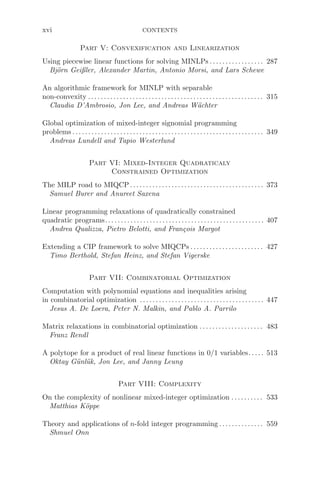
Foreword . . . . . . . . . . . . . . . . . . . . . . . . . . . . . . . . . . . . . . . . . . . . . . . . . . . . . . . . . . . . . v
Preface . . . . . . . . . . . . . . . . . . . . . . . . . . . . . . . . . . . . . . . . . . . .. . . . . . . . . . . . . . . . . . vii
Part I: Convex MINLP
Algorithms and software for convex mixed integer nonlinear
programs .. . . . . . . . . . . . . . . . . . . . . . . . . . . . . . . . . . . . . . . . . . . . . . . . . . . . . . . . . . . . . 1
Pierre Bonami, Mustafa Kilinç, and Jeff Linderoth
Subgradient based outer approximation for mixed integer second
order cone programming.. . . . . . . . . . . . . . . . . . . . . . . . . . . . . .. . . . . . . . . . . . . . . 41
Sarah Drewes and Stefan Ulbrich
Perspective reformulation and applications. . . . . . . . . . . . . . . . . . . . . . . . . . . . 61
Oktay Günlük and Jeff Linderoth
Part II: Disjunctive Programming
Generalized disjunctive programming: A framework for formulation
and alternative algorithms for MINLP optimization. . . . . . .. . . . . . . . . . . . 93
Ignacio E. Grossmann and Juan P. Ruiz
Disjunctive cuts for nonconvex MINLP . . . . . . . . . . . . . . . . . . .. . . . . . . . . . . 117
Pietro Belotti
Part III: Nonlinear Programming
Sequential quadratic programming methods . . . . . . . . . . . . . . . . . . . . . . . . . 147
Philip E. Gill and Elizabeth Wong
Using interior-point methods within an outer approximation
framework for mixed integer nonlinear programming .. . . . . . . . . . . . . . . . 225
Hande Y. Benson
Part IV: Expression Graphs
Using expression graphs in optimization algorithms .. . . . . . . . . . . . . . . . . 247
David M. Gay
Symmetry in mathematical programming .. . . . . . . . . . . . . . . . . . . . . . . . . . . 263
Leo Liberti
xv
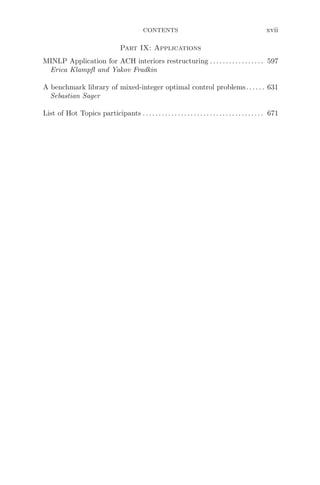
xvi CONTENTS
Part V: Convexification and Linearization
Using piecewise linear functions for solving MINLPs . . . . . . . . . . . . . . . . . 287
Björn Geißler, Alexander Martin, Antonio Morsi, and Lars Schewe
An algorithmic framework for MINLP with separable
non-convexity .. . . . . . . . . . . . . . . . . . . . . . . . . . . . . . . . . . . . . . . . . . . . . . . . . . . . . . 315
Claudia D’Ambrosio, Jon Lee, and Andreas Wächter
Global optimization of mixed-integer signomial programming
problems . . . . . . . . . . . . . . . . . . . . . . . . . . . . . . . . . . . . . . . . . . . . . . . . . . . . . . . . . . . . 349
Andreas Lundell and Tapio Westerlund
Part VI: Mixed-Integer Quadraticaly
Constrained Optimization
The MILP road to MIQCP . . . . . . . . . . . . . . . . . . . . . . . . . . . . . . . . . . . . . . . . . . 373
Samuel Burer and Anureet Saxena
Linear programming relaxations of quadratically constrained
quadratic programs.. . . . . . . . . . . . . . . . . . . . . . . . . . . . . . . . .. . . . . . . . . . . . . . . . 407
Andrea Qualizza, Pietro Belotti, and François Margot
Extending a CIP framework to solve MIQCPs . . . . . . . . . . . . . . . . . . . . . . . 427
Timo Berthold, Stefan Heinz, and Stefan Vigerske
Part VII: Combinatorial Optimization
Computation with polynomial equations and inequalities arising
in combinatorial optimization . . . . . . . . . . . . . . . . . . . . . . . . . . . . . . . . . . . . . . . 447
Jesus A. De Loera, Peter N. Malkin, and Pablo A. Parrilo
Matrix relaxations in combinatorial optimization . . . . . . . . . . . . . . . . . . . . 483
Franz Rendl
A polytope for a product of real linear functions in 0/1 variables. . . . . 513
Oktay Günlük, Jon Lee, and Janny Leung
Part VIII: Complexity
On the complexity of nonlinear mixed-integer optimization . . . . . . . . . . 533
Matthias Köppe
Theory and applications of n-fold integer programming .. . . . . . . . . . . . . 559
Shmuel Onn
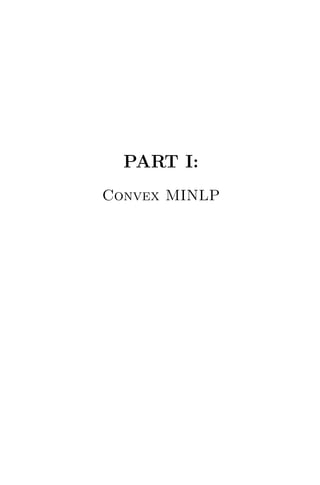
CONTENTS xvii
Part IX: Applications
MINLP Application for ACH interiors restructuring . . . . . . .. . . . . . . . . . 597
Erica Klampfl and Yakov Fradkin
A benchmark library of mixed-integer optimal control problems.. . . . . 631
Sebastian Sager
List of Hot Topics participants . . . . . . . . . . . . . . . . . . . . . . . . . . . . . . . . . . . . . . 671
PART I:
Convex MINLP
ALGORITHMS AND SOFTWARE FOR
CONVEX MIXED INTEGER NONLINEAR PROGRAMS
PIERRE BONAMI∗, MUSTAFA KILINdž, AND JEFF LINDEROTH‡
Abstract. This paper provides a survey of recent progress and software for solving
convex Mixed Integer Nonlinear Programs (MINLP)s, where the objective and con-
straints are defined by convex functions and integrality restrictions are imposed on a
subset of the decision variables. Convex MINLPs have received sustained attention in
recent years. By exploiting analogies to well-known techniques for solving Mixed Integer
Linear Programs and incorporating these techniques into software, significant improve-
ments have been made in the ability to solve these problems.
Key words. Mixed Integer Nonlinear Programming; Branch and Bound.
1. Introduction. Mixed-Integer Nonlinear Programs (MINLP)s are
optimization problems where some of the variables are constrained to take
integer values and the objective function and feasible region of the problem
are described by nonlinear functions. Such optimization problems arise in
many real world applications. Integer variables are often required to model
logical relationships, fixed charges, piecewise linear functions, disjunctive
constraints and the non-divisibility of resources. Nonlinear functions are
required to accurately reflect physical properties, covariance, and economies
of scale.
In full generality, MINLPs form a particularly broad class of challeng-
ing optimization problems, as they combine the difficulty of optimizing
over integer variables with the handling of nonlinear functions. Even if we
restrict our model to contain only linear functions, MINLP reduces to a
Mixed-Integer Linear Program (MILP), which is an NP-Hard problem [55].
On the other hand, if we restrict our model to have no integer variable but
allow for general nonlinear functions in the objective or the constraints,
then MINLP reduces to a Nonlinear Program (NLP) which is also known
to be NP-Hard [90]. Combining both integrality and nonlinearity can lead
to examples of MINLP that are undecidable [67].
∗Laboratoire d’Informatique Fondamentale de Marseille, CNRS, Aix-Marseille Uni-
versités, Parc Scientifique et Technologique de Luminy, 163 avenue de Luminy - Case
901, F-13288 Marseille Cedex 9, France (pierre.bonami@lif.univ-mrs.fr). Supported
by ANR grand BLAN06-1-138894.
†Department of Industrial and Systems Engineering, University of Wisconsin-
Madison, 1513 University Ave., Madison, WI, 53706 (kilinc@wisc.edu).
‡Department of Industrial and Systems Engineering, University of Wisconsin-
Madison, 1513 University Ave., Madison, WI 53706 (linderoth@wisc.edu). The work of
the second and third authors is supported by the US Department of Energy under grants
DE-FG02-08ER25861 and DE-FG02-09ER25869, and the National Science Foundation
under grant CCF-0830153.
1
J. Lee and S. Leyffer (eds.), Mixed Integer Nonlinear Programming, The IMA Volumes
© Springer Science+Business Media, LLC 2012
in Mathematics and its Applications 154, DOI 10.1007/978-1-4614-1927-3_1,
2 PIERRE BONAMI, MUSTAFA KILINÇ, AND JEFF LINDEROTH
In this paper, we restrict ourselves to the subclass of MINLP where
the objective function to minimize is convex, and the constraint functions
are all convex and upper bounded. In these instances, when integrality is
relaxed, the feasible set is convex. Convex MINLP is still NP-hard since it
contains MILP as a special case. Nevertheless, it can be solved much more
efficiently than general MINLP since the problem obtained by dropping
the integrity requirements is a convex NLP for which there exist efficient
algorithms. Further, the convexity of the objective function and feasible
region can be used to design specialized algorithms.
There are many diverse and important applications of MINLPs. A
small subset of these applications includes portfolio optimization [21, 68],
block layout design in the manufacturing and service sectors [33, 98], net-
work design with queuing delay constraints [27], integrated design and con-
trol of chemical processes [53], drinking water distribution systems security
[73], minimizing the environmental impact of utility plants [46], and multi-
period supply chain problems subject to probabilistic constraints [75].
Even though convex MINLP is NP-Hard, there are exact methods for
its solution—methods that terminate with a guaranteed optimal solution
or prove that no such solution exists. In this survey, our main focus is on
such exact methods and their implementation.
In the last 40 years, at least five different algorithms have been pro-
posed for solving convex MINLP to optimality. In 1965, Dakin remarked
that the branch-and-bound method did not require linearity and could be
applied to convex MINLP. In the early 70’s, Geoffrion [56] generalized Ben-
ders decomposition to make an exact algorithm for convex MINLP. In the
80’s, Gupta and Ravindran studied the application of branch and bound
[62]. At the same time, Duran and Grossmann [43] introduced the Outer
Approximation decomposition algorithm. This latter algorithm was subse-
quently improved in the 90’s by Fletcher and Leyffer [51] and also adapted
to the branch-and-cut framework by Quesada and Grossmann [96]. In the
same period, a related method called the Extended Cutting Plane method
was proposed by Westerlund and Pettersson [111]. Section 3 of this paper
will be devoted to reviewing in more detail all of these methods.
Two main ingredients of the above mentioned algorithms are solving
MILP and solving NLP. In the last decades, there have been enormous
advances in our ability to solve these two important subproblems of convex
MINLP.
We refer the reader to [100, 92] and [113] for in-depth analysis of the
theory of MILP. The advances in the theory of solving MILP have led to
the implementation of solvers both commercial and open-source which are
now routinely used to solve many industrial problems of large size. Bixby
and Rothberg [22] demonstrate that advances in algorithmic technology
alone have resulted in MILP instances solving more than 300 times faster
than a decade ago. There are effective, robust commercial MILP solvers
ALGORITHMS AND SOFTWARE FOR CONVEX MINLP 3
such as CPLEX [66], XPRESS-MP [47], and Gurobi [63]. Linderoth and
Ralphs [82] give a survey of noncommercial software for MILP.
There has also been steady progress over the past 30 years in the de-
velopment and successful implementation of algorithms for NLPs. We refer
the reader to [12] and [94] for a detailed recital of nonlinear programming
techniques. Theoretical developments have led to successful implemen-
tations in software such as SNOPT [57], filterSQP [52], CONOPT [42],
IPOPT [107], LOQO [103], and KNITRO [32]. Waltz [108] states that the
size of instance solvable by NLP is growing by nearly an order of magnitude
a decade.
Of course, solution algorithms for convex MINLP have benefit from
the technological progress made in solving MILP and NLP. However, in the
realm of MINLP, the progress has been far more modest, and the dimension
of solvable convex MINLP by current solvers is small when compared to
MILPs and NLPs. In this work, our goal is to give a brief introduction to
the techniques which are in state-of-the-art solvers for convex MINLPs. We
survey basic theory as well as recent advances that have made their way
into software. We also attempt to make a fair comparison of all algorithmic
approaches and their implementations.
The remainder of the paper can be outlined as follows. A precise de-
scription of a MINLP and algorithmic building blocks for solving MINLPs
are given in Section 2. Section 3 outlines five different solution techniques.
In Section 4, we describe in more detail some advanced techniques imple-
mented in the latest generation of solvers. Section 5 contains descriptions of
several state-of-the-art solvers that implement the different solution tech-
niques presented. Finally, in Section 6 we present a short computational
comparison of those software packages.
2. MINLP. The focus of this section is to mathematically define a
MINLP and to describe important special cases. Basic elements of algo-
rithms and subproblems related to MINLP are also introduced.
2.1. MINLP problem classes. A Mixed Integer Nonlinear Program
may be expressed in algebraic form as follows:
zminlp = minimize f(x)
subject to gj(x) ≤ 0 ∀j ∈ J, (MINLP)
x ∈ X, xI ∈ Z|I|
,
where X is a polyhedral subset of Rn
(e.g. X = {x | x ∈ Rn
+, Ax ≤ b}).
The functions f : X → R and gj : X → R are sufficiently smooth functions.
The algorithms presented here only require continuously differentiable func-
tions, but in general algorithms for solving continuous relaxations converge
much faster if functions are twice-continuously differentiable. The set J is
the index set of nonlinear constraints, I is the index set of discrete variables
and C is the index set of continuous variables, so I ∪ C = {1, . . . , n}.
4 PIERRE BONAMI, MUSTAFA KILINÇ, AND JEFF LINDEROTH
For convenience, we assume that the set X is bounded; in particular
some finite lower bounds LI and upper bounds UI on the values of the
integer variables are known. In most applications, discrete variables are
restricted to 0-1 values, i.e., xi ∈ {0, 1} ∀i ∈ I. In this survey, we focus on
the case where the functions f and gj are convex. Thus, by relaxing the
integrality constraint on x, a convex program, minimization of a convex
function over a convex set, is formed. We will call such problems convex
MINLPs. From now on, unless stated, we will refer convex MINLPs as
MINLPs.
There are a number of important special cases of MINLP. If f(x) =
xT
Qx + dT
x + h, is a (convex) quadratic function of x, and there are only
linear constraints on the problem (J = ∅), the problem is known as a mixed
integer quadratic program (MIQP). If both f(x) and gj(x) are quadratic
functions of x for each j ∈ J, the problem is known as a mixed integer
quadratically constrained program (MIQCP). Significant work was been
devoted to these important special cases [87, 29, 21].
If the objective function is linear, and all nonlinear constraints have
the form gj(x) = Ax + b2 − cT
x − d, then the problem is a Mixed Integer
Second-Order Cone Program (MISOCP). Through a well-known transfor-
mation, MIQCP can be transformed into a MISOCP. In fact, many different
types of sets defined by nonlinear constraints are representable via second-
order cone inequalities. Discussion of these transformations is out of the
scope of this work, but the interested reader may consult [15]. Relatively
recently, commercial software packages such as CPLEX [66], XPRESS-MP
[47], and Mosek [88] have all been augmented to include specialized al-
gorithms for solving these important special cases of convex MINLPs. In
what follows, we focus on general convex MINLP and software available
for its solution.
2.2. Basic elements of MINLP methods. The basic concept un-
derlying algorithms for solving (MINLP) is to generate and refine bounds
on its optimal solution value. Lower bounds are generated by solving a
relaxation of (MINLP), and upper bounds are provided by the value of
a feasible solution to (MINLP). Algorithms differ in the manner in which
these bounds are generated and the sequence of subproblems that are solved
to generate these bounds. However, algorithms share many basic common
elements, which are described next.
Linearizations: Since the objective function of (MINLP) may be non-
linear, its optimal solution may occur at a point that is interior to the
convex hull of its set of feasible solutions. It is simple to transform the
instance to have a linear objective function by introducing an auxiliary
variable η and moving the original objective function into the constraints.
Specifically, (MINLP) may be equivalently stated as
ALGORITHMS AND SOFTWARE FOR CONVEX MINLP 5
zminlp = minimize η
subject to f(x) ≤ η
gj(x) ≤ 0 ∀j ∈ J, (MINLP-1)
x ∈ X, xI ∈ Z|I|
.
Many algorithms rely on linear relaxations of (MINLP), obtained by
linearizing the objective and constraint functions at a given point x̂. Since
f and gj are convex and differentiable, the inequalities
f(x̂) + ∇f(x̂)T
(x − x̂) ≤ f(x),
gj(x̂) + ∇gj(x̂)T
(x − x̂) ≤ gj(x),
are valid for all j ∈ J and x̂ ∈ Rn
. Since f(x) ≤ η and gj(x) ≤ 0, then the
linear inequalities
f(x̂) + ∇f(x̂)T
(x − x̂) ≤ η, (2.1)
gj(x̂) + ∇gj(x̂)T
(x − x̂) ≤ 0 (2.2)
are valid for (MINLP-1). Linearizations of gj(x) outer approximate the
feasible region, and linearizations of f(x) underestimate the objective func-
tion. We often refer to (2.1)–(2.2) as outer approximation constraints.
Subproblems: One important subproblem used by a variety of algo-
rithms for (MINLP) is formed by relaxing the integrity requirements and
restricting the bounds on the integer variables. Given bounds (lI, uI) =
{(i, ui) | ∀i ∈ I}, the NLP relaxation of (MINLP) is
znlpr(l,u) = minimize f(x)
subject to gj(x) ≤ 0 ∀j ∈ J, (NLPR(lI, uI))
x ∈ X; lI ≤ xI ≤ uI.
The value znlpr(l,u) is a lower bound on the value of zminlp that can be
obtained in the subset of the feasible region of (MINLP) where the bounds
I ≤ xI ≤ uI are imposed. Specifically, if (lI, uI) are the lower and upper
bounds (LI, UI) for the original instance, then zNLPR(LI ,UI ) provides a
lower bound on zminlp.
In the special case that all of the integer variables are fixed (lI = uI =
x̂I), the fixed NLP subproblem is formed:
zNLP(x̂I ) = minimize f(x)
subject to gj(x) ≤ 0, ∀j ∈ J (NLP(x̂I))
x ∈ X; xI = x̂I.
If x̂I ∈ Z|I|
and (NLP(x̂I)) has a feasible solution, the value zNLP(x̂I ) pro-
vides an upper bound to the problem (MINLP). If (NLP(x̂I)) is infeasible,
6 PIERRE BONAMI, MUSTAFA KILINÇ, AND JEFF LINDEROTH
NLP software typically will deduce infeasibility by solving an associated
feasibility subproblem. One choice of feasibility subproblem employed by
NLP solvers is
zNLPF(x̂I ) = minimize
m

j=1
wjgj(x)+
s.t. x ∈ X, xI = x̂I, (NLPF(x̂I))
where gj(x)+
= max{0, gj(x)} measures the violation of the nonlinear con-
straints and wj ≥ 0. Since when NLP(x̂I) is infeasible NLP solvers will
return the solution to NLPF(x̂I), we will often say, by abuse of terminology,
that NLP(x̂I) is solved and its solution x is optimal or minimally infeasible,
meaning that it is the optimal solution to NLPF(x̂I).
3. Algorithms for convex MINLP. With elements of algorithms
defined, attention can be turned to describing common algorithms for
solving MINLPs. The algorithms share many general characteristics with
the well-known branch-and-bound or branch-and-cut methods for solving
MILPs.
3.1. NLP-Based Branch and Bound. Branch and bound is a
divide-and-conquer method. The dividing (branching) is done by parti-
tioning the set of feasible solutions into smaller and smaller subsets. The
conquering (fathoming) is done by bounding the value of the best feasible
solution in the subset and discarding the subset if its bound indicates that
it cannot contain an optimal solution.
Branch and bound was first applied to MILP by Land and Doig [74].
The method (and its enhancements such as branch and cut) remain the
workhorse for all of the most successful MILP software. Dakin [38] real-
ized that this method does not require linearity of the problem. Gupta
and Ravindran [62] suggested an implementation of the branch-and-bound
method for convex MINLPs and investigated different search strategies.
Other early works related to NLP-Based Branch and Bound (NLP-BB for
short) for convex MINLP include [91], [28], and [78].
In NLP-BB, the lower bounds come from solving the subproblems
(NLPR(lI, uI)). Initially, the bounds (LI, UI) (the lower and upper bounds
on the integer variables in (MINLP)) are used, so the algorithm is initialized
with a continuous relaxation whose solution value provides a lower bound
on zminlp. The variable bounds are successively refined until the subregion
can be fathomed. Continuing in this manner yields a tree L of subproblems.
A node N of the search tree is characterized by the bounds enforced on its
integer variables: N
def
= (lI, uI). Lower and upper bounds on the optimal
solution value zL ≤ zminlp ≤ zU are updated through the course of the
algorithm. Algorithm 1 gives pseudocode for the NLP-BB algorithm for
solving (MINLP).
ALGORITHMS AND SOFTWARE FOR CONVEX MINLP 7
Algorithm 1 The NLP-Based Branch-and-Bound algorithm
0. Initialize.
L ← {(LI, UI)}. zU = ∞. x∗
← NONE.
1. Terminate?
Is L = ∅? If so, the solution x∗
is optimal.
2. Select.
Choose and delete a problem Ni
= (li
I, ui
I) from L.
3. Evaluate.
Solve NLPR(li
I, ui
I). If the problem is infeasible, go to step 1, else
let znlpr(li
I ,ui
I ) be its optimal objective function value and x̂i
be its
optimal solution.
4. Prune.
If znlpr(li
I ,ui
I ) ≥ zU , go to step 1. If x̂i
is fractional, go to step 5,
else let zU ← znlpr(li
I ,ui
I ), x∗
← x̂i
, and delete from L all problems
with zj
L ≥ zU . Go to step 1.
5. Divide.
Divide the feasible region of Ni
into a number of smaller feasi-
ble subregions, creating nodes Ni1
, Ni2
, . . . , Nik
. For each j =
1, 2, . . . , k, let z
ij
L ← znlpr(li
I ,ui
I ) and add the problem Nij
to L. Go
to 1.
As described in step 4 of Algorithm 1, if NLPR(li
I, ui
I) yields an in-
tegral solution (a solution where all discrete variables take integer values),
then znlpr(li
I ,ui
I ) gives an upper bound for MINLP. Fathoming of nodes oc-
curs when the lower bound for a subregion obtained by solving NLPR(li
I,
ui
I) exceeds the current upper bound zU , when the subproblem is infeasi-
ble, or when the subproblem provides a feasible integral solution. If none
of these conditions is met, the node cannot be pruned and the subregion is
divided to create new nodes. This Divide step of Algorithm 1 may be per-
formed in many ways. In most successful implementations, the subregion
is divided by dichotomy branching. Specifically, the feasible region of Ni
is
divided into subsets by changing bounds on one integer variable based on
the solution x̂i
to NLPR(li
I, ui
I). An index j ∈ I such that x̂j ∈ Z is chosen
and two new children nodes are created by adding the bound xj ≤ x̂j to
one child and xj ≥ x̂j to the other child. The tree search continues until
all nodes are fathomed, at which point x∗
is the optimal solution.
The description makes it clear that there are various choices to be
made during the course of the algorithm. Namely, how do we select which
subproblem to evaluate, and how do we divide the feasible region? A partial
answer to these two questions will be provided in Sections 4.2 and 4.3.
The NLP-Based Branch-and-Bound algorithm is implemented in solvers
MINLP-BB [77], SBB [30], and Bonmin [24].
8 PIERRE BONAMI, MUSTAFA KILINÇ, AND JEFF LINDEROTH
3.2. Outer Approximation. The Outer Approximation (OA)
method for solving (MINLP) was first proposed by Duran and Grossmann
[43]. The fundamental insight behind the algorithm is that (MINLP)
is equivalent to a Mixed Integer Linear Program (MILP) of finite size.
The MILP is constructed by taking linearizations of the objective and
constraint functions about the solution to the subproblem NLP(x̂I) or
NLPF(x̂I) for various choices of x̂I. Specifically, for each integer assign-
ment x̂I ∈ ProjxI
(X) ∩ Z|I|
(where ProjxI
(X) denotes the projection of X
onto the space of integer constrained variables), let x ∈ arg min NLP(x̂I)
be an optimal solution to the NLP subproblem with integer variables fixed
according to x̂I. If NLP(x̂I) is not feasible, then let x ∈ arg min NLPF(x̂I)
be an optimal solution to its corresponding feasibility problem. Since
ProjxI
(X) is bounded by assumption, there are a finite number of sub-
problems NLP(x̂I). For each of these subproblems, we choose one optimal
solution, and let K be the (finite) set of these optimal solutions. Using
these definitions, an outer-approximating MILP can be specified as
zoa = min η
s.t. η ≥ f(x) + ∇f(x)T
(x − x) x ∈ K, (MILP-OA)
gj(x) + ∇gj(x)T
(x − x) ≤ 0 j ∈ J, x ∈ K,
x ∈ X, xI ∈ ZI
.
The equivalence between (MINLP) and (MILP-OA) is specified in the
following theorem:
Theorem 3.1. [43, 51, 24] If X = ∅, f and g are convex, continuously
differentiable, and a constraint qualification holds for each xk
∈ K then
zminlp = zoa. All optimal solutions of (MINLP) are optimal solutions of
(MILP-OA).
From a practical point of view it is not relevant to try and formulate
explicitly (MILP-OA) to solve (MINLP)—to explicitly build it, one would
have first to enumerate all feasible assignments for the integer variables
in X and solve the corresponding nonlinear programs NLP(x̂I). The OA
method uses an MILP relaxation (MP(K)) of (MINLP) that is built in a
manner similar to (MILP-OA) but where linearizations are only taken at
a subset K of K:
zmp(K) = min η
s.t. η ≥ f(x̄) + ∇f(x̄)T
(x − x̄) x̄ ∈ K, (MP(K))
gj(x̄) + ∇gj(x̄)T
(x − x̄) ≤ 0 j ∈ J, x̄ ∈ K,
x ∈ X, xI ∈ ZI
.
We call this problem the OA-based reduced master problem. The solu-
tion value of the reduced master problem (MP(K)), zmp(K), gives a lower
bound to (MINLP), since K ⊆ K. The OA method proceeds by iteratively
ALGORITHMS AND SOFTWARE FOR CONVEX MINLP 9
adding points to the set K. Since function linearizations are accumulated
as iterations proceed, the reduced master problem (MP(K)) yields a non-
decreasing sequence of lower bounds.
OA typically starts by solving (NLPR(LI,UI)). Linearizations about
the optimal solution to (NLPR(lI, uI)) are used to construct the first re-
duced master problem (MP(K)). Then, (MP(K)) is solved to optimality to
give an integer solution, x̂. This integer solution is then used to construct
the NLP subproblem (NLP(x̂I)). If (NLP(x̂I)) is feasible, linearizations
about the optimal solution of (NLP(x̂I)) are added to the reduced master
problem. These linearizations eliminate the current solution x̂ from the fea-
sible region of (MP(K)) unless x̂ is optimal for (MINLP). Also, the optimal
solution value zNLP(x̂I ) yields an upper bound to MINLP. If (NLP(x̂I)) is
infeasible, the feasibility subproblem (NLPF(x̂I)) is solved and lineariza-
tions about the optimal solution of (NLPF(x̂I)) are added to the reduced
master problem (MP(K)). The algorithm iterates until the lower and upper
bounds are within a specified tolerance . Algorithm 2 gives pseudocode
for the method. Theorem 3.1 guarantees that this algorithm cannot cycle
and terminates in a finite number of steps.
Note that the reduced master problem need not be solved to optimal-
ity. In fact, given the upper bound UB and a tolerance , it is sufficient
to generate any new (η̂, x̂) that is feasible to (MP(K)), satisfies the in-
tegrality requirements, and for which η ≤ UB − . This can usually be
achieved by setting a cutoff value in the MILP software to enforce the con-
straint η ≤ UB − . If a cutoff value is not used, then the infeasibility of
(MP(K)) implies the infeasibility of (MINLP). If a cutoff value is used, the
OA iterations are terminated (Step 1 of Algorithm 2) when the OA mas-
ter problem has no feasible solution. OA is implemented in the software
packages DICOPT [60] and Bonmin [24].
3.3. Generalized Benders Decomposition. Benders Decomposi-
tion was introduced by Benders [16] for the problems that are linear in the
“easy” variables, and nonlinear in the “complicating“ variables. Geoffrion
[56] introduced the Generalized Benders Decomposition (GBD) method for
MINLP. The GBD method is very similar to the OA method, differing only
in the definition of the MILP master problem. Specifically, instead of us-
ing linearizations for each nonlinear constraint, GBD uses duality theory to
derive one single constraint that combines the linearizations derived from
all the original problem constraints.
In particular, let x be the optimal solution to (NLP(x̂I)) for a given
integer assignment x̂I and μ ≥ 0 be the corresponding optimal Lagrange
multipliers. The following generalized Benders cut is valid for (MINLP)
η ≥f(x) + (∇If(x) + ∇Ig(x)μ)T
(xI − x̂I). (BC(x̂))
Note that xI = x̂I, since the integer variables are fixed. In (BC(x̂)), ∇I
refers to the gradients of functions f (or g) with respect to discrete vari-
10 PIERRE BONAMI, MUSTAFA KILINÇ, AND JEFF LINDEROTH
Algorithm 2 The Outer Approximation algorithm.
0. Initialize.
zU ← +∞. zL ← −∞. x∗
← NONE. Let x0
be the optimal solution
of (NLPR(LI,UI))
K ←

x0

. Choose a convergence tolerance .
1. Terminate?
Is zU − zL   or (MP(K)) infeasible? If so, x∗
is −optimal.
2. Lower Bound
Let zMP(K) be the optimal value of MP(K) and (η̂, x̂) its optimal
solution.
zL ← zMP(K)
3. NLP Solve
Solve (NLP(x̂I)).
Let xi
be the optimal (or minimally infeasible) solution.
4. Upper Bound?
Is xi
feasible for (MINLP) and f(xi
)  zU ? If so, x∗
← xi
and
zU ← f(xi
).
5. Refine
K ← K ∪ {xi
} and i ← i + 1.
Go to 1.
ables. The inequality (BC(x̂)) is derived by building a surrogate of the
OA constraints using the multipliers μ and simplifying the result using the
Karush-Kuhn-Tucker conditions satisfied by x (which in particular elimi-
nates the continuous variables from the inequality).
If there is no feasible solution to (NLP(x̂I)), a feasibility cut can be
obtained similarly by using the solution x to (NLPF(x̂I)) and corresponding
multipliers λ ≥ 0:
λ
T
[g(x) + ∇Ig(x)T
(xI − x̂I)] ≤ 0. (FCY(x̂))
In this way, a relaxed master problem similar to (MILP-OA) can be
defined as:
zgbd(KFS,KIS) = min η
s.t. η ≥ f(x) + (∇If(x) + ∇Ig(x)μ)T
(xI − xI) ∀x ∈ KFS,
λ
T
[g(x) + ∇Ig(x)T
(xI − xI)] ≤ 0 ∀x ∈ KIS,
(RM-GBD)
x ∈ X, xI ∈ ZI
,
where KFS is the set of solutions to feasible subproblems (NLP(x̂I)) and
KIS is the set solutions to infeasible subproblems (NLPF(x̂I)). Conver-
gence results for the GBD method are similar to those for OA.
ALGORITHMS AND SOFTWARE FOR CONVEX MINLP 11
Theorem 3.2. [56] If X = ∅, f and g are convex, and a constraint
qualification holds for each xk
∈ K, then zminlp = zgbd(KFS,KIS). The
algorithm terminates in a finite number of steps.
The inequalities used to create the master problem (RM-GBD) are
aggregations of the inequalities used for (MILP-OA). As such, the lower
bound obtained by solving a reduced version of (RM-GBD) (where only
a subset of the constraints is considered) can be significantly weaker than
for (MP(K)). This may explain why there is no available solver that uses
solely the GBD method for solving convex MINLP. Abhishek, Leyffer and
Linderoth [2] suggest to use the Benders cuts to aggregate inequalities in
an LP/NLP-BB algorithm (see Section 3.5).
3.4. Extended Cutting Plane. Westerlund and Pettersson [111]
proposed the Extended Cutting Plane (ECP) method for convex MINLPs,
which is an extension of Kelley’s cutting plane method [70] for solving
convex NLPs. The ECP method was further extended to handle pseudo-
convex function in the constraints [109] and in the objective [112] in the
α-ECP method. Since this is beyond our definition of (MINLP), we give
only here a description of the ECP method when all functions are convex.
The reader is invited to refer to [110] for an up-to-date description of this
enhanced method. The main feature of the ECP method is that it does not
require the use of an NLP solver. The algorithm is based on the iterative
solution of a reduced master problem (RM-ECP(K)). Linearizations of the
most violated constraint at the optimal solution of (RM-ECP(K)) are added
at every iteration. The MILP reduced master problem (RM-ECP(K)) is
defined as:
zecp(K) = min η
s.t. η ≥ f(x̄) + ∇f(x̄)T
(x − x̄) x̄ ∈ K (RM-ECP(K))
gj(x̄) + ∇gj(x̄)T
(x − x̄) ≤ 0 x̄ ∈ K j ∈ J(x̄)
x ∈ X, xI ∈ ZI
where J(x̄)
def
= {j ∈ arg maxj∈J gj(x̄)} is the index set of most violated
constraints for each solution x̄ ∈ K, the set of solutions to (RM-ECP(K)).
It is also possible to add linearizations of all violated constraints to (RM-
ECP(K)). In that case, J(x̄) = {j | gj(x̄)  0}. Algorithm 3 gives the
pseudocode for the ECP algorithm.
The optimal values zecp(K) of (RM-ECP(K)) generate a non-
decreasing sequence of lower bounds. Finite convergence of the algorithm
is achieved when the maximum constraint violation is smaller than a spec-
ified tolerance . Theorem 3.3 states that the sequence of objective values
obtained from the solutions to (RM-ECP(K)) converge to the optimal so-
lution value.
Theorem 3.3. [111] If X = ∅ is compact and f and g are convex and
continuously differentiable, then zecp(K) converges to zminlp.
12 PIERRE BONAMI, MUSTAFA KILINÇ, AND JEFF LINDEROTH
The ECP method may require a large number of iterations, since the
linearizations added at Step 3 are not coming from solutions to NLP sub-
problems. Convergence can often be accelerated by solving NLP subprob-
lems (NLP(x̂I)) and adding the corresponding linearizations, as in the OA
method. The Extended Cutting Plane algorithm is implemented in the
α-ECP software [110].
Algorithm 3 The Extended Cutting Plane algorithm
0. Initialize.
Choose convergence tolerance . K ← ∅.
1. Lower Bound
Let (ηi
, xi
) be the optimal solution to (RM-ECP(K)).
2. Terminate?
Is gj(x̄i
)   ∀j ∈ J and f(x̄i
) − η̄i
 ? If so, xi
is optimal with
−feasibility.
3. Refine
K ← K ∪ {xi
}, t ∈ arg maxj gj(x̄i
), and J(x̄i
) = {t}
i ← i + 1. Go to 1.
3.5. LP/NLP-Based Branch-and-Bound. The LP/NLP-Based
Branch-and-Bound algorithm (LP/NLP-BB) was first proposed by Que-
sada and Grossmann [96]. The method is an extension of the OA method
outlined in Section 3.2, but instead of solving a sequence of master prob-
lems (MP(K)), the master problem is dynamically updated in a single
branch-and-bound tree that closely resembles the branch-and-cut method
for MILP.
We denote by LP(K, i
I, ui
I) the LP relaxation of (MP(K)) obtained
by dropping the integrality requirements and setting the lower and upper
bounds on the xI variables to lI and uI respectively. The LP/NLP-BB
method starts by solving the NLP relaxation (NLPR(LI,UI)), and sets up
the reduced master problem (MP(K)). A branch-and-bound enumeration
is then started for (MP(K)) using its LP relaxation. The branch-and-
bound enumeration generates linear programs LP(K, i
I, ui
I) at each node
Ni
= (i
I, ui
I) of the tree. Whenever an integer solution is found at a
node, the standard branch and bound is interrupted and (NLP(x̂i
I)) (and
(NLPF(x̂i
I)) if NLP(x̂i
I) is infeasible) is solved by fixing integer variables
to solution values at that node. The linearizations from the solution of
(NLP(x̂i
I)) are then used to update the reduced master problem (MP(K)).
The branch-and-bound tree is then continued with the updated reduced
master problem. The main advantage of LP/NLP-BB over OA is that
the need of restarting the tree search is avoided and only a single tree is
required. Algorithm 4 gives the pseudo-code for LP/NLP-BB.
Adding linearizations dynamically to the reduced master problem
(MP(K)) is a key feature of LP/NLP-BB. Note, however that the same
ALGORITHMS AND SOFTWARE FOR CONVEX MINLP 13
idea could potentially be applied to both the GBD and ECP methods. The
LP/NLP-BB method commonly significantly reduces the total number of
nodes to be enumerated when compared to the OA method. However,
the trade-off is that the number of NLP subproblems might increase. As
part of his Ph.D. thesis, Leyffer implemented the LP/NLP-BB method
and reported substantial computational savings [76]. The LP/NLP-Based
Branch-and-Bound algorithm is implemented in solvers Bonmin [24] and
FilMINT [2].
Algorithm 4 The LP/NLP-Based Branch-and-Bound algorithm.
0. Initialize.
L ← {(LI, UI)}. zU ← +∞. x∗
← NONE.
Let x be the optimal solution of (NLPR(lI, uI)).
K ← {x}.
1. Terminate?
Is L = ∅? If so, the solution x∗
is optimal.
2. Select.
Choose and delete a problem Ni
= (li
I, ui
I) from L.
3. Evaluate.
Solve LP(K, li
I, ui
I). If the problem is infeasible, go to step 1, else
let zMPR(K,li
I ,ui
I ) be its optimal objective function value and (η̂i
, x̂i
)
be its optimal solution.
4. Prune.
If zMPR(K,li
I ,ui
I ) ≥ zU , go to step 1.
5. NLP Solve?
Is x̂i
I integer? If so, solve (NLP(x̂i
I)), otherwise go to step 8.
Let xi
be the optimal (or minimally infeasible) solution.
6. Upper bound?
Is xi
feasible for (MINLP) and f(xi
)  zU ? If so, x∗
← xi
, zU ←
f(xi
).
7. Refine.
Let K ← K ∪ (xi
). Go to step 3.
8. Divide.
Divide the feasible region of Ni
into a number of smaller feasi-
ble subregions, creating nodes Ni1
, Ni2
, . . . , Nik
. For each j =
1, 2, . . . , k, let z
ij
L ← zMPR(K,li
I ,ui
I ) and add the problem Nij
to L.
Go to step 1.
4. Implementation techniques for convex MINLP. Seasoned al-
gorithmic developers know that proper engineering and implementation can
have a large positive impact on the final performance of software. In this
section, we present techniques that have proven useful in efficiently imple-
menting the convex MINLP algorithms of Section 3.
14 PIERRE BONAMI, MUSTAFA KILINÇ, AND JEFF LINDEROTH
The algorithms for solving MINLP we presented share a great deal in
common with algorithms for solving MILP. NLP-BB is similar to a branch
and bound for MILP, simply solving a different relaxation at each node.
The LP/NLP-BB algorithm can be viewed as a branch-and-cut algorithm,
similar to those employed to solve MILP, where the refining linearizations
are an additional class of cuts used to approximate the feasible region. An
MILP solver is used as a subproblem solver in the iterative algorithms (OA,
GBD, ECP). In practice, all the methods spend most of their computing
time doing variants of the branch-and-bound algorithm. As such, it stands
to reason that advances in techniques for the implementation of branch
and bound for MILP should be applicable and have a positive impact for
solving MINLP. The reader is referred to the recent survey paper [84] for
details about modern enhancements in MILP software.
First we discuss improvements to the Refine step of LP/NLP-BB,
which may also be applicable to the GBD or ECP methods. We then pro-
ceed to the discussion of the Select and Divide steps which are important
in any branch-and-bound implementation. The section contains an intro-
duction to classes of cutting planes that may be useful for MINLP and
reviews recent developments in heuristics for MINLP.
We note that in the case of iterative methods OA, GBD and ECP,
some of these aspects are automatically taken care of by using a “black-
box” MILP solver to solve (MP(K)) as a component of the algorithm. In
the case of NLP-BB and LP/NLP-BB, one has to more carefully take these
aspects into account, in particular if one wants to be competitive in practice
with methods employing MILP solvers as components.
4.1. Linearization generation. In the OA Algorithm 2, the ECP
Algorithm 3, or the LP/NLP-BB Algorithm 4, a key step is to Refine the
approximation of the nonlinear feasible region by adding linearizations of
the objective and constraint functions (2.1) and (2.2). For convex MINLPs,
linearizations may be generated at any point and still give a valid outer
approximation of the feasible region, so for all of these algorithms, there is
a mechanism for enhancing them by adding many linear inequalities. The
situation is similar to the case of a branch-and-cut solver for MILP, where
cutting planes such as Gomory cuts [59], mixed-integer-rounding cuts [85],
and disjunctive (lift and project) cuts [9] can be added to approximate the
convex hull of integer solutions, but care must be taken in a proper imple-
mentation to not overwhelm the software used for solving the relaxations
by adding too many cuts. Thus, key to an effective refinement strategy in
many algorithms for convex MINLP is a policy for deciding when inequal-
ities should be added and removed from the master problem and at which
points the linearizations should be taken.
Cut Addition: In the branch-and-cut algorithm for solving MILP,
there is a fundamental implementation choice that must be made when
confronted with an infeasible (fractional) solution: should the solution be
ALGORITHMS AND SOFTWARE FOR CONVEX MINLP 15
eliminated by cutting or branching? Based on standard ideas employed
for answering this question in the context of MILP, we offer three rules-of-
thumb that are likely to be effective in the context of linearization-based
algorithms for solving MINLP. First, linearizations should be generated
early in the procedure, especially at the very top of the branch-and-bound
tree. Second, the incremental effectiveness of adding additional lineariza-
tions should be measured in terms of the improvement in the lower bound
obtained. When the rate of lower bound change becomes too low, the
refinement process should be stopped and the feasible region divided in-
stead. Finally, care must be taken to not overwhelm the solver used for the
relaxations of the master problem with too many linearizations.
Cut Removal: One simple strategy for limiting the number of linear
inequalities in the continuous relaxation of the master problem (MP(K)) is
to only add inequalities that are violated by the current solution to the lin-
ear program. Another simple strategy for controlling the size of (MP(K))
is to remove inactive constraints from the formulation. One technique is
to monitor the dual variable for the row associated with the linearization.
If the value of the dual variable is zero, implying that removal of the in-
equality would not change the optimal solution value, for many consecutive
solutions, then the linearization is a good candidate to be removed from
the master problem. To avoid cycling, the removed cuts are usually stored
in a pool. Whenever a cut of the pool is found to be violated by the current
solution it is put back into the formulation.
Linearization Point Selection. A fundamental question in any
linearization-based algorithm (like OA, ECP, or LP/NLP-BB) is at which
points should the linearizations be taken. Each algorithm specifies a mini-
mal set of points at which linearizations must be taken in order to ensure
convergence to the optimal solution. However, the algorithm performance
may be improved by additional linearizations. Abhishek, Leyffer, and Lin-
deroth [2] offer three suggestions for choosing points about which to take
linearizations.
The first method simply linearizes the functions f and g about the
fractional point x̂ obtained as a solution to an LP relaxation of the master
problem. This method does not require the solution of an additional (non-
linear) subproblem, merely the evaluation of the gradients of objective and
constraint functions at the (already specified) point. (The reader will note
the similarity to the ECP method).
A second alternative is to obtain linearizations about a point that is
feasible with respect to the nonlinear constraints. Specifically, given a (pos-
sibly fractional) solution x̂, the nonlinear program (NLP(x̂I)) is solved to
obtain the point about which to linearize. This method has the advan-
tage of generating linearization about points that are closer to the feasible
region than the previous method, at the expense of solving the nonlinear
program (NLP(x̂I)).
16 PIERRE BONAMI, MUSTAFA KILINÇ, AND JEFF LINDEROTH
In the third point-selection method, no variables are fixed (save those
that are fixed by the nodal subproblem), and the NLP relaxation (NLPR(lI,
uI)) is solved to obtain a point about which to generate linearizations.
These linearizations are likely to improve the lower bound by the largest
amount when added to the master problem since the bound obtained after
adding the inequalities is equal to zNLPR(li,ui), but it can be time-consuming
to compute the linearizations.
These three classes of linearizations span the trade-off spectrum of
time required to generate the linearization versus the quality/strength of
the resulting linearization. There are obviously additional methodologies
that may be employed, giving the algorithm developer significant freedom
to engineer linearization-based methods.
4.2. Branching rules. We now turn to the discussion of how to split
a subproblem in the Divide step of the algorithms. As explained in Section
2.1, we consider here only branching by dichotomy on the variables. Sup-
pose that we are at node Ni
of the branch-and-bound tree with current
solution x̂i
. The goal is to select an integer-constrained variable xj ∈ I
that is not currently integer feasible (x̂i
j ∈ Z) to create two subproblems
by imposing the constraint xj ≤ x̂i
j (branching down) and xj ≥ x̂i
j
(branching up) respectively. Ideally, one would want to select the vari-
able that leads to the smallest enumeration tree. This of course cannot be
performed exactly, since the variable which leads to the smallest subtree
cannot be know a priori.
A common heuristic reasoning to choose the branching variable is to
try to estimate how much one can improve the lower bound by branching
on each variable. Because a node of the branch-and-bound tree is fathomed
whenever the lower bound for the node is above the current upper bound,
one should want to increase the lower bound as much as possible. Suppose
that, for each variable xj, we have estimates Di
j− and Di
j+ on the increase
in the lower bound value obtained by branching respectively down and up.
A reasonable choice would be to select the variable for which both Di
j− and
Di
j+ are large. Usually, Di
j− and Di
j+ are combined in order to compute
a score for each variable and the variable of highest score is selected. A
common formula for computing this score is:
μ min(Di
j−, Di
j+) + (1 − μ) max(Di
j−, Di
j+)
(where μ ∈ [0, 1] is a prescribed parameter typipcally larger than 1
2 ).
As for the evaluation or estimation of Di
j− and Di
j+, two main methods
have been proposed: pseudo-costs [17] and strong-branching [66, 6]. Next,
we will present these two methods and how they can be combined.
4.2.1. Strong-branching. Strong-branching consists in computing
the values Di
j− and Di
j+ by performing the branching on variable xj and
solving the two associated sub-problems. For each variable xj currently
ALGORITHMS AND SOFTWARE FOR CONVEX MINLP 17
fractional in x̂i
j, we solve the two subproblems Ni
j− and Ni
j+ obtained by
branching down and up, respectively, on variable j. Because Ni
j− and/or
Ni
j+ may be proven infeasible, depending on their status, different decision
may be taken.
• If both sub-problems are infeasible: the node Ni
is infeasible and
is fathomed.
• If one of the subproblems is infeasible: the bound on variable xj can
be strengthened. Usually after the bound is modified, the node is
reprocessed from the beginning (going back to the Evaluate step).
• If both subproblems are feasible, their values are used to compute
Di
j− and Di
j+.
Strong-branching can very significantly reduce the number of nodes
in a branch-and-bound tree, but is often slow overall due to the added
computing cost of solving two subproblems for each fractional variable.
To reduce the computational cost of strong-branching, it is often efficient
to solve the subproblems only approximately. If the relaxation at hand
is an LP (for instance in LP/NLP-BB) it can be done by limiting the
number of dual simplex iterations when solving the subproblems. If the
relaxation at hand is an NLP, it can be done by solving an approximation
of the problem to solve. Two possible relaxations that have been recently
suggested [23, 106, 80] are the LP relaxation obtained by constructing an
Outer Approximation or the Quadratic Programming approximation given
by the last Quadratic Programming sub-problem in a Sequential Quadratic
Programming (SQP) solver for nonlinear programming (for background on
SQP solvers see [94]).
4.2.2. Pseudo-costs. The pseudo-costs method consists in keeping
the history of the effect of branching on each variable and utilizing this
historical information to select good branching variables. For each variable
xj, we keep track of the number of times the variable has been branched on
(τj) and the total per-unit degradation of the objective value by branching
down and up, respectively, Pj− and Pj+. Each time variable j is branched
on, Pj− and Pj+ are updated by taking into account the change of bound
at that node:
Pj− =
zi−
L − zi
L
fi
j
+ Pj−, and Pj+ =
zi+
L − zi
L
1 − fi
j
+ Pj+,
where xj is the branching variable, Ni
− and Ni
+ denote the nodes from
the down and up branch, zi
L (resp. zi−
L and zi+
L ) denote the lower bounds
computed at node Ni
(resp. Ni
− and Ni
+), and fi
j = x̂i
j − x̂i
j denotes
the fractional part of x̂i
j. Whenever a branching decision has to be made,
estimates of Di
j−, Di
j+ are computed by multiplying the average of observed
degradations with the current fractionality:
Di
j− = fi
j
Pj−
τj
, and Di
j+ = (1 − fi
j )
Pj+
τj
.
18 PIERRE BONAMI, MUSTAFA KILINÇ, AND JEFF LINDEROTH
Note that contrary to strong-branching, pseudo-costs require very little
computation since the two values Pi
j− and Pi
j+ are only updated once
the values zi−
L and zi+
L have been computed (by the normal process of
branch and bound). Thus pseudo-costs have a negligible computational
cost. Furthermore, statistical experiments have shown that pseudo-costs
often provide reasonable estimates of the objective degradations caused by
branching [83] when solving MILPs.
Two difficulties arise with pseudo-costs. The first one, is how to update
the historical data when a node is infeasible. This matter is not settled.
Typically, the pseudo-costs update is simply ignored if a node is infeasible.
The second question is how the estimates should be initialized. For
this, it seems that the agreed upon state-of-the art is to combine pseudo-
costs with strong-branching, a method that may address each of the two
methods’ drawbacks— strong-branching is too slow to be performed at
every node of the tree, and pseudo-costs need to be initialized. The idea
is to use strong-branching at the beginning of the tree search, and once all
pseudo-costs have been initialized, to revert to using pseudo-costs. Several
variants of this scheme have been proposed. A popular one is reliability
branching [4]. This rule depends on a reliability parameter κ (usually a
natural number between 1 and 8), pseudo-costs are trusted for a particular
variable only after strong-branching has been performed κ times on this
variable.
Finally, we note that while we have restricted ourselves in this dis-
cussion to dichotomy branching, one can branch in many different ways.
Most state-of-the-art solvers allow branching on SOS constraints [14]. More
generally, one could branch on split disjunctions of the form (πT
xI ≤
π0) ∨ (πT
xI ≥ π0 + 1) (where (π, π0) ∈ Zn+1
). Although promising results
have been obtained in the context of MILP [69, 37], as far as we know, these
methods have not been used yet in the context of MINLPs. Finally, meth-
ods have been proposed to branch efficiently in the presence of symmetries
[86, 95]. Again, although they would certainly be useful, these methods
have not yet been adapted into software for solving MINLPs, though some
preliminary work is being done in this direction [81].
4.3. Node selection rules. The other important strategic decision
left unspecified in Algorithms 1 and 4 is which node to choose in the Select
step. Here two goals needs to be considered: decreasing the global upper
bound zU
by finding good feasible solutions, and proving the optimality of
the current incumbent x∗
by increasing the lower bound as fast as possible.
Two classical node selection strategies are depth-first-search and best-first
(or best-bound). As its name suggest, depth first search selects at each
iteration the deepest node of the enumeration tree (or the last node put
in L). Best-first follows an opposite strategy of picking the open node Ni
with the smallest zi
L (the best lower bound).
ALGORITHMS AND SOFTWARE FOR CONVEX MINLP 19
Both these strategies have their inherent strengths and weaknesses.
Depth-first has the advantage of keeping the size of the list of open-nodes
as small as possible. Furthermore, the changes from one subproblem to
the next are minimal, which can be very advantageous for subproblem
solvers that can effective exploit “warm-start” information. Also, depth-
first search is usually able to find feasible solutions early in the tree search.
On the other hand, depth-first can exhibit extremely poor performance
if no good upper bound is known or found: it may explore many nodes
with lower bound higher than the actual optimal solution. Best-bound has
the opposite strengths and weaknesses. Its strength is that, for a fixed
branching, it minimizes the number of nodes explored (because all nodes
explored by it would be explored independently of the upper bound). Its
weaknesses are that it may require significant memory to store the list L
of active nodes, and that it usually does not find integer feasible solutions
before the end of the search. This last property may not be a shortcoming
if the goal is to prove optimality but, as many applications are too large
to be solved to optimality, it is particularly undesirable that a solver based
only on best-first aborts after several hours of computing time without
producing one feasible solution.
It should seem natural that good strategies are trying to combine both
best-first and depth first. Two main approaches are two-phase methods
[54, 13, 44, 83] and diving methods [83, 22].
Two-phase methods start by doing depth-first to find one (or a small
number of) feasible solution. The algorithm then switches to best-first in
order to try to prove optimality (if the tree grows very large, the method
may switch back to depth-first to try to keep the size of the list of active
nodes under control).
Diving methods are also two-phase methods in a sense. The first phase
called diving does depth-first search until a leaf of the tree (either an integer
feasible or an infeasible one) is found. When a leaf is found, the next node
is selected by backtracking in the tree for example to the node with best
lower bound, and another diving is performed from that node. The search
continues by iterating diving and backtracking.
Many variants of these two methods have been proposed in context
of solving MILP. Sometimes, they are combined with estimations of the
quality of integer feasible solutions that may be found in a subtree com-
puted using pseudo-costs (see for example [83]). Computationally, it is not
clear which of these variants performs better. A variant of diving called
probed diving that performs reasonably well was described by Bixby and
Rothberg [22]. Instead of conducting a pure depth-first search in the diving
phase, the probed diving method explores both children of the last node,
continuing the dive from the best one of the two (in terms of bounds).
4.4. Cutting planes. Adding inequalities to the formulation so that
its relaxation will more closely approximate the convex hull of integer fea-
20 PIERRE BONAMI, MUSTAFA KILINÇ, AND JEFF LINDEROTH
sible solutions was a major reason for the vast improvement in MILP so-
lution technology [22]. To our knowledge, very few, if any MINLP solvers
add inequalities that are specific to the nonlinear structure of the problem.
Nevertheless, a number of cutting plane techniques that could be imple-
mented have been developed in the literature. Here we outline a few of
these techniques. Most of them have been adapted from known methods in
the MILP case. We refer the reader to [36] for a recent survey on cutting
planes for MILP.
4.4.1. Gomory cuts. The earliest cutting planes for Mixed Integer
Linear Programs were Gomory Cuts [58, 59]. For simplicity of exposition,
we assume a pure Integer Linear Program (ILP): I = {1, . . . , n}, with
linear constraints given in matrix form as Ax ≤ b and x ≥ 0. The idea
underlying the inequalities is to choose a set of non-negative multipliers
u ∈ Rm
+ and form the surrogate constraint uT
Ax ≤ uT
b. Since x ≥ 0, the
inequality

j∈N uT
ajxj ≤ uT
b is valid, and since uT
ajxj is an integer,
the right-hand side may also be rounded down to form the Gomory cut

j∈N uT
ajxj ≤ uT
b. This simple procedure suffices to generate all
valid inequalities for an ILP [35]. Gomory cuts can be generalized to Mixed
Integer Gomory (MIG) cuts which are valid for MILPs. After a period of
not being used in practice to solve MILPs, Gomory cuts made a resurgence
following the work of Balas et al. [10], which demonstrated that when used
in combination with branch and bound, MIG cuts were quite effective in
practice.
For MINLP, Cezik and Iyengar [34] demonstrate that if the nonlinear
constraint set gj(x) ≤ 0 ∀j ∈ J can be described using conic constraints
Tx K b , then the Gomory procedure is still applicable. Here K, is a
homogeneous, self-dual, proper, convex cone, and the notation x K y de-
notes that (x − y) ∈ K. Each cone K has a dual cone K∗
with the property
that K∗ def
= {u | uT
z ≥ 0 ∀z ∈ K} . The extension of the Gomory proce-
dure to the case of conic integer programming is clear from the following
equivalence:
Ax K b ⇔ uT
Ax ≥ uT
b ∀u K∗ 0.
Specifically, elements from the dual cone u ∈ K∗
can be used to perform
the aggregation, and the regular Gomory procedure applied. To the au-
thors’ knowledge, no current MINLP software employs conic Gomory cuts.
However, most solvers generate Gomory cuts from the existing linear in-
equalities in the model. Further, as pointed out by Akrotirianakis, Maros,
and Rustem [5], Gomory cuts may be generated from the linearizations
(2.1) and (2.2) used in the OA, ECP, or LP/NLP-BB methods. Most
linearization-based software will by default generate Gomory cuts on these
linearizations.
4.4.2. Mixed integer rounding. Consider the simple two-variable
set X = {(x1, x2) ∈ Z × R+ | x1 ≤ b + x2}. It is easy to see that the
ALGORITHMS AND SOFTWARE FOR CONVEX MINLP 21
mixed integer rounding inequality x1 ≤ b + 1
1−f x2, where f = b − b
represents the fractional part of b, is a valid inequality for X. Studying the
convex hull of this simple set and some related counterparts have generated
a rich classes of inequalities that may significantly improve the ability to
solve MILPs [85]. Key to generating useful inequalities for computation
is to combine rows of the problem in a clever manner and to use variable
substitution techniques.
Atamtürk and Narayan [7] have extended the concept of mixed integer
rounding to the case of Mixed Integer Second-Order Cone Programming
(MISOCP). For the conic mixed integer set
T =

(x1, x2, x3) ∈ Z × R2
|

(x1 − b)2 + x2
2 ≤ x3

the following simple conic mixed integer rounding inequality

[(1 − 2f)(x1 − b) + f]2 + x2
2 ≤ x3
helps to describe the convex hull of T. They go on to show that employing
these inequalities in a cut-and-branch procedure for solving MISOCPs is
significantly beneficial. To the authors’ knowledge, no available software
employs this technology, so this may be a fruitful line of computational
research.
4.4.3. Disjunctive inequalities. Stubbs and Mehrotra [101], build-
ing on the earlier seminal work of Balas [8] on disjunctive programming
and its application to MILP (via lift and project cuts) of Balas, Ceria and
Cornuéjols [9], derive a lift and project cutting plane framework for convex
(0-1) MINLPs. Consider the feasible region of the continuous relaxation
of (MINLP-1) R = {(x, η) | f(x) ≤ η, gj(x) ≤ 0 ∀j ∈ J, x ∈ X}. The
procedure begins by choosing a (branching) dichotomy xi = 0 ∨ xi = 1
for some i ∈ I. The convex hull of the union of the two (convex) sets
R−
i
def
= {(x, η) ∈ R | xi = 0}, R+
i = {(x, η) ∈ R | xi = 1} can be repre-
sented in a space of dimension 3n + 5 as
Mi(R) =
⎧
⎪
⎪
⎨
⎪
⎪
⎩
(x, η, x−
, η−
,
x+
, η+
, λ−
, λ+
)
x = λ−
x−
+ λ+
x+
,
η = λ−
η−
+ λ+
η+
,
λ−
+ λ+
= 1, λ−
≥ 0, λ+
≥ 0
(x−
, η−
) ∈ R−
i , (x+
, η+
) ∈ R+
i
⎫
⎪
⎪
⎬
⎪
⎪
⎭
.
One possible complication with the convex hull description Mi(R) is
caused by the nonlinear, nonconvex relationships x = λ−
x−
+ λ+
x+
and
η = λ−
η−
+ λ+
η+
. However, this description can be transformed to an
equivalent description M̃i(R) with only convex functional relationships be-
tween variables using the perspective function [101, 65].
22 PIERRE BONAMI, MUSTAFA KILINÇ, AND JEFF LINDEROTH
Given some solution (x̄, η̄) /
∈ conv(R−
i ∪ R+
i ), the lift and project
procedure operates by solving a convex separation problem
min
(x,η,x̃−,η̃−,x̃+,η̃+,λ−,λ+)∈M̃i(R)
d(x, η) (4.1)
(where d(x, η) is the distance to the point (x̄, η̄) in any norm). The lift-
and-project inequality
ξT
x (x − x̄) + ξT
η (η − η̄) ≥ 0 (4.2)
separates (x̄, η̄) from conv(R−
i ∪R+
i ), where ξ is a subgradient of d(x, η) at
the optimal solution of (4.1).
An implementation and evaluation of some of these ideas in the context
of MISOCP has been done by Drewes [41]. Cezik and Iyengar [34] had
also stated that the application of disjunctive cuts to conic-IP should be
possible.
A limitation of disjunctive inequalities is that in order to generate a
valid cut, one must solve an auxiliary (separation) problem that is three
times the size of the original relaxation. In the case of MILP, clever intu-
ition of Balas and Perregaard [11] allow to solve this separation problem
while staying in the original space. No such extension is known in the case
of MINLP. Zhu and Kuno [114] have suggested to replace the true nonlin-
ear convex hull by a linear approximation taken about the solution to a
linearized master problem like MP(K).
Kılınç et al. [71] have recently made the observation that a weaker
form of the lift and project inequality (4.2) can be obtained from branching
dichotomy information. Specifically, given values η̂−
i = min{η|(x, η) ∈ R−
i }
and η̂+
i min{η|(x, η) ∈ R+
i }, the strong-branching cut
η ≥ η̂−
i + (η̂+
i − η̂−
i )xi
is valid for MINLP, and is a special case of (4.2). Note that if strong-
branching is used to determine the branching variable, then the values η̂−
i
and η̂+
i are produced as a byproduct.
4.5. Heuristics. Here we discuss heuristic methods that are aimed at
finding integer feasible solutions to MINLP with no guarantee of optimality
or success. Heuristics are usually fast algorithms. In a branch-and-bound
algorithm they are typically run right after the Evaluate step. Depending
on the actual running time of the heuristic, it may be called at every node,
every nth
node, or only at the root node. In linearization-based methods
like OA, GBD, ECP, or LP/NLP-BB, heuristics may be run in the Upper
Bound and Refine step, especially in the case when NLP(x̂I) is infeasible.
Heuristics are very important because by improving the upper bound zU ,
they help in the Prune step of the branch-and-bound algorithm or in the
convergence criterion of the other algorithms. From a practical point of
ALGORITHMS AND SOFTWARE FOR CONVEX MINLP 23
view, heuristics are extremely important when the algorithm cannot be
carried out to completion, so that a feasible solution may be returned to
the user.
Many heuristic methods have been devised for MILP, we refer the
reader to [19] for a recent and fairly complete review. For convex MINLP,
two heuristic principles that have been used are diving heuristics and the
feasibility pump.
We note that several other heuristic principles could be used such as
RINS [39] or Local Branching [49] but as far as we know, these have not
been applied yet to (convex) MINLPs and we will not cover them here.
4.5.1. Diving heuristics. Diving heuristics are very related to the
diving strategies for node selection presented in Section 4.3. The basic
principle is to simulate a dive from the current node to a leaf of the tree
by fixing variables (either one at a time or several variables at a time).
The most basic scheme is, after the NLP relaxation has been solved, to
fix the variable which is the least integer infeasible in the current solution
to the closest integer and resolve. This process is iterated until either the
current solution is integer feasible or the NLP relaxation becomes infeasible.
Many variants of this scheme have been proposed for MILP (see [19] for
a good review). These differ mainly in the the number of variables fixed,
the way to select variables to fix, and in the possibility of doing a certain
amount of backtracking (unfixing previously fixed variables). The main
difficulty when one tries to adapt these scheme to MINLP is that instead
of having to resolve an LP with a modified bound at each iteration (an
operation which is typically done extremely efficiently by state-of-the-art
LP solvers) one has to solve an NLP (where warm-starting methods are
usually much less efficient).
Bonami and Gonçalves [26] have adapted the basic scheme to MINLPs
in two different manners. First in a straightforward way, but trying to limit
the number of NLPs solved by fixing many variables at each iteration and
backtracking if the fixings induce infeasibility. The second adaptation tries
to reduce the problem to a MILP by fixing all the variables that appear in
a nonlinear term in the objective or the constraints. This MILP problem
may be given to a MILP solver in order to find a feasible solution. A similar
MINLP heuristic idea of fixing variables to create MILPs can be found in
the work [20].
4.5.2. Feasibility pumps. The feasibility pump is another heuristic
principle for quickly finding feasible solutions. It was initially proposed by
Fischetti, Glover and Lodi [48] for MILP, and can be extended to convex
MINLP in several manners.
First we present the feasibility pump in its most trivial extension to
MINLP. The basic principle of the Feasibility Pump consists of generating
a sequence of points x0
, . . . , xk
that satisfy the constraints of the contin-
uous relaxation NLPR(LI,UI). Associated with the sequence x0
, . . . , xk
24 PIERRE BONAMI, MUSTAFA KILINÇ, AND JEFF LINDEROTH
of integer infeasible points is a sequence x̂1
, . . . , x̂k+1
of points that are
integer feasible but do not necessarily satisfy the other constraints of the
problem. Specifically, x0
is the optimal solution of NLPR(LI,UI). Each
x̂i+1
is obtained by rounding xi
j to the nearest integer for each j ∈ I and
keeping the other components equal to xi
j. The sequence xi
is generated
by solving a nonlinear program whose objective function is to minimize the
distance of x to x̂i
on the integer variables according to the 1-norm:
zFP-NLP(x̂I ) = minimize

k∈I
|xk − x̂i
k|
subject to gj(x) ≤ 0 ∀j ∈ J, (FP-NLP(x̂I))
x ∈ X; LI ≤ x̂I ≤ UI.
The two sequences have the property that at each iteration the distance
between xi
and x̂i+1
is non-increasing. The procedure stops whenever an
integer feasible solution is found (or x̂k
= xk
). This basic procedure may
cycle or stall without finding an integer feasible solution and randomization
has been suggested to restart the procedure [48]. Several variants of this
basic procedure have been proposed in the context of MILP [18, 3, 50].
The authors of [1, 26] have shown that the basic principle of the Feasibility
Pump can also find good solutions in short computing time also in the
context of MINLP.
Another variant of the Feasibility Pump for convex MINLPs was pro-
posed by Bonami et al. [25]. Like in the basic FP scheme two sequences
are constructed with the same properties: x0
, . . . , xk
are points in X that
satisfy g(xi
) ≤ 0 but not xi
I ∈ Z|I|
and x̂1
, . . . , x̂k+1
are points that do
not necessarily satisfy g(x̂i
) ≤ 0 but satisfy x̂i
I ∈ Z|I|
. The sequence xi
is
generated in the same way as before but the sequence x̂i
is now generated
by solving MILPs. The MILP to solve for finding x̂i+1
is constructed by
building an outer approximation of the constraints of the problem with
linearizations taken in all the points of the sequence x0
, . . . , xi
. Then, x̂i+1
is found as the point in the current outer approximation of the constraints
that is closest to xi
in 1-norm in the space of integer constrained variables:
zFP-Mi = minimize

i∈I
|xj − xi
j|
s.t. g(xl
) + ∇g(xl
)T
(x − xl
) ≤ 0 l = 1, . . . , i, (M-FPi
)
x ∈ X, xI ∈ ZI
.
Unlike the procedure of Fischetti, Glover and Lodi, the Feasibility
Pump for MINLP cannot cycle and it is therefore an exact algorithm:
either it finds a feasible solution or it proves that none exists. This variant
of the FP principle can also be seen as a variant of the Outer Approximation
decomposition scheme presented in Section 3.2. In [25], it was also proposed
ALGORITHMS AND SOFTWARE FOR CONVEX MINLP 25
to iterate the FP scheme by integrating the linearization of the objective
function in the constraint system of (M-FPi
) turning the feasibility pump
into an exact iterative algorithm which finds solutions of increasingly better
cost until eventually proving optimality. Abhishek et al. [1] have also
proposed to integrate this Feasibility Pump into a single tree search (in the
same way as Outer Approximation decomposition can be integrated in a
single tree search when doing the LP/NLP-BB).
5. Software. There are many modern software packages implement-
ing the algorithms of Section 3 that employ the modern enhancements
described in Section 5. In this section, we describe the features of six dif-
ferent packages. The focus is on solvers for general convex MINLPs, not
only special cases such as MIQP, MIQCP, or MISOCP. All of these pack-
ages may be freely used via a web interface on NEOS (http://www-neos.
mcs.anl.gov).
5.1. α-ECP. α-ECP [110] is a solver based on the ECP method de-
scribed in Section 3.4. Problems to be solved may be specified in a text-
based format, as user-supplied subroutines, or via the GAMS algebraic
modeling language. The software is designed to solve convex MINLP, but
problems with a pseudo-convex objective function and pseudo-convex con-
straints can also be solved to global optimality with α-ECP. A significant
feature of the software is that no nonlinear subproblems are required to
be solved. (Though recent versions of the code have included an option to
occasionally solve NLP subproblems, which may improve performance, es-
pecially on pseudo-convex instances.) Recent versions of the software also
include enhancements so that each MILP subproblem need not be solved to
global optimality. α-ECP requires a (commercial) MILP software to solve
the reduced master problem (RM-ECP(K)), and CPLEX, XPRESS-MP,
or Mosek may be used for this purpose.
In the computational experiment of Section 6, α-ECP (v1.75.03) is
used with CPLEX (v12.1) as MILP solver, CONOPT (v3.24T) as NLP
solver and α-ECP is run via GAMS. Since all instances are convex, setting
the ECPstrategy option to 1 instructed α-ECP to not perform algorithmic
steps relating to the solution of pseudo-convex instances.
5.2. Bonmin. Bonmin is an open-source MINLP solver and frame-
work with implementations of algorithms NLP-BB, OA, and two different
LP/NLP-BB algorithms with different default parameters. Source code and
binaries of Bonmin are available from COIN-OR (http://www.coin-or.
org). Bonmin may be called as a solver from both the AMPL and GAMS
modeling languages.
Bonmin interacts with the COIN-OR software Cbc to manage the
branch-and-bound trees of its various algorithms. To solve NLP subprob-
lems, Bonmin may be instrumented to use either Ipopt [107] or FilterSQP
[52]. Bonmin uses the COIN-OR software Clp to solve linear programs,
26 PIERRE BONAMI, MUSTAFA KILINÇ, AND JEFF LINDEROTH
and may use Cbc or Cplex to solve MILP subproblems arising in its vari-
ous algorithms.
The Bonmin NLP-BB algorithm features a range of different heuris-
tics, advanced branching techniques such as strong-branching or pseudo-
costs branching, and five different choices for node selection strategy. The
Bonmin LP/NLP-BB methods use row management, cutting planes, and
branching strategies from Cbc. A distinguishing feature of Bonmin is that
one may instruct Bonmin to use a (time-limited) OA or feasibility pump
heuristic at the beginning of the optimization.
In the computational experiments, Bonmin (v1.1) is used with Cbc
(v2.3) as the MILP solver, Ipopt (v2.7) as NLP solver, and Clp (v1.10)
is used as LP solver. For Bonmin, the algorithms, NLP-BB (denoted
as B-BB) and LP/NLP-BB (denoted as B-Hyb) are tested. The default
search strategies of dynamic node selection (mixture of depth-first-search
and best-bound) and strong-branching were employed.
5.3. DICOPT. DICOPT is a software implementation of the OA
method described in Section 3.2. DICOPT may be used as a solver from the
GAMS modeling language. Although OA has been designed to solve convex
MINLP, DICOPT may often be used successfully as a heuristic approach
for nonconvex MINLP, as it contains features such as equality relaxation
[72] and augmented penalty methods [105] for dealing with nonconvexities.
DICOPT requires solvers for both NLP subproblems and MILP subprob-
lems, and it uses available software as a “black-box” in each case. For NLP
subproblems, possible NLP solvers include CONOPT [42], MINOS [89]
and SNOPT [57]. For MILP subproblems, possible MILP solvers include
CPLEX [66] and XPRESS [47]. DICOPT contains a number of heuristic
(inexact) stopping rules for the OA method that may be especially effective
for nonconvex instances.
In our computational experiment, the DICOPT that comes with
GAMS v23.2.1 is used with CONOPT (v3.24T) as the NLP solver and
Cplex (v12.1) as the MILP solver. In order to ensure that instances are
solved to provable optimality, the GAMS/DICOPT option stop was set to
value 1.
5.4. FilMINT. FilMINT [2] is a non-commercial solver for convex
MINLPs based on the LP/NLP-BB algorithm. FilMINT may be used
through the AMPL language.
FilMINT uses MINTO [93] a branch-and-cut framework for MILP to
solve the reduced master problem (MP(K)) and filterSQP [52] to solve
nonlinear subproblems. FilMINT uses the COIN-OR LP solver Clp or
CPLEX to solve linear programs.
FilMINT by default employs nearly all of MINTO’s enhanced MILP
features, such as cutting planes, primal heuristics, row management, and
enhanced branching and node selection rules. By default, pseudo-costs
branching is used as branching strategy and best estimate is used as node
ALGORITHMS AND SOFTWARE FOR CONVEX MINLP 27
selection strategy. An NLP-based Feasibility Pump can be run at the be-
ginning of the optimization as a heuristic procedure. The newest version of
FilMINT has been augmented with the simple strong-branching disjunctive
cuts described in Section 4.4.3.
In the computational experiments of Section 6, FilMINT v0.1 is used
with Clp as LP solver. Two versions of FilMINT are tested—the default
version and a version including the strong-branching cuts (Filmint-SBC).
5.5. MINLP BB. MINLP BB [77] is an implementation of the NLP-
BB algorithm equipped with different node selection and variable selection
rules. Instances can be specified to MINLP BB through an AMPL inter-
face.
MINLP BB contains its own tree-manager implementation, and NLP
subproblems are solved by FilterSQP [52]. Node selection strategies avail-
able in MINLP BB include depth-first-search, depth-first-search with back-
track to best-bound, best-bound, and best-estimated solution. For branch-
ing strategies, MINLP BB contains implementations of most fractional
branching, strong-branching, approximate strong-branching using second-
order information, pseudo-costs branching and reliability branching.
MINLP BB is written in FORTRAN. Thus, there is no dynamic memory
allocation, and the user must specify a maximum memory (stack) size at
the beginning of algorithm to store the list of open nodes.
For the computational experiments with MINLP BB, different levels
of stack size were tried in an attempt to use the entire available mem-
ory for each instance. The default search strategies of depth-first-search
with backtrack to best-bound and pseudo-costs branching were employed
in MINLP BB (v20090811).
5.6. SBB. SBB [30] is a NLP-based branch-and-bound solver that is
available through the GAMS modeling language. The NLP subproblems
can be solved by CONOPT [42], MINOS [89] and SNOPT [57]. Pseudo-
costs branching is an option as a branching rule. As a node selection
strategy, depth-first-search, best-bound, best-estimate or combination of
these three can be employed. Communication of subproblems between the
NLP solver and tree manager is done via files, so SBB may incur some
extra overhead when compared to other solvers.
In our computational experiments, we use the version of SBB shipped
with GAMS v23.2.1. CONOPT is used as NLP solver, and the SBB default
branching variable and node selection strategies are used.
6. Computational study.
6.1. Problems. The test instances used in the computational exper-
iments were gathered from the MacMINLP collection of test problems [79],
the GAMS collection of MINLP problems [31], the collection on the web-
site of IBM-CMU research group [99], and instances created by the authors.
Characteristics of the instances are given in Table 1, which lists whether
28 PIERRE BONAMI, MUSTAFA KILINÇ, AND JEFF LINDEROTH
or not the instance has a nonlinear objective function, the total number of
variables, the number of integer variables, the number of constraints, and
how many of the constraints are nonlinear.
BatchS: The BatchS problems [97, 104] are multi-product batch plant
design problems where the objective is to determine the volume of the
equipment, the number of units to operate in parallel, and the locations of
intermediate storage tanks.
CLay: The CLay problems [98] are constrained layout problems where
non-overlapping rectangular units must be placed within the confines of
certain designated areas such that the cost of connecting these units is
minimized.
FLay: The FLay problems [98] are farmland layout problems where
the objective is to determine the optimal length and width of a number of
rectangular patches of land with fixed area, such that the perimeter of the
set of patches is minimized.
fo-m-o: These are block layout design problems [33], where an orthog-
onal arrangement of rectangular departments within a given rectangular
facility is required. A distance-based objective function is to be minimized,
and the length and width of each department should satisfy given size and
area requirements.
RSyn: The RSyn problems [98] concern retrofit planning, where one
would like to redesign existing plants to increase throughput, reduce energy
consumption, improve yields, and reduce waste generation. Given limited
capital investments to make process improvements and cost estimations
over a given time horizon, the problem is to identify the modifications that
yield the highest income from product sales minus the cost of raw materials,
energy, and process modifications.
SLay: The SLay problems [98] are safety layout problems where opti-
mal placement of a set of units with fixed width and length is determined
such that the Euclidean distance between their center point and a prede-
fined “safety point” is minimized.
sssd: The sssd instances [45] are stochastic service system design prob-
lems. Servers are modeled as M/M/1 queues, and a set of customers must
be assigned to the servers which can be operated at different service levels.
The objective is to minimize assignment and operating costs.
Syn: The Syn instances [43, 102] are synthesis design problems dealing
with the selection of optimal configuration and parameters for a processing
system selected from a superstructure containing alternative processing
units and interconnections.
trimloss: The trimloss (tls) problems [64] are cutting stock problems
where one would like to determine how to cut out a set of product paper
rolls from raw paper rolls such that the trim loss as well as the overall
production is minimized.
uflquad: The uflquad problems [61] are (separable) quadratic uncapac-
itated facility location problems where a set of customer demands must be
ALGORITHMS AND SOFTWARE FOR CONVEX MINLP 29
Table 1
Test set statistics.
Problem NonL Obj Vars Ints Cons NonL Cons
BatchS121208M
√
407 203 1510 1
BatchS151208M
√
446 203 1780 1
BatchS201210M
√
559 251 2326 1
CLay0303H 100 21 114 36
CLay0304H 177 36 210 48
CLay0304M 57 36 58 48
CLay0305H 276 55 335 60
CLay0305M 86 55 95 60
FLay04H 235 24 278 4
FLay05H 383 40 460 5
FLay05M 63 40 60 5
FLay06M 87 60 87 6
fo7 2 115 42 197 14
fo7 115 42 197 14
fo8 147 56 257 16
m6 87 30 145 12
m7 115 42 197 14
o7 2 115 42 197 14
RSyn0805H 309 37 426 3
RSyn0805M02M 361 148 763 6
RSyn0805M03M 541 222 1275 9
RSyn0805M04M 721 296 1874 12
RSyn0810M02M 411 168 854 12
RSyn0810M03M 616 252 1434 18
RSyn0820M 216 84 357 14
RSyn0830M04H 2345 496 4156 80
RSyn0830M 251 94 405 20
RSyn0840M 281 104 456 28
SLay06H
√
343 60 435 0
SLay07H
√
477 84 609 0
SLay08H
√
633 112 812 0
SLay09H
√
811 144 1044 0
SLay09M
√
235 144 324 0
SLay10M
√
291 180 405 0
sssd-10-4-3 69 52 30 12
sssd-12-5-3 96 75 37 15
sssd-15-6-3 133 108 45 18
Syn15M04M 341 120 762 44
Syn20M03M 316 120 657 42
Syn20M04M 421 160 996 56
Syn30M02M 321 120 564 40
Syn40M03H 1147 240 1914 84
Syn40M 131 40 198 28
tls4 106 89 60 4
tls5 162 136 85 5
uflquad-20-150
√
3021 20 3150 0
uflquad-30-100
√
3031 30 3100 0
uflquad-40-80
√
3241 40 3280 0
30 PIERRE BONAMI, MUSTAFA KILINÇ, AND JEFF LINDEROTH
satisfied by open facilities. The objective is to minimize the sum of the fixed
cost for operating facilities and the shipping cost which is proportional to
the square of the quantity delivered to each customer.
All test problems are available in AMPL and GAMS formats and are
available from the authors upon request. In our experiments, α−ECP,
DICOPT, and SBB are tested through the GAMS interface, while Bonmin,
FilMINT and MINLP BB are tested through AMPL.
6.2. Computational results. The computational experiments have
been run on a cluster of identical 64-bit Intel Xeon microprocessors clocked
at 2.67 GHz, each with 3 GB RAM. All machines run the Red Hat En-
terprise Linux Server 5.3 operating system. A three hour time limit is
enforced. The computing times used in our comparisons are the wall-clock
times (including system time). All runs were made on processors dedicated
to the computation. Wall-clock times were used to accurately account for
system overhead incurred by file I/O operations required by the SBB solver.
For example, on the problem FLay05M, SBB reports a solution time of 0.0
seconds for 92241 nodes, but the wall-clock time spent is more than 17
minutes.
Table 3 summarizes the performance of the solvers on the 48 problems
of the test set. The table lists for each solver the number of times the opti-
mal solution was found, the number of times the time limit was exceeded,
the number of times the node limit exceeded, the number of times an error
occurred (other than time limit or memory limit), the number of times
the solver is fastest, and the arithmetic and geometric means of solution
times in seconds. When reporting aggregated solution times, unsolved or
failed instances are accounted for with the time limit of three hours. A
performance profile [40] of solution time is given in Figure 1. The detailed
performance of each solver on each test instance is listed in Table 4.
There are a number of interesting observations that can be made from
this experiment. First, for the instances that they can solve, the solvers
DICOPT and α-ECP tend to be very fast. Also, loosely speaking, for each
class of instances, there seems to be one or two solvers whose performance
dominates the others, and we have listed these in Table 2.
Table 2
Subjective Rating of Best Solver on Specific Instance Families.
Instance Family Best Solvers
Batch DICOPT
CLay, FLay, sssd FilMINT, MINLP BB
Fo, RSyn, Syn DICOPT, α-ECP
SLay MINLP BB
uflquad Bonmin (B-BB)
Other documents randomly have
different content
damaged disk or other medium, a computer virus, or computer
codes that damage or cannot be read by your equipment.
1.F.2. LIMITED WARRANTY, DISCLAIMER OF DAMAGES - Except for
the “Right of Replacement or Refund” described in paragraph 1.F.3,
the Project Gutenberg Literary Archive Foundation, the owner of the
Project Gutenberg™ trademark, and any other party distributing a
Project Gutenberg™ electronic work under this agreement, disclaim
all liability to you for damages, costs and expenses, including legal
fees. YOU AGREE THAT YOU HAVE NO REMEDIES FOR
NEGLIGENCE, STRICT LIABILITY, BREACH OF WARRANTY OR
BREACH OF CONTRACT EXCEPT THOSE PROVIDED IN PARAGRAPH
1.F.3. YOU AGREE THAT THE FOUNDATION, THE TRADEMARK
OWNER, AND ANY DISTRIBUTOR UNDER THIS AGREEMENT WILL
NOT BE LIABLE TO YOU FOR ACTUAL, DIRECT, INDIRECT,
CONSEQUENTIAL, PUNITIVE OR INCIDENTAL DAMAGES EVEN IF
YOU GIVE NOTICE OF THE POSSIBILITY OF SUCH DAMAGE.
1.F.3. LIMITED RIGHT OF REPLACEMENT OR REFUND - If you
discover a defect in this electronic work within 90 days of receiving
it, you can receive a refund of the money (if any) you paid for it by
sending a written explanation to the person you received the work
from. If you received the work on a physical medium, you must
return the medium with your written explanation. The person or
entity that provided you with the defective work may elect to provide
a replacement copy in lieu of a refund. If you received the work
electronically, the person or entity providing it to you may choose to
give you a second opportunity to receive the work electronically in
lieu of a refund. If the second copy is also defective, you may
demand a refund in writing without further opportunities to fix the
problem.
1.F.4. Except for the limited right of replacement or refund set forth
in paragraph 1.F.3, this work is provided to you ‘AS-IS’, WITH NO
OTHER WARRANTIES OF ANY KIND, EXPRESS OR IMPLIED,
INCLUDING BUT NOT LIMITED TO WARRANTIES OF
MERCHANTABILITY OR FITNESS FOR ANY PURPOSE.
1.F.5. Some states do not allow disclaimers of certain implied
warranties or the exclusion or limitation of certain types of damages.
If any disclaimer or limitation set forth in this agreement violates the
law of the state applicable to this agreement, the agreement shall be
interpreted to make the maximum disclaimer or limitation permitted
by the applicable state law. The invalidity or unenforceability of any
provision of this agreement shall not void the remaining provisions.
1.F.6. INDEMNITY - You agree to indemnify and hold the Foundation,
the trademark owner, any agent or employee of the Foundation,
anyone providing copies of Project Gutenberg™ electronic works in
accordance with this agreement, and any volunteers associated with
the production, promotion and distribution of Project Gutenberg™
electronic works, harmless from all liability, costs and expenses,
including legal fees, that arise directly or indirectly from any of the
following which you do or cause to occur: (a) distribution of this or
any Project Gutenberg™ work, (b) alteration, modification, or
additions or deletions to any Project Gutenberg™ work, and (c) any
Defect you cause.
Section 2. Information about the Mission
of Project Gutenberg™
Project Gutenberg™ is synonymous with the free distribution of
electronic works in formats readable by the widest variety of
computers including obsolete, old, middle-aged and new computers.
It exists because of the efforts of hundreds of volunteers and
donations from people in all walks of life.
Volunteers and financial support to provide volunteers with the
assistance they need are critical to reaching Project Gutenberg™’s
goals and ensuring that the Project Gutenberg™ collection will
remain freely available for generations to come. In 2001, the Project
Gutenberg Literary Archive Foundation was created to provide a
secure and permanent future for Project Gutenberg™ and future
generations. To learn more about the Project Gutenberg Literary
Archive Foundation and how your efforts and donations can help,
see Sections 3 and 4 and the Foundation information page at
www.gutenberg.org.
Section 3. Information about the Project
Gutenberg Literary Archive Foundation
The Project Gutenberg Literary Archive Foundation is a non-profit
501(c)(3) educational corporation organized under the laws of the
state of Mississippi and granted tax exempt status by the Internal
Revenue Service. The Foundation’s EIN or federal tax identification
number is 64-6221541. Contributions to the Project Gutenberg
Literary Archive Foundation are tax deductible to the full extent
permitted by U.S. federal laws and your state’s laws.
The Foundation’s business office is located at 809 North 1500 West,
Salt Lake City, UT 84116, (801) 596-1887. Email contact links and up
to date contact information can be found at the Foundation’s website
and official page at www.gutenberg.org/contact
Section 4. Information about Donations to
the Project Gutenberg Literary Archive
Foundation
Project Gutenberg™ depends upon and cannot survive without
widespread public support and donations to carry out its mission of
increasing the number of public domain and licensed works that can
be freely distributed in machine-readable form accessible by the
widest array of equipment including outdated equipment. Many
small donations ($1 to $5,000) are particularly important to
maintaining tax exempt status with the IRS.
The Foundation is committed to complying with the laws regulating
charities and charitable donations in all 50 states of the United
States. Compliance requirements are not uniform and it takes a
considerable effort, much paperwork and many fees to meet and
keep up with these requirements. We do not solicit donations in
locations where we have not received written confirmation of
compliance. To SEND DONATIONS or determine the status of
compliance for any particular state visit www.gutenberg.org/donate.
While we cannot and do not solicit contributions from states where
we have not met the solicitation requirements, we know of no
prohibition against accepting unsolicited donations from donors in
such states who approach us with offers to donate.
International donations are gratefully accepted, but we cannot make
any statements concerning tax treatment of donations received from
outside the United States. U.S. laws alone swamp our small staff.
Please check the Project Gutenberg web pages for current donation
methods and addresses. Donations are accepted in a number of
other ways including checks, online payments and credit card
donations. To donate, please visit: www.gutenberg.org/donate.
Section 5. General Information About
Project Gutenberg™ electronic works
Professor Michael S. Hart was the originator of the Project
Gutenberg™ concept of a library of electronic works that could be
freely shared with anyone. For forty years, he produced and
distributed Project Gutenberg™ eBooks with only a loose network of
volunteer support.
Project Gutenberg™ eBooks are often created from several printed
editions, all of which are confirmed as not protected by copyright in
the U.S. unless a copyright notice is included. Thus, we do not
necessarily keep eBooks in compliance with any particular paper
edition.
Most people start at our website which has the main PG search
facility: www.gutenberg.org.
This website includes information about Project Gutenberg™,
including how to make donations to the Project Gutenberg Literary
Archive Foundation, how to help produce our new eBooks, and how
to subscribe to our email newsletter to hear about new eBooks.
Welcome to our website – the perfect destination for book lovers and
knowledge seekers. We believe that every book holds a new world,
offering opportunities for learning, discovery, and personal growth.
That’s why we are dedicated to bringing you a diverse collection of
books, ranging from classic literature and specialized publications to
self-development guides and children's books.
More than just a book-buying platform, we strive to be a bridge
connecting you with timeless cultural and intellectual values. With an
elegant, user-friendly interface and a smart search system, you can
quickly find the books that best suit your interests. Additionally,
our special promotions and home delivery services help you save time
and fully enjoy the joy of reading.
Join us on a journey of knowledge exploration, passion nurturing, and
personal growth every day!
ebookbell.com

Mixed Integer Nonlinear Programming The Ima Volumes In Mathematics And Its Applications 2012th Edition Leyffer

  • 1.
    Mixed Integer NonlinearProgramming The Ima Volumes In Mathematics And Its Applications 2012th Edition Leyffer download https://ebookbell.com/product/mixed-integer-nonlinear- programming-the-ima-volumes-in-mathematics-and-its- applications-2012th-edition-leyffer-23633022 Explore and download more ebooks at ebookbell.com

  • 2.
    Here are somerecommended products that we believe you will be interested in. You can click the link to download. Mixed Integer Nonlinear Programming Sven Leyffer Jon Lee https://ebookbell.com/product/mixed-integer-nonlinear-programming- sven-leyffer-jon-lee-5471324 Convexification And Global Optimization In Continuous And Mixedinteger Nonlinear Programming Theory Algorithms Software And Applications Nonconvex Optimization And Its Applications 65 2002th Edition M Tawarmalani https://ebookbell.com/product/convexification-and-global-optimization- in-continuous-and-mixedinteger-nonlinear-programming-theory- algorithms-software-and-applications-nonconvex-optimization-and-its- applications-65-2002th-edition-m-tawarmalani-55934730 Relaxation And Decomposition Methods For Mixed Integer Nonlinear Programming International Series Of Numerical Mathematics 1st Edition Ivo Nowak https://ebookbell.com/product/relaxation-and-decomposition-methods- for-mixed-integer-nonlinear-programming-international-series-of- numerical-mathematics-1st-edition-ivo-nowak-2229682 Convexification And Global Optimization In Continuous And Mixedinteger Nonlinear Programming Theory Algorithms Software And Applications 1st Edition Mohit Tawarmalani https://ebookbell.com/product/convexification-and-global-optimization- in-continuous-and-mixedinteger-nonlinear-programming-theory- algorithms-software-and-applications-1st-edition-mohit- tawarmalani-4199546
  • 3.
    Fast Numerical MethodsFor Mixedinteger Nonlinear Modelpredictive Control 2011th Edition Christian Kirches https://ebookbell.com/product/fast-numerical-methods-for-mixedinteger- nonlinear-modelpredictive-control-2011th-edition-christian- kirches-2484888 Mixedinteger Representations In Control Design Mathematical Foundations And Applications 1st Edition Ionela Prodan https://ebookbell.com/product/mixedinteger-representations-in-control- design-mathematical-foundations-and-applications-1st-edition-ionela- prodan-5355252 Chemical Production Scheduling Mixedinteger Programming Models And Methods Christos T Maravelias https://ebookbell.com/product/chemical-production-scheduling- mixedinteger-programming-models-and-methods-christos-t- maravelias-46124836 Multilevel Mixedinteger Optimization Parametric Programming Approach Styliani Avraamidou Efstratios Pistikopoulos https://ebookbell.com/product/multilevel-mixedinteger-optimization- parametric-programming-approach-styliani-avraamidou-efstratios- pistikopoulos-50339422 Production Planning By Mixed Integer Programming 1st Edition Yves Pochet https://ebookbell.com/product/production-planning-by-mixed-integer- programming-1st-edition-yves-pochet-4128948
  • 6.
    For further volumes: TheIMA Volumes in Mathematics and its Applications Volume 154 http://www.springer.com/series/811
  • 7.
    Institute for Mathematicsand its Applications (IMA) The Institute for Mathematics and its Applications was estab- lished by a grant from the National Science Foundation to the University of Minnesota in 1982. The primary mission of the IMA is to foster research of a truly interdisciplinary nature, establishing links between mathematics of the highest caliber and important scientific and technological problems from other disciplines and industries. To this end, the IMA organizes a wide variety of programs, ranging from short intense workshops in areas of ex- ceptional interest and opportunity to extensive thematic programs lasting a year. IMA Volumes are used to communicate results of these programs that we believe are of particular value to the broader scientific community. The full list of IMA books can be found at the Web site of the Institute for Mathematics and its Applications: http://www.ima.umn.edu/springer/volumes.html. Presentation materials from the IMA talks are available at http://www.ima.umn.edu/talks/. Video library is at http://www.ima.umn.edu/videos/. Fadil Santosa, Director of the IMA * * * * * * * * * * IMA ANNUAL PROGRAMS 1982–1983 Statistical and Continuum Approaches to Phase Transition 1983–1984 Mathematical Models for the Economics of Decentralized Resource Allocation 1984–1985 Continuum Physics and Partial Differential Equations 1985–1986 Stochastic Differential Equations and Their Applications 1986–1987 Scientific Computation 1987–1988 Applied Combinatorics 1988–1989 Nonlinear Waves 1989–1990 Dynamical Systems and Their Applications 1990–1991 Phase Transitions and Free Boundaries 1991–1992 Applied Linear Algebra Continued at the back
  • 8.
    Jon Lee •Sven Leyffer Mixed Integer Nonlinear Programming Editors
  • 9.
    Printed on acid-freepaper Springer is part of Springer Science+Business Media (www.springer.com) Jon Lee University of Michigan Ann Arbor, Michigan 48109 USA Editors Sven Leyffer Mathematics and Computer Science Argonne National Laboratory Argonne, Illinois 60439 USA Industrial and Operations Engineering 1205 Beal Avenue ISSN Springer New York Dordrecht Heidelberg London ISBN 978-1-4614-1926-6 DOI 10.1007/978-1-4614-1927-3 e-ISBN 978-1-4614-1927-3 ¤ Springer Science+Business Media, LLC 2012 0940-6573 Library of Congress Control Number: 2011942482 All rights reserved. This work may not be translated or copied in whole or in part without the written permission of the publisher (Springer Science+Business Media, LLC, 233 Spring Street, New York, NY 10013, USA), except for brief excerpts in connection with reviews or scholarly analysis. Use in connection with any form of information storage and retrieval, electronic adaptation, computer software, or by similar or dissimilar methodology now known or hereafter developed is forbidden. The use in this publication of trade names, trademarks, service marks, and similar terms, even if they are not identified as such, is not to be taken as an expression of opinion as to whether or not they are subject to proprietary rights. Mathematics Subject Classification (2010): 05C25, 20B25, 49J15, 49M15, 49M37, 49N90, 65K05, 90C10, 90C11, 90C22, 90C25, 90C26, 90C27, 90C30, 90C35, 90C51, 90C55, 90C57, 90C60, 90C90, 93C95
  • 10.
    FOREWORD This IMA Volumein Mathematics and its Applications MIXED INTEGER NONLINEAR PROGRAMMING contains expository and research papers based on a highly successful IMA Hot Topics Workshop “Mixed-Integer Nonlinear Optimization: Algorith- mic Advances and Applications”. We are grateful to all the participants for making this occasion a very productive and stimulating one. We would like to thank Jon Lee (Industrial and Operations Engineer- ing, University of Michigan) and Sven Leyffer (Mathematics and Computer Science, Argonne National Laboratory) for their superb role as program or- ganizers and editors of this volume. We take this opportunity to thank the National Science Foundation for its support of the IMA. Series Editors Fadil Santosa, Director of the IMA Markus Keel, Deputy Director of the IMA v
  • 12.
    PREFACE Many engineering, operations,and scientific applications include a mixture of discrete and continuous decision variables and nonlinear relationships involving the decision variables that have a pronounced effect on the set of feasible and optimal solutions. Mixed-integer nonlinear programming (MINLP) problems combine the numerical difficulties of handling nonlin- ear functions with the challenge of optimizing in the context of nonconvex functions and discrete variables. MINLP is one of the most flexible model- ing paradigms available for optimization; but because its scope is so broad, in the most general cases it is hopelessly intractable. Nonetheless, an ex- panding body of researchers and practitioners — including chemical en- gineers, operations researchers, industrial engineers, mechanical engineers, economists, statisticians, computer scientists, operations managers, and mathematical programmers — are interested in solving large-scale MINLP instances. Of course, the wealth of applications that can be accurately mod- eled by using MINLP is not yet matched by the capability of available optimization solvers. Yet, the two key components of MINLP — mixed- integer linear programming (MILP) and nonlinear programming (NLP) — have experienced tremendous progress over the past 15 years. By cleverly incorporating many theoretical advances in MILP research, powerful aca- demic, open-source, and commercial solvers have paved the way for MILP to emerge as a viable, widely used decision-making tool. Similarly, new paradigms and better theoretical understanding have created faster and more reliable NLP solvers that work well, even under adverse conditions such as failure of constraint qualifications. In the fall of 2008, a Hot-Topics Workshop on MINLP was organized at the IMA, with the goal of synthesizing these advances and inspiring new ideas in order to transform MINLP. The workshop attracted more than 75 attendees, over 20 talks, and over 20 posters. The present volume collects 22 invited articles, organized into nine sections on the diverse aspects of MINLP. The volume includes survey articles, new research material, and novel applications of MINLP. In its most general and abstract form, a MINLP can be expressed as minimize x f(x) subject to x ∈ F, (1) where f : Rn → R is a function and the feasible set F contains both non- linear and discrete structure. We note that we do not generally assume smoothness of f or convexity of the functions involved. Different realiza- tions of the objective function f and the feasible set F give rise to key classes of MINLPs addressed by papers in this collection. vii
  • 13.
    viii PREFACE Part I.Convex MINLP. Even though mixed-integer optimization prob- lems are nonconvex as a result of the presence of discrete variables, the term convex MINLP is commonly used to refer to a class of MINLPs for which a convex program results when any explicit restrictions of discrete- ness on variables are relaxed (i.e., removed). In its simplest definition, for a convex MINLP, we may assume that the objective function f in (1) is a convex function and that the feasible set F is described by a set of convex nonlinear function, c : Rn → Rm , and a set of indices, I ⊂ {1, . . ., n}, of integer variables: F = {x ∈ Rn | c(x) ≤ 0, and xi ∈ Z, ∀i ∈ I}. (2) Typically, we also demand some smoothness of the functions involved. Sometimes it is useful to expand the definition of convex MINLP to sim- ply require that the functions be convex on the feasible region. Besides problems that can be directly modeled as convex MINLPs, the subject has relevance to methods that create convex MINLP subproblems. Algorithms and software for convex mixed-integer nonlinear programs (P. Bonami, M. Kilinç, and J. Linderoth) discusses the state of the art for algorithms and software aimed at convex MINLPs. Important elements of successful methods include a tree search (to handle the discrete variables), NLP subproblems to tighten linearizations, and MILP master problems to collect and exploit the linearizations. A special type of convex constraint is a second-order cone constraint: y2 ≤ z, where y is vector variable and z is a scalar variable. Subgradient- based outer approximation for mixed-integer second-order cone program- ming (S. Drewes and S. Ulbrich) demonstrates how such constraints can be handled by using outer-approximation techniques. A main difficulty, which the authors address using subgradients, is that at the point (y, z) = (0, 0), the function y2 is not differentiable. Many convex MINLPs have “off/on” decisions that force a continuous variable either to be 0 or to be in a convex set. Perspective reformula- tion and applications (O. Günlük and J. Linderoth) describes an effective reformulation technique that is applicable to such situations. The perspec- tive g(x, t) = tc(x/t) of a convex function c(x) is itself convex, and this property can be used to construct tight reformulations. The perspective reformulation is closely related to the subject of the next section: disjunc- tive programming. Part II. Disjunctive programming. Disjunctive programs involve con- tinuous variable together with Boolean variables which model logical propo- sitions directly rather than by means of an algebraic formulation. Generalized disjunctive programming: A framework for formulation and alternative algorithms for MINLP optimization (I.E. Grossmann and J.P. Ruiz) addresses generalized disjunctive programs (GDPs), which are MINLPs that involve general disjunctions and nonlinear terms. GDPs can
  • 14.
    PREFACE ix be formulatedas MINLPs either through the “big-M” formulation, or by using the perspective of the nonlinear functions. The authors describe two approaches: disjunctive branch-and-bound, which branches on the dis- junctions, and and logic-based outer approximation, which constructs a disjunctive MILP master problem. Under the assumption that the problem functions are factorable (i.e., the functions can be computed in a finite number of simple steps by us- ing unary and binary operators), a MINLP can be reformulated as an equivalent MINLP where the only nonlinear constraints are equations in- volving two or three variables. The paper Disjunctive cuts for nonconvex MINLP (P. Belotti) describes a procedure for generating disjunctive cuts. First, spatial branching is performed on an original problem variable. Next, bound reduction is applied to the two resulting relaxations, and linear relaxations are created from a small number of outer approximations of each nonlinear expression. Then a cut-generation LP is used to produce a new cut. Part III. Nonlinear programming. For several important and practical approaches to solving MINLPs, the most important part is the fast and accurate solution of NLP subproblems. NLPs arise both as nodes in branch- and-bound trees and as subproblems for fixed integer or Boolean variables. The papers in this section discuss two complementary techniques for solving NLPs: active-set methods in the form of sequential quadratic programming (SQP) methods and interior-point methods (IPMs). Sequential quadratic programming methods (P.E. Gill and E. Wong) is a survey of a key NLP approach, sequential quadratic programming (SQP), that is especially relevant to MINLP. SQP methods solve NLPs by a sequence of quadratic programming approximations and are particularly well-suited to warm starts and re-solves that occur in MINLP. IPMs are an alternative to SQP methods. However, standard IPMs can stall if started near a solution, or even fail on infeasible NLPs, mak- ing them less suitable for MINLP. Using interior-point methods within an outer approximation framework for mixed-integer nonlinear programming (H.Y. Benson) suggests a primal-dual regularization that penalizes the con- straints and bounds the slack variables to overcome the difficulties caused by warm starts and infeasible subproblems. Part IV. Expression graphs. Expression graphs are a convenient way to represent functions. An expression graph is a directed graph in which each node represents an arithmetic operation, incoming edges represent op- erations, and outgoing edges represent the result of the operation. Expres- sion graphs can be manipulated to obtain derivative information, perform problem simplifications through presolve operations, or obtain relaxations of nonconvex constraints. Using expression graphs in optimization algorithms (D.M. Gay) dis- cusses how expression graphs allow gradients and Hessians to be computed
  • 15.
    x PREFACE efficiently byexploiting group partial separability. In addition, the author describes how expression graphs can be used to tighten bounds on variables to provide tighter outer approximations of nonconvex expressions, detect convexity (e.g., for quadratic constraints), and propagate constraints. Symmetry arises in many MINLP formulations and can mean that a problem or subproblem may have many symmetric optima or near op- tima, resulting in large search trees and inefficient pruning. Symmetry in mathematical programming (L. Liberti) describes how the symmetry group of a MINLP can be detected by parsing the expression graph. Once the symmetry group is known, we can add symmetry-breaking constraints or employ special branching schemes such as orbital branching that mitigate the adverse effects of symmetry. Part V. Convexification and linearization. A popular and classical approach for handling nonconvex functions is to approximate them by using piecewise-linear functions. This approach requires the addition of binary variables that model the piecewise approximation. The advantage of such an approach is that advanced MILP techniques can be applied. The disad- vantage of the approach is that the approximations are not exact and that it suffers from the curse of dimensionality. Using piecewise linear functions for solving MINLPs (B. Geißler, A. Martin, A. Morsi, and L. Schewe) details how to carry out piecewise-linear approximation for MINLP. The authors review two formulations of piece- wise linearization: the convex combination technique and the incremental technique. They introduce a piecewise-polyhedral outer-approximation al- gorithm based on rigorous error estimates, and they demonstrate compu- tational success on water network and gas network problems. A global-optimization algorithm for mixed-integer nonlinear programs having separable nonconvexity (C. D’Ambrosio, J. Lee, and A. Wächter) introduces a method for MINLPs that have all of their nonconvexity in separable form. The approach aims to retain and exploit existing convexity in the formulation. Global optimization of mixed-integer signomial programming problems (A. Lundell and T. Westerlund) describes a global optimization algorithm for MINLPs containing signomial functions. The method obtains a convex relaxation through reformulations, by using single-variable transformations in concert with piecewise-linear approximations of the inverse transforma- tions. Part VI. Mixed-integer quadratically-constrained optimization. In seeking a more structured setting than general MINLP, but with consid- erably more modeling power than is afforded by MILP, one naturally con- siders mixed-integer models with quadratic functions, namely, MIQCPs. Such models are NP-hard, but they have enough structure that can be exploited in order to gain computational advantages over treating such problems as general MINLPs.
  • 16.
    PREFACE xi The MILProad to MIQCP (S. Burer and A. Saxena) surveys re- sults in mixed-integer quadratically constrained programming. Strong con- vex relaxations and valid inequalities are the basis of efficient, practical techniques for global optimization. Some of the relaxations and inequal- ities are derived from the algebraic formulation, while others are based on disjunctive programming. Much of the inspiration derives from MILP methodology. Linear programming relaxations of quadratically-constrained quadratic programs (A. Qualizza, P. Belotti, and F. Margot) investigates the use of LP tools for approximately solving semidefinite programming (SDP) relaxations of quadratically-constrained quadratic programs. The authors present classes of valid linear inequalities based on spectral decomposition, together with computational results. Extending a CIP framework to solve MIQCPs (T. Berthold, S. Heinz, and S. Vigerske) discusses how to build a solver for MIQCPs by extending a framework for constraint integer programming (CIP). The advantage of this approach is that we can utilize the full power of advanced MILP and con- straint programming technologies. For relaxation, the approach employs an outer approximation generated by linearization of convex constraints and linear underestimation of nonconvex constraints. Reformulation, sep- aration, and propagation techniques are used to handle the quadratic con- straints efficiently. The authors implemented these methods in the branch- cut-and-price framework SCIP. Part VII. Combinatorial optimization. Because of the success of MILP methods and because of beautiful and algorithmically important re- sults from polyhedral combinatorics, nonlinear functions and formulations have not been heavily investigated for combinatorial optimization prob- lems. With improvements in software for general NLP, SDP, and MINLP, however, researchers are now investing considerable effort in trying to ex- ploit these gains for combinatorial-optimization problems. Computation with polynomial equations and inequalities arising in combinatorial optimization (J.A. De Loera, P.N. Malkin, and P.A. Par- rilo) discusses how the algebra of multivariate polynomials can be used to create large-scale linear algebra or semidefinite-programming relaxations of many kinds of combinatorial feasibility and optimization problems. Matrix relaxations in combinatorial optimization (F. Rendl) discusses the use of SDP as a modeling tool in combinatorial optimization. The main techniques to get matrix relaxations of combinatorial-optimization problems are presented. Semidefiniteness constraints lead to tractable re- laxations, while constraints that matrices be completely positive or copos- itive do not. This survey illustrates the enormous power and potential of matrix relaxations. A polytope for a product of real linear functions in 0/1 variables (O. Günlük, J. Lee, and J. Leung) uses polyhedral methods to give a tight
  • 17.
    xii PREFACE formulation forthe convex hull of a product of two linear functions in 0/1 variables. As an example, by writing a pair of general integer vari- ables in binary expansion, the authors have a technique for linearizing their product. Part VIII. Complexity. General MINLP is incomputable, independent of conjectures such as P=NP. From the point of view of complexity the- ory, however, considerable room exists for negative results (e.g., incom- putability, intractablility and inapproximability results) and positive re- sults (e.g., polynomial-time algorithms and approximations schemes) for restricted classes of MINLPs. On the complexity of nonlinear mixed-integer optimization (M. Köppe) is a survey on the computational complexity of MINLP. It includes incom- putability results that arise from number theory and logic, fully polynomial- time approximation schemes in fixed dimension, and polynomial-time al- gorithms for special cases. Theory and applications of n-fold integer programming (S. Onn) is an overview of the theory of n-fold integer programming, which enables the polynomial-time solution of fundamental linear and nonlinear inte- ger programming problems in variable dimension. This framework yields polynomial-time algorithms in several application areas, including multi- commodity flows and privacy in statistical databases. Part IX. Applications. A wide range of applications of MINLP exist. This section focuses on two new application domains. MINLP application for ACH interiors restructuring (E. Klampfl and Y. Fradkin) describes a very large-scale application of MINLP developed by the Ford Motor Company. The MINLP models the re-engineering of 42 product lines over 26 manufacturing processes and 50 potential supplier sites. The resulting MINLP model has 350,000 variables (17,000 binary) and 1.6 million constraints and is well beyond the size that state-of-the-art MINLP solvers can handle. The authors develop a piecewise-linearization scheme for the objective and a decomposition technique that decouples the problem into two coupled MILPs that are solved iteratively. A benchmark library of mixed-integer optimal control problems (S. Sager) describes a challenging new class of MINLPs. These are optimal control problems, involving differential-algebraic equation constraints and integrality restrictions on the controls, such as gear ratios. The authors de- scribe 12 models from a range of applications, including biology, industrial engineering, trajectory optimization, and process control. Acknowledgments. We gratefully acknowledge the generous financial support from the IMA that made this workshop possible, as well as fi- nancial support from IBM. This work was supported in part by the Of- fice of Advanced Scientific Computing Research, Office of Science, U.S. Department of Energy, under Contract DE-AC02-06CH11357. Special
  • 18.
    PREFACE xiii thanks aredue to Fadil Santosa, Chun Liu, Patricia Brick, Dzung Nguyen, Holly Pinkerton, and Eve Marofsky from the IMA, who made the organi- zation of the workshop and the publication of this special volume such an easy and enjoyable affair. Jon Lee University of Michigan Sven Leyffer Argonne National Laboratory
  • 20.
    CONTENTS Foreword . .. . . . . . . . . . . . . . . . . . . . . . . . . . . . . . . . . . . . . . . . . . . . . . . . . . . . . . . . . . . v Preface . . . . . . . . . . . . . . . . . . . . . . . . . . . . . . . . . . . . . . . . . . . .. . . . . . . . . . . . . . . . . . vii Part I: Convex MINLP Algorithms and software for convex mixed integer nonlinear programs .. . . . . . . . . . . . . . . . . . . . . . . . . . . . . . . . . . . . . . . . . . . . . . . . . . . . . . . . . . . . . 1 Pierre Bonami, Mustafa Kilinç, and Jeff Linderoth Subgradient based outer approximation for mixed integer second order cone programming.. . . . . . . . . . . . . . . . . . . . . . . . . . . . . .. . . . . . . . . . . . . . . 41 Sarah Drewes and Stefan Ulbrich Perspective reformulation and applications. . . . . . . . . . . . . . . . . . . . . . . . . . . . 61 Oktay Günlük and Jeff Linderoth Part II: Disjunctive Programming Generalized disjunctive programming: A framework for formulation and alternative algorithms for MINLP optimization. . . . . . .. . . . . . . . . . . . 93 Ignacio E. Grossmann and Juan P. Ruiz Disjunctive cuts for nonconvex MINLP . . . . . . . . . . . . . . . . . . .. . . . . . . . . . . 117 Pietro Belotti Part III: Nonlinear Programming Sequential quadratic programming methods . . . . . . . . . . . . . . . . . . . . . . . . . 147 Philip E. Gill and Elizabeth Wong Using interior-point methods within an outer approximation framework for mixed integer nonlinear programming .. . . . . . . . . . . . . . . . 225 Hande Y. Benson Part IV: Expression Graphs Using expression graphs in optimization algorithms .. . . . . . . . . . . . . . . . . 247 David M. Gay Symmetry in mathematical programming .. . . . . . . . . . . . . . . . . . . . . . . . . . . 263 Leo Liberti xv
  • 21.
    xvi CONTENTS Part V:Convexification and Linearization Using piecewise linear functions for solving MINLPs . . . . . . . . . . . . . . . . . 287 Björn Geißler, Alexander Martin, Antonio Morsi, and Lars Schewe An algorithmic framework for MINLP with separable non-convexity .. . . . . . . . . . . . . . . . . . . . . . . . . . . . . . . . . . . . . . . . . . . . . . . . . . . . . . 315 Claudia D’Ambrosio, Jon Lee, and Andreas Wächter Global optimization of mixed-integer signomial programming problems . . . . . . . . . . . . . . . . . . . . . . . . . . . . . . . . . . . . . . . . . . . . . . . . . . . . . . . . . . . . 349 Andreas Lundell and Tapio Westerlund Part VI: Mixed-Integer Quadraticaly Constrained Optimization The MILP road to MIQCP . . . . . . . . . . . . . . . . . . . . . . . . . . . . . . . . . . . . . . . . . . 373 Samuel Burer and Anureet Saxena Linear programming relaxations of quadratically constrained quadratic programs.. . . . . . . . . . . . . . . . . . . . . . . . . . . . . . . . .. . . . . . . . . . . . . . . . 407 Andrea Qualizza, Pietro Belotti, and François Margot Extending a CIP framework to solve MIQCPs . . . . . . . . . . . . . . . . . . . . . . . 427 Timo Berthold, Stefan Heinz, and Stefan Vigerske Part VII: Combinatorial Optimization Computation with polynomial equations and inequalities arising in combinatorial optimization . . . . . . . . . . . . . . . . . . . . . . . . . . . . . . . . . . . . . . . 447 Jesus A. De Loera, Peter N. Malkin, and Pablo A. Parrilo Matrix relaxations in combinatorial optimization . . . . . . . . . . . . . . . . . . . . 483 Franz Rendl A polytope for a product of real linear functions in 0/1 variables. . . . . 513 Oktay Günlük, Jon Lee, and Janny Leung Part VIII: Complexity On the complexity of nonlinear mixed-integer optimization . . . . . . . . . . 533 Matthias Köppe Theory and applications of n-fold integer programming .. . . . . . . . . . . . . 559 Shmuel Onn
  • 22.
    CONTENTS xvii Part IX:Applications MINLP Application for ACH interiors restructuring . . . . . . .. . . . . . . . . . 597 Erica Klampfl and Yakov Fradkin A benchmark library of mixed-integer optimal control problems.. . . . . 631 Sebastian Sager List of Hot Topics participants . . . . . . . . . . . . . . . . . . . . . . . . . . . . . . . . . . . . . . 671
  • 24.
  • 25.
    ALGORITHMS AND SOFTWAREFOR CONVEX MIXED INTEGER NONLINEAR PROGRAMS PIERRE BONAMI∗, MUSTAFA KILINdž, AND JEFF LINDEROTH‡ Abstract. This paper provides a survey of recent progress and software for solving convex Mixed Integer Nonlinear Programs (MINLP)s, where the objective and con- straints are defined by convex functions and integrality restrictions are imposed on a subset of the decision variables. Convex MINLPs have received sustained attention in recent years. By exploiting analogies to well-known techniques for solving Mixed Integer Linear Programs and incorporating these techniques into software, significant improve- ments have been made in the ability to solve these problems. Key words. Mixed Integer Nonlinear Programming; Branch and Bound. 1. Introduction. Mixed-Integer Nonlinear Programs (MINLP)s are optimization problems where some of the variables are constrained to take integer values and the objective function and feasible region of the problem are described by nonlinear functions. Such optimization problems arise in many real world applications. Integer variables are often required to model logical relationships, fixed charges, piecewise linear functions, disjunctive constraints and the non-divisibility of resources. Nonlinear functions are required to accurately reflect physical properties, covariance, and economies of scale. In full generality, MINLPs form a particularly broad class of challeng- ing optimization problems, as they combine the difficulty of optimizing over integer variables with the handling of nonlinear functions. Even if we restrict our model to contain only linear functions, MINLP reduces to a Mixed-Integer Linear Program (MILP), which is an NP-Hard problem [55]. On the other hand, if we restrict our model to have no integer variable but allow for general nonlinear functions in the objective or the constraints, then MINLP reduces to a Nonlinear Program (NLP) which is also known to be NP-Hard [90]. Combining both integrality and nonlinearity can lead to examples of MINLP that are undecidable [67]. ∗Laboratoire d’Informatique Fondamentale de Marseille, CNRS, Aix-Marseille Uni- versités, Parc Scientifique et Technologique de Luminy, 163 avenue de Luminy - Case 901, F-13288 Marseille Cedex 9, France (pierre.bonami@lif.univ-mrs.fr). Supported by ANR grand BLAN06-1-138894. †Department of Industrial and Systems Engineering, University of Wisconsin- Madison, 1513 University Ave., Madison, WI, 53706 (kilinc@wisc.edu). ‡Department of Industrial and Systems Engineering, University of Wisconsin- Madison, 1513 University Ave., Madison, WI 53706 (linderoth@wisc.edu). The work of the second and third authors is supported by the US Department of Energy under grants DE-FG02-08ER25861 and DE-FG02-09ER25869, and the National Science Foundation under grant CCF-0830153. 1 J. Lee and S. Leyffer (eds.), Mixed Integer Nonlinear Programming, The IMA Volumes © Springer Science+Business Media, LLC 2012 in Mathematics and its Applications 154, DOI 10.1007/978-1-4614-1927-3_1,
  • 26.
    2 PIERRE BONAMI,MUSTAFA KILINÇ, AND JEFF LINDEROTH In this paper, we restrict ourselves to the subclass of MINLP where the objective function to minimize is convex, and the constraint functions are all convex and upper bounded. In these instances, when integrality is relaxed, the feasible set is convex. Convex MINLP is still NP-hard since it contains MILP as a special case. Nevertheless, it can be solved much more efficiently than general MINLP since the problem obtained by dropping the integrity requirements is a convex NLP for which there exist efficient algorithms. Further, the convexity of the objective function and feasible region can be used to design specialized algorithms. There are many diverse and important applications of MINLPs. A small subset of these applications includes portfolio optimization [21, 68], block layout design in the manufacturing and service sectors [33, 98], net- work design with queuing delay constraints [27], integrated design and con- trol of chemical processes [53], drinking water distribution systems security [73], minimizing the environmental impact of utility plants [46], and multi- period supply chain problems subject to probabilistic constraints [75]. Even though convex MINLP is NP-Hard, there are exact methods for its solution—methods that terminate with a guaranteed optimal solution or prove that no such solution exists. In this survey, our main focus is on such exact methods and their implementation. In the last 40 years, at least five different algorithms have been pro- posed for solving convex MINLP to optimality. In 1965, Dakin remarked that the branch-and-bound method did not require linearity and could be applied to convex MINLP. In the early 70’s, Geoffrion [56] generalized Ben- ders decomposition to make an exact algorithm for convex MINLP. In the 80’s, Gupta and Ravindran studied the application of branch and bound [62]. At the same time, Duran and Grossmann [43] introduced the Outer Approximation decomposition algorithm. This latter algorithm was subse- quently improved in the 90’s by Fletcher and Leyffer [51] and also adapted to the branch-and-cut framework by Quesada and Grossmann [96]. In the same period, a related method called the Extended Cutting Plane method was proposed by Westerlund and Pettersson [111]. Section 3 of this paper will be devoted to reviewing in more detail all of these methods. Two main ingredients of the above mentioned algorithms are solving MILP and solving NLP. In the last decades, there have been enormous advances in our ability to solve these two important subproblems of convex MINLP. We refer the reader to [100, 92] and [113] for in-depth analysis of the theory of MILP. The advances in the theory of solving MILP have led to the implementation of solvers both commercial and open-source which are now routinely used to solve many industrial problems of large size. Bixby and Rothberg [22] demonstrate that advances in algorithmic technology alone have resulted in MILP instances solving more than 300 times faster than a decade ago. There are effective, robust commercial MILP solvers
  • 27.
    ALGORITHMS AND SOFTWAREFOR CONVEX MINLP 3 such as CPLEX [66], XPRESS-MP [47], and Gurobi [63]. Linderoth and Ralphs [82] give a survey of noncommercial software for MILP. There has also been steady progress over the past 30 years in the de- velopment and successful implementation of algorithms for NLPs. We refer the reader to [12] and [94] for a detailed recital of nonlinear programming techniques. Theoretical developments have led to successful implemen- tations in software such as SNOPT [57], filterSQP [52], CONOPT [42], IPOPT [107], LOQO [103], and KNITRO [32]. Waltz [108] states that the size of instance solvable by NLP is growing by nearly an order of magnitude a decade. Of course, solution algorithms for convex MINLP have benefit from the technological progress made in solving MILP and NLP. However, in the realm of MINLP, the progress has been far more modest, and the dimension of solvable convex MINLP by current solvers is small when compared to MILPs and NLPs. In this work, our goal is to give a brief introduction to the techniques which are in state-of-the-art solvers for convex MINLPs. We survey basic theory as well as recent advances that have made their way into software. We also attempt to make a fair comparison of all algorithmic approaches and their implementations. The remainder of the paper can be outlined as follows. A precise de- scription of a MINLP and algorithmic building blocks for solving MINLPs are given in Section 2. Section 3 outlines five different solution techniques. In Section 4, we describe in more detail some advanced techniques imple- mented in the latest generation of solvers. Section 5 contains descriptions of several state-of-the-art solvers that implement the different solution tech- niques presented. Finally, in Section 6 we present a short computational comparison of those software packages. 2. MINLP. The focus of this section is to mathematically define a MINLP and to describe important special cases. Basic elements of algo- rithms and subproblems related to MINLP are also introduced. 2.1. MINLP problem classes. A Mixed Integer Nonlinear Program may be expressed in algebraic form as follows: zminlp = minimize f(x) subject to gj(x) ≤ 0 ∀j ∈ J, (MINLP) x ∈ X, xI ∈ Z|I| , where X is a polyhedral subset of Rn (e.g. X = {x | x ∈ Rn +, Ax ≤ b}). The functions f : X → R and gj : X → R are sufficiently smooth functions. The algorithms presented here only require continuously differentiable func- tions, but in general algorithms for solving continuous relaxations converge much faster if functions are twice-continuously differentiable. The set J is the index set of nonlinear constraints, I is the index set of discrete variables and C is the index set of continuous variables, so I ∪ C = {1, . . . , n}.
  • 28.
    4 PIERRE BONAMI,MUSTAFA KILINÇ, AND JEFF LINDEROTH For convenience, we assume that the set X is bounded; in particular some finite lower bounds LI and upper bounds UI on the values of the integer variables are known. In most applications, discrete variables are restricted to 0-1 values, i.e., xi ∈ {0, 1} ∀i ∈ I. In this survey, we focus on the case where the functions f and gj are convex. Thus, by relaxing the integrality constraint on x, a convex program, minimization of a convex function over a convex set, is formed. We will call such problems convex MINLPs. From now on, unless stated, we will refer convex MINLPs as MINLPs. There are a number of important special cases of MINLP. If f(x) = xT Qx + dT x + h, is a (convex) quadratic function of x, and there are only linear constraints on the problem (J = ∅), the problem is known as a mixed integer quadratic program (MIQP). If both f(x) and gj(x) are quadratic functions of x for each j ∈ J, the problem is known as a mixed integer quadratically constrained program (MIQCP). Significant work was been devoted to these important special cases [87, 29, 21]. If the objective function is linear, and all nonlinear constraints have the form gj(x) = Ax + b2 − cT x − d, then the problem is a Mixed Integer Second-Order Cone Program (MISOCP). Through a well-known transfor- mation, MIQCP can be transformed into a MISOCP. In fact, many different types of sets defined by nonlinear constraints are representable via second- order cone inequalities. Discussion of these transformations is out of the scope of this work, but the interested reader may consult [15]. Relatively recently, commercial software packages such as CPLEX [66], XPRESS-MP [47], and Mosek [88] have all been augmented to include specialized al- gorithms for solving these important special cases of convex MINLPs. In what follows, we focus on general convex MINLP and software available for its solution. 2.2. Basic elements of MINLP methods. The basic concept un- derlying algorithms for solving (MINLP) is to generate and refine bounds on its optimal solution value. Lower bounds are generated by solving a relaxation of (MINLP), and upper bounds are provided by the value of a feasible solution to (MINLP). Algorithms differ in the manner in which these bounds are generated and the sequence of subproblems that are solved to generate these bounds. However, algorithms share many basic common elements, which are described next. Linearizations: Since the objective function of (MINLP) may be non- linear, its optimal solution may occur at a point that is interior to the convex hull of its set of feasible solutions. It is simple to transform the instance to have a linear objective function by introducing an auxiliary variable η and moving the original objective function into the constraints. Specifically, (MINLP) may be equivalently stated as
  • 29.
    ALGORITHMS AND SOFTWAREFOR CONVEX MINLP 5 zminlp = minimize η subject to f(x) ≤ η gj(x) ≤ 0 ∀j ∈ J, (MINLP-1) x ∈ X, xI ∈ Z|I| . Many algorithms rely on linear relaxations of (MINLP), obtained by linearizing the objective and constraint functions at a given point x̂. Since f and gj are convex and differentiable, the inequalities f(x̂) + ∇f(x̂)T (x − x̂) ≤ f(x), gj(x̂) + ∇gj(x̂)T (x − x̂) ≤ gj(x), are valid for all j ∈ J and x̂ ∈ Rn . Since f(x) ≤ η and gj(x) ≤ 0, then the linear inequalities f(x̂) + ∇f(x̂)T (x − x̂) ≤ η, (2.1) gj(x̂) + ∇gj(x̂)T (x − x̂) ≤ 0 (2.2) are valid for (MINLP-1). Linearizations of gj(x) outer approximate the feasible region, and linearizations of f(x) underestimate the objective func- tion. We often refer to (2.1)–(2.2) as outer approximation constraints. Subproblems: One important subproblem used by a variety of algo- rithms for (MINLP) is formed by relaxing the integrity requirements and restricting the bounds on the integer variables. Given bounds (lI, uI) = {(i, ui) | ∀i ∈ I}, the NLP relaxation of (MINLP) is znlpr(l,u) = minimize f(x) subject to gj(x) ≤ 0 ∀j ∈ J, (NLPR(lI, uI)) x ∈ X; lI ≤ xI ≤ uI. The value znlpr(l,u) is a lower bound on the value of zminlp that can be obtained in the subset of the feasible region of (MINLP) where the bounds I ≤ xI ≤ uI are imposed. Specifically, if (lI, uI) are the lower and upper bounds (LI, UI) for the original instance, then zNLPR(LI ,UI ) provides a lower bound on zminlp. In the special case that all of the integer variables are fixed (lI = uI = x̂I), the fixed NLP subproblem is formed: zNLP(x̂I ) = minimize f(x) subject to gj(x) ≤ 0, ∀j ∈ J (NLP(x̂I)) x ∈ X; xI = x̂I. If x̂I ∈ Z|I| and (NLP(x̂I)) has a feasible solution, the value zNLP(x̂I ) pro- vides an upper bound to the problem (MINLP). If (NLP(x̂I)) is infeasible,
  • 30.
    6 PIERRE BONAMI,MUSTAFA KILINÇ, AND JEFF LINDEROTH NLP software typically will deduce infeasibility by solving an associated feasibility subproblem. One choice of feasibility subproblem employed by NLP solvers is zNLPF(x̂I ) = minimize m j=1 wjgj(x)+ s.t. x ∈ X, xI = x̂I, (NLPF(x̂I)) where gj(x)+ = max{0, gj(x)} measures the violation of the nonlinear con- straints and wj ≥ 0. Since when NLP(x̂I) is infeasible NLP solvers will return the solution to NLPF(x̂I), we will often say, by abuse of terminology, that NLP(x̂I) is solved and its solution x is optimal or minimally infeasible, meaning that it is the optimal solution to NLPF(x̂I). 3. Algorithms for convex MINLP. With elements of algorithms defined, attention can be turned to describing common algorithms for solving MINLPs. The algorithms share many general characteristics with the well-known branch-and-bound or branch-and-cut methods for solving MILPs. 3.1. NLP-Based Branch and Bound. Branch and bound is a divide-and-conquer method. The dividing (branching) is done by parti- tioning the set of feasible solutions into smaller and smaller subsets. The conquering (fathoming) is done by bounding the value of the best feasible solution in the subset and discarding the subset if its bound indicates that it cannot contain an optimal solution. Branch and bound was first applied to MILP by Land and Doig [74]. The method (and its enhancements such as branch and cut) remain the workhorse for all of the most successful MILP software. Dakin [38] real- ized that this method does not require linearity of the problem. Gupta and Ravindran [62] suggested an implementation of the branch-and-bound method for convex MINLPs and investigated different search strategies. Other early works related to NLP-Based Branch and Bound (NLP-BB for short) for convex MINLP include [91], [28], and [78]. In NLP-BB, the lower bounds come from solving the subproblems (NLPR(lI, uI)). Initially, the bounds (LI, UI) (the lower and upper bounds on the integer variables in (MINLP)) are used, so the algorithm is initialized with a continuous relaxation whose solution value provides a lower bound on zminlp. The variable bounds are successively refined until the subregion can be fathomed. Continuing in this manner yields a tree L of subproblems. A node N of the search tree is characterized by the bounds enforced on its integer variables: N def = (lI, uI). Lower and upper bounds on the optimal solution value zL ≤ zminlp ≤ zU are updated through the course of the algorithm. Algorithm 1 gives pseudocode for the NLP-BB algorithm for solving (MINLP).
  • 31.
    ALGORITHMS AND SOFTWAREFOR CONVEX MINLP 7 Algorithm 1 The NLP-Based Branch-and-Bound algorithm 0. Initialize. L ← {(LI, UI)}. zU = ∞. x∗ ← NONE. 1. Terminate? Is L = ∅? If so, the solution x∗ is optimal. 2. Select. Choose and delete a problem Ni = (li I, ui I) from L. 3. Evaluate. Solve NLPR(li I, ui I). If the problem is infeasible, go to step 1, else let znlpr(li I ,ui I ) be its optimal objective function value and x̂i be its optimal solution. 4. Prune. If znlpr(li I ,ui I ) ≥ zU , go to step 1. If x̂i is fractional, go to step 5, else let zU ← znlpr(li I ,ui I ), x∗ ← x̂i , and delete from L all problems with zj L ≥ zU . Go to step 1. 5. Divide. Divide the feasible region of Ni into a number of smaller feasi- ble subregions, creating nodes Ni1 , Ni2 , . . . , Nik . For each j = 1, 2, . . . , k, let z ij L ← znlpr(li I ,ui I ) and add the problem Nij to L. Go to 1. As described in step 4 of Algorithm 1, if NLPR(li I, ui I) yields an in- tegral solution (a solution where all discrete variables take integer values), then znlpr(li I ,ui I ) gives an upper bound for MINLP. Fathoming of nodes oc- curs when the lower bound for a subregion obtained by solving NLPR(li I, ui I) exceeds the current upper bound zU , when the subproblem is infeasi- ble, or when the subproblem provides a feasible integral solution. If none of these conditions is met, the node cannot be pruned and the subregion is divided to create new nodes. This Divide step of Algorithm 1 may be per- formed in many ways. In most successful implementations, the subregion is divided by dichotomy branching. Specifically, the feasible region of Ni is divided into subsets by changing bounds on one integer variable based on the solution x̂i to NLPR(li I, ui I). An index j ∈ I such that x̂j ∈ Z is chosen and two new children nodes are created by adding the bound xj ≤ x̂j to one child and xj ≥ x̂j to the other child. The tree search continues until all nodes are fathomed, at which point x∗ is the optimal solution. The description makes it clear that there are various choices to be made during the course of the algorithm. Namely, how do we select which subproblem to evaluate, and how do we divide the feasible region? A partial answer to these two questions will be provided in Sections 4.2 and 4.3. The NLP-Based Branch-and-Bound algorithm is implemented in solvers MINLP-BB [77], SBB [30], and Bonmin [24].
  • 32.
    8 PIERRE BONAMI,MUSTAFA KILINÇ, AND JEFF LINDEROTH 3.2. Outer Approximation. The Outer Approximation (OA) method for solving (MINLP) was first proposed by Duran and Grossmann [43]. The fundamental insight behind the algorithm is that (MINLP) is equivalent to a Mixed Integer Linear Program (MILP) of finite size. The MILP is constructed by taking linearizations of the objective and constraint functions about the solution to the subproblem NLP(x̂I) or NLPF(x̂I) for various choices of x̂I. Specifically, for each integer assign- ment x̂I ∈ ProjxI (X) ∩ Z|I| (where ProjxI (X) denotes the projection of X onto the space of integer constrained variables), let x ∈ arg min NLP(x̂I) be an optimal solution to the NLP subproblem with integer variables fixed according to x̂I. If NLP(x̂I) is not feasible, then let x ∈ arg min NLPF(x̂I) be an optimal solution to its corresponding feasibility problem. Since ProjxI (X) is bounded by assumption, there are a finite number of sub- problems NLP(x̂I). For each of these subproblems, we choose one optimal solution, and let K be the (finite) set of these optimal solutions. Using these definitions, an outer-approximating MILP can be specified as zoa = min η s.t. η ≥ f(x) + ∇f(x)T (x − x) x ∈ K, (MILP-OA) gj(x) + ∇gj(x)T (x − x) ≤ 0 j ∈ J, x ∈ K, x ∈ X, xI ∈ ZI . The equivalence between (MINLP) and (MILP-OA) is specified in the following theorem: Theorem 3.1. [43, 51, 24] If X = ∅, f and g are convex, continuously differentiable, and a constraint qualification holds for each xk ∈ K then zminlp = zoa. All optimal solutions of (MINLP) are optimal solutions of (MILP-OA). From a practical point of view it is not relevant to try and formulate explicitly (MILP-OA) to solve (MINLP)—to explicitly build it, one would have first to enumerate all feasible assignments for the integer variables in X and solve the corresponding nonlinear programs NLP(x̂I). The OA method uses an MILP relaxation (MP(K)) of (MINLP) that is built in a manner similar to (MILP-OA) but where linearizations are only taken at a subset K of K: zmp(K) = min η s.t. η ≥ f(x̄) + ∇f(x̄)T (x − x̄) x̄ ∈ K, (MP(K)) gj(x̄) + ∇gj(x̄)T (x − x̄) ≤ 0 j ∈ J, x̄ ∈ K, x ∈ X, xI ∈ ZI . We call this problem the OA-based reduced master problem. The solu- tion value of the reduced master problem (MP(K)), zmp(K), gives a lower bound to (MINLP), since K ⊆ K. The OA method proceeds by iteratively
  • 33.
    ALGORITHMS AND SOFTWAREFOR CONVEX MINLP 9 adding points to the set K. Since function linearizations are accumulated as iterations proceed, the reduced master problem (MP(K)) yields a non- decreasing sequence of lower bounds. OA typically starts by solving (NLPR(LI,UI)). Linearizations about the optimal solution to (NLPR(lI, uI)) are used to construct the first re- duced master problem (MP(K)). Then, (MP(K)) is solved to optimality to give an integer solution, x̂. This integer solution is then used to construct the NLP subproblem (NLP(x̂I)). If (NLP(x̂I)) is feasible, linearizations about the optimal solution of (NLP(x̂I)) are added to the reduced master problem. These linearizations eliminate the current solution x̂ from the fea- sible region of (MP(K)) unless x̂ is optimal for (MINLP). Also, the optimal solution value zNLP(x̂I ) yields an upper bound to MINLP. If (NLP(x̂I)) is infeasible, the feasibility subproblem (NLPF(x̂I)) is solved and lineariza- tions about the optimal solution of (NLPF(x̂I)) are added to the reduced master problem (MP(K)). The algorithm iterates until the lower and upper bounds are within a specified tolerance . Algorithm 2 gives pseudocode for the method. Theorem 3.1 guarantees that this algorithm cannot cycle and terminates in a finite number of steps. Note that the reduced master problem need not be solved to optimal- ity. In fact, given the upper bound UB and a tolerance , it is sufficient to generate any new (η̂, x̂) that is feasible to (MP(K)), satisfies the in- tegrality requirements, and for which η ≤ UB − . This can usually be achieved by setting a cutoff value in the MILP software to enforce the con- straint η ≤ UB − . If a cutoff value is not used, then the infeasibility of (MP(K)) implies the infeasibility of (MINLP). If a cutoff value is used, the OA iterations are terminated (Step 1 of Algorithm 2) when the OA mas- ter problem has no feasible solution. OA is implemented in the software packages DICOPT [60] and Bonmin [24]. 3.3. Generalized Benders Decomposition. Benders Decomposi- tion was introduced by Benders [16] for the problems that are linear in the “easy” variables, and nonlinear in the “complicating“ variables. Geoffrion [56] introduced the Generalized Benders Decomposition (GBD) method for MINLP. The GBD method is very similar to the OA method, differing only in the definition of the MILP master problem. Specifically, instead of us- ing linearizations for each nonlinear constraint, GBD uses duality theory to derive one single constraint that combines the linearizations derived from all the original problem constraints. In particular, let x be the optimal solution to (NLP(x̂I)) for a given integer assignment x̂I and μ ≥ 0 be the corresponding optimal Lagrange multipliers. The following generalized Benders cut is valid for (MINLP) η ≥f(x) + (∇If(x) + ∇Ig(x)μ)T (xI − x̂I). (BC(x̂)) Note that xI = x̂I, since the integer variables are fixed. In (BC(x̂)), ∇I refers to the gradients of functions f (or g) with respect to discrete vari-
  • 34.
    10 PIERRE BONAMI,MUSTAFA KILINÇ, AND JEFF LINDEROTH Algorithm 2 The Outer Approximation algorithm. 0. Initialize. zU ← +∞. zL ← −∞. x∗ ← NONE. Let x0 be the optimal solution of (NLPR(LI,UI)) K ← x0 . Choose a convergence tolerance . 1. Terminate? Is zU − zL or (MP(K)) infeasible? If so, x∗ is −optimal. 2. Lower Bound Let zMP(K) be the optimal value of MP(K) and (η̂, x̂) its optimal solution. zL ← zMP(K) 3. NLP Solve Solve (NLP(x̂I)). Let xi be the optimal (or minimally infeasible) solution. 4. Upper Bound? Is xi feasible for (MINLP) and f(xi ) zU ? If so, x∗ ← xi and zU ← f(xi ). 5. Refine K ← K ∪ {xi } and i ← i + 1. Go to 1. ables. The inequality (BC(x̂)) is derived by building a surrogate of the OA constraints using the multipliers μ and simplifying the result using the Karush-Kuhn-Tucker conditions satisfied by x (which in particular elimi- nates the continuous variables from the inequality). If there is no feasible solution to (NLP(x̂I)), a feasibility cut can be obtained similarly by using the solution x to (NLPF(x̂I)) and corresponding multipliers λ ≥ 0: λ T [g(x) + ∇Ig(x)T (xI − x̂I)] ≤ 0. (FCY(x̂)) In this way, a relaxed master problem similar to (MILP-OA) can be defined as: zgbd(KFS,KIS) = min η s.t. η ≥ f(x) + (∇If(x) + ∇Ig(x)μ)T (xI − xI) ∀x ∈ KFS, λ T [g(x) + ∇Ig(x)T (xI − xI)] ≤ 0 ∀x ∈ KIS, (RM-GBD) x ∈ X, xI ∈ ZI , where KFS is the set of solutions to feasible subproblems (NLP(x̂I)) and KIS is the set solutions to infeasible subproblems (NLPF(x̂I)). Conver- gence results for the GBD method are similar to those for OA.
  • 35.
    ALGORITHMS AND SOFTWAREFOR CONVEX MINLP 11 Theorem 3.2. [56] If X = ∅, f and g are convex, and a constraint qualification holds for each xk ∈ K, then zminlp = zgbd(KFS,KIS). The algorithm terminates in a finite number of steps. The inequalities used to create the master problem (RM-GBD) are aggregations of the inequalities used for (MILP-OA). As such, the lower bound obtained by solving a reduced version of (RM-GBD) (where only a subset of the constraints is considered) can be significantly weaker than for (MP(K)). This may explain why there is no available solver that uses solely the GBD method for solving convex MINLP. Abhishek, Leyffer and Linderoth [2] suggest to use the Benders cuts to aggregate inequalities in an LP/NLP-BB algorithm (see Section 3.5). 3.4. Extended Cutting Plane. Westerlund and Pettersson [111] proposed the Extended Cutting Plane (ECP) method for convex MINLPs, which is an extension of Kelley’s cutting plane method [70] for solving convex NLPs. The ECP method was further extended to handle pseudo- convex function in the constraints [109] and in the objective [112] in the α-ECP method. Since this is beyond our definition of (MINLP), we give only here a description of the ECP method when all functions are convex. The reader is invited to refer to [110] for an up-to-date description of this enhanced method. The main feature of the ECP method is that it does not require the use of an NLP solver. The algorithm is based on the iterative solution of a reduced master problem (RM-ECP(K)). Linearizations of the most violated constraint at the optimal solution of (RM-ECP(K)) are added at every iteration. The MILP reduced master problem (RM-ECP(K)) is defined as: zecp(K) = min η s.t. η ≥ f(x̄) + ∇f(x̄)T (x − x̄) x̄ ∈ K (RM-ECP(K)) gj(x̄) + ∇gj(x̄)T (x − x̄) ≤ 0 x̄ ∈ K j ∈ J(x̄) x ∈ X, xI ∈ ZI where J(x̄) def = {j ∈ arg maxj∈J gj(x̄)} is the index set of most violated constraints for each solution x̄ ∈ K, the set of solutions to (RM-ECP(K)). It is also possible to add linearizations of all violated constraints to (RM- ECP(K)). In that case, J(x̄) = {j | gj(x̄) 0}. Algorithm 3 gives the pseudocode for the ECP algorithm. The optimal values zecp(K) of (RM-ECP(K)) generate a non- decreasing sequence of lower bounds. Finite convergence of the algorithm is achieved when the maximum constraint violation is smaller than a spec- ified tolerance . Theorem 3.3 states that the sequence of objective values obtained from the solutions to (RM-ECP(K)) converge to the optimal so- lution value. Theorem 3.3. [111] If X = ∅ is compact and f and g are convex and continuously differentiable, then zecp(K) converges to zminlp.
  • 36.
    12 PIERRE BONAMI,MUSTAFA KILINÇ, AND JEFF LINDEROTH The ECP method may require a large number of iterations, since the linearizations added at Step 3 are not coming from solutions to NLP sub- problems. Convergence can often be accelerated by solving NLP subprob- lems (NLP(x̂I)) and adding the corresponding linearizations, as in the OA method. The Extended Cutting Plane algorithm is implemented in the α-ECP software [110]. Algorithm 3 The Extended Cutting Plane algorithm 0. Initialize. Choose convergence tolerance . K ← ∅. 1. Lower Bound Let (ηi , xi ) be the optimal solution to (RM-ECP(K)). 2. Terminate? Is gj(x̄i ) ∀j ∈ J and f(x̄i ) − η̄i ? If so, xi is optimal with −feasibility. 3. Refine K ← K ∪ {xi }, t ∈ arg maxj gj(x̄i ), and J(x̄i ) = {t} i ← i + 1. Go to 1. 3.5. LP/NLP-Based Branch-and-Bound. The LP/NLP-Based Branch-and-Bound algorithm (LP/NLP-BB) was first proposed by Que- sada and Grossmann [96]. The method is an extension of the OA method outlined in Section 3.2, but instead of solving a sequence of master prob- lems (MP(K)), the master problem is dynamically updated in a single branch-and-bound tree that closely resembles the branch-and-cut method for MILP. We denote by LP(K, i I, ui I) the LP relaxation of (MP(K)) obtained by dropping the integrality requirements and setting the lower and upper bounds on the xI variables to lI and uI respectively. The LP/NLP-BB method starts by solving the NLP relaxation (NLPR(LI,UI)), and sets up the reduced master problem (MP(K)). A branch-and-bound enumeration is then started for (MP(K)) using its LP relaxation. The branch-and- bound enumeration generates linear programs LP(K, i I, ui I) at each node Ni = (i I, ui I) of the tree. Whenever an integer solution is found at a node, the standard branch and bound is interrupted and (NLP(x̂i I)) (and (NLPF(x̂i I)) if NLP(x̂i I) is infeasible) is solved by fixing integer variables to solution values at that node. The linearizations from the solution of (NLP(x̂i I)) are then used to update the reduced master problem (MP(K)). The branch-and-bound tree is then continued with the updated reduced master problem. The main advantage of LP/NLP-BB over OA is that the need of restarting the tree search is avoided and only a single tree is required. Algorithm 4 gives the pseudo-code for LP/NLP-BB. Adding linearizations dynamically to the reduced master problem (MP(K)) is a key feature of LP/NLP-BB. Note, however that the same
  • 37.
    ALGORITHMS AND SOFTWAREFOR CONVEX MINLP 13 idea could potentially be applied to both the GBD and ECP methods. The LP/NLP-BB method commonly significantly reduces the total number of nodes to be enumerated when compared to the OA method. However, the trade-off is that the number of NLP subproblems might increase. As part of his Ph.D. thesis, Leyffer implemented the LP/NLP-BB method and reported substantial computational savings [76]. The LP/NLP-Based Branch-and-Bound algorithm is implemented in solvers Bonmin [24] and FilMINT [2]. Algorithm 4 The LP/NLP-Based Branch-and-Bound algorithm. 0. Initialize. L ← {(LI, UI)}. zU ← +∞. x∗ ← NONE. Let x be the optimal solution of (NLPR(lI, uI)). K ← {x}. 1. Terminate? Is L = ∅? If so, the solution x∗ is optimal. 2. Select. Choose and delete a problem Ni = (li I, ui I) from L. 3. Evaluate. Solve LP(K, li I, ui I). If the problem is infeasible, go to step 1, else let zMPR(K,li I ,ui I ) be its optimal objective function value and (η̂i , x̂i ) be its optimal solution. 4. Prune. If zMPR(K,li I ,ui I ) ≥ zU , go to step 1. 5. NLP Solve? Is x̂i I integer? If so, solve (NLP(x̂i I)), otherwise go to step 8. Let xi be the optimal (or minimally infeasible) solution. 6. Upper bound? Is xi feasible for (MINLP) and f(xi ) zU ? If so, x∗ ← xi , zU ← f(xi ). 7. Refine. Let K ← K ∪ (xi ). Go to step 3. 8. Divide. Divide the feasible region of Ni into a number of smaller feasi- ble subregions, creating nodes Ni1 , Ni2 , . . . , Nik . For each j = 1, 2, . . . , k, let z ij L ← zMPR(K,li I ,ui I ) and add the problem Nij to L. Go to step 1. 4. Implementation techniques for convex MINLP. Seasoned al- gorithmic developers know that proper engineering and implementation can have a large positive impact on the final performance of software. In this section, we present techniques that have proven useful in efficiently imple- menting the convex MINLP algorithms of Section 3.
  • 38.
    14 PIERRE BONAMI,MUSTAFA KILINÇ, AND JEFF LINDEROTH The algorithms for solving MINLP we presented share a great deal in common with algorithms for solving MILP. NLP-BB is similar to a branch and bound for MILP, simply solving a different relaxation at each node. The LP/NLP-BB algorithm can be viewed as a branch-and-cut algorithm, similar to those employed to solve MILP, where the refining linearizations are an additional class of cuts used to approximate the feasible region. An MILP solver is used as a subproblem solver in the iterative algorithms (OA, GBD, ECP). In practice, all the methods spend most of their computing time doing variants of the branch-and-bound algorithm. As such, it stands to reason that advances in techniques for the implementation of branch and bound for MILP should be applicable and have a positive impact for solving MINLP. The reader is referred to the recent survey paper [84] for details about modern enhancements in MILP software. First we discuss improvements to the Refine step of LP/NLP-BB, which may also be applicable to the GBD or ECP methods. We then pro- ceed to the discussion of the Select and Divide steps which are important in any branch-and-bound implementation. The section contains an intro- duction to classes of cutting planes that may be useful for MINLP and reviews recent developments in heuristics for MINLP. We note that in the case of iterative methods OA, GBD and ECP, some of these aspects are automatically taken care of by using a “black- box” MILP solver to solve (MP(K)) as a component of the algorithm. In the case of NLP-BB and LP/NLP-BB, one has to more carefully take these aspects into account, in particular if one wants to be competitive in practice with methods employing MILP solvers as components. 4.1. Linearization generation. In the OA Algorithm 2, the ECP Algorithm 3, or the LP/NLP-BB Algorithm 4, a key step is to Refine the approximation of the nonlinear feasible region by adding linearizations of the objective and constraint functions (2.1) and (2.2). For convex MINLPs, linearizations may be generated at any point and still give a valid outer approximation of the feasible region, so for all of these algorithms, there is a mechanism for enhancing them by adding many linear inequalities. The situation is similar to the case of a branch-and-cut solver for MILP, where cutting planes such as Gomory cuts [59], mixed-integer-rounding cuts [85], and disjunctive (lift and project) cuts [9] can be added to approximate the convex hull of integer solutions, but care must be taken in a proper imple- mentation to not overwhelm the software used for solving the relaxations by adding too many cuts. Thus, key to an effective refinement strategy in many algorithms for convex MINLP is a policy for deciding when inequal- ities should be added and removed from the master problem and at which points the linearizations should be taken. Cut Addition: In the branch-and-cut algorithm for solving MILP, there is a fundamental implementation choice that must be made when confronted with an infeasible (fractional) solution: should the solution be
  • 39.
    ALGORITHMS AND SOFTWAREFOR CONVEX MINLP 15 eliminated by cutting or branching? Based on standard ideas employed for answering this question in the context of MILP, we offer three rules-of- thumb that are likely to be effective in the context of linearization-based algorithms for solving MINLP. First, linearizations should be generated early in the procedure, especially at the very top of the branch-and-bound tree. Second, the incremental effectiveness of adding additional lineariza- tions should be measured in terms of the improvement in the lower bound obtained. When the rate of lower bound change becomes too low, the refinement process should be stopped and the feasible region divided in- stead. Finally, care must be taken to not overwhelm the solver used for the relaxations of the master problem with too many linearizations. Cut Removal: One simple strategy for limiting the number of linear inequalities in the continuous relaxation of the master problem (MP(K)) is to only add inequalities that are violated by the current solution to the lin- ear program. Another simple strategy for controlling the size of (MP(K)) is to remove inactive constraints from the formulation. One technique is to monitor the dual variable for the row associated with the linearization. If the value of the dual variable is zero, implying that removal of the in- equality would not change the optimal solution value, for many consecutive solutions, then the linearization is a good candidate to be removed from the master problem. To avoid cycling, the removed cuts are usually stored in a pool. Whenever a cut of the pool is found to be violated by the current solution it is put back into the formulation. Linearization Point Selection. A fundamental question in any linearization-based algorithm (like OA, ECP, or LP/NLP-BB) is at which points should the linearizations be taken. Each algorithm specifies a mini- mal set of points at which linearizations must be taken in order to ensure convergence to the optimal solution. However, the algorithm performance may be improved by additional linearizations. Abhishek, Leyffer, and Lin- deroth [2] offer three suggestions for choosing points about which to take linearizations. The first method simply linearizes the functions f and g about the fractional point x̂ obtained as a solution to an LP relaxation of the master problem. This method does not require the solution of an additional (non- linear) subproblem, merely the evaluation of the gradients of objective and constraint functions at the (already specified) point. (The reader will note the similarity to the ECP method). A second alternative is to obtain linearizations about a point that is feasible with respect to the nonlinear constraints. Specifically, given a (pos- sibly fractional) solution x̂, the nonlinear program (NLP(x̂I)) is solved to obtain the point about which to linearize. This method has the advan- tage of generating linearization about points that are closer to the feasible region than the previous method, at the expense of solving the nonlinear program (NLP(x̂I)).
  • 40.
    16 PIERRE BONAMI,MUSTAFA KILINÇ, AND JEFF LINDEROTH In the third point-selection method, no variables are fixed (save those that are fixed by the nodal subproblem), and the NLP relaxation (NLPR(lI, uI)) is solved to obtain a point about which to generate linearizations. These linearizations are likely to improve the lower bound by the largest amount when added to the master problem since the bound obtained after adding the inequalities is equal to zNLPR(li,ui), but it can be time-consuming to compute the linearizations. These three classes of linearizations span the trade-off spectrum of time required to generate the linearization versus the quality/strength of the resulting linearization. There are obviously additional methodologies that may be employed, giving the algorithm developer significant freedom to engineer linearization-based methods. 4.2. Branching rules. We now turn to the discussion of how to split a subproblem in the Divide step of the algorithms. As explained in Section 2.1, we consider here only branching by dichotomy on the variables. Sup- pose that we are at node Ni of the branch-and-bound tree with current solution x̂i . The goal is to select an integer-constrained variable xj ∈ I that is not currently integer feasible (x̂i j ∈ Z) to create two subproblems by imposing the constraint xj ≤ x̂i j (branching down) and xj ≥ x̂i j (branching up) respectively. Ideally, one would want to select the vari- able that leads to the smallest enumeration tree. This of course cannot be performed exactly, since the variable which leads to the smallest subtree cannot be know a priori. A common heuristic reasoning to choose the branching variable is to try to estimate how much one can improve the lower bound by branching on each variable. Because a node of the branch-and-bound tree is fathomed whenever the lower bound for the node is above the current upper bound, one should want to increase the lower bound as much as possible. Suppose that, for each variable xj, we have estimates Di j− and Di j+ on the increase in the lower bound value obtained by branching respectively down and up. A reasonable choice would be to select the variable for which both Di j− and Di j+ are large. Usually, Di j− and Di j+ are combined in order to compute a score for each variable and the variable of highest score is selected. A common formula for computing this score is: μ min(Di j−, Di j+) + (1 − μ) max(Di j−, Di j+) (where μ ∈ [0, 1] is a prescribed parameter typipcally larger than 1 2 ). As for the evaluation or estimation of Di j− and Di j+, two main methods have been proposed: pseudo-costs [17] and strong-branching [66, 6]. Next, we will present these two methods and how they can be combined. 4.2.1. Strong-branching. Strong-branching consists in computing the values Di j− and Di j+ by performing the branching on variable xj and solving the two associated sub-problems. For each variable xj currently
  • 41.
    ALGORITHMS AND SOFTWAREFOR CONVEX MINLP 17 fractional in x̂i j, we solve the two subproblems Ni j− and Ni j+ obtained by branching down and up, respectively, on variable j. Because Ni j− and/or Ni j+ may be proven infeasible, depending on their status, different decision may be taken. • If both sub-problems are infeasible: the node Ni is infeasible and is fathomed. • If one of the subproblems is infeasible: the bound on variable xj can be strengthened. Usually after the bound is modified, the node is reprocessed from the beginning (going back to the Evaluate step). • If both subproblems are feasible, their values are used to compute Di j− and Di j+. Strong-branching can very significantly reduce the number of nodes in a branch-and-bound tree, but is often slow overall due to the added computing cost of solving two subproblems for each fractional variable. To reduce the computational cost of strong-branching, it is often efficient to solve the subproblems only approximately. If the relaxation at hand is an LP (for instance in LP/NLP-BB) it can be done by limiting the number of dual simplex iterations when solving the subproblems. If the relaxation at hand is an NLP, it can be done by solving an approximation of the problem to solve. Two possible relaxations that have been recently suggested [23, 106, 80] are the LP relaxation obtained by constructing an Outer Approximation or the Quadratic Programming approximation given by the last Quadratic Programming sub-problem in a Sequential Quadratic Programming (SQP) solver for nonlinear programming (for background on SQP solvers see [94]). 4.2.2. Pseudo-costs. The pseudo-costs method consists in keeping the history of the effect of branching on each variable and utilizing this historical information to select good branching variables. For each variable xj, we keep track of the number of times the variable has been branched on (τj) and the total per-unit degradation of the objective value by branching down and up, respectively, Pj− and Pj+. Each time variable j is branched on, Pj− and Pj+ are updated by taking into account the change of bound at that node: Pj− = zi− L − zi L fi j + Pj−, and Pj+ = zi+ L − zi L 1 − fi j + Pj+, where xj is the branching variable, Ni − and Ni + denote the nodes from the down and up branch, zi L (resp. zi− L and zi+ L ) denote the lower bounds computed at node Ni (resp. Ni − and Ni +), and fi j = x̂i j − x̂i j denotes the fractional part of x̂i j. Whenever a branching decision has to be made, estimates of Di j−, Di j+ are computed by multiplying the average of observed degradations with the current fractionality: Di j− = fi j Pj− τj , and Di j+ = (1 − fi j ) Pj+ τj .
  • 42.
    18 PIERRE BONAMI,MUSTAFA KILINÇ, AND JEFF LINDEROTH Note that contrary to strong-branching, pseudo-costs require very little computation since the two values Pi j− and Pi j+ are only updated once the values zi− L and zi+ L have been computed (by the normal process of branch and bound). Thus pseudo-costs have a negligible computational cost. Furthermore, statistical experiments have shown that pseudo-costs often provide reasonable estimates of the objective degradations caused by branching [83] when solving MILPs. Two difficulties arise with pseudo-costs. The first one, is how to update the historical data when a node is infeasible. This matter is not settled. Typically, the pseudo-costs update is simply ignored if a node is infeasible. The second question is how the estimates should be initialized. For this, it seems that the agreed upon state-of-the art is to combine pseudo- costs with strong-branching, a method that may address each of the two methods’ drawbacks— strong-branching is too slow to be performed at every node of the tree, and pseudo-costs need to be initialized. The idea is to use strong-branching at the beginning of the tree search, and once all pseudo-costs have been initialized, to revert to using pseudo-costs. Several variants of this scheme have been proposed. A popular one is reliability branching [4]. This rule depends on a reliability parameter κ (usually a natural number between 1 and 8), pseudo-costs are trusted for a particular variable only after strong-branching has been performed κ times on this variable. Finally, we note that while we have restricted ourselves in this dis- cussion to dichotomy branching, one can branch in many different ways. Most state-of-the-art solvers allow branching on SOS constraints [14]. More generally, one could branch on split disjunctions of the form (πT xI ≤ π0) ∨ (πT xI ≥ π0 + 1) (where (π, π0) ∈ Zn+1 ). Although promising results have been obtained in the context of MILP [69, 37], as far as we know, these methods have not been used yet in the context of MINLPs. Finally, meth- ods have been proposed to branch efficiently in the presence of symmetries [86, 95]. Again, although they would certainly be useful, these methods have not yet been adapted into software for solving MINLPs, though some preliminary work is being done in this direction [81]. 4.3. Node selection rules. The other important strategic decision left unspecified in Algorithms 1 and 4 is which node to choose in the Select step. Here two goals needs to be considered: decreasing the global upper bound zU by finding good feasible solutions, and proving the optimality of the current incumbent x∗ by increasing the lower bound as fast as possible. Two classical node selection strategies are depth-first-search and best-first (or best-bound). As its name suggest, depth first search selects at each iteration the deepest node of the enumeration tree (or the last node put in L). Best-first follows an opposite strategy of picking the open node Ni with the smallest zi L (the best lower bound).
  • 43.
    ALGORITHMS AND SOFTWAREFOR CONVEX MINLP 19 Both these strategies have their inherent strengths and weaknesses. Depth-first has the advantage of keeping the size of the list of open-nodes as small as possible. Furthermore, the changes from one subproblem to the next are minimal, which can be very advantageous for subproblem solvers that can effective exploit “warm-start” information. Also, depth- first search is usually able to find feasible solutions early in the tree search. On the other hand, depth-first can exhibit extremely poor performance if no good upper bound is known or found: it may explore many nodes with lower bound higher than the actual optimal solution. Best-bound has the opposite strengths and weaknesses. Its strength is that, for a fixed branching, it minimizes the number of nodes explored (because all nodes explored by it would be explored independently of the upper bound). Its weaknesses are that it may require significant memory to store the list L of active nodes, and that it usually does not find integer feasible solutions before the end of the search. This last property may not be a shortcoming if the goal is to prove optimality but, as many applications are too large to be solved to optimality, it is particularly undesirable that a solver based only on best-first aborts after several hours of computing time without producing one feasible solution. It should seem natural that good strategies are trying to combine both best-first and depth first. Two main approaches are two-phase methods [54, 13, 44, 83] and diving methods [83, 22]. Two-phase methods start by doing depth-first to find one (or a small number of) feasible solution. The algorithm then switches to best-first in order to try to prove optimality (if the tree grows very large, the method may switch back to depth-first to try to keep the size of the list of active nodes under control). Diving methods are also two-phase methods in a sense. The first phase called diving does depth-first search until a leaf of the tree (either an integer feasible or an infeasible one) is found. When a leaf is found, the next node is selected by backtracking in the tree for example to the node with best lower bound, and another diving is performed from that node. The search continues by iterating diving and backtracking. Many variants of these two methods have been proposed in context of solving MILP. Sometimes, they are combined with estimations of the quality of integer feasible solutions that may be found in a subtree com- puted using pseudo-costs (see for example [83]). Computationally, it is not clear which of these variants performs better. A variant of diving called probed diving that performs reasonably well was described by Bixby and Rothberg [22]. Instead of conducting a pure depth-first search in the diving phase, the probed diving method explores both children of the last node, continuing the dive from the best one of the two (in terms of bounds). 4.4. Cutting planes. Adding inequalities to the formulation so that its relaxation will more closely approximate the convex hull of integer fea-
  • 44.
    20 PIERRE BONAMI,MUSTAFA KILINÇ, AND JEFF LINDEROTH sible solutions was a major reason for the vast improvement in MILP so- lution technology [22]. To our knowledge, very few, if any MINLP solvers add inequalities that are specific to the nonlinear structure of the problem. Nevertheless, a number of cutting plane techniques that could be imple- mented have been developed in the literature. Here we outline a few of these techniques. Most of them have been adapted from known methods in the MILP case. We refer the reader to [36] for a recent survey on cutting planes for MILP. 4.4.1. Gomory cuts. The earliest cutting planes for Mixed Integer Linear Programs were Gomory Cuts [58, 59]. For simplicity of exposition, we assume a pure Integer Linear Program (ILP): I = {1, . . . , n}, with linear constraints given in matrix form as Ax ≤ b and x ≥ 0. The idea underlying the inequalities is to choose a set of non-negative multipliers u ∈ Rm + and form the surrogate constraint uT Ax ≤ uT b. Since x ≥ 0, the inequality j∈N uT ajxj ≤ uT b is valid, and since uT ajxj is an integer, the right-hand side may also be rounded down to form the Gomory cut j∈N uT ajxj ≤ uT b. This simple procedure suffices to generate all valid inequalities for an ILP [35]. Gomory cuts can be generalized to Mixed Integer Gomory (MIG) cuts which are valid for MILPs. After a period of not being used in practice to solve MILPs, Gomory cuts made a resurgence following the work of Balas et al. [10], which demonstrated that when used in combination with branch and bound, MIG cuts were quite effective in practice. For MINLP, Cezik and Iyengar [34] demonstrate that if the nonlinear constraint set gj(x) ≤ 0 ∀j ∈ J can be described using conic constraints Tx K b , then the Gomory procedure is still applicable. Here K, is a homogeneous, self-dual, proper, convex cone, and the notation x K y de- notes that (x − y) ∈ K. Each cone K has a dual cone K∗ with the property that K∗ def = {u | uT z ≥ 0 ∀z ∈ K} . The extension of the Gomory proce- dure to the case of conic integer programming is clear from the following equivalence: Ax K b ⇔ uT Ax ≥ uT b ∀u K∗ 0. Specifically, elements from the dual cone u ∈ K∗ can be used to perform the aggregation, and the regular Gomory procedure applied. To the au- thors’ knowledge, no current MINLP software employs conic Gomory cuts. However, most solvers generate Gomory cuts from the existing linear in- equalities in the model. Further, as pointed out by Akrotirianakis, Maros, and Rustem [5], Gomory cuts may be generated from the linearizations (2.1) and (2.2) used in the OA, ECP, or LP/NLP-BB methods. Most linearization-based software will by default generate Gomory cuts on these linearizations. 4.4.2. Mixed integer rounding. Consider the simple two-variable set X = {(x1, x2) ∈ Z × R+ | x1 ≤ b + x2}. It is easy to see that the
  • 45.
    ALGORITHMS AND SOFTWAREFOR CONVEX MINLP 21 mixed integer rounding inequality x1 ≤ b + 1 1−f x2, where f = b − b represents the fractional part of b, is a valid inequality for X. Studying the convex hull of this simple set and some related counterparts have generated a rich classes of inequalities that may significantly improve the ability to solve MILPs [85]. Key to generating useful inequalities for computation is to combine rows of the problem in a clever manner and to use variable substitution techniques. Atamtürk and Narayan [7] have extended the concept of mixed integer rounding to the case of Mixed Integer Second-Order Cone Programming (MISOCP). For the conic mixed integer set T = (x1, x2, x3) ∈ Z × R2 | (x1 − b)2 + x2 2 ≤ x3 the following simple conic mixed integer rounding inequality [(1 − 2f)(x1 − b) + f]2 + x2 2 ≤ x3 helps to describe the convex hull of T. They go on to show that employing these inequalities in a cut-and-branch procedure for solving MISOCPs is significantly beneficial. To the authors’ knowledge, no available software employs this technology, so this may be a fruitful line of computational research. 4.4.3. Disjunctive inequalities. Stubbs and Mehrotra [101], build- ing on the earlier seminal work of Balas [8] on disjunctive programming and its application to MILP (via lift and project cuts) of Balas, Ceria and Cornuéjols [9], derive a lift and project cutting plane framework for convex (0-1) MINLPs. Consider the feasible region of the continuous relaxation of (MINLP-1) R = {(x, η) | f(x) ≤ η, gj(x) ≤ 0 ∀j ∈ J, x ∈ X}. The procedure begins by choosing a (branching) dichotomy xi = 0 ∨ xi = 1 for some i ∈ I. The convex hull of the union of the two (convex) sets R− i def = {(x, η) ∈ R | xi = 0}, R+ i = {(x, η) ∈ R | xi = 1} can be repre- sented in a space of dimension 3n + 5 as Mi(R) = ⎧ ⎪ ⎪ ⎨ ⎪ ⎪ ⎩ (x, η, x− , η− , x+ , η+ , λ− , λ+ ) x = λ− x− + λ+ x+ , η = λ− η− + λ+ η+ , λ− + λ+ = 1, λ− ≥ 0, λ+ ≥ 0 (x− , η− ) ∈ R− i , (x+ , η+ ) ∈ R+ i ⎫ ⎪ ⎪ ⎬ ⎪ ⎪ ⎭ . One possible complication with the convex hull description Mi(R) is caused by the nonlinear, nonconvex relationships x = λ− x− + λ+ x+ and η = λ− η− + λ+ η+ . However, this description can be transformed to an equivalent description M̃i(R) with only convex functional relationships be- tween variables using the perspective function [101, 65].
  • 46.
    22 PIERRE BONAMI,MUSTAFA KILINÇ, AND JEFF LINDEROTH Given some solution (x̄, η̄) / ∈ conv(R− i ∪ R+ i ), the lift and project procedure operates by solving a convex separation problem min (x,η,x̃−,η̃−,x̃+,η̃+,λ−,λ+)∈M̃i(R) d(x, η) (4.1) (where d(x, η) is the distance to the point (x̄, η̄) in any norm). The lift- and-project inequality ξT x (x − x̄) + ξT η (η − η̄) ≥ 0 (4.2) separates (x̄, η̄) from conv(R− i ∪R+ i ), where ξ is a subgradient of d(x, η) at the optimal solution of (4.1). An implementation and evaluation of some of these ideas in the context of MISOCP has been done by Drewes [41]. Cezik and Iyengar [34] had also stated that the application of disjunctive cuts to conic-IP should be possible. A limitation of disjunctive inequalities is that in order to generate a valid cut, one must solve an auxiliary (separation) problem that is three times the size of the original relaxation. In the case of MILP, clever intu- ition of Balas and Perregaard [11] allow to solve this separation problem while staying in the original space. No such extension is known in the case of MINLP. Zhu and Kuno [114] have suggested to replace the true nonlin- ear convex hull by a linear approximation taken about the solution to a linearized master problem like MP(K). Kılınç et al. [71] have recently made the observation that a weaker form of the lift and project inequality (4.2) can be obtained from branching dichotomy information. Specifically, given values η̂− i = min{η|(x, η) ∈ R− i } and η̂+ i min{η|(x, η) ∈ R+ i }, the strong-branching cut η ≥ η̂− i + (η̂+ i − η̂− i )xi is valid for MINLP, and is a special case of (4.2). Note that if strong- branching is used to determine the branching variable, then the values η̂− i and η̂+ i are produced as a byproduct. 4.5. Heuristics. Here we discuss heuristic methods that are aimed at finding integer feasible solutions to MINLP with no guarantee of optimality or success. Heuristics are usually fast algorithms. In a branch-and-bound algorithm they are typically run right after the Evaluate step. Depending on the actual running time of the heuristic, it may be called at every node, every nth node, or only at the root node. In linearization-based methods like OA, GBD, ECP, or LP/NLP-BB, heuristics may be run in the Upper Bound and Refine step, especially in the case when NLP(x̂I) is infeasible. Heuristics are very important because by improving the upper bound zU , they help in the Prune step of the branch-and-bound algorithm or in the convergence criterion of the other algorithms. From a practical point of
  • 47.
    ALGORITHMS AND SOFTWAREFOR CONVEX MINLP 23 view, heuristics are extremely important when the algorithm cannot be carried out to completion, so that a feasible solution may be returned to the user. Many heuristic methods have been devised for MILP, we refer the reader to [19] for a recent and fairly complete review. For convex MINLP, two heuristic principles that have been used are diving heuristics and the feasibility pump. We note that several other heuristic principles could be used such as RINS [39] or Local Branching [49] but as far as we know, these have not been applied yet to (convex) MINLPs and we will not cover them here. 4.5.1. Diving heuristics. Diving heuristics are very related to the diving strategies for node selection presented in Section 4.3. The basic principle is to simulate a dive from the current node to a leaf of the tree by fixing variables (either one at a time or several variables at a time). The most basic scheme is, after the NLP relaxation has been solved, to fix the variable which is the least integer infeasible in the current solution to the closest integer and resolve. This process is iterated until either the current solution is integer feasible or the NLP relaxation becomes infeasible. Many variants of this scheme have been proposed for MILP (see [19] for a good review). These differ mainly in the the number of variables fixed, the way to select variables to fix, and in the possibility of doing a certain amount of backtracking (unfixing previously fixed variables). The main difficulty when one tries to adapt these scheme to MINLP is that instead of having to resolve an LP with a modified bound at each iteration (an operation which is typically done extremely efficiently by state-of-the-art LP solvers) one has to solve an NLP (where warm-starting methods are usually much less efficient). Bonami and Gonçalves [26] have adapted the basic scheme to MINLPs in two different manners. First in a straightforward way, but trying to limit the number of NLPs solved by fixing many variables at each iteration and backtracking if the fixings induce infeasibility. The second adaptation tries to reduce the problem to a MILP by fixing all the variables that appear in a nonlinear term in the objective or the constraints. This MILP problem may be given to a MILP solver in order to find a feasible solution. A similar MINLP heuristic idea of fixing variables to create MILPs can be found in the work [20]. 4.5.2. Feasibility pumps. The feasibility pump is another heuristic principle for quickly finding feasible solutions. It was initially proposed by Fischetti, Glover and Lodi [48] for MILP, and can be extended to convex MINLP in several manners. First we present the feasibility pump in its most trivial extension to MINLP. The basic principle of the Feasibility Pump consists of generating a sequence of points x0 , . . . , xk that satisfy the constraints of the contin- uous relaxation NLPR(LI,UI). Associated with the sequence x0 , . . . , xk
  • 48.
    24 PIERRE BONAMI,MUSTAFA KILINÇ, AND JEFF LINDEROTH of integer infeasible points is a sequence x̂1 , . . . , x̂k+1 of points that are integer feasible but do not necessarily satisfy the other constraints of the problem. Specifically, x0 is the optimal solution of NLPR(LI,UI). Each x̂i+1 is obtained by rounding xi j to the nearest integer for each j ∈ I and keeping the other components equal to xi j. The sequence xi is generated by solving a nonlinear program whose objective function is to minimize the distance of x to x̂i on the integer variables according to the 1-norm: zFP-NLP(x̂I ) = minimize k∈I |xk − x̂i k| subject to gj(x) ≤ 0 ∀j ∈ J, (FP-NLP(x̂I)) x ∈ X; LI ≤ x̂I ≤ UI. The two sequences have the property that at each iteration the distance between xi and x̂i+1 is non-increasing. The procedure stops whenever an integer feasible solution is found (or x̂k = xk ). This basic procedure may cycle or stall without finding an integer feasible solution and randomization has been suggested to restart the procedure [48]. Several variants of this basic procedure have been proposed in the context of MILP [18, 3, 50]. The authors of [1, 26] have shown that the basic principle of the Feasibility Pump can also find good solutions in short computing time also in the context of MINLP. Another variant of the Feasibility Pump for convex MINLPs was pro- posed by Bonami et al. [25]. Like in the basic FP scheme two sequences are constructed with the same properties: x0 , . . . , xk are points in X that satisfy g(xi ) ≤ 0 but not xi I ∈ Z|I| and x̂1 , . . . , x̂k+1 are points that do not necessarily satisfy g(x̂i ) ≤ 0 but satisfy x̂i I ∈ Z|I| . The sequence xi is generated in the same way as before but the sequence x̂i is now generated by solving MILPs. The MILP to solve for finding x̂i+1 is constructed by building an outer approximation of the constraints of the problem with linearizations taken in all the points of the sequence x0 , . . . , xi . Then, x̂i+1 is found as the point in the current outer approximation of the constraints that is closest to xi in 1-norm in the space of integer constrained variables: zFP-Mi = minimize i∈I |xj − xi j| s.t. g(xl ) + ∇g(xl )T (x − xl ) ≤ 0 l = 1, . . . , i, (M-FPi ) x ∈ X, xI ∈ ZI . Unlike the procedure of Fischetti, Glover and Lodi, the Feasibility Pump for MINLP cannot cycle and it is therefore an exact algorithm: either it finds a feasible solution or it proves that none exists. This variant of the FP principle can also be seen as a variant of the Outer Approximation decomposition scheme presented in Section 3.2. In [25], it was also proposed
  • 49.
    ALGORITHMS AND SOFTWAREFOR CONVEX MINLP 25 to iterate the FP scheme by integrating the linearization of the objective function in the constraint system of (M-FPi ) turning the feasibility pump into an exact iterative algorithm which finds solutions of increasingly better cost until eventually proving optimality. Abhishek et al. [1] have also proposed to integrate this Feasibility Pump into a single tree search (in the same way as Outer Approximation decomposition can be integrated in a single tree search when doing the LP/NLP-BB). 5. Software. There are many modern software packages implement- ing the algorithms of Section 3 that employ the modern enhancements described in Section 5. In this section, we describe the features of six dif- ferent packages. The focus is on solvers for general convex MINLPs, not only special cases such as MIQP, MIQCP, or MISOCP. All of these pack- ages may be freely used via a web interface on NEOS (http://www-neos. mcs.anl.gov). 5.1. α-ECP. α-ECP [110] is a solver based on the ECP method de- scribed in Section 3.4. Problems to be solved may be specified in a text- based format, as user-supplied subroutines, or via the GAMS algebraic modeling language. The software is designed to solve convex MINLP, but problems with a pseudo-convex objective function and pseudo-convex con- straints can also be solved to global optimality with α-ECP. A significant feature of the software is that no nonlinear subproblems are required to be solved. (Though recent versions of the code have included an option to occasionally solve NLP subproblems, which may improve performance, es- pecially on pseudo-convex instances.) Recent versions of the software also include enhancements so that each MILP subproblem need not be solved to global optimality. α-ECP requires a (commercial) MILP software to solve the reduced master problem (RM-ECP(K)), and CPLEX, XPRESS-MP, or Mosek may be used for this purpose. In the computational experiment of Section 6, α-ECP (v1.75.03) is used with CPLEX (v12.1) as MILP solver, CONOPT (v3.24T) as NLP solver and α-ECP is run via GAMS. Since all instances are convex, setting the ECPstrategy option to 1 instructed α-ECP to not perform algorithmic steps relating to the solution of pseudo-convex instances. 5.2. Bonmin. Bonmin is an open-source MINLP solver and frame- work with implementations of algorithms NLP-BB, OA, and two different LP/NLP-BB algorithms with different default parameters. Source code and binaries of Bonmin are available from COIN-OR (http://www.coin-or. org). Bonmin may be called as a solver from both the AMPL and GAMS modeling languages. Bonmin interacts with the COIN-OR software Cbc to manage the branch-and-bound trees of its various algorithms. To solve NLP subprob- lems, Bonmin may be instrumented to use either Ipopt [107] or FilterSQP [52]. Bonmin uses the COIN-OR software Clp to solve linear programs,
  • 50.
    26 PIERRE BONAMI,MUSTAFA KILINÇ, AND JEFF LINDEROTH and may use Cbc or Cplex to solve MILP subproblems arising in its vari- ous algorithms. The Bonmin NLP-BB algorithm features a range of different heuris- tics, advanced branching techniques such as strong-branching or pseudo- costs branching, and five different choices for node selection strategy. The Bonmin LP/NLP-BB methods use row management, cutting planes, and branching strategies from Cbc. A distinguishing feature of Bonmin is that one may instruct Bonmin to use a (time-limited) OA or feasibility pump heuristic at the beginning of the optimization. In the computational experiments, Bonmin (v1.1) is used with Cbc (v2.3) as the MILP solver, Ipopt (v2.7) as NLP solver, and Clp (v1.10) is used as LP solver. For Bonmin, the algorithms, NLP-BB (denoted as B-BB) and LP/NLP-BB (denoted as B-Hyb) are tested. The default search strategies of dynamic node selection (mixture of depth-first-search and best-bound) and strong-branching were employed. 5.3. DICOPT. DICOPT is a software implementation of the OA method described in Section 3.2. DICOPT may be used as a solver from the GAMS modeling language. Although OA has been designed to solve convex MINLP, DICOPT may often be used successfully as a heuristic approach for nonconvex MINLP, as it contains features such as equality relaxation [72] and augmented penalty methods [105] for dealing with nonconvexities. DICOPT requires solvers for both NLP subproblems and MILP subprob- lems, and it uses available software as a “black-box” in each case. For NLP subproblems, possible NLP solvers include CONOPT [42], MINOS [89] and SNOPT [57]. For MILP subproblems, possible MILP solvers include CPLEX [66] and XPRESS [47]. DICOPT contains a number of heuristic (inexact) stopping rules for the OA method that may be especially effective for nonconvex instances. In our computational experiment, the DICOPT that comes with GAMS v23.2.1 is used with CONOPT (v3.24T) as the NLP solver and Cplex (v12.1) as the MILP solver. In order to ensure that instances are solved to provable optimality, the GAMS/DICOPT option stop was set to value 1. 5.4. FilMINT. FilMINT [2] is a non-commercial solver for convex MINLPs based on the LP/NLP-BB algorithm. FilMINT may be used through the AMPL language. FilMINT uses MINTO [93] a branch-and-cut framework for MILP to solve the reduced master problem (MP(K)) and filterSQP [52] to solve nonlinear subproblems. FilMINT uses the COIN-OR LP solver Clp or CPLEX to solve linear programs. FilMINT by default employs nearly all of MINTO’s enhanced MILP features, such as cutting planes, primal heuristics, row management, and enhanced branching and node selection rules. By default, pseudo-costs branching is used as branching strategy and best estimate is used as node
  • 51.
    ALGORITHMS AND SOFTWAREFOR CONVEX MINLP 27 selection strategy. An NLP-based Feasibility Pump can be run at the be- ginning of the optimization as a heuristic procedure. The newest version of FilMINT has been augmented with the simple strong-branching disjunctive cuts described in Section 4.4.3. In the computational experiments of Section 6, FilMINT v0.1 is used with Clp as LP solver. Two versions of FilMINT are tested—the default version and a version including the strong-branching cuts (Filmint-SBC). 5.5. MINLP BB. MINLP BB [77] is an implementation of the NLP- BB algorithm equipped with different node selection and variable selection rules. Instances can be specified to MINLP BB through an AMPL inter- face. MINLP BB contains its own tree-manager implementation, and NLP subproblems are solved by FilterSQP [52]. Node selection strategies avail- able in MINLP BB include depth-first-search, depth-first-search with back- track to best-bound, best-bound, and best-estimated solution. For branch- ing strategies, MINLP BB contains implementations of most fractional branching, strong-branching, approximate strong-branching using second- order information, pseudo-costs branching and reliability branching. MINLP BB is written in FORTRAN. Thus, there is no dynamic memory allocation, and the user must specify a maximum memory (stack) size at the beginning of algorithm to store the list of open nodes. For the computational experiments with MINLP BB, different levels of stack size were tried in an attempt to use the entire available mem- ory for each instance. The default search strategies of depth-first-search with backtrack to best-bound and pseudo-costs branching were employed in MINLP BB (v20090811). 5.6. SBB. SBB [30] is a NLP-based branch-and-bound solver that is available through the GAMS modeling language. The NLP subproblems can be solved by CONOPT [42], MINOS [89] and SNOPT [57]. Pseudo- costs branching is an option as a branching rule. As a node selection strategy, depth-first-search, best-bound, best-estimate or combination of these three can be employed. Communication of subproblems between the NLP solver and tree manager is done via files, so SBB may incur some extra overhead when compared to other solvers. In our computational experiments, we use the version of SBB shipped with GAMS v23.2.1. CONOPT is used as NLP solver, and the SBB default branching variable and node selection strategies are used. 6. Computational study. 6.1. Problems. The test instances used in the computational exper- iments were gathered from the MacMINLP collection of test problems [79], the GAMS collection of MINLP problems [31], the collection on the web- site of IBM-CMU research group [99], and instances created by the authors. Characteristics of the instances are given in Table 1, which lists whether
  • 52.
    28 PIERRE BONAMI,MUSTAFA KILINÇ, AND JEFF LINDEROTH or not the instance has a nonlinear objective function, the total number of variables, the number of integer variables, the number of constraints, and how many of the constraints are nonlinear. BatchS: The BatchS problems [97, 104] are multi-product batch plant design problems where the objective is to determine the volume of the equipment, the number of units to operate in parallel, and the locations of intermediate storage tanks. CLay: The CLay problems [98] are constrained layout problems where non-overlapping rectangular units must be placed within the confines of certain designated areas such that the cost of connecting these units is minimized. FLay: The FLay problems [98] are farmland layout problems where the objective is to determine the optimal length and width of a number of rectangular patches of land with fixed area, such that the perimeter of the set of patches is minimized. fo-m-o: These are block layout design problems [33], where an orthog- onal arrangement of rectangular departments within a given rectangular facility is required. A distance-based objective function is to be minimized, and the length and width of each department should satisfy given size and area requirements. RSyn: The RSyn problems [98] concern retrofit planning, where one would like to redesign existing plants to increase throughput, reduce energy consumption, improve yields, and reduce waste generation. Given limited capital investments to make process improvements and cost estimations over a given time horizon, the problem is to identify the modifications that yield the highest income from product sales minus the cost of raw materials, energy, and process modifications. SLay: The SLay problems [98] are safety layout problems where opti- mal placement of a set of units with fixed width and length is determined such that the Euclidean distance between their center point and a prede- fined “safety point” is minimized. sssd: The sssd instances [45] are stochastic service system design prob- lems. Servers are modeled as M/M/1 queues, and a set of customers must be assigned to the servers which can be operated at different service levels. The objective is to minimize assignment and operating costs. Syn: The Syn instances [43, 102] are synthesis design problems dealing with the selection of optimal configuration and parameters for a processing system selected from a superstructure containing alternative processing units and interconnections. trimloss: The trimloss (tls) problems [64] are cutting stock problems where one would like to determine how to cut out a set of product paper rolls from raw paper rolls such that the trim loss as well as the overall production is minimized. uflquad: The uflquad problems [61] are (separable) quadratic uncapac- itated facility location problems where a set of customer demands must be
  • 53.
    ALGORITHMS AND SOFTWAREFOR CONVEX MINLP 29 Table 1 Test set statistics. Problem NonL Obj Vars Ints Cons NonL Cons BatchS121208M √ 407 203 1510 1 BatchS151208M √ 446 203 1780 1 BatchS201210M √ 559 251 2326 1 CLay0303H 100 21 114 36 CLay0304H 177 36 210 48 CLay0304M 57 36 58 48 CLay0305H 276 55 335 60 CLay0305M 86 55 95 60 FLay04H 235 24 278 4 FLay05H 383 40 460 5 FLay05M 63 40 60 5 FLay06M 87 60 87 6 fo7 2 115 42 197 14 fo7 115 42 197 14 fo8 147 56 257 16 m6 87 30 145 12 m7 115 42 197 14 o7 2 115 42 197 14 RSyn0805H 309 37 426 3 RSyn0805M02M 361 148 763 6 RSyn0805M03M 541 222 1275 9 RSyn0805M04M 721 296 1874 12 RSyn0810M02M 411 168 854 12 RSyn0810M03M 616 252 1434 18 RSyn0820M 216 84 357 14 RSyn0830M04H 2345 496 4156 80 RSyn0830M 251 94 405 20 RSyn0840M 281 104 456 28 SLay06H √ 343 60 435 0 SLay07H √ 477 84 609 0 SLay08H √ 633 112 812 0 SLay09H √ 811 144 1044 0 SLay09M √ 235 144 324 0 SLay10M √ 291 180 405 0 sssd-10-4-3 69 52 30 12 sssd-12-5-3 96 75 37 15 sssd-15-6-3 133 108 45 18 Syn15M04M 341 120 762 44 Syn20M03M 316 120 657 42 Syn20M04M 421 160 996 56 Syn30M02M 321 120 564 40 Syn40M03H 1147 240 1914 84 Syn40M 131 40 198 28 tls4 106 89 60 4 tls5 162 136 85 5 uflquad-20-150 √ 3021 20 3150 0 uflquad-30-100 √ 3031 30 3100 0 uflquad-40-80 √ 3241 40 3280 0
  • 54.
    30 PIERRE BONAMI,MUSTAFA KILINÇ, AND JEFF LINDEROTH satisfied by open facilities. The objective is to minimize the sum of the fixed cost for operating facilities and the shipping cost which is proportional to the square of the quantity delivered to each customer. All test problems are available in AMPL and GAMS formats and are available from the authors upon request. In our experiments, α−ECP, DICOPT, and SBB are tested through the GAMS interface, while Bonmin, FilMINT and MINLP BB are tested through AMPL. 6.2. Computational results. The computational experiments have been run on a cluster of identical 64-bit Intel Xeon microprocessors clocked at 2.67 GHz, each with 3 GB RAM. All machines run the Red Hat En- terprise Linux Server 5.3 operating system. A three hour time limit is enforced. The computing times used in our comparisons are the wall-clock times (including system time). All runs were made on processors dedicated to the computation. Wall-clock times were used to accurately account for system overhead incurred by file I/O operations required by the SBB solver. For example, on the problem FLay05M, SBB reports a solution time of 0.0 seconds for 92241 nodes, but the wall-clock time spent is more than 17 minutes. Table 3 summarizes the performance of the solvers on the 48 problems of the test set. The table lists for each solver the number of times the opti- mal solution was found, the number of times the time limit was exceeded, the number of times the node limit exceeded, the number of times an error occurred (other than time limit or memory limit), the number of times the solver is fastest, and the arithmetic and geometric means of solution times in seconds. When reporting aggregated solution times, unsolved or failed instances are accounted for with the time limit of three hours. A performance profile [40] of solution time is given in Figure 1. The detailed performance of each solver on each test instance is listed in Table 4. There are a number of interesting observations that can be made from this experiment. First, for the instances that they can solve, the solvers DICOPT and α-ECP tend to be very fast. Also, loosely speaking, for each class of instances, there seems to be one or two solvers whose performance dominates the others, and we have listed these in Table 2. Table 2 Subjective Rating of Best Solver on Specific Instance Families. Instance Family Best Solvers Batch DICOPT CLay, FLay, sssd FilMINT, MINLP BB Fo, RSyn, Syn DICOPT, α-ECP SLay MINLP BB uflquad Bonmin (B-BB)
  • 55.
    Other documents randomlyhave different content
  • 56.
    damaged disk orother medium, a computer virus, or computer codes that damage or cannot be read by your equipment. 1.F.2. LIMITED WARRANTY, DISCLAIMER OF DAMAGES - Except for the “Right of Replacement or Refund” described in paragraph 1.F.3, the Project Gutenberg Literary Archive Foundation, the owner of the Project Gutenberg™ trademark, and any other party distributing a Project Gutenberg™ electronic work under this agreement, disclaim all liability to you for damages, costs and expenses, including legal fees. YOU AGREE THAT YOU HAVE NO REMEDIES FOR NEGLIGENCE, STRICT LIABILITY, BREACH OF WARRANTY OR BREACH OF CONTRACT EXCEPT THOSE PROVIDED IN PARAGRAPH 1.F.3. YOU AGREE THAT THE FOUNDATION, THE TRADEMARK OWNER, AND ANY DISTRIBUTOR UNDER THIS AGREEMENT WILL NOT BE LIABLE TO YOU FOR ACTUAL, DIRECT, INDIRECT, CONSEQUENTIAL, PUNITIVE OR INCIDENTAL DAMAGES EVEN IF YOU GIVE NOTICE OF THE POSSIBILITY OF SUCH DAMAGE. 1.F.3. LIMITED RIGHT OF REPLACEMENT OR REFUND - If you discover a defect in this electronic work within 90 days of receiving it, you can receive a refund of the money (if any) you paid for it by sending a written explanation to the person you received the work from. If you received the work on a physical medium, you must return the medium with your written explanation. The person or entity that provided you with the defective work may elect to provide a replacement copy in lieu of a refund. If you received the work electronically, the person or entity providing it to you may choose to give you a second opportunity to receive the work electronically in lieu of a refund. If the second copy is also defective, you may demand a refund in writing without further opportunities to fix the problem. 1.F.4. Except for the limited right of replacement or refund set forth in paragraph 1.F.3, this work is provided to you ‘AS-IS’, WITH NO OTHER WARRANTIES OF ANY KIND, EXPRESS OR IMPLIED,
  • 57.
    INCLUDING BUT NOTLIMITED TO WARRANTIES OF MERCHANTABILITY OR FITNESS FOR ANY PURPOSE. 1.F.5. Some states do not allow disclaimers of certain implied warranties or the exclusion or limitation of certain types of damages. If any disclaimer or limitation set forth in this agreement violates the law of the state applicable to this agreement, the agreement shall be interpreted to make the maximum disclaimer or limitation permitted by the applicable state law. The invalidity or unenforceability of any provision of this agreement shall not void the remaining provisions. 1.F.6. INDEMNITY - You agree to indemnify and hold the Foundation, the trademark owner, any agent or employee of the Foundation, anyone providing copies of Project Gutenberg™ electronic works in accordance with this agreement, and any volunteers associated with the production, promotion and distribution of Project Gutenberg™ electronic works, harmless from all liability, costs and expenses, including legal fees, that arise directly or indirectly from any of the following which you do or cause to occur: (a) distribution of this or any Project Gutenberg™ work, (b) alteration, modification, or additions or deletions to any Project Gutenberg™ work, and (c) any Defect you cause. Section 2. Information about the Mission of Project Gutenberg™ Project Gutenberg™ is synonymous with the free distribution of electronic works in formats readable by the widest variety of computers including obsolete, old, middle-aged and new computers. It exists because of the efforts of hundreds of volunteers and donations from people in all walks of life. Volunteers and financial support to provide volunteers with the assistance they need are critical to reaching Project Gutenberg™’s goals and ensuring that the Project Gutenberg™ collection will
  • 58.
    remain freely availablefor generations to come. In 2001, the Project Gutenberg Literary Archive Foundation was created to provide a secure and permanent future for Project Gutenberg™ and future generations. To learn more about the Project Gutenberg Literary Archive Foundation and how your efforts and donations can help, see Sections 3 and 4 and the Foundation information page at www.gutenberg.org. Section 3. Information about the Project Gutenberg Literary Archive Foundation The Project Gutenberg Literary Archive Foundation is a non-profit 501(c)(3) educational corporation organized under the laws of the state of Mississippi and granted tax exempt status by the Internal Revenue Service. The Foundation’s EIN or federal tax identification number is 64-6221541. Contributions to the Project Gutenberg Literary Archive Foundation are tax deductible to the full extent permitted by U.S. federal laws and your state’s laws. The Foundation’s business office is located at 809 North 1500 West, Salt Lake City, UT 84116, (801) 596-1887. Email contact links and up to date contact information can be found at the Foundation’s website and official page at www.gutenberg.org/contact Section 4. Information about Donations to the Project Gutenberg Literary Archive Foundation Project Gutenberg™ depends upon and cannot survive without widespread public support and donations to carry out its mission of increasing the number of public domain and licensed works that can be freely distributed in machine-readable form accessible by the widest array of equipment including outdated equipment. Many
  • 59.
    small donations ($1to $5,000) are particularly important to maintaining tax exempt status with the IRS. The Foundation is committed to complying with the laws regulating charities and charitable donations in all 50 states of the United States. Compliance requirements are not uniform and it takes a considerable effort, much paperwork and many fees to meet and keep up with these requirements. We do not solicit donations in locations where we have not received written confirmation of compliance. To SEND DONATIONS or determine the status of compliance for any particular state visit www.gutenberg.org/donate. While we cannot and do not solicit contributions from states where we have not met the solicitation requirements, we know of no prohibition against accepting unsolicited donations from donors in such states who approach us with offers to donate. International donations are gratefully accepted, but we cannot make any statements concerning tax treatment of donations received from outside the United States. U.S. laws alone swamp our small staff. Please check the Project Gutenberg web pages for current donation methods and addresses. Donations are accepted in a number of other ways including checks, online payments and credit card donations. To donate, please visit: www.gutenberg.org/donate. Section 5. General Information About Project Gutenberg™ electronic works Professor Michael S. Hart was the originator of the Project Gutenberg™ concept of a library of electronic works that could be freely shared with anyone. For forty years, he produced and distributed Project Gutenberg™ eBooks with only a loose network of volunteer support.
  • 60.
    Project Gutenberg™ eBooksare often created from several printed editions, all of which are confirmed as not protected by copyright in the U.S. unless a copyright notice is included. Thus, we do not necessarily keep eBooks in compliance with any particular paper edition. Most people start at our website which has the main PG search facility: www.gutenberg.org. This website includes information about Project Gutenberg™, including how to make donations to the Project Gutenberg Literary Archive Foundation, how to help produce our new eBooks, and how to subscribe to our email newsletter to hear about new eBooks.
  • 61.
    Welcome to ourwebsite – the perfect destination for book lovers and knowledge seekers. We believe that every book holds a new world, offering opportunities for learning, discovery, and personal growth. That’s why we are dedicated to bringing you a diverse collection of books, ranging from classic literature and specialized publications to self-development guides and children's books. More than just a book-buying platform, we strive to be a bridge connecting you with timeless cultural and intellectual values. With an elegant, user-friendly interface and a smart search system, you can quickly find the books that best suit your interests. Additionally, our special promotions and home delivery services help you save time and fully enjoy the joy of reading. Join us on a journey of knowledge exploration, passion nurturing, and personal growth every day! ebookbell.com