Nonlinear Conjugate Gradient Methods For
Unconstrained Optimization Paginationcover
download
https://ebookbell.com/product/nonlinear-conjugate-gradient-
methods-for-unconstrained-optimization-paginationcover-58413230
Explore and download more ebooks at ebookbell.com
Here are some recommended products that we believe you will be
interested in. You can click the link to download.
Nonlinear Conjugate Gradient Methods For Unconstrained Optimization
Neculai Andrei
https://ebookbell.com/product/nonlinear-conjugate-gradient-methods-
for-unconstrained-optimization-neculai-andrei-11169016
Nonlinear Dynamics And Applications Proceedings Of The Icnda 2022
Santo Banerjee
https://ebookbell.com/product/nonlinear-dynamics-and-applications-
proceedings-of-the-icnda-2022-santo-banerjee-46502562
Nonlinear Analysis Geometry And Applications Proceedings Of The Second
Nlagabirs Symposium Cap Skirring Senegal January 2530 2022 Diaraf Seck
https://ebookbell.com/product/nonlinear-analysis-geometry-and-
applications-proceedings-of-the-second-nlagabirs-symposium-cap-
skirring-senegal-january-2530-2022-diaraf-seck-46517662
Nonlinear Dynamics And Complexity Mathematical Modelling Of Realworld
Problems Carla Ma Pinto
https://ebookbell.com/product/nonlinear-dynamics-and-complexity-
mathematical-modelling-of-realworld-problems-carla-ma-pinto-46706642
Nonlinear Systems In Heat Transfer Davood Domiri Ganji Amin
Sedighiamiri
https://ebookbell.com/product/nonlinear-systems-in-heat-transfer-
davood-domiri-ganji-amin-sedighiamiri-46818072
Nonlinear Mechanics For Composite Heterogeneous Structures Georgios A
Drosopoulos
https://ebookbell.com/product/nonlinear-mechanics-for-composite-
heterogeneous-structures-georgios-a-drosopoulos-46892442
Nonlinear Filters Theory And Applications Peyman Setoodeh Saeid Habibi
https://ebookbell.com/product/nonlinear-filters-theory-and-
applications-peyman-setoodeh-saeid-habibi-46897012
Nonlinear Waves And Solitons On Contours And Closed Surfaces 3rd
Edition Andrei Ludu
https://ebookbell.com/product/nonlinear-waves-and-solitons-on-
contours-and-closed-surfaces-3rd-edition-andrei-ludu-47210964
Nonlinear Channel Models And Their Simulations Yecai Guo
https://ebookbell.com/product/nonlinear-channel-models-and-their-
simulations-yecai-guo-47291530
Springer Optimization and Its Applications 158
Nonlinear Conjugate
Gradient Methods
for Unconstrained
Optimization
Neculai Andrei
Springer Optimization and Its Applications
Volume 158
Series Editors
Panos M. Pardalos, University of Florida
My T. Thai, University of Florida
Honorary Editor
Ding-Zhu Du, University of Texas at Dallas
Advisory Editors
Roman V. Belavkin, Middlesex University
John R. Birge, University of Chicago
Sergiy Butenko, Texas A&M University
Franco Giannessi, University of Pisa
Vipin Kumar, University of Minnesota
Anna Nagurney, University of Massachusetts Amherst
Jun Pei, Hefei University of Technology
Oleg Prokopyev, University of Pittsburgh
Steffen Rebennack, Karlsruhe Institute of Technology
Mauricio Resende, Amazon
Tamás Terlaky, Lehigh University
Van Vu, Yale University
Guoliang Xue, Arizona State University
Yinyu Ye, Stanford University
Aims and Scope
Optimization has continued to expand in all directions at an astonishing rate. New
algorithmic and theoretical techniques are continually developing and the diffusion
into other disciplines is proceeding at a rapid pace, with a spot light on machine
learning, artificial intelligence, and quantum computing. Our knowledge of all
aspects of the field has grown even more profound. At the same time, one of the
most striking trends in optimization is the constantly increasing emphasis on the
interdisciplinary nature of the field. Optimization has been a basic tool in areas not
limited to applied mathematics, engineering, medicine, economics, computer
science, operations research, and other sciences.
The series Springer Optimization and Its Applications (SOIA) aims to publish
state-of-the-art expository works (monographs, contributed volumes, textbooks,
handbooks) that focus on theory, methods, and applications of optimization. Topics
covered include, but are not limited to, nonlinear optimization, combinatorial
optimization, continuous optimization, stochastic optimization, Bayesian
optimization, optimal control, discrete optimization, multi-objective optimization,
and more. New to the series portfolio include Works at the intersection of
optimization and machine learning, artificial intelligence, and quantum computing.
Volumes from this series are indexed by Web of Science, zbMATH, Mathematical
Reviews, and SCOPUS.
More information about this series at http://www.springer.com/series/7393
Neculai Andrei
Center for Advanced Modeling
and Optimization
Academy of Romanian Scientists
Bucharest, Romania
ISSN 1931-6828 ISSN 1931-6836 (electronic)
Springer Optimization and Its Applications
ISBN 978-3-030-42949-2 ISBN 978-3-030-42950-8 (eBook)
https://doi.org/10.1007/978-3-030-42950-8
Mathematics Subject Classification (2010): 49M37, 65K05, 90C30, 90C06, 90C90
© Springer Nature Switzerland AG 2020
This work is subject to copyright. All rights are reserved by the Publisher, whether the whole or part
of the material is concerned, specifically the rights of translation, reprinting, reuse of illustrations,
recitation, broadcasting, reproduction on microfilms or in any other physical way, and transmission
or information storage and retrieval, electronic adaptation, computer software, or by similar or dissimilar
methodology now known or hereafter developed.
The use of general descriptive names, registered names, trademarks, service marks, etc. in this
publication does not imply, even in the absence of a specific statement, that such names are exempt from
the relevant protective laws and regulations and therefore free for general use.
The publisher, the authors and the editors are safe to assume that the advice and information in this
book are believed to be true and accurate at the date of publication. Neither the publisher nor the
authors or the editors give a warranty, expressed or implied, with respect to the material contained
herein or for any errors or omissions that may have been made. The publisher remains neutral with regard
to jurisdictional claims in published maps and institutional affiliations.
This Springer imprint is published by the registered company Springer Nature Switzerland AG
The registered company address is: Gewerbestrasse 11, 6330 Cham, Switzerland
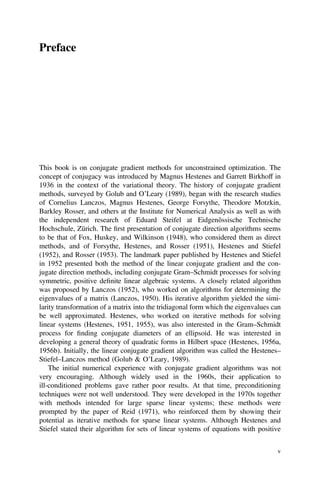
Preface
This book is on conjugate gradient methods for unconstrained optimization. The
concept of conjugacy was introduced by Magnus Hestenes and Garrett Birkhoff in
1936 in the context of the variational theory. The history of conjugate gradient
methods, surveyed by Golub and O’Leary (1989), began with the research studies
of Cornelius Lanczos, Magnus Hestenes, George Forsythe, Theodore Motzkin,
Barkley Rosser, and others at the Institute for Numerical Analysis as well as with
the independent research of Eduard Steifel at Eidgenössische Technische
Hochschule, Zürich. The first presentation of conjugate direction algorithms seems
to be that of Fox, Huskey, and Wilkinson (1948), who considered them as direct
methods, and of Forsythe, Hestenes, and Rosser (1951), Hestenes and Stiefel
(1952), and Rosser (1953). The landmark paper published by Hestenes and Stiefel
in 1952 presented both the method of the linear conjugate gradient and the con-
jugate direction methods, including conjugate Gram–Schmidt processes for solving
symmetric, positive definite linear algebraic systems. A closely related algorithm
was proposed by Lanczos (1952), who worked on algorithms for determining the
eigenvalues of a matrix (Lanczos, 1950). His iterative algorithm yielded the simi-
larity transformation of a matrix into the tridiagonal form which the eigenvalues can
be well approximated. Hestenes, who worked on iterative methods for solving
linear systems (Hestenes, 1951, 1955), was also interested in the Gram–Schmidt
process for finding conjugate diameters of an ellipsoid. He was interested in
developing a general theory of quadratic forms in Hilbert space (Hestenes, 1956a,
1956b). Initially, the linear conjugate gradient algorithm was called the Hestenes–
Stiefel–Lanczos method (Golub & O’Leary, 1989).
The initial numerical experience with conjugate gradient algorithms was not
very encouraging. Although widely used in the 1960s, their application to
ill-conditioned problems gave rather poor results. At that time, preconditioning
techniques were not well understood. They were developed in the 1970s together
with methods intended for large sparse linear systems; these methods were
prompted by the paper of Reid (1971), who reinforced them by showing their
potential as iterative methods for sparse linear systems. Although Hestenes and
Stiefel stated their algorithm for sets of linear systems of equations with positive
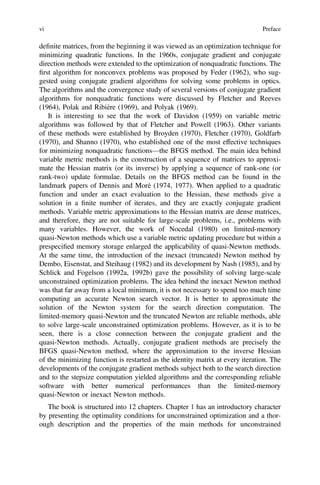
v
definite matrices, from the beginning it was viewed as an optimization technique for
minimizing quadratic functions. In the 1960s, conjugate gradient and conjugate
direction methods were extended to the optimization of nonquadratic functions. The
first algorithm for nonconvex problems was proposed by Feder (1962), who sug-
gested using conjugate gradient algorithms for solving some problems in optics.
The algorithms and the convergence study of several versions of conjugate gradient
algorithms for nonquadratic functions were discussed by Fletcher and Reeves
(1964), Polak and Ribière (1969), and Polyak (1969).
It is interesting to see that the work of Davidon (1959) on variable metric
algorithms was followed by that of Fletcher and Powell (1963). Other variants
of these methods were established by Broyden (1970), Fletcher (1970), Goldfarb
(1970), and Shanno (1970), who established one of the most effective techniques
for minimizing nonquadratic functions—the BFGS method. The main idea behind
variable metric methods is the construction of a sequence of matrices to approxi-
mate the Hessian matrix (or its inverse) by applying a sequence of rank-one (or
rank-two) update formulae. Details on the BFGS method can be found in the
landmark papers of Dennis and Moré (1974, 1977). When applied to a quadratic
function and under an exact evaluation to the Hessian, these methods give a
solution in a finite number of iterates, and they are exactly conjugate gradient
methods. Variable metric approximations to the Hessian matrix are dense matrices,
and therefore, they are not suitable for large-scale problems, i.e., problems with
many variables. However, the work of Nocedal (1980) on limited-memory
quasi-Newton methods which use a variable metric updating procedure but within a
prespecified memory storage enlarged the applicability of quasi-Newton methods.
At the same time, the introduction of the inexact (truncated) Newton method by
Dembo, Eisenstat, and Steihaug (1982) and its development by Nash (1985), and by
Schlick and Fogelson (1992a, 1992b) gave the possibility of solving large-scale
unconstrained optimization problems. The idea behind the inexact Newton method
was that far away from a local minimum, it is not necessary to spend too much time
computing an accurate Newton search vector. It is better to approximate the
solution of the Newton system for the search direction computation. The
limited-memory quasi-Newton and the truncated Newton are reliable methods, able
to solve large-scale unconstrained optimization problems. However, as it is to be
seen, there is a close connection between the conjugate gradient and the
quasi-Newton methods. Actually, conjugate gradient methods are precisely the
BFGS quasi-Newton method, where the approximation to the inverse Hessian
of the minimizing function is restarted as the identity matrix at every iteration. The
developments of the conjugate gradient methods subject both to the search direction
and to the stepsize computation yielded algorithms and the corresponding reliable
software with better numerical performances than the limited-memory
quasi-Newton or inexact Newton methods.
The book is structured into 12 chapters. Chapter 1 has an introductory character
by presenting the optimality conditions for unconstrained optimization and a thor-
ough description and the properties of the main methods for unconstrained
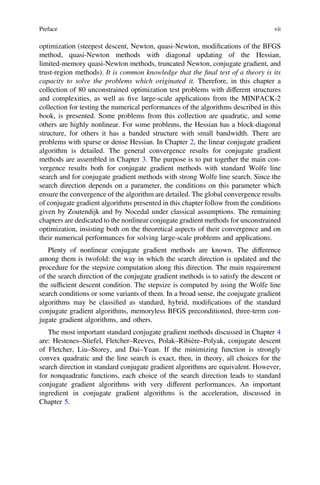
vi Preface
optimization (steepest descent, Newton, quasi-Newton, modifications of the BFGS
method, quasi-Newton methods with diagonal updating of the Hessian,
limited-memory quasi-Newton methods, truncated Newton, conjugate gradient, and
trust-region methods). It is common knowledge that the final test of a theory is its
capacity to solve the problems which originated it. Therefore, in this chapter a
collection of 80 unconstrained optimization test problems with different structures
and complexities, as well as five large-scale applications from the MINPACK-2
collection for testing the numerical performances of the algorithms described in this
book, is presented. Some problems from this collection are quadratic, and some
others are highly nonlinear. For some problems, the Hessian has a block-diagonal
structure, for others it has a banded structure with small bandwidth. There are
problems with sparse or dense Hessian. In Chapter 2, the linear conjugate gradient
algorithm is detailed. The general convergence results for conjugate gradient
methods are assembled in Chapter 3. The purpose is to put together the main con-
vergence results both for conjugate gradient methods with standard Wolfe line
search and for conjugate gradient methods with strong Wolfe line search. Since the
search direction depends on a parameter, the conditions on this parameter which
ensure the convergence of the algorithm are detailed. The global convergence results
of conjugate gradient algorithms presented in this chapter follow from the conditions
given by Zoutendijk and by Nocedal under classical assumptions. The remaining
chapters are dedicated to the nonlinear conjugate gradient methods for unconstrained
optimization, insisting both on the theoretical aspects of their convergence and on
their numerical performances for solving large-scale problems and applications.
Plenty of nonlinear conjugate gradient methods are known. The difference
among them is twofold: the way in which the search direction is updated and the
procedure for the stepsize computation along this direction. The main requirement
of the search direction of the conjugate gradient methods is to satisfy the descent or
the sufficient descent condition. The stepsize is computed by using the Wolfe line
search conditions or some variants of them. In a broad sense, the conjugate gradient
algorithms may be classified as standard, hybrid, modifications of the standard
conjugate gradient algorithms, memoryless BFGS preconditioned, three-term con-
jugate gradient algorithms, and others.
The most important standard conjugate gradient methods discussed in Chapter 4
are: Hestenes–Stiefel, Fletcher–Reeves, Polak–Ribière–Polyak, conjugate descent
of Fletcher, Liu–Storey, and Dai–Yuan. If the minimizing function is strongly
convex quadratic and the line search is exact, then, in theory, all choices for the
search direction in standard conjugate gradient algorithms are equivalent. However,
for nonquadratic functions, each choice of the search direction leads to standard
conjugate gradient algorithms with very different performances. An important
ingredient in conjugate gradient algorithms is the acceleration, discussed in
Chapter 5.
Preface vii
Hybrid conjugate gradient algorithms presented in Chapter 6 try to combine the
standard conjugate gradient methods in order to exploit the attractive features of
each one. To obtain hybrid conjugate gradient algorithms, the standard schemes
may be combined in two different ways. The first combination is based on the
projection concept. The idea of these methods is to consider a pair of standard
conjugate gradient methods and use one of them when a criterion is satisfied. As
soon as the criterion has been violated, then the other standard conjugate gradient
from the pair is used. The second class of the hybrid conjugate gradient methods is
based on the convex combination of the standard methods. This idea of these
methods is to choose a pair of standard methods and to combine them in a convex
way, where the parameter in the convex combination is computed by using the
conjugacy condition or the Newton search direction. In general, the hybrid methods
based on the convex combination of the standard schemes outperform the hybrid
methods based on the projection concept. The hybrid methods are more efficient
and more robust than the standard ones.
An important class of conjugate gradient algorithms discussed in Chapter 7 is
obtained by modifying the standard algorithms. Any standard conjugate gradient
algorithm may be modified in such a way that the corresponding search direction is
descent, and the numerical performances are improved. In this area of research,
only some modifications of the Hestenes–Stifel standard conjugate gradient algo-
rithm are presented. Today’s best-performing conjugate gradient algorithms are the
modifications of the Hestenes–Stiefel conjugate gradient algorithm: CG-DESCENT
of Hager and Zhang (2005) and DESCON of Andrei (2013c). CG-DESCENT is a
conjugate gradient algorithm with guaranteed descent. In fact, CG-DESCENT can
be viewed as an adaptive version of the Dai and Liao conjugate gradient algorithm
with a special value for its parameter. The search direction of CG-DESCENT is
related to the memoryless quasi-Newton direction of Perry–Shanno. DESCON is a
conjugate gradient algorithm with guaranteed descent and conjugacy conditions and
with a modified Wolfe line search. Mainly, it is a modification of the Hestenes–
Stiefel conjugate gradient algorithm. In CG-DESCENT, the stepsize is computed
by using the standard Wolfe line search or an approximate Wolfe line search
introduced by Hager and Zhang (2005, 2006a, 2006b), which is responsible for the
high performances of the algorithm. In DESCON, the stepsize is computed by using
the modified Wolfe line search introduced by Andrei (2013c), in which the
parameter in the curvature condition of the Wolfe line search is adaptively modified
at every iteration. Besides, DESCON is equipped with an acceleration scheme
which improves its performances.
The first connection between the conjugate gradient algorithms and the
quasi-Newton ones was presented by Perry (1976), who expressed the Hestenes–
Stiefel search direction as a matrix multiplying the negative gradient. Later on,
Shanno (1978a) showed that the conjugate gradient methods are exactly the BFGS
quasi-Newton methods, where the approximation to the inverse Hessian is restarted
as the identity matrix at every iteration. In other words, conjugate gradient methods
are memoryless quasi-Newton methods. This was the starting point of a very prolific
viii Preface
research area of memoryless quasi-Newton conjugate gradient methods, which is
discussed in Chapter 8. The point was how the second-order information of the
minimizing function should be introduced in the formula for updating the search
direction. Using this idea to include the curvature of the minimizing function in the
search direction computation, Shanno (1983) elaborated CONMIN as the first
conjugate gradient algorithm memoryless BFGS preconditioned. Later on, by using
a combination of the scaled memoryless BFGS method and the preconditioning,
Andrei (2007a, 2007b, 2007c, 2008a) elaborated SCALCG as a double-quasi-
Newton update scheme. Dai and Kou (2013) elaborated the CGOPT algorithm as a
family of conjugate gradient methods based on the self-scaling memoryless BFGS
method in which the search direction is computed in a one-dimensional manifold.
The search direction in CGOPT is chosen to be closest to the Perry–Shanno direc-
tion. The stepsize in CGOPT is computed by using an improved Wolfe line search
introduced by Dai and Kou (2013). CGOPT with improved Wolfe line search and a
special restart condition is one of the best conjugate gradient algorithms. New
conjugate gradient algorithms based on the self-scaling memoryless BFGS updating
using the determinant or the trace of the iteration matrix or the measure function of
Byrd and Nocedal are presented in this chapter.
Beale (1972) and Nazareth (1977) introduced the three-term conjugate gradient
methods, presented, and analyzed in Chapter 9. The convergence rate of the con-
jugate gradient method may be improved from linear to n-step quadratic if the
method is restarted with the negative gradient direction at every n iterations. One
such restart technique was proposed by Beale (1972). In his restarting procedure,
the restart direction is a combination of the negative gradient and the previous
search direction which includes the second-order derivative information achieved
by searching along the previous direction. Thus, a three-term conjugate gradient
was obtained. In order to achieve finite convergence for an arbitrary initial search
direction, Nazareth (1977) proposed a conjugate gradient method in which the
search direction has three terms. Plenty of three-term conjugate gradient algorithms
are known. This chapter presents only the three-term conjugate gradient with
descent and conjugacy conditions, the three-term conjugate gradient method with
subspace minimization, and the three-term conjugate gradient method with mini-
mization of one-parameter quadratic model of the minimizing function. The
three-term conjugate gradient concept is an interesting innovation. However, the
numerical performances of these algorithms are modest.
Preconditioning of the conjugate gradient algorithms is presented in Chapter 10.
This is a technique for accelerating the convergence of algorithms. In fact, pre-
conditioning was used in the previous chapters as well, but it is here where the
proper preconditioning by a change of variables which improves the eigenvalues
distribution of the iteration matrix is emphasized.
Some other conjugate gradient methods, like those based on clustering the
eigenvalues of the iteration matrix or on minimizing the condition number of this
matrix, including the methods with guaranteed descent and conjugacy conditions
Preface ix
are presented in Chapter 11. Clustering the eigenvalues of the iteration matrix and
minimizing its condition number are two important approaches to basically pursue
similar ideas for improving the performances of the corresponding conjugate gra-
dient algorithms. However, the approximations of the Hessian used in these algo-
rithms play a crucial role in capturing the curvature of the minimizing function. The
methods with clustering the eigenvalues or minimizing the condition number of the
iteration matrix are very close to those based on memoryless BFGS preconditioned,
the best ones in this class, but they are strongly dependent on the approximation
of the Hessian used in the search direction definition. The methods in which both
the sufficient descent and the conjugacy conditions are satisfied do not perform very
well. Apart from these two conditions, some additional ingredients are necessary for
them to perform better. This chapter also focuses on some combinations between
the conjugate gradient algorithm satisfying the sufficient descent and the conjugacy
conditions and the limited-memory BFGS algorithms. Finally, the limited-memory
L-BFGS preconditioned conjugate gradient algorithm (L-CG-DESCENT) of Hager
and Zhang (2013) and the subspace minimization conjugate gradient algorithms
based on cubic regularization (Zhao, Liu, & Liu, 2019) are discussed.
The last chapter details some discussions and conclusions on the conjugate
gradient methods presented in this book, insisting on the performances of the
algorithms for solving large-scale applications from MINPACK-2 collection
(Averick, Carter, Moré, & Xue, 1992) up to 250,000 variables.
Optimization algorithms, particularly the conjugate gradient ones, involve some
advanced mathematical concepts used in defining them and in proving their con-
vergence and complexity. Therefore, Appendix A contains some key elements
from: linear algebra, real analysis, functional analysis, and convexity. The readers
are recommended to go through this appendix first. Appendix B presents the
algebraic expression of 80 unconstrained optimization problems, included in the
UOP collection, used for testing the performances of the algorithms described in
this book.
The reader will find a well-organized book, written at an accessible level and
presenting in a rigorous and friendly manner the recent theoretical developments of
conjugate gradient methods for unconstrained optimization, computational results,
and performances of algorithms for solving a large class of unconstrained opti-
mization problems with different structures and complexities as well as performances
and behavior of algorithms for solving large-scale unconstrained optimization
engineering applications. A great deal of attention has been given to the computa-
tional performances and numerical results of these algorithms and comparisons for
solving unconstrained optimization problems and large-scale applications. Plenty of
Dolan and Moré (2002) performance profiles which illustrate the behavior of the
algorithms have been given. Basically, the main purpose of the book has been to
establish the computational power of the most known conjugate gradient algorithms
for solving large-scale and complex unconstrained optimization problems.
x Preface
The book is an invitation for researchers working in the unconstrained opti-
mization area to understand, learn, and develop new conjugate gradient algorithms
with better properties. It is of great interests to all those interested in developing and
using new advanced techniques for solving unconstrained optimization complex
problems. Mathematical programming researchers, theoreticians, and practitioners
in operations research, practitioners in engineering and industry researchers as well
as graduate students in mathematics, Ph.D., and master students in mathematical
programming will find plenty of information and practical aspects for solving
large-scale unconstrained optimization problems and applications by conjugate
gradient methods.
I am grateful to the Alexander von Humboldt Foundation for its appreciation
and generous financial support during the 2+ years at different universities in
Germany. My thanks also go to Elizabeth Loew and to all the staff of Springer, for
their encouragement, competent, and superb assistance with the preparation of this
book. Finally, my deepest thanks go to my wife, Mihaela, for her constant
understanding and support along the years.
Tohăniţa / Bran Resort,
Bucharest, Romania
January 2020
Neculai Andrei
Preface xi
Contents
1 Introduction: Overview of Unconstrained Optimization . . . . . . . . . 1
1.1 The Problem. . . . . . . . . . . . . . . . . . . . . . . . . . . . . . . . . . . . . . 1
1.2 Line Search . . . . . . . . . . . . . . . . . . . . . . . . . . . . . . . . . . . . . . 3
1.3 Optimality Conditions for Unconstrained Optimization . . . . . . . 14
1.4 Overview of Unconstrained Optimization Methods . . . . . . . . . . 17
1.4.1 Steepest Descent Method . . . . . . . . . . . . . . . . . . . . . . 17
1.4.2 Newton Method . . . . . . . . . . . . . . . . . . . . . . . . . . . . . 18
1.4.3 Quasi-Newton Methods . . . . . . . . . . . . . . . . . . . . . . . 21
1.4.4 Modifications of the BFGS Method . . . . . . . . . . . . . . . 25
1.4.5 Quasi-Newton Methods with Diagonal Updating
of the Hessian . . . . . . . . . . . . . . . . . . . . . . . . . . . . . . 35
1.4.6 Limited-Memory Quasi-Newton Methods . . . . . . . . . . 38
1.4.7 Truncated Newton Methods . . . . . . . . . . . . . . . . . . . . 39
1.4.8 Conjugate Gradient Methods . . . . . . . . . . . . . . . . . . . . 41
1.4.9 Trust-Region Methods . . . . . . . . . . . . . . . . . . . . . . . . 43
1.4.10 p-Regularized Methods . . . . . . . . . . . . . . . . . . . . . . . . 45
1.5 Test Problems and Applications . . . . . . . . . . . . . . . . . . . . . . . . 48
1.6 Numerical Experiments . . . . . . . . . . . . . . . . . . . . . . . . . . . . . . 60
Notes and References . . . . . . . . . . . . . . . . . . . . . . . . . . . . . . . . . . . . 62
2 Linear Conjugate Gradient Algorithm . . . . . . . . . . . . . . . . . . . . . . 67
2.1 Line Search . . . . . . . . . . . . . . . . . . . . . . . . . . . . . . . . . . . . . . 68
2.2 Fundamental Property of the Line Search Method
with Conjugate Directions . . . . . . . . . . . . . . . . . . . . . . . . . . . . 69
2.3 The Linear Conjugate Gradient Algorithm . . . . . . . . . . . . . . . . 71
2.4 Convergence Rate of the Linear Conjugate Gradient
Algorithm. . . . . . . . . . . . . . . . . . . . . . . . . . . . . . . . . . . . . . . . 73
2.5 Comparison of the Convergence Rate of the Linear
Conjugate Gradient and of the Steepest Descent . . . . . . . . . . . . 84
xiii
2.6 Preconditioning of the Linear Conjugate Gradient
Algorithms . . . . . . . . . . . . . . . . . . . . . . . . . . . . . . . . . . . . . . . 85
Notes and References . . . . . . . . . . . . . . . . . . . . . . . . . . . . . . . . . . . . 87
3 General Convergence Results for Nonlinear Conjugate
Gradient Methods . . . . . . . . . . . . . . . . . . . . . . . . . . . . . . . . . . . . . . 89
3.1 Types of Convergence . . . . . . . . . . . . . . . . . . . . . . . . . . . . . . 90
3.2 The Concept of Nonlinear Conjugate Gradient . . . . . . . . . . . . . 93
3.3 General Convergence Results for Nonlinear Conjugate
Gradient Methods . . . . . . . . . . . . . . . . . . . . . . . . . . . . . . . . . . 96
3.3.1 Convergence Under the Strong Wolfe Line Search . . . . 103
3.3.2 Convergence Under the Standard Wolfe Line
Search . . . . . . . . . . . . . . . . . . . . . . . . . . . . . . . . . . . . 110
3.4 Criticism of the Convergence Results . . . . . . . . . . . . . . . . . . . . 117
Notes and References . . . . . . . . . . . . . . . . . . . . . . . . . . . . . . . . . . . . 122
4 Standard Conjugate Gradient Methods . . . . . . . . . . . . . . . . . . . . . 125
4.1 Conjugate Gradient Methods with gk þ 1
k k2
in the Numerator
of bk . . . . . . . . . . . . . . . . . . . . . . . . . . . . . . . . . . . . . . . . . . . 127
4.2 Conjugate Gradient Methods with gT
k þ 1yk in the Numerator
of bk . . . . . . . . . . . . . . . . . . . . . . . . . . . . . . . . . . . . . . . . . . . 143
4.3 Numerical Study . . . . . . . . . . . . . . . . . . . . . . . . . . . . . . . . . . . 154
Notes and References . . . . . . . . . . . . . . . . . . . . . . . . . . . . . . . . . . . . 159
5 Acceleration of Conjugate Gradient Algorithms . . . . . . . . . . . . . . . 161
5.1 Standard Wolfe Line Search with Cubic Interpolation . . . . . . . . 162
5.2 Acceleration of Nonlinear Conjugate Gradient Algorithms. . . . . 166
5.3 Numerical Study . . . . . . . . . . . . . . . . . . . . . . . . . . . . . . . . . . . 173
Notes and References . . . . . . . . . . . . . . . . . . . . . . . . . . . . . . . . . . . . 175
6 Hybrid and Parameterized Conjugate Gradient Methods . . . . . . . . 177
6.1 Hybrid Conjugate Gradient Methods Based on the Projection
Concept . . . . . . . . . . . . . . . . . . . . . . . . . . . . . . . . . . . . . . . . . 178
6.2 Hybrid Conjugate Gradient Methods as Convex
Combinations of the Standard Conjugate Gradient Methods . . . 188
6.3 Parameterized Conjugate Gradient Methods . . . . . . . . . . . . . . . 203
Notes and References . . . . . . . . . . . . . . . . . . . . . . . . . . . . . . . . . . . . 204
7 Conjugate Gradient Methods as Modifications of the Standard
Schemes . . . . . . . . . . . . . . . . . . . . . . . . . . . . . . . . . . . . . . . . . . . . . 205
7.1 Conjugate Gradient with Dai and Liao Conjugacy
Condition (DL) . . . . . . . . . . . . . . . . . . . . . . . . . . . . . . . . . . . . 206
7.2 Conjugate Gradient with Guaranteed Descent
(CG-DESCENT) . . . . . . . . . . . . . . . . . . . . . . . . . . . . . . . . . . . 218
xiv Contents
7.3 Conjugate Gradient with Guaranteed Descent and Conjugacy
Conditions and a Modified Wolfe Line Search (DESCON) . . . . 227
Notes and References . . . . . . . . . . . . . . . . . . . . . . . . . . . . . . . . . . . . 245
8 Conjugate Gradient Methods Memoryless BFGS
Preconditioned . . . . . . . . . . . . . . . . . . . . . . . . . . . . . . . . . . . . . . . . 249
8.1 Conjugate Gradient Memoryless BFGS Preconditioned
(CONMIN). . . . . . . . . . . . . . . . . . . . . . . . . . . . . . . . . . . . . . . 250
8.2 Scaling Conjugate Gradient Memoryless BFGS
Preconditioned (SCALCG) . . . . . . . . . . . . . . . . . . . . . . . . . . . 261
8.3 Conjugate Gradient Method Closest to Scaled Memoryless
BFGS Search Direction (DK/CGOPT) . . . . . . . . . . . . . . . . . . . 278
8.4 New Conjugate Gradient Algorithms Based on Self-Scaling
Memoryless BFGS Updating . . . . . . . . . . . . . . . . . . . . . . . . . . 290
Notes and References . . . . . . . . . . . . . . . . . . . . . . . . . . . . . . . . . . . . 308
9 Three-Term Conjugate Gradient Methods . . . . . . . . . . . . . . . . . . . 311
9.1 A Three-Term Conjugate Gradient Method with Descent
and Conjugacy Conditions (TTCG) . . . . . . . . . . . . . . . . . . . . . 316
9.2 A Three-Term Conjugate Gradient Method with Subspace
Minimization (TTS) . . . . . . . . . . . . . . . . . . . . . . . . . . . . . . . . 324
9.3 A Three-Term Conjugate Gradient Method with Minimization
of One-Parameter Quadratic Model of Minimizing Function
(TTDES) . . . . . . . . . . . . . . . . . . . . . . . . . . . . . . . . . . . . . . . . 334
Notes and References . . . . . . . . . . . . . . . . . . . . . . . . . . . . . . . . . . . . 345
10 Preconditioning of the Nonlinear Conjugate Gradient
Algorithms . . . . . . . . . . . . . . . . . . . . . . . . . . . . . . . . . . . . . . . . . . . 349
10.1 Preconditioners Based on Diagonal Approximations
to the Hessian . . . . . . . . . . . . . . . . . . . . . . . . . . . . . . . . . . . . . 352
10.2 Criticism of Preconditioning the Nonlinear Conjugate
Gradient Algorithms . . . . . . . . . . . . . . . . . . . . . . . . . . . . . . . . 357
Notes and References . . . . . . . . . . . . . . . . . . . . . . . . . . . . . . . . . . . . 358
11 Other Conjugate Gradient Methods . . . . . . . . . . . . . . . . . . . . . . . . 361
11.1 Eigenvalues Versus Singular Values in Conjugate Gradient
Algorithms (CECG and SVCG) . . . . . . . . . . . . . . . . . . . . . . . . 363
11.2 A Conjugate Gradient Algorithm with Guaranteed Descent
and Conjugacy Conditions (CGSYS) . . . . . . . . . . . . . . . . . . . . 377
11.3 Combination of Conjugate Gradient with Limited-Memory
BFGS Methods . . . . . . . . . . . . . . . . . . . . . . . . . . . . . . . . . . . . 385
11.4 Conjugate Gradient with Subspace Minimization Based
on Regularization Model of the Minimizing Function . . . . . . . . 400
Notes and References . . . . . . . . . . . . . . . . . . . . . . . . . . . . . . . . . . . . 413
Contents xv
12 Discussions, Conclusions, and Large-Scale Optimization. . . . . . . . . 415
Notes and References . . . . . . . . . . . . . . . . . . . . . . . . . . . . . . . . . . . . 430
Appendix A: Mathematical Review . . . . . . . . . . . . . . . . . . . . . . . . . . . . . . 433
Appendix B: UOP: A Collection of 80 Unconstrained Optimization
Test Problems . . . . . . . . . . . . . . . . . . . . . . . . . . . . . . . . . . . . 455
References . . . . . . . . . . . . . . . . . . . . . . . . . . . . . . . . . . . . . . . . . . . . . . . . . . 467
Author Index. . . . . . . . . . . . . . . . . . . . . . . . . . . . . . . . . . . . . . . . . . . . . . . . 487
Subject Index. . . . . . . . . . . . . . . . . . . . . . . . . . . . . . . . . . . . . . . . . . . . . . . . 493
xvi Contents
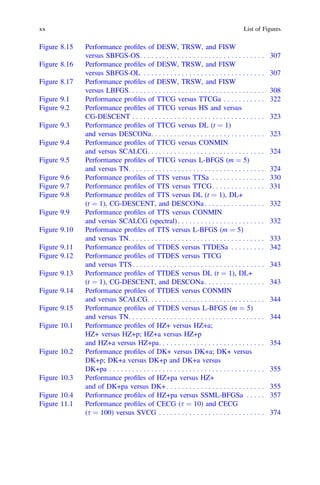
List of Figures
Figure 1.1 Solution of the application A1—Elastic–Plastic Torsion.
nx ¼ 200; ny ¼ 200 . . . . . . . . . . . . . . . . . . . . . . . . . . . . . . . 53
Figure 1.2 Solution of the application A2—Pressure Distribution
in a Journal Bearing. nx ¼ 200; ny ¼ 200 . . . . . . . . . . . . . . 54
Figure 1.3 Solution of the application A3—Optimal Design
with Composite Materials. nx ¼ 200; ny ¼ 200 . . . . . . . . . . 56
Figure 1.4 Solution of the application A4—Steady-State Combustion.
nx ¼ 200; ny ¼ 200 . . . . . . . . . . . . . . . . . . . . . . . . . . . . . . . 58
Figure 1.5 Solution of the application A5—minimal surfaces with
Enneper boundary conditions. nx ¼ 200; ny ¼ 200 . . . . . . . 59
Figure 1.6 Performance profiles of L-BFGS (m ¼ 5) versus TN
(Truncated Newton) based on: iterations calls, function
calls, and CPU time, respectively . . . . . . . . . . . . . . . . . . . . . 63
Figure 2.1 Some Chebyshev polynomials . . . . . . . . . . . . . . . . . . . . . . . 77
Figure 2.2 Performance of the linear conjugate gradient algorithm
for solving the linear system Ax ¼ b, where:
a) A ¼ diagð1; 2; . . .; 1000Þ, b) the diagonal elements
of A are uniformly distributed in [0,1), c) the eigenvalues
of A are distributed in 10 intervals, and d) the eigenvalues
of A are distributed in 5 intervals . . . . . . . . . . . . . . . . . . . . . 80
Figure 2.3 Performance of the linear conjugate gradient algorithm
for solving the linear system Ax ¼ b, where the matrix
A has a large eigenvalue separated from others, which
are uniformly distributed in [0,1) . . . . . . . . . . . . . . . . . . . . . 80
Figure 2.4 Evolution of the error b  Axk
k k . . . . . . . . . . . . . . . . . . . . . 81
Figure 2.5 Evolution of the error b  Axk
k k of the linear conjugate
gradient algorithm for different numbers ðn2Þ of blocks
on the main diagonal of matrix A . . . . . . . . . . . . . . . . . . . . . 83
xvii
Figure 3.1 Performance profiles of Hestenes–Stiefel conjugate
gradient with standard Wolfe line search versus Hestenes–
Stiefel conjugate gradient with strong Wolfe line search,
based on CPU time. . . . . . . . . . . . . . . . . . . . . . . . . . . . . . . . 122
Figure 4.1 Performance profiles of the standard conjugate gradient
methods . . . . . . . . . . . . . . . . . . . . . . . . . . . . . . . . . . . . . . . . 155
Figure 4.2 Performance profiles of the standard conjugate gradient
methods . . . . . . . . . . . . . . . . . . . . . . . . . . . . . . . . . . . . . . . . 156
Figure 4.3 Performance profiles of seven standard conjugate gradient
methods . . . . . . . . . . . . . . . . . . . . . . . . . . . . . . . . . . . . . . . . 157
Figure 5.1 Subroutine LineSearch which generates safeguarded
stepsizes satisfying the standard Wolfe line search
with cubic interpolation. . . . . . . . . . . . . . . . . . . . . . . . . . . . . 164
Figure 5.2 Performance profiles of ACCPRP+ versus PRP+
and of ACCDY versus DY . . . . . . . . . . . . . . . . . . . . . . . . . . 173
Figure 6.1 Performance profiles of some hybrid conjugate gradient
methods based on the projection concept . . . . . . . . . . . . . . . 183
Figure 6.2 Performance profiles of the hybrid conjugate gradient
methods HS-DY, hDY LS-CD, and of PRP-FR, GN,
and TAS based on the projection concept. . . . . . . . . . . . . . . 184
Figure 6.3 Global performance profiles of six hybrid conjugate
gradient methods. . . . . . . . . . . . . . . . . . . . . . . . . . . . . . . . . . 185
Figure 6.4 Performance profiles of the hybrid conjugate gradient
methods (HS-DY, PRP-FR) versus the standard
conjugate gradient methods (PRP+ , LS, HS, PRP) . . . . . . . 186
Figure 6.5 Performance profiles of NDLSDY versus the standard
conjugate gradient methods LS, DY, PRP, CD, FR,
and HS . . . . . . . . . . . . . . . . . . . . . . . . . . . . . . . . . . . . . . . . . 195
Figure 6.6 Performance profiles of NDLSDY versus the hybrid
conjugate gradient methods hDY, HS-DY, PRP-FR,
and LS-CD . . . . . . . . . . . . . . . . . . . . . . . . . . . . . . . . . . . . . . 196
Figure 6.7 Performance profiles of NDHSDY versus NDLSDY . . . . . . 197
Figure 6.8 Performance profiles of NDLSDY and NDHSDY
versus CCPRPDY and NDPRPDY . . . . . . . . . . . . . . . . . . . . 198
Figure 6.9 Performance profiles of NDHSDY versus NDHSDYa
and of NDLSDY versus NDLSDYa . . . . . . . . . . . . . . . . . . . 200
Figure 6.10 Performance profiles of NDHSDYM versus NDHSDY. . . . . 203
Figure 7.1 Performance profiles of DL+ (t = 1) versus DL (t = 1). . . . . 216
Figure 7.2 Performance profiles of DL (t = 1) and DL+ (t = 1)
versus HS, PRP, FR, and DY . . . . . . . . . . . . . . . . . . . . . . . . 217
Figure 7.3 Performance profiles of CG-DESCENT versus HS,
PRP, DY, and LS . . . . . . . . . . . . . . . . . . . . . . . . . . . . . . . . . 224
xviii List of Figures
Figure 7.4 Performance profiles of CG-DESCENTaw
(CG-DESCENT with approximate Wolfe conditions)
versus HS, PRP, DY, and LS . . . . . . . . . . . . . . . . . . . . . . . . 225
Figure 7.5 Performance profiles of CG-DESCENT and
CG-DESCENTaw (CG-DESCENT with approximate
Wolfe conditions) versus DL (t = 1) and DL+ (t = 1) . . . . . 226
Figure 7.6 Performance profile of CG-DESCENT versus L-BFGS
(m = 5) and versus TN . . . . . . . . . . . . . . . . . . . . . . . . . . . . . 227
Figure 7.7 Performance profile of DESCONa versus HS
and versus PRP. . . . . . . . . . . . . . . . . . . . . . . . . . . . . . . . . . . 243
Figure 7.8 Performance profile of DESCONa versus DL (t = 1)
and versus CG-DESCENT . . . . . . . . . . . . . . . . . . . . . . . . . . 243
Figure 7.9 Performances of DESCONa versus CG-DESCENTaw . . . . . 244
Figure 7.10 Performance profile of DESCONa versus L-BFGS (m = 5)
and versus TN. . . . . . . . . . . . . . . . . . . . . . . . . . . . . . . . . . . . 244
Figure 8.1 Performance profiles of CONMIN versus HS, PRP, DY,
and LS . . . . . . . . . . . . . . . . . . . . . . . . . . . . . . . . . . . . . . . . . 260
Figure 8.2 Performance profiles of CONMIN versus hDY, HS-DY,
GN, and LS-CD . . . . . . . . . . . . . . . . . . . . . . . . . . . . . . . . . . 261
Figure 8.3 Performance profiles of CONMIN versus DL (t ¼ 1),
DL+ (t ¼ 1). CG-DESCENT and DESCONa . . . . . . . . . . . . 262
Figure 8.4 Performance profiles of CONMIN versus L-BFGS (m ¼ 5)
and versus TN. . . . . . . . . . . . . . . . . . . . . . . . . . . . . . . . . . . . 262
Figure 8.5 Performance profiles of SCALCG (spectral) versus
SCALCGa (spectral) . . . . . . . . . . . . . . . . . . . . . . . . . . . . . . . 276
Figure 8.6 Performance profiles of SCALCG (spectral) versus DL
(t ¼ 1), CG-DESCENT, DESCON, and CONMIN . . . . . . . . 277
Figure 8.7 Performance profiles of SCALCGa (SCALCG accelerated)
versus DL (t ¼ 1). CG-DESCENT, DESCONa
and CONMIN . . . . . . . . . . . . . . . . . . . . . . . . . . . . . . . . . . . . 278
Figure 8.8 Performance profiles of DK+w versus CONMIN,
SCALCG (spectral). CG-DESCENT and DESCONa . . . . . . 285
Figure 8.9 Performance profiles of DK+aw versus CONMIN,
SCALCG (spectral). CG-DESCENTaw and DESCONa . . . . 286
Figure 8.10 Performance profiles of DK+iw versus DK+w
and versus DK+aw . . . . . . . . . . . . . . . . . . . . . . . . . . . . . . . . 287
Figure 8.11 Performance profiles of DK+iw versus CONMIN,
SCALCG (spectral). CG-DESCENTaw, and DESCONa. . . . 288
Figure 8.12 Performance profiles of DESW versus TRSW, of DESW
versus FISW, and of TRSW versus FISW . . . . . . . . . . . . . . 305
Figure 8.13 Performance profiles of DESW, TRSW, and FISW
versus CG-DESCENT. . . . . . . . . . . . . . . . . . . . . . . . . . . . . . 306
Figure 8.14 Performance profiles of DESW, TRSW, and FISW
versus DESCONa . . . . . . . . . . . . . . . . . . . . . . . . . . . . . . . . . 306
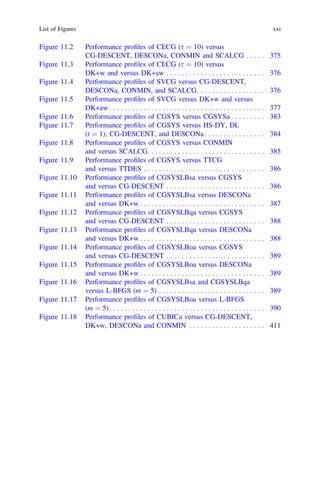
List of Figures xix
Figure 8.15 Performance profiles of DESW, TRSW, and FISW
versus SBFGS-OS. . . . . . . . . . . . . . . . . . . . . . . . . . . . . . . . . 307
Figure 8.16 Performance profiles of DESW, TRSW, and FISW
versus SBFGS-OL . . . . . . . . . . . . . . . . . . . . . . . . . . . . . . . . 307
Figure 8.17 Performance profiles of DESW, TRSW, and FISW
versus LBFGS. . . . . . . . . . . . . . . . . . . . . . . . . . . . . . . . . . . . 308
Figure 9.1 Performance profiles of TTCG versus TTCGa . . . . . . . . . . . 322
Figure 9.2 Performance profiles of TTCG versus HS and versus
CG-DESCENT . . . . . . . . . . . . . . . . . . . . . . . . . . . . . . . . . . . 323
Figure 9.3 Performance profiles of TTCG versus DL (t ¼ 1)
and versus DESCONa. . . . . . . . . . . . . . . . . . . . . . . . . . . . . . 323
Figure 9.4 Performance profiles of TTCG versus CONMIN
and versus SCALCG. . . . . . . . . . . . . . . . . . . . . . . . . . . . . . . 324
Figure 9.5 Performance profiles of TTCG versus L-BFGS (m ¼ 5)
and versus TN. . . . . . . . . . . . . . . . . . . . . . . . . . . . . . . . . . . . 324
Figure 9.6 Performance profiles of TTS versus TTSa . . . . . . . . . . . . . . 330
Figure 9.7 Performance profiles of TTS versus TTCG. . . . . . . . . . . . . . 331
Figure 9.8 Performance profiles of TTS versus DL (t ¼ 1), DL+
(t ¼ 1), CG-DESCENT, and DESCONa . . . . . . . . . . . . . . . . 332
Figure 9.9 Performance profiles of TTS versus CONMIN
and versus SCALCG (spectral) . . . . . . . . . . . . . . . . . . . . . . . 332
Figure 9.10 Performance profiles of TTS versus L-BFGS (m ¼ 5)
and versus TN. . . . . . . . . . . . . . . . . . . . . . . . . . . . . . . . . . . . 333
Figure 9.11 Performance profiles of TTDES versus TTDESa . . . . . . . . . 342
Figure 9.12 Performance profiles of TTDES versus TTCG
and versus TTS. . . . . . . . . . . . . . . . . . . . . . . . . . . . . . . . . . . 343
Figure 9.13 Performance profiles of TTDES versus DL (t ¼ 1), DL+
(t ¼ 1), CG-DESCENT, and DESCONa . . . . . . . . . . . . . . . . 343
Figure 9.14 Performance profiles of TTDES versus CONMIN
and versus SCALCG. . . . . . . . . . . . . . . . . . . . . . . . . . . . . . . 344
Figure 9.15 Performance profiles of TTDES versus L-BFGS (m ¼ 5)
and versus TN. . . . . . . . . . . . . . . . . . . . . . . . . . . . . . . . . . . . 344
Figure 10.1 Performance profiles of HZ+ versus HZ+a;
HZ+ versus HZ+p; HZ+a versus HZ+p
and HZ+a versus HZ+pa. . . . . . . . . . . . . . . . . . . . . . . . . . . . 354
Figure 10.2 Performance profiles of DK+ versus DK+a; DK+ versus
DK+p; DK+a versus DK+p and DK+a versus
DK+pa . . . . . . . . . . . . . . . . . . . . . . . . . . . . . . . . . . . . . . . . . 355
Figure 10.3 Performance profiles of HZ+pa versus HZ+
and of DK+pa versus DK+ . . . . . . . . . . . . . . . . . . . . . . . . . . 355
Figure 10.4 Performance profiles of HZ+pa versus SSML-BFGSa . . . . . 357
Figure 11.1 Performance profiles of CECG (s ¼ 10) and CECG
(s ¼ 100) versus SVCG . . . . . . . . . . . . . . . . . . . . . . . . . . . . 374
xx List of Figures
Figure 11.2 Performance profiles of CECG (s ¼ 10) versus
CG-DESCENT, DESCONa, CONMIN and SCALCG . . . . . 375
Figure 11.3 Performance profiles of CECG (s ¼ 10) versus
DK+w and versus DK+aw . . . . . . . . . . . . . . . . . . . . . . . . . . 376
Figure 11.4 Performance profiles of SVCG versus CG-DESCENT,
DESCONa, CONMIN, and SCALCG. . . . . . . . . . . . . . . . . . 376
Figure 11.5 Performance profiles of SVCG versus DK+w and versus
DK+aw . . . . . . . . . . . . . . . . . . . . . . . . . . . . . . . . . . . . . . . . . 377
Figure 11.6 Performance profiles of CGSYS versus CGSYSa . . . . . . . . . 383
Figure 11.7 Performance profiles of CGSYS versus HS-DY, DL
(t ¼ 1), CG-DESCENT, and DESCONa . . . . . . . . . . . . . . . . 384
Figure 11.8 Performance profiles of CGSYS versus CONMIN
and versus SCALCG. . . . . . . . . . . . . . . . . . . . . . . . . . . . . . . 385
Figure 11.9 Performance profiles of CGSYS versus TTCG
and versus TTDES . . . . . . . . . . . . . . . . . . . . . . . . . . . . . . . . 386
Figure 11.10 Performance profiles of CGSYSLBsa versus CGSYS
and versus CG-DESCENT . . . . . . . . . . . . . . . . . . . . . . . . . . 386
Figure 11.11 Performance profiles of CGSYSLBsa versus DESCONa
and versus DK+w . . . . . . . . . . . . . . . . . . . . . . . . . . . . . . . . . 387
Figure 11.12 Performance profiles of CGSYSLBqa versus CGSYS
and versus CG-DESCENT . . . . . . . . . . . . . . . . . . . . . . . . . . 388
Figure 11.13 Performance profiles of CGSYSLBqa versus DESCONa
and versus DK+w . . . . . . . . . . . . . . . . . . . . . . . . . . . . . . . . . 388
Figure 11.14 Performance profiles of CGSYSLBoa versus CGSYS
and versus CG-DESCENT . . . . . . . . . . . . . . . . . . . . . . . . . . 389
Figure 11.15 Performance profiles of CGSYSLBoa versus DESCONa
and versus DK+w . . . . . . . . . . . . . . . . . . . . . . . . . . . . . . . . . 389
Figure 11.16 Performance profiles of CGSYSLBsa and CGSYSLBqa
versus L-BFGS (m ¼ 5) . . . . . . . . . . . . . . . . . . . . . . . . . . . . 389
Figure 11.17 Performance profiles of CGSYSLBoa versus L-BFGS
(m ¼ 5) . . . . . . . . . . . . . . . . . . . . . . . . . . . . . . . . . . . . . . . . . 390
Figure 11.18 Performance profiles of CUBICa versus CG-DESCENT,
DK+w, DESCONa and CONMIN . . . . . . . . . . . . . . . . . . . . 411
List of Figures xxi
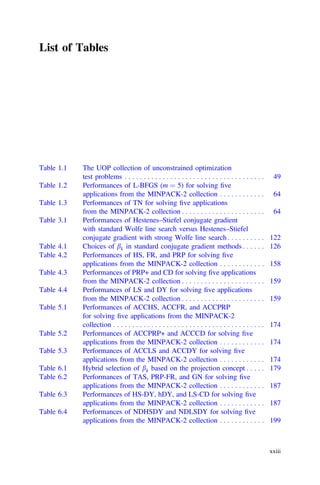
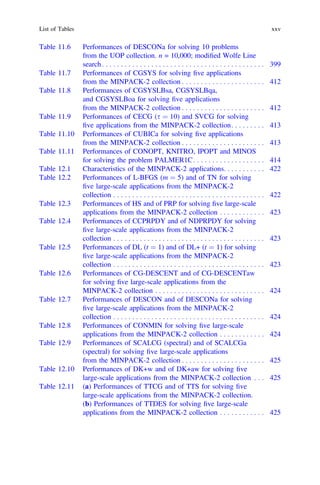
List of Tables
Table 1.1 The UOP collection of unconstrained optimization
test problems . . . . . . . . . . . . . . . . . . . . . . . . . . . . . . . . . . . . . 49
Table 1.2 Performances of L-BFGS (m ¼ 5) for solving five
applications from the MINPACK-2 collection . . . . . . . . . . . . 64
Table 1.3 Performances of TN for solving five applications
from the MINPACK-2 collection . . . . . . . . . . . . . . . . . . . . . . 64
Table 3.1 Performances of Hestenes–Stiefel conjugate gradient
with standard Wolfe line search versus Hestenes–Stiefel
conjugate gradient with strong Wolfe line search. . . . . . . . . . 122
Table 4.1 Choices of bk in standard conjugate gradient methods . . . . . . 126
Table 4.2 Performances of HS, FR, and PRP for solving five
applications from the MINPACK-2 collection . . . . . . . . . . . . 158
Table 4.3 Performances of PRP+ and CD for solving five applications
from the MINPACK-2 collection . . . . . . . . . . . . . . . . . . . . . . 159
Table 4.4 Performances of LS and DY for solving five applications
from the MINPACK-2 collection . . . . . . . . . . . . . . . . . . . . . . 159
Table 5.1 Performances of ACCHS, ACCFR, and ACCPRP
for solving five applications from the MINPACK-2
collection . . . . . . . . . . . . . . . . . . . . . . . . . . . . . . . . . . . . . . . . 174
Table 5.2 Performances of ACCPRP+ and ACCCD for solving five
applications from the MINPACK-2 collection . . . . . . . . . . . . 174
Table 5.3 Performances of ACCLS and ACCDY for solving five
applications from the MINPACK-2 collection . . . . . . . . . . . . 174
Table 6.1 Hybrid selection of bk based on the projection concept . . . . . 179
Table 6.2 Performances of TAS, PRP-FR, and GN for solving five
applications from the MINPACK-2 collection . . . . . . . . . . . . 187
Table 6.3 Performances of HS-DY, hDY, and LS-CD for solving five
applications from the MINPACK-2 collection . . . . . . . . . . . . 187
Table 6.4 Performances of NDHSDY and NDLSDY for solving five
applications from the MINPACK-2 collection . . . . . . . . . . . . 199
xxiii
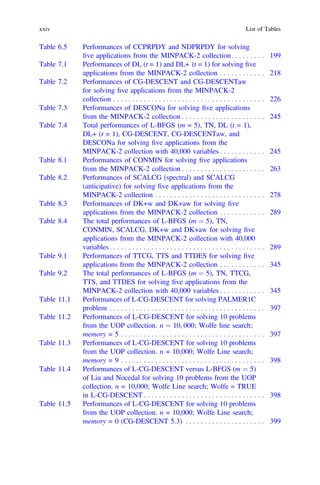
Table 6.5 Performances of CCPRPDY and NDPRPDY for solving
five applications from the MINPACK-2 collection. . . . . . . . . 199
Table 7.1 Performances of DL (t = 1) and DL+ (t = 1) for solving five
applications from the MINPACK-2 collection . . . . . . . . . . . . 218
Table 7.2 Performances of CG-DESCENT and CG-DESCENTaw
for solving five applications from the MINPACK-2
collection . . . . . . . . . . . . . . . . . . . . . . . . . . . . . . . . . . . . . . . . 226
Table 7.3 Performances of DESCONa for solving five applications
from the MINPACK-2 collection . . . . . . . . . . . . . . . . . . . . . . 245
Table 7.4 Total performances of L-BFGS (m = 5), TN, DL (t = 1),
DL+ (t = 1), CG-DESCENT, CG-DESCENTaw, and
DESCONa for solving five applications from the
MINPACK-2 collection with 40,000 variables . . . . . . . . . . . . 245
Table 8.1 Performances of CONMIN for solving five applications
from the MINPACK-2 collection . . . . . . . . . . . . . . . . . . . . . . 263
Table 8.2 Performances of SCALCG (spectral) and SCALCG
(anticipative) for solving five applications from the
MINPACK-2 collection . . . . . . . . . . . . . . . . . . . . . . . . . . . . . 278
Table 8.3 Performances of DK+w and DK+aw for solving five
applications from the MINPACK-2 collection . . . . . . . . . . . . 289
Table 8.4 The total performances of L-BFGS (m ¼ 5), TN,
CONMIN, SCALCG, DK+w and DK+aw for solving five
applications from the MINPACK-2 collection with 40,000
variables. . . . . . . . . . . . . . . . . . . . . . . . . . . . . . . . . . . . . . . . . 289
Table 9.1 Performances of TTCG, TTS and TTDES for solving five
applications from the MINPACK-2 collection . . . . . . . . . . . . 345
Table 9.2 The total performances of L-BFGS (m ¼ 5), TN, TTCG,
TTS, and TTDES for solving five applications from the
MINPACK-2 collection with 40,000 variables . . . . . . . . . . . . 345
Table 11.1 Performances of L-CG-DESCENT for solving PALMER1C
problem . . . . . . . . . . . . . . . . . . . . . . . . . . . . . . . . . . . . . . . . . 397
Table 11.2 Performances of L-CG-DESCENT for solving 10 problems
from the UOP collection. n ¼ 10; 000; Wolfe line search;
memory = 5 . . . . . . . . . . . . . . . . . . . . . . . . . . . . . . . . . . . . . . 397
Table 11.3 Performances of L-CG-DESCENT for solving 10 problems
from the UOP collection. n = 10,000; Wolfe Line search;
memory = 9 . . . . . . . . . . . . . . . . . . . . . . . . . . . . . . . . . . . . . . 398
Table 11.4 Performances of L-CG-DESCENT versus L-BFGS (m ¼ 5)
of Liu and Nocedal for solving 10 problems from the UOP
collection. n = 10,000; Wolfe Line search; Wolfe = TRUE
in L-CG-DESCENT . . . . . . . . . . . . . . . . . . . . . . . . . . . . . . . . 398
Table 11.5 Performances of L-CG-DESCENT for solving 10 problems
from the UOP collection. n = 10,000; Wolfe Line search;
memory = 0 (CG-DESCENT 5.3) . . . . . . . . . . . . . . . . . . . . . 399
xxiv List of Tables
Table 11.6 Performances of DESCONa for solving 10 problems
from the UOP collection. n = 10,000; modified Wolfe Line
search. . . . . . . . . . . . . . . . . . . . . . . . . . . . . . . . . . . . . . . . . . . 399
Table 11.7 Performances of CGSYS for solving five applications
from the MINPACK-2 collection . . . . . . . . . . . . . . . . . . . . . . 412
Table 11.8 Performances of CGSYSLBsa, CGSYSLBqa,
and CGSYSLBoa for solving five applications
from the MINPACK-2 collection . . . . . . . . . . . . . . . . . . . . . . 412
Table 11.9 Performances of CECG (s ¼ 10) and SVCG for solving
five applications from the MINPACK-2 collection. . . . . . . . . 413
Table 11.10 Performances of CUBICa for solving five applications
from the MINPACK-2 collection . . . . . . . . . . . . . . . . . . . . . . 413
Table 11.11 Performances of CONOPT, KNITRO, IPOPT and MINOS
for solving the problem PALMER1C. . . . . . . . . . . . . . . . . . . 414
Table 12.1 Characteristics of the MINPACK-2 applications. . . . . . . . . . . 422
Table 12.2 Performances of L-BFGS (m ¼ 5) and of TN for solving
five large-scale applications from the MINPACK-2
collection . . . . . . . . . . . . . . . . . . . . . . . . . . . . . . . . . . . . . . . . 422
Table 12.3 Performances of HS and of PRP for solving five large-scale
applications from the MINPACK-2 collection . . . . . . . . . . . . 423
Table 12.4 Performances of CCPRPDY and of NDPRPDY for solving
five large-scale applications from the MINPACK-2
collection . . . . . . . . . . . . . . . . . . . . . . . . . . . . . . . . . . . . . . . . 423
Table 12.5 Performances of DL (t ¼ 1) and of DL+ (t ¼ 1) for solving
five large-scale applications from the MINPACK-2
collection . . . . . . . . . . . . . . . . . . . . . . . . . . . . . . . . . . . . . . . . 423
Table 12.6 Performances of CG-DESCENT and of CG-DESCENTaw
for solving five large-scale applications from the
MINPACK-2 collection . . . . . . . . . . . . . . . . . . . . . . . . . . . . . 424
Table 12.7 Performances of DESCON and of DESCONa for solving
five large-scale applications from the MINPACK-2
collection . . . . . . . . . . . . . . . . . . . . . . . . . . . . . . . . . . . . . . . . 424
Table 12.8 Performances of CONMIN for solving five large-scale
applications from the MINPACK-2 collection . . . . . . . . . . . . 424
Table 12.9 Performances of SCALCG (spectral) and of SCALCGa
(spectral) for solving five large-scale applications
from the MINPACK-2 collection . . . . . . . . . . . . . . . . . . . . . . 425
Table 12.10 Performances of DK+w and of DK+aw for solving five
large-scale applications from the MINPACK-2 collection . . . 425
Table 12.11 (a) Performances of TTCG and of TTS for solving five
large-scale applications from the MINPACK-2 collection.
(b) Performances of TTDES for solving five large-scale
applications from the MINPACK-2 collection . . . . . . . . . . . . 425
List of Tables xxv
Table 12.12 Performances of CGSYS and of CGSYSLBsa for solving
five large-scale applications from the MINPACK-2
collection . . . . . . . . . . . . . . . . . . . . . . . . . . . . . . . . . . . . . . . . 426
Table 12.13 Performances of CECG (s ¼ 10) and of SVCG for solving
five large-scale applications from the MINPACK-2
collection . . . . . . . . . . . . . . . . . . . . . . . . . . . . . . . . . . . . . . . . 426
Table 12.14 Performances of CUBICa for solving five large-scale
applications from the MINPACK-2 collection . . . . . . . . . . . . 426
Table 12.15 Total performances of L-BFGS (m ¼ 5), TN, HS, PRP,
CCPRPDY, NDPRPDY, CCPRPDYa, NDPRPDYa, DL
(t ¼ 1), DL+ (t ¼ 1), CG-DESCENT, CG-DESCENTaw,
DESCON, DESCONa, CONMIN, SCALCG, SCALCGa,
DK+w, DK+aw, TTCG, TTS, TTDES, CGSYS,
CGSYSLBsa, CECG, SVCG, and CUBICa for solving
all five large-scale applications from the MINPACK-2
collection with 250,000 variables each. . . . . . . . . . . . . . . . . . 429
xxvi List of Tables
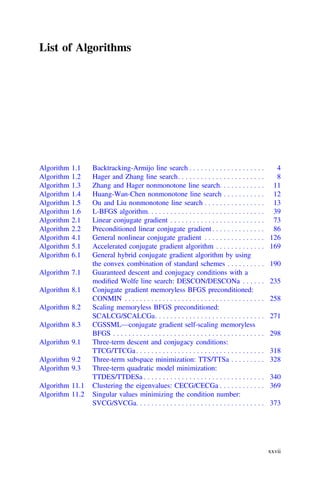
List of Algorithms
Algorithm 1.1 Backtracking-Armijo line search . . . . . . . . . . . . . . . . . . . . 4
Algorithm 1.2 Hager and Zhang line search. . . . . . . . . . . . . . . . . . . . . . . 8
Algorithm 1.3 Zhang and Hager nonmonotone line search. . . . . . . . . . . . 11
Algorithm 1.4 Huang-Wan-Chen nonmonotone line search . . . . . . . . . . . 12
Algorithm 1.5 Ou and Liu nonmonotone line search . . . . . . . . . . . . . . . . 13
Algorithm 1.6 L-BFGS algorithm. . . . . . . . . . . . . . . . . . . . . . . . . . . . . . . 39
Algorithm 2.1 Linear conjugate gradient . . . . . . . . . . . . . . . . . . . . . . . . . 73
Algorithm 2.2 Preconditioned linear conjugate gradient . . . . . . . . . . . . . . 86
Algorithm 4.1 General nonlinear conjugate gradient . . . . . . . . . . . . . . . . 126
Algorithm 5.1 Accelerated conjugate gradient algorithm . . . . . . . . . . . . . 169
Algorithm 6.1 General hybrid conjugate gradient algorithm by using
the convex combination of standard schemes . . . . . . . . . . 190
Algorithm 7.1 Guaranteed descent and conjugacy conditions with a
modified Wolfe line search: DESCON/DESCONa . . . . . . 235
Algorithm 8.1 Conjugate gradient memoryless BFGS preconditioned:
CONMIN . . . . . . . . . . . . . . . . . . . . . . . . . . . . . . . . . . . . . 258
Algorithm 8.2 Scaling memoryless BFGS preconditioned:
SCALCG/SCALCGa. . . . . . . . . . . . . . . . . . . . . . . . . . . . . 271
Algorithm 8.3 CGSSML—conjugate gradient self-scaling memoryless
BFGS . . . . . . . . . . . . . . . . . . . . . . . . . . . . . . . . . . . . . . . . 298
Algorithm 9.1 Three-term descent and conjugacy conditions:
TTCG/TTCGa. . . . . . . . . . . . . . . . . . . . . . . . . . . . . . . . . . 318
Algorithm 9.2 Three-term subspace minimization: TTS/TTSa . . . . . . . . . 328
Algorithm 9.3 Three-term quadratic model minimization:
TTDES/TTDESa . . . . . . . . . . . . . . . . . . . . . . . . . . . . . . . . 340
Algorithm 11.1 Clustering the eigenvalues: CECG/CECGa . . . . . . . . . . . . 369
Algorithm 11.2 Singular values minimizing the condition number:
SVCG/SVCGa. . . . . . . . . . . . . . . . . . . . . . . . . . . . . . . . . . 373
xxvii
Algorithm 11.3 Guaranteed descent and conjugacy conditions:
CGSYS/CGSYSa . . . . . . . . . . . . . . . . . . . . . . . . . . . . . . . 382
Algorithm 11.4 Subspace minimization based on cubic regularization
CUBIC/CUBICa . . . . . . . . . . . . . . . . . . . . . . . . . . . . . . . . 407
xxviii List of Algorithms
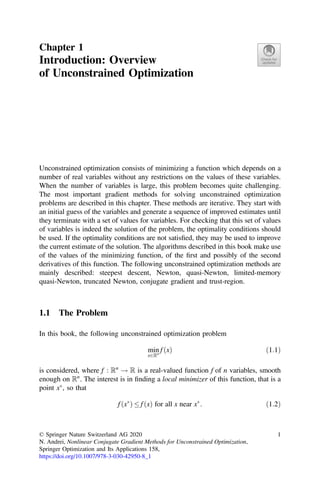
Chapter 1
Introduction: Overview
of Unconstrained Optimization
Unconstrained optimization consists of minimizing a function which depends on a
number of real variables without any restrictions on the values of these variables.
When the number of variables is large, this problem becomes quite challenging.
The most important gradient methods for solving unconstrained optimization
problems are described in this chapter. These methods are iterative. They start with
an initial guess of the variables and generate a sequence of improved estimates until
they terminate with a set of values for variables. For checking that this set of values
of variables is indeed the solution of the problem, the optimality conditions should
be used. If the optimality conditions are not satisfied, they may be used to improve
the current estimate of the solution. The algorithms described in this book make use
of the values of the minimizing function, of the first and possibly of the second
derivatives of this function. The following unconstrained optimization methods are
mainly described: steepest descent, Newton, quasi-Newton, limited-memory
quasi-Newton, truncated Newton, conjugate gradient and trust-region.
1.1 The Problem
In this book, the following unconstrained optimization problem
min
x2Rn
f ðxÞ ð1:1Þ
is considered, where f : Rn
! R is a real-valued function f of n variables, smooth
enough on Rn
. The interest is in finding a local minimizer of this function, that is a
point x
, so that
f x
ð Þ  f ðxÞ for all x near x
: ð1:2Þ
© Springer Nature Switzerland AG 2020
N. Andrei, Nonlinear Conjugate Gradient Methods for Unconstrained Optimization,
Springer Optimization and Its Applications 158,
https://doi.org/10.1007/978-3-030-42950-8_1
1
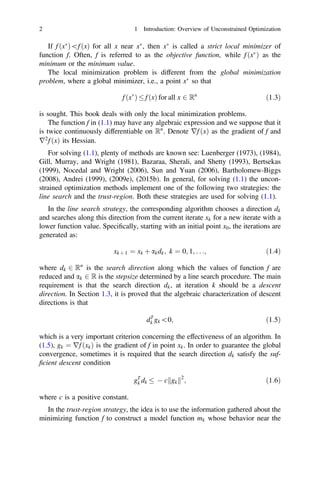
If f ðx
Þf ðxÞ for all x near x
, then x
is called a strict local minimizer of
function f. Often, f is referred to as the objective function, while f ðx
Þ as the
minimum or the minimum value.
The local minimization problem is different from the global minimization
problem, where a global minimizer, i.e., a point x
so that
f ðx
Þ  f ðxÞ for all x 2 Rn
ð1:3Þ
is sought. This book deals with only the local minimization problems.
The function f in (1.1) may have any algebraic expression and we suppose that it
is twice continuously differentiable on Rn
. Denote rf ðxÞ as the gradient of f and
r2
f ðxÞ its Hessian.
For solving (1.1), plenty of methods are known see: Luenberger (1973), (1984),
Gill, Murray, and Wright (1981), Bazaraa, Sherali, and Shetty (1993), Bertsekas
(1999), Nocedal and Wright (2006), Sun and Yuan (2006), Bartholomew-Biggs
(2008), Andrei (1999), (2009e), (2015b). In general, for solving (1.1) the uncon-
strained optimization methods implement one of the following two strategies: the
line search and the trust-region. Both these strategies are used for solving (1.1).
In the line search strategy, the corresponding algorithm chooses a direction dk
and searches along this direction from the current iterate xk for a new iterate with a
lower function value. Specifically, starting with an initial point x0, the iterations are
generated as:
xk þ 1 ¼ xk þ akdk; k ¼ 0; 1; . . .; ð1:4Þ
where dk 2 Rn
is the search direction along which the values of function f are
reduced and ak 2 R is the stepsize determined by a line search procedure. The main
requirement is that the search direction dk, at iteration k should be a descent
direction. In Section 1.3, it is proved that the algebraic characterization of descent
directions is that
dT
k gk0; ð1:5Þ
which is a very important criterion concerning the effectiveness of an algorithm. In
(1.5), gk ¼ rf ðxkÞ is the gradient of f in point xk. In order to guarantee the global
convergence, sometimes it is required that the search direction dk satisfy the suf-
ficient descent condition
gT
k dk   c gk
k k2
; ð1:6Þ
where c is a positive constant.
In the trust-region strategy, the idea is to use the information gathered about the
minimizing function f to construct a model function mk whose behavior near the
2 1 Introduction: Overview of Unconstrained Optimization
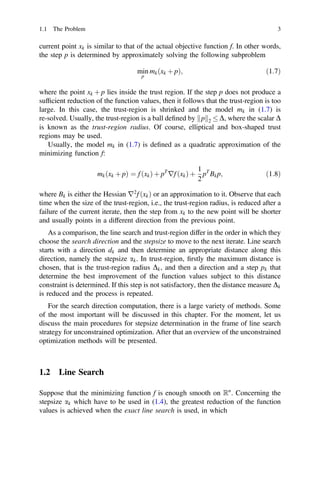
current point xk is similar to that of the actual objective function f. In other words,
the step p is determined by approximately solving the following subproblem
min
p
mkðxk þ pÞ; ð1:7Þ
where the point xk þ p lies inside the trust region. If the step p does not produce a
sufficient reduction of the function values, then it follows that the trust-region is too
large. In this case, the trust-region is shrinked and the model mk in (1.7) is
re-solved. Usually, the trust-region is a ball defined by p
k k2  D, where the scalar D
is known as the trust-region radius. Of course, elliptical and box-shaped trust
regions may be used.
Usually, the model mk in (1.7) is defined as a quadratic approximation of the
minimizing function f:
mkðxk þ pÞ ¼ f ðxkÞ þ pT
rf ðxkÞ þ
1
2
pT
Bkp; ð1:8Þ
where Bk is either the Hessian r2
f ðxkÞ or an approximation to it. Observe that each
time when the size of the trust-region, i.e., the trust-region radius, is reduced after a
failure of the current iterate, then the step from xk to the new point will be shorter
and usually points in a different direction from the previous point.
As a comparison, the line search and trust-region differ in the order in which they
choose the search direction and the stepsize to move to the next iterate. Line search
starts with a direction dk and then determine an appropriate distance along this
direction, namely the stepsize ak. In trust-region, firstly the maximum distance is
chosen, that is the trust-region radius Dk, and then a direction and a step pk that
determine the best improvement of the function values subject to this distance
constraint is determined. If this step is not satisfactory, then the distance measure Dk
is reduced and the process is repeated.
For the search direction computation, there is a large variety of methods. Some
of the most important will be discussed in this chapter. For the moment, let us
discuss the main procedures for stepsize determination in the frame of line search
strategy for unconstrained optimization. After that an overview of the unconstrained
optimization methods will be presented.
1.2 Line Search
Suppose that the minimizing function f is enough smooth on Rn
. Concerning the
stepsize ak which have to be used in (1.4), the greatest reduction of the function
values is achieved when the exact line search is used, in which
1.1 The Problem 3
ak ¼ arg min
a  0
f ðxk þ adkÞ: ð1:9Þ
In other words, the exact line search determines a stepsize ak as solution of the
equation
rf ðxk þ akdkÞT
dk ¼ 0: ð1:10Þ
However, being impractical, the exact line search is rarely used in optimization
algorithms. Instead, an inexact line search is often used. Plenty of inexact line
search methods were proposed: Goldstein (1965), Armijo (1966), Wolfe (1969,
1971), Powell (1976a), Lemaréchal (1981), Shanno (1983), Dennis and Schnabel
(1983), Al-Baali and Fletcher (1984), Hager (1989), Moré and Thuente (1990),
Lukšan (1992), Potra and Shi (1995), Hager and Zhang (2005), Gu and Mo (2008),
Ou and Liu (2017), and many others. The challenges in finding a good stepsize ak
by inexact line search are both in avoiding that the stepsize is too long or too short.
Therefore, the inexact line search methods concentrate on: a good initial selection
of stepsize, criteria that assures that ak are neither too long nor too short and
construction of a sequence of updates that satisfies the above requirements.
Generally, the inexact line search procedures are based on quadratic or cubic
polynomial interpolations of the values of the one dimensional function ukðaÞ ¼
f ðxk þ adkÞ; a  0. For minimizing the polynomial approximation of ukðaÞ, the
inexact line search procedures generate a sequence of stepsizes until one of these
values of the stepsize satisfies some stopping conditions.
Backtracking—Armijo line search
One of the very simple and efficient line search procedure is particularly the
backtracking line search (Ortega  Rheinboldt, 1970). This procedure considers
the following scalars: 0c1, 0b1 and sk ¼ gT
k dk= gk
k k2
and takes the
following steps based on the Armijo’s rule:
Algorithm 1.1 Backtracking-Armijo line search
1. Consider the descent direction dk for f at xk. Set a ¼ sk
2. While f ðxk þ adkÞ [ f ðxkÞ þ cagT
k dk, set a ¼ ab
3. Set ak ¼ a ♦
Observe that this line search requires that the achieved reduction in f be at least a
fixed fraction c of the reduction promised by the first-order Taylor approximation of
f at xk. Typically, c ¼ 0:0001 and b ¼ 0:8, meaning that a small portion of the
decrease predicted by the linear approximation of f at the current point is accepted.
Observe that, when dk ¼ gk, then sk ¼ 1.
4 1 Introduction: Overview of Unconstrained Optimization
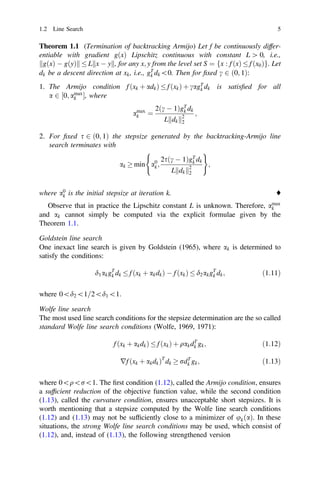
Theorem 1.1 (Termination of backtracking Armijo) Let f be continuously differ-
entiable with gradient gðxÞ Lipschitz continuous with constant L [ 0, i.e.,
gðxÞ  gðyÞ
k k  L x  y
k k, for any x; y from the level set S ¼ fx : f ðxÞ  f ðx0Þg. Let
dk be a descent direction at xk, i.e., gT
k dk0. Then for fixed c 2 ð0; 1Þ:
1. The Armijo condition f ðxk þ adkÞ  f ðxkÞ þ cagT
k dk is satisfied for all
a 2 ½0; amax
k , where
amax
k ¼
2ðc  1ÞgT
k dk
L dk
k k2
2
;
2. For fixed s 2 ð0; 1Þ the stepsize generated by the backtracking-Armijo line
search terminates with
ak  min a0
k;
2sðc  1ÞgT
k dk
L dk
k k2
2
( )
;
where a0
k is the initial stepsize at iteration k. ♦
Observe that in practice the Lipschitz constant L is unknown. Therefore, amax
k
and ak cannot simply be computed via the explicit formulae given by the
Theorem 1.1.
Goldstein line search
One inexact line search is given by Goldstein (1965), where ak is determined to
satisfy the conditions:
d1akgT
k dk  f ðxk þ akdkÞ  f ðxkÞ  d2akgT
k dk; ð1:11Þ
where 0d21=2d11:
Wolfe line search
The most used line search conditions for the stepsize determination are the so called
standard Wolfe line search conditions (Wolfe, 1969, 1971):
f ðxk þ akdkÞ  f ðxkÞ þ qakdT
k gk; ð1:12Þ
rf ðxk þ akdkÞT
dk  rdT
k gk; ð1:13Þ
where 0qr1. The first condition (1.12), called the Armijo condition, ensures
a sufficient reduction of the objective function value, while the second condition
(1.13), called the curvature condition, ensures unacceptable short stepsizes. It is
worth mentioning that a stepsize computed by the Wolfe line search conditions
(1.12) and (1.13) may not be sufficiently close to a minimizer of ukðaÞ. In these
situations, the strong Wolfe line search conditions may be used, which consist of
(1.12), and, instead of (1.13), the following strengthened version
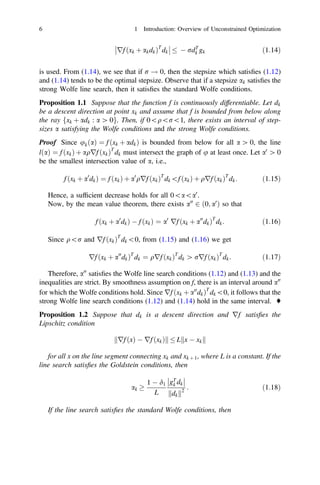
1.2 Line Search 5
rf ðxk þ akdkÞT
dk


   rdT
k gk ð1:14Þ
is used. From (1.14), we see that if r ! 0, then the stepsize which satisfies (1.12)
and (1.14) tends to be the optimal stepsize. Observe that if a stepsize ak satisfies the
strong Wolfe line search, then it satisfies the standard Wolfe conditions.
Proposition 1.1 Suppose that the function f is continuously differentiable. Let dk
be a descent direction at point xk and assume that f is bounded from below along
the ray fxk þ adk : a [ 0g. Then, if 0qr1, there exists an interval of step-
sizes a satisfying the Wolfe conditions and the strong Wolfe conditions.
Proof Since ukðaÞ ¼ f ðxk þ adkÞ is bounded from below for all a [ 0, the line
lðaÞ ¼ f ðxkÞ þ aqrf ðxkÞT
dk must intersect the graph of u at least once. Let a0
[ 0
be the smallest intersection value of a, i.e.,
f ðxk þ a0
dkÞ ¼ f ðxkÞ þ a0
qrf ðxkÞT
dkf ðxkÞ þ qrf ðxkÞT
dk: ð1:15Þ
Hence, a sufficient decrease holds for all 0aa0
.
Now, by the mean value theorem, there exists a00
2 ð0; a0
Þ so that
f ðxk þ a0
dkÞ  f ðxkÞ ¼ a0
rf ðxk þ a00
dkÞT
dk: ð1:16Þ
Since qr and rf ðxkÞT
dk0, from (1.15) and (1.16) we get
rf ðxk þ a00
dkÞT
dk ¼ qrf ðxkÞT
dk [ rrf ðxkÞT
dk: ð1:17Þ
Therefore, a00
satisfies the Wolfe line search conditions (1.12) and (1.13) and the
inequalities are strict. By smoothness assumption on f, there is an interval around a00
for which the Wolfe conditions hold. Since rf ðxk þ a00
dkÞT
dk0, it follows that the
strong Wolfe line search conditions (1.12) and (1.14) hold in the same interval. ♦
Proposition 1.2 Suppose that dk is a descent direction and rf satisfies the
Lipschitz condition
rf ðxÞ  rf ðxkÞ
k k  L x  xk
k k
for all x on the line segment connecting xk and xk þ 1, where L is a constant. If the
line search satisfies the Goldstein conditions, then
ak 
1  d1
L
gT
k dk


dk
k k2
: ð1:18Þ
If the line search satisfies the standard Wolfe conditions, then
6 1 Introduction: Overview of Unconstrained Optimization
ak 
1  r
L
gT
k dk


dk
k k2
: ð1:19Þ
Proof If the Goldstein conditions hold, then by (1.11) and the mean value theorem
we have
d1akgT
k dk  f ðxk þ akdkÞ  f ðxkÞ
¼ akrf ðxk þ ndkÞT
dk
 akgT
k dk þ La2
k dk
k k2
;
where n 2 ½0; ak. From the above inequality, we get (1.18).
Subtracting gT
k dk from both sides of (1.13) and using the Lipschitz condition, it
follows that
ðr  1ÞgT
k dk  ðgk þ 1  gkÞT
dk  akL dk
k k2
:
But dk is a descent direction and r1, therefore (1.19) follows from the above
inequality. ♦
A detailed presentation and a safeguarded Fortran implementation of the Wolfe
line search (1.12) and (1.13) with cubic interpolation is given in Chapter 5.
Generalized Wolfe line search
In the generalized Wolfe line search, the absolute value in (1.14) is replaced by a
pair of inequalities:
r1dT
k gk  dT
k gk þ 1   r2dT
k gk; ð1:20Þ
where 0qr11 and r2  0. The particular case in which r1 ¼ r2 ¼ r corre-
sponds to the strong Wolfe line search.
Hager-Zhang line search
Hager and Zhang (2005) introduced the approximate Wolfe line search
rdT
k gk  dT
k gk þ 1  ð2q  1ÞdT
k gk; ð1:21Þ
where 0q1=2 and qr1. Observe that the approximate Wolfe line search
(1.21) has the same form as the generalized Wolfe line search (1.20), but with a
special choice for r2. The first inequality in (1.21) is the same as (1.13). When f is
quadratic, the second inequality in (1.21) is equivalent to (1.12).
In general, when ukðaÞ ¼ f ðxk þ adkÞ is replaced by a quadratic interpolating
qð:Þ that matches ukðaÞ at a ¼ 0 and u0
kðaÞ at a ¼ 0 and a ¼ ak, (1.12) reduces to
the second inequality in (1.21). Observe that the decay condition (1.12) is a
component of the generalized Wolfe line search, while in the approximate Wolfe
line search the decay condition is approximately enforced through the second
inequality in (1.21). As shown by Hager and Zhang (2005), the first Wolfe con-
dition (1.12) limits the accuracy of a conjugate gradient method to the order of the
1.2 Line Search 7
square root of the machine precision, while with the approximate Wolfe line search,
we can achieve accuracy to the order of the machine precision.
The approximate Wolfe line search is based on the derivative of ukðaÞ. This can
be achieved by using a quadratic approximation of uk. The quadratic interpolating
polynomial q that matches ukðaÞ at a ¼ 0 and u0
ðaÞ at a ¼ 0 and a ¼ ak (which is
unknown) is given by
qðaÞ ¼ ukð0Þ þ u0
kð0Þa þ
u0
kðakÞ  u0
kð0Þ
2ak
a2
:
Observe that the first Wolfe condition (1.12) can be written as
ukðakÞ  ukð0Þ þ qaku0
kð0Þ. Now, if uk is replaced by q in the first Wolfe condi-
tion, we get qðakÞ  qð0Þ þ qq0
ðakÞ, which is rewritten as
u0
kðakÞ  u0
kð0Þ
2
ak þ u0
kð0Þak  qaku0
kð0Þ;
and can be restated as
u0
kðakÞ  ð2q  1Þu0
kð0Þ; ð1:22Þ
where qminf0:5; rg, which is exactly the second inequality in (1.21).
In terms of function ukð:Þ, the approximate line search aims at finding the
stepsize ak which satisfies the Wolfe conditions:
ukðaÞ  ukð0Þ þ qu0
kð0Þa; and u0
kðaÞ  ru0
kð0Þ; ð1:23Þ
which are called LS1 conditions, or the conditions (1.22) together with
ukðaÞ  ukð0Þ þ ek; and ek ¼ e f ðxkÞ
j j; ð1:24Þ
where e is a small positive parameter (e ¼ 106
), which are called LS2 conditions.
ek is an estimate for the error in the value of f at iteration k. With these, the
approximate Wolfe line search algorithm is as follows:
Algorithm 1.2 Hager and Zhang line search
1. Choose an initial interval ½a0; b0 and set k ¼ 0
2. If either LS1 or LS2 conditions are satisfied at ak, stop
3. Define a new interval ½a; b by using the secant2
procedure: ½a; b ¼ secant2
ðak; bkÞ
4. If b  a [ cðbk  akÞ, then c ¼ ða þ bÞ=2 and use the update procedure:
½a; b ¼ updateða; b; cÞ, where c 2 ð0; 1Þ: c ¼ 0:66
ð Þ
5. Set ½ak; bk ¼ ½a; b and k ¼ k þ 1 and go to step 2 ♦
The update procedure changes the current bracketing interval ½a; b into a new
one ½
a; 
b by using an additional point which is either obtained by a bisection step or
a secant step. The input data in the procedure update are the points a; b; c. The
parameter in the procedure update is h 2 ð0; 1Þ h ¼ 0:5
ð Þ. The output data are 
a; 
b.
8 1 Introduction: Overview of Unconstrained Optimization
The update procedure
1. If c 62 ða; bÞ; then set 
a ¼ a; 
b ¼ b and return
2. If u0
kðcÞ  0; then set 
a ¼ a; 
b ¼ c and return
3. If u0
kðcÞ0 and ukðcÞ  ukð0Þ þ ek; then set 
a ¼ c; 
b ¼ b and return
4. If u0
kðcÞ0 and ukðcÞ [ ukð0Þ þ ek, then set ^
a ¼ a; ^
b ¼ c and perform the following
steps:
(a) Set d ¼ ð1  hÞ^
a þ h^
b: If u0
kðdÞ  0; set 
b ¼ d; 
a ¼ ^
a and return,
(b) If u0
kðdÞ0 and ukðdÞ  ukð0Þ þ ek; then set ^
a ¼ d and go to step (a),
(c) If u0
kðdÞ0 and ukðdÞ [ ukð0Þ þ ek; then set ^
b ¼ d and go to step (a) ♦
The update procedure finds the interval ½
a; 
b so that
ukð
aÞukð0Þ þ ek; u0
kð
aÞ0 and u0
kð
bÞ  0: ð1:25Þ
Eventually, a nested sequence of intervals ½ak; bk is determined, which con-
verges to the point that satisfies either LS1 (1.23) or LS2 (1.22) and (1.24)
conditions.
The secant procedure updates the interval by secant steps. If c is obtained from a
secant step based on the function values at a and b, then we write
c ¼ secant ða; bÞ ¼
au0
kðbÞ  bu0
kðaÞ
u0
kðbÞ  u0
kðaÞ
:
Since we do not know whether u0
is a convex or a concave function, then a pair
of secant steps is generated by a procedure denoted secant2
, defined as follows. The
input data are the points a and b. The outputs are 
a and 
b which define the interval
½
a; 
b.
Procedure secant2
1. Set c ¼ sec ant ða; bÞ and ½A; B ¼ updateða; b; cÞ
2. If c ¼ B, then 
c ¼ secantðb; BÞ
3. If c ¼ A, then 
c ¼ secantða; AÞ
4. If c ¼ A or c ¼ B; then ½
a; 
b ¼ update ðA; B;
cÞ. Otherwise, ½
a; 
b ¼ ½A; B ♦
The Hager and Zhang line search procedure finds the stepsize ak satisfying either
LS1 or LS2 in a finite number of operations, as it is stated in the following theorem
proved by Hager and Zhang (2005).
Theorem 1.2 Suppose that ukðaÞ is continuously differentiable on an interval
½a0; b0, where (1.25) holds. If q 2 ð0; 1=2Þ, then the Hager and Zhang line search
procedure terminates at a point satisfying either LS1 or LS2 conditions. ♦
Under some additional assumptions, the convergence analysis of the secant2
procedure was given by Hager and Zhang (2005), proving that the interval width
generated by it is tending to zero, with the root convergence order 1 þ
ffiffiffi
2
p
. This line
1.2 Line Search 9
search procedure is implemented in CG-DESCENT, one of the most advanced
conjugate gradient algorithms, which is presented in Chapter 7.
Dai and Kou line search
In practical computations, the first Wolfe condition (1.12) may never be satisfied
because of the numerical errors, even for tinny values of q. In order to avoid the
numerical drawback of the Wolfe line search, Hager and Zhang (2005) introduced a
combination of the original Wolfe conditions and the approximate Wolfe conditions
(1.21). Their line search is working well in numerical computations, but in theory it
cannot guarantee the global convergence of the algorithm. Therefore, in order to
overcome this deficiency of the approximate Wolfe line search, Dai and Kou (2013)
introduced the so called improved Wolfe line search: “given a constant parameter
e [ 0, a positive sequence fgkg satisfying
P
k  1 gk1 as well as the parameters q
and r satisfying 0qr1, Dai and Kou (2013) proposed the following modified
Wolfe condition:
f ðxk þ adkÞ  f ðxkÞ þ min e gT
k dk


; qagT
k dk þ gk
 
:00
ð1:26Þ
The line search satisfying (1.26) and (1.13) is called the improved Wolfe line
search. If f is continuously differentiable and bounded from below, the gradient g is
Lipschitz continuous and dk is a descent direction (i.e., gT
k dk0), then there must
exist a suitable stepsize satisfying (1.13) and (1.26), since they are weaker than the
standard Wolfe conditions.
Nonmonotone line search Grippo, Lampariello, and Lucidi
The nonmonotone line search for Newton’s methods was introduced by Grippo,
Lampariello, and Lucidi (1986). In this method the stepsize ak satisfies the fol-
lowing condition:
f ðxk þ akdkÞ  max
0  j  mðkÞ
f ðxkjÞ þ qakgT
k dk; ð1:27Þ
where q 2 ð0; 1Þ, mð0Þ ¼ 0, 0  mðkÞ  minfmðk  1Þ þ 1; Mg and M is a pre-
specified nonnegative integer. Theoretical analysis and numerical experiments
showed the efficiency and robustness of this line search for solving unconstrained
optimization problems in the context of the Newton method. The r-linear conver-
gence for the nonmonotone line search (1.27), when the objective function f is
strongly convex, was proved by Dai (2002b).
Although these nonmonotone techniques based on (1.27) work well in many
cases, there are some drawbacks. First, a good function value generated in any
iteration is essentially discarded due to the max in (1.27). Second, in some cases,
the numerical performance is very dependent on the choice of M see Raydan
(1997). Furthermore, it has been pointed out by Dai (2002b) that although an
iterative method is generating r-linearly convergent iterations for a strongly convex
function, the iterates may not satisfy the condition (1.27) for k sufficiently large, for
any fixed bound M on the memory.
10 1 Introduction: Overview of Unconstrained Optimization
Nonmonotone line search Zhang and Hager
Zhang and Hager (2004) proposed another nonmonotone line search technique by
replacing the maximum function values in (1.27) with an average of function
values. Suppose that dk is a descent direction. Their line search determines a
stepsize ak as follows.
Algorithm 1.3 Zhang and Hager nonmonotone line search
1. Choose a starting guess x0 and the parameters: 0  gmin  gmax  1; 0qr1b and
l [ 0: Set C0 ¼ f ðx0Þ; Q0 ¼ 1 and k ¼ 0
2. If rf ðxkÞ
k k is sufficiently small, then stop
3. Line search update: Set xk þ 1 ¼ xk þ akdk; where ak satisfies either the nonmonotone
Wolfe conditions:
f ðxk þ akdkÞ  Ck þ qakgT
k dk; (1.28)
rf ðxk þ akdkÞT
dk  rdT
k gk; (1.29)
or the nonmonotone Armijo conditions: ak ¼ 
akbhk
, where 
ak [ 0 is the trial step and hk
is the largest integer such that (1.28) holds and ak  l
4. Choose gk 2 ½gmin; gmax and set:
Qk þ 1 ¼ gkQk þ 1; (1.30)
Ck þ 1 ¼ gk QkCk þ f ðxk þ 1Þ
Qk þ 1
(1.31)
5. Set k ¼ k þ 1 and go to strp 2 ♦
Observe that Ck þ 1 is a convex combination of Ck and f ðxk þ 1Þ. Since
C0 ¼ f ðx0Þ, it follows that Ck is a convex combination of the function values
f ðx0Þ; f ðx1Þ; . . .; f ðxkÞ. Parameter gk control the degree of nonmonotonicity. If gk ¼
0 for all k, then this nonmonotone line search reduces to the monotone Wolfe or
Armijo line search. If gk ¼ 1 for all k, then Ck ¼ Ak, where
Ak ¼
1
k þ 1
X
n
i¼0
f ðxiÞ:
Theorem 1.3 If gT
k dk  0 for each k, then for the iterates generated by the non-
monotone line search Zhang and Hager algorithm, we have f ðxkÞ  Ck  Ak for
each k. Moreover, if gT
k dk0 and f ðxÞ is bounded from below, then there exists ak
satisfying either Wolfe or Armijo conditions of the line search update. ♦
Zhang and Hager (2004) proved the convergence of their algorithm.
Theorem 1.4 Suppose that f is bounded from below and there exist the positive
constants c1 and c2 such that gT
k dk   c1 gk
k k2
and dk
k k  c2 gk
k k for all suffi-
ciently large k. Then, under the Wolfe line search if rf is Lipschitz continuous, then
the iterates xk generated by the nonmonotone line search Zhang and Hager
algorithm have the property that lim infk!1 rf ðxkÞ
k k ¼ 0. Morover, if gmax1,
then limk!1 rf ðxkÞ ¼ 0. ♦
1.2 Line Search 11
The numerical results reported by Zhang and Hager (2004) showed that this
nonmonotone line search is superior to the nonmonotone technique (1.27).
Nonmonotone line search Gu and Mo
Recently, a modified version of the nonmonotone line search (1.27) has been
proposed by Gu and Mo (2008). In this method, the current nonmonotone term is a
convex combination of the previous nonmonotone term and the current value of the
objective function, instead of an average of the successive objective function values
introduced by Zhang and Hager (2004), i.e., the stepsize ak is computed to satisfy
the following line search condition:
f ðxk þ akdkÞ  Dk þ qakgT
k dk; ð1:32Þ
where
D0 ¼ f ðx0Þ; k ¼ 0;
Dk ¼ hkDk1 þ ð1  hkÞf ðxkÞ; k  1;

ð1:33Þ
with 0  hk  hmax1 and q 2 ð0; 1Þ. Theoretical and numerical results, reported
by Gu and Mo (2008), in the frame of the trust-region method, showed the effi-
ciency of this nonmonotone line search scheme.
Nonmonotone line search Huang, Wan and Chen
Recently, Huang, Wan, and Chen (2014) proposed a new nonmonotone line search
as an improved version of the nonmonotone line search technique proposed by
Zhang and Hager. Their algorithm implementing the nonmonotone Armijo condi-
tion has the same properties as the nonmonotone line search algorithm of Zhang
and Hager, as well as some other properties that certify its convergence in very mild
conditions. Suppose that at xk the search direction is dk. The nonmonotone line
search proposed by Huang, Wan, and Chen is as follows:
Algorithm 1.4 Huang-Wan-Chen nonmonotone line search
1. Choose 0  gmin  gmax1b, dmax1, 0dminð1  gmaxÞdmax, e [ 0 small enough
and l [ 0
2. If gk
k k  e, then the algorithm stop
3. Choose gk 2 ½gmin; gmax. Compute Qk þ 1 and Ck þ 1 by (1.30) and (1.31) respectively.
Choose dmin  dk  dmax=Qk þ 1. Let ak ¼ 
akbhk
 l be a stepsize satisfying
Ck þ 1 ¼
gkQkCk þ f ðxk þ akdkÞ
Qk þ 1
 Ck þ dkakgT
k dk; (1.34)
where hk is the largest integer such that (1.34) holds and Qk, Ck, Qk þ 1, and Ck þ 1 are
computed as in the nonmonotone line search of Zhang and Hager
4. Set xk þ 1 ¼ xk þ akdk. Set k ¼ k þ 1 and go to step 2 ♦
If the minimizing function f is continuously differentiable and if gT
k dk  0 for
each k, then there exists a trial step 
ak such that (1.34) holds. The convergence of
this nonmonotone line search is obtained in the same conditions as in Theorem 1.4.
The r-linear convergence is proved for strongly convex functions.
12 1 Introduction: Overview of Unconstrained Optimization
Nonmonotone line search Ou and Liu
Based on (1.32) a new modified nonmonotone memory gradient algorithm for
unconstrained optimization was elaborated by Ou and Liu (2017). Given
q1 2 ð0; 1Þ, q2 [ 0 and b 2 ð0; 1Þ set sk ¼ ðgT
k dkÞ= dk
k k2
and compute the step-
size ak ¼ maxfsk; skb; skb2
; . . .g satisfying the line search condition:
f ðxk þ akdkÞ  Dk þ q1akgT
k dk  q2a2
k dk
k k2
; ð1:35Þ
where Dk is defined by (1.33) and dk is a descent direction, i.e., gT
k dk0. Observe
that if q2 ¼ 0 and sk  s for all k, then the nonmonotone line search (1.35) reduces
to the nonmonotone line search (1.32). The algorithm corresponding to this non-
monotone line search presented by Ou and Liu is as follows.
Algorithm 1.5 Ou and Liu nonmonotone line search
1. Consider a starting guess x0 and select the parameters: e  0; 0s1; q1 2 ð0; 1Þ;
q2 [ 0; b 2 ð0; 1Þ and an integer m [ 0. Set k ¼ 0
2. If gk
k k  e; then stop
3. Compute the direction dk by the following recursive formula:
dk ¼
gk; if k  m;
kkgk 
Pm
i¼1 kkidki if k  m þ 1;

(1.36)
where
kki ¼
s
m
gk
k k2
gk
k k2
þ gT
k dki


; i ¼ 1; . . .; m;
kk ¼ 1 
Xm
i¼1
kki
4. Using the above procedure, determine the stepsize ak satisfying (1.35) and set
xk þ 1 ¼ xk þ akdk
5. Set k ¼ k þ 1 and go to step 2 ♦
The algorithm has the following interesting properties. For any k  0, it follows
that gT
k dk   ð1  sÞ gk
k k2
. For any k  m; it follows that
dk
k k  max
1  i  m
f gk
k k; dki
k kg: Moreover, for any k  0, dk
k k  max
0  j  k
f gj


g.
Theorem 1.5 If the objective function is bounded from below on the level set
S ¼ fx : f ðxÞ  f ðx0Þg and the gradient rf ðxÞ is Lipschitz continuous on an open
convex set that contains S, then the algorithm of Ou and Liu terminates in a finite
number of iterates. Moreover, if the algorithm generates an infinite sequence fxkg,
then limk! þ 1 gk
k k ¼ 0. ♦
Numerical results, presented by Ou and Liu (2017), showed that this method is
suitable for solving large-scale unconstrained optimization problems and is more
stable than other similar methods.
A special nonmonotone line search is the Barzilai and Borwein (1988) method.
In this method, the next approximation to the minimum is computed as
xk þ 1 ¼ xk  Dkgk, k ¼ 0; 1; . . .; where Dk ¼ akI, I being the identity matrix. The
1.2 Line Search 13
stepsize ak is computed as solution of the problem min
ak
sk  Dkyk
k k, or as solution
of min
ak
D1
k sk  yk


. In the first case ak ¼ ðsT
k ykÞ= yk
k k2
and in the second one
ak ¼ sk
k k2
=ðsT
k ykÞ, where sk ¼ xk þ 1  xk and yk ¼ gk þ 1  gk. Barzilai and
Borwein proved that their algorithm is superlinearly convergent. Many researcher
studied the Barzilai and Borwein algorithm including: Raydan (1997), Grippo and
Sciandrone (2002), Dai, Hager, Schittkowski, and Zhang (2006), Dai and Liao
(2002), Narushima, Wakamatsu, Yabe, (2008), Liu and Liu (2019).
Nonmonotone line search methods have been investigated by many authors, for
example, see Dai (2002b) and the references therein. Observe that all these non-
monotone line searchs concentrate on modifying the first Wolfe condition (1.12).
Also, the approximate Wolfe line search (1.21) of Hager and Zhang and the
improved Wolfe line search (1.26) and (1.13) of Dai and Kou modify the first Wolfe
condition, responsible for a sufficient reduction of the objective function value. No
numerical comparisons among these nonmonotone line searches have been given.
As for stopping the iterative scheme (1.4), one of the most popular criteria is
gk
k k  e; where e is a small positive constant and :
k k is the Euclidian or l1 norm.
In the following, the optimality conditions for unconstrained optimization are
presented and then the most important algorithms for the search direction dk in (1.4)
are shortly discussed.
1.3 Optimality Conditions for Unconstrained
Optimization
In this section, we are interested in giving conditions under which a solution for the
problem (1.1) exists. The purpose is to discuss the main concepts and the funda-
mental results in unconstrained optimization known as optimality conditions. Both
necessary and sufficient conditions for optimality are presented. Plenty of very good
books showing these conditions are known: Bertsekas (1999), Nocedal and Wright
(2006), Sun and Yuan (2006), Chachuat (2007), Andrei (2017c), etc. To formulate
the optimality conditions, it is necessary to introduce some concepts which char-
acterize an improving direction along which the values of the function f decrease
(see Appendix A).
Definition 1.1 (Descent Direction). Suppose that f : Rn
! R is continuous at x
.
A vector d 2 Rn
is a descent direction for f at x
if there exists d [ 0 so that
f ðx
þ kdÞf ðx
Þ for any k 2 ð0; dÞ. The cone of descent directions at x
, denoted
by Cddðx
Þ is given by:
Cddðx
Þ ¼ fd : there exists d [ 0 such that f ðx
þ kdÞf ðx
Þ; for any k 2 ð0; dÞg:
Assume that f is a differentiable function. To get an algebraic characterization for
a descent direction for f at x
let us define the set
14 1 Introduction: Overview of Unconstrained Optimization
C0ðx
Þ ¼ fd : rf ðx
ÞT
d0g:
The following result shows that every d 2 C0ðx
Þ is a descent direction at x
.
Proposition 1.3 (Algebraic Characterization of a Descent Direction). Suppose
that f : Rn
! R is differentiable at x
. If there exists a vector d so that
rf ðx
ÞT
d0, then d is a descent direction for f at x
, i.e., C0ðx
ÞCddðx
Þ.
Proof Since f is differentiable at x
, it follows that
f ðx
þ kdÞ ¼ f ðx
Þ þ krf ðx
ÞT
d þ k d
k koðkdÞ;
where limk!0 oðkdÞ ¼ 0. Therefore,
f ðx
þ kdÞ  f ðx
Þ
k
¼ rf ðx
ÞT
d þ d
k koðkdÞ:
Since rf ðx
ÞT
d0 and limk!0 oðkdÞ ¼ 0, it follows that there exists a d [ 0 so
that rf ðx
ÞT
d þ d
k koðkdÞ0 for all k 2 ð0; dÞ. ♦
Theorem 1.6 (First-Order Necessary Conditions for a Local Minimum). Suppose
that f : Rn
! R is differentiable at x
. If x
is a local minimum, then rf ðx
Þ ¼ 0.
Proof Suppose that rf ðx
Þ 6¼ 0. If we consider d ¼ rf ðx
Þ, then
rf ðx
ÞT
d ¼  rf ðx
Þ
k k2
0. By Proposition 1.3 there exists a d [ 0 so that for
any k 2 ð0; dÞ, f ðx
þ kdÞf ðx
Þ. But this is in contradiction with the assumption
that x
is a local minimum for f. ♦
Observe that the above necessary condition represents a system of n algebraic
nonlinear equations. All the points x
which solve the system rf ðxÞ ¼ 0 are called
stationary points. Clearly, the stationary points need not all be local minima. They
could very well be local maxima or even saddle points. In order to characterize a
local minimum, we need more restrictive necessary conditions involving the
Hessian matrix of the function f.
Theorem 1.7 (Second-Order Necessary Conditions for a Local Minimum).
Suppose that f : Rn
! R is twice differentiable at point x
. If x
is a local minimum,
then rf ðx
Þ ¼ 0 and r2
f ðx
Þ is positive semidefinite.
Proof Consider an arbitrary direction d. Then, using the differentiability of f at x
we get
f ðx
þ kdÞ ¼ f ðx
Þ þ krf ðx
ÞT
d þ
1
2
k2
dT
r2
f ðx
Þd þ k2
d
k k2
oðkdÞ;
where limk!0 oðkdÞ ¼ 0. Since x
is a local minimum, rf ðx
Þ ¼ 0. Therefore,
1.3 Optimality Conditions for Unconstrained Optimization 15
f ðx
þ kdÞ  f ðx
Þ
k2
¼
1
2
dT
r2
f ðx
Þd þ d
k k2
oðkdÞ:
Since x
is a local minimum, for k sufficiently small, f ðx
þ kdÞ  f ðx
Þ. For
k ! 0 it follows from the above equality that dT
r2
f ðx
Þd  0. Since d is an
arbitrary direction, it follows that r2
f ðx
Þ is positive semidefinite. ♦
In the above theorems, we have presented the necessary conditions for a point x
to be a local minimum, i.e., these conditions must be satisfied at every local min-
imum solution. However, a point satisfying these necessary conditions need not be
a local minimum. In the following theorems, the sufficient conditions for a global
minimum are given, provided that the objective function is convex on Rn
.
The following theorem can be proved. It shows that the convexity is crucial in
global nonlinear optimization.
Theorem 1.8 (First-Order Sufficient Conditions for a Strict Local Minimum).
Suppose that f : Rn
! R is differentiable at x
and convex on Rn
. If rf ðx
Þ ¼ 0;
then x
is a global minimum of f on Rn
.
Proof Since f is convex on Rn
and differentiable at x
then from the property of
convex functions given by the Proposition A4.3 it follows that for any x 2 Rn
f ðxÞ  f ðx
Þ þ rf ðx
ÞT
ðx  x
Þ. But x
is a stationary point, i.e., f ðxÞ  f ðx
Þ for
any x 2 Rn
. ♦
The following theorem gives the second-order sufficient conditions character-
izing a local minimum point for those functions which are strictly convex in a
neighborhood of the minimum point.
Theorem 1.9 (Second-Order Sufficient Conditions for a Strict Local Minimum).
Suppose that f : Rn
! R is twice differentiable at point x
. If rf ðx
Þ ¼ 0 and
r2
f ðx
Þ is positive definite, then x
is a local minimum of f.
Proof Since f is twice differentiable, for any d 2 Rn
, we can write:
f ðx
þ dÞ ¼ f ðx
Þ þ rf ðx
ÞT
d þ
1
2
dT
r2
f ðx
Þd þ d
k k2
oðdÞ;
where limd!0 oðdÞ ¼ 0. Let k be the smallest eigenvalue of r2
f ðx
Þ. Since r2
f ðx
Þ
is positive definite, it follows that k [ 0 and dT
r2
f ðx
Þd  k d
k k2
. Therefore, since
rf ðx
Þ ¼ 0; we can write:
f ðx
þ dÞ  f ðx
Þ 
k
2
þ oðdÞ

d
k k2
:
Since limd!0 oðdÞ ¼ 0, then there exists a g [ 0 so that oðdÞ
j jk=4 for any
d 2 Bð0; gÞ, where Bð0; gÞ is the open ball of radius g centered at 0. Hence
16 1 Introduction: Overview of Unconstrained Optimization
f ðx
þ dÞ  f ðx
Þ 
k
4
d
k k2
[ 0
for any d 2 Bð0; gÞnf0g, i.e., x
is a strict local minimum of function f. ♦
If we assume f to be twice continuously differentiable, we observe that, since
r2
f ðx
Þ is positive definite, then r2
f ðx
Þ is positive definite in a small neighbor-
hood of x
and therefore f is strictly convex in a small neighborhood of x
. Hence,
x
is a strict local minimum, it is the unique global minimum over a small neigh-
borhood of x
.
1.4 Overview of Unconstrained Optimization Methods
In this section, let us present some of the most important unconstrained opti-
mization methods based on the gradient computation, insisting on their definition,
their advantages and disadvantages, as well as on their convergence properties. The
main difference among these methods is the procedure for the search direction dk
computation. For stepsize ak computation, the most used procedure is that of Wolfe
(standard). The following methods are discussed: the steepest descent, Newton,
quasi-Newton, limited-memory quasi-Newton, truncated Newton, conjugate gra-
dient, trust-region, and p-regularized methods.
1.4.1 Steepest Descent Method
The fundamental method for the unconstrained optimization is the steepest descent.
This is the simplest method, designed by Cauchy (1847), in which the search
direction is selected as:
dk ¼ gk: ð1:37Þ
At the current point xk, the direction of the negative gradient is the best direction
of search for a minimum of f. However, as soon as we move in this direction, it
ceases to be the best one and continues to deteriorate until it becomes orthogonal to
gk, That is, the method begins to take small steps without making significant
progress to minimum. This is its major drawback, the steps it takes are too long, i.e.,
there are some other points zk on the line segment connecting xk and xk þ 1, where
rf ðzkÞ provides a better new search direction than rf ðxk þ 1Þ. The steepest
descent method is globally convergent under a large variety of inexact line search
procedures. However, its convergence is only linear and it is badly affected by
ill-conditioning (Akaike, 1959). The convergence rate of this method is strongly
1.3 Optimality Conditions for Unconstrained Optimization 17
dependent on the distribution of the eigenvalues of the Hessian of the minimizing
function.
Theorem 1.10 Suppose that f is twice continuously differentiable. If the Hessian
r2
f ðx
Þ of function f is positive definite and has the smallest eigenvalue k1 [ 0 and
the largest eigenvalue kn [ 0, then the sequence of objective values ff ðxkÞg gen-
erated by the steepest descent algorithm converges to f ðx
Þ linearly with a con-
vergence ratio no greater than
kn  k1
kn þ k1
2
¼
j  1
j þ 1
2
; ð1:38Þ
i.e.,
f ðxk þ 1Þ 
j  1
j þ 1
2
f ðxkÞ; ð1:39Þ
where j ¼ kn=k1 is the condition number of the Hessian. ♦
This is one of the best estimation we can obtain for steepest decent in certain
conditions. For strongly convex functions for which the gradient is Lipschitz
continuous, Nemirovsky and Yudin (1983) define the global estimate of the rate of
convergence of an iterative method as f ðxk þ 1Þ  f ðx
Þ  chðx1  x
; m; L; kÞ, where
hð:Þ is a function, c is a constant, m is a lower bound on the smallest eigenvalue of
the Hessian r2
f ðxÞ, L is the Lipschitz constant, and k is the iteration number. The
faster the rate at which h converges to 0 as k ! 1, the more efficient the algorithm.
The advantages of the steepest descent method are as follows. It is globally
convergent to local minimizer from any starting point x0. Many other optimization
methods switch to steepest descent when they do not make sufficient progress. On
the other hand, it has the following disadvantages. It is not scale invariant, i.e.,
changing the scalar product on Rn
will change the notion of gradient. Besides,
usually it is very (very) slow, i.e., its convergence is linear. Numerically, it is often
not convergent at all. An acceleration of the steepest descent method with back-
tracking was given by Andrei (2006a) and discussed by Babaie-Kafaki and Rezaee
(2018).
1.4.2 Newton Method
The Newton method is based on the quadratic approximation of the function f and
on the exact minimization of this quadratic approximation. Thus, near the current
point xk, the function f is approximated by the truncated Taylor series
18 1 Introduction: Overview of Unconstrained Optimization
f ðxÞ ffi f ðxkÞ þ rf ðxkÞT
ðx  xkÞ þ
1
2
ðx  xkÞT
r2
f ðxkÞðx  xkÞ; ð1:40Þ
known as the local quadratic model of f around xk. Minimizing the right-hand side
of (1.40), the search direction of the Newton method is computed as
dk ¼ r2
f ðxkÞ1
gk; ð1:41Þ
Therefore, the Newton method is defined as:
xk þ 1 ¼ xk  akr2
f ðxkÞ1
gk; k ¼ 0; 1; . . .; ð1:42Þ
where ak is the stepsize. For the Newton method (1.42), we see that dk is a descent
direction if and only if r2
f ðxkÞ is a positive definite matrix. If the starting point x0
is close to x
, then the sequence fxkg generated by the Newton method converges to
x
with a quadratic rate. More exactly:
Theorem 1.11 (Local convergence of the Newton method) Let the function f be
twice continuously differentiable on Rn
and its Hessian r2
f ðxÞ be uniformly
Lipschitz continuous on Rn
. Let iterates xk be generated by the Newton method
(1.42) with backtracking-Armijo line search using a0
k ¼ 1 and c1=2. If the
sequence fxkg has an accumulation point x
where r2
f ðx
Þ is positive definite,
then:
1. ak ¼ 1 for all k large enough,
2. limk!1 xk ¼ x
;
3. The sequence fxkg converges q-quadratically to x
, that is, there exists a
constant K [ 0 such that
lim
k!1
xk þ 1x
k k
xkx
k k2  K: ♦
The machinery that makes Theorem 1.11 work is that once the sequence fxkg
generated by the Newton method enters a certain domain of attraction of x
, then it
cannot escape from this domain and immediately the quadratic convergence to x
starts. The main drawback of this method consists of computing and saving the
Hessian matrix, which is an n n matrix. Clearly, the Newton method is not
suitable for solving large-scale problems. Besides, far away from the solution, the
Hessian matrix may not be a positive definite matrix and therefore the search
direction (1.41) may not be a descent one. Some modifications of the Newton
method are discussed in this chapter, others are presented in (Sun  Yuan, 2006;
Nocedal  Wright, 2006; Andrei, 2009e; Luenberger  Ye, 2016).
The following theorem shows the evolution of the error of the Newton method
along the iterations, as well as the main characteristics of the method (Kelley, 1995,
1999).
1.4 Overview of Unconstrained Optimization Methods 19
Theorem 1.12 Consider ek ¼ xk  x
as the error at iteration k. Let r2
f ðxkÞ be
invertible and Dk 2 Rn n
so that r2
f ðxkÞ1
Dk


1. If for the problem (1.1) the
Newton step
xk þ 1 ¼ xk  r2
f ðxkÞ1
rf ðxkÞ ð1:43Þ
is applied by using ðr2
f ðxkÞ þ DkÞ and ðrf ðxkÞ þ dkÞ instead of r2
f ðxkÞ and
rf ðxkÞ respectively, then for Dk sufficiently small in norm, dk [ 0 and xk suffi-
ciently close to x
.
ek þ 1
k k  K ek
k k2
þ Dk
k k ek
k k þ dk
k k ; ð1:44Þ
for some positive constant K. ♦
The interpretation of (1.44) is as follows. Observe that in the norm of the error
ek þ 1, given by (1.44), the inaccuracy evaluation of the Hessian, given by Dk
k k, is
multiplied by the norm of the previous error. On the other hand, the inaccuracy
evaluation of the gradient, given by dk
k k, is not multiplied by the previous error and
has a direct influence on ek þ 1
k k. In other words, in the norm of the error, the
inaccuracy in the Hessian has a smaller influence than the inaccuracy of the gra-
dient. Therefore, in this context, from (1.44) the following remarks may be
emphasized:
1. If both Dk and dk are zero, then the quadratic convergence of the Newton
method is obtained.
2. If dk 6¼ 0 and dk
k k is not convergent to zero, then there is no guarantee that the
error for the Newton method will converge to zero.
3. If Dk
k k 6¼ 0, then the convergence of the Newton method is slowed down from
quadratic to linear, or to superlinear if Dk
k k ! 0.
Therefore, we see that the inaccuracy evaluation of the Hessian of the mini-
mizing function is not so important. It is the accuracy of the evaluation of the
gradient which is more important. This is the motivation for the development of the
quasi-Newton methods or, for example, the methods in which the Hessian is
approximated as a diagonal matrix, (Nazareth, 1995; Dennis  Wolkowicz, 1993;
Zhu, Nazareth,  Wolkowicz, 1999; Leong, Farid,  Hassan, 2010, 2012; Andrei,
2018e, 2019c, 2019d).
Some disadvantages of the Newton method are as follows:
1. Lack of global convergence. If the initial point is not sufficiently close to the
solution, i.e., it is not within the region of convergence, then the Newton method
may diverge. In other words, the Newton method does not have the global
convergence property. This is because, far away from the solution, the search
direction (1.41) may not be a valid descent direction even if gT
k dk0, a unit
stepsize might not give a descent in minimizing the function values. The remedy
is to use the globalization strategies. The first one is the line search which alters
20 1 Introduction: Overview of Unconstrained Optimization
the magnitude of the step. The second one is the trust-region which modifies
both the stepsize and the direction.
2. Singular Hessian. The second difficulty is when the Hessian r2
f ðxkÞ becomes
singular during the progress of iterations, or becomes nonpositive definite.
When the Hessian is singular at the solution point, then the Newton method
loses its quadratic convergence property. In this case, the remedy is to select a
positive definite matrix Mk in such a way that r2
f ðxkÞ þ Mk is sufficiently
positive definite and solve the system ðr2
f ðxkÞ þ MkÞdk ¼ gk. The regular-
ization term Mk is typically chosen by using the spectral decomposition of the
Hessian, or as Mk ¼ maxf0; kminðr2
f ðxkÞÞgI, where kminðr2
f ðxkÞÞ is the
smallest eigenvalue of the Hessian. Another method for modifying the Newton
method is to use the modified Cholesky factorization see Gill and Murray
(1974), Gill, Murray, and Wright (1981), Schnabel and Eskow (1999), Moré and
Sorensen (1984).
3. Computational efficiency. At each iteration, the Newton method requires the
computation of the Hessian matrix r2
f ðxkÞ, which may be a difficult task,
especially for large-scale problems and for finding the solution of a linear
system. One possibility is to replace the analytic Hessian by a finite difference
approximation see Sun and Yuan (2006). However, this is costly because
n additional evaluations of the minimizing function are required at each itera-
tion. To reduce the computational effort, the quasi-Newton methods may be
used. These methods generate approximations to the Hessian matrix using the
information gathered from the previous iterations. To avoid solving a linear
system for the search direction computation, variants of the quasi-Newton
methods which generate approximations to the inverse Hessian may be used.
Anyway, when run, the Newton method is the best.
1.4.3 Quasi-Newton Methods
These methods were introduced by Davidon (1959) and developed by Broyden
(1970), Fletcher (1970), Goldfarb (1970), Shanno (1970), Powell (1970) and
modified by many others. A deep analysis of these methods was presented by
Dennis and Moré (1974, 1977).
The idea underlying the quasi-Newton methods is to use an approximation to the
inverse Hessian instead of the true Hessian required in the Newton method (1.42).
Many approximations to the inverse Hessian are known, from the simplest one
where it remains fixed throughout the iterative process to more sophisticated ones
that are built by using the information gathered during the iterations.
1.4 Overview of Unconstrained Optimization Methods 21
The search directions in quasi-Newton methods are computed as
dk ¼ Hkgk; ð1:45Þ
where Hk 2 Rn n
is an approximation to the inverse Hessian. At the iteration k, the
approximation Hk to the inverse Hessian is updated to achieve Hk þ 1 as a new
approximation to the inverse Hessian in such a way that Hk þ 1 satisfies a particular
equation, namely the secant equation, which includes the second order information.
The most used equation is the standard secant equation:
Hk þ 1yk ¼ sk; ð1:46Þ
where sk ¼ xk þ 1  xk and yk ¼ gk þ 1  gk:
Given the initial approximation H0 to the inverse Hessian as an arbitrary sym-
metric and positive definite matrix, the most known quasi-Newton updating for-
mulae are the BFGS (Broyden–Fletcher–Goldfarb–Shanno) and DFP (Davidon–
Fletcher–Powell) updates:
HBFGS
k þ 1 ¼ Hk 
skyT
k Hk þ HkyksT
k
yT
k sk
þ 1 þ
yT
k Hkyk
yT
k sk
sksT
k
yT
k sk
; ð1:47Þ
HDFP
k þ 1 ¼ Hk 
HkykyT
k Hk
yT
k Hkyk
þ
sksT
k
yT
k sk
: ð1:48Þ
The BFGS and DFP updates can be linearly combined, thus obtaining the
Broyden class of quasi-Newton update formula
H/
k þ 1 ¼ /HBFGS
k þ 1 þ ð1  /ÞHDFP
k þ 1
¼ Hk 
HkykyT
k Hk
yT
k Hkyk
þ
sksT
k
yT
k sk
þ /vkvT
k ;
ð1:49Þ
where / is a real parameter and
vk ¼
ffiffiffiffiffiffiffiffiffiffiffiffiffiffi
yT
k Hkyk
q
sk
yT
k sk

Hkyk
yT
k Hkyk
: ð1:50Þ
The main characteristics of the Broyden class of update are as follows (Sun 
Yuan, 2006). If Hk is positive definite and the line search ensures that yT
k sk [ 0,
then H/
k þ 1 with /  0 is also a positive definite matrix and therefore, the search
direction dk þ 1 ¼ H/
k þ 1gk þ 1 is a descent direction. For a strictly convex quadratic
objective function, the search directions of the Broyden class of quasi-Newton
method are conjugate directions. Therefore, the method possesses the quadratic
termination property. If the minimizing function f is convex and / 2 ½0; 1, then the
Broyden class of the quasi-Newton methods is globally and locally superlinear
22 1 Introduction: Overview of Unconstrained Optimization
convergent (Sun  Yuan, 2006). Intensive numerical experiments showed that
among the quasi-Newton update formulae of the Broyden class, the BFGS is the top
performer (Xu  Zhang, 2001).
It is worth mentioning that similar to the quasi-Newton approximations to the
inverse Hessian fHkg satisfying the secant Equation (1.46), the quasi-Newton
approximations to the (direct) Hessian fBkg can be defined, for which the following
equivalent version of the standard secant Equation (1.46) is satisfied
Bk þ 1sk ¼ yk: ð1:51Þ
In this case, the search direction can be obtained by solving the linear algebraic
system (the quasi-Newton system)
Bkdk ¼ gk: ð1:52Þ
Now, to determine the BFGS and DFP updates of the (direct) Hessian, the
following inverse must be computed: ðHBFGS
k þ 1 Þ1
and ðHDFP
k þ 1Þ1
respectively. For
this, the Sherman–Morrison formula is used (see Appendix A).
Therefore, using Sherman–Morrison formula from (1.47) to (1.48) the corre-
sponding update of Bk is as follows:
BBFGS
k þ 1 ¼ Bk 
BksksT
k Bk
sT
k Bksk
þ
ykyT
k
yT
k sk
; ð1:53Þ
BDFP
k þ 1 ¼ Bk þ
ðyk  BkskÞyT
k þ ykðyk  BkskÞT
yT
k sk

ðyk  BkskÞT
sk
ðyT
k skÞ2
ykyT
k : ð1:54Þ
The convergence of the quasi-Newton methods is proved under the following
classical assumptions: the function f is twice continuously differentiable and
bounded below; the level set S ¼ fx 2 Rn
: f ðxÞ  f ðx0Þg is bounded; the gradient
gðxÞ is Lipschitz continuous with constant L [ 0, i.e., gðxÞ  gðyÞ
k k  L x  y
k k,
for any x; y 2 Rn
.
In the convergence analysis, a key requirement for a line search algorithm like
(1.4) is that the search direction dk is a direction of sufficient descent, which is
defined as
gT
k dk
gk
k k dk
k k
  e; ð1:55Þ
where e [ 0. This condition bounds the elements of the sequence fdkg of the search
directions from being arbitrarily close to the orthogonality to the gradient. Often,
the line search methods are so that dk is defined in a way that satisfies the sufficient
descent condition (1.55), even though an explicit value for e [ 0 is not known.
1.4 Overview of Unconstrained Optimization Methods 23
Theorem 1.13 Suppose that fBkg is a sequence of bounded and positive definite
symmetric matrices whose condition number is also bounded, i.e., the smallest
eigenvalue is bounded away from zero. If dk is defined to be the solution of the
system (1.52), then fdkg is a sequence of sufficient descent directions.
Proof Let Bk be a symmetric positive definite matrix with eigenvalues
0kk
1  kk
2   kk
n. Therefore, from (1.52) it follows that
gk
k k ¼ Bkdk
k k  Bk
k k dk
k k ¼ kk
n dk
k k: ð1:56Þ
From (1.52), using (1.56) we have

gT
k dk
gk
k k dk
k k
¼
dT
k Bkdk
gk
k k dk
k k
 kk
1
dk
k k2
gk
k k dk
k k
¼ kk
1
dk
k k
gk
k k
 kk
1
dk
k k
kk
n dk
k k
¼
kk
1
kk
n
[ 0:
The quality of the search direction dk can be determined by studying the angle hk
between the steepest descent direction gk and the search direction dk. Hence,
applying this result to each matrix in the sequence fBkg, we get
cos hk ¼ 
gT
k dk
gk
k k dk
k k

kk
1
kk
n

1
M
; ð1:57Þ
where M is a positive constant. Observe that M is a positive constant and it is well
defined since the smallest eigenvalue of matrices Bk in the sequence fBkg generated
by the algorithm is bounded away from zero. Therefore, the search directions fdkg
generated as solutions of (1.52) form a sequence of sufficient descent directions. ♦
The main consequence of this theorem on how to modify the quasi-Newton
system defining the search direction dk is to ensure that it is a solution of a system
that has the same properties as Bk.
A global convergence result for the BFGS method was given by Powell (1976a).
Using the trace and the determinant to measure the effect of the two rank-one
corrections on Bk in (1.53), he proved that if f is convex, then for any starting point
x0 and any positive definite starting matrix B0, the BFGS method gives
lim infk!1 gk
k k ¼ 0: In addition, if the sequence fxkg converges to a solution point
at which the Hessian matrix is positive definite, then the rate of convergence is
superlinear. The analysis of Powell was extended by Byrd, Nocedal, and Yuan
(1987) to the Broyden class of quasi-Newton methods.
With Wolfe line search, BFGS approximation is always positive definite, so the
line search works very well. It behaves “almost” like Newton in the limit (con-
vergence is superlinear). DFP has the interesting property that, for a quadratic
objective, it simultaneously generates the directions of the conjugate gradient
method while constructing the inverse Hessian. However, DFP is highly sensitive to
inaccuracies in line searches.
24 1 Introduction: Overview of Unconstrained Optimization
Random documents with unrelated
content Scribd suggests to you:
PLEASE READ THIS BEFORE YOU DISTRIBUTE OR USE THIS WORK
To protect the Project Gutenberg™ mission of promoting the
free distribution of electronic works, by using or distributing this
work (or any other work associated in any way with the phrase
“Project Gutenberg”), you agree to comply with all the terms of
the Full Project Gutenberg™ License available with this file or
online at www.gutenberg.org/license.
Section 1. General Terms of Use and
Redistributing Project Gutenberg™
electronic works
1.A. By reading or using any part of this Project Gutenberg™
electronic work, you indicate that you have read, understand,
agree to and accept all the terms of this license and intellectual
property (trademark/copyright) agreement. If you do not agree
to abide by all the terms of this agreement, you must cease
using and return or destroy all copies of Project Gutenberg™
electronic works in your possession. If you paid a fee for
obtaining a copy of or access to a Project Gutenberg™
electronic work and you do not agree to be bound by the terms
of this agreement, you may obtain a refund from the person or
entity to whom you paid the fee as set forth in paragraph 1.E.8.
1.B. “Project Gutenberg” is a registered trademark. It may only
be used on or associated in any way with an electronic work by
people who agree to be bound by the terms of this agreement.
There are a few things that you can do with most Project
Gutenberg™ electronic works even without complying with the
full terms of this agreement. See paragraph 1.C below. There
are a lot of things you can do with Project Gutenberg™
electronic works if you follow the terms of this agreement and
help preserve free future access to Project Gutenberg™
electronic works. See paragraph 1.E below.
1.C. The Project Gutenberg Literary Archive Foundation (“the
Foundation” or PGLAF), owns a compilation copyright in the
collection of Project Gutenberg™ electronic works. Nearly all the
individual works in the collection are in the public domain in the
United States. If an individual work is unprotected by copyright
law in the United States and you are located in the United
States, we do not claim a right to prevent you from copying,
distributing, performing, displaying or creating derivative works
based on the work as long as all references to Project
Gutenberg are removed. Of course, we hope that you will
support the Project Gutenberg™ mission of promoting free
access to electronic works by freely sharing Project Gutenberg™
works in compliance with the terms of this agreement for
keeping the Project Gutenberg™ name associated with the
work. You can easily comply with the terms of this agreement
by keeping this work in the same format with its attached full
Project Gutenberg™ License when you share it without charge
with others.
1.D. The copyright laws of the place where you are located also
govern what you can do with this work. Copyright laws in most
countries are in a constant state of change. If you are outside
the United States, check the laws of your country in addition to
the terms of this agreement before downloading, copying,
displaying, performing, distributing or creating derivative works
based on this work or any other Project Gutenberg™ work. The
Foundation makes no representations concerning the copyright
status of any work in any country other than the United States.
1.E. Unless you have removed all references to Project
Gutenberg:
1.E.1. The following sentence, with active links to, or other
immediate access to, the full Project Gutenberg™ License must
appear prominently whenever any copy of a Project
Gutenberg™ work (any work on which the phrase “Project
Gutenberg” appears, or with which the phrase “Project
Gutenberg” is associated) is accessed, displayed, performed,
viewed, copied or distributed:
This eBook is for the use of anyone anywhere in the United
States and most other parts of the world at no cost and
with almost no restrictions whatsoever. You may copy it,
give it away or re-use it under the terms of the Project
Gutenberg License included with this eBook or online at
www.gutenberg.org. If you are not located in the United
States, you will have to check the laws of the country
where you are located before using this eBook.
1.E.2. If an individual Project Gutenberg™ electronic work is
derived from texts not protected by U.S. copyright law (does not
contain a notice indicating that it is posted with permission of
the copyright holder), the work can be copied and distributed to
anyone in the United States without paying any fees or charges.
If you are redistributing or providing access to a work with the
phrase “Project Gutenberg” associated with or appearing on the
work, you must comply either with the requirements of
paragraphs 1.E.1 through 1.E.7 or obtain permission for the use
of the work and the Project Gutenberg™ trademark as set forth
in paragraphs 1.E.8 or 1.E.9.
1.E.3. If an individual Project Gutenberg™ electronic work is
posted with the permission of the copyright holder, your use and
distribution must comply with both paragraphs 1.E.1 through
1.E.7 and any additional terms imposed by the copyright holder.
Additional terms will be linked to the Project Gutenberg™
License for all works posted with the permission of the copyright
holder found at the beginning of this work.
1.E.4. Do not unlink or detach or remove the full Project
Gutenberg™ License terms from this work, or any files
containing a part of this work or any other work associated with
Project Gutenberg™.
1.E.5. Do not copy, display, perform, distribute or redistribute
this electronic work, or any part of this electronic work, without
prominently displaying the sentence set forth in paragraph 1.E.1
with active links or immediate access to the full terms of the
Project Gutenberg™ License.
1.E.6. You may convert to and distribute this work in any binary,
compressed, marked up, nonproprietary or proprietary form,
including any word processing or hypertext form. However, if
you provide access to or distribute copies of a Project
Gutenberg™ work in a format other than “Plain Vanilla ASCII” or
other format used in the official version posted on the official
Project Gutenberg™ website (www.gutenberg.org), you must,
at no additional cost, fee or expense to the user, provide a copy,
a means of exporting a copy, or a means of obtaining a copy
upon request, of the work in its original “Plain Vanilla ASCII” or
other form. Any alternate format must include the full Project
Gutenberg™ License as specified in paragraph 1.E.1.
1.E.7. Do not charge a fee for access to, viewing, displaying,
performing, copying or distributing any Project Gutenberg™
works unless you comply with paragraph 1.E.8 or 1.E.9.
1.E.8. You may charge a reasonable fee for copies of or
providing access to or distributing Project Gutenberg™
electronic works provided that:
• You pay a royalty fee of 20% of the gross profits you derive
from the use of Project Gutenberg™ works calculated using the
method you already use to calculate your applicable taxes. The
fee is owed to the owner of the Project Gutenberg™ trademark,
but he has agreed to donate royalties under this paragraph to
the Project Gutenberg Literary Archive Foundation. Royalty
payments must be paid within 60 days following each date on
which you prepare (or are legally required to prepare) your
periodic tax returns. Royalty payments should be clearly marked
as such and sent to the Project Gutenberg Literary Archive
Foundation at the address specified in Section 4, “Information
about donations to the Project Gutenberg Literary Archive
Foundation.”
• You provide a full refund of any money paid by a user who
notifies you in writing (or by e-mail) within 30 days of receipt
that s/he does not agree to the terms of the full Project
Gutenberg™ License. You must require such a user to return or
destroy all copies of the works possessed in a physical medium
and discontinue all use of and all access to other copies of
Project Gutenberg™ works.
• You provide, in accordance with paragraph 1.F.3, a full refund of
any money paid for a work or a replacement copy, if a defect in
the electronic work is discovered and reported to you within 90
days of receipt of the work.
• You comply with all other terms of this agreement for free
distribution of Project Gutenberg™ works.
1.E.9. If you wish to charge a fee or distribute a Project
Gutenberg™ electronic work or group of works on different
terms than are set forth in this agreement, you must obtain
permission in writing from the Project Gutenberg Literary
Archive Foundation, the manager of the Project Gutenberg™
trademark. Contact the Foundation as set forth in Section 3
below.
1.F.
1.F.1. Project Gutenberg volunteers and employees expend
considerable effort to identify, do copyright research on,
transcribe and proofread works not protected by U.S. copyright
law in creating the Project Gutenberg™ collection. Despite these
efforts, Project Gutenberg™ electronic works, and the medium
on which they may be stored, may contain “Defects,” such as,
but not limited to, incomplete, inaccurate or corrupt data,
transcription errors, a copyright or other intellectual property
infringement, a defective or damaged disk or other medium, a
computer virus, or computer codes that damage or cannot be
read by your equipment.
1.F.2. LIMITED WARRANTY, DISCLAIMER OF DAMAGES - Except
for the “Right of Replacement or Refund” described in
paragraph 1.F.3, the Project Gutenberg Literary Archive
Foundation, the owner of the Project Gutenberg™ trademark,
and any other party distributing a Project Gutenberg™ electronic
work under this agreement, disclaim all liability to you for
damages, costs and expenses, including legal fees. YOU AGREE
THAT YOU HAVE NO REMEDIES FOR NEGLIGENCE, STRICT
LIABILITY, BREACH OF WARRANTY OR BREACH OF CONTRACT
EXCEPT THOSE PROVIDED IN PARAGRAPH 1.F.3. YOU AGREE
THAT THE FOUNDATION, THE TRADEMARK OWNER, AND ANY
DISTRIBUTOR UNDER THIS AGREEMENT WILL NOT BE LIABLE
TO YOU FOR ACTUAL, DIRECT, INDIRECT, CONSEQUENTIAL,
PUNITIVE OR INCIDENTAL DAMAGES EVEN IF YOU GIVE
NOTICE OF THE POSSIBILITY OF SUCH DAMAGE.
1.F.3. LIMITED RIGHT OF REPLACEMENT OR REFUND - If you
discover a defect in this electronic work within 90 days of
receiving it, you can receive a refund of the money (if any) you
paid for it by sending a written explanation to the person you
received the work from. If you received the work on a physical
medium, you must return the medium with your written
explanation. The person or entity that provided you with the
defective work may elect to provide a replacement copy in lieu
of a refund. If you received the work electronically, the person
or entity providing it to you may choose to give you a second
opportunity to receive the work electronically in lieu of a refund.
If the second copy is also defective, you may demand a refund
in writing without further opportunities to fix the problem.
1.F.4. Except for the limited right of replacement or refund set
forth in paragraph 1.F.3, this work is provided to you ‘AS-IS’,
WITH NO OTHER WARRANTIES OF ANY KIND, EXPRESS OR
IMPLIED, INCLUDING BUT NOT LIMITED TO WARRANTIES OF
MERCHANTABILITY OR FITNESS FOR ANY PURPOSE.
1.F.5. Some states do not allow disclaimers of certain implied
warranties or the exclusion or limitation of certain types of
damages. If any disclaimer or limitation set forth in this
agreement violates the law of the state applicable to this
agreement, the agreement shall be interpreted to make the
maximum disclaimer or limitation permitted by the applicable
state law. The invalidity or unenforceability of any provision of
this agreement shall not void the remaining provisions.
1.F.6. INDEMNITY - You agree to indemnify and hold the
Foundation, the trademark owner, any agent or employee of the
Foundation, anyone providing copies of Project Gutenberg™
electronic works in accordance with this agreement, and any
volunteers associated with the production, promotion and
distribution of Project Gutenberg™ electronic works, harmless
from all liability, costs and expenses, including legal fees, that
arise directly or indirectly from any of the following which you
do or cause to occur: (a) distribution of this or any Project
Gutenberg™ work, (b) alteration, modification, or additions or
deletions to any Project Gutenberg™ work, and (c) any Defect
you cause.
Section 2. Information about the Mission
of Project Gutenberg™
Project Gutenberg™ is synonymous with the free distribution of
electronic works in formats readable by the widest variety of
computers including obsolete, old, middle-aged and new
computers. It exists because of the efforts of hundreds of
volunteers and donations from people in all walks of life.
Volunteers and financial support to provide volunteers with the
assistance they need are critical to reaching Project
Gutenberg™’s goals and ensuring that the Project Gutenberg™
collection will remain freely available for generations to come. In
2001, the Project Gutenberg Literary Archive Foundation was
created to provide a secure and permanent future for Project
Gutenberg™ and future generations. To learn more about the
Project Gutenberg Literary Archive Foundation and how your
efforts and donations can help, see Sections 3 and 4 and the
Foundation information page at www.gutenberg.org.
Section 3. Information about the Project
Gutenberg Literary Archive Foundation
The Project Gutenberg Literary Archive Foundation is a non-
profit 501(c)(3) educational corporation organized under the
laws of the state of Mississippi and granted tax exempt status
by the Internal Revenue Service. The Foundation’s EIN or
federal tax identification number is 64-6221541. Contributions
to the Project Gutenberg Literary Archive Foundation are tax
deductible to the full extent permitted by U.S. federal laws and
your state’s laws.
The Foundation’s business office is located at 809 North 1500
West, Salt Lake City, UT 84116, (801) 596-1887. Email contact
links and up to date contact information can be found at the
Foundation’s website and official page at
www.gutenberg.org/contact
Section 4. Information about Donations to
the Project Gutenberg Literary Archive
Foundation
Project Gutenberg™ depends upon and cannot survive without
widespread public support and donations to carry out its mission
of increasing the number of public domain and licensed works
that can be freely distributed in machine-readable form
accessible by the widest array of equipment including outdated
equipment. Many small donations ($1 to $5,000) are particularly
important to maintaining tax exempt status with the IRS.
The Foundation is committed to complying with the laws
regulating charities and charitable donations in all 50 states of
the United States. Compliance requirements are not uniform
and it takes a considerable effort, much paperwork and many
fees to meet and keep up with these requirements. We do not
solicit donations in locations where we have not received written
confirmation of compliance. To SEND DONATIONS or determine
the status of compliance for any particular state visit
www.gutenberg.org/donate.
While we cannot and do not solicit contributions from states
where we have not met the solicitation requirements, we know
of no prohibition against accepting unsolicited donations from
donors in such states who approach us with offers to donate.
International donations are gratefully accepted, but we cannot
make any statements concerning tax treatment of donations
received from outside the United States. U.S. laws alone swamp
our small staff.
Please check the Project Gutenberg web pages for current
donation methods and addresses. Donations are accepted in a
number of other ways including checks, online payments and
credit card donations. To donate, please visit:
www.gutenberg.org/donate.
Section 5. General Information About
Project Gutenberg™ electronic works
Professor Michael S. Hart was the originator of the Project
Gutenberg™ concept of a library of electronic works that could
be freely shared with anyone. For forty years, he produced and
distributed Project Gutenberg™ eBooks with only a loose
network of volunteer support.
Project Gutenberg™ eBooks are often created from several
printed editions, all of which are confirmed as not protected by
copyright in the U.S. unless a copyright notice is included. Thus,
we do not necessarily keep eBooks in compliance with any
particular paper edition.
Most people start at our website which has the main PG search
facility: www.gutenberg.org.
This website includes information about Project Gutenberg™,
including how to make donations to the Project Gutenberg
Literary Archive Foundation, how to help produce our new
eBooks, and how to subscribe to our email newsletter to hear
about new eBooks.
Welcome to our website – the perfect destination for book lovers and
knowledge seekers. We believe that every book holds a new world,
offering opportunities for learning, discovery, and personal growth.
That’s why we are dedicated to bringing you a diverse collection of
books, ranging from classic literature and specialized publications to
self-development guides and children's books.
More than just a book-buying platform, we strive to be a bridge
connecting you with timeless cultural and intellectual values. With an
elegant, user-friendly interface and a smart search system, you can
quickly find the books that best suit your interests. Additionally,
our special promotions and home delivery services help you save time
and fully enjoy the joy of reading.
Join us on a journey of knowledge exploration, passion nurturing, and
personal growth every day!
ebookbell.com

Nonlinear Conjugate Gradient Methods For Unconstrained Optimization Paginationcover

  • 1.
    Nonlinear Conjugate GradientMethods For Unconstrained Optimization Paginationcover download https://ebookbell.com/product/nonlinear-conjugate-gradient- methods-for-unconstrained-optimization-paginationcover-58413230 Explore and download more ebooks at ebookbell.com

  • 2.
    Here are somerecommended products that we believe you will be interested in. You can click the link to download. Nonlinear Conjugate Gradient Methods For Unconstrained Optimization Neculai Andrei https://ebookbell.com/product/nonlinear-conjugate-gradient-methods- for-unconstrained-optimization-neculai-andrei-11169016 Nonlinear Dynamics And Applications Proceedings Of The Icnda 2022 Santo Banerjee https://ebookbell.com/product/nonlinear-dynamics-and-applications- proceedings-of-the-icnda-2022-santo-banerjee-46502562 Nonlinear Analysis Geometry And Applications Proceedings Of The Second Nlagabirs Symposium Cap Skirring Senegal January 2530 2022 Diaraf Seck https://ebookbell.com/product/nonlinear-analysis-geometry-and- applications-proceedings-of-the-second-nlagabirs-symposium-cap- skirring-senegal-january-2530-2022-diaraf-seck-46517662 Nonlinear Dynamics And Complexity Mathematical Modelling Of Realworld Problems Carla Ma Pinto https://ebookbell.com/product/nonlinear-dynamics-and-complexity- mathematical-modelling-of-realworld-problems-carla-ma-pinto-46706642
  • 3.
    Nonlinear Systems InHeat Transfer Davood Domiri Ganji Amin Sedighiamiri https://ebookbell.com/product/nonlinear-systems-in-heat-transfer- davood-domiri-ganji-amin-sedighiamiri-46818072 Nonlinear Mechanics For Composite Heterogeneous Structures Georgios A Drosopoulos https://ebookbell.com/product/nonlinear-mechanics-for-composite- heterogeneous-structures-georgios-a-drosopoulos-46892442 Nonlinear Filters Theory And Applications Peyman Setoodeh Saeid Habibi https://ebookbell.com/product/nonlinear-filters-theory-and- applications-peyman-setoodeh-saeid-habibi-46897012 Nonlinear Waves And Solitons On Contours And Closed Surfaces 3rd Edition Andrei Ludu https://ebookbell.com/product/nonlinear-waves-and-solitons-on- contours-and-closed-surfaces-3rd-edition-andrei-ludu-47210964 Nonlinear Channel Models And Their Simulations Yecai Guo https://ebookbell.com/product/nonlinear-channel-models-and-their- simulations-yecai-guo-47291530
  • 5.
    Springer Optimization andIts Applications 158 Nonlinear Conjugate Gradient Methods for Unconstrained Optimization Neculai Andrei
  • 6.
    Springer Optimization andIts Applications Volume 158 Series Editors Panos M. Pardalos, University of Florida My T. Thai, University of Florida Honorary Editor Ding-Zhu Du, University of Texas at Dallas Advisory Editors Roman V. Belavkin, Middlesex University John R. Birge, University of Chicago Sergiy Butenko, Texas A&M University Franco Giannessi, University of Pisa Vipin Kumar, University of Minnesota Anna Nagurney, University of Massachusetts Amherst Jun Pei, Hefei University of Technology Oleg Prokopyev, University of Pittsburgh Steffen Rebennack, Karlsruhe Institute of Technology Mauricio Resende, Amazon Tamás Terlaky, Lehigh University Van Vu, Yale University Guoliang Xue, Arizona State University Yinyu Ye, Stanford University
  • 7.
    Aims and Scope Optimizationhas continued to expand in all directions at an astonishing rate. New algorithmic and theoretical techniques are continually developing and the diffusion into other disciplines is proceeding at a rapid pace, with a spot light on machine learning, artificial intelligence, and quantum computing. Our knowledge of all aspects of the field has grown even more profound. At the same time, one of the most striking trends in optimization is the constantly increasing emphasis on the interdisciplinary nature of the field. Optimization has been a basic tool in areas not limited to applied mathematics, engineering, medicine, economics, computer science, operations research, and other sciences. The series Springer Optimization and Its Applications (SOIA) aims to publish state-of-the-art expository works (monographs, contributed volumes, textbooks, handbooks) that focus on theory, methods, and applications of optimization. Topics covered include, but are not limited to, nonlinear optimization, combinatorial optimization, continuous optimization, stochastic optimization, Bayesian optimization, optimal control, discrete optimization, multi-objective optimization, and more. New to the series portfolio include Works at the intersection of optimization and machine learning, artificial intelligence, and quantum computing. Volumes from this series are indexed by Web of Science, zbMATH, Mathematical Reviews, and SCOPUS. More information about this series at http://www.springer.com/series/7393
  • 8.
    Neculai Andrei Center forAdvanced Modeling and Optimization Academy of Romanian Scientists Bucharest, Romania ISSN 1931-6828 ISSN 1931-6836 (electronic) Springer Optimization and Its Applications ISBN 978-3-030-42949-2 ISBN 978-3-030-42950-8 (eBook) https://doi.org/10.1007/978-3-030-42950-8 Mathematics Subject Classification (2010): 49M37, 65K05, 90C30, 90C06, 90C90 © Springer Nature Switzerland AG 2020 This work is subject to copyright. All rights are reserved by the Publisher, whether the whole or part of the material is concerned, specifically the rights of translation, reprinting, reuse of illustrations, recitation, broadcasting, reproduction on microfilms or in any other physical way, and transmission or information storage and retrieval, electronic adaptation, computer software, or by similar or dissimilar methodology now known or hereafter developed. The use of general descriptive names, registered names, trademarks, service marks, etc. in this publication does not imply, even in the absence of a specific statement, that such names are exempt from the relevant protective laws and regulations and therefore free for general use. The publisher, the authors and the editors are safe to assume that the advice and information in this book are believed to be true and accurate at the date of publication. Neither the publisher nor the authors or the editors give a warranty, expressed or implied, with respect to the material contained herein or for any errors or omissions that may have been made. The publisher remains neutral with regard to jurisdictional claims in published maps and institutional affiliations. This Springer imprint is published by the registered company Springer Nature Switzerland AG The registered company address is: Gewerbestrasse 11, 6330 Cham, Switzerland
  • 9.
    Preface This book ison conjugate gradient methods for unconstrained optimization. The concept of conjugacy was introduced by Magnus Hestenes and Garrett Birkhoff in 1936 in the context of the variational theory. The history of conjugate gradient methods, surveyed by Golub and O’Leary (1989), began with the research studies of Cornelius Lanczos, Magnus Hestenes, George Forsythe, Theodore Motzkin, Barkley Rosser, and others at the Institute for Numerical Analysis as well as with the independent research of Eduard Steifel at Eidgenössische Technische Hochschule, Zürich. The first presentation of conjugate direction algorithms seems to be that of Fox, Huskey, and Wilkinson (1948), who considered them as direct methods, and of Forsythe, Hestenes, and Rosser (1951), Hestenes and Stiefel (1952), and Rosser (1953). The landmark paper published by Hestenes and Stiefel in 1952 presented both the method of the linear conjugate gradient and the con- jugate direction methods, including conjugate Gram–Schmidt processes for solving symmetric, positive definite linear algebraic systems. A closely related algorithm was proposed by Lanczos (1952), who worked on algorithms for determining the eigenvalues of a matrix (Lanczos, 1950). His iterative algorithm yielded the simi- larity transformation of a matrix into the tridiagonal form which the eigenvalues can be well approximated. Hestenes, who worked on iterative methods for solving linear systems (Hestenes, 1951, 1955), was also interested in the Gram–Schmidt process for finding conjugate diameters of an ellipsoid. He was interested in developing a general theory of quadratic forms in Hilbert space (Hestenes, 1956a, 1956b). Initially, the linear conjugate gradient algorithm was called the Hestenes– Stiefel–Lanczos method (Golub & O’Leary, 1989). The initial numerical experience with conjugate gradient algorithms was not very encouraging. Although widely used in the 1960s, their application to ill-conditioned problems gave rather poor results. At that time, preconditioning techniques were not well understood. They were developed in the 1970s together with methods intended for large sparse linear systems; these methods were prompted by the paper of Reid (1971), who reinforced them by showing their potential as iterative methods for sparse linear systems. Although Hestenes and Stiefel stated their algorithm for sets of linear systems of equations with positive v
  • 10.
    definite matrices, fromthe beginning it was viewed as an optimization technique for minimizing quadratic functions. In the 1960s, conjugate gradient and conjugate direction methods were extended to the optimization of nonquadratic functions. The first algorithm for nonconvex problems was proposed by Feder (1962), who sug- gested using conjugate gradient algorithms for solving some problems in optics. The algorithms and the convergence study of several versions of conjugate gradient algorithms for nonquadratic functions were discussed by Fletcher and Reeves (1964), Polak and Ribière (1969), and Polyak (1969). It is interesting to see that the work of Davidon (1959) on variable metric algorithms was followed by that of Fletcher and Powell (1963). Other variants of these methods were established by Broyden (1970), Fletcher (1970), Goldfarb (1970), and Shanno (1970), who established one of the most effective techniques for minimizing nonquadratic functions—the BFGS method. The main idea behind variable metric methods is the construction of a sequence of matrices to approxi- mate the Hessian matrix (or its inverse) by applying a sequence of rank-one (or rank-two) update formulae. Details on the BFGS method can be found in the landmark papers of Dennis and Moré (1974, 1977). When applied to a quadratic function and under an exact evaluation to the Hessian, these methods give a solution in a finite number of iterates, and they are exactly conjugate gradient methods. Variable metric approximations to the Hessian matrix are dense matrices, and therefore, they are not suitable for large-scale problems, i.e., problems with many variables. However, the work of Nocedal (1980) on limited-memory quasi-Newton methods which use a variable metric updating procedure but within a prespecified memory storage enlarged the applicability of quasi-Newton methods. At the same time, the introduction of the inexact (truncated) Newton method by Dembo, Eisenstat, and Steihaug (1982) and its development by Nash (1985), and by Schlick and Fogelson (1992a, 1992b) gave the possibility of solving large-scale unconstrained optimization problems. The idea behind the inexact Newton method was that far away from a local minimum, it is not necessary to spend too much time computing an accurate Newton search vector. It is better to approximate the solution of the Newton system for the search direction computation. The limited-memory quasi-Newton and the truncated Newton are reliable methods, able to solve large-scale unconstrained optimization problems. However, as it is to be seen, there is a close connection between the conjugate gradient and the quasi-Newton methods. Actually, conjugate gradient methods are precisely the BFGS quasi-Newton method, where the approximation to the inverse Hessian of the minimizing function is restarted as the identity matrix at every iteration. The developments of the conjugate gradient methods subject both to the search direction and to the stepsize computation yielded algorithms and the corresponding reliable software with better numerical performances than the limited-memory quasi-Newton or inexact Newton methods. The book is structured into 12 chapters. Chapter 1 has an introductory character by presenting the optimality conditions for unconstrained optimization and a thor- ough description and the properties of the main methods for unconstrained vi Preface
  • 11.
    optimization (steepest descent,Newton, quasi-Newton, modifications of the BFGS method, quasi-Newton methods with diagonal updating of the Hessian, limited-memory quasi-Newton methods, truncated Newton, conjugate gradient, and trust-region methods). It is common knowledge that the final test of a theory is its capacity to solve the problems which originated it. Therefore, in this chapter a collection of 80 unconstrained optimization test problems with different structures and complexities, as well as five large-scale applications from the MINPACK-2 collection for testing the numerical performances of the algorithms described in this book, is presented. Some problems from this collection are quadratic, and some others are highly nonlinear. For some problems, the Hessian has a block-diagonal structure, for others it has a banded structure with small bandwidth. There are problems with sparse or dense Hessian. In Chapter 2, the linear conjugate gradient algorithm is detailed. The general convergence results for conjugate gradient methods are assembled in Chapter 3. The purpose is to put together the main con- vergence results both for conjugate gradient methods with standard Wolfe line search and for conjugate gradient methods with strong Wolfe line search. Since the search direction depends on a parameter, the conditions on this parameter which ensure the convergence of the algorithm are detailed. The global convergence results of conjugate gradient algorithms presented in this chapter follow from the conditions given by Zoutendijk and by Nocedal under classical assumptions. The remaining chapters are dedicated to the nonlinear conjugate gradient methods for unconstrained optimization, insisting both on the theoretical aspects of their convergence and on their numerical performances for solving large-scale problems and applications. Plenty of nonlinear conjugate gradient methods are known. The difference among them is twofold: the way in which the search direction is updated and the procedure for the stepsize computation along this direction. The main requirement of the search direction of the conjugate gradient methods is to satisfy the descent or the sufficient descent condition. The stepsize is computed by using the Wolfe line search conditions or some variants of them. In a broad sense, the conjugate gradient algorithms may be classified as standard, hybrid, modifications of the standard conjugate gradient algorithms, memoryless BFGS preconditioned, three-term con- jugate gradient algorithms, and others. The most important standard conjugate gradient methods discussed in Chapter 4 are: Hestenes–Stiefel, Fletcher–Reeves, Polak–Ribière–Polyak, conjugate descent of Fletcher, Liu–Storey, and Dai–Yuan. If the minimizing function is strongly convex quadratic and the line search is exact, then, in theory, all choices for the search direction in standard conjugate gradient algorithms are equivalent. However, for nonquadratic functions, each choice of the search direction leads to standard conjugate gradient algorithms with very different performances. An important ingredient in conjugate gradient algorithms is the acceleration, discussed in Chapter 5. Preface vii
  • 12.
    Hybrid conjugate gradientalgorithms presented in Chapter 6 try to combine the standard conjugate gradient methods in order to exploit the attractive features of each one. To obtain hybrid conjugate gradient algorithms, the standard schemes may be combined in two different ways. The first combination is based on the projection concept. The idea of these methods is to consider a pair of standard conjugate gradient methods and use one of them when a criterion is satisfied. As soon as the criterion has been violated, then the other standard conjugate gradient from the pair is used. The second class of the hybrid conjugate gradient methods is based on the convex combination of the standard methods. This idea of these methods is to choose a pair of standard methods and to combine them in a convex way, where the parameter in the convex combination is computed by using the conjugacy condition or the Newton search direction. In general, the hybrid methods based on the convex combination of the standard schemes outperform the hybrid methods based on the projection concept. The hybrid methods are more efficient and more robust than the standard ones. An important class of conjugate gradient algorithms discussed in Chapter 7 is obtained by modifying the standard algorithms. Any standard conjugate gradient algorithm may be modified in such a way that the corresponding search direction is descent, and the numerical performances are improved. In this area of research, only some modifications of the Hestenes–Stifel standard conjugate gradient algo- rithm are presented. Today’s best-performing conjugate gradient algorithms are the modifications of the Hestenes–Stiefel conjugate gradient algorithm: CG-DESCENT of Hager and Zhang (2005) and DESCON of Andrei (2013c). CG-DESCENT is a conjugate gradient algorithm with guaranteed descent. In fact, CG-DESCENT can be viewed as an adaptive version of the Dai and Liao conjugate gradient algorithm with a special value for its parameter. The search direction of CG-DESCENT is related to the memoryless quasi-Newton direction of Perry–Shanno. DESCON is a conjugate gradient algorithm with guaranteed descent and conjugacy conditions and with a modified Wolfe line search. Mainly, it is a modification of the Hestenes– Stiefel conjugate gradient algorithm. In CG-DESCENT, the stepsize is computed by using the standard Wolfe line search or an approximate Wolfe line search introduced by Hager and Zhang (2005, 2006a, 2006b), which is responsible for the high performances of the algorithm. In DESCON, the stepsize is computed by using the modified Wolfe line search introduced by Andrei (2013c), in which the parameter in the curvature condition of the Wolfe line search is adaptively modified at every iteration. Besides, DESCON is equipped with an acceleration scheme which improves its performances. The first connection between the conjugate gradient algorithms and the quasi-Newton ones was presented by Perry (1976), who expressed the Hestenes– Stiefel search direction as a matrix multiplying the negative gradient. Later on, Shanno (1978a) showed that the conjugate gradient methods are exactly the BFGS quasi-Newton methods, where the approximation to the inverse Hessian is restarted as the identity matrix at every iteration. In other words, conjugate gradient methods are memoryless quasi-Newton methods. This was the starting point of a very prolific viii Preface
  • 13.
    research area ofmemoryless quasi-Newton conjugate gradient methods, which is discussed in Chapter 8. The point was how the second-order information of the minimizing function should be introduced in the formula for updating the search direction. Using this idea to include the curvature of the minimizing function in the search direction computation, Shanno (1983) elaborated CONMIN as the first conjugate gradient algorithm memoryless BFGS preconditioned. Later on, by using a combination of the scaled memoryless BFGS method and the preconditioning, Andrei (2007a, 2007b, 2007c, 2008a) elaborated SCALCG as a double-quasi- Newton update scheme. Dai and Kou (2013) elaborated the CGOPT algorithm as a family of conjugate gradient methods based on the self-scaling memoryless BFGS method in which the search direction is computed in a one-dimensional manifold. The search direction in CGOPT is chosen to be closest to the Perry–Shanno direc- tion. The stepsize in CGOPT is computed by using an improved Wolfe line search introduced by Dai and Kou (2013). CGOPT with improved Wolfe line search and a special restart condition is one of the best conjugate gradient algorithms. New conjugate gradient algorithms based on the self-scaling memoryless BFGS updating using the determinant or the trace of the iteration matrix or the measure function of Byrd and Nocedal are presented in this chapter. Beale (1972) and Nazareth (1977) introduced the three-term conjugate gradient methods, presented, and analyzed in Chapter 9. The convergence rate of the con- jugate gradient method may be improved from linear to n-step quadratic if the method is restarted with the negative gradient direction at every n iterations. One such restart technique was proposed by Beale (1972). In his restarting procedure, the restart direction is a combination of the negative gradient and the previous search direction which includes the second-order derivative information achieved by searching along the previous direction. Thus, a three-term conjugate gradient was obtained. In order to achieve finite convergence for an arbitrary initial search direction, Nazareth (1977) proposed a conjugate gradient method in which the search direction has three terms. Plenty of three-term conjugate gradient algorithms are known. This chapter presents only the three-term conjugate gradient with descent and conjugacy conditions, the three-term conjugate gradient method with subspace minimization, and the three-term conjugate gradient method with mini- mization of one-parameter quadratic model of the minimizing function. The three-term conjugate gradient concept is an interesting innovation. However, the numerical performances of these algorithms are modest. Preconditioning of the conjugate gradient algorithms is presented in Chapter 10. This is a technique for accelerating the convergence of algorithms. In fact, pre- conditioning was used in the previous chapters as well, but it is here where the proper preconditioning by a change of variables which improves the eigenvalues distribution of the iteration matrix is emphasized. Some other conjugate gradient methods, like those based on clustering the eigenvalues of the iteration matrix or on minimizing the condition number of this matrix, including the methods with guaranteed descent and conjugacy conditions Preface ix
  • 14.
    are presented inChapter 11. Clustering the eigenvalues of the iteration matrix and minimizing its condition number are two important approaches to basically pursue similar ideas for improving the performances of the corresponding conjugate gra- dient algorithms. However, the approximations of the Hessian used in these algo- rithms play a crucial role in capturing the curvature of the minimizing function. The methods with clustering the eigenvalues or minimizing the condition number of the iteration matrix are very close to those based on memoryless BFGS preconditioned, the best ones in this class, but they are strongly dependent on the approximation of the Hessian used in the search direction definition. The methods in which both the sufficient descent and the conjugacy conditions are satisfied do not perform very well. Apart from these two conditions, some additional ingredients are necessary for them to perform better. This chapter also focuses on some combinations between the conjugate gradient algorithm satisfying the sufficient descent and the conjugacy conditions and the limited-memory BFGS algorithms. Finally, the limited-memory L-BFGS preconditioned conjugate gradient algorithm (L-CG-DESCENT) of Hager and Zhang (2013) and the subspace minimization conjugate gradient algorithms based on cubic regularization (Zhao, Liu, & Liu, 2019) are discussed. The last chapter details some discussions and conclusions on the conjugate gradient methods presented in this book, insisting on the performances of the algorithms for solving large-scale applications from MINPACK-2 collection (Averick, Carter, Moré, & Xue, 1992) up to 250,000 variables. Optimization algorithms, particularly the conjugate gradient ones, involve some advanced mathematical concepts used in defining them and in proving their con- vergence and complexity. Therefore, Appendix A contains some key elements from: linear algebra, real analysis, functional analysis, and convexity. The readers are recommended to go through this appendix first. Appendix B presents the algebraic expression of 80 unconstrained optimization problems, included in the UOP collection, used for testing the performances of the algorithms described in this book. The reader will find a well-organized book, written at an accessible level and presenting in a rigorous and friendly manner the recent theoretical developments of conjugate gradient methods for unconstrained optimization, computational results, and performances of algorithms for solving a large class of unconstrained opti- mization problems with different structures and complexities as well as performances and behavior of algorithms for solving large-scale unconstrained optimization engineering applications. A great deal of attention has been given to the computa- tional performances and numerical results of these algorithms and comparisons for solving unconstrained optimization problems and large-scale applications. Plenty of Dolan and Moré (2002) performance profiles which illustrate the behavior of the algorithms have been given. Basically, the main purpose of the book has been to establish the computational power of the most known conjugate gradient algorithms for solving large-scale and complex unconstrained optimization problems. x Preface
  • 15.
    The book isan invitation for researchers working in the unconstrained opti- mization area to understand, learn, and develop new conjugate gradient algorithms with better properties. It is of great interests to all those interested in developing and using new advanced techniques for solving unconstrained optimization complex problems. Mathematical programming researchers, theoreticians, and practitioners in operations research, practitioners in engineering and industry researchers as well as graduate students in mathematics, Ph.D., and master students in mathematical programming will find plenty of information and practical aspects for solving large-scale unconstrained optimization problems and applications by conjugate gradient methods. I am grateful to the Alexander von Humboldt Foundation for its appreciation and generous financial support during the 2+ years at different universities in Germany. My thanks also go to Elizabeth Loew and to all the staff of Springer, for their encouragement, competent, and superb assistance with the preparation of this book. Finally, my deepest thanks go to my wife, Mihaela, for her constant understanding and support along the years. Tohăniţa / Bran Resort, Bucharest, Romania January 2020 Neculai Andrei Preface xi
  • 16.
    Contents 1 Introduction: Overviewof Unconstrained Optimization . . . . . . . . . 1 1.1 The Problem. . . . . . . . . . . . . . . . . . . . . . . . . . . . . . . . . . . . . . 1 1.2 Line Search . . . . . . . . . . . . . . . . . . . . . . . . . . . . . . . . . . . . . . 3 1.3 Optimality Conditions for Unconstrained Optimization . . . . . . . 14 1.4 Overview of Unconstrained Optimization Methods . . . . . . . . . . 17 1.4.1 Steepest Descent Method . . . . . . . . . . . . . . . . . . . . . . 17 1.4.2 Newton Method . . . . . . . . . . . . . . . . . . . . . . . . . . . . . 18 1.4.3 Quasi-Newton Methods . . . . . . . . . . . . . . . . . . . . . . . 21 1.4.4 Modifications of the BFGS Method . . . . . . . . . . . . . . . 25 1.4.5 Quasi-Newton Methods with Diagonal Updating of the Hessian . . . . . . . . . . . . . . . . . . . . . . . . . . . . . . 35 1.4.6 Limited-Memory Quasi-Newton Methods . . . . . . . . . . 38 1.4.7 Truncated Newton Methods . . . . . . . . . . . . . . . . . . . . 39 1.4.8 Conjugate Gradient Methods . . . . . . . . . . . . . . . . . . . . 41 1.4.9 Trust-Region Methods . . . . . . . . . . . . . . . . . . . . . . . . 43 1.4.10 p-Regularized Methods . . . . . . . . . . . . . . . . . . . . . . . . 45 1.5 Test Problems and Applications . . . . . . . . . . . . . . . . . . . . . . . . 48 1.6 Numerical Experiments . . . . . . . . . . . . . . . . . . . . . . . . . . . . . . 60 Notes and References . . . . . . . . . . . . . . . . . . . . . . . . . . . . . . . . . . . . 62 2 Linear Conjugate Gradient Algorithm . . . . . . . . . . . . . . . . . . . . . . 67 2.1 Line Search . . . . . . . . . . . . . . . . . . . . . . . . . . . . . . . . . . . . . . 68 2.2 Fundamental Property of the Line Search Method with Conjugate Directions . . . . . . . . . . . . . . . . . . . . . . . . . . . . 69 2.3 The Linear Conjugate Gradient Algorithm . . . . . . . . . . . . . . . . 71 2.4 Convergence Rate of the Linear Conjugate Gradient Algorithm. . . . . . . . . . . . . . . . . . . . . . . . . . . . . . . . . . . . . . . . 73 2.5 Comparison of the Convergence Rate of the Linear Conjugate Gradient and of the Steepest Descent . . . . . . . . . . . . 84 xiii
  • 17.
    2.6 Preconditioning ofthe Linear Conjugate Gradient Algorithms . . . . . . . . . . . . . . . . . . . . . . . . . . . . . . . . . . . . . . . 85 Notes and References . . . . . . . . . . . . . . . . . . . . . . . . . . . . . . . . . . . . 87 3 General Convergence Results for Nonlinear Conjugate Gradient Methods . . . . . . . . . . . . . . . . . . . . . . . . . . . . . . . . . . . . . . 89 3.1 Types of Convergence . . . . . . . . . . . . . . . . . . . . . . . . . . . . . . 90 3.2 The Concept of Nonlinear Conjugate Gradient . . . . . . . . . . . . . 93 3.3 General Convergence Results for Nonlinear Conjugate Gradient Methods . . . . . . . . . . . . . . . . . . . . . . . . . . . . . . . . . . 96 3.3.1 Convergence Under the Strong Wolfe Line Search . . . . 103 3.3.2 Convergence Under the Standard Wolfe Line Search . . . . . . . . . . . . . . . . . . . . . . . . . . . . . . . . . . . . 110 3.4 Criticism of the Convergence Results . . . . . . . . . . . . . . . . . . . . 117 Notes and References . . . . . . . . . . . . . . . . . . . . . . . . . . . . . . . . . . . . 122 4 Standard Conjugate Gradient Methods . . . . . . . . . . . . . . . . . . . . . 125 4.1 Conjugate Gradient Methods with gk þ 1 k k2 in the Numerator of bk . . . . . . . . . . . . . . . . . . . . . . . . . . . . . . . . . . . . . . . . . . . 127 4.2 Conjugate Gradient Methods with gT k þ 1yk in the Numerator of bk . . . . . . . . . . . . . . . . . . . . . . . . . . . . . . . . . . . . . . . . . . . 143 4.3 Numerical Study . . . . . . . . . . . . . . . . . . . . . . . . . . . . . . . . . . . 154 Notes and References . . . . . . . . . . . . . . . . . . . . . . . . . . . . . . . . . . . . 159 5 Acceleration of Conjugate Gradient Algorithms . . . . . . . . . . . . . . . 161 5.1 Standard Wolfe Line Search with Cubic Interpolation . . . . . . . . 162 5.2 Acceleration of Nonlinear Conjugate Gradient Algorithms. . . . . 166 5.3 Numerical Study . . . . . . . . . . . . . . . . . . . . . . . . . . . . . . . . . . . 173 Notes and References . . . . . . . . . . . . . . . . . . . . . . . . . . . . . . . . . . . . 175 6 Hybrid and Parameterized Conjugate Gradient Methods . . . . . . . . 177 6.1 Hybrid Conjugate Gradient Methods Based on the Projection Concept . . . . . . . . . . . . . . . . . . . . . . . . . . . . . . . . . . . . . . . . . 178 6.2 Hybrid Conjugate Gradient Methods as Convex Combinations of the Standard Conjugate Gradient Methods . . . 188 6.3 Parameterized Conjugate Gradient Methods . . . . . . . . . . . . . . . 203 Notes and References . . . . . . . . . . . . . . . . . . . . . . . . . . . . . . . . . . . . 204 7 Conjugate Gradient Methods as Modifications of the Standard Schemes . . . . . . . . . . . . . . . . . . . . . . . . . . . . . . . . . . . . . . . . . . . . . 205 7.1 Conjugate Gradient with Dai and Liao Conjugacy Condition (DL) . . . . . . . . . . . . . . . . . . . . . . . . . . . . . . . . . . . . 206 7.2 Conjugate Gradient with Guaranteed Descent (CG-DESCENT) . . . . . . . . . . . . . . . . . . . . . . . . . . . . . . . . . . . 218 xiv Contents
  • 18.
    7.3 Conjugate Gradientwith Guaranteed Descent and Conjugacy Conditions and a Modified Wolfe Line Search (DESCON) . . . . 227 Notes and References . . . . . . . . . . . . . . . . . . . . . . . . . . . . . . . . . . . . 245 8 Conjugate Gradient Methods Memoryless BFGS Preconditioned . . . . . . . . . . . . . . . . . . . . . . . . . . . . . . . . . . . . . . . . 249 8.1 Conjugate Gradient Memoryless BFGS Preconditioned (CONMIN). . . . . . . . . . . . . . . . . . . . . . . . . . . . . . . . . . . . . . . 250 8.2 Scaling Conjugate Gradient Memoryless BFGS Preconditioned (SCALCG) . . . . . . . . . . . . . . . . . . . . . . . . . . . 261 8.3 Conjugate Gradient Method Closest to Scaled Memoryless BFGS Search Direction (DK/CGOPT) . . . . . . . . . . . . . . . . . . . 278 8.4 New Conjugate Gradient Algorithms Based on Self-Scaling Memoryless BFGS Updating . . . . . . . . . . . . . . . . . . . . . . . . . . 290 Notes and References . . . . . . . . . . . . . . . . . . . . . . . . . . . . . . . . . . . . 308 9 Three-Term Conjugate Gradient Methods . . . . . . . . . . . . . . . . . . . 311 9.1 A Three-Term Conjugate Gradient Method with Descent and Conjugacy Conditions (TTCG) . . . . . . . . . . . . . . . . . . . . . 316 9.2 A Three-Term Conjugate Gradient Method with Subspace Minimization (TTS) . . . . . . . . . . . . . . . . . . . . . . . . . . . . . . . . 324 9.3 A Three-Term Conjugate Gradient Method with Minimization of One-Parameter Quadratic Model of Minimizing Function (TTDES) . . . . . . . . . . . . . . . . . . . . . . . . . . . . . . . . . . . . . . . . 334 Notes and References . . . . . . . . . . . . . . . . . . . . . . . . . . . . . . . . . . . . 345 10 Preconditioning of the Nonlinear Conjugate Gradient Algorithms . . . . . . . . . . . . . . . . . . . . . . . . . . . . . . . . . . . . . . . . . . . 349 10.1 Preconditioners Based on Diagonal Approximations to the Hessian . . . . . . . . . . . . . . . . . . . . . . . . . . . . . . . . . . . . . 352 10.2 Criticism of Preconditioning the Nonlinear Conjugate Gradient Algorithms . . . . . . . . . . . . . . . . . . . . . . . . . . . . . . . . 357 Notes and References . . . . . . . . . . . . . . . . . . . . . . . . . . . . . . . . . . . . 358 11 Other Conjugate Gradient Methods . . . . . . . . . . . . . . . . . . . . . . . . 361 11.1 Eigenvalues Versus Singular Values in Conjugate Gradient Algorithms (CECG and SVCG) . . . . . . . . . . . . . . . . . . . . . . . . 363 11.2 A Conjugate Gradient Algorithm with Guaranteed Descent and Conjugacy Conditions (CGSYS) . . . . . . . . . . . . . . . . . . . . 377 11.3 Combination of Conjugate Gradient with Limited-Memory BFGS Methods . . . . . . . . . . . . . . . . . . . . . . . . . . . . . . . . . . . . 385 11.4 Conjugate Gradient with Subspace Minimization Based on Regularization Model of the Minimizing Function . . . . . . . . 400 Notes and References . . . . . . . . . . . . . . . . . . . . . . . . . . . . . . . . . . . . 413 Contents xv
  • 19.
    12 Discussions, Conclusions,and Large-Scale Optimization. . . . . . . . . 415 Notes and References . . . . . . . . . . . . . . . . . . . . . . . . . . . . . . . . . . . . 430 Appendix A: Mathematical Review . . . . . . . . . . . . . . . . . . . . . . . . . . . . . . 433 Appendix B: UOP: A Collection of 80 Unconstrained Optimization Test Problems . . . . . . . . . . . . . . . . . . . . . . . . . . . . . . . . . . . . 455 References . . . . . . . . . . . . . . . . . . . . . . . . . . . . . . . . . . . . . . . . . . . . . . . . . . 467 Author Index. . . . . . . . . . . . . . . . . . . . . . . . . . . . . . . . . . . . . . . . . . . . . . . . 487 Subject Index. . . . . . . . . . . . . . . . . . . . . . . . . . . . . . . . . . . . . . . . . . . . . . . . 493 xvi Contents
  • 20.
    List of Figures Figure1.1 Solution of the application A1—Elastic–Plastic Torsion. nx ¼ 200; ny ¼ 200 . . . . . . . . . . . . . . . . . . . . . . . . . . . . . . . 53 Figure 1.2 Solution of the application A2—Pressure Distribution in a Journal Bearing. nx ¼ 200; ny ¼ 200 . . . . . . . . . . . . . . 54 Figure 1.3 Solution of the application A3—Optimal Design with Composite Materials. nx ¼ 200; ny ¼ 200 . . . . . . . . . . 56 Figure 1.4 Solution of the application A4—Steady-State Combustion. nx ¼ 200; ny ¼ 200 . . . . . . . . . . . . . . . . . . . . . . . . . . . . . . . 58 Figure 1.5 Solution of the application A5—minimal surfaces with Enneper boundary conditions. nx ¼ 200; ny ¼ 200 . . . . . . . 59 Figure 1.6 Performance profiles of L-BFGS (m ¼ 5) versus TN (Truncated Newton) based on: iterations calls, function calls, and CPU time, respectively . . . . . . . . . . . . . . . . . . . . . 63 Figure 2.1 Some Chebyshev polynomials . . . . . . . . . . . . . . . . . . . . . . . 77 Figure 2.2 Performance of the linear conjugate gradient algorithm for solving the linear system Ax ¼ b, where: a) A ¼ diagð1; 2; . . .; 1000Þ, b) the diagonal elements of A are uniformly distributed in [0,1), c) the eigenvalues of A are distributed in 10 intervals, and d) the eigenvalues of A are distributed in 5 intervals . . . . . . . . . . . . . . . . . . . . . 80 Figure 2.3 Performance of the linear conjugate gradient algorithm for solving the linear system Ax ¼ b, where the matrix A has a large eigenvalue separated from others, which are uniformly distributed in [0,1) . . . . . . . . . . . . . . . . . . . . . 80 Figure 2.4 Evolution of the error b Axk k k . . . . . . . . . . . . . . . . . . . . . 81 Figure 2.5 Evolution of the error b Axk k k of the linear conjugate gradient algorithm for different numbers ðn2Þ of blocks on the main diagonal of matrix A . . . . . . . . . . . . . . . . . . . . . 83 xvii
  • 21.
    Figure 3.1 Performanceprofiles of Hestenes–Stiefel conjugate gradient with standard Wolfe line search versus Hestenes– Stiefel conjugate gradient with strong Wolfe line search, based on CPU time. . . . . . . . . . . . . . . . . . . . . . . . . . . . . . . . 122 Figure 4.1 Performance profiles of the standard conjugate gradient methods . . . . . . . . . . . . . . . . . . . . . . . . . . . . . . . . . . . . . . . . 155 Figure 4.2 Performance profiles of the standard conjugate gradient methods . . . . . . . . . . . . . . . . . . . . . . . . . . . . . . . . . . . . . . . . 156 Figure 4.3 Performance profiles of seven standard conjugate gradient methods . . . . . . . . . . . . . . . . . . . . . . . . . . . . . . . . . . . . . . . . 157 Figure 5.1 Subroutine LineSearch which generates safeguarded stepsizes satisfying the standard Wolfe line search with cubic interpolation. . . . . . . . . . . . . . . . . . . . . . . . . . . . . 164 Figure 5.2 Performance profiles of ACCPRP+ versus PRP+ and of ACCDY versus DY . . . . . . . . . . . . . . . . . . . . . . . . . . 173 Figure 6.1 Performance profiles of some hybrid conjugate gradient methods based on the projection concept . . . . . . . . . . . . . . . 183 Figure 6.2 Performance profiles of the hybrid conjugate gradient methods HS-DY, hDY LS-CD, and of PRP-FR, GN, and TAS based on the projection concept. . . . . . . . . . . . . . . 184 Figure 6.3 Global performance profiles of six hybrid conjugate gradient methods. . . . . . . . . . . . . . . . . . . . . . . . . . . . . . . . . . 185 Figure 6.4 Performance profiles of the hybrid conjugate gradient methods (HS-DY, PRP-FR) versus the standard conjugate gradient methods (PRP+ , LS, HS, PRP) . . . . . . . 186 Figure 6.5 Performance profiles of NDLSDY versus the standard conjugate gradient methods LS, DY, PRP, CD, FR, and HS . . . . . . . . . . . . . . . . . . . . . . . . . . . . . . . . . . . . . . . . . 195 Figure 6.6 Performance profiles of NDLSDY versus the hybrid conjugate gradient methods hDY, HS-DY, PRP-FR, and LS-CD . . . . . . . . . . . . . . . . . . . . . . . . . . . . . . . . . . . . . . 196 Figure 6.7 Performance profiles of NDHSDY versus NDLSDY . . . . . . 197 Figure 6.8 Performance profiles of NDLSDY and NDHSDY versus CCPRPDY and NDPRPDY . . . . . . . . . . . . . . . . . . . . 198 Figure 6.9 Performance profiles of NDHSDY versus NDHSDYa and of NDLSDY versus NDLSDYa . . . . . . . . . . . . . . . . . . . 200 Figure 6.10 Performance profiles of NDHSDYM versus NDHSDY. . . . . 203 Figure 7.1 Performance profiles of DL+ (t = 1) versus DL (t = 1). . . . . 216 Figure 7.2 Performance profiles of DL (t = 1) and DL+ (t = 1) versus HS, PRP, FR, and DY . . . . . . . . . . . . . . . . . . . . . . . . 217 Figure 7.3 Performance profiles of CG-DESCENT versus HS, PRP, DY, and LS . . . . . . . . . . . . . . . . . . . . . . . . . . . . . . . . . 224 xviii List of Figures
  • 22.
    Figure 7.4 Performanceprofiles of CG-DESCENTaw (CG-DESCENT with approximate Wolfe conditions) versus HS, PRP, DY, and LS . . . . . . . . . . . . . . . . . . . . . . . . 225 Figure 7.5 Performance profiles of CG-DESCENT and CG-DESCENTaw (CG-DESCENT with approximate Wolfe conditions) versus DL (t = 1) and DL+ (t = 1) . . . . . 226 Figure 7.6 Performance profile of CG-DESCENT versus L-BFGS (m = 5) and versus TN . . . . . . . . . . . . . . . . . . . . . . . . . . . . . 227 Figure 7.7 Performance profile of DESCONa versus HS and versus PRP. . . . . . . . . . . . . . . . . . . . . . . . . . . . . . . . . . . 243 Figure 7.8 Performance profile of DESCONa versus DL (t = 1) and versus CG-DESCENT . . . . . . . . . . . . . . . . . . . . . . . . . . 243 Figure 7.9 Performances of DESCONa versus CG-DESCENTaw . . . . . 244 Figure 7.10 Performance profile of DESCONa versus L-BFGS (m = 5) and versus TN. . . . . . . . . . . . . . . . . . . . . . . . . . . . . . . . . . . . 244 Figure 8.1 Performance profiles of CONMIN versus HS, PRP, DY, and LS . . . . . . . . . . . . . . . . . . . . . . . . . . . . . . . . . . . . . . . . . 260 Figure 8.2 Performance profiles of CONMIN versus hDY, HS-DY, GN, and LS-CD . . . . . . . . . . . . . . . . . . . . . . . . . . . . . . . . . . 261 Figure 8.3 Performance profiles of CONMIN versus DL (t ¼ 1), DL+ (t ¼ 1). CG-DESCENT and DESCONa . . . . . . . . . . . . 262 Figure 8.4 Performance profiles of CONMIN versus L-BFGS (m ¼ 5) and versus TN. . . . . . . . . . . . . . . . . . . . . . . . . . . . . . . . . . . . 262 Figure 8.5 Performance profiles of SCALCG (spectral) versus SCALCGa (spectral) . . . . . . . . . . . . . . . . . . . . . . . . . . . . . . . 276 Figure 8.6 Performance profiles of SCALCG (spectral) versus DL (t ¼ 1), CG-DESCENT, DESCON, and CONMIN . . . . . . . . 277 Figure 8.7 Performance profiles of SCALCGa (SCALCG accelerated) versus DL (t ¼ 1). CG-DESCENT, DESCONa and CONMIN . . . . . . . . . . . . . . . . . . . . . . . . . . . . . . . . . . . . 278 Figure 8.8 Performance profiles of DK+w versus CONMIN, SCALCG (spectral). CG-DESCENT and DESCONa . . . . . . 285 Figure 8.9 Performance profiles of DK+aw versus CONMIN, SCALCG (spectral). CG-DESCENTaw and DESCONa . . . . 286 Figure 8.10 Performance profiles of DK+iw versus DK+w and versus DK+aw . . . . . . . . . . . . . . . . . . . . . . . . . . . . . . . . 287 Figure 8.11 Performance profiles of DK+iw versus CONMIN, SCALCG (spectral). CG-DESCENTaw, and DESCONa. . . . 288 Figure 8.12 Performance profiles of DESW versus TRSW, of DESW versus FISW, and of TRSW versus FISW . . . . . . . . . . . . . . 305 Figure 8.13 Performance profiles of DESW, TRSW, and FISW versus CG-DESCENT. . . . . . . . . . . . . . . . . . . . . . . . . . . . . . 306 Figure 8.14 Performance profiles of DESW, TRSW, and FISW versus DESCONa . . . . . . . . . . . . . . . . . . . . . . . . . . . . . . . . . 306 List of Figures xix
  • 23.
    Figure 8.15 Performanceprofiles of DESW, TRSW, and FISW versus SBFGS-OS. . . . . . . . . . . . . . . . . . . . . . . . . . . . . . . . . 307 Figure 8.16 Performance profiles of DESW, TRSW, and FISW versus SBFGS-OL . . . . . . . . . . . . . . . . . . . . . . . . . . . . . . . . 307 Figure 8.17 Performance profiles of DESW, TRSW, and FISW versus LBFGS. . . . . . . . . . . . . . . . . . . . . . . . . . . . . . . . . . . . 308 Figure 9.1 Performance profiles of TTCG versus TTCGa . . . . . . . . . . . 322 Figure 9.2 Performance profiles of TTCG versus HS and versus CG-DESCENT . . . . . . . . . . . . . . . . . . . . . . . . . . . . . . . . . . . 323 Figure 9.3 Performance profiles of TTCG versus DL (t ¼ 1) and versus DESCONa. . . . . . . . . . . . . . . . . . . . . . . . . . . . . . 323 Figure 9.4 Performance profiles of TTCG versus CONMIN and versus SCALCG. . . . . . . . . . . . . . . . . . . . . . . . . . . . . . . 324 Figure 9.5 Performance profiles of TTCG versus L-BFGS (m ¼ 5) and versus TN. . . . . . . . . . . . . . . . . . . . . . . . . . . . . . . . . . . . 324 Figure 9.6 Performance profiles of TTS versus TTSa . . . . . . . . . . . . . . 330 Figure 9.7 Performance profiles of TTS versus TTCG. . . . . . . . . . . . . . 331 Figure 9.8 Performance profiles of TTS versus DL (t ¼ 1), DL+ (t ¼ 1), CG-DESCENT, and DESCONa . . . . . . . . . . . . . . . . 332 Figure 9.9 Performance profiles of TTS versus CONMIN and versus SCALCG (spectral) . . . . . . . . . . . . . . . . . . . . . . . 332 Figure 9.10 Performance profiles of TTS versus L-BFGS (m ¼ 5) and versus TN. . . . . . . . . . . . . . . . . . . . . . . . . . . . . . . . . . . . 333 Figure 9.11 Performance profiles of TTDES versus TTDESa . . . . . . . . . 342 Figure 9.12 Performance profiles of TTDES versus TTCG and versus TTS. . . . . . . . . . . . . . . . . . . . . . . . . . . . . . . . . . . 343 Figure 9.13 Performance profiles of TTDES versus DL (t ¼ 1), DL+ (t ¼ 1), CG-DESCENT, and DESCONa . . . . . . . . . . . . . . . . 343 Figure 9.14 Performance profiles of TTDES versus CONMIN and versus SCALCG. . . . . . . . . . . . . . . . . . . . . . . . . . . . . . . 344 Figure 9.15 Performance profiles of TTDES versus L-BFGS (m ¼ 5) and versus TN. . . . . . . . . . . . . . . . . . . . . . . . . . . . . . . . . . . . 344 Figure 10.1 Performance profiles of HZ+ versus HZ+a; HZ+ versus HZ+p; HZ+a versus HZ+p and HZ+a versus HZ+pa. . . . . . . . . . . . . . . . . . . . . . . . . . . . 354 Figure 10.2 Performance profiles of DK+ versus DK+a; DK+ versus DK+p; DK+a versus DK+p and DK+a versus DK+pa . . . . . . . . . . . . . . . . . . . . . . . . . . . . . . . . . . . . . . . . . 355 Figure 10.3 Performance profiles of HZ+pa versus HZ+ and of DK+pa versus DK+ . . . . . . . . . . . . . . . . . . . . . . . . . . 355 Figure 10.4 Performance profiles of HZ+pa versus SSML-BFGSa . . . . . 357 Figure 11.1 Performance profiles of CECG (s ¼ 10) and CECG (s ¼ 100) versus SVCG . . . . . . . . . . . . . . . . . . . . . . . . . . . . 374 xx List of Figures
  • 24.
    Figure 11.2 Performanceprofiles of CECG (s ¼ 10) versus CG-DESCENT, DESCONa, CONMIN and SCALCG . . . . . 375 Figure 11.3 Performance profiles of CECG (s ¼ 10) versus DK+w and versus DK+aw . . . . . . . . . . . . . . . . . . . . . . . . . . 376 Figure 11.4 Performance profiles of SVCG versus CG-DESCENT, DESCONa, CONMIN, and SCALCG. . . . . . . . . . . . . . . . . . 376 Figure 11.5 Performance profiles of SVCG versus DK+w and versus DK+aw . . . . . . . . . . . . . . . . . . . . . . . . . . . . . . . . . . . . . . . . . 377 Figure 11.6 Performance profiles of CGSYS versus CGSYSa . . . . . . . . . 383 Figure 11.7 Performance profiles of CGSYS versus HS-DY, DL (t ¼ 1), CG-DESCENT, and DESCONa . . . . . . . . . . . . . . . . 384 Figure 11.8 Performance profiles of CGSYS versus CONMIN and versus SCALCG. . . . . . . . . . . . . . . . . . . . . . . . . . . . . . . 385 Figure 11.9 Performance profiles of CGSYS versus TTCG and versus TTDES . . . . . . . . . . . . . . . . . . . . . . . . . . . . . . . . 386 Figure 11.10 Performance profiles of CGSYSLBsa versus CGSYS and versus CG-DESCENT . . . . . . . . . . . . . . . . . . . . . . . . . . 386 Figure 11.11 Performance profiles of CGSYSLBsa versus DESCONa and versus DK+w . . . . . . . . . . . . . . . . . . . . . . . . . . . . . . . . . 387 Figure 11.12 Performance profiles of CGSYSLBqa versus CGSYS and versus CG-DESCENT . . . . . . . . . . . . . . . . . . . . . . . . . . 388 Figure 11.13 Performance profiles of CGSYSLBqa versus DESCONa and versus DK+w . . . . . . . . . . . . . . . . . . . . . . . . . . . . . . . . . 388 Figure 11.14 Performance profiles of CGSYSLBoa versus CGSYS and versus CG-DESCENT . . . . . . . . . . . . . . . . . . . . . . . . . . 389 Figure 11.15 Performance profiles of CGSYSLBoa versus DESCONa and versus DK+w . . . . . . . . . . . . . . . . . . . . . . . . . . . . . . . . . 389 Figure 11.16 Performance profiles of CGSYSLBsa and CGSYSLBqa versus L-BFGS (m ¼ 5) . . . . . . . . . . . . . . . . . . . . . . . . . . . . 389 Figure 11.17 Performance profiles of CGSYSLBoa versus L-BFGS (m ¼ 5) . . . . . . . . . . . . . . . . . . . . . . . . . . . . . . . . . . . . . . . . . 390 Figure 11.18 Performance profiles of CUBICa versus CG-DESCENT, DK+w, DESCONa and CONMIN . . . . . . . . . . . . . . . . . . . . 411 List of Figures xxi
  • 25.
    List of Tables Table1.1 The UOP collection of unconstrained optimization test problems . . . . . . . . . . . . . . . . . . . . . . . . . . . . . . . . . . . . . 49 Table 1.2 Performances of L-BFGS (m ¼ 5) for solving five applications from the MINPACK-2 collection . . . . . . . . . . . . 64 Table 1.3 Performances of TN for solving five applications from the MINPACK-2 collection . . . . . . . . . . . . . . . . . . . . . . 64 Table 3.1 Performances of Hestenes–Stiefel conjugate gradient with standard Wolfe line search versus Hestenes–Stiefel conjugate gradient with strong Wolfe line search. . . . . . . . . . 122 Table 4.1 Choices of bk in standard conjugate gradient methods . . . . . . 126 Table 4.2 Performances of HS, FR, and PRP for solving five applications from the MINPACK-2 collection . . . . . . . . . . . . 158 Table 4.3 Performances of PRP+ and CD for solving five applications from the MINPACK-2 collection . . . . . . . . . . . . . . . . . . . . . . 159 Table 4.4 Performances of LS and DY for solving five applications from the MINPACK-2 collection . . . . . . . . . . . . . . . . . . . . . . 159 Table 5.1 Performances of ACCHS, ACCFR, and ACCPRP for solving five applications from the MINPACK-2 collection . . . . . . . . . . . . . . . . . . . . . . . . . . . . . . . . . . . . . . . . 174 Table 5.2 Performances of ACCPRP+ and ACCCD for solving five applications from the MINPACK-2 collection . . . . . . . . . . . . 174 Table 5.3 Performances of ACCLS and ACCDY for solving five applications from the MINPACK-2 collection . . . . . . . . . . . . 174 Table 6.1 Hybrid selection of bk based on the projection concept . . . . . 179 Table 6.2 Performances of TAS, PRP-FR, and GN for solving five applications from the MINPACK-2 collection . . . . . . . . . . . . 187 Table 6.3 Performances of HS-DY, hDY, and LS-CD for solving five applications from the MINPACK-2 collection . . . . . . . . . . . . 187 Table 6.4 Performances of NDHSDY and NDLSDY for solving five applications from the MINPACK-2 collection . . . . . . . . . . . . 199 xxiii
  • 26.
    Table 6.5 Performancesof CCPRPDY and NDPRPDY for solving five applications from the MINPACK-2 collection. . . . . . . . . 199 Table 7.1 Performances of DL (t = 1) and DL+ (t = 1) for solving five applications from the MINPACK-2 collection . . . . . . . . . . . . 218 Table 7.2 Performances of CG-DESCENT and CG-DESCENTaw for solving five applications from the MINPACK-2 collection . . . . . . . . . . . . . . . . . . . . . . . . . . . . . . . . . . . . . . . . 226 Table 7.3 Performances of DESCONa for solving five applications from the MINPACK-2 collection . . . . . . . . . . . . . . . . . . . . . . 245 Table 7.4 Total performances of L-BFGS (m = 5), TN, DL (t = 1), DL+ (t = 1), CG-DESCENT, CG-DESCENTaw, and DESCONa for solving five applications from the MINPACK-2 collection with 40,000 variables . . . . . . . . . . . . 245 Table 8.1 Performances of CONMIN for solving five applications from the MINPACK-2 collection . . . . . . . . . . . . . . . . . . . . . . 263 Table 8.2 Performances of SCALCG (spectral) and SCALCG (anticipative) for solving five applications from the MINPACK-2 collection . . . . . . . . . . . . . . . . . . . . . . . . . . . . . 278 Table 8.3 Performances of DK+w and DK+aw for solving five applications from the MINPACK-2 collection . . . . . . . . . . . . 289 Table 8.4 The total performances of L-BFGS (m ¼ 5), TN, CONMIN, SCALCG, DK+w and DK+aw for solving five applications from the MINPACK-2 collection with 40,000 variables. . . . . . . . . . . . . . . . . . . . . . . . . . . . . . . . . . . . . . . . . 289 Table 9.1 Performances of TTCG, TTS and TTDES for solving five applications from the MINPACK-2 collection . . . . . . . . . . . . 345 Table 9.2 The total performances of L-BFGS (m ¼ 5), TN, TTCG, TTS, and TTDES for solving five applications from the MINPACK-2 collection with 40,000 variables . . . . . . . . . . . . 345 Table 11.1 Performances of L-CG-DESCENT for solving PALMER1C problem . . . . . . . . . . . . . . . . . . . . . . . . . . . . . . . . . . . . . . . . . 397 Table 11.2 Performances of L-CG-DESCENT for solving 10 problems from the UOP collection. n ¼ 10; 000; Wolfe line search; memory = 5 . . . . . . . . . . . . . . . . . . . . . . . . . . . . . . . . . . . . . . 397 Table 11.3 Performances of L-CG-DESCENT for solving 10 problems from the UOP collection. n = 10,000; Wolfe Line search; memory = 9 . . . . . . . . . . . . . . . . . . . . . . . . . . . . . . . . . . . . . . 398 Table 11.4 Performances of L-CG-DESCENT versus L-BFGS (m ¼ 5) of Liu and Nocedal for solving 10 problems from the UOP collection. n = 10,000; Wolfe Line search; Wolfe = TRUE in L-CG-DESCENT . . . . . . . . . . . . . . . . . . . . . . . . . . . . . . . . 398 Table 11.5 Performances of L-CG-DESCENT for solving 10 problems from the UOP collection. n = 10,000; Wolfe Line search; memory = 0 (CG-DESCENT 5.3) . . . . . . . . . . . . . . . . . . . . . 399 xxiv List of Tables
  • 27.
    Table 11.6 Performancesof DESCONa for solving 10 problems from the UOP collection. n = 10,000; modified Wolfe Line search. . . . . . . . . . . . . . . . . . . . . . . . . . . . . . . . . . . . . . . . . . . 399 Table 11.7 Performances of CGSYS for solving five applications from the MINPACK-2 collection . . . . . . . . . . . . . . . . . . . . . . 412 Table 11.8 Performances of CGSYSLBsa, CGSYSLBqa, and CGSYSLBoa for solving five applications from the MINPACK-2 collection . . . . . . . . . . . . . . . . . . . . . . 412 Table 11.9 Performances of CECG (s ¼ 10) and SVCG for solving five applications from the MINPACK-2 collection. . . . . . . . . 413 Table 11.10 Performances of CUBICa for solving five applications from the MINPACK-2 collection . . . . . . . . . . . . . . . . . . . . . . 413 Table 11.11 Performances of CONOPT, KNITRO, IPOPT and MINOS for solving the problem PALMER1C. . . . . . . . . . . . . . . . . . . 414 Table 12.1 Characteristics of the MINPACK-2 applications. . . . . . . . . . . 422 Table 12.2 Performances of L-BFGS (m ¼ 5) and of TN for solving five large-scale applications from the MINPACK-2 collection . . . . . . . . . . . . . . . . . . . . . . . . . . . . . . . . . . . . . . . . 422 Table 12.3 Performances of HS and of PRP for solving five large-scale applications from the MINPACK-2 collection . . . . . . . . . . . . 423 Table 12.4 Performances of CCPRPDY and of NDPRPDY for solving five large-scale applications from the MINPACK-2 collection . . . . . . . . . . . . . . . . . . . . . . . . . . . . . . . . . . . . . . . . 423 Table 12.5 Performances of DL (t ¼ 1) and of DL+ (t ¼ 1) for solving five large-scale applications from the MINPACK-2 collection . . . . . . . . . . . . . . . . . . . . . . . . . . . . . . . . . . . . . . . . 423 Table 12.6 Performances of CG-DESCENT and of CG-DESCENTaw for solving five large-scale applications from the MINPACK-2 collection . . . . . . . . . . . . . . . . . . . . . . . . . . . . . 424 Table 12.7 Performances of DESCON and of DESCONa for solving five large-scale applications from the MINPACK-2 collection . . . . . . . . . . . . . . . . . . . . . . . . . . . . . . . . . . . . . . . . 424 Table 12.8 Performances of CONMIN for solving five large-scale applications from the MINPACK-2 collection . . . . . . . . . . . . 424 Table 12.9 Performances of SCALCG (spectral) and of SCALCGa (spectral) for solving five large-scale applications from the MINPACK-2 collection . . . . . . . . . . . . . . . . . . . . . . 425 Table 12.10 Performances of DK+w and of DK+aw for solving five large-scale applications from the MINPACK-2 collection . . . 425 Table 12.11 (a) Performances of TTCG and of TTS for solving five large-scale applications from the MINPACK-2 collection. (b) Performances of TTDES for solving five large-scale applications from the MINPACK-2 collection . . . . . . . . . . . . 425 List of Tables xxv
  • 28.
    Table 12.12 Performancesof CGSYS and of CGSYSLBsa for solving five large-scale applications from the MINPACK-2 collection . . . . . . . . . . . . . . . . . . . . . . . . . . . . . . . . . . . . . . . . 426 Table 12.13 Performances of CECG (s ¼ 10) and of SVCG for solving five large-scale applications from the MINPACK-2 collection . . . . . . . . . . . . . . . . . . . . . . . . . . . . . . . . . . . . . . . . 426 Table 12.14 Performances of CUBICa for solving five large-scale applications from the MINPACK-2 collection . . . . . . . . . . . . 426 Table 12.15 Total performances of L-BFGS (m ¼ 5), TN, HS, PRP, CCPRPDY, NDPRPDY, CCPRPDYa, NDPRPDYa, DL (t ¼ 1), DL+ (t ¼ 1), CG-DESCENT, CG-DESCENTaw, DESCON, DESCONa, CONMIN, SCALCG, SCALCGa, DK+w, DK+aw, TTCG, TTS, TTDES, CGSYS, CGSYSLBsa, CECG, SVCG, and CUBICa for solving all five large-scale applications from the MINPACK-2 collection with 250,000 variables each. . . . . . . . . . . . . . . . . . 429 xxvi List of Tables
  • 29.
    List of Algorithms Algorithm1.1 Backtracking-Armijo line search . . . . . . . . . . . . . . . . . . . . 4 Algorithm 1.2 Hager and Zhang line search. . . . . . . . . . . . . . . . . . . . . . . 8 Algorithm 1.3 Zhang and Hager nonmonotone line search. . . . . . . . . . . . 11 Algorithm 1.4 Huang-Wan-Chen nonmonotone line search . . . . . . . . . . . 12 Algorithm 1.5 Ou and Liu nonmonotone line search . . . . . . . . . . . . . . . . 13 Algorithm 1.6 L-BFGS algorithm. . . . . . . . . . . . . . . . . . . . . . . . . . . . . . . 39 Algorithm 2.1 Linear conjugate gradient . . . . . . . . . . . . . . . . . . . . . . . . . 73 Algorithm 2.2 Preconditioned linear conjugate gradient . . . . . . . . . . . . . . 86 Algorithm 4.1 General nonlinear conjugate gradient . . . . . . . . . . . . . . . . 126 Algorithm 5.1 Accelerated conjugate gradient algorithm . . . . . . . . . . . . . 169 Algorithm 6.1 General hybrid conjugate gradient algorithm by using the convex combination of standard schemes . . . . . . . . . . 190 Algorithm 7.1 Guaranteed descent and conjugacy conditions with a modified Wolfe line search: DESCON/DESCONa . . . . . . 235 Algorithm 8.1 Conjugate gradient memoryless BFGS preconditioned: CONMIN . . . . . . . . . . . . . . . . . . . . . . . . . . . . . . . . . . . . . 258 Algorithm 8.2 Scaling memoryless BFGS preconditioned: SCALCG/SCALCGa. . . . . . . . . . . . . . . . . . . . . . . . . . . . . 271 Algorithm 8.3 CGSSML—conjugate gradient self-scaling memoryless BFGS . . . . . . . . . . . . . . . . . . . . . . . . . . . . . . . . . . . . . . . . 298 Algorithm 9.1 Three-term descent and conjugacy conditions: TTCG/TTCGa. . . . . . . . . . . . . . . . . . . . . . . . . . . . . . . . . . 318 Algorithm 9.2 Three-term subspace minimization: TTS/TTSa . . . . . . . . . 328 Algorithm 9.3 Three-term quadratic model minimization: TTDES/TTDESa . . . . . . . . . . . . . . . . . . . . . . . . . . . . . . . . 340 Algorithm 11.1 Clustering the eigenvalues: CECG/CECGa . . . . . . . . . . . . 369 Algorithm 11.2 Singular values minimizing the condition number: SVCG/SVCGa. . . . . . . . . . . . . . . . . . . . . . . . . . . . . . . . . . 373 xxvii
  • 30.
    Algorithm 11.3 Guaranteeddescent and conjugacy conditions: CGSYS/CGSYSa . . . . . . . . . . . . . . . . . . . . . . . . . . . . . . . 382 Algorithm 11.4 Subspace minimization based on cubic regularization CUBIC/CUBICa . . . . . . . . . . . . . . . . . . . . . . . . . . . . . . . . 407 xxviii List of Algorithms
  • 31.
    Chapter 1 Introduction: Overview ofUnconstrained Optimization Unconstrained optimization consists of minimizing a function which depends on a number of real variables without any restrictions on the values of these variables. When the number of variables is large, this problem becomes quite challenging. The most important gradient methods for solving unconstrained optimization problems are described in this chapter. These methods are iterative. They start with an initial guess of the variables and generate a sequence of improved estimates until they terminate with a set of values for variables. For checking that this set of values of variables is indeed the solution of the problem, the optimality conditions should be used. If the optimality conditions are not satisfied, they may be used to improve the current estimate of the solution. The algorithms described in this book make use of the values of the minimizing function, of the first and possibly of the second derivatives of this function. The following unconstrained optimization methods are mainly described: steepest descent, Newton, quasi-Newton, limited-memory quasi-Newton, truncated Newton, conjugate gradient and trust-region. 1.1 The Problem In this book, the following unconstrained optimization problem min x2Rn f ðxÞ ð1:1Þ is considered, where f : Rn ! R is a real-valued function f of n variables, smooth enough on Rn . The interest is in finding a local minimizer of this function, that is a point x , so that f x ð Þ f ðxÞ for all x near x : ð1:2Þ © Springer Nature Switzerland AG 2020 N. Andrei, Nonlinear Conjugate Gradient Methods for Unconstrained Optimization, Springer Optimization and Its Applications 158, https://doi.org/10.1007/978-3-030-42950-8_1 1
  • 32.
    If f ðx ÞfðxÞ for all x near x , then x is called a strict local minimizer of function f. Often, f is referred to as the objective function, while f ðx Þ as the minimum or the minimum value. The local minimization problem is different from the global minimization problem, where a global minimizer, i.e., a point x so that f ðx Þ f ðxÞ for all x 2 Rn ð1:3Þ is sought. This book deals with only the local minimization problems. The function f in (1.1) may have any algebraic expression and we suppose that it is twice continuously differentiable on Rn . Denote rf ðxÞ as the gradient of f and r2 f ðxÞ its Hessian. For solving (1.1), plenty of methods are known see: Luenberger (1973), (1984), Gill, Murray, and Wright (1981), Bazaraa, Sherali, and Shetty (1993), Bertsekas (1999), Nocedal and Wright (2006), Sun and Yuan (2006), Bartholomew-Biggs (2008), Andrei (1999), (2009e), (2015b). In general, for solving (1.1) the uncon- strained optimization methods implement one of the following two strategies: the line search and the trust-region. Both these strategies are used for solving (1.1). In the line search strategy, the corresponding algorithm chooses a direction dk and searches along this direction from the current iterate xk for a new iterate with a lower function value. Specifically, starting with an initial point x0, the iterations are generated as: xk þ 1 ¼ xk þ akdk; k ¼ 0; 1; . . .; ð1:4Þ where dk 2 Rn is the search direction along which the values of function f are reduced and ak 2 R is the stepsize determined by a line search procedure. The main requirement is that the search direction dk, at iteration k should be a descent direction. In Section 1.3, it is proved that the algebraic characterization of descent directions is that dT k gk0; ð1:5Þ which is a very important criterion concerning the effectiveness of an algorithm. In (1.5), gk ¼ rf ðxkÞ is the gradient of f in point xk. In order to guarantee the global convergence, sometimes it is required that the search direction dk satisfy the suf- ficient descent condition gT k dk c gk k k2 ; ð1:6Þ where c is a positive constant. In the trust-region strategy, the idea is to use the information gathered about the minimizing function f to construct a model function mk whose behavior near the 2 1 Introduction: Overview of Unconstrained Optimization
  • 33.
    current point xkis similar to that of the actual objective function f. In other words, the step p is determined by approximately solving the following subproblem min p mkðxk þ pÞ; ð1:7Þ where the point xk þ p lies inside the trust region. If the step p does not produce a sufficient reduction of the function values, then it follows that the trust-region is too large. In this case, the trust-region is shrinked and the model mk in (1.7) is re-solved. Usually, the trust-region is a ball defined by p k k2 D, where the scalar D is known as the trust-region radius. Of course, elliptical and box-shaped trust regions may be used. Usually, the model mk in (1.7) is defined as a quadratic approximation of the minimizing function f: mkðxk þ pÞ ¼ f ðxkÞ þ pT rf ðxkÞ þ 1 2 pT Bkp; ð1:8Þ where Bk is either the Hessian r2 f ðxkÞ or an approximation to it. Observe that each time when the size of the trust-region, i.e., the trust-region radius, is reduced after a failure of the current iterate, then the step from xk to the new point will be shorter and usually points in a different direction from the previous point. As a comparison, the line search and trust-region differ in the order in which they choose the search direction and the stepsize to move to the next iterate. Line search starts with a direction dk and then determine an appropriate distance along this direction, namely the stepsize ak. In trust-region, firstly the maximum distance is chosen, that is the trust-region radius Dk, and then a direction and a step pk that determine the best improvement of the function values subject to this distance constraint is determined. If this step is not satisfactory, then the distance measure Dk is reduced and the process is repeated. For the search direction computation, there is a large variety of methods. Some of the most important will be discussed in this chapter. For the moment, let us discuss the main procedures for stepsize determination in the frame of line search strategy for unconstrained optimization. After that an overview of the unconstrained optimization methods will be presented. 1.2 Line Search Suppose that the minimizing function f is enough smooth on Rn . Concerning the stepsize ak which have to be used in (1.4), the greatest reduction of the function values is achieved when the exact line search is used, in which 1.1 The Problem 3
  • 34.
    ak ¼ argmin a 0 f ðxk þ adkÞ: ð1:9Þ In other words, the exact line search determines a stepsize ak as solution of the equation rf ðxk þ akdkÞT dk ¼ 0: ð1:10Þ However, being impractical, the exact line search is rarely used in optimization algorithms. Instead, an inexact line search is often used. Plenty of inexact line search methods were proposed: Goldstein (1965), Armijo (1966), Wolfe (1969, 1971), Powell (1976a), Lemaréchal (1981), Shanno (1983), Dennis and Schnabel (1983), Al-Baali and Fletcher (1984), Hager (1989), Moré and Thuente (1990), Lukšan (1992), Potra and Shi (1995), Hager and Zhang (2005), Gu and Mo (2008), Ou and Liu (2017), and many others. The challenges in finding a good stepsize ak by inexact line search are both in avoiding that the stepsize is too long or too short. Therefore, the inexact line search methods concentrate on: a good initial selection of stepsize, criteria that assures that ak are neither too long nor too short and construction of a sequence of updates that satisfies the above requirements. Generally, the inexact line search procedures are based on quadratic or cubic polynomial interpolations of the values of the one dimensional function ukðaÞ ¼ f ðxk þ adkÞ; a 0. For minimizing the polynomial approximation of ukðaÞ, the inexact line search procedures generate a sequence of stepsizes until one of these values of the stepsize satisfies some stopping conditions. Backtracking—Armijo line search One of the very simple and efficient line search procedure is particularly the backtracking line search (Ortega Rheinboldt, 1970). This procedure considers the following scalars: 0c1, 0b1 and sk ¼ gT k dk= gk k k2 and takes the following steps based on the Armijo’s rule: Algorithm 1.1 Backtracking-Armijo line search 1. Consider the descent direction dk for f at xk. Set a ¼ sk 2. While f ðxk þ adkÞ [ f ðxkÞ þ cagT k dk, set a ¼ ab 3. Set ak ¼ a ♦ Observe that this line search requires that the achieved reduction in f be at least a fixed fraction c of the reduction promised by the first-order Taylor approximation of f at xk. Typically, c ¼ 0:0001 and b ¼ 0:8, meaning that a small portion of the decrease predicted by the linear approximation of f at the current point is accepted. Observe that, when dk ¼ gk, then sk ¼ 1. 4 1 Introduction: Overview of Unconstrained Optimization
  • 35.
    Theorem 1.1 (Terminationof backtracking Armijo) Let f be continuously differ- entiable with gradient gðxÞ Lipschitz continuous with constant L [ 0, i.e., gðxÞ gðyÞ k k L x y k k, for any x; y from the level set S ¼ fx : f ðxÞ f ðx0Þg. Let dk be a descent direction at xk, i.e., gT k dk0. Then for fixed c 2 ð0; 1Þ: 1. The Armijo condition f ðxk þ adkÞ f ðxkÞ þ cagT k dk is satisfied for all a 2 ½0; amax k , where amax k ¼ 2ðc 1ÞgT k dk L dk k k2 2 ; 2. For fixed s 2 ð0; 1Þ the stepsize generated by the backtracking-Armijo line search terminates with ak min a0 k; 2sðc 1ÞgT k dk L dk k k2 2 ( ) ; where a0 k is the initial stepsize at iteration k. ♦ Observe that in practice the Lipschitz constant L is unknown. Therefore, amax k and ak cannot simply be computed via the explicit formulae given by the Theorem 1.1. Goldstein line search One inexact line search is given by Goldstein (1965), where ak is determined to satisfy the conditions: d1akgT k dk f ðxk þ akdkÞ f ðxkÞ d2akgT k dk; ð1:11Þ where 0d21=2d11: Wolfe line search The most used line search conditions for the stepsize determination are the so called standard Wolfe line search conditions (Wolfe, 1969, 1971): f ðxk þ akdkÞ f ðxkÞ þ qakdT k gk; ð1:12Þ rf ðxk þ akdkÞT dk rdT k gk; ð1:13Þ where 0qr1. The first condition (1.12), called the Armijo condition, ensures a sufficient reduction of the objective function value, while the second condition (1.13), called the curvature condition, ensures unacceptable short stepsizes. It is worth mentioning that a stepsize computed by the Wolfe line search conditions (1.12) and (1.13) may not be sufficiently close to a minimizer of ukðaÞ. In these situations, the strong Wolfe line search conditions may be used, which consist of (1.12), and, instead of (1.13), the following strengthened version 1.2 Line Search 5
  • 36.
    rf ðxk þakdkÞT dk rdT k gk ð1:14Þ is used. From (1.14), we see that if r ! 0, then the stepsize which satisfies (1.12) and (1.14) tends to be the optimal stepsize. Observe that if a stepsize ak satisfies the strong Wolfe line search, then it satisfies the standard Wolfe conditions. Proposition 1.1 Suppose that the function f is continuously differentiable. Let dk be a descent direction at point xk and assume that f is bounded from below along the ray fxk þ adk : a [ 0g. Then, if 0qr1, there exists an interval of step- sizes a satisfying the Wolfe conditions and the strong Wolfe conditions. Proof Since ukðaÞ ¼ f ðxk þ adkÞ is bounded from below for all a [ 0, the line lðaÞ ¼ f ðxkÞ þ aqrf ðxkÞT dk must intersect the graph of u at least once. Let a0 [ 0 be the smallest intersection value of a, i.e., f ðxk þ a0 dkÞ ¼ f ðxkÞ þ a0 qrf ðxkÞT dkf ðxkÞ þ qrf ðxkÞT dk: ð1:15Þ Hence, a sufficient decrease holds for all 0aa0 . Now, by the mean value theorem, there exists a00 2 ð0; a0 Þ so that f ðxk þ a0 dkÞ f ðxkÞ ¼ a0 rf ðxk þ a00 dkÞT dk: ð1:16Þ Since qr and rf ðxkÞT dk0, from (1.15) and (1.16) we get rf ðxk þ a00 dkÞT dk ¼ qrf ðxkÞT dk [ rrf ðxkÞT dk: ð1:17Þ Therefore, a00 satisfies the Wolfe line search conditions (1.12) and (1.13) and the inequalities are strict. By smoothness assumption on f, there is an interval around a00 for which the Wolfe conditions hold. Since rf ðxk þ a00 dkÞT dk0, it follows that the strong Wolfe line search conditions (1.12) and (1.14) hold in the same interval. ♦ Proposition 1.2 Suppose that dk is a descent direction and rf satisfies the Lipschitz condition rf ðxÞ rf ðxkÞ k k L x xk k k for all x on the line segment connecting xk and xk þ 1, where L is a constant. If the line search satisfies the Goldstein conditions, then ak 1 d1 L gT k dk dk k k2 : ð1:18Þ If the line search satisfies the standard Wolfe conditions, then 6 1 Introduction: Overview of Unconstrained Optimization
  • 37.
    ak 1 r L gT k dk dk k k2 : ð1:19Þ Proof If the Goldstein conditions hold, then by (1.11) and the mean value theorem we have d1akgT k dk f ðxk þ akdkÞ f ðxkÞ ¼ akrf ðxk þ ndkÞT dk akgT k dk þ La2 k dk k k2 ; where n 2 ½0; ak. From the above inequality, we get (1.18). Subtracting gT k dk from both sides of (1.13) and using the Lipschitz condition, it follows that ðr 1ÞgT k dk ðgk þ 1 gkÞT dk akL dk k k2 : But dk is a descent direction and r1, therefore (1.19) follows from the above inequality. ♦ A detailed presentation and a safeguarded Fortran implementation of the Wolfe line search (1.12) and (1.13) with cubic interpolation is given in Chapter 5. Generalized Wolfe line search In the generalized Wolfe line search, the absolute value in (1.14) is replaced by a pair of inequalities: r1dT k gk dT k gk þ 1 r2dT k gk; ð1:20Þ where 0qr11 and r2 0. The particular case in which r1 ¼ r2 ¼ r corre- sponds to the strong Wolfe line search. Hager-Zhang line search Hager and Zhang (2005) introduced the approximate Wolfe line search rdT k gk dT k gk þ 1 ð2q 1ÞdT k gk; ð1:21Þ where 0q1=2 and qr1. Observe that the approximate Wolfe line search (1.21) has the same form as the generalized Wolfe line search (1.20), but with a special choice for r2. The first inequality in (1.21) is the same as (1.13). When f is quadratic, the second inequality in (1.21) is equivalent to (1.12). In general, when ukðaÞ ¼ f ðxk þ adkÞ is replaced by a quadratic interpolating qð:Þ that matches ukðaÞ at a ¼ 0 and u0 kðaÞ at a ¼ 0 and a ¼ ak, (1.12) reduces to the second inequality in (1.21). Observe that the decay condition (1.12) is a component of the generalized Wolfe line search, while in the approximate Wolfe line search the decay condition is approximately enforced through the second inequality in (1.21). As shown by Hager and Zhang (2005), the first Wolfe con- dition (1.12) limits the accuracy of a conjugate gradient method to the order of the 1.2 Line Search 7
  • 38.
    square root ofthe machine precision, while with the approximate Wolfe line search, we can achieve accuracy to the order of the machine precision. The approximate Wolfe line search is based on the derivative of ukðaÞ. This can be achieved by using a quadratic approximation of uk. The quadratic interpolating polynomial q that matches ukðaÞ at a ¼ 0 and u0 ðaÞ at a ¼ 0 and a ¼ ak (which is unknown) is given by qðaÞ ¼ ukð0Þ þ u0 kð0Þa þ u0 kðakÞ u0 kð0Þ 2ak a2 : Observe that the first Wolfe condition (1.12) can be written as ukðakÞ ukð0Þ þ qaku0 kð0Þ. Now, if uk is replaced by q in the first Wolfe condi- tion, we get qðakÞ qð0Þ þ qq0 ðakÞ, which is rewritten as u0 kðakÞ u0 kð0Þ 2 ak þ u0 kð0Þak qaku0 kð0Þ; and can be restated as u0 kðakÞ ð2q 1Þu0 kð0Þ; ð1:22Þ where qminf0:5; rg, which is exactly the second inequality in (1.21). In terms of function ukð:Þ, the approximate line search aims at finding the stepsize ak which satisfies the Wolfe conditions: ukðaÞ ukð0Þ þ qu0 kð0Þa; and u0 kðaÞ ru0 kð0Þ; ð1:23Þ which are called LS1 conditions, or the conditions (1.22) together with ukðaÞ ukð0Þ þ ek; and ek ¼ e f ðxkÞ j j; ð1:24Þ where e is a small positive parameter (e ¼ 106 ), which are called LS2 conditions. ek is an estimate for the error in the value of f at iteration k. With these, the approximate Wolfe line search algorithm is as follows: Algorithm 1.2 Hager and Zhang line search 1. Choose an initial interval ½a0; b0 and set k ¼ 0 2. If either LS1 or LS2 conditions are satisfied at ak, stop 3. Define a new interval ½a; b by using the secant2 procedure: ½a; b ¼ secant2 ðak; bkÞ 4. If b a [ cðbk akÞ, then c ¼ ða þ bÞ=2 and use the update procedure: ½a; b ¼ updateða; b; cÞ, where c 2 ð0; 1Þ: c ¼ 0:66 ð Þ 5. Set ½ak; bk ¼ ½a; b and k ¼ k þ 1 and go to step 2 ♦ The update procedure changes the current bracketing interval ½a; b into a new one ½ a; b by using an additional point which is either obtained by a bisection step or a secant step. The input data in the procedure update are the points a; b; c. The parameter in the procedure update is h 2 ð0; 1Þ h ¼ 0:5 ð Þ. The output data are a; b. 8 1 Introduction: Overview of Unconstrained Optimization
  • 39.
    The update procedure 1.If c 62 ða; bÞ; then set a ¼ a; b ¼ b and return 2. If u0 kðcÞ 0; then set a ¼ a; b ¼ c and return 3. If u0 kðcÞ0 and ukðcÞ ukð0Þ þ ek; then set a ¼ c; b ¼ b and return 4. If u0 kðcÞ0 and ukðcÞ [ ukð0Þ þ ek, then set ^ a ¼ a; ^ b ¼ c and perform the following steps: (a) Set d ¼ ð1 hÞ^ a þ h^ b: If u0 kðdÞ 0; set b ¼ d; a ¼ ^ a and return, (b) If u0 kðdÞ0 and ukðdÞ ukð0Þ þ ek; then set ^ a ¼ d and go to step (a), (c) If u0 kðdÞ0 and ukðdÞ [ ukð0Þ þ ek; then set ^ b ¼ d and go to step (a) ♦ The update procedure finds the interval ½ a; b so that ukð aÞukð0Þ þ ek; u0 kð aÞ0 and u0 kð bÞ 0: ð1:25Þ Eventually, a nested sequence of intervals ½ak; bk is determined, which con- verges to the point that satisfies either LS1 (1.23) or LS2 (1.22) and (1.24) conditions. The secant procedure updates the interval by secant steps. If c is obtained from a secant step based on the function values at a and b, then we write c ¼ secant ða; bÞ ¼ au0 kðbÞ bu0 kðaÞ u0 kðbÞ u0 kðaÞ : Since we do not know whether u0 is a convex or a concave function, then a pair of secant steps is generated by a procedure denoted secant2 , defined as follows. The input data are the points a and b. The outputs are a and b which define the interval ½ a; b. Procedure secant2 1. Set c ¼ sec ant ða; bÞ and ½A; B ¼ updateða; b; cÞ 2. If c ¼ B, then c ¼ secantðb; BÞ 3. If c ¼ A, then c ¼ secantða; AÞ 4. If c ¼ A or c ¼ B; then ½ a; b ¼ update ðA; B; cÞ. Otherwise, ½ a; b ¼ ½A; B ♦ The Hager and Zhang line search procedure finds the stepsize ak satisfying either LS1 or LS2 in a finite number of operations, as it is stated in the following theorem proved by Hager and Zhang (2005). Theorem 1.2 Suppose that ukðaÞ is continuously differentiable on an interval ½a0; b0, where (1.25) holds. If q 2 ð0; 1=2Þ, then the Hager and Zhang line search procedure terminates at a point satisfying either LS1 or LS2 conditions. ♦ Under some additional assumptions, the convergence analysis of the secant2 procedure was given by Hager and Zhang (2005), proving that the interval width generated by it is tending to zero, with the root convergence order 1 þ ffiffiffi 2 p . This line 1.2 Line Search 9
  • 40.
    search procedure isimplemented in CG-DESCENT, one of the most advanced conjugate gradient algorithms, which is presented in Chapter 7. Dai and Kou line search In practical computations, the first Wolfe condition (1.12) may never be satisfied because of the numerical errors, even for tinny values of q. In order to avoid the numerical drawback of the Wolfe line search, Hager and Zhang (2005) introduced a combination of the original Wolfe conditions and the approximate Wolfe conditions (1.21). Their line search is working well in numerical computations, but in theory it cannot guarantee the global convergence of the algorithm. Therefore, in order to overcome this deficiency of the approximate Wolfe line search, Dai and Kou (2013) introduced the so called improved Wolfe line search: “given a constant parameter e [ 0, a positive sequence fgkg satisfying P k 1 gk1 as well as the parameters q and r satisfying 0qr1, Dai and Kou (2013) proposed the following modified Wolfe condition: f ðxk þ adkÞ f ðxkÞ þ min e gT k dk ; qagT k dk þ gk :00 ð1:26Þ The line search satisfying (1.26) and (1.13) is called the improved Wolfe line search. If f is continuously differentiable and bounded from below, the gradient g is Lipschitz continuous and dk is a descent direction (i.e., gT k dk0), then there must exist a suitable stepsize satisfying (1.13) and (1.26), since they are weaker than the standard Wolfe conditions. Nonmonotone line search Grippo, Lampariello, and Lucidi The nonmonotone line search for Newton’s methods was introduced by Grippo, Lampariello, and Lucidi (1986). In this method the stepsize ak satisfies the fol- lowing condition: f ðxk þ akdkÞ max 0 j mðkÞ f ðxkjÞ þ qakgT k dk; ð1:27Þ where q 2 ð0; 1Þ, mð0Þ ¼ 0, 0 mðkÞ minfmðk 1Þ þ 1; Mg and M is a pre- specified nonnegative integer. Theoretical analysis and numerical experiments showed the efficiency and robustness of this line search for solving unconstrained optimization problems in the context of the Newton method. The r-linear conver- gence for the nonmonotone line search (1.27), when the objective function f is strongly convex, was proved by Dai (2002b). Although these nonmonotone techniques based on (1.27) work well in many cases, there are some drawbacks. First, a good function value generated in any iteration is essentially discarded due to the max in (1.27). Second, in some cases, the numerical performance is very dependent on the choice of M see Raydan (1997). Furthermore, it has been pointed out by Dai (2002b) that although an iterative method is generating r-linearly convergent iterations for a strongly convex function, the iterates may not satisfy the condition (1.27) for k sufficiently large, for any fixed bound M on the memory. 10 1 Introduction: Overview of Unconstrained Optimization
  • 41.
    Nonmonotone line searchZhang and Hager Zhang and Hager (2004) proposed another nonmonotone line search technique by replacing the maximum function values in (1.27) with an average of function values. Suppose that dk is a descent direction. Their line search determines a stepsize ak as follows. Algorithm 1.3 Zhang and Hager nonmonotone line search 1. Choose a starting guess x0 and the parameters: 0 gmin gmax 1; 0qr1b and l [ 0: Set C0 ¼ f ðx0Þ; Q0 ¼ 1 and k ¼ 0 2. If rf ðxkÞ k k is sufficiently small, then stop 3. Line search update: Set xk þ 1 ¼ xk þ akdk; where ak satisfies either the nonmonotone Wolfe conditions: f ðxk þ akdkÞ Ck þ qakgT k dk; (1.28) rf ðxk þ akdkÞT dk rdT k gk; (1.29) or the nonmonotone Armijo conditions: ak ¼ akbhk , where ak [ 0 is the trial step and hk is the largest integer such that (1.28) holds and ak l 4. Choose gk 2 ½gmin; gmax and set: Qk þ 1 ¼ gkQk þ 1; (1.30) Ck þ 1 ¼ gk QkCk þ f ðxk þ 1Þ Qk þ 1 (1.31) 5. Set k ¼ k þ 1 and go to strp 2 ♦ Observe that Ck þ 1 is a convex combination of Ck and f ðxk þ 1Þ. Since C0 ¼ f ðx0Þ, it follows that Ck is a convex combination of the function values f ðx0Þ; f ðx1Þ; . . .; f ðxkÞ. Parameter gk control the degree of nonmonotonicity. If gk ¼ 0 for all k, then this nonmonotone line search reduces to the monotone Wolfe or Armijo line search. If gk ¼ 1 for all k, then Ck ¼ Ak, where Ak ¼ 1 k þ 1 X n i¼0 f ðxiÞ: Theorem 1.3 If gT k dk 0 for each k, then for the iterates generated by the non- monotone line search Zhang and Hager algorithm, we have f ðxkÞ Ck Ak for each k. Moreover, if gT k dk0 and f ðxÞ is bounded from below, then there exists ak satisfying either Wolfe or Armijo conditions of the line search update. ♦ Zhang and Hager (2004) proved the convergence of their algorithm. Theorem 1.4 Suppose that f is bounded from below and there exist the positive constants c1 and c2 such that gT k dk c1 gk k k2 and dk k k c2 gk k k for all suffi- ciently large k. Then, under the Wolfe line search if rf is Lipschitz continuous, then the iterates xk generated by the nonmonotone line search Zhang and Hager algorithm have the property that lim infk!1 rf ðxkÞ k k ¼ 0. Morover, if gmax1, then limk!1 rf ðxkÞ ¼ 0. ♦ 1.2 Line Search 11
  • 42.
    The numerical resultsreported by Zhang and Hager (2004) showed that this nonmonotone line search is superior to the nonmonotone technique (1.27). Nonmonotone line search Gu and Mo Recently, a modified version of the nonmonotone line search (1.27) has been proposed by Gu and Mo (2008). In this method, the current nonmonotone term is a convex combination of the previous nonmonotone term and the current value of the objective function, instead of an average of the successive objective function values introduced by Zhang and Hager (2004), i.e., the stepsize ak is computed to satisfy the following line search condition: f ðxk þ akdkÞ Dk þ qakgT k dk; ð1:32Þ where D0 ¼ f ðx0Þ; k ¼ 0; Dk ¼ hkDk1 þ ð1 hkÞf ðxkÞ; k 1; ð1:33Þ with 0 hk hmax1 and q 2 ð0; 1Þ. Theoretical and numerical results, reported by Gu and Mo (2008), in the frame of the trust-region method, showed the effi- ciency of this nonmonotone line search scheme. Nonmonotone line search Huang, Wan and Chen Recently, Huang, Wan, and Chen (2014) proposed a new nonmonotone line search as an improved version of the nonmonotone line search technique proposed by Zhang and Hager. Their algorithm implementing the nonmonotone Armijo condi- tion has the same properties as the nonmonotone line search algorithm of Zhang and Hager, as well as some other properties that certify its convergence in very mild conditions. Suppose that at xk the search direction is dk. The nonmonotone line search proposed by Huang, Wan, and Chen is as follows: Algorithm 1.4 Huang-Wan-Chen nonmonotone line search 1. Choose 0 gmin gmax1b, dmax1, 0dminð1 gmaxÞdmax, e [ 0 small enough and l [ 0 2. If gk k k e, then the algorithm stop 3. Choose gk 2 ½gmin; gmax. Compute Qk þ 1 and Ck þ 1 by (1.30) and (1.31) respectively. Choose dmin dk dmax=Qk þ 1. Let ak ¼ akbhk l be a stepsize satisfying Ck þ 1 ¼ gkQkCk þ f ðxk þ akdkÞ Qk þ 1 Ck þ dkakgT k dk; (1.34) where hk is the largest integer such that (1.34) holds and Qk, Ck, Qk þ 1, and Ck þ 1 are computed as in the nonmonotone line search of Zhang and Hager 4. Set xk þ 1 ¼ xk þ akdk. Set k ¼ k þ 1 and go to step 2 ♦ If the minimizing function f is continuously differentiable and if gT k dk 0 for each k, then there exists a trial step ak such that (1.34) holds. The convergence of this nonmonotone line search is obtained in the same conditions as in Theorem 1.4. The r-linear convergence is proved for strongly convex functions. 12 1 Introduction: Overview of Unconstrained Optimization
  • 43.
    Nonmonotone line searchOu and Liu Based on (1.32) a new modified nonmonotone memory gradient algorithm for unconstrained optimization was elaborated by Ou and Liu (2017). Given q1 2 ð0; 1Þ, q2 [ 0 and b 2 ð0; 1Þ set sk ¼ ðgT k dkÞ= dk k k2 and compute the step- size ak ¼ maxfsk; skb; skb2 ; . . .g satisfying the line search condition: f ðxk þ akdkÞ Dk þ q1akgT k dk q2a2 k dk k k2 ; ð1:35Þ where Dk is defined by (1.33) and dk is a descent direction, i.e., gT k dk0. Observe that if q2 ¼ 0 and sk s for all k, then the nonmonotone line search (1.35) reduces to the nonmonotone line search (1.32). The algorithm corresponding to this non- monotone line search presented by Ou and Liu is as follows. Algorithm 1.5 Ou and Liu nonmonotone line search 1. Consider a starting guess x0 and select the parameters: e 0; 0s1; q1 2 ð0; 1Þ; q2 [ 0; b 2 ð0; 1Þ and an integer m [ 0. Set k ¼ 0 2. If gk k k e; then stop 3. Compute the direction dk by the following recursive formula: dk ¼ gk; if k m; kkgk Pm i¼1 kkidki if k m þ 1; (1.36) where kki ¼ s m gk k k2 gk k k2 þ gT k dki ; i ¼ 1; . . .; m; kk ¼ 1 Xm i¼1 kki 4. Using the above procedure, determine the stepsize ak satisfying (1.35) and set xk þ 1 ¼ xk þ akdk 5. Set k ¼ k þ 1 and go to step 2 ♦ The algorithm has the following interesting properties. For any k 0, it follows that gT k dk ð1 sÞ gk k k2 . For any k m; it follows that dk k k max 1 i m f gk k k; dki k kg: Moreover, for any k 0, dk k k max 0 j k f gj g. Theorem 1.5 If the objective function is bounded from below on the level set S ¼ fx : f ðxÞ f ðx0Þg and the gradient rf ðxÞ is Lipschitz continuous on an open convex set that contains S, then the algorithm of Ou and Liu terminates in a finite number of iterates. Moreover, if the algorithm generates an infinite sequence fxkg, then limk! þ 1 gk k k ¼ 0. ♦ Numerical results, presented by Ou and Liu (2017), showed that this method is suitable for solving large-scale unconstrained optimization problems and is more stable than other similar methods. A special nonmonotone line search is the Barzilai and Borwein (1988) method. In this method, the next approximation to the minimum is computed as xk þ 1 ¼ xk Dkgk, k ¼ 0; 1; . . .; where Dk ¼ akI, I being the identity matrix. The 1.2 Line Search 13
  • 44.
    stepsize ak iscomputed as solution of the problem min ak sk Dkyk k k, or as solution of min ak D1 k sk yk . In the first case ak ¼ ðsT k ykÞ= yk k k2 and in the second one ak ¼ sk k k2 =ðsT k ykÞ, where sk ¼ xk þ 1 xk and yk ¼ gk þ 1 gk. Barzilai and Borwein proved that their algorithm is superlinearly convergent. Many researcher studied the Barzilai and Borwein algorithm including: Raydan (1997), Grippo and Sciandrone (2002), Dai, Hager, Schittkowski, and Zhang (2006), Dai and Liao (2002), Narushima, Wakamatsu, Yabe, (2008), Liu and Liu (2019). Nonmonotone line search methods have been investigated by many authors, for example, see Dai (2002b) and the references therein. Observe that all these non- monotone line searchs concentrate on modifying the first Wolfe condition (1.12). Also, the approximate Wolfe line search (1.21) of Hager and Zhang and the improved Wolfe line search (1.26) and (1.13) of Dai and Kou modify the first Wolfe condition, responsible for a sufficient reduction of the objective function value. No numerical comparisons among these nonmonotone line searches have been given. As for stopping the iterative scheme (1.4), one of the most popular criteria is gk k k e; where e is a small positive constant and : k k is the Euclidian or l1 norm. In the following, the optimality conditions for unconstrained optimization are presented and then the most important algorithms for the search direction dk in (1.4) are shortly discussed. 1.3 Optimality Conditions for Unconstrained Optimization In this section, we are interested in giving conditions under which a solution for the problem (1.1) exists. The purpose is to discuss the main concepts and the funda- mental results in unconstrained optimization known as optimality conditions. Both necessary and sufficient conditions for optimality are presented. Plenty of very good books showing these conditions are known: Bertsekas (1999), Nocedal and Wright (2006), Sun and Yuan (2006), Chachuat (2007), Andrei (2017c), etc. To formulate the optimality conditions, it is necessary to introduce some concepts which char- acterize an improving direction along which the values of the function f decrease (see Appendix A). Definition 1.1 (Descent Direction). Suppose that f : Rn ! R is continuous at x . A vector d 2 Rn is a descent direction for f at x if there exists d [ 0 so that f ðx þ kdÞf ðx Þ for any k 2 ð0; dÞ. The cone of descent directions at x , denoted by Cddðx Þ is given by: Cddðx Þ ¼ fd : there exists d [ 0 such that f ðx þ kdÞf ðx Þ; for any k 2 ð0; dÞg: Assume that f is a differentiable function. To get an algebraic characterization for a descent direction for f at x let us define the set 14 1 Introduction: Overview of Unconstrained Optimization
  • 45.
    C0ðx Þ ¼ fd: rf ðx ÞT d0g: The following result shows that every d 2 C0ðx Þ is a descent direction at x . Proposition 1.3 (Algebraic Characterization of a Descent Direction). Suppose that f : Rn ! R is differentiable at x . If there exists a vector d so that rf ðx ÞT d0, then d is a descent direction for f at x , i.e., C0ðx ÞCddðx Þ. Proof Since f is differentiable at x , it follows that f ðx þ kdÞ ¼ f ðx Þ þ krf ðx ÞT d þ k d k koðkdÞ; where limk!0 oðkdÞ ¼ 0. Therefore, f ðx þ kdÞ f ðx Þ k ¼ rf ðx ÞT d þ d k koðkdÞ: Since rf ðx ÞT d0 and limk!0 oðkdÞ ¼ 0, it follows that there exists a d [ 0 so that rf ðx ÞT d þ d k koðkdÞ0 for all k 2 ð0; dÞ. ♦ Theorem 1.6 (First-Order Necessary Conditions for a Local Minimum). Suppose that f : Rn ! R is differentiable at x . If x is a local minimum, then rf ðx Þ ¼ 0. Proof Suppose that rf ðx Þ 6¼ 0. If we consider d ¼ rf ðx Þ, then rf ðx ÞT d ¼ rf ðx Þ k k2 0. By Proposition 1.3 there exists a d [ 0 so that for any k 2 ð0; dÞ, f ðx þ kdÞf ðx Þ. But this is in contradiction with the assumption that x is a local minimum for f. ♦ Observe that the above necessary condition represents a system of n algebraic nonlinear equations. All the points x which solve the system rf ðxÞ ¼ 0 are called stationary points. Clearly, the stationary points need not all be local minima. They could very well be local maxima or even saddle points. In order to characterize a local minimum, we need more restrictive necessary conditions involving the Hessian matrix of the function f. Theorem 1.7 (Second-Order Necessary Conditions for a Local Minimum). Suppose that f : Rn ! R is twice differentiable at point x . If x is a local minimum, then rf ðx Þ ¼ 0 and r2 f ðx Þ is positive semidefinite. Proof Consider an arbitrary direction d. Then, using the differentiability of f at x we get f ðx þ kdÞ ¼ f ðx Þ þ krf ðx ÞT d þ 1 2 k2 dT r2 f ðx Þd þ k2 d k k2 oðkdÞ; where limk!0 oðkdÞ ¼ 0. Since x is a local minimum, rf ðx Þ ¼ 0. Therefore, 1.3 Optimality Conditions for Unconstrained Optimization 15
  • 46.
    f ðx þ kdÞ f ðx Þ k2 ¼ 1 2 dT r2 f ðx Þd þ d k k2 oðkdÞ: Since x is a local minimum, for k sufficiently small, f ðx þ kdÞ f ðx Þ. For k ! 0 it follows from the above equality that dT r2 f ðx Þd 0. Since d is an arbitrary direction, it follows that r2 f ðx Þ is positive semidefinite. ♦ In the above theorems, we have presented the necessary conditions for a point x to be a local minimum, i.e., these conditions must be satisfied at every local min- imum solution. However, a point satisfying these necessary conditions need not be a local minimum. In the following theorems, the sufficient conditions for a global minimum are given, provided that the objective function is convex on Rn . The following theorem can be proved. It shows that the convexity is crucial in global nonlinear optimization. Theorem 1.8 (First-Order Sufficient Conditions for a Strict Local Minimum). Suppose that f : Rn ! R is differentiable at x and convex on Rn . If rf ðx Þ ¼ 0; then x is a global minimum of f on Rn . Proof Since f is convex on Rn and differentiable at x then from the property of convex functions given by the Proposition A4.3 it follows that for any x 2 Rn f ðxÞ f ðx Þ þ rf ðx ÞT ðx x Þ. But x is a stationary point, i.e., f ðxÞ f ðx Þ for any x 2 Rn . ♦ The following theorem gives the second-order sufficient conditions character- izing a local minimum point for those functions which are strictly convex in a neighborhood of the minimum point. Theorem 1.9 (Second-Order Sufficient Conditions for a Strict Local Minimum). Suppose that f : Rn ! R is twice differentiable at point x . If rf ðx Þ ¼ 0 and r2 f ðx Þ is positive definite, then x is a local minimum of f. Proof Since f is twice differentiable, for any d 2 Rn , we can write: f ðx þ dÞ ¼ f ðx Þ þ rf ðx ÞT d þ 1 2 dT r2 f ðx Þd þ d k k2 oðdÞ; where limd!0 oðdÞ ¼ 0. Let k be the smallest eigenvalue of r2 f ðx Þ. Since r2 f ðx Þ is positive definite, it follows that k [ 0 and dT r2 f ðx Þd k d k k2 . Therefore, since rf ðx Þ ¼ 0; we can write: f ðx þ dÞ f ðx Þ k 2 þ oðdÞ d k k2 : Since limd!0 oðdÞ ¼ 0, then there exists a g [ 0 so that oðdÞ j jk=4 for any d 2 Bð0; gÞ, where Bð0; gÞ is the open ball of radius g centered at 0. Hence 16 1 Introduction: Overview of Unconstrained Optimization
  • 47.
    f ðx þ dÞ f ðx Þ k 4 d k k2 [ 0 for any d 2 Bð0; gÞnf0g, i.e., x is a strict local minimum of function f. ♦ If we assume f to be twice continuously differentiable, we observe that, since r2 f ðx Þ is positive definite, then r2 f ðx Þ is positive definite in a small neighbor- hood of x and therefore f is strictly convex in a small neighborhood of x . Hence, x is a strict local minimum, it is the unique global minimum over a small neigh- borhood of x . 1.4 Overview of Unconstrained Optimization Methods In this section, let us present some of the most important unconstrained opti- mization methods based on the gradient computation, insisting on their definition, their advantages and disadvantages, as well as on their convergence properties. The main difference among these methods is the procedure for the search direction dk computation. For stepsize ak computation, the most used procedure is that of Wolfe (standard). The following methods are discussed: the steepest descent, Newton, quasi-Newton, limited-memory quasi-Newton, truncated Newton, conjugate gra- dient, trust-region, and p-regularized methods. 1.4.1 Steepest Descent Method The fundamental method for the unconstrained optimization is the steepest descent. This is the simplest method, designed by Cauchy (1847), in which the search direction is selected as: dk ¼ gk: ð1:37Þ At the current point xk, the direction of the negative gradient is the best direction of search for a minimum of f. However, as soon as we move in this direction, it ceases to be the best one and continues to deteriorate until it becomes orthogonal to gk, That is, the method begins to take small steps without making significant progress to minimum. This is its major drawback, the steps it takes are too long, i.e., there are some other points zk on the line segment connecting xk and xk þ 1, where rf ðzkÞ provides a better new search direction than rf ðxk þ 1Þ. The steepest descent method is globally convergent under a large variety of inexact line search procedures. However, its convergence is only linear and it is badly affected by ill-conditioning (Akaike, 1959). The convergence rate of this method is strongly 1.3 Optimality Conditions for Unconstrained Optimization 17
  • 48.
    dependent on thedistribution of the eigenvalues of the Hessian of the minimizing function. Theorem 1.10 Suppose that f is twice continuously differentiable. If the Hessian r2 f ðx Þ of function f is positive definite and has the smallest eigenvalue k1 [ 0 and the largest eigenvalue kn [ 0, then the sequence of objective values ff ðxkÞg gen- erated by the steepest descent algorithm converges to f ðx Þ linearly with a con- vergence ratio no greater than kn k1 kn þ k1 2 ¼ j 1 j þ 1 2 ; ð1:38Þ i.e., f ðxk þ 1Þ j 1 j þ 1 2 f ðxkÞ; ð1:39Þ where j ¼ kn=k1 is the condition number of the Hessian. ♦ This is one of the best estimation we can obtain for steepest decent in certain conditions. For strongly convex functions for which the gradient is Lipschitz continuous, Nemirovsky and Yudin (1983) define the global estimate of the rate of convergence of an iterative method as f ðxk þ 1Þ f ðx Þ chðx1 x ; m; L; kÞ, where hð:Þ is a function, c is a constant, m is a lower bound on the smallest eigenvalue of the Hessian r2 f ðxÞ, L is the Lipschitz constant, and k is the iteration number. The faster the rate at which h converges to 0 as k ! 1, the more efficient the algorithm. The advantages of the steepest descent method are as follows. It is globally convergent to local minimizer from any starting point x0. Many other optimization methods switch to steepest descent when they do not make sufficient progress. On the other hand, it has the following disadvantages. It is not scale invariant, i.e., changing the scalar product on Rn will change the notion of gradient. Besides, usually it is very (very) slow, i.e., its convergence is linear. Numerically, it is often not convergent at all. An acceleration of the steepest descent method with back- tracking was given by Andrei (2006a) and discussed by Babaie-Kafaki and Rezaee (2018). 1.4.2 Newton Method The Newton method is based on the quadratic approximation of the function f and on the exact minimization of this quadratic approximation. Thus, near the current point xk, the function f is approximated by the truncated Taylor series 18 1 Introduction: Overview of Unconstrained Optimization
  • 49.
    f ðxÞ ffif ðxkÞ þ rf ðxkÞT ðx xkÞ þ 1 2 ðx xkÞT r2 f ðxkÞðx xkÞ; ð1:40Þ known as the local quadratic model of f around xk. Minimizing the right-hand side of (1.40), the search direction of the Newton method is computed as dk ¼ r2 f ðxkÞ1 gk; ð1:41Þ Therefore, the Newton method is defined as: xk þ 1 ¼ xk akr2 f ðxkÞ1 gk; k ¼ 0; 1; . . .; ð1:42Þ where ak is the stepsize. For the Newton method (1.42), we see that dk is a descent direction if and only if r2 f ðxkÞ is a positive definite matrix. If the starting point x0 is close to x , then the sequence fxkg generated by the Newton method converges to x with a quadratic rate. More exactly: Theorem 1.11 (Local convergence of the Newton method) Let the function f be twice continuously differentiable on Rn and its Hessian r2 f ðxÞ be uniformly Lipschitz continuous on Rn . Let iterates xk be generated by the Newton method (1.42) with backtracking-Armijo line search using a0 k ¼ 1 and c1=2. If the sequence fxkg has an accumulation point x where r2 f ðx Þ is positive definite, then: 1. ak ¼ 1 for all k large enough, 2. limk!1 xk ¼ x ; 3. The sequence fxkg converges q-quadratically to x , that is, there exists a constant K [ 0 such that lim k!1 xk þ 1x k k xkx k k2 K: ♦ The machinery that makes Theorem 1.11 work is that once the sequence fxkg generated by the Newton method enters a certain domain of attraction of x , then it cannot escape from this domain and immediately the quadratic convergence to x starts. The main drawback of this method consists of computing and saving the Hessian matrix, which is an n n matrix. Clearly, the Newton method is not suitable for solving large-scale problems. Besides, far away from the solution, the Hessian matrix may not be a positive definite matrix and therefore the search direction (1.41) may not be a descent one. Some modifications of the Newton method are discussed in this chapter, others are presented in (Sun Yuan, 2006; Nocedal Wright, 2006; Andrei, 2009e; Luenberger Ye, 2016). The following theorem shows the evolution of the error of the Newton method along the iterations, as well as the main characteristics of the method (Kelley, 1995, 1999). 1.4 Overview of Unconstrained Optimization Methods 19
  • 50.
    Theorem 1.12 Considerek ¼ xk x as the error at iteration k. Let r2 f ðxkÞ be invertible and Dk 2 Rn n so that r2 f ðxkÞ1 Dk 1. If for the problem (1.1) the Newton step xk þ 1 ¼ xk r2 f ðxkÞ1 rf ðxkÞ ð1:43Þ is applied by using ðr2 f ðxkÞ þ DkÞ and ðrf ðxkÞ þ dkÞ instead of r2 f ðxkÞ and rf ðxkÞ respectively, then for Dk sufficiently small in norm, dk [ 0 and xk suffi- ciently close to x . ek þ 1 k k K ek k k2 þ Dk k k ek k k þ dk k k ; ð1:44Þ for some positive constant K. ♦ The interpretation of (1.44) is as follows. Observe that in the norm of the error ek þ 1, given by (1.44), the inaccuracy evaluation of the Hessian, given by Dk k k, is multiplied by the norm of the previous error. On the other hand, the inaccuracy evaluation of the gradient, given by dk k k, is not multiplied by the previous error and has a direct influence on ek þ 1 k k. In other words, in the norm of the error, the inaccuracy in the Hessian has a smaller influence than the inaccuracy of the gra- dient. Therefore, in this context, from (1.44) the following remarks may be emphasized: 1. If both Dk and dk are zero, then the quadratic convergence of the Newton method is obtained. 2. If dk 6¼ 0 and dk k k is not convergent to zero, then there is no guarantee that the error for the Newton method will converge to zero. 3. If Dk k k 6¼ 0, then the convergence of the Newton method is slowed down from quadratic to linear, or to superlinear if Dk k k ! 0. Therefore, we see that the inaccuracy evaluation of the Hessian of the mini- mizing function is not so important. It is the accuracy of the evaluation of the gradient which is more important. This is the motivation for the development of the quasi-Newton methods or, for example, the methods in which the Hessian is approximated as a diagonal matrix, (Nazareth, 1995; Dennis Wolkowicz, 1993; Zhu, Nazareth, Wolkowicz, 1999; Leong, Farid, Hassan, 2010, 2012; Andrei, 2018e, 2019c, 2019d). Some disadvantages of the Newton method are as follows: 1. Lack of global convergence. If the initial point is not sufficiently close to the solution, i.e., it is not within the region of convergence, then the Newton method may diverge. In other words, the Newton method does not have the global convergence property. This is because, far away from the solution, the search direction (1.41) may not be a valid descent direction even if gT k dk0, a unit stepsize might not give a descent in minimizing the function values. The remedy is to use the globalization strategies. The first one is the line search which alters 20 1 Introduction: Overview of Unconstrained Optimization
  • 51.
    the magnitude ofthe step. The second one is the trust-region which modifies both the stepsize and the direction. 2. Singular Hessian. The second difficulty is when the Hessian r2 f ðxkÞ becomes singular during the progress of iterations, or becomes nonpositive definite. When the Hessian is singular at the solution point, then the Newton method loses its quadratic convergence property. In this case, the remedy is to select a positive definite matrix Mk in such a way that r2 f ðxkÞ þ Mk is sufficiently positive definite and solve the system ðr2 f ðxkÞ þ MkÞdk ¼ gk. The regular- ization term Mk is typically chosen by using the spectral decomposition of the Hessian, or as Mk ¼ maxf0; kminðr2 f ðxkÞÞgI, where kminðr2 f ðxkÞÞ is the smallest eigenvalue of the Hessian. Another method for modifying the Newton method is to use the modified Cholesky factorization see Gill and Murray (1974), Gill, Murray, and Wright (1981), Schnabel and Eskow (1999), Moré and Sorensen (1984). 3. Computational efficiency. At each iteration, the Newton method requires the computation of the Hessian matrix r2 f ðxkÞ, which may be a difficult task, especially for large-scale problems and for finding the solution of a linear system. One possibility is to replace the analytic Hessian by a finite difference approximation see Sun and Yuan (2006). However, this is costly because n additional evaluations of the minimizing function are required at each itera- tion. To reduce the computational effort, the quasi-Newton methods may be used. These methods generate approximations to the Hessian matrix using the information gathered from the previous iterations. To avoid solving a linear system for the search direction computation, variants of the quasi-Newton methods which generate approximations to the inverse Hessian may be used. Anyway, when run, the Newton method is the best. 1.4.3 Quasi-Newton Methods These methods were introduced by Davidon (1959) and developed by Broyden (1970), Fletcher (1970), Goldfarb (1970), Shanno (1970), Powell (1970) and modified by many others. A deep analysis of these methods was presented by Dennis and Moré (1974, 1977). The idea underlying the quasi-Newton methods is to use an approximation to the inverse Hessian instead of the true Hessian required in the Newton method (1.42). Many approximations to the inverse Hessian are known, from the simplest one where it remains fixed throughout the iterative process to more sophisticated ones that are built by using the information gathered during the iterations. 1.4 Overview of Unconstrained Optimization Methods 21
  • 52.
    The search directionsin quasi-Newton methods are computed as dk ¼ Hkgk; ð1:45Þ where Hk 2 Rn n is an approximation to the inverse Hessian. At the iteration k, the approximation Hk to the inverse Hessian is updated to achieve Hk þ 1 as a new approximation to the inverse Hessian in such a way that Hk þ 1 satisfies a particular equation, namely the secant equation, which includes the second order information. The most used equation is the standard secant equation: Hk þ 1yk ¼ sk; ð1:46Þ where sk ¼ xk þ 1 xk and yk ¼ gk þ 1 gk: Given the initial approximation H0 to the inverse Hessian as an arbitrary sym- metric and positive definite matrix, the most known quasi-Newton updating for- mulae are the BFGS (Broyden–Fletcher–Goldfarb–Shanno) and DFP (Davidon– Fletcher–Powell) updates: HBFGS k þ 1 ¼ Hk skyT k Hk þ HkyksT k yT k sk þ 1 þ yT k Hkyk yT k sk sksT k yT k sk ; ð1:47Þ HDFP k þ 1 ¼ Hk HkykyT k Hk yT k Hkyk þ sksT k yT k sk : ð1:48Þ The BFGS and DFP updates can be linearly combined, thus obtaining the Broyden class of quasi-Newton update formula H/ k þ 1 ¼ /HBFGS k þ 1 þ ð1 /ÞHDFP k þ 1 ¼ Hk HkykyT k Hk yT k Hkyk þ sksT k yT k sk þ /vkvT k ; ð1:49Þ where / is a real parameter and vk ¼ ffiffiffiffiffiffiffiffiffiffiffiffiffiffi yT k Hkyk q sk yT k sk Hkyk yT k Hkyk : ð1:50Þ The main characteristics of the Broyden class of update are as follows (Sun Yuan, 2006). If Hk is positive definite and the line search ensures that yT k sk [ 0, then H/ k þ 1 with / 0 is also a positive definite matrix and therefore, the search direction dk þ 1 ¼ H/ k þ 1gk þ 1 is a descent direction. For a strictly convex quadratic objective function, the search directions of the Broyden class of quasi-Newton method are conjugate directions. Therefore, the method possesses the quadratic termination property. If the minimizing function f is convex and / 2 ½0; 1, then the Broyden class of the quasi-Newton methods is globally and locally superlinear 22 1 Introduction: Overview of Unconstrained Optimization
  • 53.
    convergent (Sun Yuan, 2006). Intensive numerical experiments showed that among the quasi-Newton update formulae of the Broyden class, the BFGS is the top performer (Xu Zhang, 2001). It is worth mentioning that similar to the quasi-Newton approximations to the inverse Hessian fHkg satisfying the secant Equation (1.46), the quasi-Newton approximations to the (direct) Hessian fBkg can be defined, for which the following equivalent version of the standard secant Equation (1.46) is satisfied Bk þ 1sk ¼ yk: ð1:51Þ In this case, the search direction can be obtained by solving the linear algebraic system (the quasi-Newton system) Bkdk ¼ gk: ð1:52Þ Now, to determine the BFGS and DFP updates of the (direct) Hessian, the following inverse must be computed: ðHBFGS k þ 1 Þ1 and ðHDFP k þ 1Þ1 respectively. For this, the Sherman–Morrison formula is used (see Appendix A). Therefore, using Sherman–Morrison formula from (1.47) to (1.48) the corre- sponding update of Bk is as follows: BBFGS k þ 1 ¼ Bk BksksT k Bk sT k Bksk þ ykyT k yT k sk ; ð1:53Þ BDFP k þ 1 ¼ Bk þ ðyk BkskÞyT k þ ykðyk BkskÞT yT k sk ðyk BkskÞT sk ðyT k skÞ2 ykyT k : ð1:54Þ The convergence of the quasi-Newton methods is proved under the following classical assumptions: the function f is twice continuously differentiable and bounded below; the level set S ¼ fx 2 Rn : f ðxÞ f ðx0Þg is bounded; the gradient gðxÞ is Lipschitz continuous with constant L [ 0, i.e., gðxÞ gðyÞ k k L x y k k, for any x; y 2 Rn . In the convergence analysis, a key requirement for a line search algorithm like (1.4) is that the search direction dk is a direction of sufficient descent, which is defined as gT k dk gk k k dk k k e; ð1:55Þ where e [ 0. This condition bounds the elements of the sequence fdkg of the search directions from being arbitrarily close to the orthogonality to the gradient. Often, the line search methods are so that dk is defined in a way that satisfies the sufficient descent condition (1.55), even though an explicit value for e [ 0 is not known. 1.4 Overview of Unconstrained Optimization Methods 23
  • 54.
    Theorem 1.13 Supposethat fBkg is a sequence of bounded and positive definite symmetric matrices whose condition number is also bounded, i.e., the smallest eigenvalue is bounded away from zero. If dk is defined to be the solution of the system (1.52), then fdkg is a sequence of sufficient descent directions. Proof Let Bk be a symmetric positive definite matrix with eigenvalues 0kk 1 kk 2 kk n. Therefore, from (1.52) it follows that gk k k ¼ Bkdk k k Bk k k dk k k ¼ kk n dk k k: ð1:56Þ From (1.52), using (1.56) we have gT k dk gk k k dk k k ¼ dT k Bkdk gk k k dk k k kk 1 dk k k2 gk k k dk k k ¼ kk 1 dk k k gk k k kk 1 dk k k kk n dk k k ¼ kk 1 kk n [ 0: The quality of the search direction dk can be determined by studying the angle hk between the steepest descent direction gk and the search direction dk. Hence, applying this result to each matrix in the sequence fBkg, we get cos hk ¼ gT k dk gk k k dk k k kk 1 kk n 1 M ; ð1:57Þ where M is a positive constant. Observe that M is a positive constant and it is well defined since the smallest eigenvalue of matrices Bk in the sequence fBkg generated by the algorithm is bounded away from zero. Therefore, the search directions fdkg generated as solutions of (1.52) form a sequence of sufficient descent directions. ♦ The main consequence of this theorem on how to modify the quasi-Newton system defining the search direction dk is to ensure that it is a solution of a system that has the same properties as Bk. A global convergence result for the BFGS method was given by Powell (1976a). Using the trace and the determinant to measure the effect of the two rank-one corrections on Bk in (1.53), he proved that if f is convex, then for any starting point x0 and any positive definite starting matrix B0, the BFGS method gives lim infk!1 gk k k ¼ 0: In addition, if the sequence fxkg converges to a solution point at which the Hessian matrix is positive definite, then the rate of convergence is superlinear. The analysis of Powell was extended by Byrd, Nocedal, and Yuan (1987) to the Broyden class of quasi-Newton methods. With Wolfe line search, BFGS approximation is always positive definite, so the line search works very well. It behaves “almost” like Newton in the limit (con- vergence is superlinear). DFP has the interesting property that, for a quadratic objective, it simultaneously generates the directions of the conjugate gradient method while constructing the inverse Hessian. However, DFP is highly sensitive to inaccuracies in line searches. 24 1 Introduction: Overview of Unconstrained Optimization
  • 55.
    Random documents withunrelated content Scribd suggests to you:
  • 56.
    PLEASE READ THISBEFORE YOU DISTRIBUTE OR USE THIS WORK To protect the Project Gutenberg™ mission of promoting the free distribution of electronic works, by using or distributing this work (or any other work associated in any way with the phrase “Project Gutenberg”), you agree to comply with all the terms of the Full Project Gutenberg™ License available with this file or online at www.gutenberg.org/license. Section 1. General Terms of Use and Redistributing Project Gutenberg™ electronic works 1.A. By reading or using any part of this Project Gutenberg™ electronic work, you indicate that you have read, understand, agree to and accept all the terms of this license and intellectual property (trademark/copyright) agreement. If you do not agree to abide by all the terms of this agreement, you must cease using and return or destroy all copies of Project Gutenberg™ electronic works in your possession. If you paid a fee for obtaining a copy of or access to a Project Gutenberg™ electronic work and you do not agree to be bound by the terms of this agreement, you may obtain a refund from the person or entity to whom you paid the fee as set forth in paragraph 1.E.8. 1.B. “Project Gutenberg” is a registered trademark. It may only be used on or associated in any way with an electronic work by people who agree to be bound by the terms of this agreement. There are a few things that you can do with most Project Gutenberg™ electronic works even without complying with the full terms of this agreement. See paragraph 1.C below. There are a lot of things you can do with Project Gutenberg™ electronic works if you follow the terms of this agreement and help preserve free future access to Project Gutenberg™ electronic works. See paragraph 1.E below.
  • 57.
    1.C. The ProjectGutenberg Literary Archive Foundation (“the Foundation” or PGLAF), owns a compilation copyright in the collection of Project Gutenberg™ electronic works. Nearly all the individual works in the collection are in the public domain in the United States. If an individual work is unprotected by copyright law in the United States and you are located in the United States, we do not claim a right to prevent you from copying, distributing, performing, displaying or creating derivative works based on the work as long as all references to Project Gutenberg are removed. Of course, we hope that you will support the Project Gutenberg™ mission of promoting free access to electronic works by freely sharing Project Gutenberg™ works in compliance with the terms of this agreement for keeping the Project Gutenberg™ name associated with the work. You can easily comply with the terms of this agreement by keeping this work in the same format with its attached full Project Gutenberg™ License when you share it without charge with others. 1.D. The copyright laws of the place where you are located also govern what you can do with this work. Copyright laws in most countries are in a constant state of change. If you are outside the United States, check the laws of your country in addition to the terms of this agreement before downloading, copying, displaying, performing, distributing or creating derivative works based on this work or any other Project Gutenberg™ work. The Foundation makes no representations concerning the copyright status of any work in any country other than the United States. 1.E. Unless you have removed all references to Project Gutenberg: 1.E.1. The following sentence, with active links to, or other immediate access to, the full Project Gutenberg™ License must appear prominently whenever any copy of a Project Gutenberg™ work (any work on which the phrase “Project
  • 58.
    Gutenberg” appears, orwith which the phrase “Project Gutenberg” is associated) is accessed, displayed, performed, viewed, copied or distributed: This eBook is for the use of anyone anywhere in the United States and most other parts of the world at no cost and with almost no restrictions whatsoever. You may copy it, give it away or re-use it under the terms of the Project Gutenberg License included with this eBook or online at www.gutenberg.org. If you are not located in the United States, you will have to check the laws of the country where you are located before using this eBook. 1.E.2. If an individual Project Gutenberg™ electronic work is derived from texts not protected by U.S. copyright law (does not contain a notice indicating that it is posted with permission of the copyright holder), the work can be copied and distributed to anyone in the United States without paying any fees or charges. If you are redistributing or providing access to a work with the phrase “Project Gutenberg” associated with or appearing on the work, you must comply either with the requirements of paragraphs 1.E.1 through 1.E.7 or obtain permission for the use of the work and the Project Gutenberg™ trademark as set forth in paragraphs 1.E.8 or 1.E.9. 1.E.3. If an individual Project Gutenberg™ electronic work is posted with the permission of the copyright holder, your use and distribution must comply with both paragraphs 1.E.1 through 1.E.7 and any additional terms imposed by the copyright holder. Additional terms will be linked to the Project Gutenberg™ License for all works posted with the permission of the copyright holder found at the beginning of this work. 1.E.4. Do not unlink or detach or remove the full Project Gutenberg™ License terms from this work, or any files
  • 59.
    containing a partof this work or any other work associated with Project Gutenberg™. 1.E.5. Do not copy, display, perform, distribute or redistribute this electronic work, or any part of this electronic work, without prominently displaying the sentence set forth in paragraph 1.E.1 with active links or immediate access to the full terms of the Project Gutenberg™ License. 1.E.6. You may convert to and distribute this work in any binary, compressed, marked up, nonproprietary or proprietary form, including any word processing or hypertext form. However, if you provide access to or distribute copies of a Project Gutenberg™ work in a format other than “Plain Vanilla ASCII” or other format used in the official version posted on the official Project Gutenberg™ website (www.gutenberg.org), you must, at no additional cost, fee or expense to the user, provide a copy, a means of exporting a copy, or a means of obtaining a copy upon request, of the work in its original “Plain Vanilla ASCII” or other form. Any alternate format must include the full Project Gutenberg™ License as specified in paragraph 1.E.1. 1.E.7. Do not charge a fee for access to, viewing, displaying, performing, copying or distributing any Project Gutenberg™ works unless you comply with paragraph 1.E.8 or 1.E.9. 1.E.8. You may charge a reasonable fee for copies of or providing access to or distributing Project Gutenberg™ electronic works provided that: • You pay a royalty fee of 20% of the gross profits you derive from the use of Project Gutenberg™ works calculated using the method you already use to calculate your applicable taxes. The fee is owed to the owner of the Project Gutenberg™ trademark, but he has agreed to donate royalties under this paragraph to the Project Gutenberg Literary Archive Foundation. Royalty
  • 60.
    payments must bepaid within 60 days following each date on which you prepare (or are legally required to prepare) your periodic tax returns. Royalty payments should be clearly marked as such and sent to the Project Gutenberg Literary Archive Foundation at the address specified in Section 4, “Information about donations to the Project Gutenberg Literary Archive Foundation.” • You provide a full refund of any money paid by a user who notifies you in writing (or by e-mail) within 30 days of receipt that s/he does not agree to the terms of the full Project Gutenberg™ License. You must require such a user to return or destroy all copies of the works possessed in a physical medium and discontinue all use of and all access to other copies of Project Gutenberg™ works. • You provide, in accordance with paragraph 1.F.3, a full refund of any money paid for a work or a replacement copy, if a defect in the electronic work is discovered and reported to you within 90 days of receipt of the work. • You comply with all other terms of this agreement for free distribution of Project Gutenberg™ works. 1.E.9. If you wish to charge a fee or distribute a Project Gutenberg™ electronic work or group of works on different terms than are set forth in this agreement, you must obtain permission in writing from the Project Gutenberg Literary Archive Foundation, the manager of the Project Gutenberg™ trademark. Contact the Foundation as set forth in Section 3 below. 1.F. 1.F.1. Project Gutenberg volunteers and employees expend considerable effort to identify, do copyright research on, transcribe and proofread works not protected by U.S. copyright
  • 61.
    law in creatingthe Project Gutenberg™ collection. Despite these efforts, Project Gutenberg™ electronic works, and the medium on which they may be stored, may contain “Defects,” such as, but not limited to, incomplete, inaccurate or corrupt data, transcription errors, a copyright or other intellectual property infringement, a defective or damaged disk or other medium, a computer virus, or computer codes that damage or cannot be read by your equipment. 1.F.2. LIMITED WARRANTY, DISCLAIMER OF DAMAGES - Except for the “Right of Replacement or Refund” described in paragraph 1.F.3, the Project Gutenberg Literary Archive Foundation, the owner of the Project Gutenberg™ trademark, and any other party distributing a Project Gutenberg™ electronic work under this agreement, disclaim all liability to you for damages, costs and expenses, including legal fees. YOU AGREE THAT YOU HAVE NO REMEDIES FOR NEGLIGENCE, STRICT LIABILITY, BREACH OF WARRANTY OR BREACH OF CONTRACT EXCEPT THOSE PROVIDED IN PARAGRAPH 1.F.3. YOU AGREE THAT THE FOUNDATION, THE TRADEMARK OWNER, AND ANY DISTRIBUTOR UNDER THIS AGREEMENT WILL NOT BE LIABLE TO YOU FOR ACTUAL, DIRECT, INDIRECT, CONSEQUENTIAL, PUNITIVE OR INCIDENTAL DAMAGES EVEN IF YOU GIVE NOTICE OF THE POSSIBILITY OF SUCH DAMAGE. 1.F.3. LIMITED RIGHT OF REPLACEMENT OR REFUND - If you discover a defect in this electronic work within 90 days of receiving it, you can receive a refund of the money (if any) you paid for it by sending a written explanation to the person you received the work from. If you received the work on a physical medium, you must return the medium with your written explanation. The person or entity that provided you with the defective work may elect to provide a replacement copy in lieu of a refund. If you received the work electronically, the person or entity providing it to you may choose to give you a second opportunity to receive the work electronically in lieu of a refund.
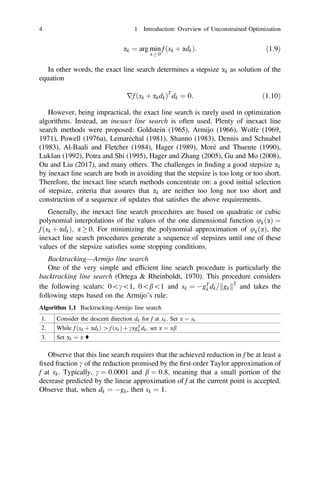
  • 62.
    If the secondcopy is also defective, you may demand a refund in writing without further opportunities to fix the problem. 1.F.4. Except for the limited right of replacement or refund set forth in paragraph 1.F.3, this work is provided to you ‘AS-IS’, WITH NO OTHER WARRANTIES OF ANY KIND, EXPRESS OR IMPLIED, INCLUDING BUT NOT LIMITED TO WARRANTIES OF MERCHANTABILITY OR FITNESS FOR ANY PURPOSE. 1.F.5. Some states do not allow disclaimers of certain implied warranties or the exclusion or limitation of certain types of damages. If any disclaimer or limitation set forth in this agreement violates the law of the state applicable to this agreement, the agreement shall be interpreted to make the maximum disclaimer or limitation permitted by the applicable state law. The invalidity or unenforceability of any provision of this agreement shall not void the remaining provisions. 1.F.6. INDEMNITY - You agree to indemnify and hold the Foundation, the trademark owner, any agent or employee of the Foundation, anyone providing copies of Project Gutenberg™ electronic works in accordance with this agreement, and any volunteers associated with the production, promotion and distribution of Project Gutenberg™ electronic works, harmless from all liability, costs and expenses, including legal fees, that arise directly or indirectly from any of the following which you do or cause to occur: (a) distribution of this or any Project Gutenberg™ work, (b) alteration, modification, or additions or deletions to any Project Gutenberg™ work, and (c) any Defect you cause. Section 2. Information about the Mission of Project Gutenberg™
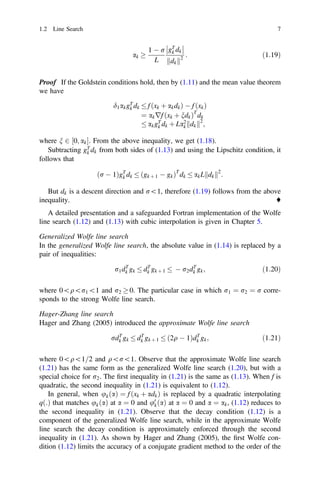
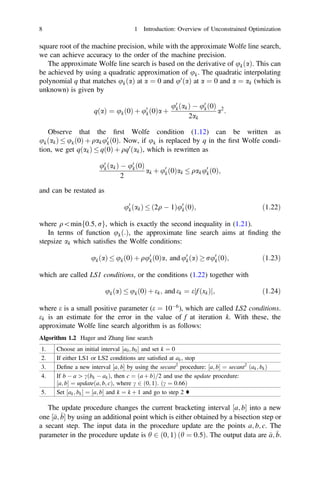
  • 63.
    Project Gutenberg™ issynonymous with the free distribution of electronic works in formats readable by the widest variety of computers including obsolete, old, middle-aged and new computers. It exists because of the efforts of hundreds of volunteers and donations from people in all walks of life. Volunteers and financial support to provide volunteers with the assistance they need are critical to reaching Project Gutenberg™’s goals and ensuring that the Project Gutenberg™ collection will remain freely available for generations to come. In 2001, the Project Gutenberg Literary Archive Foundation was created to provide a secure and permanent future for Project Gutenberg™ and future generations. To learn more about the Project Gutenberg Literary Archive Foundation and how your efforts and donations can help, see Sections 3 and 4 and the Foundation information page at www.gutenberg.org. Section 3. Information about the Project Gutenberg Literary Archive Foundation The Project Gutenberg Literary Archive Foundation is a non- profit 501(c)(3) educational corporation organized under the laws of the state of Mississippi and granted tax exempt status by the Internal Revenue Service. The Foundation’s EIN or federal tax identification number is 64-6221541. Contributions to the Project Gutenberg Literary Archive Foundation are tax deductible to the full extent permitted by U.S. federal laws and your state’s laws. The Foundation’s business office is located at 809 North 1500 West, Salt Lake City, UT 84116, (801) 596-1887. Email contact links and up to date contact information can be found at the Foundation’s website and official page at www.gutenberg.org/contact
  • 64.
    Section 4. Informationabout Donations to the Project Gutenberg Literary Archive Foundation Project Gutenberg™ depends upon and cannot survive without widespread public support and donations to carry out its mission of increasing the number of public domain and licensed works that can be freely distributed in machine-readable form accessible by the widest array of equipment including outdated equipment. Many small donations ($1 to $5,000) are particularly important to maintaining tax exempt status with the IRS. The Foundation is committed to complying with the laws regulating charities and charitable donations in all 50 states of the United States. Compliance requirements are not uniform and it takes a considerable effort, much paperwork and many fees to meet and keep up with these requirements. We do not solicit donations in locations where we have not received written confirmation of compliance. To SEND DONATIONS or determine the status of compliance for any particular state visit www.gutenberg.org/donate. While we cannot and do not solicit contributions from states where we have not met the solicitation requirements, we know of no prohibition against accepting unsolicited donations from donors in such states who approach us with offers to donate. International donations are gratefully accepted, but we cannot make any statements concerning tax treatment of donations received from outside the United States. U.S. laws alone swamp our small staff. Please check the Project Gutenberg web pages for current donation methods and addresses. Donations are accepted in a number of other ways including checks, online payments and
  • 65.
    credit card donations.To donate, please visit: www.gutenberg.org/donate. Section 5. General Information About Project Gutenberg™ electronic works Professor Michael S. Hart was the originator of the Project Gutenberg™ concept of a library of electronic works that could be freely shared with anyone. For forty years, he produced and distributed Project Gutenberg™ eBooks with only a loose network of volunteer support. Project Gutenberg™ eBooks are often created from several printed editions, all of which are confirmed as not protected by copyright in the U.S. unless a copyright notice is included. Thus, we do not necessarily keep eBooks in compliance with any particular paper edition. Most people start at our website which has the main PG search facility: www.gutenberg.org. This website includes information about Project Gutenberg™, including how to make donations to the Project Gutenberg Literary Archive Foundation, how to help produce our new eBooks, and how to subscribe to our email newsletter to hear about new eBooks.
  • 66.
    Welcome to ourwebsite – the perfect destination for book lovers and knowledge seekers. We believe that every book holds a new world, offering opportunities for learning, discovery, and personal growth. That’s why we are dedicated to bringing you a diverse collection of books, ranging from classic literature and specialized publications to self-development guides and children's books. More than just a book-buying platform, we strive to be a bridge connecting you with timeless cultural and intellectual values. With an elegant, user-friendly interface and a smart search system, you can quickly find the books that best suit your interests. Additionally, our special promotions and home delivery services help you save time and fully enjoy the joy of reading. Join us on a journey of knowledge exploration, passion nurturing, and personal growth every day! ebookbell.com