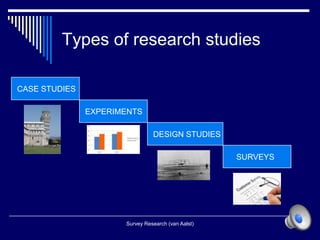
Types of research studies
1
CASE STUDIES
EXPERIMENTS
DESIGN STUDIES
SURVEYS
Survey Research (van Aalst)
Goals of survey research
 Measure or estimate a population on one or
more variables
 How many households have a computer < 3
years old, for different strata of income and
education levels?
 How many classrooms have more than one
computer, for schools in areas with different
socio-economic status?
 What is the distribution of income from work,
for Hong Kong, Taipei, and Singapore?
Survey Research (van Aalst) 2
4.Surveys
Example
2006 New Zealand Census
Survey Research (van Aalst) 3
4.Surveys
TIMSS 2011
Survey Research (van Aalst) 4
4.Surveys
Survey methods
 Generally uses descriptive statistics for
testing hypotheses or answering research
questions
 Can be done via questionnaires,
interviewing, and observation
 Questionnaires most common
 Interview and observation data need to be
quantified
 What are the advantages of each method?
Survey Research (van Aalst) 5
4.Surveys
Sampling
 Sometimes whole population is
measured
 All taxpayers in Hong Kong
 All persons entering Hong Kong by air
 Most often a representative and
randomly selected sample is used and
one makes inferences about the
population from that sample
Survey Research (van Aalst) 6
4.Surveys
Representative sample
 Are the following representative samples
of their populations?
 The men and women in this course as a
sample of all men and women taking M.
Sc. courses in Hong Kong?
 People in Hong Kong who have a
broadband connection to the Internet as a
sample of all people in Hong Kong?
Survey Research (van Aalst) 7
4.Surveys
Random sample
 Each member of the population has an
equal chance being selected for the
survey
 Maximizes the chance that patterns in the
sample match those in the population
 Statistically useful
 Mean value and variation in the population
can be estimated from knowing the mean
value and variation of the random sample
 When the sample is not random this kind of
estimation is less accurate
Survey Research (van Aalst) 8
4.Surveys
Problems with representativeness
and randomness
 Low response rates, say 20%
 sub-populations may be systematically
excluded
 Systematic bias
 A random sample is no longer random or
representative when some students do not
turn up for a test
 Sampling % of total population may over-
represent major urban centers and under-
represent rural areas
Survey Research (van Aalst) 9
4.Surveys
Planning a questionnaire
 Can use a flow chart technique to plan
the sequencing of questions
 Be able to anticipate the type & range of
responses that their questions are likely
to elicit
Survey Research (van Aalst) 10
4.Surveys
A flow chart technique for
question planning
Survey Research (van Aalst) 11
4.Surveys
Operationalizing the
questionnaire
 Clear purpose
 Clear on what needs to be included or
covered
 Exhaustive coverage of elements
 Asks most appropriate kinds of question
 Elicits most appropriate kinds of data to
answer the research purposes
 Asks for empirical data
Survey Research (van Aalst) 12
4.Surveys
Avoiding pitfalls in question writing
 Avoid leading questions which suggests
that there is only one acceptable answer
 “Do you prefer abstract, academic-type
courses, or practical courses that have
some pay-off in your day-to-day teaching?”
Survey Research (van Aalst) 13
4.Surveys
Avoiding pitfalls in question writing
 Avoid complex questions
 “Would you prefer a short, non-award
bearing course (3, 4 or 5 sessions) with
part-day release (e.g. Wednesday
afternoons) and one evening per week
attendance with financial reimbursement
for travel, or a longer, non-award bearing
course (6, 7 or 8 sessions) with full-day
release, or the whole course designed on
part-day release without evening
attendance?”
Survey Research (van Aalst) 14
4.Surveys
Avoiding pitfalls in question writing
 Avoid irritating questions or instructions
 “Have you ever attended an in-service
course of any kind during your entire
career?”
 Avoid questions that use negatives and
double negatives
 “How strongly do you feel that no teacher
should enroll on the in-service, award-
bearing course who has not completed at
least two years full-time teaching?”
Survey Research (van Aalst) 15
4.Surveys
Avoiding pitfalls in question writing
 Avoid ambiguity in words
 “Does your child regularly do homework?”
(Once a day, once a year, once a term, once a
week?)
 How many computers do you have in
school?
(Present but broken; out of school being
repaired, staffs’ or students’?)
Survey Research (van Aalst) 16
4.Surveys
Avoiding pitfalls in question writing
 Avoid any overlap of categories.
 “How old are you?
 15-20
 20-30
 30-40
 40-50”
Survey Research (van Aalst) 17
4.Surveys
Cover letters/sheets and follow-up
letters
 Provide title for project
 State purpose and expected benefits
 Mention sponsorship or permission for
the research
 Mention incentives for completion
 Provide assurances of confidentiality,
anonymity and non-traceability
 Thank respondents in advance for their
co-operation
Survey Research (van Aalst) 18
4.Surveys
Piloting the questionnaire
 Check clarity of questionnaire items,
instructions, and layout
 Gain feedback on validity of items
 Eliminate ambiguities
 Check time to complete
 Identify misunderstood or non-
completed items
 Check if it is too long or too short, too
easy or too difficult
Survey Research (van Aalst) 19
4.Surveys
Further reading
 Fowler, Jr., F. J. (2009). Survey research
methods, 4th edition. Thousand Oaks,
CA: SAGE.
Survey Research (van Aalst) 20

Mite 6025 surveys

  • 1.
    Types of researchstudies 1 CASE STUDIES EXPERIMENTS DESIGN STUDIES SURVEYS Survey Research (van Aalst)
  • 2.
    Goals of surveyresearch  Measure or estimate a population on one or more variables  How many households have a computer < 3 years old, for different strata of income and education levels?  How many classrooms have more than one computer, for schools in areas with different socio-economic status?  What is the distribution of income from work, for Hong Kong, Taipei, and Singapore? Survey Research (van Aalst) 2 4.Surveys
  • 3.
    Example 2006 New ZealandCensus Survey Research (van Aalst) 3 4.Surveys
  • 4.
    TIMSS 2011 Survey Research(van Aalst) 4 4.Surveys
  • 5.
    Survey methods  Generallyuses descriptive statistics for testing hypotheses or answering research questions  Can be done via questionnaires, interviewing, and observation  Questionnaires most common  Interview and observation data need to be quantified  What are the advantages of each method? Survey Research (van Aalst) 5 4.Surveys
  • 6.
    Sampling  Sometimes wholepopulation is measured  All taxpayers in Hong Kong  All persons entering Hong Kong by air  Most often a representative and randomly selected sample is used and one makes inferences about the population from that sample Survey Research (van Aalst) 6 4.Surveys
  • 7.
    Representative sample  Arethe following representative samples of their populations?  The men and women in this course as a sample of all men and women taking M. Sc. courses in Hong Kong?  People in Hong Kong who have a broadband connection to the Internet as a sample of all people in Hong Kong? Survey Research (van Aalst) 7 4.Surveys
  • 8.
    Random sample  Eachmember of the population has an equal chance being selected for the survey  Maximizes the chance that patterns in the sample match those in the population  Statistically useful  Mean value and variation in the population can be estimated from knowing the mean value and variation of the random sample  When the sample is not random this kind of estimation is less accurate Survey Research (van Aalst) 8 4.Surveys
  • 9.
    Problems with representativeness andrandomness  Low response rates, say 20%  sub-populations may be systematically excluded  Systematic bias  A random sample is no longer random or representative when some students do not turn up for a test  Sampling % of total population may over- represent major urban centers and under- represent rural areas Survey Research (van Aalst) 9 4.Surveys
  • 10.
    Planning a questionnaire Can use a flow chart technique to plan the sequencing of questions  Be able to anticipate the type & range of responses that their questions are likely to elicit Survey Research (van Aalst) 10 4.Surveys
  • 11.
    A flow charttechnique for question planning Survey Research (van Aalst) 11 4.Surveys
  • 12.
    Operationalizing the questionnaire  Clearpurpose  Clear on what needs to be included or covered  Exhaustive coverage of elements  Asks most appropriate kinds of question  Elicits most appropriate kinds of data to answer the research purposes  Asks for empirical data Survey Research (van Aalst) 12 4.Surveys
  • 13.
    Avoiding pitfalls inquestion writing  Avoid leading questions which suggests that there is only one acceptable answer  “Do you prefer abstract, academic-type courses, or practical courses that have some pay-off in your day-to-day teaching?” Survey Research (van Aalst) 13 4.Surveys
  • 14.
    Avoiding pitfalls inquestion writing  Avoid complex questions  “Would you prefer a short, non-award bearing course (3, 4 or 5 sessions) with part-day release (e.g. Wednesday afternoons) and one evening per week attendance with financial reimbursement for travel, or a longer, non-award bearing course (6, 7 or 8 sessions) with full-day release, or the whole course designed on part-day release without evening attendance?” Survey Research (van Aalst) 14 4.Surveys
  • 15.
    Avoiding pitfalls inquestion writing  Avoid irritating questions or instructions  “Have you ever attended an in-service course of any kind during your entire career?”  Avoid questions that use negatives and double negatives  “How strongly do you feel that no teacher should enroll on the in-service, award- bearing course who has not completed at least two years full-time teaching?” Survey Research (van Aalst) 15 4.Surveys
  • 16.
    Avoiding pitfalls inquestion writing  Avoid ambiguity in words  “Does your child regularly do homework?” (Once a day, once a year, once a term, once a week?)  How many computers do you have in school? (Present but broken; out of school being repaired, staffs’ or students’?) Survey Research (van Aalst) 16 4.Surveys
  • 17.
    Avoiding pitfalls inquestion writing  Avoid any overlap of categories.  “How old are you?  15-20  20-30  30-40  40-50” Survey Research (van Aalst) 17 4.Surveys
  • 18.
    Cover letters/sheets andfollow-up letters  Provide title for project  State purpose and expected benefits  Mention sponsorship or permission for the research  Mention incentives for completion  Provide assurances of confidentiality, anonymity and non-traceability  Thank respondents in advance for their co-operation Survey Research (van Aalst) 18 4.Surveys
  • 19.
    Piloting the questionnaire Check clarity of questionnaire items, instructions, and layout  Gain feedback on validity of items  Eliminate ambiguities  Check time to complete  Identify misunderstood or non- completed items  Check if it is too long or too short, too easy or too difficult Survey Research (van Aalst) 19 4.Surveys
  • 20.
    Further reading  Fowler,Jr., F. J. (2009). Survey research methods, 4th edition. Thousand Oaks, CA: SAGE. Survey Research (van Aalst) 20