Week-5
Systems Approach to Problem Solving
MANAGEMENT INFORMATION SYSTEMS 8/E
Raymond McLeod, Jr. and George Schell
Copyright 2001 Prentice-Hall, Inc. 6-1
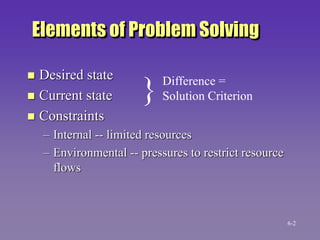
Elements of Problem Solving
 Desired state
 Current state
 Constraints
– Internal -- limited resources
– Environmental -- pressures to restrict resource
flows
} Difference =
Solution Criterion
6-2
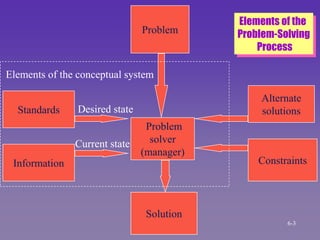
Problem
Standards
Information
Problem
solver
(manager)
Solution
Alternate
solutions
Constraints
Desired state
Current state
Elements of the conceptual system
Elements of the
Problem-Solving
Process
6-3
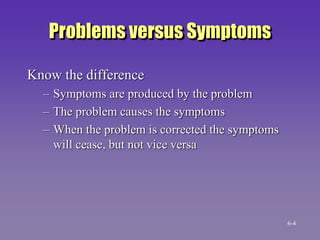
Problems versus Symptoms
Know the difference
– Symptoms are produced by the problem
– The problem causes the symptoms
– When the problem is corrected the symptoms
will cease, but not vice versa
6-4
Problem Structure
 Structured
– Elements and relationships understood
 Unstructured
– No elements or relationships understood
 Semistructured
– Some elements understood
 DSS concept of managers and the computer
working jointly towards a solution
6-5
Problem Structure
DSS
Computer
Solve
Manager
Solve
Structured Semi-structured Unstructured
6-6
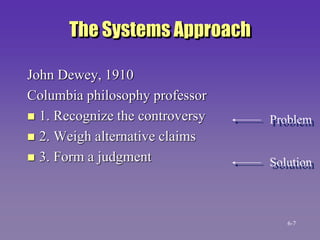
The Systems Approach
John Dewey, 1910
Columbia philosophy professor
 1. Recognize the controversy
 2. Weigh alternative claims
 3. Form a judgment
Problem
Solution
6-7
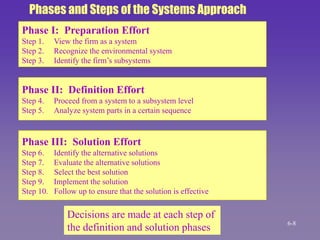
Phase I: Preparation Effort
Step 1. View the firm as a system
Step 2. Recognize the environmental system
Step 3. Identify the firm’s subsystems
Phase II: Definition Effort
Step 4. Proceed from a system to a subsystem level
Step 5. Analyze system parts in a certain sequence
Phase III: Solution Effort
Step 6. Identify the alternative solutions
Step 7. Evaluate the alternative solutions
Step 8. Select the best solution
Step 9. Implement the solution
Step 10. Follow up to ensure that the solution is effective
Phases and Steps of the Systems Approach
Decisions are made at each step of
the definition and solution phases 6-8
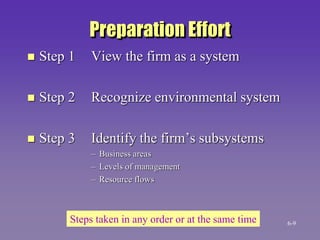
Preparation Effort
 Step 1 View the firm as a system
 Step 2 Recognize environmental system
 Step 3 Identify the firm’s subsystems
– Business areas
– Levels of management
– Resource flows
Steps taken in any order or at the same time 6-9
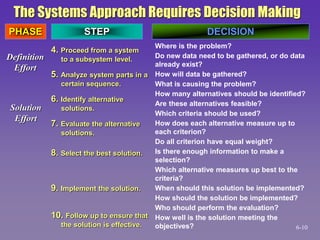
The Systems Approach Requires Decision Making
Definition
Effort
Solution
Effort
PHASE STEP DECISION
4. Proceed from a system
to a subsystem level.
5. Analyze system parts in a
certain sequence.
6. Identify alternative
solutions.
7. Evaluate the alternative
solutions.
8. Select the best solution.
9. Implement the solution.
10. Follow up to ensure that
the solution is effective.
Where is the problem?
Do new data need to be gathered, or do data
already exist?
How will data be gathered?
What is causing the problem?
How many alternatives should be identified?
Are these alternatives feasible?
Which criteria should be used?
How does each alternative measure up to
each criterion?
Do all criterion have equal weight?
Is there enough information to make a
selection?
Which alternative measures up best to the
criteria?
When should this solution be implemented?
How should the solution be implemented?
Who should perform the evaluation?
How well is the solution meeting the
objectives? 6-10
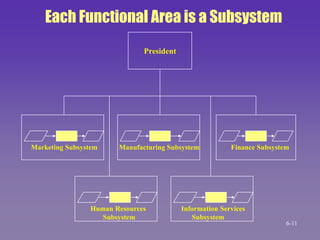
Marketing Subsystem Manufacturing Subsystem Finance Subsystem
President
Each Functional Area is a Subsystem
Human Resources
Subsystem
Information Services
Subsystem
6-11
Something Triggers the Definition Effort
The trigger can be:
1.An action
2.The passage of time
3. From within the firm or the environment
6-12
Definition Effort
 Step 4: Proceed from System to Subsystem
Level
– Each level is a system
– Are subsystems integrated into a smoothly
functioning unit?
– Does the subsystem need to be broken down
further?
6-13
Definition Effort [cont.]
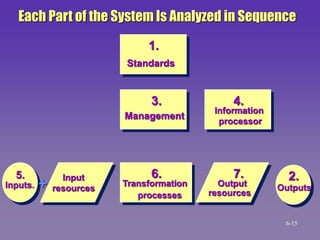
 Step 5: Analyze System Parts in a Certain
Sequence
1. Evaluation standards. They must be valid,
realistic, understandable, measurable
2. Compare system outputs with standards
3. Evaluate management
4. Evaluate the information processor
5. Evaluate the inputs and input resources
6. Evaluate the transformation processes
7. Evaluate the output resources
6-14
1.
Standards
3.
Management
4.
Information
processor
5. Input
resources
6.
Transformation
processes
7.
Output
resources
2.
Outputs
Each Part of the System Is Analyzed in Sequence
+
Inputs.
6-15
Solution Effort
 Step 6: Identify alternatives
– Find different ways to solve the same problem
» Brainstorming
» Joint Application Design (JAD) session
 Step 7: Evaluate alternative solutions
 Step 8: Select the best solution
» Analysis
» Judgment
» Bargaining
6-16
Final Steps of the Solution Effort
 Step 9: Implement the solution
 Step 10: Follow-up to ensure that the
solution is effective
6-17
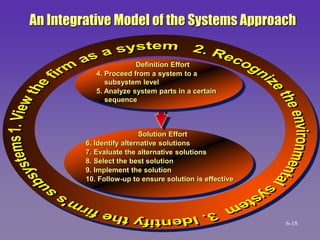
An Integrative Model of the Systems Approach
Solution Effort
6. Identify alternative solutions
7. Evaluate the alternative solutions
8. Select the best solution
9. Implement the solution
10. Follow-up to ensure solution is effective
Definition Effort
4. Proceed from a system to a
subsystem level
5. Analyze system parts in a certain
sequence
6-18
Review of Systems Approach
 Integrating each step of the systems
approach is a managerial challenge
 Managerial preparation effort is a good
starting point
 Next, manager engages in functional
decomposition
– Definition effort
 Finally, manager solves problem
– Solution effort
6-19
Summary
 Models are abstractions of reality
– Four types of models
– General systems model
 Physical system
 Conceptual system
 Information Processor
– Computer
– Noncomputer
6-20
Summary [cont.]
 Management by exception
 Managerial problem solving
 Classification of problems
– Structured
– Unstructured
 Use of the systems approach
6-21

MIS Wk-5.ppt

  • 1.
    Week-5 Systems Approach toProblem Solving MANAGEMENT INFORMATION SYSTEMS 8/E Raymond McLeod, Jr. and George Schell Copyright 2001 Prentice-Hall, Inc. 6-1
  • 2.
    Elements of ProblemSolving  Desired state  Current state  Constraints – Internal -- limited resources – Environmental -- pressures to restrict resource flows } Difference = Solution Criterion 6-2
  • 3.
  • 4.
    Problems versus Symptoms Knowthe difference – Symptoms are produced by the problem – The problem causes the symptoms – When the problem is corrected the symptoms will cease, but not vice versa 6-4
  • 5.
    Problem Structure  Structured –Elements and relationships understood  Unstructured – No elements or relationships understood  Semistructured – Some elements understood  DSS concept of managers and the computer working jointly towards a solution 6-5
  • 6.
  • 7.
    The Systems Approach JohnDewey, 1910 Columbia philosophy professor  1. Recognize the controversy  2. Weigh alternative claims  3. Form a judgment Problem Solution 6-7
  • 8.
    Phase I: PreparationEffort Step 1. View the firm as a system Step 2. Recognize the environmental system Step 3. Identify the firm’s subsystems Phase II: Definition Effort Step 4. Proceed from a system to a subsystem level Step 5. Analyze system parts in a certain sequence Phase III: Solution Effort Step 6. Identify the alternative solutions Step 7. Evaluate the alternative solutions Step 8. Select the best solution Step 9. Implement the solution Step 10. Follow up to ensure that the solution is effective Phases and Steps of the Systems Approach Decisions are made at each step of the definition and solution phases 6-8
  • 9.
    Preparation Effort  Step1 View the firm as a system  Step 2 Recognize environmental system  Step 3 Identify the firm’s subsystems – Business areas – Levels of management – Resource flows Steps taken in any order or at the same time 6-9
  • 10.
    The Systems ApproachRequires Decision Making Definition Effort Solution Effort PHASE STEP DECISION 4. Proceed from a system to a subsystem level. 5. Analyze system parts in a certain sequence. 6. Identify alternative solutions. 7. Evaluate the alternative solutions. 8. Select the best solution. 9. Implement the solution. 10. Follow up to ensure that the solution is effective. Where is the problem? Do new data need to be gathered, or do data already exist? How will data be gathered? What is causing the problem? How many alternatives should be identified? Are these alternatives feasible? Which criteria should be used? How does each alternative measure up to each criterion? Do all criterion have equal weight? Is there enough information to make a selection? Which alternative measures up best to the criteria? When should this solution be implemented? How should the solution be implemented? Who should perform the evaluation? How well is the solution meeting the objectives? 6-10
  • 11.
    Marketing Subsystem ManufacturingSubsystem Finance Subsystem President Each Functional Area is a Subsystem Human Resources Subsystem Information Services Subsystem 6-11
  • 12.
    Something Triggers theDefinition Effort The trigger can be: 1.An action 2.The passage of time 3. From within the firm or the environment 6-12
  • 13.
    Definition Effort  Step4: Proceed from System to Subsystem Level – Each level is a system – Are subsystems integrated into a smoothly functioning unit? – Does the subsystem need to be broken down further? 6-13
  • 14.
    Definition Effort [cont.] Step 5: Analyze System Parts in a Certain Sequence 1. Evaluation standards. They must be valid, realistic, understandable, measurable 2. Compare system outputs with standards 3. Evaluate management 4. Evaluate the information processor 5. Evaluate the inputs and input resources 6. Evaluate the transformation processes 7. Evaluate the output resources 6-14
  • 15.
  • 16.
    Solution Effort  Step6: Identify alternatives – Find different ways to solve the same problem » Brainstorming » Joint Application Design (JAD) session  Step 7: Evaluate alternative solutions  Step 8: Select the best solution » Analysis » Judgment » Bargaining 6-16
  • 17.
    Final Steps ofthe Solution Effort  Step 9: Implement the solution  Step 10: Follow-up to ensure that the solution is effective 6-17
  • 18.
    An Integrative Modelof the Systems Approach Solution Effort 6. Identify alternative solutions 7. Evaluate the alternative solutions 8. Select the best solution 9. Implement the solution 10. Follow-up to ensure solution is effective Definition Effort 4. Proceed from a system to a subsystem level 5. Analyze system parts in a certain sequence 6-18
  • 19.
    Review of SystemsApproach  Integrating each step of the systems approach is a managerial challenge  Managerial preparation effort is a good starting point  Next, manager engages in functional decomposition – Definition effort  Finally, manager solves problem – Solution effort 6-19
  • 20.
    Summary  Models areabstractions of reality – Four types of models – General systems model  Physical system  Conceptual system  Information Processor – Computer – Noncomputer 6-20
  • 21.
    Summary [cont.]  Managementby exception  Managerial problem solving  Classification of problems – Structured – Unstructured  Use of the systems approach 6-21