MIRROR

Reflective Learning at Work
Exploiting Apps to Support Dementia and Residential
Care

© MIRROR Project - Co-Funded by EU IST FP7 – www.mirror-project.eu
Event Agenda
1.
2.
3.
4.
5.

Introduction of Mirror, reflective learning and app sphere
The Digital life history app and manager
The Yammer App extended with reflective learning
The 3D Virtual care home App for carer training
The CaReflect App with proximity sensors to provide
evidence about care activities to reflect on
6. The Carer App for challenging behaviour
7. Adoption, exploitation and funding options
8. Collaborative buffet lunch for further discussions

© MIRROR Project - Co-Funded by EU IST FP7 – www.mirror-project.eu
MIRROR
How technology can help care home
staff reflect and learn
Ian Turner
Chairman RNHA

© MIRROR Project - Co-Funded by EU IST FP7 – www.mirror-project.eu
Registered Nursing
Home Association
▪
▪
▪
▪
▪

1000 small and medium Care Homes in membership
Based in Birmingham with 10 staff
20,000 staff checks on DBS per annum
Roadshow of current issues annually
Represents members with government, regulator
and other professional bodies

© MIRROR Project - Co-Funded by EU IST FP7 – www.mirror-project.eu
The Mirror Project
▪
▪
▪
▪
▪

Theme “Reflective Learning”
Four year EC funded project
Middle of the final year
Collaboration of various european universities
Testbeds also include european partners, eg italian
emergency services and german neurological clinic

© MIRROR Project - Co-Funded by EU IST FP7 – www.mirror-project.eu
Why Dementia Care and
Reflective Learning?
▪ Healthcare can offer limited support for dementia
being task / intervention based
▪ Social Care “enabling” is the dominant model
▪ That enabling requires staff to understand the
behaviour of the individual
▪ Requires staff to be a detective to reflect on
information known about the person

© MIRROR Project - Co-Funded by EU IST FP7 – www.mirror-project.eu
Caring for those Living with
Dementia
▪ In the late stages of the disease all the medical
model can offer is sedation
▪ Task based care will usually lead to confrontation
between resident and carer
▪ Supervision and enabling care is the aim
▪ Care Planning is not just task / issue based

© MIRROR Project - Co-Funded by EU IST FP7 – www.mirror-project.eu
Care for those Living with
Dementia
▪ Carers need to know as much about the person in
order to understand the behaviour and preferences
of the individual
▪ Gentleman wakes at 4am every day
▪ Devon lady becomes agitated in early evening

Currently record life history on paper but life histories
only started on admission

© MIRROR Project - Co-Funded by EU IST FP7 – www.mirror-project.eu
Care for those Living with
Dementia
▪ Memory from this morning will be minimal, if at all,
which means the person will not remember the last
meal or drink
▪ They will not remember their visitors or probably
where they are living
▪ Long term memory will be much clearer
▪ Boredom and inactivity can result
▪ Need to start data capture on diagnosis

© MIRROR Project - Co-Funded by EU IST FP7 – www.mirror-project.eu
Care for those Living with Dementia

▪ A range of “meaningful activity” is required
▪ Activity cannot be restricted to 2-5pm on weekday
afternoons
▪ All care staff must be responsible for such activity in
partnership with activity staff
▪ A part time secretary
▪ Childcare remembered
▪ Swimming for a resident

© MIRROR Project - Co-Funded by EU IST FP7 – www.mirror-project.eu
Care for those Living with Dementia

▪ We need a range of therapies:
▪
▪
▪
▪
▪
▪
▪

Music
Doll
Complimentary therapies, eg reflexology
Garden based
Hobby based
DIY – the man’s shed
etc

© MIRROR Project - Co-Funded by EU IST FP7 – www.mirror-project.eu
Care for those Living with
Dementia
▪ Staff cannot be “robotic” in delivering care to those
living with dementia
▪ Staff must think about how to approach residents
▪ Staff must see the whole person they are caring for
▪ Staff must think about why residents are reacting to
them in a particular way

© MIRROR Project - Co-Funded by EU IST FP7 – www.mirror-project.eu
Care for those Living with Dementia

▪ NICE have set an English standard for dementia
which concentrates on diagnosis and early stages of
the disease with some elements applicable to the
later stages.
▪ My three major factors for later stages are
▪ Life Histories
▪ Meaningful activities, and
▪ Reflective practice

© MIRROR Project - Co-Funded by EU IST FP7 – www.mirror-project.eu
The Carer Role
▪
▪
▪
▪
▪
▪

Demanding role
People skills are vital
Values are central
Person centred
Technical skills can be taught
Staff training is significant effort

© MIRROR Project - Co-Funded by EU IST FP7 – www.mirror-project.eu
Standards in Social Care in
England
▪ Regulatory standards – 360 of them in Essential
Standards of Quality and Safety
▪ Just about to start another set where the inspectors
judgement will be about is the service safe, is it
effective, is it caring, is it responsive to people’s
needs, and is it well led?
▪ This will be the fourth major upheaval in ten years

© MIRROR Project - Co-Funded by EU IST FP7 – www.mirror-project.eu
Standards in Social Care in
England
▪ Whilst these standards are not prescriptive (and will
not be in the future) this means that everyone has
got a different angle / statement / value
▪ Take medication, is it zero tolerance to recorded
administration, zero tolerance to medication not
being available or some other measure. Compare
with general compliance.

© MIRROR Project - Co-Funded by EU IST FP7 – www.mirror-project.eu
Standards in Social Care in England

▪ Consequence is
▪ Staff nervousness of not doing the right thing
▪ Lack of confidence in many homes
▪ Different views and performance levels being demanded
by regulators, commissioners, environmental health or
safeguarding staff
▪ Hence providers need to be very clear to staff about the
standard of performance expected of them, which is a
challenge

© MIRROR Project - Co-Funded by EU IST FP7 – www.mirror-project.eu
Information Technology in Care
Homes
▪ Generally restricted to the manager and
administrator
▪ Typically payroll and accounts
▪ If care plans are stored electronically they will not
be available to care staff outside office hours
▪ 98% of Care Home had internet access 3yrs ago, but
access very limited

© MIRROR Project - Co-Funded by EU IST FP7 – www.mirror-project.eu
Social Care and Information
Technology
▪ We are at the data capture stage in the sector
overall
▪ Systems are percieved as for the administrator and
manager
▪ Outside MIRROR - medication is a good example –
the first systems are just coming into use
▪ Infrastructure, eg WiFi, in most homes, not
available

© MIRROR Project - Co-Funded by EU IST FP7 – www.mirror-project.eu
Issues Arising from Research
▪ There is little formal reflection in most homes
(“too busy”), but widely accepted as needed.
▪ Significant change in acceptance of care staff to
technology. Now, often ahead of management!
▪ Many care homes lacking IT infrastructure, with
poor provision for carers, and hardly any for
residents, but the demand is coming.
▪ A need for care staff training, including how to
help and mediate the technology for residents.
© MIRROR Project - Co-Funded by EU IST FP7 – www.mirror-project.eu
Current Position
▪ All MIRROR apps were received positively by
homes and staff.
▪ Now second round of testing in residential care
homes. Again, positive responses, particularly
among new and inexperienced staff.
▪ New & novel apps for staff are seen as a
refreshing change. They won’t replace traditional
training, but can have a part to play.
▪ MIRROR believes that, at last, the time for
technology in residential care homes has come.
© MIRROR Project - Co-Funded by EU IST FP7 – www.mirror-project.eu
NHS Number
▪ Department of Health wishes to encourage the
collection and use of NHS Number to facilitate data
exchange between all parties.
▪ Currently only asking for collection and storage of
NHS number
▪ Validation rules at
http://systems.hscic.gov.uk/nhsnumber/stafffaqs.p
df

© MIRROR Project - Co-Funded by EU IST FP7 – www.mirror-project.eu
The Digital Life History App

© MIRROR Project - Co-Funded by EU IST FP7 – www.mirror-project.eu
The Digital Life History App
Tablet-based app providing resident life information
▪ Paper-based storybooks difficult to update and share
▪ Existing digital solutions insufficiently flexible

Key app features
▪
▪
▪
▪

Life history information updates by carers and relatives
One-stop for information, videos and external links
Supports reminiscence through stories with residents
Guiding personal care on myhomelife care values

© MIRROR Project - Co-Funded by EU IST FP7 – www.mirror-project.eu
The Digital Life History App:
Architecture and Evaluation

Carers

Carer

Resident life
Resident life
history
history
information
information
database
database

Relatives
Resident life
history manager

Server
Server

Resident life
history app

Early use in one residential home
▪ Digital Life History Manager used to document full
resident life histories from physical books
© MIRROR Project - Co-Funded by EU IST FP7 – www.mirror-project.eu

Resident
The Extended Yammer App

© MIRROR Project - Co-Funded by EU IST FP7 – www.mirror-project.eu
Extended Yammer App
Replace paper notebook with
mobile app
▪ Adapt enterprise microblogging as prototype
▪ Direct in-situ care note entry
on mobile device
▪ Direct access to all care
notes about resident
▪ Real-time supervision of care
progress
▪ Integration with electronic
care record systems
© MIRROR Project - Co-Funded by EU IST FP7 – www.mirror-project.eu
Extended Yammer App Architecture

Exported
care notes

Carers

Resident care
Resident care
record
record
database
database
Care note
reflections
Device
Device

© MIRROR Project - Co-Funded by EU IST FP7 – www.mirror-project.eu

Server
Server
Extended Yammer App Evaluation
Used effectively in residential homes
▪ Carers able and willing to use app during and after shifts
▪ Increased number and detail of captured care notes
▪ Some increases in number of reflections about care

Important contextual factors
▪ Fitted with flexible care work practices
▪ Used before shift to prepare for care activities
▪ Perceptions of relatives sometimes negative

Future app evolutions
▪ More explicit support for reflection about residents
▪ Contextualise care notes in digital life history
© MIRROR Project - Co-Funded by EU IST FP7 – www.mirror-project.eu
Virtual Care Home App
• 3D game for the health
and care sector to train
carers deal with difficult
dialogues and stressful
situations at work
• To facilitate the
reflection process
during the training and
to giving users a virtual
tutoring support during
the gameplay.
© MIRROR Project - Co-Funded by EU IST FP7 – www.mirror-project.eu
Virtual Care Home Components

Serious Games

User Tools for reflection

3D Virtual Care Home
Mini Games
Branching Stories
Virtual Tutor

Wizard tool for content
Self-evaluation;
Global feedback;
Graphic comparison;
Learning diary.

© MIRROR Project - Co-Funded by EU IST FP7 – www.mirror-project.eu
The CaReflect App and Proximity
Sensors

© MIRROR Project - Co-Funded by EU IST FP7 – www.mirror-project.eu
CaReflect

© MIRROR Project - Co-Funded by EU IST FP7 – www.mirror-project.eu

33
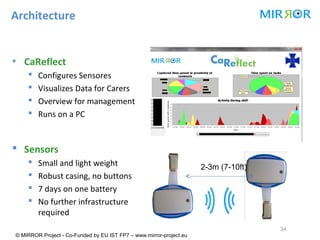
Architecture

▪ CaReflect





Configures Sensores
Visualizes Data for Carers
Overview for management
Runs on a PC

 Sensors





Small and light weight
Robust casing, no buttons
7 days on one battery
No further infrastructure
required

2-3m (7-10ft)

34
© MIRROR Project - Co-Funded by EU IST FP7 – www.mirror-project.eu
Summary
▪ Measure and Quantify Care
 Wearable sensors
 Visualize contact times

▪ Current state – after test in two care homes
 Very positive feedback, e.g. initiated group discussion
 No privacy concerns but various benefits are envisioned
 Neglect monitoring
 Evidence to relatives

 Preparing for next study
«CaReflect does not try to provide the answers but
helps to ask the questions»
© MIRROR Project - Co-Funded by EU IST FP7 – www.mirror-project.eu

35
The Carer App

© MIRROR Project - Co-Funded by EU IST FP7 – www.mirror-project.eu
Carer App
Personal support to resolve challenging behaviour
with creative thinking that personalises care
1. Other, less-constrained worlds to resolve case
2. Analogical cases to transfer ideas to resolve case
3. Previous dementia cases to reuse ideas to resolve
case

Case base of good practices
▪

Natural language descriptions of successful care
work

Simple audio-recording of ideas
▪

Structure, playback and export care plans to share

© MIRROR Project - Co-Funded by EU IST FP7 – www.mirror-project.eu
Carer App Architecture

Case-based reasoning
discovery service
discovery service
Analogical reasoning
discovery service
discovery service
Carers
Creativity prompt
Creativity prompt
generation service
generation service
Server
Server

© MIRROR Project - Co-Funded by EU IST FP7 – www.mirror-project.eu

Good care
Good care
practice xml
practice xml
repository
repository
Carer App Evaluations
Used effectively in residential care homes
▪ Carers used retrieved dementia cases over others
▪ Generated, played back, improved and shared audio ideas
▪ Led to care improvements attributed to recorded ideas

Important contextual factors
▪ More app use outside of shifts – time and space
▪ Align app use with care home values, practices

Future app evolutions
▪ Integrate idea generation with digital life histories
▪ Enhanced web support for collecting good care practices
© MIRROR Project - Co-Funded by EU IST FP7 – www.mirror-project.eu
Third-Source Funding Options

© MIRROR Project - Co-Funded by EU IST FP7 – www.mirror-project.eu
Third-Source Funding Options
1. Knowledge Transfer Partnerships
▪ Fund 50-67% of project for 1-2 years
▪ Product development, service rollout
▪ Incremental proposal process

1. Collaboration with Charities
▪ For example Leverhulme Trust,
Joseph Roundtree Foundation,
Dementia Action Alliance

1. Bilateral Development Projects
▪ Seek University resources to support

© MIRROR Project - Co-Funded by EU IST FP7 – www.mirror-project.eu

Mirror Reflective learning at work

  • 1.
    MIRROR Reflective Learning atWork Exploiting Apps to Support Dementia and Residential Care © MIRROR Project - Co-Funded by EU IST FP7 – www.mirror-project.eu
  • 2.
    Event Agenda 1. 2. 3. 4. 5. Introduction ofMirror, reflective learning and app sphere The Digital life history app and manager The Yammer App extended with reflective learning The 3D Virtual care home App for carer training The CaReflect App with proximity sensors to provide evidence about care activities to reflect on 6. The Carer App for challenging behaviour 7. Adoption, exploitation and funding options 8. Collaborative buffet lunch for further discussions © MIRROR Project - Co-Funded by EU IST FP7 – www.mirror-project.eu
  • 3.
    MIRROR How technology canhelp care home staff reflect and learn Ian Turner Chairman RNHA © MIRROR Project - Co-Funded by EU IST FP7 – www.mirror-project.eu
  • 4.
    Registered Nursing Home Association ▪ ▪ ▪ ▪ ▪ 1000small and medium Care Homes in membership Based in Birmingham with 10 staff 20,000 staff checks on DBS per annum Roadshow of current issues annually Represents members with government, regulator and other professional bodies © MIRROR Project - Co-Funded by EU IST FP7 – www.mirror-project.eu
  • 5.
    The Mirror Project ▪ ▪ ▪ ▪ ▪ Theme“Reflective Learning” Four year EC funded project Middle of the final year Collaboration of various european universities Testbeds also include european partners, eg italian emergency services and german neurological clinic © MIRROR Project - Co-Funded by EU IST FP7 – www.mirror-project.eu
  • 6.
    Why Dementia Careand Reflective Learning? ▪ Healthcare can offer limited support for dementia being task / intervention based ▪ Social Care “enabling” is the dominant model ▪ That enabling requires staff to understand the behaviour of the individual ▪ Requires staff to be a detective to reflect on information known about the person © MIRROR Project - Co-Funded by EU IST FP7 – www.mirror-project.eu
  • 7.
    Caring for thoseLiving with Dementia ▪ In the late stages of the disease all the medical model can offer is sedation ▪ Task based care will usually lead to confrontation between resident and carer ▪ Supervision and enabling care is the aim ▪ Care Planning is not just task / issue based © MIRROR Project - Co-Funded by EU IST FP7 – www.mirror-project.eu
  • 8.
    Care for thoseLiving with Dementia ▪ Carers need to know as much about the person in order to understand the behaviour and preferences of the individual ▪ Gentleman wakes at 4am every day ▪ Devon lady becomes agitated in early evening Currently record life history on paper but life histories only started on admission © MIRROR Project - Co-Funded by EU IST FP7 – www.mirror-project.eu
  • 9.
    Care for thoseLiving with Dementia ▪ Memory from this morning will be minimal, if at all, which means the person will not remember the last meal or drink ▪ They will not remember their visitors or probably where they are living ▪ Long term memory will be much clearer ▪ Boredom and inactivity can result ▪ Need to start data capture on diagnosis © MIRROR Project - Co-Funded by EU IST FP7 – www.mirror-project.eu
  • 10.
    Care for thoseLiving with Dementia ▪ A range of “meaningful activity” is required ▪ Activity cannot be restricted to 2-5pm on weekday afternoons ▪ All care staff must be responsible for such activity in partnership with activity staff ▪ A part time secretary ▪ Childcare remembered ▪ Swimming for a resident © MIRROR Project - Co-Funded by EU IST FP7 – www.mirror-project.eu
  • 11.
    Care for thoseLiving with Dementia ▪ We need a range of therapies: ▪ ▪ ▪ ▪ ▪ ▪ ▪ Music Doll Complimentary therapies, eg reflexology Garden based Hobby based DIY – the man’s shed etc © MIRROR Project - Co-Funded by EU IST FP7 – www.mirror-project.eu
  • 12.
    Care for thoseLiving with Dementia ▪ Staff cannot be “robotic” in delivering care to those living with dementia ▪ Staff must think about how to approach residents ▪ Staff must see the whole person they are caring for ▪ Staff must think about why residents are reacting to them in a particular way © MIRROR Project - Co-Funded by EU IST FP7 – www.mirror-project.eu
  • 13.
    Care for thoseLiving with Dementia ▪ NICE have set an English standard for dementia which concentrates on diagnosis and early stages of the disease with some elements applicable to the later stages. ▪ My three major factors for later stages are ▪ Life Histories ▪ Meaningful activities, and ▪ Reflective practice © MIRROR Project - Co-Funded by EU IST FP7 – www.mirror-project.eu
  • 14.
    The Carer Role ▪ ▪ ▪ ▪ ▪ ▪ Demandingrole People skills are vital Values are central Person centred Technical skills can be taught Staff training is significant effort © MIRROR Project - Co-Funded by EU IST FP7 – www.mirror-project.eu
  • 15.
    Standards in SocialCare in England ▪ Regulatory standards – 360 of them in Essential Standards of Quality and Safety ▪ Just about to start another set where the inspectors judgement will be about is the service safe, is it effective, is it caring, is it responsive to people’s needs, and is it well led? ▪ This will be the fourth major upheaval in ten years © MIRROR Project - Co-Funded by EU IST FP7 – www.mirror-project.eu
  • 16.
    Standards in SocialCare in England ▪ Whilst these standards are not prescriptive (and will not be in the future) this means that everyone has got a different angle / statement / value ▪ Take medication, is it zero tolerance to recorded administration, zero tolerance to medication not being available or some other measure. Compare with general compliance. © MIRROR Project - Co-Funded by EU IST FP7 – www.mirror-project.eu
  • 17.
    Standards in SocialCare in England ▪ Consequence is ▪ Staff nervousness of not doing the right thing ▪ Lack of confidence in many homes ▪ Different views and performance levels being demanded by regulators, commissioners, environmental health or safeguarding staff ▪ Hence providers need to be very clear to staff about the standard of performance expected of them, which is a challenge © MIRROR Project - Co-Funded by EU IST FP7 – www.mirror-project.eu
  • 18.
    Information Technology inCare Homes ▪ Generally restricted to the manager and administrator ▪ Typically payroll and accounts ▪ If care plans are stored electronically they will not be available to care staff outside office hours ▪ 98% of Care Home had internet access 3yrs ago, but access very limited © MIRROR Project - Co-Funded by EU IST FP7 – www.mirror-project.eu
  • 19.
    Social Care andInformation Technology ▪ We are at the data capture stage in the sector overall ▪ Systems are percieved as for the administrator and manager ▪ Outside MIRROR - medication is a good example – the first systems are just coming into use ▪ Infrastructure, eg WiFi, in most homes, not available © MIRROR Project - Co-Funded by EU IST FP7 – www.mirror-project.eu
  • 20.
    Issues Arising fromResearch ▪ There is little formal reflection in most homes (“too busy”), but widely accepted as needed. ▪ Significant change in acceptance of care staff to technology. Now, often ahead of management! ▪ Many care homes lacking IT infrastructure, with poor provision for carers, and hardly any for residents, but the demand is coming. ▪ A need for care staff training, including how to help and mediate the technology for residents. © MIRROR Project - Co-Funded by EU IST FP7 – www.mirror-project.eu
  • 21.
    Current Position ▪ AllMIRROR apps were received positively by homes and staff. ▪ Now second round of testing in residential care homes. Again, positive responses, particularly among new and inexperienced staff. ▪ New & novel apps for staff are seen as a refreshing change. They won’t replace traditional training, but can have a part to play. ▪ MIRROR believes that, at last, the time for technology in residential care homes has come. © MIRROR Project - Co-Funded by EU IST FP7 – www.mirror-project.eu
  • 22.
    NHS Number ▪ Departmentof Health wishes to encourage the collection and use of NHS Number to facilitate data exchange between all parties. ▪ Currently only asking for collection and storage of NHS number ▪ Validation rules at http://systems.hscic.gov.uk/nhsnumber/stafffaqs.p df © MIRROR Project - Co-Funded by EU IST FP7 – www.mirror-project.eu
  • 23.
    The Digital LifeHistory App © MIRROR Project - Co-Funded by EU IST FP7 – www.mirror-project.eu
  • 24.
    The Digital LifeHistory App Tablet-based app providing resident life information ▪ Paper-based storybooks difficult to update and share ▪ Existing digital solutions insufficiently flexible Key app features ▪ ▪ ▪ ▪ Life history information updates by carers and relatives One-stop for information, videos and external links Supports reminiscence through stories with residents Guiding personal care on myhomelife care values © MIRROR Project - Co-Funded by EU IST FP7 – www.mirror-project.eu
  • 25.
    The Digital LifeHistory App: Architecture and Evaluation Carers Carer Resident life Resident life history history information information database database Relatives Resident life history manager Server Server Resident life history app Early use in one residential home ▪ Digital Life History Manager used to document full resident life histories from physical books © MIRROR Project - Co-Funded by EU IST FP7 – www.mirror-project.eu Resident
  • 26.
    The Extended YammerApp © MIRROR Project - Co-Funded by EU IST FP7 – www.mirror-project.eu
  • 27.
    Extended Yammer App Replacepaper notebook with mobile app ▪ Adapt enterprise microblogging as prototype ▪ Direct in-situ care note entry on mobile device ▪ Direct access to all care notes about resident ▪ Real-time supervision of care progress ▪ Integration with electronic care record systems © MIRROR Project - Co-Funded by EU IST FP7 – www.mirror-project.eu
  • 28.
    Extended Yammer AppArchitecture Exported care notes Carers Resident care Resident care record record database database Care note reflections Device Device © MIRROR Project - Co-Funded by EU IST FP7 – www.mirror-project.eu Server Server
  • 29.
    Extended Yammer AppEvaluation Used effectively in residential homes ▪ Carers able and willing to use app during and after shifts ▪ Increased number and detail of captured care notes ▪ Some increases in number of reflections about care Important contextual factors ▪ Fitted with flexible care work practices ▪ Used before shift to prepare for care activities ▪ Perceptions of relatives sometimes negative Future app evolutions ▪ More explicit support for reflection about residents ▪ Contextualise care notes in digital life history © MIRROR Project - Co-Funded by EU IST FP7 – www.mirror-project.eu
  • 30.
    Virtual Care HomeApp • 3D game for the health and care sector to train carers deal with difficult dialogues and stressful situations at work • To facilitate the reflection process during the training and to giving users a virtual tutoring support during the gameplay. © MIRROR Project - Co-Funded by EU IST FP7 – www.mirror-project.eu
  • 31.
    Virtual Care HomeComponents Serious Games User Tools for reflection 3D Virtual Care Home Mini Games Branching Stories Virtual Tutor Wizard tool for content Self-evaluation; Global feedback; Graphic comparison; Learning diary. © MIRROR Project - Co-Funded by EU IST FP7 – www.mirror-project.eu
  • 32.
    The CaReflect Appand Proximity Sensors © MIRROR Project - Co-Funded by EU IST FP7 – www.mirror-project.eu
  • 33.
    CaReflect © MIRROR Project- Co-Funded by EU IST FP7 – www.mirror-project.eu 33
  • 34.
    Architecture ▪ CaReflect     Configures Sensores VisualizesData for Carers Overview for management Runs on a PC  Sensors     Small and light weight Robust casing, no buttons 7 days on one battery No further infrastructure required 2-3m (7-10ft) 34 © MIRROR Project - Co-Funded by EU IST FP7 – www.mirror-project.eu
  • 35.
    Summary ▪ Measure andQuantify Care  Wearable sensors  Visualize contact times ▪ Current state – after test in two care homes  Very positive feedback, e.g. initiated group discussion  No privacy concerns but various benefits are envisioned  Neglect monitoring  Evidence to relatives  Preparing for next study «CaReflect does not try to provide the answers but helps to ask the questions» © MIRROR Project - Co-Funded by EU IST FP7 – www.mirror-project.eu 35
  • 36.
    The Carer App ©MIRROR Project - Co-Funded by EU IST FP7 – www.mirror-project.eu
  • 37.
    Carer App Personal supportto resolve challenging behaviour with creative thinking that personalises care 1. Other, less-constrained worlds to resolve case 2. Analogical cases to transfer ideas to resolve case 3. Previous dementia cases to reuse ideas to resolve case Case base of good practices ▪ Natural language descriptions of successful care work Simple audio-recording of ideas ▪ Structure, playback and export care plans to share © MIRROR Project - Co-Funded by EU IST FP7 – www.mirror-project.eu
  • 38.
    Carer App Architecture Case-basedreasoning Case-based reasoning discovery service discovery service Analogical reasoning Analogical reasoning discovery service discovery service Carers Creativity prompt Creativity prompt generation service generation service Server Server © MIRROR Project - Co-Funded by EU IST FP7 – www.mirror-project.eu Good care Good care practice xml practice xml repository repository
  • 39.
    Carer App Evaluations Usedeffectively in residential care homes ▪ Carers used retrieved dementia cases over others ▪ Generated, played back, improved and shared audio ideas ▪ Led to care improvements attributed to recorded ideas Important contextual factors ▪ More app use outside of shifts – time and space ▪ Align app use with care home values, practices Future app evolutions ▪ Integrate idea generation with digital life histories ▪ Enhanced web support for collecting good care practices © MIRROR Project - Co-Funded by EU IST FP7 – www.mirror-project.eu
  • 40.
    Third-Source Funding Options ©MIRROR Project - Co-Funded by EU IST FP7 – www.mirror-project.eu
  • 41.
    Third-Source Funding Options 1.Knowledge Transfer Partnerships ▪ Fund 50-67% of project for 1-2 years ▪ Product development, service rollout ▪ Incremental proposal process 1. Collaboration with Charities ▪ For example Leverhulme Trust, Joseph Roundtree Foundation, Dementia Action Alliance 1. Bilateral Development Projects ▪ Seek University resources to support © MIRROR Project - Co-Funded by EU IST FP7 – www.mirror-project.eu