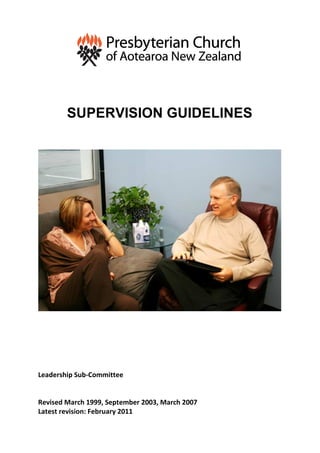
SUPERVISION GUIDELINES
Leadership Sub-Committee
Revised March 1999, September 2003, March 2007
Latest revision: February 2011
CONTENTS
Introduction 1
What supervision is 2
Who should have supervision? 3
A good supervisor 6
Preparing for supervision 7
Supervision Contracts – Why Have Them? 8
References 9
For further information, please contact:
Parish and People Advisory Service
Assembly Office
PO Box 9049
Wellington.
Phone: (04) 801 6000
Fax: (04) 801 6001
E-mail: juliette@presbyterian.org.nz
The Leadership Sub-Committee acknowledges the contribution to this document by
Margaret Feist and Margaret Pullar for a workshop in Southland Presbytery in 1993.
1
All paid ministry staff in the Presbyterian Church of Aotearoa New Zealand are required to have
regular, intentional and external supervision. GA 2010
INTRODUCTION
Johnson in Carroll and Gilbert (2006) says that ‘supervision is a place of trust where a healthy
relationship gives me a safe place to acknowledge and work with my clinical concerns, stresses,
fears and joys.’
Supervision should be seen as an investment in the health and ongoing development of those in
ministerial roles in the church. Supervision should also be seen as a long-term context which may act
to prevent the necessity of ‘the ambulance at the bottom of the cliff’ and will be a relationship
already established when the fallout of ministry means an ‘ambulance’ or some critical help is
needed.
The nature of church ministry and human relationships is such that conflict is inevitable no matter
how well things start out and despite goodwill intended. All ministry staff, including volunteers, have
the potential to be in conflict with others, either with those being ministered to, or those in
leadership or management. No one is exempt from engaging in conflicted interactions when
situations arise that involves disagreement, or change to be managed. If discussions around these
issues are to take place how we manage these discussions and the emotion that is engendered is
crucial. Having the opportunity to take already occurred or potential situations to supervision can
provide a more complete perspective so that action takes place rather than reaction.
The supervision context is not clouded by the conflicts in relationships occurring within the ministry
setting. It is safe, unbiased and objective and therefore, must be external to the ministry context.
Supervision provides a neutral place to talk about the nature of the conflict, to understand one’s
own role in it and to grow in skills and competency in working with it and through it.
2
WHAT SUPERVISION IS
One definition of the function of supervision is described by Inskipp and Proctor (1993) as attending
to the following three categories:
• NORMATIVE – effective practice. Professional and ethical conduct.
• FORMATIVE – learning and development, ongoing formation, future
• RESTORATIVE – support, well-being, self-care, work/study/life balance
Supervision can be seen as:
• A ‘dynamic and generative collaboration’.
• Power together
• An emphasis on learning, stimulation and creativity
• Able to provide benefits to morale, wellbeing, satisfaction, retention…
• An invitation or opportunity to experience new insights, and for personal and professional
development
Supervision as a professional growth strategy (Carroll, 2006)
• Alerts ministers to ethical and professional issues in their work and creates ethical
watchfulness.
• Allows ministers to measure the impact of their work on their lives and identify their
personal reactions to their professional work.
• Creates a layer of accountability and offers a ‘third-person’ perspective (feedback and
discernment).
• Is ultimately for the welfare and better service of the persons ministered to.
• Can ‘buffer’ the negative effects of working in a complex social and spiritual environment
because the supervisory interpersonal interaction provides social and emotional support
leading to greater long term job satisfaction and motivational commitment.
Distinctions between supervision, therapy and spiritual direction:
• The supervision focus is upon the work of the supervisee.
• Supervision has an educative function, e.g. via reflective processes or feedback.
• Personal growth is a by-product not the aim of supervision.
• Spiritual growth is by-product not the aim of supervision.
THE FOCUS OF SUPERVISION
The GOAL is continuing improvement in the QUALITY of ministry
The CONTEXT is an atmosphere of TRUST and OPENNESS
The VEHICLE is a RELATIONSHIP
The FOCUS is actual EVENTS
SUPERVISION ISN’T…
Supervision isn’t friendship, giving advice, spiritual direction, therapy, counselling, prayer, telling
your story, joint sermon preparation, discussion of common problems or concerns. All these may be
good things in themselves; if supervision time is used for them, it isn’t supervision. Supervision isn’t
an intimate relationship on any level.
3
WHO SHOULD HAVE SUPERVISION?
All paid ministry staff in the Presbyterian Church of Aotearoa New Zealand are required to have
regular, intentional and external supervision.
1 DEFINITIONS
1.1 MINISTRY:
‘Ministry’ is to be understood as:
• a person to person interaction between the minister and those to whom ministry is offered
• being on an individual or corporate basis
• for the purpose of empowering the gospel, pastoral care, discipleship, teaching and training or
providing the management context which enables the former to take place
• being on a regular basis.
1.2 PAID:
A person receiving remuneration for the provision of ‘ministry’ as per above.
1.3 MINISTRY STAFF:
Any person responsible for ‘ministry’ within the Church context. This includes:
1.3.1 National Ordained Ministers, those in Local Ministry Teams, Local Ordained Ministers, KCML
lecturers, AES and those in recognised Assembly roles.
1.3.2 Ordinands
1.3.3 Other paid Ministry staff:
• Children and Family Pastors and paid workers
• Youth Pastors and paid workers
• Other paid Pastoral Staff
• Full-time Administrators, Parish Managers, National staff
1.4 REGULAR:
Monthly supervision is the recommended minimum for those in paid ministry, regardless of the
number of hours worked.
1.5 INTENTIONAL:
1.5.1 A structured conversation with a person who has an understanding of the goals and
purposes of supervision and has received either psychological training or some form of
training recognised by the Presbyterian Church.
1.5.2 The minister is equipped to get the full benefit of the supervision process by understanding
the nature and purpose of supervision and by being prepared for each meeting.
1.6 EXTERNAL:
1.6.1 A supervisor should be an appropriately-skilled and experienced person who is neutral and
outside the church context within which the ministry is being offered, and is not involved in
the supervisee’s ministry role.
1.6.2 Collegial supervision is discouraged, except by a minister specifically trained, working or
retired and outside the supervisee’s context.
1.6.3 Ministry staff who fall into category 1.3.1 are encouraged to seek fully trained supervisors.
4
2 EMPLOYER RESPONSIBILITIES FOR MINISTERS AND ORDINANDS ( including fulltime
youth/children’s pastors etc
The Presbytery Ministry Committee is required to oversee supervision.
BOO (2008) 8.4(d): “Presbytery has responsibility of overseeing supervision, education and training
of ministers and students.”
BOO 9.6 (1): “Presbytery must ensure that every person selected for training as a minister has
adequate supervision.” In practice KCML undertakes to ensure that this requirement is in place.
2.1 Presbytery Ministry Committee shall maintain lists of suitable supervisors and be proactive in
ensuring supervisors are available in their areas.
2.2 Presbytery Ministry Committee shall annually check that the minister is undertaking
supervision as per the definitions above and that this is proving satisfactory.
2.3 Presbytery Ministry Committee shall ensure that ministers are aware of how to access the
maximum benefit from supervision.
2.4 Presbytery Ministry Committee shall ensure that parishes understand the supervision
requirement for their paid ministry staff and budget for it.
2.5 Ministry Development Reviewers shall ensure that ministers have been in regular and
intentional supervision. A minister must be in regular supervision before the Certificate of
Good standing can be issued.
2.6 For those in training as interns or as part of the leadership team under the senior minister or
his or her delegate, internal supervision of work done is normal and necessary.
2.7 External supervision on a monthly basis provides a neutral context alongside this in which to
reflect on the overall nature of what is being experienced in the ministry context.
3 MINISTER’S RESPONSIBILITIES
The responsibility to undertake the supervision lies with the Minister.
BOO 6.8(2): “A minister is responsible for nurturing and practising his or her own spiritual life and for
undertaking ministry development in accordance with supplementary provisions.”
“Ongoing ministry development, reviews and supervision are core requirements for a Certificate of
Good Standing.” Ministry Development Supplementary Provision
3.1 It is the responsibility of the minister to use regular supervision to maintain accountability, self
care and a high standard of pastoral care.
3.2 It is the responsibility of the minister to arrange their own supervision.
3.3 It is the responsibility of the minister to ensure that they know how to access the maximum
benefit from supervision.
4 PARISH RESPONSIBILITIES
5
4.1 The Conditions of Service Manual 2.7.1.1 indicates parishes are to pay reasonable costs
associated with supervision, including the cost of travel.
4.2 In the case of their ordained ministry staff, parishes should expect fully trained professionals to
be accessed as supervisors. The average cost of external supervision is currently $80-150.
5 TEAM MINISTRY
5.1 Where several ministers work together, team supervision shall be necessary on a regular basis,
in addition to individual supervision.
5.2 The regularity of this should be established in consultation with ministers involved and the
parish council. Six weekly to bi monthly is a suggestion.
5.3 This type of supervision should be undertaken by a professionally trained supervisor.
6 PART TIME OFFICE STAFF AND VOLUNTEERS
Cost is a significant deterrent to access of professional supervision, especially where multiple
volunteer part time office staff and a range of volunteers is concerned.
It is recommended that mentoring relationships be developed at the discretion of the leadership
and staff management. Mentors may be readily found within the local church community and may
be able to provide a helpful context for a staff member or volunteer to discuss their contribution to
the life of the church for the same reasons as outlined in the supervision rationale.
A GOOD SUPERVISOR
Options regarding supervisors for ministers and ordinands are:
• Professionally trained counsellors, psychologists within the local community.
• Members of the New Zealand Association of Counsellors.
• CAIRA accredited supervisors
• Ministers with evidence of supervision training and experience who have completed a
Psychological Services training course or Presbytery approved training.
Options for other paid ministry staff are:
• Same as above for pastoral and management staff who work full time.
• For part time staff use of local mentors who may be suitably trained through Presbytery or
who have significant experience in the helping professions.
A good supervisor provides:
• a supportive, safe environment
• full attention
• space for you to reflect on what you do and how you do it
• feedback to you
• space for feedback from you
• relevant information
A good supervisor will encourage you to:
• be active in supervision
• accept responsibility for your thoughts, feelings, attitudes, actions
• observe and clarify your thoughts, feelings, reactions
6
• become aware of the effects of your words and actions
• find other ways of looking at things
• discover and explore your options
• come to your own conclusions, choices and decisions
• acknowledge your strengths and successes
• keep the focus on the event material you present
• keep in mind the fundamental goal of improved quality of service
A good supervisor has knowledge, experience, integrity and skill to:
• maintain ‘professional distance’
• help you deal with transference and counter transference in your work and the supervision
process. [Transference: the active past. Although we are in the present, our past is always
with us, and dynamic in every relationship. Because it arises in the past, it fails to fit the
present. Inappropriateness is an important signal of transference.]
• recognise parallel process. [What you present from my work is mirrored in the relationship
with my supervisor.]
• recognise the limits of their own skill and offer me appropriate referral.
A supervisor is responsible for seeing that supervision
• stays within the ethical boundaries agreed in the contract
• does not become counselling or therapy
• is not used for any purpose but supervision
PREPARING FOR SUPERVISION
As supervisees we are responsible for what we present in supervision and for identifying what
makes it important enough to spend time on.
Anything is appropriate that arises from actual events and can affect, or is affecting, the quality of
our work, for instance our role in a particular situation, priorities, time management, insights,
people, committees or institutions, changes, pressures, needs….
Any one of the following may be useful in deciding what to choose
• The most significant event in my work since my last supervision is…
• This incident/concern keeps pushing itself back into my mind…
• I am aware of very strong feelings about something that has happened…
• When [this] happened it seemed to be a pattern repeating itself…
• I am so [tired, miserable, elated, worried]…
• I want to clarify where I stand on a particular issue…
• I want to stop something like [this] happening again…
• I want to get something like [this] to happen more often…
• I seem to keep avoiding/putting off…
When we arrive for supervision we need to be able to say
• This happened
• This is my question
• This is what I want
Supervision works best if:
• We are open, honest
• We report our behaviour, observations, reactions and feelings accurately
• We accept feedback
7
• We monitor our feelings and responses (including our need to justify, explain)
• We remember that what happens in supervision is our responsibility
• We remember that the purpose of the whole undertaking is to keep improving the quality of
the service we give
SUPERVISION CONTRACTS – WHY HAVE THEM?
A contract describes a unique relationship. Each supervision relationship is unique; it is the only
supervision in which these particular people work together. Their experience and understanding of
supervision may differ, so they need to clarify what they are doing. If they don’t there can be
confusion and disappointment. A contract is the best safeguard.
A contract helps establish the relationship. Negotiating a written contract can be an important step
in the setting up supervision. It can be a learning experience and a model. It emphasises each
person’s commitment. It requires the effective use of time.
A contract provides a framework. Some people find making a detailed, specific contract a good
base for on-going work. A contract sets ground rules for the shared task. It provides a framework
for evaluation (are we doing what we agreed to do?). It can be re-negotiated and adapted to meet
needs.
Significant things to consider in negotiating a contract:
1. The purpose of the supervision.
2. What each person expects the process of supervision to be like
3. What each person expects a supervision session to be like.
4. What the roles and tasks of the supervisee will be in this relationship.
5. What the roles and tasks of the supervisor will be in this relationship.
6. How and when the supervision will be evaluated.
7. What ethical code or covenant will be adhered to.
8. The working details:
(a) What preparation will be done.
(b) The working format of the session – e.g. how it will begin and end.
(c) How material will be presented [e.g. orally, written, verbatim, tape]
(d) What records will be kept and how material will be disposed of.
(e) The frequency, day, time and length of sessions.
(f) Starting and review dates and the proposed duration of the contract.
(g) Agreement about cancellations, regularity, punctuality, interruptions.
(h) Evaluation.
(i) Confidentiality [what might lead the supervisor to wish to break confidentiality?
What would he or she do? See also (d) above.]
(j) What to do if there is conflict, or if one participant has a complaint.
9. How payment will be arranged.
Not everything suggested here will be written into the contract but discussing it helps to clarify both
parties’ expectations. Sometimes it may clarify for one or other person that the relationship is not
likely to work.
8
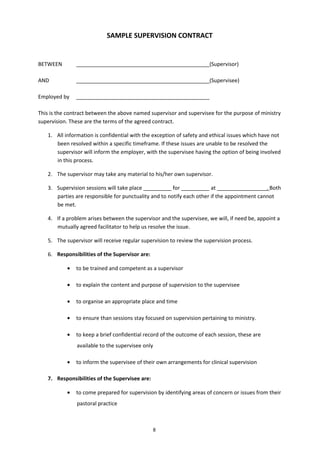
SAMPLE SUPERVISION CONTRACT
BETWEEN (Supervisor)
AND (Supervisee)
Employed by
This is the contract between the above named supervisor and supervisee for the purpose of ministry
supervision. These are the terms of the agreed contract.
1. All information is confidential with the exception of safety and ethical issues which have not
been resolved within a specific timeframe. If these issues are unable to be resolved the
supervisor will inform the employer, with the supervisee having the option of being involved
in this process.
2. The supervisor may take any material to his/her own supervisor.
3. Supervision sessions will take place for at . Both
parties are responsible for punctuality and to notify each other if the appointment cannot
be met.
4. If a problem arises between the supervisor and the supervisee, we will, if need be, appoint a
mutually agreed facilitator to help us resolve the issue.
5. The supervisor will receive regular supervision to review the supervision process.
6. Responsibilities of the Supervisor are:
• to be trained and competent as a supervisor
• to explain the content and purpose of supervision to the supervisee
• to organise an appropriate place and time
• to ensure than sessions stay focused on supervision pertaining to ministry.
• to keep a brief confidential record of the outcome of each session, these are
available to the supervisee only
• to inform the supervisee of their own arrangements for clinical supervision
7. Responsibilities of the Supervisee are:
• to come prepared for supervision by identifying areas of concern or issues from their
pastoral practice
9
• as a first priority, identify aspects of their work which have safety and ethical
implications
• to follow through on any mutually agreed outcomes within the agreed timeframe
8. The supervisee agrees to tell the supervisor:
• of any event or circumstance in his/her own life which may be affecting his/her
provision of ministry
• any time he/she thinks that an attitude or feeling (positive or negative) about a
person might be affecting in any way the treatment and ministry to that person
• of the progress of any other supervision or training
• about what he/she finds helpful or unhelpful about the supervision provided
9. It is expected that the relationship between supervisor and supervisee will be honest, safe
and equal.
10. This contract will be renegotiated after six months, with the option of the supervisee either
continuing with or changing their supervisor.
11. The fee will be
Signature of Supervisor Date:
Signature of Supervisee Date:
REFERENCES
Baxter, R. & Mayor, T. (2008) Supervision Scrapbook. Wellington: Presbyterian Church of Aotearoa
New Zealand (Limited edition)
10
Carroll, M. (2006) One more time: What is supervision? Psychotherapy in Australia.
Carroll, M. & Gilbert, M. (2006) On being a Supervisee: Creating Learning Partnerships. Victoria:
PsychOz Publications, p6
Inskipp, F. & Proctor, B. (1995) The Art, Craft and Tasks of Counselling Supervision: Part 2, Becoming
a Supervisor. Twickenham: Middlesex, Cascade.

Ministerial Supervision Guidelines (PCANZ) 2011

  • 1.
    SUPERVISION GUIDELINES Leadership Sub-Committee RevisedMarch 1999, September 2003, March 2007 Latest revision: February 2011
  • 2.
    CONTENTS Introduction 1 What supervisionis 2 Who should have supervision? 3 A good supervisor 6 Preparing for supervision 7 Supervision Contracts – Why Have Them? 8 References 9 For further information, please contact: Parish and People Advisory Service Assembly Office PO Box 9049 Wellington. Phone: (04) 801 6000 Fax: (04) 801 6001 E-mail: juliette@presbyterian.org.nz The Leadership Sub-Committee acknowledges the contribution to this document by Margaret Feist and Margaret Pullar for a workshop in Southland Presbytery in 1993.
  • 3.
    1 All paid ministrystaff in the Presbyterian Church of Aotearoa New Zealand are required to have regular, intentional and external supervision. GA 2010 INTRODUCTION Johnson in Carroll and Gilbert (2006) says that ‘supervision is a place of trust where a healthy relationship gives me a safe place to acknowledge and work with my clinical concerns, stresses, fears and joys.’ Supervision should be seen as an investment in the health and ongoing development of those in ministerial roles in the church. Supervision should also be seen as a long-term context which may act to prevent the necessity of ‘the ambulance at the bottom of the cliff’ and will be a relationship already established when the fallout of ministry means an ‘ambulance’ or some critical help is needed. The nature of church ministry and human relationships is such that conflict is inevitable no matter how well things start out and despite goodwill intended. All ministry staff, including volunteers, have the potential to be in conflict with others, either with those being ministered to, or those in leadership or management. No one is exempt from engaging in conflicted interactions when situations arise that involves disagreement, or change to be managed. If discussions around these issues are to take place how we manage these discussions and the emotion that is engendered is crucial. Having the opportunity to take already occurred or potential situations to supervision can provide a more complete perspective so that action takes place rather than reaction. The supervision context is not clouded by the conflicts in relationships occurring within the ministry setting. It is safe, unbiased and objective and therefore, must be external to the ministry context. Supervision provides a neutral place to talk about the nature of the conflict, to understand one’s own role in it and to grow in skills and competency in working with it and through it.
  • 4.
    2 WHAT SUPERVISION IS Onedefinition of the function of supervision is described by Inskipp and Proctor (1993) as attending to the following three categories: • NORMATIVE – effective practice. Professional and ethical conduct. • FORMATIVE – learning and development, ongoing formation, future • RESTORATIVE – support, well-being, self-care, work/study/life balance Supervision can be seen as: • A ‘dynamic and generative collaboration’. • Power together • An emphasis on learning, stimulation and creativity • Able to provide benefits to morale, wellbeing, satisfaction, retention… • An invitation or opportunity to experience new insights, and for personal and professional development Supervision as a professional growth strategy (Carroll, 2006) • Alerts ministers to ethical and professional issues in their work and creates ethical watchfulness. • Allows ministers to measure the impact of their work on their lives and identify their personal reactions to their professional work. • Creates a layer of accountability and offers a ‘third-person’ perspective (feedback and discernment). • Is ultimately for the welfare and better service of the persons ministered to. • Can ‘buffer’ the negative effects of working in a complex social and spiritual environment because the supervisory interpersonal interaction provides social and emotional support leading to greater long term job satisfaction and motivational commitment. Distinctions between supervision, therapy and spiritual direction: • The supervision focus is upon the work of the supervisee. • Supervision has an educative function, e.g. via reflective processes or feedback. • Personal growth is a by-product not the aim of supervision. • Spiritual growth is by-product not the aim of supervision. THE FOCUS OF SUPERVISION The GOAL is continuing improvement in the QUALITY of ministry The CONTEXT is an atmosphere of TRUST and OPENNESS The VEHICLE is a RELATIONSHIP The FOCUS is actual EVENTS SUPERVISION ISN’T… Supervision isn’t friendship, giving advice, spiritual direction, therapy, counselling, prayer, telling your story, joint sermon preparation, discussion of common problems or concerns. All these may be good things in themselves; if supervision time is used for them, it isn’t supervision. Supervision isn’t an intimate relationship on any level.
  • 5.
    3 WHO SHOULD HAVESUPERVISION? All paid ministry staff in the Presbyterian Church of Aotearoa New Zealand are required to have regular, intentional and external supervision. 1 DEFINITIONS 1.1 MINISTRY: ‘Ministry’ is to be understood as: • a person to person interaction between the minister and those to whom ministry is offered • being on an individual or corporate basis • for the purpose of empowering the gospel, pastoral care, discipleship, teaching and training or providing the management context which enables the former to take place • being on a regular basis. 1.2 PAID: A person receiving remuneration for the provision of ‘ministry’ as per above. 1.3 MINISTRY STAFF: Any person responsible for ‘ministry’ within the Church context. This includes: 1.3.1 National Ordained Ministers, those in Local Ministry Teams, Local Ordained Ministers, KCML lecturers, AES and those in recognised Assembly roles. 1.3.2 Ordinands 1.3.3 Other paid Ministry staff: • Children and Family Pastors and paid workers • Youth Pastors and paid workers • Other paid Pastoral Staff • Full-time Administrators, Parish Managers, National staff 1.4 REGULAR: Monthly supervision is the recommended minimum for those in paid ministry, regardless of the number of hours worked. 1.5 INTENTIONAL: 1.5.1 A structured conversation with a person who has an understanding of the goals and purposes of supervision and has received either psychological training or some form of training recognised by the Presbyterian Church. 1.5.2 The minister is equipped to get the full benefit of the supervision process by understanding the nature and purpose of supervision and by being prepared for each meeting. 1.6 EXTERNAL: 1.6.1 A supervisor should be an appropriately-skilled and experienced person who is neutral and outside the church context within which the ministry is being offered, and is not involved in the supervisee’s ministry role. 1.6.2 Collegial supervision is discouraged, except by a minister specifically trained, working or retired and outside the supervisee’s context. 1.6.3 Ministry staff who fall into category 1.3.1 are encouraged to seek fully trained supervisors.
  • 6.
    4 2 EMPLOYER RESPONSIBILITIESFOR MINISTERS AND ORDINANDS ( including fulltime youth/children’s pastors etc The Presbytery Ministry Committee is required to oversee supervision. BOO (2008) 8.4(d): “Presbytery has responsibility of overseeing supervision, education and training of ministers and students.” BOO 9.6 (1): “Presbytery must ensure that every person selected for training as a minister has adequate supervision.” In practice KCML undertakes to ensure that this requirement is in place. 2.1 Presbytery Ministry Committee shall maintain lists of suitable supervisors and be proactive in ensuring supervisors are available in their areas. 2.2 Presbytery Ministry Committee shall annually check that the minister is undertaking supervision as per the definitions above and that this is proving satisfactory. 2.3 Presbytery Ministry Committee shall ensure that ministers are aware of how to access the maximum benefit from supervision. 2.4 Presbytery Ministry Committee shall ensure that parishes understand the supervision requirement for their paid ministry staff and budget for it. 2.5 Ministry Development Reviewers shall ensure that ministers have been in regular and intentional supervision. A minister must be in regular supervision before the Certificate of Good standing can be issued. 2.6 For those in training as interns or as part of the leadership team under the senior minister or his or her delegate, internal supervision of work done is normal and necessary. 2.7 External supervision on a monthly basis provides a neutral context alongside this in which to reflect on the overall nature of what is being experienced in the ministry context. 3 MINISTER’S RESPONSIBILITIES The responsibility to undertake the supervision lies with the Minister. BOO 6.8(2): “A minister is responsible for nurturing and practising his or her own spiritual life and for undertaking ministry development in accordance with supplementary provisions.” “Ongoing ministry development, reviews and supervision are core requirements for a Certificate of Good Standing.” Ministry Development Supplementary Provision 3.1 It is the responsibility of the minister to use regular supervision to maintain accountability, self care and a high standard of pastoral care. 3.2 It is the responsibility of the minister to arrange their own supervision. 3.3 It is the responsibility of the minister to ensure that they know how to access the maximum benefit from supervision. 4 PARISH RESPONSIBILITIES
  • 7.
    5 4.1 The Conditionsof Service Manual 2.7.1.1 indicates parishes are to pay reasonable costs associated with supervision, including the cost of travel. 4.2 In the case of their ordained ministry staff, parishes should expect fully trained professionals to be accessed as supervisors. The average cost of external supervision is currently $80-150. 5 TEAM MINISTRY 5.1 Where several ministers work together, team supervision shall be necessary on a regular basis, in addition to individual supervision. 5.2 The regularity of this should be established in consultation with ministers involved and the parish council. Six weekly to bi monthly is a suggestion. 5.3 This type of supervision should be undertaken by a professionally trained supervisor. 6 PART TIME OFFICE STAFF AND VOLUNTEERS Cost is a significant deterrent to access of professional supervision, especially where multiple volunteer part time office staff and a range of volunteers is concerned. It is recommended that mentoring relationships be developed at the discretion of the leadership and staff management. Mentors may be readily found within the local church community and may be able to provide a helpful context for a staff member or volunteer to discuss their contribution to the life of the church for the same reasons as outlined in the supervision rationale. A GOOD SUPERVISOR Options regarding supervisors for ministers and ordinands are: • Professionally trained counsellors, psychologists within the local community. • Members of the New Zealand Association of Counsellors. • CAIRA accredited supervisors • Ministers with evidence of supervision training and experience who have completed a Psychological Services training course or Presbytery approved training. Options for other paid ministry staff are: • Same as above for pastoral and management staff who work full time. • For part time staff use of local mentors who may be suitably trained through Presbytery or who have significant experience in the helping professions. A good supervisor provides: • a supportive, safe environment • full attention • space for you to reflect on what you do and how you do it • feedback to you • space for feedback from you • relevant information A good supervisor will encourage you to: • be active in supervision • accept responsibility for your thoughts, feelings, attitudes, actions • observe and clarify your thoughts, feelings, reactions
  • 8.
    6 • become awareof the effects of your words and actions • find other ways of looking at things • discover and explore your options • come to your own conclusions, choices and decisions • acknowledge your strengths and successes • keep the focus on the event material you present • keep in mind the fundamental goal of improved quality of service A good supervisor has knowledge, experience, integrity and skill to: • maintain ‘professional distance’ • help you deal with transference and counter transference in your work and the supervision process. [Transference: the active past. Although we are in the present, our past is always with us, and dynamic in every relationship. Because it arises in the past, it fails to fit the present. Inappropriateness is an important signal of transference.] • recognise parallel process. [What you present from my work is mirrored in the relationship with my supervisor.] • recognise the limits of their own skill and offer me appropriate referral. A supervisor is responsible for seeing that supervision • stays within the ethical boundaries agreed in the contract • does not become counselling or therapy • is not used for any purpose but supervision PREPARING FOR SUPERVISION As supervisees we are responsible for what we present in supervision and for identifying what makes it important enough to spend time on. Anything is appropriate that arises from actual events and can affect, or is affecting, the quality of our work, for instance our role in a particular situation, priorities, time management, insights, people, committees or institutions, changes, pressures, needs…. Any one of the following may be useful in deciding what to choose • The most significant event in my work since my last supervision is… • This incident/concern keeps pushing itself back into my mind… • I am aware of very strong feelings about something that has happened… • When [this] happened it seemed to be a pattern repeating itself… • I am so [tired, miserable, elated, worried]… • I want to clarify where I stand on a particular issue… • I want to stop something like [this] happening again… • I want to get something like [this] to happen more often… • I seem to keep avoiding/putting off… When we arrive for supervision we need to be able to say • This happened • This is my question • This is what I want Supervision works best if: • We are open, honest • We report our behaviour, observations, reactions and feelings accurately • We accept feedback
  • 9.
    7 • We monitorour feelings and responses (including our need to justify, explain) • We remember that what happens in supervision is our responsibility • We remember that the purpose of the whole undertaking is to keep improving the quality of the service we give SUPERVISION CONTRACTS – WHY HAVE THEM? A contract describes a unique relationship. Each supervision relationship is unique; it is the only supervision in which these particular people work together. Their experience and understanding of supervision may differ, so they need to clarify what they are doing. If they don’t there can be confusion and disappointment. A contract is the best safeguard. A contract helps establish the relationship. Negotiating a written contract can be an important step in the setting up supervision. It can be a learning experience and a model. It emphasises each person’s commitment. It requires the effective use of time. A contract provides a framework. Some people find making a detailed, specific contract a good base for on-going work. A contract sets ground rules for the shared task. It provides a framework for evaluation (are we doing what we agreed to do?). It can be re-negotiated and adapted to meet needs. Significant things to consider in negotiating a contract: 1. The purpose of the supervision. 2. What each person expects the process of supervision to be like 3. What each person expects a supervision session to be like. 4. What the roles and tasks of the supervisee will be in this relationship. 5. What the roles and tasks of the supervisor will be in this relationship. 6. How and when the supervision will be evaluated. 7. What ethical code or covenant will be adhered to. 8. The working details: (a) What preparation will be done. (b) The working format of the session – e.g. how it will begin and end. (c) How material will be presented [e.g. orally, written, verbatim, tape] (d) What records will be kept and how material will be disposed of. (e) The frequency, day, time and length of sessions. (f) Starting and review dates and the proposed duration of the contract. (g) Agreement about cancellations, regularity, punctuality, interruptions. (h) Evaluation. (i) Confidentiality [what might lead the supervisor to wish to break confidentiality? What would he or she do? See also (d) above.] (j) What to do if there is conflict, or if one participant has a complaint. 9. How payment will be arranged. Not everything suggested here will be written into the contract but discussing it helps to clarify both parties’ expectations. Sometimes it may clarify for one or other person that the relationship is not likely to work.
  • 10.
    8 SAMPLE SUPERVISION CONTRACT BETWEEN(Supervisor) AND (Supervisee) Employed by This is the contract between the above named supervisor and supervisee for the purpose of ministry supervision. These are the terms of the agreed contract. 1. All information is confidential with the exception of safety and ethical issues which have not been resolved within a specific timeframe. If these issues are unable to be resolved the supervisor will inform the employer, with the supervisee having the option of being involved in this process. 2. The supervisor may take any material to his/her own supervisor. 3. Supervision sessions will take place for at . Both parties are responsible for punctuality and to notify each other if the appointment cannot be met. 4. If a problem arises between the supervisor and the supervisee, we will, if need be, appoint a mutually agreed facilitator to help us resolve the issue. 5. The supervisor will receive regular supervision to review the supervision process. 6. Responsibilities of the Supervisor are: • to be trained and competent as a supervisor • to explain the content and purpose of supervision to the supervisee • to organise an appropriate place and time • to ensure than sessions stay focused on supervision pertaining to ministry. • to keep a brief confidential record of the outcome of each session, these are available to the supervisee only • to inform the supervisee of their own arrangements for clinical supervision 7. Responsibilities of the Supervisee are: • to come prepared for supervision by identifying areas of concern or issues from their pastoral practice
  • 11.
    9 • as afirst priority, identify aspects of their work which have safety and ethical implications • to follow through on any mutually agreed outcomes within the agreed timeframe 8. The supervisee agrees to tell the supervisor: • of any event or circumstance in his/her own life which may be affecting his/her provision of ministry • any time he/she thinks that an attitude or feeling (positive or negative) about a person might be affecting in any way the treatment and ministry to that person • of the progress of any other supervision or training • about what he/she finds helpful or unhelpful about the supervision provided 9. It is expected that the relationship between supervisor and supervisee will be honest, safe and equal. 10. This contract will be renegotiated after six months, with the option of the supervisee either continuing with or changing their supervisor. 11. The fee will be Signature of Supervisor Date: Signature of Supervisee Date: REFERENCES Baxter, R. & Mayor, T. (2008) Supervision Scrapbook. Wellington: Presbyterian Church of Aotearoa New Zealand (Limited edition)
  • 12.
    10 Carroll, M. (2006)One more time: What is supervision? Psychotherapy in Australia. Carroll, M. & Gilbert, M. (2006) On being a Supervisee: Creating Learning Partnerships. Victoria: PsychOz Publications, p6 Inskipp, F. & Proctor, B. (1995) The Art, Craft and Tasks of Counselling Supervision: Part 2, Becoming a Supervisor. Twickenham: Middlesex, Cascade.