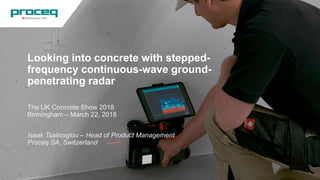
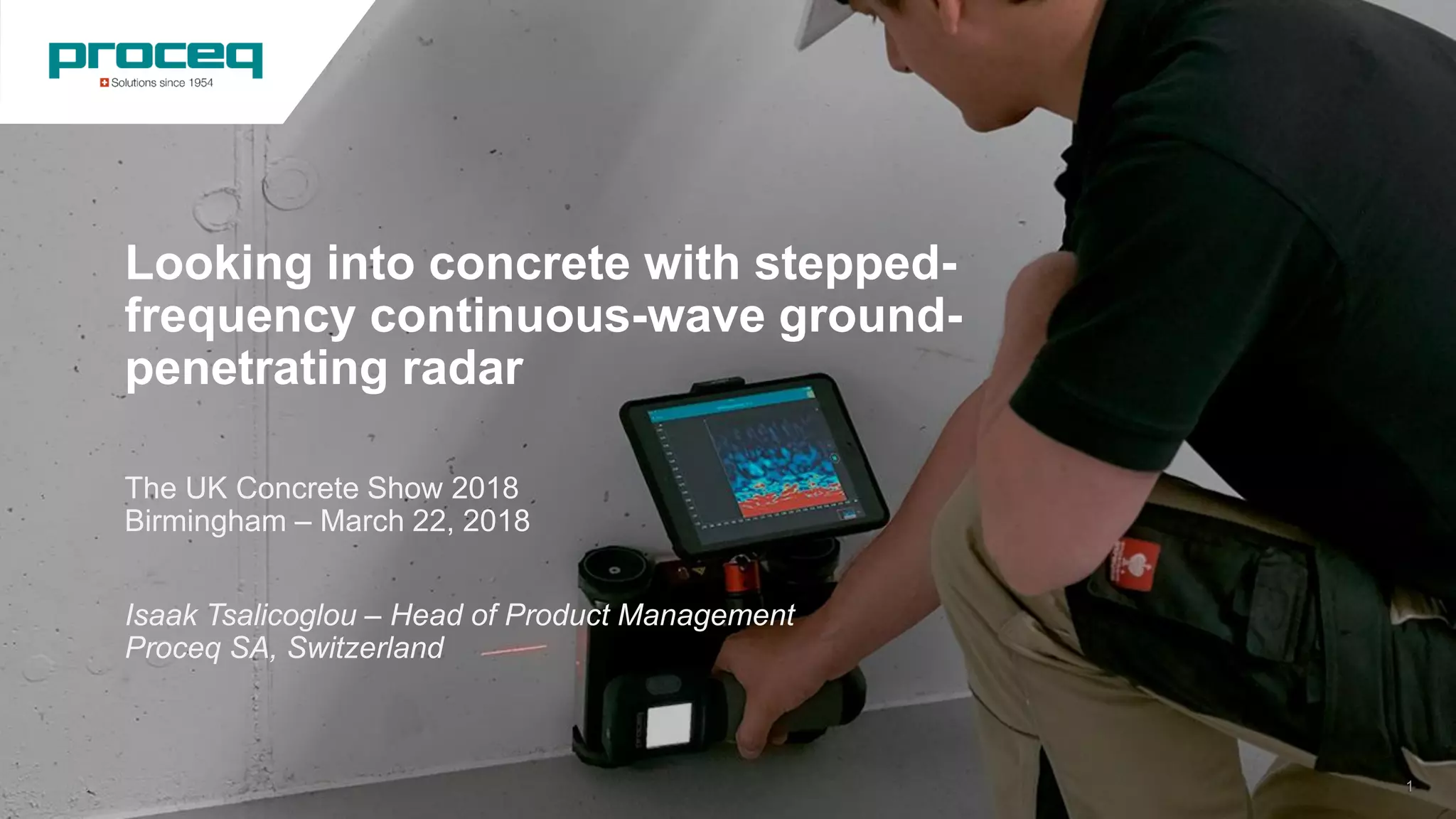
Looking into concrete with stepped-
frequency continuous-wave ground-
penetrating radar
The UK Concrete Show 2018
Birmingham – March 22, 2018
Isaak Tsalicoglou – Head of Product Management
Proceq SA, Switzerland
© Proceq 2018 1
1
Overview
Traditional ground-penetrating radar (“GPR”) and the key trade-off
Stepped-frequency continuous-wave ("SFCW") GPR
Experimental setup and validation
Real-world examples
© Proceq 2018 Looking into concrete with stepped-frequency continuous-wave ground-penetrating radar 2
2
3
4
Observations and conclusions5
1
Overview
Traditional ground-penetrating radar (“GPR”) and the key trade-off
Stepped-frequency continuous-wave ("SFCW") GPR
Experimental setup and validation
© Proceq 2018 Looking into concrete with stepped-frequency continuous-wave ground-penetrating radar 3
2
3
Real-world examples4
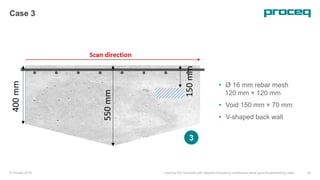
Observations and conclusions5
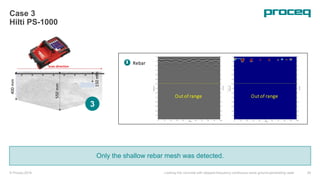
© Proceq 2018 Looking into concrete with stepped-frequency continuous-wave ground-penetrating radar 4
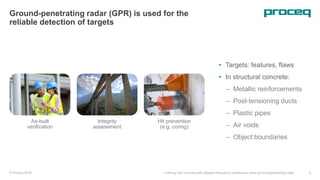
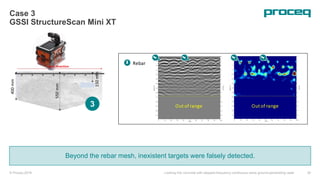
As-built
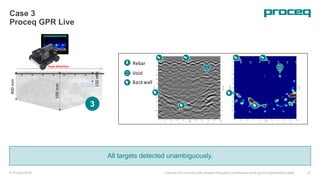
verification
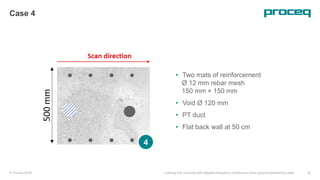
Integrity
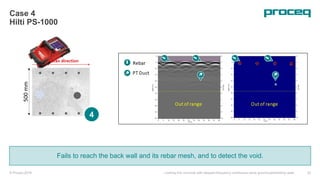
assessment
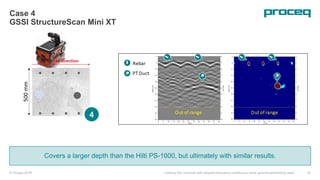
Hit prevention
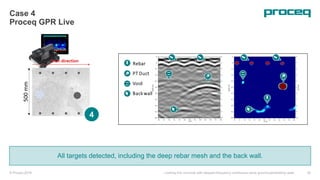
(e.g. coring)
Ground-penetrating radar (GPR) is used for the
reliable detection of targets
• Targets: features, flaws
• In structural concrete:
 Metallic reinforcements
 Post-tensioning ducts
 Plastic pipes
 Air voids
 Object boundaries
© Proceq 2018 Looking into concrete with stepped-frequency continuous-wave ground-penetrating radar 5
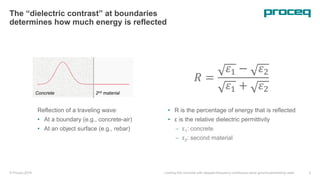
The “dielectric contrast” at boundaries
determines how much energy is reflected
Concrete 2nd material
Reflection of a traveling wave:
• At a boundary (e.g., concrete-air)
• At an object surface (e.g., rebar)
• R is the percentage of energy that is reflected
• ε is the relative dielectric permittivity
 ε1: concrete
 ε2: second material
𝑅 =
𝜀1 − 𝜀2
𝜀1 + 𝜀2
© Proceq 2018 Looking into concrete with stepped-frequency continuous-wave ground-penetrating radar 6
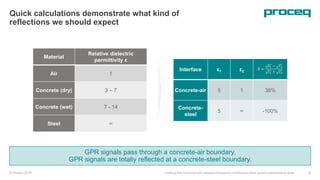
GPR signals pass through a concrete-air boundary.
GPR signals are totally reflected at a concrete-steel boundary.
Quick calculations demonstrate what kind of
reflections we should expect
Interface ε1 ε2
Concrete-air 5 1 38%
Concrete-
steel
5 ∞ -100%
𝑅 =
𝜀1 − 𝜀2
𝜀1 + 𝜀2
Material
Relative dielectric
permittivity ε
Air 1
Concrete (dry) 3 – 7
Concrete (wet) 7 - 14
Steel ∞
© Proceq 2018 Looking into concrete with stepped-frequency continuous-wave ground-penetrating radar 7
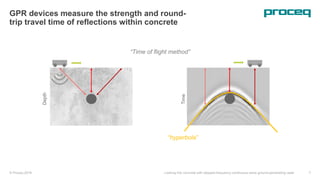
GPR devices measure the strength and round-
trip travel time of reflections within concrete
Depth
Time
“hyperbola”
“Time of flight method”
© Proceq 2018 Looking into concrete with stepped-frequency continuous-wave ground-penetrating radar 8
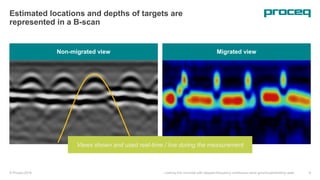
Estimated locations and depths of targets are
represented in a B-scan
Non-migrated view Migrated view
Views shown and used real-time / live during the measurement
© Proceq 2018 Looking into concrete with stepped-frequency continuous-wave ground-penetrating radar 9
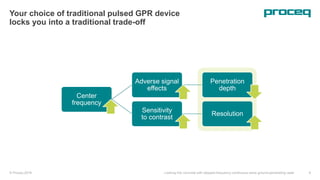
Your choice of traditional pulsed GPR device
locks you into a traditional trade-off
Center
frequency
Adverse signal
effects
Penetration
depth
Sensitivity
to contrast
Resolution
© Proceq 2018 Looking into concrete with stepped-frequency continuous-wave ground-penetrating radar 10
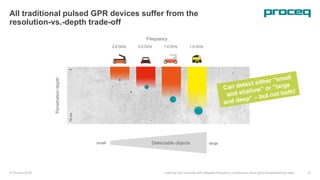
All traditional pulsed GPR devices suffer from the
resolution-vs.-depth trade-off
Detectable objectssmall large
Ultra wideband technologyPenetrationdepth
070cm
2.6 GHz 2.0 GHz 1.6 GHz 1.0 GHz
Frequency
1
Overview
Traditional ground-penetrating Radar (“GPR”) and the key trade-off
Stepped-frequency continuous-wave ("SFCW") GPR
Experimental setup and validation
© Proceq 2018 Looking into concrete with stepped-frequency continuous-wave ground-penetrating radar 11
2
3
Real-world examples4
Observations and conclusions5
© Proceq 2018 Looking into concrete with stepped-frequency continuous-wave ground-penetrating radar 12
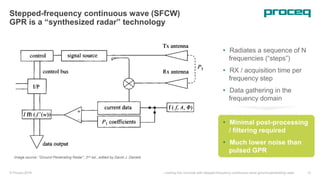
Stepped-frequency continuous wave (SFCW)
GPR is a “synthesized radar” technology
Image source: “Ground Penetrating Radar”, 2nd ed., edited by David J. Daniels
• Radiates a sequence of N
frequencies (“steps”)
• RX / acquisition time per
frequency step
• Data gathering in the
frequency domain
• Minimal post-processing
/ filtering required
• Much lower noise than
pulsed GPR
© Proceq 2018 Looking into concrete with stepped-frequency continuous-wave ground-penetrating radar 13
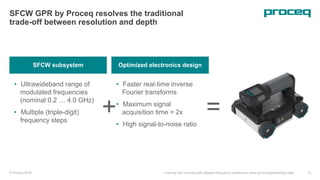
SFCW subsystem
SFCW GPR by Proceq resolves the traditional
trade-off between resolution and depth
• Ultrawideband range of
modulated frequencies
(nominal 0.2 … 4.0 GHz)
• Multiple (triple-digit)
frequency steps
Optimized electronics design
• Faster real-time inverse
Fourier transforms
• Maximum signal
acquisition time > 2x
• High signal-to-noise ratio
+ =
© Proceq 2018 Looking into concrete with stepped-frequency continuous-wave ground-penetrating radar 14
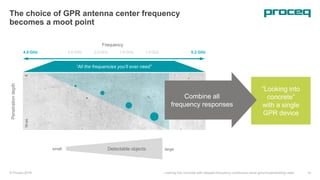
The choice of GPR antenna center frequency
becomes a moot point
“Looking into
concrete”
with a single
GPR device
Detectable objectssmall large
Ultra wideband technology
Penetrationdepth
070cm
2.6 GHz 2.0 GHz 1.6 GHz 1.0 GHz
Frequency
4.0 GHz 0.2 GHz
Combine all
frequency responses
“All the frequencies you’ll ever need”
© Proceq 2018 Looking into concrete with stepped-frequency continuous-wave ground-penetrating radar 15
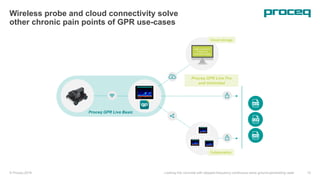
Wireless probe and cloud connectivity solve
other chronic pain points of GPR use-cases
Share
SEGY
JPEG
User’s account on
Proceq Live
(unlimited storage)
Collaboration
Cloud storage
Proceq GPR Live Basic
Proceq GPR Live Pro
and Unlimited
1
Overview
Traditional ground-penetrating Radar (“GPR”) and the key trade-off
Stepped-frequency continuous-wave ("SFCW") GPR
Experimental setup and validation
© Proceq 2018 Looking into concrete with stepped-frequency continuous-wave ground-penetrating radar 16
2
3
Real-world examples4
Observations and conclusions5
© Proceq 2018 Looking into concrete with stepped-frequency continuous-wave ground-penetrating radar 17
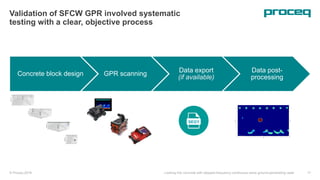
Validation of SFCW GPR involved systematic
testing with a clear, objective process
Concrete block design GPR scanning
Data export
(if available)
Data post-
processing
SEGY
© Proceq 2018 Looking into concrete with stepped-frequency continuous-wave ground-penetrating radar 18
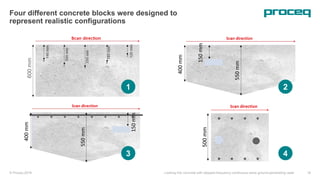
Four different concrete blocks were designed to
represent realistic configurations
1 2
3 4
© Proceq 2018 Looking into concrete with stepped-frequency continuous-wave ground-penetrating radar 19
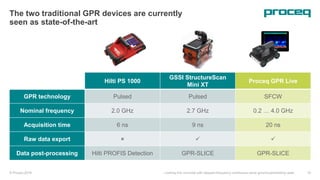
Hilti PS 1000
GSSI StructureScan
Mini XT
Proceq GPR Live
GPR technology Pulsed Pulsed SFCW
Nominal frequency 2.0 GHz 2.7 GHz 0.2 … 4.0 GHz
Acquisition time 6 ns 9 ns 20 ns
Raw data export  ✓ ✓
Data post-processing Hilti PROFIS Detection GPR-SLICE GPR-SLICE
The two traditional GPR devices are currently
seen as state-of-the-art
© Proceq 2018 Looking into concrete with stepped-frequency continuous-wave ground-penetrating radar 20
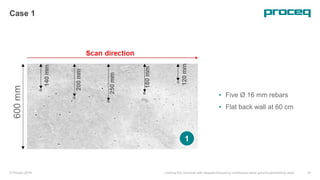
Case 1
• Five Ø 16 mm rebars
• Flat back wall at 60 cm
1
© Proceq 2018 Looking into concrete with stepped-frequency continuous-wave ground-penetrating radar 21
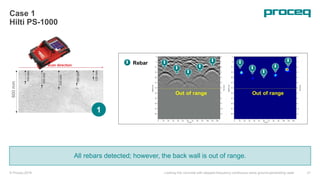
Case 1
Hilti PS-1000
All rebars detected; however, the back wall is out of range.
1
© Proceq 2018 Looking into concrete with stepped-frequency continuous-wave ground-penetrating radar 22
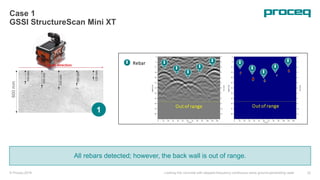
Case 1
GSSI StructureScan Mini XT
All rebars detected; however, the back wall is out of range.
1
© Proceq 2018 Looking into concrete with stepped-frequency continuous-wave ground-penetrating radar 23
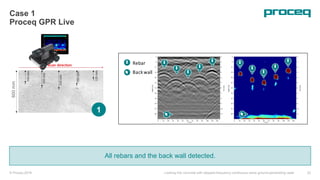
Case 1
Proceq GPR Live
All rebars and the back wall detected.
1
© Proceq 2018 Looking into concrete with stepped-frequency continuous-wave ground-penetrating radar 24
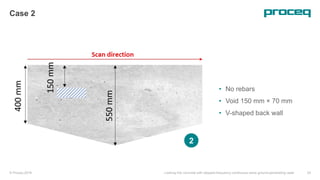
Case 2
• No rebars
• Void 150 mm × 70 mm
• V-shaped back wall
2
© Proceq 2018 Looking into concrete with stepped-frequency continuous-wave ground-penetrating radar 25
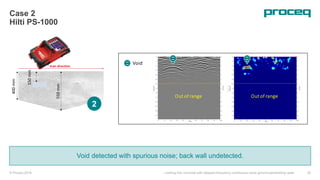
Case 2
Hilti PS-1000
Void detected with spurious noise; back wall undetected.
2
© Proceq 2018 Looking into concrete with stepped-frequency continuous-wave ground-penetrating radar 26
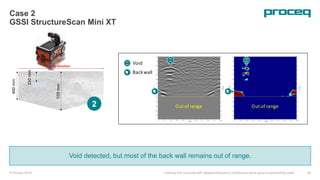
Case 2
GSSI StructureScan Mini XT
Void detected, but most of the back wall remains out of range.
2
© Proceq 2018 Looking into concrete with stepped-frequency continuous-wave ground-penetrating radar 27
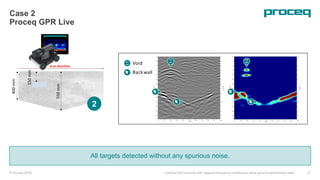
Case 2
Proceq GPR Live
All targets detected without any spurious noise.
2
© Proceq 2018 Looking into concrete with stepped-frequency continuous-wave ground-penetrating radar 28
Case 3
• Ø 16 mm rebar mesh
120 mm × 120 mm
• Void 150 mm × 70 mm
• V-shaped back wall
3
© Proceq 2018 Looking into concrete with stepped-frequency continuous-wave ground-penetrating radar 29
Case 3
Hilti PS-1000
Only the shallow rebar mesh was detected.
3
© Proceq 2018 Looking into concrete with stepped-frequency continuous-wave ground-penetrating radar 30
Case 3
GSSI StructureScan Mini XT
Beyond the rebar mesh, inexistent targets were falsely detected.
3
© Proceq 2018 Looking into concrete with stepped-frequency continuous-wave ground-penetrating radar 31
Case 3
Proceq GPR Live
All targets detected unambiguously.
3
© Proceq 2018 Looking into concrete with stepped-frequency continuous-wave ground-penetrating radar 32
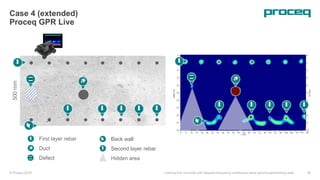
Case 4
• Two mats of reinforcement
Ø 12 mm rebar mesh
150 mm × 150 mm
• Void Ø 120 mm
• PT duct
• Flat back wall at 50 cm
4
© Proceq 2018 Looking into concrete with stepped-frequency continuous-wave ground-penetrating radar 33
Case 4
Hilti PS-1000
Fails to reach the back wall and its rebar mesh, and to detect the void.
4
© Proceq 2018 Looking into concrete with stepped-frequency continuous-wave ground-penetrating radar 34
Case 4
GSSI StructureScan Mini XT
Covers a larger depth than the Hilti PS-1000, but ultimately with similar results.
4
© Proceq 2018 Looking into concrete with stepped-frequency continuous-wave ground-penetrating radar 35
Case 4
Proceq GPR Live
All targets detected, including the deep rebar mesh and the back wall.
4
© Proceq 2018 Looking into concrete with stepped-frequency continuous-wave ground-penetrating radar 36
Case 4 (extended)
Proceq GPR Live
First layer rebar
Duct
Defect
Back wall
Second layer rebar
Hidden area
1
Overview
Traditional ground-penetrating Radar (“GPR”) and the key trade-off
Stepped-frequency continuous-wave ("SFCW") GPR
Experimental setup and validation
© Proceq 2018 Looking into concrete with stepped-frequency continuous-wave ground-penetrating radar 37
2
3
Real-world examples4
Observations and conclusions5
© Proceq 2018 Looking into concrete with stepped-frequency continuous-wave ground-penetrating radar 38
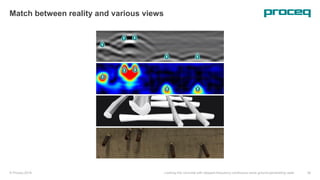
Match between reality and various views
© Proceq 2018 Looking into concrete with stepped-frequency continuous-wave ground-penetrating radar 39
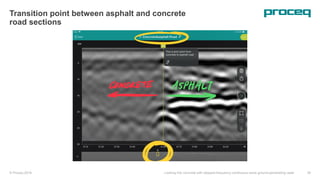
Transition point between asphalt and concrete
road sections
© Proceq 2018 Looking into concrete with stepped-frequency continuous-wave ground-penetrating radar 40
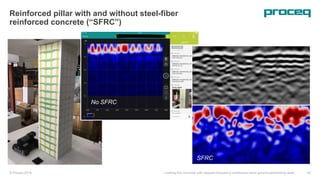
Reinforced pillar with and without steel-fiber
reinforced concrete (“SFRC”)
No SFRC
SFRC
© Proceq 2018 Looking into concrete with stepped-frequency continuous-wave ground-penetrating radar 41
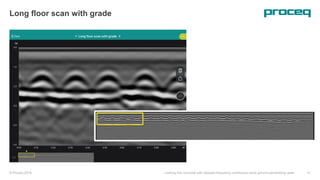
Long floor scan with grade
© Proceq 2018 Looking into concrete with stepped-frequency continuous-wave ground-penetrating radar 42
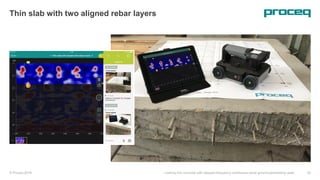
Thin slab with two aligned rebar layers
© Proceq 2018 Looking into concrete with stepped-frequency continuous-wave ground-penetrating radar 43
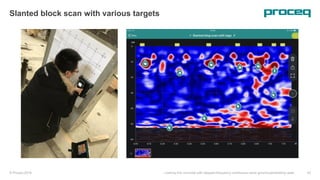
Slanted block scan with various targets
© Proceq 2018 Looking into concrete with stepped-frequency continuous-wave ground-penetrating radar 44
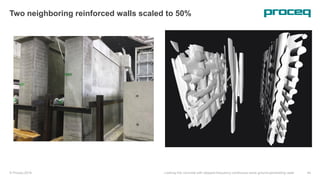
Two neighboring reinforced walls scaled to 50%
1
Overview
Traditional ground-penetrating Radar (“GPR”) and the key trade-off
Stepped-frequency continuous-wave ("SFCW") GPR
Experimental setup and validation
© Proceq 2018 Looking into concrete with stepped-frequency continuous-wave ground-penetrating radar 45
2
3
Real-world examples4
Observations and conclusions5
© Proceq 2018 Looking into concrete with stepped-frequency continuous-wave ground-penetrating radar 46
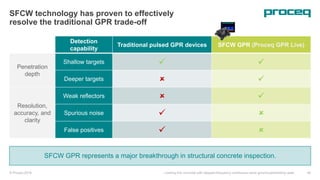
Detection
capability
Traditional pulsed GPR devices SFCW GPR (Proceq GPR Live)
Penetration
depth
Shallow targets ✓ ✓
Deeper targets  ✓
Resolution,
accuracy, and
clarity
Weak reflectors  ✓
Spurious noise ✓ 
False positives ✓ 
SFCW GPR represents a major breakthrough in structural concrete inspection.
SFCW technology has proven to effectively
resolve the traditional GPR trade-off

Looking into concrete with stepped-frequency continuous-wave ground-penetrating radar

  • 1.
    Looking into concretewith stepped- frequency continuous-wave ground- penetrating radar The UK Concrete Show 2018 Birmingham – March 22, 2018 Isaak Tsalicoglou – Head of Product Management Proceq SA, Switzerland © Proceq 2018 1
  • 2.
    1 Overview Traditional ground-penetrating radar(“GPR”) and the key trade-off Stepped-frequency continuous-wave ("SFCW") GPR Experimental setup and validation Real-world examples © Proceq 2018 Looking into concrete with stepped-frequency continuous-wave ground-penetrating radar 2 2 3 4 Observations and conclusions5
  • 3.
    1 Overview Traditional ground-penetrating radar(“GPR”) and the key trade-off Stepped-frequency continuous-wave ("SFCW") GPR Experimental setup and validation © Proceq 2018 Looking into concrete with stepped-frequency continuous-wave ground-penetrating radar 3 2 3 Real-world examples4 Observations and conclusions5
  • 4.
    © Proceq 2018Looking into concrete with stepped-frequency continuous-wave ground-penetrating radar 4 As-built verification Integrity assessment Hit prevention (e.g. coring) Ground-penetrating radar (GPR) is used for the reliable detection of targets • Targets: features, flaws • In structural concrete:  Metallic reinforcements  Post-tensioning ducts  Plastic pipes  Air voids  Object boundaries
  • 5.
    © Proceq 2018Looking into concrete with stepped-frequency continuous-wave ground-penetrating radar 5 The “dielectric contrast” at boundaries determines how much energy is reflected Concrete 2nd material Reflection of a traveling wave: • At a boundary (e.g., concrete-air) • At an object surface (e.g., rebar) • R is the percentage of energy that is reflected • ε is the relative dielectric permittivity  ε1: concrete  ε2: second material 𝑅 = 𝜀1 − 𝜀2 𝜀1 + 𝜀2
  • 6.
    © Proceq 2018Looking into concrete with stepped-frequency continuous-wave ground-penetrating radar 6 GPR signals pass through a concrete-air boundary. GPR signals are totally reflected at a concrete-steel boundary. Quick calculations demonstrate what kind of reflections we should expect Interface ε1 ε2 Concrete-air 5 1 38% Concrete- steel 5 ∞ -100% 𝑅 = 𝜀1 − 𝜀2 𝜀1 + 𝜀2 Material Relative dielectric permittivity ε Air 1 Concrete (dry) 3 – 7 Concrete (wet) 7 - 14 Steel ∞
  • 7.
    © Proceq 2018Looking into concrete with stepped-frequency continuous-wave ground-penetrating radar 7 GPR devices measure the strength and round- trip travel time of reflections within concrete Depth Time “hyperbola” “Time of flight method”
  • 8.
    © Proceq 2018Looking into concrete with stepped-frequency continuous-wave ground-penetrating radar 8 Estimated locations and depths of targets are represented in a B-scan Non-migrated view Migrated view Views shown and used real-time / live during the measurement
  • 9.
    © Proceq 2018Looking into concrete with stepped-frequency continuous-wave ground-penetrating radar 9 Your choice of traditional pulsed GPR device locks you into a traditional trade-off Center frequency Adverse signal effects Penetration depth Sensitivity to contrast Resolution
  • 10.
    © Proceq 2018Looking into concrete with stepped-frequency continuous-wave ground-penetrating radar 10 All traditional pulsed GPR devices suffer from the resolution-vs.-depth trade-off Detectable objectssmall large Ultra wideband technologyPenetrationdepth 070cm 2.6 GHz 2.0 GHz 1.6 GHz 1.0 GHz Frequency
  • 11.
    1 Overview Traditional ground-penetrating Radar(“GPR”) and the key trade-off Stepped-frequency continuous-wave ("SFCW") GPR Experimental setup and validation © Proceq 2018 Looking into concrete with stepped-frequency continuous-wave ground-penetrating radar 11 2 3 Real-world examples4 Observations and conclusions5
  • 12.
    © Proceq 2018Looking into concrete with stepped-frequency continuous-wave ground-penetrating radar 12 Stepped-frequency continuous wave (SFCW) GPR is a “synthesized radar” technology Image source: “Ground Penetrating Radar”, 2nd ed., edited by David J. Daniels • Radiates a sequence of N frequencies (“steps”) • RX / acquisition time per frequency step • Data gathering in the frequency domain • Minimal post-processing / filtering required • Much lower noise than pulsed GPR
  • 13.
    © Proceq 2018Looking into concrete with stepped-frequency continuous-wave ground-penetrating radar 13 SFCW subsystem SFCW GPR by Proceq resolves the traditional trade-off between resolution and depth • Ultrawideband range of modulated frequencies (nominal 0.2 … 4.0 GHz) • Multiple (triple-digit) frequency steps Optimized electronics design • Faster real-time inverse Fourier transforms • Maximum signal acquisition time > 2x • High signal-to-noise ratio + =
  • 14.
    © Proceq 2018Looking into concrete with stepped-frequency continuous-wave ground-penetrating radar 14 The choice of GPR antenna center frequency becomes a moot point “Looking into concrete” with a single GPR device Detectable objectssmall large Ultra wideband technology Penetrationdepth 070cm 2.6 GHz 2.0 GHz 1.6 GHz 1.0 GHz Frequency 4.0 GHz 0.2 GHz Combine all frequency responses “All the frequencies you’ll ever need”
  • 15.
    © Proceq 2018Looking into concrete with stepped-frequency continuous-wave ground-penetrating radar 15 Wireless probe and cloud connectivity solve other chronic pain points of GPR use-cases Share SEGY JPEG User’s account on Proceq Live (unlimited storage) Collaboration Cloud storage Proceq GPR Live Basic Proceq GPR Live Pro and Unlimited
  • 16.
    1 Overview Traditional ground-penetrating Radar(“GPR”) and the key trade-off Stepped-frequency continuous-wave ("SFCW") GPR Experimental setup and validation © Proceq 2018 Looking into concrete with stepped-frequency continuous-wave ground-penetrating radar 16 2 3 Real-world examples4 Observations and conclusions5
  • 17.
    © Proceq 2018Looking into concrete with stepped-frequency continuous-wave ground-penetrating radar 17 Validation of SFCW GPR involved systematic testing with a clear, objective process Concrete block design GPR scanning Data export (if available) Data post- processing SEGY
  • 18.
    © Proceq 2018Looking into concrete with stepped-frequency continuous-wave ground-penetrating radar 18 Four different concrete blocks were designed to represent realistic configurations 1 2 3 4
  • 19.
    © Proceq 2018Looking into concrete with stepped-frequency continuous-wave ground-penetrating radar 19 Hilti PS 1000 GSSI StructureScan Mini XT Proceq GPR Live GPR technology Pulsed Pulsed SFCW Nominal frequency 2.0 GHz 2.7 GHz 0.2 … 4.0 GHz Acquisition time 6 ns 9 ns 20 ns Raw data export  ✓ ✓ Data post-processing Hilti PROFIS Detection GPR-SLICE GPR-SLICE The two traditional GPR devices are currently seen as state-of-the-art
  • 20.
    © Proceq 2018Looking into concrete with stepped-frequency continuous-wave ground-penetrating radar 20 Case 1 • Five Ø 16 mm rebars • Flat back wall at 60 cm 1
  • 21.
    © Proceq 2018Looking into concrete with stepped-frequency continuous-wave ground-penetrating radar 21 Case 1 Hilti PS-1000 All rebars detected; however, the back wall is out of range. 1
  • 22.
    © Proceq 2018Looking into concrete with stepped-frequency continuous-wave ground-penetrating radar 22 Case 1 GSSI StructureScan Mini XT All rebars detected; however, the back wall is out of range. 1
  • 23.
    © Proceq 2018Looking into concrete with stepped-frequency continuous-wave ground-penetrating radar 23 Case 1 Proceq GPR Live All rebars and the back wall detected. 1
  • 24.
    © Proceq 2018Looking into concrete with stepped-frequency continuous-wave ground-penetrating radar 24 Case 2 • No rebars • Void 150 mm × 70 mm • V-shaped back wall 2
  • 25.
    © Proceq 2018Looking into concrete with stepped-frequency continuous-wave ground-penetrating radar 25 Case 2 Hilti PS-1000 Void detected with spurious noise; back wall undetected. 2
  • 26.
    © Proceq 2018Looking into concrete with stepped-frequency continuous-wave ground-penetrating radar 26 Case 2 GSSI StructureScan Mini XT Void detected, but most of the back wall remains out of range. 2
  • 27.
    © Proceq 2018Looking into concrete with stepped-frequency continuous-wave ground-penetrating radar 27 Case 2 Proceq GPR Live All targets detected without any spurious noise. 2
  • 28.
    © Proceq 2018Looking into concrete with stepped-frequency continuous-wave ground-penetrating radar 28 Case 3 • Ø 16 mm rebar mesh 120 mm × 120 mm • Void 150 mm × 70 mm • V-shaped back wall 3
  • 29.
    © Proceq 2018Looking into concrete with stepped-frequency continuous-wave ground-penetrating radar 29 Case 3 Hilti PS-1000 Only the shallow rebar mesh was detected. 3
  • 30.
    © Proceq 2018Looking into concrete with stepped-frequency continuous-wave ground-penetrating radar 30 Case 3 GSSI StructureScan Mini XT Beyond the rebar mesh, inexistent targets were falsely detected. 3
  • 31.
    © Proceq 2018Looking into concrete with stepped-frequency continuous-wave ground-penetrating radar 31 Case 3 Proceq GPR Live All targets detected unambiguously. 3
  • 32.
    © Proceq 2018Looking into concrete with stepped-frequency continuous-wave ground-penetrating radar 32 Case 4 • Two mats of reinforcement Ø 12 mm rebar mesh 150 mm × 150 mm • Void Ø 120 mm • PT duct • Flat back wall at 50 cm 4
  • 33.
    © Proceq 2018Looking into concrete with stepped-frequency continuous-wave ground-penetrating radar 33 Case 4 Hilti PS-1000 Fails to reach the back wall and its rebar mesh, and to detect the void. 4
  • 34.
    © Proceq 2018Looking into concrete with stepped-frequency continuous-wave ground-penetrating radar 34 Case 4 GSSI StructureScan Mini XT Covers a larger depth than the Hilti PS-1000, but ultimately with similar results. 4
  • 35.
    © Proceq 2018Looking into concrete with stepped-frequency continuous-wave ground-penetrating radar 35 Case 4 Proceq GPR Live All targets detected, including the deep rebar mesh and the back wall. 4
  • 36.
    © Proceq 2018Looking into concrete with stepped-frequency continuous-wave ground-penetrating radar 36 Case 4 (extended) Proceq GPR Live First layer rebar Duct Defect Back wall Second layer rebar Hidden area
  • 37.
    1 Overview Traditional ground-penetrating Radar(“GPR”) and the key trade-off Stepped-frequency continuous-wave ("SFCW") GPR Experimental setup and validation © Proceq 2018 Looking into concrete with stepped-frequency continuous-wave ground-penetrating radar 37 2 3 Real-world examples4 Observations and conclusions5
  • 38.
    © Proceq 2018Looking into concrete with stepped-frequency continuous-wave ground-penetrating radar 38 Match between reality and various views
  • 39.
    © Proceq 2018Looking into concrete with stepped-frequency continuous-wave ground-penetrating radar 39 Transition point between asphalt and concrete road sections
  • 40.
    © Proceq 2018Looking into concrete with stepped-frequency continuous-wave ground-penetrating radar 40 Reinforced pillar with and without steel-fiber reinforced concrete (“SFRC”) No SFRC SFRC
  • 41.
    © Proceq 2018Looking into concrete with stepped-frequency continuous-wave ground-penetrating radar 41 Long floor scan with grade
  • 42.
    © Proceq 2018Looking into concrete with stepped-frequency continuous-wave ground-penetrating radar 42 Thin slab with two aligned rebar layers
  • 43.
    © Proceq 2018Looking into concrete with stepped-frequency continuous-wave ground-penetrating radar 43 Slanted block scan with various targets
  • 44.
    © Proceq 2018Looking into concrete with stepped-frequency continuous-wave ground-penetrating radar 44 Two neighboring reinforced walls scaled to 50%
  • 45.
    1 Overview Traditional ground-penetrating Radar(“GPR”) and the key trade-off Stepped-frequency continuous-wave ("SFCW") GPR Experimental setup and validation © Proceq 2018 Looking into concrete with stepped-frequency continuous-wave ground-penetrating radar 45 2 3 Real-world examples4 Observations and conclusions5
  • 46.
    © Proceq 2018Looking into concrete with stepped-frequency continuous-wave ground-penetrating radar 46 Detection capability Traditional pulsed GPR devices SFCW GPR (Proceq GPR Live) Penetration depth Shallow targets ✓ ✓ Deeper targets  ✓ Resolution, accuracy, and clarity Weak reflectors  ✓ Spurious noise ✓  False positives ✓  SFCW GPR represents a major breakthrough in structural concrete inspection. SFCW technology has proven to effectively resolve the traditional GPR trade-off