Definition of a Mineral
2.2 Minerals
1. Naturally occurring
2. Solid substance
3. Orderly crystalline structure
4. Definite chemical composition
5. Generally considered inorganic
How Minerals Form
2.2 Minerals
1. Crystallization from magma
2. Precipitation
3. Pressure and temperature
4. Hydrothermal solutions
Minerals Formed as a Result of
Crystallization of Magma
Mineral Groups
◆ Can be classified based on their
composition
2.2 Minerals
1. Silicates
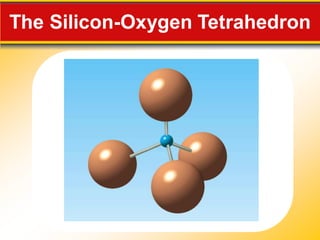
• Silicon and oxygen combine to form a structure
called the silicon-oxygen tetrahedron. This
silicon-oxygen tetrahedron provides the
framework of every silicate mineral.
The Silicon-Oxygen Tetrahedron
Silicon-Oxygen Chains, Sheets,
and Three-Dimensional Networks
Mineral Groups
2.2 Minerals
2. Carbonates
• Minerals that contain the elements carbon,
oxygen, and one or more other metallic
elements
3. Oxides
• Minerals that contain oxygen and one or more
other elements, which are usually metals
Mineral Groups
2.2 Minerals
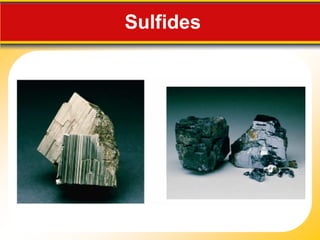
4. Sulfates and Sulfides
• Minerals that contain the element sulfur
5. Halides
• Minerals that contain a halogen ion plus one or
more other elements
6. Native elements
• Minerals that exist in relatively pure form
Sulfides
Native Copper
Color
2.3 Properties of Minerals
◆ Small amounts of different elements can
give the same mineral different colors.
Streak
2.3 Properties of Minerals
◆ Streak is the color of a mineral in its
powdered form.
Luster
2.3 Properties of Minerals
◆ Luster is used to describe how light is
reflected from the surface of a mineral.
Pyrite (Fool’s Gold) Displays
Metallic Luster.
Crystal Form
2.3 Properties of Minerals
◆ Crystal form is the visible expression
of a mineral’s internal arrangement of
atoms.
Quartz Often Exhibits
Good Crystal Form.
Hardness
2.3 Properties of Minerals
◆ Hardness is a measure of the
resistance of a mineral to being
scratched.
◆ Mohs scale consists of 10 minerals
arranged from 10 (hardest) to 1 (softest).
Mohs Scale of Hardness
Cleavage
2.3 Properties of Minerals
◆ Cleavage is the tendency of a mineral to
cleave, or break, along flat, even
surfaces.
Mica Has Cleavage in One Direction
Fracture
2.3 Properties of Minerals
◆ Minerals that do not show cleavage
when broken are said to fracture.
◆ Fracture—the uneven breakage of
a mineral
Conchoidal Fracture
Density
2.3 Properties of Minerals
◆ Density is a property of all matter that
is the ratio of an object’s mass to its
volume.
Distinctive Properties of Minerals
2.3 Properties of Minerals
◆ Some minerals can be recognized by
other distinctive properties.

Minerals