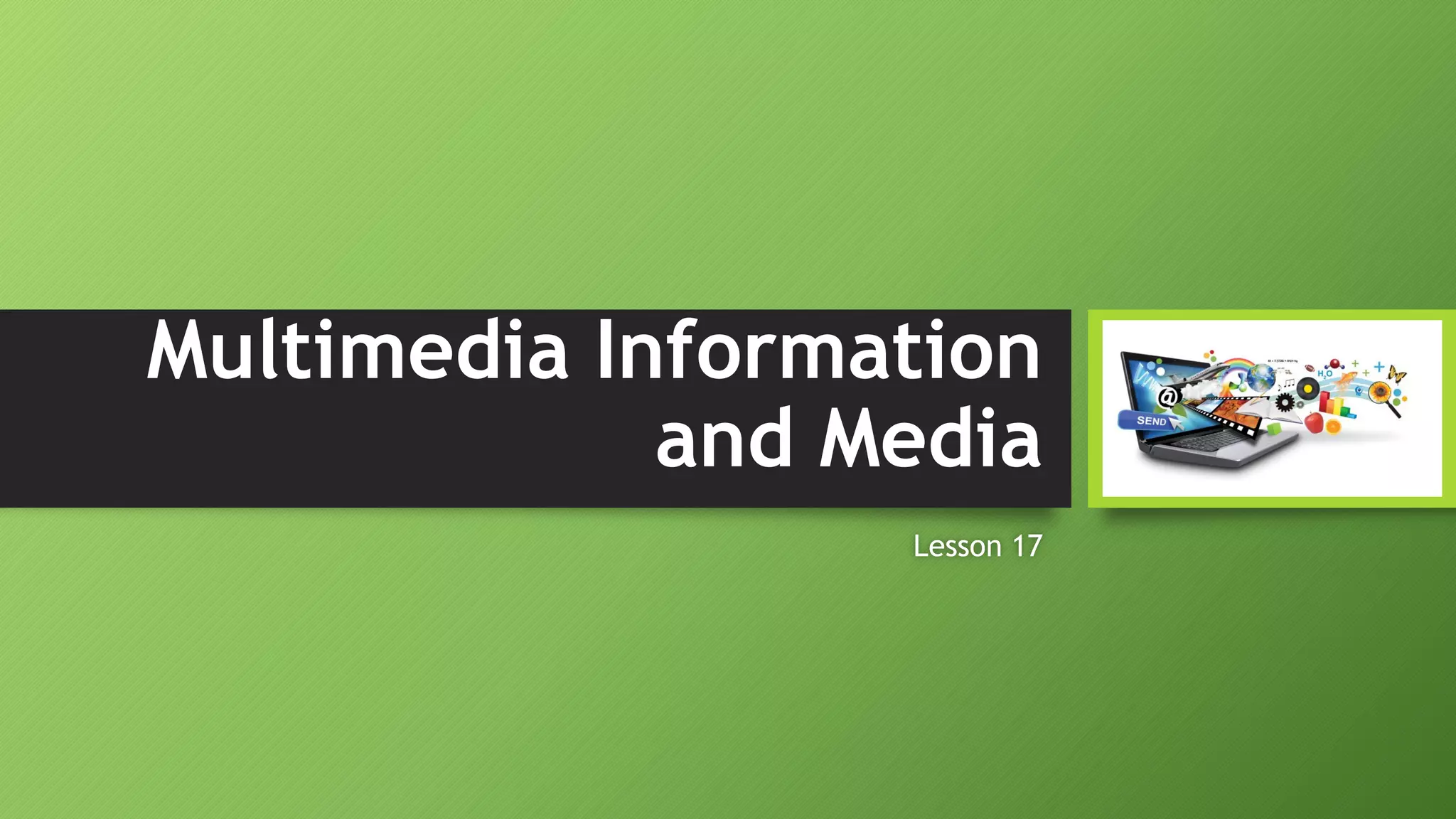
Multimedia Information
and Media
Lesson 17
Multimedia
• Over the years, it has been established that
information can be expressed through text,
speech, sound, graphics or images, animation,
and video. A combination of these media sources
is considered multimedia.
Multimedia
“Dave Marshall defines multimedia as “the field
concerned with the computer-controlled
integration of text, graphics, drawings, still and
moving images (video), animation, audio, and any
other media where every type of information can
be represented, stored, transmitted and processed
digitally.”
Multimedia
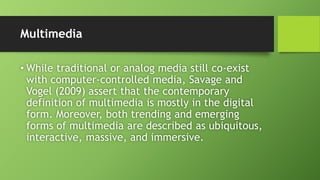
• While traditional or analog media still co-exist
with computer-controlled media, Savage and
Vogel (2009) assert that the contemporary
definition of multimedia is mostly in the digital
form. Moreover, both trending and emerging
forms of multimedia are described as ubiquitous,
interactive, massive, and immersive.
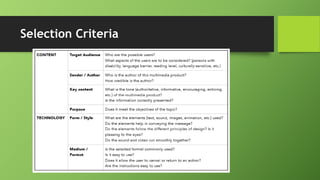
Selection Criteria
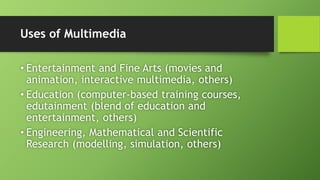
Uses of Multimedia
• Entertainment and Fine Arts (movies and
animation, interactive multimedia, others)
• Education (computer-based training courses,
edutainment (blend of education and
entertainment, others)
• Engineering, Mathematical and Scientific
Research (modelling, simulation, others)
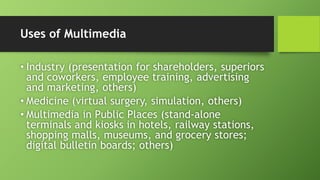
Uses of Multimedia
• Industry (presentation for shareholders, superiors
and coworkers, employee training, advertising
and marketing, others)
• Medicine (virtual surgery, simulation, others)
• Multimedia in Public Places (stand-alone
terminals and kiosks in hotels, railway stations,
shopping malls, museums, and grocery stores;
digital bulletin boards; others)
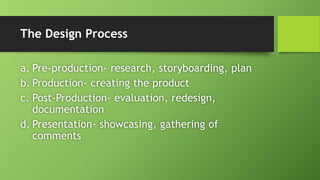
The Design Process
a. Pre-production- research, storyboarding, plan
b. Production- creating the product
c. Post-Production- evaluation, redesign,
documentation
d. Presentation- showcasing, gathering of
comments

MIL-Lesson-17.pdf

  • 1.
  • 2.
    Multimedia • Over theyears, it has been established that information can be expressed through text, speech, sound, graphics or images, animation, and video. A combination of these media sources is considered multimedia.
  • 3.
    Multimedia “Dave Marshall definesmultimedia as “the field concerned with the computer-controlled integration of text, graphics, drawings, still and moving images (video), animation, audio, and any other media where every type of information can be represented, stored, transmitted and processed digitally.”
  • 4.
    Multimedia • While traditionalor analog media still co-exist with computer-controlled media, Savage and Vogel (2009) assert that the contemporary definition of multimedia is mostly in the digital form. Moreover, both trending and emerging forms of multimedia are described as ubiquitous, interactive, massive, and immersive.
  • 5.
  • 6.
    Uses of Multimedia •Entertainment and Fine Arts (movies and animation, interactive multimedia, others) • Education (computer-based training courses, edutainment (blend of education and entertainment, others) • Engineering, Mathematical and Scientific Research (modelling, simulation, others)
  • 7.
    Uses of Multimedia •Industry (presentation for shareholders, superiors and coworkers, employee training, advertising and marketing, others) • Medicine (virtual surgery, simulation, others) • Multimedia in Public Places (stand-alone terminals and kiosks in hotels, railway stations, shopping malls, museums, and grocery stores; digital bulletin boards; others)
  • 8.
    The Design Process a.Pre-production- research, storyboarding, plan b. Production- creating the product c. Post-Production- evaluation, redesign, documentation d. Presentation- showcasing, gathering of comments