dude...Understanding the Millennial Mindset
We say: why?  They say why not?
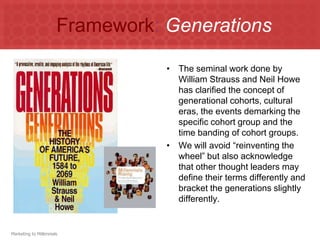
The seminal work done by William Strauss and Neil Howe has clarified the concept of generational cohorts, cultural eras, the events demarking the specific cohort group and the time banding of cohort groups.We will avoid “reinventing the wheel” but also acknowledge that other thought leaders may define their terms differently and bracket the generations slightly differently.Framework:Generations
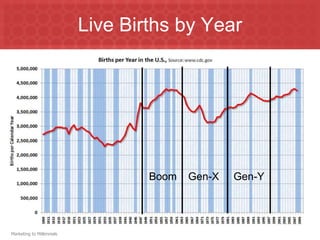
Live Births by YearBoomGen-XGen-Y
Big Picture
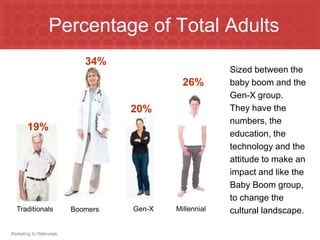
Percentage of Total Adults34%Sized between the baby boom and the Gen-X group.  They have the numbers, the education, the technology and the attitude to make an impact and like the Baby Boom group, to change the cultural landscape.26%20%19%Gen-XMillennialTraditionalsBoomers
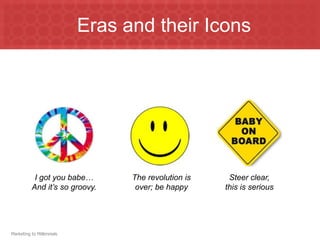
Eras and their IconsI got you babe…And it’s so groovy.The revolution is over; be happySteer clear, this is serious
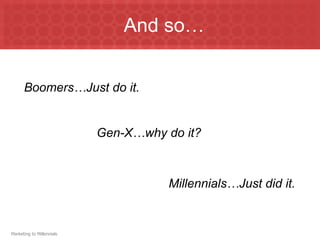
And so…Boomers…Just do it.Gen-X…why do it?Millennials…Just did it.
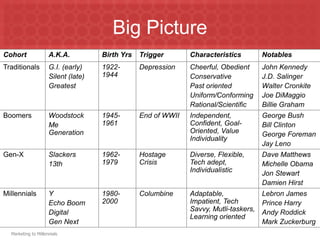
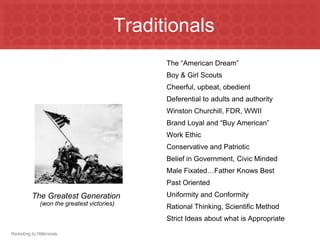
TraditionalsThe “American Dream”Boy & Girl ScoutsCheerful, upbeat, obedientDeferential to adults and authorityWinston Churchill, FDR, WWIIBrand Loyal and “Buy American”Work EthicConservative and PatrioticBelief in Government, Civic MindedMale Fixated…Father Knows BestPast OrientedUniformity and ConformityRational Thinking, Scientific MethodStrict Ideas about what is AppropriateThe Greatest Generation (won the greatest victories)
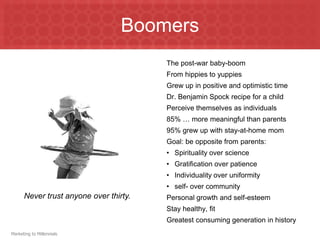
BoomersThe post-war baby-boomFrom hippies to yuppiesGrew up in positive and optimistic timeDr. Benjamin Spock recipe for a childPerceive themselves as individuals85% … more meaningful than parents95% grew up with stay-at-home momGoal: be opposite from parents:Spirituality over scienceGratification over patienceIndividuality over uniformityself- over communityPersonal growth and self-esteemStay healthy, fitGreatest consuming generation in historyNever trust anyone over thirty.
Before there was Got Milk?There was Got Mom?
Gen-X13th generation (that’s unlucky)Most aborted generation in historySlackersIncreasing divorce ratesLatch keyed, neglected & ignoredChildren less valued by societySkeptical of authorityNot threatened by authorityInformal dress codePersonal determinism, self-reliantIndividualized and independentBelieve in actions over wordsHands-off supervision “I have a life”We are not a “target market”
MillennialsRaised by “soccer moms”Psychologically impacted by danger in worldSchool desks in pods, not rowsBirthdays take entire weekEveryone gets a trophy (just for showing up)Early education about pollution, environmentNew breed of feminism, don’t use “f” wordOpen minded and multi-culturalGet along with and actually like parentsPolitically activeExtreme tech savvy, “digital natives”Resilient and not bothered by set backsJob satisfaction over money or opportunityNeed lots of supervision and structureAn “echo” generationThe re-valuation of the American Child
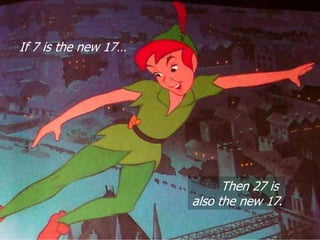
If 7 is the new 17…Then 27 is also the new 17.
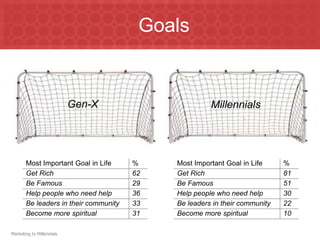
GoalsGen-XMillennials
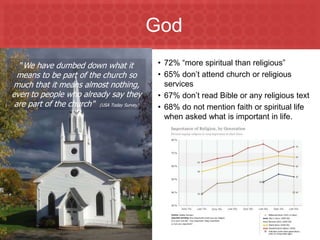
God72% “more spiritual than religious”65% don’t attend church or religious services67% don’t read Bible or any religious text68% do not mention faith or spiritual life when asked what is important in life."We have dumbed down what it means to be part of the church so much that it means almost nothing, even to people who already say they are part of the church"  (USA Today Survey)
GoogleGoogle accounts for 65.1% of all internet searches.Google has 88 Billion searches per monthThat’s about 3 Billion per day, or 2 Million per second
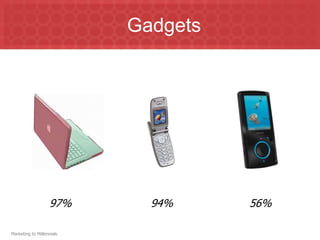
Gadgets97%94%56%
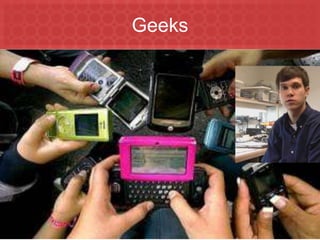
Geeks
Go Girls
Great KidsIt’s not so much about how good you are as much as it is that you just “are.” Winning isn’t everything when “everyone is a winner.”  Showing up is half the battle for these kids and their families.  Partly because they are over-booked but mostly because they are just so darn cute.
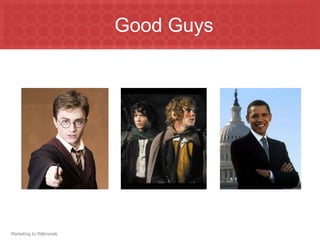
Good Guys
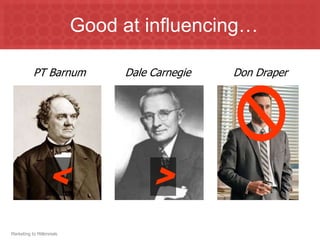
Good at influencing…Don DraperPT BarnumDale Carnegie<>
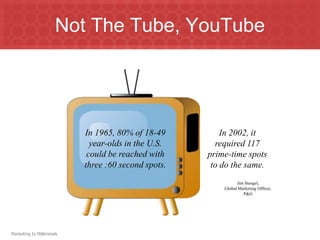
Not The Tube, YouTubeIn 1965, 80% of 18-49 year-olds in the U.S. could be reached with three :60 second spots.In 2002, it required 117 prime-time spots to do the same.Jim Stengel, Global Marketing Officer, P&G
Social Media and the Internet 81% of 18-21 year olds have a profile on a social media website
 31% check it several times per day
 24% have posted a video of themselves online
 59% get their news from the internet
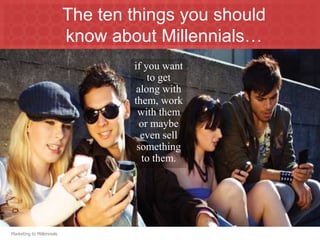
 32% of Millennials have watched a video online in the past 24 hoursThe ten things you should know about Millennials…if you want to get along with them, work with them or maybe even sell something to them.
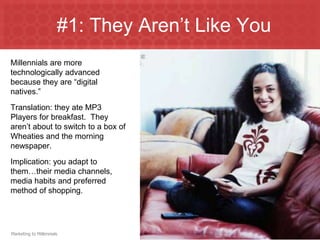
#1: They Aren’t Like YouMillennials are more technologically advanced because they are “digital natives.”  Translation: they ate MP3 Players for breakfast.  They aren’t about to switch to a box of Wheaties and the morning newspaper.Implication: you adapt to them…their media channels, media habits and preferred method of shopping.
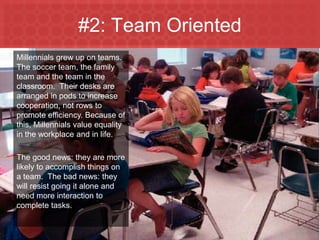
#2: Team OrientedMillennials grew up on teams.  The soccer team, the family team and the team in the classroom.  Their desks are arranged in pods to increase cooperation, not rows to promote efficiency. Because of this, Millennials value equality in the workplace and in life.The good news: they are more likely to accomplish things on a team.  The bad news: they will resist going it alone and need more interaction to complete tasks.
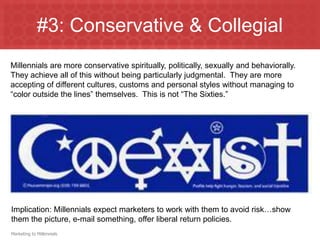
#3: Conservative & CollegialMillennials are more conservative spiritually, politically, sexually and behaviorally.  They achieve all of this without being particularly judgmental.  They are more accepting of different cultures, customs and personal styles without managing to “color outside the lines” themselves.  This is not “The Sixties.”  Implication: Millennials expect marketers to work with them to avoid risk…show them the picture, e-mail something, offer liberal return policies.
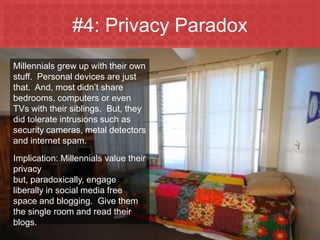
#4: Privacy ParadoxMillennials grew up with their own stuff.  Personal devices are just that.  And, most didn’t share bedrooms, computers or even TVs with their siblings.  But, they did tolerate intrusions such as security cameras, metal detectors and internet spam.Implication: Millennials value their privacy but, paradoxically, engage liberally in social media free space and blogging.  Give them the single room and read their blogs.
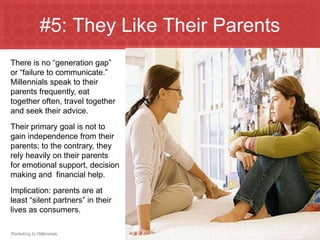
#5: They Like Their ParentsThere is no “generation gap” or “failure to communicate.”  Millennials speak to their parents frequently, eat together often, travel together and seek their advice.  Their primary goal is not to gain independence from their parents; to the contrary, they rely heavily on their parents for emotional support, decision making and  financial help.Implication: parents are at least “silent partners” in their lives as consumers.
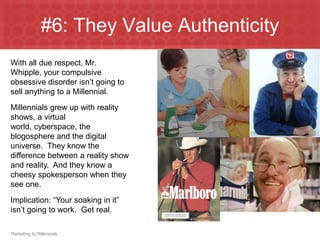
#6: They Value AuthenticityWith all due respect, Mr. Whipple, your compulsive obsessive disorder isn’t going to sell anything to a Millennial.Millennials grew up with reality shows, a virtual world, cyberspace, the blogosphere and the digital universe.  They know the difference between a reality show and reality.  And they know a cheesy spokesperson when they see one.  Implication: “Your soaking in it” isn’t going to work.  Get real.
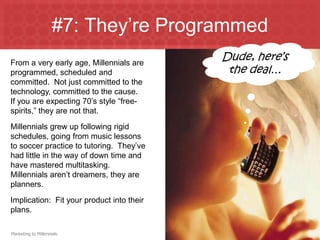
#7: They’re ProgrammedDude, here’s the deal…From a very early age, Millennials are programmed, scheduled and committed.  Not just committed to the technology, committed to the cause.  If you are expecting 70’s style “free-spirits,” they are not that.  Millennials grew up following rigid schedules, going from music lessons to soccer practice to tutoring.  They’ve had little in the way of down time and have mastered multitasking. Millennials aren’t dreamers, they are planners.  Implication:  Fit your product into their plans.
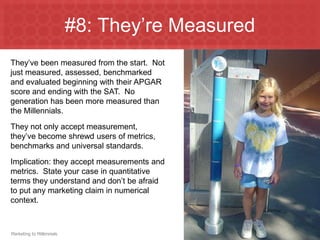
#8: They’re MeasuredThey’ve been measured from the start.  Not just measured, assessed, benchmarked and evaluated beginning with their APGAR score and ending with the SAT.  No generation has been more measured than the Millennials.They not only accept measurement, they’ve become shrewd users of metrics, benchmarks and universal standards.Implication: they accept measurements and metrics.  State your case in quantitative terms they understand and don’t be afraid to put any marketing claim in numerical context.
Millennials

  • 1.
  • 2.
    We say: why? They say why not?
  • 3.
    The seminal workdone by William Strauss and Neil Howe has clarified the concept of generational cohorts, cultural eras, the events demarking the specific cohort group and the time banding of cohort groups.We will avoid “reinventing the wheel” but also acknowledge that other thought leaders may define their terms differently and bracket the generations slightly differently.Framework:Generations
  • 4.
    Live Births byYearBoomGen-XGen-Y
  • 5.
  • 6.
    Percentage of TotalAdults34%Sized between the baby boom and the Gen-X group. They have the numbers, the education, the technology and the attitude to make an impact and like the Baby Boom group, to change the cultural landscape.26%20%19%Gen-XMillennialTraditionalsBoomers
  • 7.
    Eras and theirIconsI got you babe…And it’s so groovy.The revolution is over; be happySteer clear, this is serious
  • 8.
    And so…Boomers…Just doit.Gen-X…why do it?Millennials…Just did it.
  • 11.
    TraditionalsThe “American Dream”Boy& Girl ScoutsCheerful, upbeat, obedientDeferential to adults and authorityWinston Churchill, FDR, WWIIBrand Loyal and “Buy American”Work EthicConservative and PatrioticBelief in Government, Civic MindedMale Fixated…Father Knows BestPast OrientedUniformity and ConformityRational Thinking, Scientific MethodStrict Ideas about what is AppropriateThe Greatest Generation (won the greatest victories)
  • 15.
    BoomersThe post-war baby-boomFromhippies to yuppiesGrew up in positive and optimistic timeDr. Benjamin Spock recipe for a childPerceive themselves as individuals85% … more meaningful than parents95% grew up with stay-at-home momGoal: be opposite from parents:Spirituality over scienceGratification over patienceIndividuality over uniformityself- over communityPersonal growth and self-esteemStay healthy, fitGreatest consuming generation in historyNever trust anyone over thirty.
  • 16.
    Before there wasGot Milk?There was Got Mom?
  • 19.
    Gen-X13th generation (that’sunlucky)Most aborted generation in historySlackersIncreasing divorce ratesLatch keyed, neglected & ignoredChildren less valued by societySkeptical of authorityNot threatened by authorityInformal dress codePersonal determinism, self-reliantIndividualized and independentBelieve in actions over wordsHands-off supervision “I have a life”We are not a “target market”
  • 22.
    MillennialsRaised by “soccermoms”Psychologically impacted by danger in worldSchool desks in pods, not rowsBirthdays take entire weekEveryone gets a trophy (just for showing up)Early education about pollution, environmentNew breed of feminism, don’t use “f” wordOpen minded and multi-culturalGet along with and actually like parentsPolitically activeExtreme tech savvy, “digital natives”Resilient and not bothered by set backsJob satisfaction over money or opportunityNeed lots of supervision and structureAn “echo” generationThe re-valuation of the American Child
  • 23.
    If 7 isthe new 17…Then 27 is also the new 17.
  • 24.
  • 25.
    God72% “more spiritualthan religious”65% don’t attend church or religious services67% don’t read Bible or any religious text68% do not mention faith or spiritual life when asked what is important in life."We have dumbed down what it means to be part of the church so much that it means almost nothing, even to people who already say they are part of the church" (USA Today Survey)
  • 26.
    GoogleGoogle accounts for65.1% of all internet searches.Google has 88 Billion searches per monthThat’s about 3 Billion per day, or 2 Million per second
  • 27.
  • 28.
  • 29.
  • 30.
    Great KidsIt’s notso much about how good you are as much as it is that you just “are.” Winning isn’t everything when “everyone is a winner.” Showing up is half the battle for these kids and their families. Partly because they are over-booked but mostly because they are just so darn cute.
  • 31.
  • 32.
    Good at influencing…DonDraperPT BarnumDale Carnegie<>
  • 33.
    Not The Tube,YouTubeIn 1965, 80% of 18-49 year-olds in the U.S. could be reached with three :60 second spots.In 2002, it required 117 prime-time spots to do the same.Jim Stengel, Global Marketing Officer, P&G
  • 34.
    Social Media andthe Internet 81% of 18-21 year olds have a profile on a social media website
  • 35.
    31% checkit several times per day
  • 36.
    24% haveposted a video of themselves online
  • 37.
    59% gettheir news from the internet
  • 38.
    32% ofMillennials have watched a video online in the past 24 hoursThe ten things you should know about Millennials…if you want to get along with them, work with them or maybe even sell something to them.
  • 39.
    #1: They Aren’tLike YouMillennials are more technologically advanced because they are “digital natives.” Translation: they ate MP3 Players for breakfast. They aren’t about to switch to a box of Wheaties and the morning newspaper.Implication: you adapt to them…their media channels, media habits and preferred method of shopping.
  • 40.
    #2: Team OrientedMillennialsgrew up on teams. The soccer team, the family team and the team in the classroom. Their desks are arranged in pods to increase cooperation, not rows to promote efficiency. Because of this, Millennials value equality in the workplace and in life.The good news: they are more likely to accomplish things on a team. The bad news: they will resist going it alone and need more interaction to complete tasks.
  • 41.
    #3: Conservative &CollegialMillennials are more conservative spiritually, politically, sexually and behaviorally. They achieve all of this without being particularly judgmental. They are more accepting of different cultures, customs and personal styles without managing to “color outside the lines” themselves. This is not “The Sixties.” Implication: Millennials expect marketers to work with them to avoid risk…show them the picture, e-mail something, offer liberal return policies.
  • 42.
    #4: Privacy ParadoxMillennialsgrew up with their own stuff. Personal devices are just that. And, most didn’t share bedrooms, computers or even TVs with their siblings. But, they did tolerate intrusions such as security cameras, metal detectors and internet spam.Implication: Millennials value their privacy but, paradoxically, engage liberally in social media free space and blogging. Give them the single room and read their blogs.
  • 43.
    #5: They LikeTheir ParentsThere is no “generation gap” or “failure to communicate.” Millennials speak to their parents frequently, eat together often, travel together and seek their advice. Their primary goal is not to gain independence from their parents; to the contrary, they rely heavily on their parents for emotional support, decision making and financial help.Implication: parents are at least “silent partners” in their lives as consumers.
  • 44.
    #6: They ValueAuthenticityWith all due respect, Mr. Whipple, your compulsive obsessive disorder isn’t going to sell anything to a Millennial.Millennials grew up with reality shows, a virtual world, cyberspace, the blogosphere and the digital universe. They know the difference between a reality show and reality. And they know a cheesy spokesperson when they see one. Implication: “Your soaking in it” isn’t going to work. Get real.
  • 45.
    #7: They’re ProgrammedDude,here’s the deal…From a very early age, Millennials are programmed, scheduled and committed. Not just committed to the technology, committed to the cause. If you are expecting 70’s style “free-spirits,” they are not that. Millennials grew up following rigid schedules, going from music lessons to soccer practice to tutoring. They’ve had little in the way of down time and have mastered multitasking. Millennials aren’t dreamers, they are planners. Implication: Fit your product into their plans.
  • 46.
    #8: They’re MeasuredThey’vebeen measured from the start. Not just measured, assessed, benchmarked and evaluated beginning with their APGAR score and ending with the SAT. No generation has been more measured than the Millennials.They not only accept measurement, they’ve become shrewd users of metrics, benchmarks and universal standards.Implication: they accept measurements and metrics. State your case in quantitative terms they understand and don’t be afraid to put any marketing claim in numerical context.