CLASSIFICATION OF MILK SAMPLES BASED
ON THEIR ELEMENTAL COMPOSITION.
INDUCTIVELY COUPLED PLASMA MASS
SPECTROMETRY DETERMINATION
AFTER SINGLE-STEP SOLUBILIZATION
WITH N,N-DIMETHYLFORMAMIDE.
Marianela SAVIO, Silvana M. AZCARATE,
Patricia SMICHOWSKI, José M. CAMIÑA,
Luis D. MARTINEZ, Raúl A. GIL
…is vital in human diet: high nutritional value and
health benefits.
…Habitual consumption is recommended.
…contain minor and trace elements, that mainly
fluctuate according to physiological functions and
extrinsic factors.
…For their nutritional and toxicological
relevance, trace element determination in
milk is of major importance.
… is one of the most relevant and decisive
stages in the whole analytical procedure.
The development of a simple, fast
and direct procedure for milk
analysis is thus attractive.
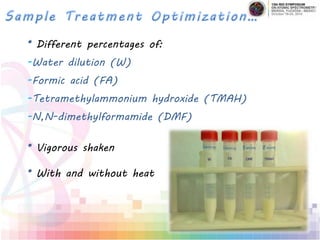
* Different percentages of:
-Water dilution (W)
-Formic acid (FA)
-Tetramethylammonium hydroxide (TMAH)
-N,N-dimethylformamide (DMF)
* Vigorous shaken
* With and without heat
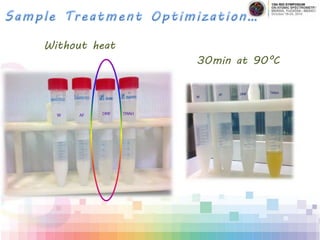
Without heat
30min at 90°C
… Another critical stage of the analytical
process is the introduction to ICPMS.
Direct analysis of milk is a challenge.
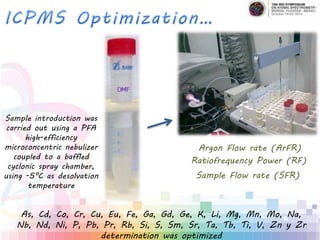
As, Cd, Co, Cr, Cu, Eu, Fe, Ga, Gd, Ge, K, Li, Mg, Mn, Mo, Na,
Nb, Nd, Ni, P, Pb, Pr, Rb, Si, S, Sm, Sr, Ta, Tb, Ti, V, Zn y Zr
determination was optimized
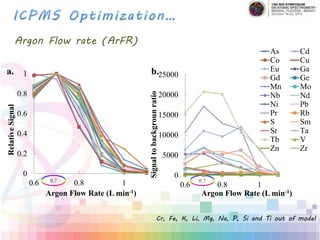
Argon Flow rate (ArFR)
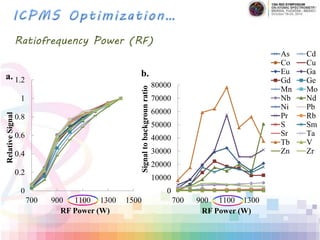
Ratiofrequency Power (RF)
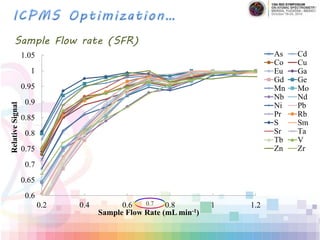
Sample Flow rate (SFR)
Sample introduction was
carried out using a PFA
high-efficiency
microconcentric nebulizer
coupled to a baffled
cyclonic spray chamber,
using -5°C as desolvation
temperature
Argon Flow rate (ArFR)
0.7 0.7
0
0.2
0.4
0.6
0.8
1
0.6 0.8 1
RelativeSignal
Argon Flow Rate (L min-1)
a.
0
5000
10000
15000
20000
25000
0.6 0.8 1
Signaltobackgrounratio
Argon Flow Rate (L min-1)
b.
As Cd
Co Cu
Eu Ga
Gd Ge
Mn Mo
Nb Nd
Ni Pb
Pr Rb
S Sm
Sr Ta
Tb V
Zn Zr
Cr, Fe, K, Li, Mg, Na, P, Si and Ti out of model
0
0.2
0.4
0.6
0.8
1
1.2
700 900 1100 1300 1500
RelativeSignal
RF Power (W)
a.
0
10000
20000
30000
40000
50000
60000
70000
80000
700 900 1100 1300
Signaltobackgrounratio
RF Power (W)
b.
As Cd
Co Cu
Eu Ga
Gd Ge
Mn Mo
Nb Nd
Ni Pb
Pr Rb
S Sm
Sr Ta
Tb V
Zn Zr
Ratiofrequency Power (RF)
0.7
0.6
0.65
0.7
0.75
0.8
0.85
0.9
0.95
1
1.05
0.2 0.4 0.6 0.8 1 1.2
RelativeSignal
Sample Flow Rate (mL min-1)
As Cd
Co Cu
Eu Ga
Gd Ge
Mn Mo
Nb Nd
Ni Pb
Pr Rb
S Sm
Sr Ta
Tb V
Zn Zr
Sample Flow rate (SFR)
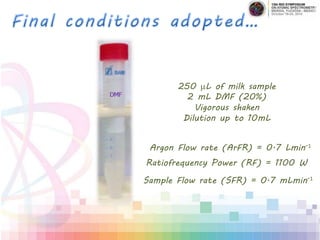
Argon Flow rate (ArFR) = 0.7 Lmin-1
Ratiofrequency Power (RF) = 1100 W
Sample Flow rate (SFR) = 0.7 mLmin-1
250 mL of milk sample
2 mL DMF (20%)
Vigorous shaken
Dilution up to 10mL
Microwave digestion
-0.5 g of each milk were weighed
- Treated with 7 mL of HNO3 and 1 mL of H2O2
-Subjected to a two steps temperature program
-10 min up to 200°C and up to 1000 watts
- kept 20 min at 200°C, up to 1000 watt.
- Then, samples diluted to 50 mL.
Mo
Nb
S
V
Zr
80%
90%
100%
110%
120%
80% 90% 100% 110% 120%
DMFrecovery(%)
MW recovery (%)
a. Aqueous Calibration
As
Cd
Co
Cu
Eu
Ga
Gd
Ge
Mn
Mo
Nb
Nd
Ni
Pb
Pr
Rb
S
Sm
Sr
Ta Tb
V
Zn
Zr
80%
90%
100%
110%
120%
80% 90% 100% 110% 120%
DMFrecovery(%)
MW recovery (%)
b. Matrix Matching
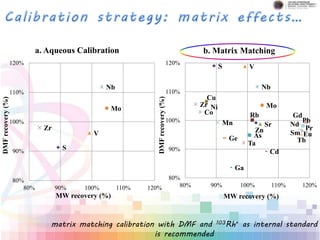
matrix matching calibration with DMF and 103Rh+ as internal standard
is recommended
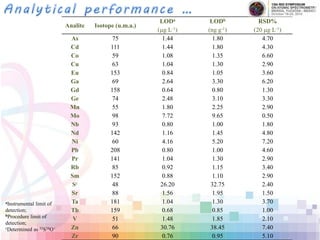
Analite Isotope (u.m.a.)
LODa LODb RSD%
(mg L-1) (ng g-1) (20 mg L-1)
As 75 1.44 1.80 4.70
Cd 111 1.44 1.80 4.30
Co 59 1.08 1.35 6.60
Cu 63 1.04 1.30 2.90
Eu 153 0.84 1.05 3.60
Ga 69 2.64 3.30 6.20
Gd 158 0.64 0.80 1.30
Ge 74 2.48 3.10 3.30
Mn 55 1.80 2.25 2.90
Mo 98 7.72 9.65 0.50
Nb 93 0.80 1.00 1.80
Nd 142 1.16 1.45 4.80
Ni 60 4.16 5.20 7.20
Pb 208 0.80 1.00 4.60
Pr 141 1.04 1.30 2.90
Rb 85 0.92 1.15 3.40
Sm 152 0.88 1.10 2.90
Sc 48 26.20 32.75 2.40
Sr 88 1.56 1.95 1.50
Ta 181 1.04 1.30 3.70
Tb 159 0.68 0.85 1.00
V 51 1.48 1.85 2.10
Zn 66 30.76 38.45 7.40
Zr 90 0.76 0.95 5.10
aInstrumental limit of
detection;
bProcedure limit of
detection;
cDetermined as 32S16O+
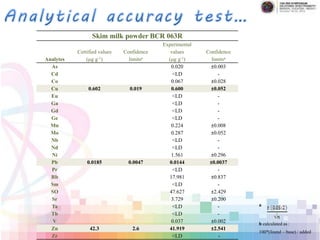
Skim milk powder BCR 063R
Analytes
Certified values Confidence
limitsa
Experimental
values Confidence
limitsa(mg g-1) (mg g-1)
As 0.020 ±0.003
Cd <LD -
Co 0.067 ±0.028
Cu 0.602 0.019 0.600 ±0.052
Eu <LD -
Ga <LD -
Gd <LD -
Ge <LD -
Mn 0.224 ±0.008
Mo 0.287 ±0.052
Nb <LD -
Nd <LD -
Ni 1.561 ±0.296
Pb 0.0185 0.0047 0.0144 ±0.0037
Pr <LD -
Rb 17.981 ±0.837
Sm <LD -
SO 47.627 ±2.429
Sr 3.729 ±0.200
Ta <LD -
Tb <LD -
V 0.037 ±0.002
Zn 42.3 2.6 41.919 ±2.541
Zr <LD -
a
b calculated as :
100*(found – base) / added
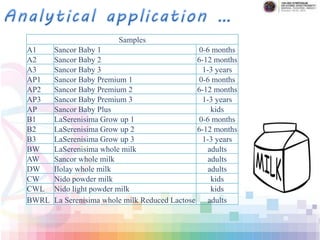
Samples
A1 Sancor Baby 1 0-6 months
A2 Sancor Baby 2 6-12 months
A3 Sancor Baby 3 1-3 years
AP1 Sancor Baby Premium 1 0-6 months
AP2 Sancor Baby Premium 2 6-12 months
AP3 Sancor Baby Premium 3 1-3 years
AP Sancor Baby Plus kids
B1 LaSerenisima Grow up 1 0-6 months
B2 LaSerenisima Grow up 2 6-12 months
B3 LaSerenisima Grow up 3 1-3 years
BW LaSerenisima whole milk adults
AW Sancor whole milk adults
DW Ilolay whole milk adults
CW Nido powder milk kids
CWL Nido light powder milk kids
BWRL La Serenisima whole milk Reduced Lactose adults
Analyte A1 A2 A3 AP1 AP2 AP3 AP AW
[mg L-1] Baby 1 Baby 2 Baby 3 Baby
Premium 1
Baby
Premium 2
Baby
Premium 3
Baby
Plus 3
Whole milk
0-6 months 6-12 months 1-3 years 0-6 months 6-12 months 1-3 years 1-3 years adults
As <LD <LD 2.58±0.51 <LD 1.44±0.14 1.44±0.03 <LD 2.80±0.03
Co 2.16 ±0.17 2.74±0.31 3.88±0.57 3.94±0.93 2.92±0.01 3.76±0.34 5.58±0.54 6.90±0.36
Cu 367.1±7.6 517.7±2.5 27.1±0.7 400.8±1.3 515.5±19.4 26.58±0.48 21.22±0.31 31.64±0.39
Eu <LD <LD <LD 1.34±0.19 <LD <LD <LD <LD
Gd 0.74±0.17 <LD <LD 0.96±0.25 <LD <LD 1.18±0.01 0.9±0.1
Mn 194.2±1.47 59.8±1.5 37.1±0.2 219.3±7.8 55.0±2.4 39.12±0.28 38.94±4.21 27.86±1.89
Mo 21.14±1.13 17.8±3.6 31.5±0.1 12.38±0.79 11.6±0.02 16.38±0.84 12.18±0.51 27.6±0.31
Nb 1.74±0.42 <LD <LD <LD <LD <LD 3.40±0.39 <LD
Nd <LD <LD 1.28±0.1 2.12±0.08 <LD <LD 1.12±0.08 <LD
Ni 26.12±0.96 54.6±1.8 61.9±1.9 66.26±11.62 55.9±0.9 70.8±1.1 129.8±4.1 157.7±0.25
Pb 7.36±1.05 <LD <LD <LD 0.98±0.17 <LD <LD <LD
Rb 176.82±7.38 449.2±23.4 478.9±4.3 124.0±2.8 387.7±5.6 478.6±16.3 319.5±3.4 555.0±13.04
Sm <LD <LD <LD 1.36±0.06 <LD <LD 1.18±0.02 1.24±0.11
S 1099±51 2852±97 3159±123 1112±15 2605±5 3246±134 2498±158 3194±47
Sr 403.4±24.5 1077±42 1316±51 377.7±3.2 939±19 1343±49 1047±1 720.4±6.0
Tb <LD <LD <LD 0.84±0.14 <LD <LD 0.88±0.03 <LD
V 4.96±0.65 6.26±0.85 7.48±0.31 18.04±1.89 5.84±0.08 6.36±0.36 6.86±0.57 17.08±0.37
Zn 5295±6 5838±162 10101±61 7888±375 8569±300 10148±217 7907±227 2815±30
In all cases the concentrations of Cd, Ga, Ge, Pr, Ta and Zr were lower than their respective detection limits.
Analyte B1 B2 B3 BW BWRL CW CWL DW
[mg L-1]
Baby 1 Baby 2 Baby 3 Whole milk Whole milk
Lactose
Reduced
Powder
milk
Light powder milk Whole milk
0-6 months 6-12 months 1-3 years adults adults kids kids adults
As 2.86±0.45 1.82±0.22 <LD <LD 3.22±0.19 3.83±0.09 2.92±0.44 <LD
Co 5.72±0.45 7.96±0.91 7.92±0.06 7.1±0.03 5.53±0.34 4.3±0.09 5.92±0.24 5.86±0.19
Cu 391.3±10.6 573.8±20.9 219.2±4.5 31.88±3.17 25.5±0.44 18.2±0.3 29.33±0.37 25.16±0.22
Eu <LD 0.88±0.17 <LD <LD <LD <LD <LD <LD
Gd <LD <LD <LD <LD <LD <LD <LD <LD
Mn 967.4±17.5 708.1±41.4 469.0±20.5 28.8±7.4 17.07±0.49 17.3±0.1 38.23±1.62 23.26±2.91
Mo 7.60±1.50 11.48±1.44 20.16±6.64 24.0±6.9 33.50±0.08 32.16±0.12 27.6±0.8 18.1±0.9
Nb <LD <LD <LD <LD <LD <LD <LD <LD
Nd <LD <LD 1.28±0.37 <LD <LD <LD <LD <LD
Ni 54.74±5.34 123.1±7.38 153.1±11.7 162.5±28.7 121.9±6.8 101.1±2.2 131.6±5.6 141.5±7.5
Pb <LD <LD <LD <LD <LD <LD <LD <LD
Rb 387.3±13.5 354.2±22.3 602.9±22.7 691.8±72.1 697.8±14.4 433.7±0.6 497.5±10.5 437.8±8.0
Sm <LD <LD <LD <LD <LD <LD <LD <LD
S 1967±40 2260.2±90.6 2973±161 3288±413 3230±139 2374±22 3181±42 2881±132
Sr 415.6±15.0 588.2±30.5 647.9±35.6 757.2±86.8 761.5±30.1 562.4±9.7 749.3±14.8 958.7±23.8
Tb <LD <LD <LD <LD <LD <LD <LD <LD
V 9.0±0.6 12.1±1.9 11.16±0.71 13.44±3.31 11.30±0.31 11.12±0.67 8.80±0.22 10.1±0.5
Zn 5129±95 4282±132 4251±232 2981±229 2621±119 3994±68 5158±23 2293±117.7
In the case of As, Cd and Pb, they complied with the maximum limits established by the Codex Alimentarius Commission,
being <0.05; <0.05; < 0.02 mg Kg-1 respectively.
A1
A1
A2
A2
A3
A3
AP2
AP2
AP1
AP1
AP3
AP3
AP
AP
B1
B1
B2
B2
B3
B3
BW
BW
AW
AW
DW
DW
CW
CW
CWL
CWLBWRL
BWRL
-2000
-1500
-1000
-500
0
500
1000
1500
2000
-4000 -3000 -2000 -1000 0 1000 2000 3000 4000 5000
I II
III
IV
a.
b.
Cu
Mn
Rb
S
Sr
Zn
-0.4
-0.2
0.0
0.2
0.4
0.6
0.8
1.0
-0.20 0.00 0.20 0.40 0.60 0.80 1.00 1
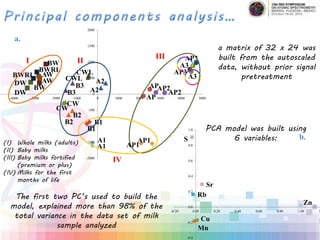
a matrix of 32 x 24 was
built from the autoscaled
data, without prior signal
pretreatment
PCA model was built using
6 variables:
The first two PC’s used to build the
model, explained more than 98% of the
total variance in the data set of milk
sample analyzed
(I) Whole milks (adults)
(II) Baby milks
(III) Baby milks fortified
(premium or plus)
(IV) Milks for the first
months of life
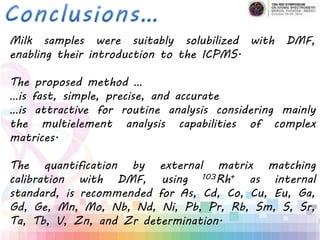
Milk samples were suitably solubilized with DMF,
enabling their introduction to the ICPMS.
The proposed method …
…is fast, simple, precise, and accurate
…is attractive for routine analysis considering mainly
the multielement analysis capabilities of complex
matrices.
The quantification by external matrix matching
calibration with DMF, using 103Rh+ as internal
standard, is recommended for As, Cd, Co, Cu, Eu, Ga,
Gd, Ge, Mn, Mo, Nb, Nd, Ni, Pb, Pr, Rb, Sm, S, Sr,
Ta, Tb, V, Zn, and Zr determination.
PCA studies have been performed with six variables:
Zn, S, Mn, Cu, Rb and Sr.
Valuable information is obtained allowing milk
classification according to elemental contents:
adult, baby and baby fortified.
Results from this study emphasized the importance of
the multielement determination of milk samples to
carry out…
… traceability and/or origin denomination studies
… and also to assess their quality.
Dr. Liliana Saldívar
Dr. Patricia Smichowski
Dr. Maria Goreti R. Vale
and the Organizer Committee
CLASSIFICATION OF MILK SAMPLES BASED
ON THEIR ELEMENTAL COMPOSITION.
INDUCTIVELY COUPLED PLASMA MASS
SPECTROMETRY DETERMINATION
AFTER SINGLE-STEP SOLUBILIZATION
WITH N,N-DIMETHYLFORMAMIDE.
Marianela SAVIOa, Silvana M. AZCARATEb,
Patricia SMICHOWSKIc,d, José M. CAMIÑAb,
Luis D. MARTINEZa, Raúl A. GILa
aInstituto de Química de San Luis (CCT-San Luis)- Área de Química Analítica. Facultad de Química Bioquímica y Farmacia. Universidad Nacional
de San Luis. Chacabuco y Pedernera. D5700BWQ San Luis, ARGENTINA.
b Instituto de Ciencias de la Tierra y Ambientales de La Pampa (INCITAP). Facultad de Ciencias Exactas y Naturales. Universidad Nacional de La
Pampa. Av. Uruguay 151. L6300XAI Santa Rosa, La Pampa, ARGENTINA.
dComisión Nacional de Energía Atómica, Gerencia Química, Av. Gral Paz 1499, B1650KNA San Martín, Buenos Aires, ARGENTINA.
eConsejo Nacional de Investigaciones Científicas y Técnicas (CONICET), Av. Rivadavia 1917, C1033AAJ-Ciudad de Buenos Aires, ARGENTINA
*Author to whom correspondence should be addressed: marianelasavio@gmail.com

Clasificación de leches a través del análisis elemental por ICPMS.

  • 1.
    CLASSIFICATION OF MILKSAMPLES BASED ON THEIR ELEMENTAL COMPOSITION. INDUCTIVELY COUPLED PLASMA MASS SPECTROMETRY DETERMINATION AFTER SINGLE-STEP SOLUBILIZATION WITH N,N-DIMETHYLFORMAMIDE. Marianela SAVIO, Silvana M. AZCARATE, Patricia SMICHOWSKI, José M. CAMIÑA, Luis D. MARTINEZ, Raúl A. GIL
  • 2.
    …is vital inhuman diet: high nutritional value and health benefits. …Habitual consumption is recommended. …contain minor and trace elements, that mainly fluctuate according to physiological functions and extrinsic factors. …For their nutritional and toxicological relevance, trace element determination in milk is of major importance.
  • 3.
    … is oneof the most relevant and decisive stages in the whole analytical procedure. The development of a simple, fast and direct procedure for milk analysis is thus attractive.
  • 4.
    * Different percentagesof: -Water dilution (W) -Formic acid (FA) -Tetramethylammonium hydroxide (TMAH) -N,N-dimethylformamide (DMF) * Vigorous shaken * With and without heat
  • 5.
  • 6.
    … Another criticalstage of the analytical process is the introduction to ICPMS. Direct analysis of milk is a challenge.
  • 7.
    As, Cd, Co,Cr, Cu, Eu, Fe, Ga, Gd, Ge, K, Li, Mg, Mn, Mo, Na, Nb, Nd, Ni, P, Pb, Pr, Rb, Si, S, Sm, Sr, Ta, Tb, Ti, V, Zn y Zr determination was optimized Argon Flow rate (ArFR) Ratiofrequency Power (RF) Sample Flow rate (SFR) Sample introduction was carried out using a PFA high-efficiency microconcentric nebulizer coupled to a baffled cyclonic spray chamber, using -5°C as desolvation temperature
  • 8.
    Argon Flow rate(ArFR) 0.7 0.7 0 0.2 0.4 0.6 0.8 1 0.6 0.8 1 RelativeSignal Argon Flow Rate (L min-1) a. 0 5000 10000 15000 20000 25000 0.6 0.8 1 Signaltobackgrounratio Argon Flow Rate (L min-1) b. As Cd Co Cu Eu Ga Gd Ge Mn Mo Nb Nd Ni Pb Pr Rb S Sm Sr Ta Tb V Zn Zr Cr, Fe, K, Li, Mg, Na, P, Si and Ti out of model
  • 9.
    0 0.2 0.4 0.6 0.8 1 1.2 700 900 11001300 1500 RelativeSignal RF Power (W) a. 0 10000 20000 30000 40000 50000 60000 70000 80000 700 900 1100 1300 Signaltobackgrounratio RF Power (W) b. As Cd Co Cu Eu Ga Gd Ge Mn Mo Nb Nd Ni Pb Pr Rb S Sm Sr Ta Tb V Zn Zr Ratiofrequency Power (RF)
  • 10.
    0.7 0.6 0.65 0.7 0.75 0.8 0.85 0.9 0.95 1 1.05 0.2 0.4 0.60.8 1 1.2 RelativeSignal Sample Flow Rate (mL min-1) As Cd Co Cu Eu Ga Gd Ge Mn Mo Nb Nd Ni Pb Pr Rb S Sm Sr Ta Tb V Zn Zr Sample Flow rate (SFR)
  • 11.
    Argon Flow rate(ArFR) = 0.7 Lmin-1 Ratiofrequency Power (RF) = 1100 W Sample Flow rate (SFR) = 0.7 mLmin-1 250 mL of milk sample 2 mL DMF (20%) Vigorous shaken Dilution up to 10mL
  • 12.
    Microwave digestion -0.5 gof each milk were weighed - Treated with 7 mL of HNO3 and 1 mL of H2O2 -Subjected to a two steps temperature program -10 min up to 200°C and up to 1000 watts - kept 20 min at 200°C, up to 1000 watt. - Then, samples diluted to 50 mL.
  • 13.
    Mo Nb S V Zr 80% 90% 100% 110% 120% 80% 90% 100%110% 120% DMFrecovery(%) MW recovery (%) a. Aqueous Calibration As Cd Co Cu Eu Ga Gd Ge Mn Mo Nb Nd Ni Pb Pr Rb S Sm Sr Ta Tb V Zn Zr 80% 90% 100% 110% 120% 80% 90% 100% 110% 120% DMFrecovery(%) MW recovery (%) b. Matrix Matching matrix matching calibration with DMF and 103Rh+ as internal standard is recommended
  • 14.
    Analite Isotope (u.m.a.) LODaLODb RSD% (mg L-1) (ng g-1) (20 mg L-1) As 75 1.44 1.80 4.70 Cd 111 1.44 1.80 4.30 Co 59 1.08 1.35 6.60 Cu 63 1.04 1.30 2.90 Eu 153 0.84 1.05 3.60 Ga 69 2.64 3.30 6.20 Gd 158 0.64 0.80 1.30 Ge 74 2.48 3.10 3.30 Mn 55 1.80 2.25 2.90 Mo 98 7.72 9.65 0.50 Nb 93 0.80 1.00 1.80 Nd 142 1.16 1.45 4.80 Ni 60 4.16 5.20 7.20 Pb 208 0.80 1.00 4.60 Pr 141 1.04 1.30 2.90 Rb 85 0.92 1.15 3.40 Sm 152 0.88 1.10 2.90 Sc 48 26.20 32.75 2.40 Sr 88 1.56 1.95 1.50 Ta 181 1.04 1.30 3.70 Tb 159 0.68 0.85 1.00 V 51 1.48 1.85 2.10 Zn 66 30.76 38.45 7.40 Zr 90 0.76 0.95 5.10 aInstrumental limit of detection; bProcedure limit of detection; cDetermined as 32S16O+
  • 15.
    Skim milk powderBCR 063R Analytes Certified values Confidence limitsa Experimental values Confidence limitsa(mg g-1) (mg g-1) As 0.020 ±0.003 Cd <LD - Co 0.067 ±0.028 Cu 0.602 0.019 0.600 ±0.052 Eu <LD - Ga <LD - Gd <LD - Ge <LD - Mn 0.224 ±0.008 Mo 0.287 ±0.052 Nb <LD - Nd <LD - Ni 1.561 ±0.296 Pb 0.0185 0.0047 0.0144 ±0.0037 Pr <LD - Rb 17.981 ±0.837 Sm <LD - SO 47.627 ±2.429 Sr 3.729 ±0.200 Ta <LD - Tb <LD - V 0.037 ±0.002 Zn 42.3 2.6 41.919 ±2.541 Zr <LD - a b calculated as : 100*(found – base) / added
  • 16.
    Samples A1 Sancor Baby1 0-6 months A2 Sancor Baby 2 6-12 months A3 Sancor Baby 3 1-3 years AP1 Sancor Baby Premium 1 0-6 months AP2 Sancor Baby Premium 2 6-12 months AP3 Sancor Baby Premium 3 1-3 years AP Sancor Baby Plus kids B1 LaSerenisima Grow up 1 0-6 months B2 LaSerenisima Grow up 2 6-12 months B3 LaSerenisima Grow up 3 1-3 years BW LaSerenisima whole milk adults AW Sancor whole milk adults DW Ilolay whole milk adults CW Nido powder milk kids CWL Nido light powder milk kids BWRL La Serenisima whole milk Reduced Lactose adults
  • 17.
    Analyte A1 A2A3 AP1 AP2 AP3 AP AW [mg L-1] Baby 1 Baby 2 Baby 3 Baby Premium 1 Baby Premium 2 Baby Premium 3 Baby Plus 3 Whole milk 0-6 months 6-12 months 1-3 years 0-6 months 6-12 months 1-3 years 1-3 years adults As <LD <LD 2.58±0.51 <LD 1.44±0.14 1.44±0.03 <LD 2.80±0.03 Co 2.16 ±0.17 2.74±0.31 3.88±0.57 3.94±0.93 2.92±0.01 3.76±0.34 5.58±0.54 6.90±0.36 Cu 367.1±7.6 517.7±2.5 27.1±0.7 400.8±1.3 515.5±19.4 26.58±0.48 21.22±0.31 31.64±0.39 Eu <LD <LD <LD 1.34±0.19 <LD <LD <LD <LD Gd 0.74±0.17 <LD <LD 0.96±0.25 <LD <LD 1.18±0.01 0.9±0.1 Mn 194.2±1.47 59.8±1.5 37.1±0.2 219.3±7.8 55.0±2.4 39.12±0.28 38.94±4.21 27.86±1.89 Mo 21.14±1.13 17.8±3.6 31.5±0.1 12.38±0.79 11.6±0.02 16.38±0.84 12.18±0.51 27.6±0.31 Nb 1.74±0.42 <LD <LD <LD <LD <LD 3.40±0.39 <LD Nd <LD <LD 1.28±0.1 2.12±0.08 <LD <LD 1.12±0.08 <LD Ni 26.12±0.96 54.6±1.8 61.9±1.9 66.26±11.62 55.9±0.9 70.8±1.1 129.8±4.1 157.7±0.25 Pb 7.36±1.05 <LD <LD <LD 0.98±0.17 <LD <LD <LD Rb 176.82±7.38 449.2±23.4 478.9±4.3 124.0±2.8 387.7±5.6 478.6±16.3 319.5±3.4 555.0±13.04 Sm <LD <LD <LD 1.36±0.06 <LD <LD 1.18±0.02 1.24±0.11 S 1099±51 2852±97 3159±123 1112±15 2605±5 3246±134 2498±158 3194±47 Sr 403.4±24.5 1077±42 1316±51 377.7±3.2 939±19 1343±49 1047±1 720.4±6.0 Tb <LD <LD <LD 0.84±0.14 <LD <LD 0.88±0.03 <LD V 4.96±0.65 6.26±0.85 7.48±0.31 18.04±1.89 5.84±0.08 6.36±0.36 6.86±0.57 17.08±0.37 Zn 5295±6 5838±162 10101±61 7888±375 8569±300 10148±217 7907±227 2815±30 In all cases the concentrations of Cd, Ga, Ge, Pr, Ta and Zr were lower than their respective detection limits.
  • 18.
    Analyte B1 B2B3 BW BWRL CW CWL DW [mg L-1] Baby 1 Baby 2 Baby 3 Whole milk Whole milk Lactose Reduced Powder milk Light powder milk Whole milk 0-6 months 6-12 months 1-3 years adults adults kids kids adults As 2.86±0.45 1.82±0.22 <LD <LD 3.22±0.19 3.83±0.09 2.92±0.44 <LD Co 5.72±0.45 7.96±0.91 7.92±0.06 7.1±0.03 5.53±0.34 4.3±0.09 5.92±0.24 5.86±0.19 Cu 391.3±10.6 573.8±20.9 219.2±4.5 31.88±3.17 25.5±0.44 18.2±0.3 29.33±0.37 25.16±0.22 Eu <LD 0.88±0.17 <LD <LD <LD <LD <LD <LD Gd <LD <LD <LD <LD <LD <LD <LD <LD Mn 967.4±17.5 708.1±41.4 469.0±20.5 28.8±7.4 17.07±0.49 17.3±0.1 38.23±1.62 23.26±2.91 Mo 7.60±1.50 11.48±1.44 20.16±6.64 24.0±6.9 33.50±0.08 32.16±0.12 27.6±0.8 18.1±0.9 Nb <LD <LD <LD <LD <LD <LD <LD <LD Nd <LD <LD 1.28±0.37 <LD <LD <LD <LD <LD Ni 54.74±5.34 123.1±7.38 153.1±11.7 162.5±28.7 121.9±6.8 101.1±2.2 131.6±5.6 141.5±7.5 Pb <LD <LD <LD <LD <LD <LD <LD <LD Rb 387.3±13.5 354.2±22.3 602.9±22.7 691.8±72.1 697.8±14.4 433.7±0.6 497.5±10.5 437.8±8.0 Sm <LD <LD <LD <LD <LD <LD <LD <LD S 1967±40 2260.2±90.6 2973±161 3288±413 3230±139 2374±22 3181±42 2881±132 Sr 415.6±15.0 588.2±30.5 647.9±35.6 757.2±86.8 761.5±30.1 562.4±9.7 749.3±14.8 958.7±23.8 Tb <LD <LD <LD <LD <LD <LD <LD <LD V 9.0±0.6 12.1±1.9 11.16±0.71 13.44±3.31 11.30±0.31 11.12±0.67 8.80±0.22 10.1±0.5 Zn 5129±95 4282±132 4251±232 2981±229 2621±119 3994±68 5158±23 2293±117.7 In the case of As, Cd and Pb, they complied with the maximum limits established by the Codex Alimentarius Commission, being <0.05; <0.05; < 0.02 mg Kg-1 respectively.
  • 19.
    A1 A1 A2 A2 A3 A3 AP2 AP2 AP1 AP1 AP3 AP3 AP AP B1 B1 B2 B2 B3 B3 BW BW AW AW DW DW CW CW CWL CWLBWRL BWRL -2000 -1500 -1000 -500 0 500 1000 1500 2000 -4000 -3000 -2000-1000 0 1000 2000 3000 4000 5000 I II III IV a. b. Cu Mn Rb S Sr Zn -0.4 -0.2 0.0 0.2 0.4 0.6 0.8 1.0 -0.20 0.00 0.20 0.40 0.60 0.80 1.00 1 a matrix of 32 x 24 was built from the autoscaled data, without prior signal pretreatment PCA model was built using 6 variables: The first two PC’s used to build the model, explained more than 98% of the total variance in the data set of milk sample analyzed (I) Whole milks (adults) (II) Baby milks (III) Baby milks fortified (premium or plus) (IV) Milks for the first months of life
  • 20.
    Milk samples weresuitably solubilized with DMF, enabling their introduction to the ICPMS. The proposed method … …is fast, simple, precise, and accurate …is attractive for routine analysis considering mainly the multielement analysis capabilities of complex matrices. The quantification by external matrix matching calibration with DMF, using 103Rh+ as internal standard, is recommended for As, Cd, Co, Cu, Eu, Ga, Gd, Ge, Mn, Mo, Nb, Nd, Ni, Pb, Pr, Rb, Sm, S, Sr, Ta, Tb, V, Zn, and Zr determination.
  • 21.
    PCA studies havebeen performed with six variables: Zn, S, Mn, Cu, Rb and Sr. Valuable information is obtained allowing milk classification according to elemental contents: adult, baby and baby fortified. Results from this study emphasized the importance of the multielement determination of milk samples to carry out… … traceability and/or origin denomination studies … and also to assess their quality.
  • 23.
    Dr. Liliana Saldívar Dr.Patricia Smichowski Dr. Maria Goreti R. Vale and the Organizer Committee
  • 24.
    CLASSIFICATION OF MILKSAMPLES BASED ON THEIR ELEMENTAL COMPOSITION. INDUCTIVELY COUPLED PLASMA MASS SPECTROMETRY DETERMINATION AFTER SINGLE-STEP SOLUBILIZATION WITH N,N-DIMETHYLFORMAMIDE. Marianela SAVIOa, Silvana M. AZCARATEb, Patricia SMICHOWSKIc,d, José M. CAMIÑAb, Luis D. MARTINEZa, Raúl A. GILa aInstituto de Química de San Luis (CCT-San Luis)- Área de Química Analítica. Facultad de Química Bioquímica y Farmacia. Universidad Nacional de San Luis. Chacabuco y Pedernera. D5700BWQ San Luis, ARGENTINA. b Instituto de Ciencias de la Tierra y Ambientales de La Pampa (INCITAP). Facultad de Ciencias Exactas y Naturales. Universidad Nacional de La Pampa. Av. Uruguay 151. L6300XAI Santa Rosa, La Pampa, ARGENTINA. dComisión Nacional de Energía Atómica, Gerencia Química, Av. Gral Paz 1499, B1650KNA San Martín, Buenos Aires, ARGENTINA. eConsejo Nacional de Investigaciones Científicas y Técnicas (CONICET), Av. Rivadavia 1917, C1033AAJ-Ciudad de Buenos Aires, ARGENTINA *Author to whom correspondence should be addressed: marianelasavio@gmail.com

Editor's Notes

  • #3 Milk is an important food in the human diet, as it contains many essential nutrients, providing high nutritional value and health benefits. Habitual consumption is recommended during all stages of development and life, especially for infants and children Milk and milk products are the most diversified natural foodstuffs, which contain minor and trace elements. This elements mainly fluctuate according to physiological functions of cows and extrinsic factors, as human activities, environmental and geological background For his nutritional value and toxicological relevance, trace element determination in milk is of major importance. -----
  • #4 Organic sample preparation for trace elements analysis has always been a challenge in analytical chemistry. In fact, it is one of the most relevant and decisive stages in the whole analytical procedure for trace elements determination. When spectrometric techniques are used for detection, a complete solubilization of sample is general required, but this procedure may cause sample losses and contamination.. So, The development of a simple, fast and direct procedure for milk analysis is attractive.
  • #5 Different sample preparation were assayed Recent contributions in this field propose treatments using: - acid media (like formic acid) or -alkaline media (such, tetramethylammonium hydroxide) - Also, A simple water dilution was assayed And In the case of the polar organic solvent dimethylformamide (DMF), we had no data with regarding to their use in preparation of organic samples; it has been used in the synthesis of organic compounds, and chromatographic applications. The samples were Shaken vigorously A duplicate of this samples preparation were submitted to heat
  • #6 As we could observe: With a Simple dilution, the solutions remain turbid, despite providing heat or not. FA (formic acid) with both treatments solutions are less turbid, Also with TMAH (Tetramethylammonium Hydroxide) solutions are less turbid. But, If heat is applied, the samples appear to undergo Maillard reactions, they change colors In the case of using 20% DMF (dimethylformamide) and without heat, samples were appropriately solubilized, and we decide to chosee this sample preparation for the work.
  • #7 We know that Inorganic mass spectrometry with inductively coupled plasma (ICPMS) is one of the most powerful analytical tools for trace elemental determination due to its extreme sensitivity, selectivity and capability of multielemental and isotopic analysis … also is well-known that another decisive stage of the analytical process is the introduction to ICPMS through nebulization, even more if we are dealing with organic samples. Thus, direct analysis of milk is a challenge. Milk presents a complex colloidal system with diverse components such as fat emulsion, casein micelle suspension and others, Usually is recommended the introduction of digested and diluted samples to ICP is required to limit the amount of dissolved solids and organic matter So, Elemental analysis by direct nebulization of milk may block the cones, could deposit organic matter in the injector tube of the torch, and could cause spectral and non-spectral interferences due to the complexity of the matrix. These issues may be tackled following an overall instrument optimization. The decrease of temperature using cooled spray chamber or the addition of oxygen into the plasma that aids oxidation to organic matter, have been reported to overcome these drawbacks. …ICPMS conditions were optimized
  • #8 … -For optimization of the instrumental parameters of ICPMS, digested  samples with DMF were enriched to a final concentration of 40 ug L-1 with multielemental standard solution.  -Also a solution containing only the reagents (blank) was compared in order to evaluate the background contribution of some carbon-containing polyatomic ions. -Sample introduction was carried out using a PFA high-efficiency microconcentric nebulizer coupled to a baffled cyclonic spray chamber, using -5°C as desolvation temperature - The argon gas flow (Ar FR) and radiofrequency power (RF power) were optimized for maximum analyte intensity and minimum background. Also SFR was optimized. -The decrease of temperature using cooled spray chamber or the addition of oxygen into the plasma that aids oxidation to organic matter, have been reported to overcome these drawbacks. They were also tested…we decided to work at -5C and oxigen was no nedded. A number of 33 analites were optimized (As, Cd, Co, Cr, Cu, Eu, Fe, Ga, Gd, Ge, K, Li, Mg, Mn, Mo, Na,Nb, Nd, Ni, P, Pb, Pr, Rb, Si, S, Sm, Sr, Ta, Tb, Ti, V, Zn and Zr.)… This was done through evaluation of the measured analytical signals in terms of ArFR (mL min-1) and RF power (watts) obtained with both synthetic sample and a reagent blank (Figs. 1 and 2). In spite of the drawbacks mentioned above, particle sizes should not be too critical during nebulization, and samples are expected to be aspirated successfully by a pneumatic nebulizer. In addition to particle sizes, however, the chemical form of the analyte in the matrix may also be critical
  • #9 Of This (33) analites 9 were out of model.. Cr, Fe, K, Li, Mg, Na, P, Si and Ti analytes do not fit in the models and are not ilustred here. So…24 analites were used throught analysis We could observe in the Figure that most analytes reached maximum sensitivities at an Ar flow rate of 0.7 L min−1 and also suggests that the carbon-containing polyatomic ions did not contribute significantly; evidencing that efficient elimination of the solvent in the spray chamber was achieved. It can be inferred that polyatomic ions containing carbon do not appear, since the signal is higher than the background, demonstrating efficient removal of the solvent in the spray chamber.
  • #10 Analyte relative signals versus applied RF power was plotted, and also the contribution to background of carbon-based polyatomic ions. The outcome indicates that despite better sensitivities were reached at 1400 W, the strong background contribution (lower SBR) moved the optimum condition to 1100 W RF power as compromise condition. As for the carbon-based polyatomic ions: the greater RF power, the higher the formation.
  • #11 The sample flow rate is a parameter directly related to the efficiency of the nebulizer, which allows controlling the entry of the sample and thus the amount of carbon. So, sample flow rate (SFR) was optimized to reach the best nebulization efficiency and also, to handle sample (matrix) input to the ICP . A characteristic SFR plot was thus obtained : With increasing SFR, the signal for the analytes increased, remaining constant after 0.7 ml min-1. Consequently, 0.7 mL min−1 SFR was thus established for all further experiments aiming to minimize the amount of carbon to be introduced to the ICP.  
  • #12 Final conditions for analytes determination in milk are summarizes in this tables The samples were prepared: using 250uL added of 2Ml of DMF shaken vigorpusly and diluted up to 10 mL ICPMS conditions Argon Flow rate (ArFR) = 0.7 Lmin-1 Ratiofrequency Power (RF) = 1100 W Sample Flow rate (SFR) = 0.7 mLmin-1
  • #13 Comparative studies were carried out using microwave digestion. - 0.5 g of milk was weighed - Was treated with 7 mL of HNO3 and 1 mL of H2O2 PTFE reactors of a microwave oven - Was subjected to a temperature program (ramp: 10 min at 200 ° C and up to 1000W step of 20 min at 200 to 1000W). Then, the samples were diluted to 50 mL.
  • #14 Calibration strategy: matrix effects With the aim of evaluate and lighten matrix effects and to come across to a proper calibration strategy for accurate analysis of milk samples treated with DMF, two approaches were evaluated: -aqueous calibration. - and matrix matching calibration. Samples were prepared as indicated above, spiked with 10 ug L-1 of the analytes and the obtained % recoveries were contrasted with those obtained after microwave digestion. - Figure a. shows that in the case of external calibration against aqueous standard solutions, only 5 analytes (Mo, Nb, S, V and Zr) could be quantitatively recovered (% recoveries between 80 and 120). If no IS was used, only As attained good recovery. - On the other hand, Fig. b shows that when matrix matching calibration was used, quantitative recoveries of the majority of the analytes was achieve (whether IS was used or not). Twenty three analytes out of twenty four analyzed, achieved good recoveries without IS; but when IS was used all analytes could be recovered. In sum, it may be pointed out that matrix matching calibration with DMF and 103Rh+ as internal standard is recommended for 24 analytes (As, Cd, Co, Cu, Eu, Ga, Gd, Ge, Mn, Mo, Nb, Nd, Ni, Pb, Pr, Rb, Sm, S, Sr, Ta, Tb, V, Zn, and Zr) determination in milk samples pretreated with DMF.
  • #15 The recommended procedure involved low dilution factors resulting in low detection limits (DL) for most analytes which were evaluated as 3.3 times the standard deviation (n=10) of the blank. Detections limits varied between 0.64 ugL-1 Gd to 30.76 ugL-1 for Zn. The precision was calculated as percent relative standard deviation (RSD %, n=3) for a standard with a concentration at the middle of the calibration plot. In all cases rsd were lower than 7.20 % Considering the complexity of the samples analyzed, the analytical performance (Table 1) was satisfactory in comparison with figures achieved using a conventional nebulizer.
  • #16 A reference material Skim milk powder (BCR 063R) from Community Bureau of Reference was employed for accuracy check. The certified values and the found values for the analytes Cu, Pb and Zn that are present in the reference material are shown in Table The results were compared through a paired t-test and no significant differences were observed (n=3, p=0.05). Other analytes that were neither certified nor informed were also determined. Spiked aliquots of this sample were also evaluated and the recoveries were quantitative.
  • #17 The analyzed samples were commercially available milk samples of different brands from Argentina. A certified reference material namely, Milk samples were labeled as: A, B, C and D according to their type and trade marks 1,2,3 according to the range of month of baby life Each sample was independently treated with DMF as recommended and analyzed in triplicate. The average concentrations of the analytes found in each milk sample are shown in Table 3.
  • #18 The average concentrations of the analytes found in each milk sample are shown in Table 3. In all cases the concentrations of Cd, Ga, Ge, Pr, and Ta were lower than their respective detection limits. The presence of As, Co, Cu, Eu, Gd, Mn, Mo, Nb, Nd, Ni, Pb, Pr, Rb, S, Sm, Sr, Tb, V and Zn was evidenced in one or more milk samples. As, Cd, Co, Cu, Eu, Ga, Gd, Ge, , Mn, Mo,,Nb, Nd, Ni, Pb, Pr, Rb, S, Sm, Sr, Ta, Tb,, V, Zn and Zr Cr, Fe, K, Li, Mg, Na, P, Si and Ti a
  • #19 The average concentrations of the analytes found in each milk sample are shown in Table 3. In the case of As, Cd and Pb, they complied with the maximum limits established by the Codex Alimentarius Commission, being <0.05; <0.05; < 0.02 mg Kg-1 respectively.
  • #20 Principal components analysis was applied to the matrix formed by the multielemental concentrations corresponding to a duplicate of the 16 milk samples. Thus, a matrix of 32 x 24 was built from the autoscaled data, without prior signal pretreatment. From the loadings plots it was determined that the most outstanding variables in the discrimination of the groups were S, Zn, and to a lesser extent, Sr, Rb, Mn and Cu. So, The PCA model was built using 6 variables, corresponding to Cu, Mn, Rb, S, Sr and Zn concentrations. The first two PC’s used to build the model, explained more than 98% of the total variance in the data set of milk sample analyzed. the score plot shows the formation of four groups: -The samples separation through the first component is correlated with the Zn low, medium and high concentration in samples from whole milks (adults) (I), baby milks (II) and baby milks fortified (premium or plus) (III), respectively. - There is also the formation of a subset of the second component corresponding to baby milks administered in the first few months of life (IV), which require larger amounts of Mn and Cu and less S. It is noticeably that sample A3, unfortified milk, fell within fortified milk group. Additionally, A3 showed an identical classification to sample AP3. Consequently, it was possible to conclude that these samples are very similar because they belong to the same factory (perhaps the same sample in different packaging). From this exploratory analysis it can be concluded that the content of trace metals could be related to the nutritional value required by infants at different stages of growth. From this analysis it could be possible to evaluate a classification model that distinguish between different milks to assess fraud and / or alterations in the domestic market. This requires a study with larger sample and adding more brand names.
  • #21 In this work, A single-step sample preparation procedure is described for multi-elemental analysis of milk samples Samples of milk are suitably solubilized with DMF, enabling their introduction to the ICPMS using a microconcentric nebulizer operated at -5 °C. and thus reducing significantly time of analysis This undemanding and rapid sample preparation procedure makes the proposed method an attractive approach for routine analysis considering mainly the multielement analysis capabilities of complex matrices with high carbon concentration, as milk. Furthermore, the proposed method is fast, simple, precise, accurate and less expensive than other approaches. In addition, the achieved sensitivities are higher than those reached with conventional microwave digestion.
  • #22 PCA studies have been performed with six variables: Zn, S, Mn, Cu, Rb and Sr. Valuable information could be obtained allowing milk classification (adult, baby or baby fortified) according to elemental contents. Results from this study emphasized the importance of the multielement determination of trace elements in milk samples to carry out traceability and/or origin denomination studies and also to assess their quality. From this analysis could evaluate the possibility of classification models that distinguish between different milks to assess fraud and / or alterations in the domestic market. This requires a study with larger sample and adding more brand names. A partir de este análisis se podría evaluar la posibilidad de obtener modelos de clasificación que permitan distinguir entre diferentes leches con el fin de evaluar fraudes y/o adulteraciones en el mercado nacional. Para ello es necesario un estudio con mayor número de muestras y con la incorporación de más marcas comerciales.
  • #23 thank the institutions that make possible to me to be here
  • #25 As the presenter expressed the title of our work is CLASSIFICATION OF MILK SAMPLES BASED ON THEIR ELEMENTAL COMPOSITION. INDUCTIVELY COUPLED PLASMA MASS SPECTROMETRY DETERMINATION AFTER SINGLE-STEP SOLUBILIZATION WITH N,N-DIMETHYLFORMAMIDE. This work was developed in Argentina, in national university of san luis, CONicet institute INQUISAl (chemistry institute of san luis) , in collaboration with nacional university of la pampa, CONICET institute INCITAP (earth ciences and environment institute of la pampa), and national commission of atomic energy.