The Connected Consumer and
    Smart M2M Services

            Mike Ueland
            Vice President & General Manager
            Telit Wireless Solutions
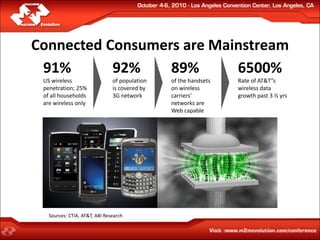
Connected Consumers are Mainstream
 91%       92%    89%      6500%
 US wireless                   of population   of the handsets   Rate of AT&T”s
 penetration; 25%              is covered by   on wireless       wireless data
 of all households             3G network      carriers’         growth past 3 ½ yrs
 are wireless only                             networks are
                                               Web capable


   Sources: CTIA, AT&T, ABI Research
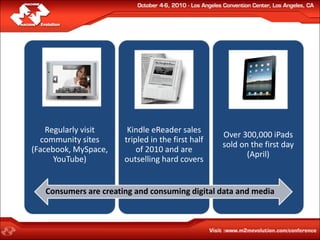
Regularly visit     Kindle eReader sales
                                                   Over 300,000 iPads
  community sites      tripled in the first half
                                                   sold on the first day
(Facebook, MySpace,        of 2010 and are
                                                          (April)
      YouTube)         outselling hard covers


   Consumers are creating and consuming digital data and media
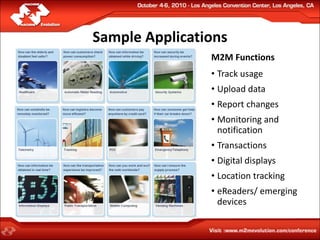
Sample Applications
                M2M Functions
                • Track usage
                • Upload data
                • Report changes
                • Monitoring and
                  notification
                • Transactions
                • Digital displays
                • Location tracking
                • eReaders/ emerging
                  devices
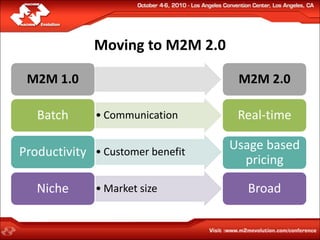
Moving to M2M 2.0

 M2M 1.0                           M2M 2.0

   Batch      • Communication      Real-time

Productivity • Customer benefit   Usage based
                                    pricing

   Niche      • Market size         Broad
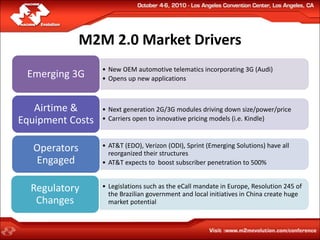
M2M 2.0 Market Drivers
                  • New OEM automotive telematics incorporating 3G (Audi)
 Emerging 3G      • Opens up new applications


   Airtime &      • Next generation 2G/3G modules driving down size/power/price
Equipment Costs   • Carriers open to innovative pricing models (i.e. Kindle)


   Operators      • AT&T (EDO), Verizon (ODI), Sprint (Emerging Solutions) have all
                    reorganized their structures
   Engaged        • AT&T expects to boost subscriber penetration to 500%


  Regulatory      • Legislations such as the eCall mandate in Europe, Resolution 245 of
                    the Brazilian government and local initiatives in China create huge
   Changes          market potential
M2M‘s Impact on the Connected Consumer
m2m Enables Economic Incentives and Influences Positive Consumer Behavior

  Recent reductions in the cost to deploy are enabling more
   consumer-focused applications
  Applications have the potential to make a BIG impact on choices we
   make in our daily lives
  Applications can produce positive benefits to individuals and society
  Many of the new applications are driven by the principles of
   behavioral economics
  Behavioral economics is a field of economic research that looks at
   how individuals make economic related decisions – what does this
   really mean….
What is Behavioral Economics?
   All of economics is meant to be about people’s behavior. Right??
   So, what is behavioral economics, and how does it differ from traditional economics?
Traditional Economics
                                                                     Behavioral Economics
• Conceptualizes the world populated by humans that are
                                                                     A classic example is the
  rational that behave in a way to maximize their                   difference between opt-in
  individual self-interest                                          and opt-out in a program
                                                                     such as organ donation.
• Framework ignores or rules out virtually all behavior and
                                                                    If you tell people that they
  includes unrealistic traits                                          can opt-in to donating
                                                                       their organs if they are
                                                                        killed, a few will feel
Behavioral Economics                                                strongly enough to do it—
                                                                     most people won't. If you
• Assumes individuals don’t always make “rational”                   switch that to opt-out the
  decisions because of being influenced by other                       reverse happens—very
                                                                         few people opt out.
  factors/context
• Markets are inefficient
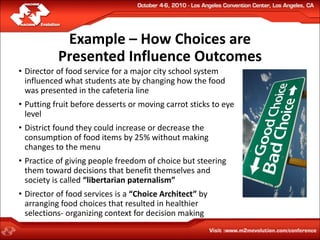
Example – How Choices are
           Presented Influence Outcomes
• Director of food service for a major city school system
  influenced what students ate by changing how the food
  was presented in the cafeteria line
• Putting fruit before desserts or moving carrot sticks to eye
  level
• District found they could increase or decrease the
  consumption of food items by 25% without making
  changes to the menu
• Practice of giving people freedom of choice but steering
  them toward decisions that benefit themselves and
  society is called “libertarian paternalism”
• Director of food services is a “Choice Architect” by
  arranging food choices that resulted in healthier
  selections- organizing context for decision making
Applying Libertarian Paternalism to M2M
     Applications Provide Incentives for People to “Do The Right Thing”

• Pay as You Drive captures driving behavior and encourages better driving
  habits through lower rates
    • i.e. Progressive Insurance with MyRate Program
• Congestion-based tolls to reduce traffic accidents, congestion and pollution
• Demand response programs in the utility sector encourage people to shift
  electric power usage to nonpeak periods
• Pay as You Throw households that throw out more pay more for trash
  collection encourages recycling
• Medical reminders to patients encourages better overall health
    • i.e. mHealth solution from Vitality, GlowCaps
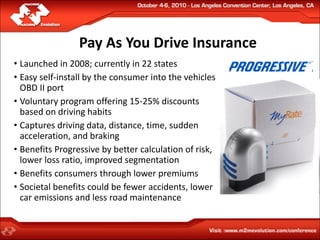
Pay As You Drive Insurance
• Launched in 2008; currently in 22 states
• Easy self-install by the consumer into the vehicles
  OBD II port
• Voluntary program offering 15-25% discounts
  based on driving habits
• Captures driving data, distance, time, sudden
  acceleration, and braking
• Benefits Progressive by better calculation of risk,
  lower loss ratio, improved segmentation
• Benefits consumers through lower premiums
• Societal benefits could be fewer accidents, lower
  car emissions and less road maintenance
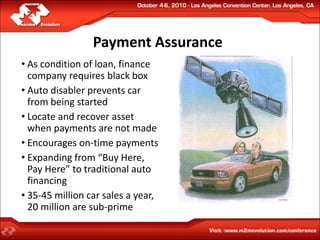
Payment Assurance
• As condition of loan, finance
  company requires black box
• Auto disabler prevents car
  from being started
• Locate and recover asset
  when payments are not made
• Encourages on-time payments
• Expanding from “Buy Here,
  Pay Here” to traditional auto
  financing
• 35-45 million car sales a year,
  20 million are sub-prime
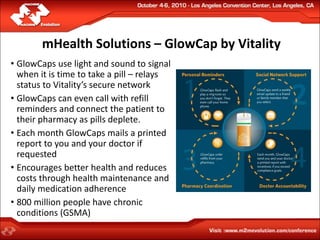
mHealth Solutions – GlowCap by Vitality
• GlowCaps use light and sound to signal
  when it is time to take a pill – relays
  status to Vitality’s secure network
• GlowCaps can even call with refill
  reminders and connect the patient to
  their pharmacy as pills deplete.
• Each month GlowCaps mails a printed
  report to you and your doctor if
  requested
• Encourages better health and reduces
  costs through health maintenance and
  daily medication adherence
• 800 million people have chronic
  conditions (GSMA)
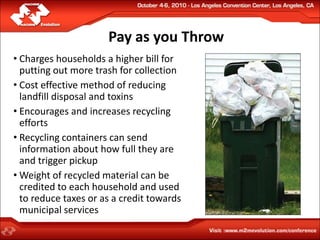
Pay as you Throw
• Charges households a higher bill for
  putting out more trash for collection
• Cost effective method of reducing
  landfill disposal and toxins
• Encourages and increases recycling
  efforts
• Recycling containers can send
  information about how full they are
  and trigger pickup
• Weight of recycled material can be
  credited to each household and used
  to reduce taxes or as a credit towards
  municipal services
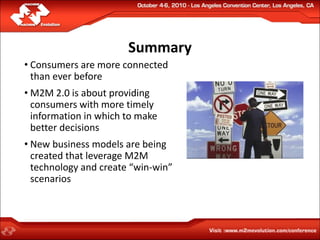
Summary
• Consumers are more connected
  than ever before
• M2M 2.0 is about providing
  consumers with more timely
  information in which to make
  better decisions
• New business models are being
  created that leverage M2M
  technology and create “win-win”
  scenarios
Mike ueland, telit

Mike ueland, telit

  • 2.
    The Connected Consumerand Smart M2M Services Mike Ueland Vice President & General Manager Telit Wireless Solutions
  • 3.
    Connected Consumers areMainstream 91% 92% 89% 6500% US wireless of population of the handsets Rate of AT&T”s penetration; 25% is covered by on wireless wireless data of all households 3G network carriers’ growth past 3 ½ yrs are wireless only networks are Web capable Sources: CTIA, AT&T, ABI Research
  • 4.
    Regularly visit Kindle eReader sales Over 300,000 iPads community sites tripled in the first half sold on the first day (Facebook, MySpace, of 2010 and are (April) YouTube) outselling hard covers Consumers are creating and consuming digital data and media
  • 5.
    Sample Applications M2M Functions • Track usage • Upload data • Report changes • Monitoring and notification • Transactions • Digital displays • Location tracking • eReaders/ emerging devices
  • 6.
    Moving to M2M2.0 M2M 1.0 M2M 2.0 Batch • Communication Real-time Productivity • Customer benefit Usage based pricing Niche • Market size Broad
  • 7.
    M2M 2.0 MarketDrivers • New OEM automotive telematics incorporating 3G (Audi) Emerging 3G • Opens up new applications Airtime & • Next generation 2G/3G modules driving down size/power/price Equipment Costs • Carriers open to innovative pricing models (i.e. Kindle) Operators • AT&T (EDO), Verizon (ODI), Sprint (Emerging Solutions) have all reorganized their structures Engaged • AT&T expects to boost subscriber penetration to 500% Regulatory • Legislations such as the eCall mandate in Europe, Resolution 245 of the Brazilian government and local initiatives in China create huge Changes market potential
  • 8.
    M2M‘s Impact onthe Connected Consumer m2m Enables Economic Incentives and Influences Positive Consumer Behavior  Recent reductions in the cost to deploy are enabling more consumer-focused applications  Applications have the potential to make a BIG impact on choices we make in our daily lives  Applications can produce positive benefits to individuals and society  Many of the new applications are driven by the principles of behavioral economics  Behavioral economics is a field of economic research that looks at how individuals make economic related decisions – what does this really mean….
  • 9.
    What is BehavioralEconomics? All of economics is meant to be about people’s behavior. Right?? So, what is behavioral economics, and how does it differ from traditional economics? Traditional Economics Behavioral Economics • Conceptualizes the world populated by humans that are A classic example is the rational that behave in a way to maximize their difference between opt-in individual self-interest and opt-out in a program such as organ donation. • Framework ignores or rules out virtually all behavior and If you tell people that they includes unrealistic traits can opt-in to donating their organs if they are killed, a few will feel Behavioral Economics strongly enough to do it— most people won't. If you • Assumes individuals don’t always make “rational” switch that to opt-out the decisions because of being influenced by other reverse happens—very few people opt out. factors/context • Markets are inefficient
  • 10.
    Example – HowChoices are Presented Influence Outcomes • Director of food service for a major city school system influenced what students ate by changing how the food was presented in the cafeteria line • Putting fruit before desserts or moving carrot sticks to eye level • District found they could increase or decrease the consumption of food items by 25% without making changes to the menu • Practice of giving people freedom of choice but steering them toward decisions that benefit themselves and society is called “libertarian paternalism” • Director of food services is a “Choice Architect” by arranging food choices that resulted in healthier selections- organizing context for decision making
  • 11.
    Applying Libertarian Paternalismto M2M Applications Provide Incentives for People to “Do The Right Thing” • Pay as You Drive captures driving behavior and encourages better driving habits through lower rates • i.e. Progressive Insurance with MyRate Program • Congestion-based tolls to reduce traffic accidents, congestion and pollution • Demand response programs in the utility sector encourage people to shift electric power usage to nonpeak periods • Pay as You Throw households that throw out more pay more for trash collection encourages recycling • Medical reminders to patients encourages better overall health • i.e. mHealth solution from Vitality, GlowCaps
  • 12.
    Pay As YouDrive Insurance • Launched in 2008; currently in 22 states • Easy self-install by the consumer into the vehicles OBD II port • Voluntary program offering 15-25% discounts based on driving habits • Captures driving data, distance, time, sudden acceleration, and braking • Benefits Progressive by better calculation of risk, lower loss ratio, improved segmentation • Benefits consumers through lower premiums • Societal benefits could be fewer accidents, lower car emissions and less road maintenance
  • 13.
    Payment Assurance • Ascondition of loan, finance company requires black box • Auto disabler prevents car from being started • Locate and recover asset when payments are not made • Encourages on-time payments • Expanding from “Buy Here, Pay Here” to traditional auto financing • 35-45 million car sales a year, 20 million are sub-prime
  • 14.
    mHealth Solutions –GlowCap by Vitality • GlowCaps use light and sound to signal when it is time to take a pill – relays status to Vitality’s secure network • GlowCaps can even call with refill reminders and connect the patient to their pharmacy as pills deplete. • Each month GlowCaps mails a printed report to you and your doctor if requested • Encourages better health and reduces costs through health maintenance and daily medication adherence • 800 million people have chronic conditions (GSMA)
  • 15.
    Pay as youThrow • Charges households a higher bill for putting out more trash for collection • Cost effective method of reducing landfill disposal and toxins • Encourages and increases recycling efforts • Recycling containers can send information about how full they are and trigger pickup • Weight of recycled material can be credited to each household and used to reduce taxes or as a credit towards municipal services
  • 16.
    Summary • Consumers aremore connected than ever before • M2M 2.0 is about providing consumers with more timely information in which to make better decisions • New business models are being created that leverage M2M technology and create “win-win” scenarios