Midpoint and Partition Formulas
The student will be able to (I can):
• Find the midpoint of two given points.
• Find the coordinates of an endpoint given one endpoint
and a midpoint.
• Find the coordinates of a point a fractional distance from
one end of a segment.
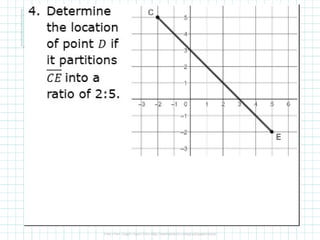
Partitions Formula
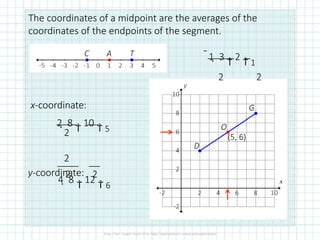
The coordinates of a midpoint are the averages of the
coordinates of the endpoints of the segment.
1  3

2
 1
2 2
C A T
G
x-coordinate:
(5, 6)
D
O
2  8

10
 5
2 2
2
2
y-coordinate:
4  8

12
 6
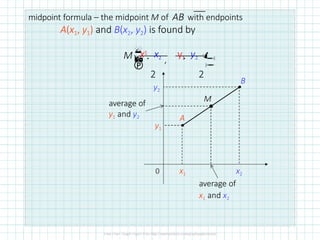
midpoint formula – the midpoint M of AB with endpoints
A(x1, y1) and B(x2, y2) is found by
1
M

x  x2
,
y1  y2 
2 2
 
 
A
B
y2
●
M
average of
y1 and y2
0 x1
y1
x2
average of
x1 and x2
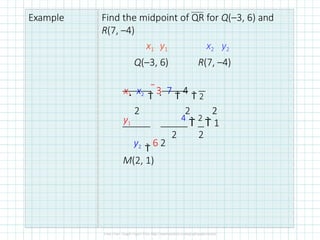
Example Find the midpoint of QR for Q(–3, 6) and
R(7, –4)
x1 y1 x2 y2
Q(–3, 6) R(7, –4)
x1  x2

3  7

4
 2
2 2 2
2
y1
y2

6 2
4

2
 1
2
M(2, 1)
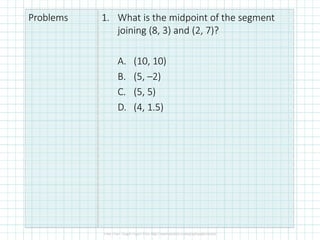
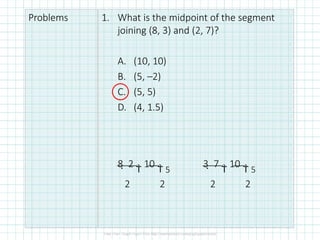
Problems 1. What is the midpoint of the segment
joining (8, 3) and (2, 7)?
A. (10, 10)
B. (5, –2)
C. (5, 5)
D. (4, 1.5)
Problems 1. What is the midpoint of the segment
joining (8, 3) and (2, 7)?
A. (10, 10)
B. (5, –2)
C. (5, 5)
D. (4, 1.5)
8  2

10
 5
2 2
3  7

10
 5
2 2
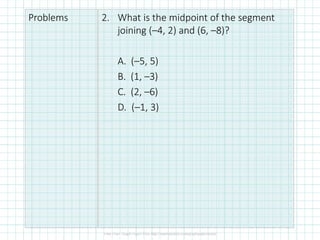
Problems 2. What is the midpoint of the segment
joining (–4, 2) and (6, –8)?
A. (–5, 5)
B. (1, –3)
C. (2, –6)
D. (–1, 3)
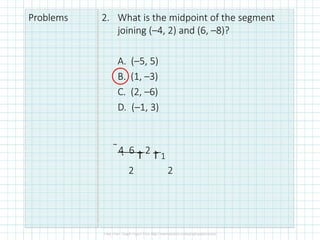
Problems 2. What is the midpoint of the segment
joining (–4, 2) and (6, –8)?
A. (–5, 5)
B. (1, –3)
C. (2, –6)
D. (–1, 3)
4  6

2
 1
2 2
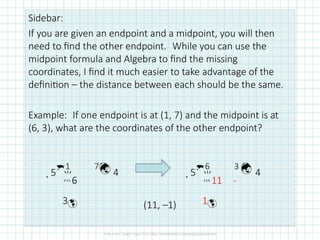
Sidebar:
If you are given an endpoint and a midpoint, you will then
need to find the other endpoint. While you can use the
midpoint formula and Algebra to find the missing
coordinates, I find it much easier to take advantage of the
definition – the distance between each should be the same.
Example: If one endpoint is at (1, 7) and the midpoint is at
(6, 3), what are the coordinates of the other endpoint?
(11, –1)
5
1 7
 4
 
6
3
5
6 3 
 4
 
11 -
1
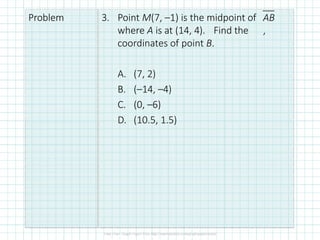
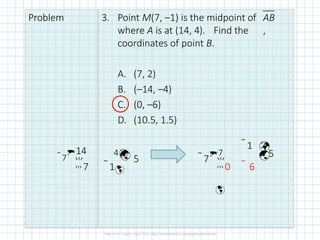
Problem 3. Point M(7, –1) is the midpoint of
where A is at (14, 4). Find the
coordinates of point B.
AB
,
A. (7, 2)
B. (–14, –4)
C. (0, –6)
D. (10.5, 1.5)
Problem 3. Point M(7, –1) is the midpoint of
where A is at (14, 4). Find the
coordinates of point B.
AB
,
A. (7, 2)
B. (–14, –4)
C. (0, –6)
D. (10.5, 1.5)
7
14 4
 5
 
7 1
1 
7
7  5
 
0  6

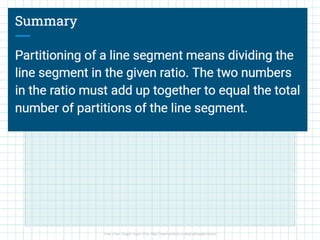
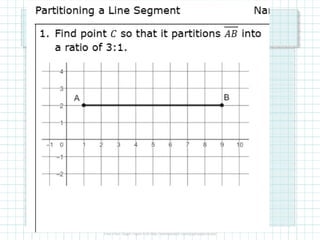
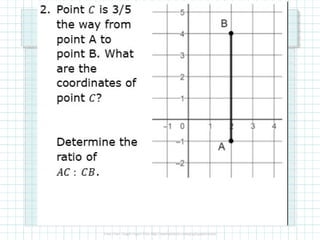
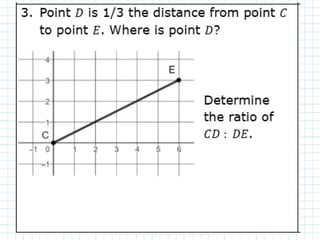
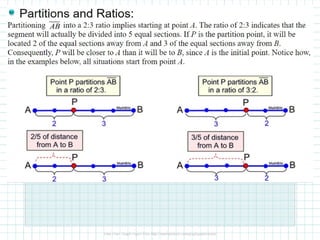
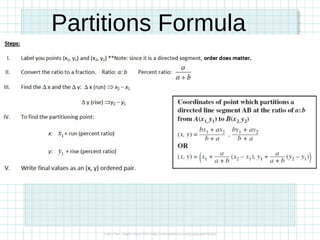
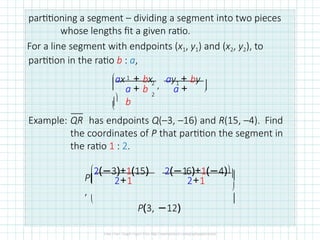
partitioning a segment – dividing a segment into two pieces
whose lengths fit a given ratio.
For a line segment with endpoints (x1, y1) and (x2, y2), to
partition in the ratio b : a,
2
, 1
2
ax + bx ay + by

 



1
a + b a +
b
Example: QR has endpoints Q(–3, –16) and R(15, –4). Find
the coordinates of P that partition the segment in
the ratio 1 : 2.
2(−3)+1(15) 2(−16)+1(−4)
P
,

2+1 2+1




P(3, −12)
midpoint and partition formula for geometry

midpoint and partition formula for geometry

  • 1.
    Midpoint and PartitionFormulas The student will be able to (I can): • Find the midpoint of two given points. • Find the coordinates of an endpoint given one endpoint and a midpoint. • Find the coordinates of a point a fractional distance from one end of a segment.
  • 9.
  • 10.
    The coordinates ofa midpoint are the averages of the coordinates of the endpoints of the segment. 1  3  2  1 2 2 C A T G x-coordinate: (5, 6) D O 2  8  10  5 2 2 2 2 y-coordinate: 4  8  12  6
  • 11.
    midpoint formula –the midpoint M of AB with endpoints A(x1, y1) and B(x2, y2) is found by 1 M  x  x2 , y1  y2  2 2     A B y2 ● M average of y1 and y2 0 x1 y1 x2 average of x1 and x2
  • 12.
    Example Find themidpoint of QR for Q(–3, 6) and R(7, –4) x1 y1 x2 y2 Q(–3, 6) R(7, –4) x1  x2  3  7  4  2 2 2 2 2 y1 y2  6 2 4  2  1 2 M(2, 1)
  • 13.
    Problems 1. Whatis the midpoint of the segment joining (8, 3) and (2, 7)? A. (10, 10) B. (5, –2) C. (5, 5) D. (4, 1.5)
  • 14.
    Problems 1. Whatis the midpoint of the segment joining (8, 3) and (2, 7)? A. (10, 10) B. (5, –2) C. (5, 5) D. (4, 1.5) 8  2  10  5 2 2 3  7  10  5 2 2
  • 15.
    Problems 2. Whatis the midpoint of the segment joining (–4, 2) and (6, –8)? A. (–5, 5) B. (1, –3) C. (2, –6) D. (–1, 3)
  • 16.
    Problems 2. Whatis the midpoint of the segment joining (–4, 2) and (6, –8)? A. (–5, 5) B. (1, –3) C. (2, –6) D. (–1, 3) 4  6  2  1 2 2
  • 17.
    Sidebar: If you aregiven an endpoint and a midpoint, you will then need to find the other endpoint. While you can use the midpoint formula and Algebra to find the missing coordinates, I find it much easier to take advantage of the definition – the distance between each should be the same. Example: If one endpoint is at (1, 7) and the midpoint is at (6, 3), what are the coordinates of the other endpoint? (11, –1) 5 1 7  4   6 3 5 6 3   4   11 - 1
  • 18.
    Problem 3. PointM(7, –1) is the midpoint of where A is at (14, 4). Find the coordinates of point B. AB , A. (7, 2) B. (–14, –4) C. (0, –6) D. (10.5, 1.5)
  • 19.
    Problem 3. PointM(7, –1) is the midpoint of where A is at (14, 4). Find the coordinates of point B. AB , A. (7, 2) B. (–14, –4) C. (0, –6) D. (10.5, 1.5) 7 14 4  5   7 1 1  7 7  5   0  6 
  • 20.
    partitioning a segment– dividing a segment into two pieces whose lengths fit a given ratio. For a line segment with endpoints (x1, y1) and (x2, y2), to partition in the ratio b : a, 2 , 1 2 ax + bx ay + by       1 a + b a + b Example: QR has endpoints Q(–3, –16) and R(15, –4). Find the coordinates of P that partition the segment in the ratio 1 : 2. 2(−3)+1(15) 2(−16)+1(−4) P ,  2+1 2+1     P(3, −12)