Mid exam / first term 2011 G.A. Atoll School, Kolamaafushi
Page 1 of 8
Biology/Grade 9
c
Student’s Name: ………………………………. Index: ……………. Class…………….
First Mid Term Examination
BIOLOGY
GRADE – 9
Total Marks: 50 Date: 8th
March 2011 Duration: 50 Minutes First Term- 2011
This document consists of 8 printed pages.
Section A (10 marks)
Answer all the questions by drawing a circle on the correct answer.
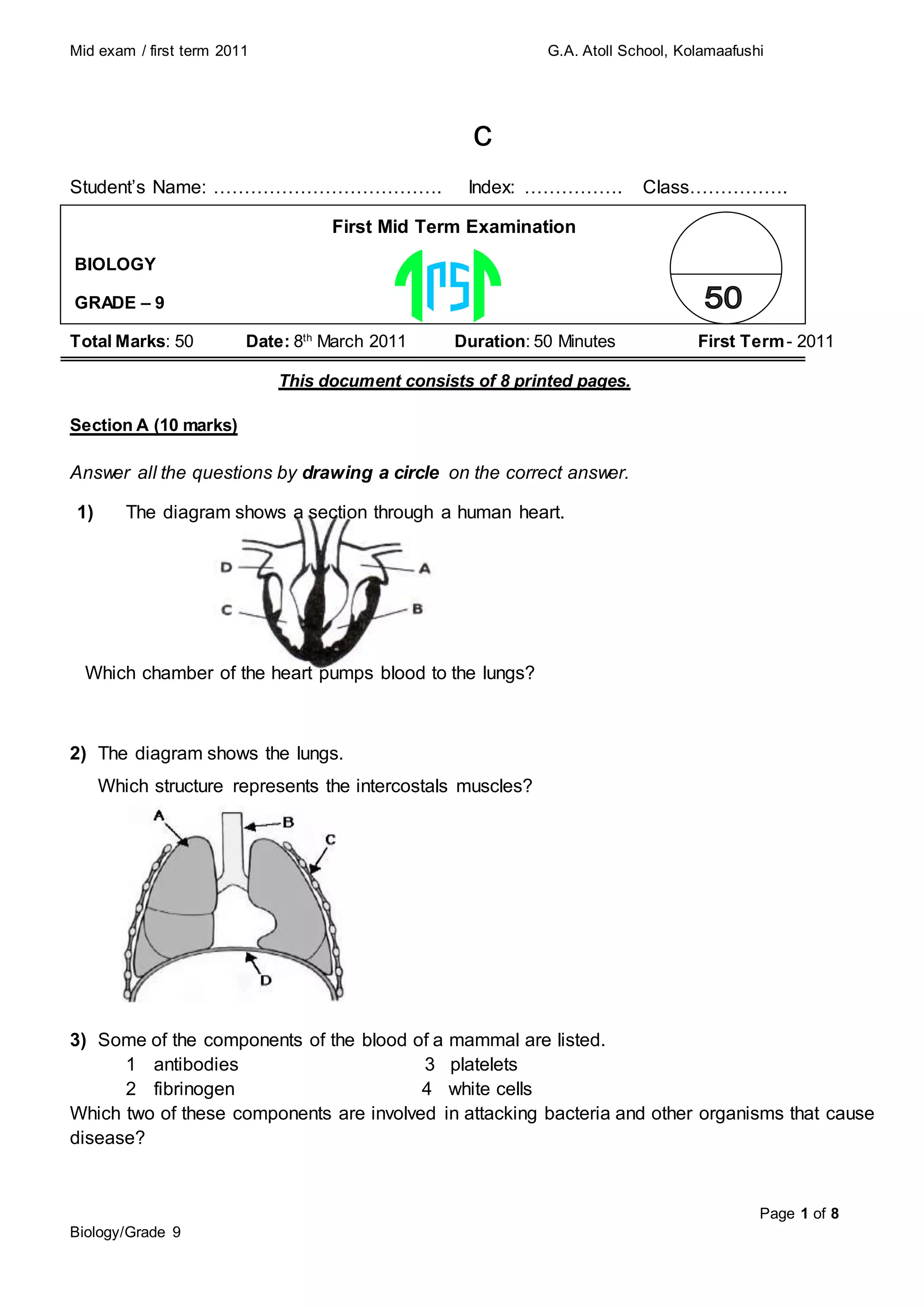
1) The diagram shows a section through a human heart.
Which chamber of the heart pumps blood to the lungs?
2) The diagram shows the lungs.
Which structure represents the intercostals muscles?
3) Some of the components of the blood of a mammal are listed.
1 antibodies 3 platelets
2 fibrinogen 4 white cells
Which two of these components are involved in attacking bacteria and other organisms that cause
disease?
Mid exam / first term 2011 G.A. Atoll School, Kolamaafushi
Page 2 of 8
Biology/Grade 9
A. 1 and 2 B. 1 and 4 C. 2 and 3 D. 3 and 4
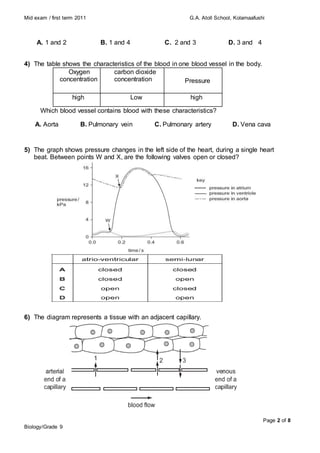
4) The table shows the characteristics of the blood in one blood vessel in the body.
Oxygen
concentration
carbon dioxide
concentration Pressure
high Low high
Which blood vessel contains blood with these characteristics?
A. Aorta B. Pulmonary vein C. Pulmonary artery D. Vena cava
5) The graph shows pressure changes in the left side of the heart, during a single heart
beat. Between points W and X, are the following valves open or closed?
6) The diagram represents a tissue with an adjacent capillary.
Mid exam / first term 2011 G.A. Atoll School, Kolamaafushi
Page 3 of 8
Biology/Grade 9
Which substances can 1, 2 and 3 represent?
1 2 3
A Glucose Tissue Fluid Carbon dioxide
B Oxygen Carbon dioxide Glucose
C Tissue Fluid Glucose Oxygen
D Tissue Fluid Oxygen Carbon dioxide
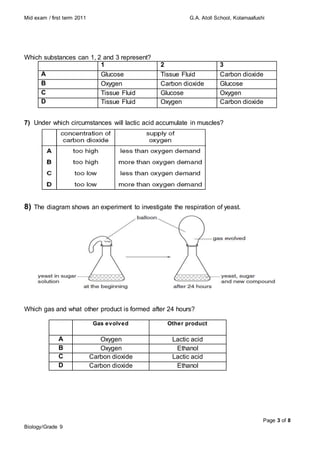
7) Under which circumstances will lactic acid accumulate in muscles?
8) The diagram shows an experiment to investigate the respiration of yeast.
Which gas and what other product is formed after 24 hours?
Gas evolved Other product
A Oxygen Lactic acid
B Oxygen Ethanol
C Carbon dioxide Lactic acid
D Carbon dioxide Ethanol
Mid exam / first term 2011 G.A. Atoll School, Kolamaafushi
Page 4 of 8
Biology/Grade 9
9) The graph shows changes in the concentration of lactic acid in the muscles of an athlete
both during and after a race
Concentration of lactic acid
in the muscles
Time after start of the race (minutes)
10) What do the cilia do in the bronchi of the lungs?
Section B (30 marks)
1) The diagram below represents the structure of the heart.
a) Use arrows to indicate the direction of blood flow through the heart. [1]
b) Name the parts labelled A to D.
A…………………………. B………………………….
C…………………………. D…………………………. [2]
When did the athlete finish the race?
A 1.0 minutes B 5.5 minutes C 7.5 minutes D 10.0 minutes
A
A A A
A
A A
A
A A
A
A B
B
B
C
A A A
A
A A
A
A A
A
D
B
A A A
A
A A
A
A A
A
A A A
A
A A
A
A A
A
B
A A A
A
A A
A
A A
A
E
A A A
A
A A
A
A A
A
F
A A A
A
A A
A
A A
A
G
A A A
A
A A
A
A A
A
Mid exam / first term 2011 G.A. Atoll School, Kolamaafushi
Page 5 of 8
Biology/Grade 9
c) What are the functions of D and E?
D………………………………………………………………………………………………
E…………………………………………………………………………………………….. [1]
d) Fig. 1.1 shows the volume of oxygenated blood pumped out of the left ventricle per
minute when the body is at rest and during exercise.
e) What is the maximum increase in the volume of blood pumped out of the left
ventricle during exercise?
……………………………………………………………………………………………....…[1]
f) Explain the advantages of this increased flow of blood during exercise.
……………………………………………………………………………………………………
……………………………………………………………………………………………………
……………………………………………………………………………………………………
…………………………………………………………………………………….............….[3]
a) How does cardiac muscle differ from muscles which move the body?
……………………………………………………………………………………………………
…………………………………………………………………………………………......….[1]
b) Complete the table to show whether the blood in vessels F and G, is oxygenated or
deoxygenated and under high or low pressure. [2]
Type of blood Type of pressure
F
G
[Total 11 marks]
Mid exam / first term 2011 G.A. Atoll School, Kolamaafushi
Page 6 of 8
Biology/Grade 9
2) Fig. shows a computerized image taken through the thorax (chest) of a person lying on their
back.
a) Identify the structures F, G, H . [3]
F..............................................
G..............................................
H..............................................
b) Areobic respiration takes place in the mitochondria of the cell
i) Define the term aerobic respiration. Write the equation. [2]
……………………………………………………………………………….....................................
....................................................................................................................................................
...................................................................................................................................................
[Total 5 marks]
3) Fig. shows a section through a small surface wound to the skin.
a) Name structure O and the type of blood vessel P shown in figure.
D……………………………………………………………………………………………….
E…………………………………………………………………………………………….... [1]
Mid exam / first term 2011 G.A. Atoll School, Kolamaafushi
Page 7 of 8
Biology/Grade 9
b) State two features that are characteristic of the type of blood vessel P.
1…………………………………………………………………………………………………
2………………………………………………………………………………...……….....… [2]
c) Explain what is happening to the bacteria in the above figure.
i) At M
……………………………………………………………………………………………………
…………………………………………………………………………………………......….[1]
ii) At N
……………………………………………………………………………………………………
…………………………………………………………………………………………….......[1]
d) Explain how the wound is being sealed in the region under the scab.
……………………………………………………………………………………………………
……………………………………………………………………………………………………
……………………………………………………………………………………………………
………………………………………………………………………………………..............[4]
[Total 9 marks]
4) The diagram represents a group of body cells and some parts of the circulatory system.
The arrows show movement of fluids.
a) Name the fluids contained in space x, y and z.
x………………………….. y……………………………. Z……………………… [1]
b) Name one substance that the cells remove from the fluid in y and one substance that
the cells add up to the fluid in y.
Removed substance: ………………………………………
Added substance: …………………………………………. [2]
YZ
Y
X
Lymphatic
capillary
Mid exam / first term 2011 G.A. Atoll School, Kolamaafushi
Page 8 of 8
Biology/Grade 9
c) Name a disease caused due to the blockage of vessels through which liquid X passes.
……………………………………………………………………………….……………..... [1]
d) Name a causative agent for the name disease in (e).
………………………………………………………………………………………………... [1]
[Total 5 marks]
Section C (10 marks)
1) a) Explain how structure of arteries are related to function of the circulatory
system [4]
b) Explain how a diet high in animal fat may cause coronary heart disease. [2]
[Total: 6]
2) Explain how the structures of alveoli are adapted to carry out the functions. [4]
[Total: 4]
Good luck

Mid exam bio

  • 1.
    Mid exam /first term 2011 G.A. Atoll School, Kolamaafushi Page 1 of 8 Biology/Grade 9 c Student’s Name: ………………………………. Index: ……………. Class……………. First Mid Term Examination BIOLOGY GRADE – 9 Total Marks: 50 Date: 8th March 2011 Duration: 50 Minutes First Term- 2011 This document consists of 8 printed pages. Section A (10 marks) Answer all the questions by drawing a circle on the correct answer. 1) The diagram shows a section through a human heart. Which chamber of the heart pumps blood to the lungs? 2) The diagram shows the lungs. Which structure represents the intercostals muscles? 3) Some of the components of the blood of a mammal are listed. 1 antibodies 3 platelets 2 fibrinogen 4 white cells Which two of these components are involved in attacking bacteria and other organisms that cause disease?
  • 2.
    Mid exam /first term 2011 G.A. Atoll School, Kolamaafushi Page 2 of 8 Biology/Grade 9 A. 1 and 2 B. 1 and 4 C. 2 and 3 D. 3 and 4 4) The table shows the characteristics of the blood in one blood vessel in the body. Oxygen concentration carbon dioxide concentration Pressure high Low high Which blood vessel contains blood with these characteristics? A. Aorta B. Pulmonary vein C. Pulmonary artery D. Vena cava 5) The graph shows pressure changes in the left side of the heart, during a single heart beat. Between points W and X, are the following valves open or closed? 6) The diagram represents a tissue with an adjacent capillary.
  • 3.
    Mid exam /first term 2011 G.A. Atoll School, Kolamaafushi Page 3 of 8 Biology/Grade 9 Which substances can 1, 2 and 3 represent? 1 2 3 A Glucose Tissue Fluid Carbon dioxide B Oxygen Carbon dioxide Glucose C Tissue Fluid Glucose Oxygen D Tissue Fluid Oxygen Carbon dioxide 7) Under which circumstances will lactic acid accumulate in muscles? 8) The diagram shows an experiment to investigate the respiration of yeast. Which gas and what other product is formed after 24 hours? Gas evolved Other product A Oxygen Lactic acid B Oxygen Ethanol C Carbon dioxide Lactic acid D Carbon dioxide Ethanol
  • 4.
    Mid exam /first term 2011 G.A. Atoll School, Kolamaafushi Page 4 of 8 Biology/Grade 9 9) The graph shows changes in the concentration of lactic acid in the muscles of an athlete both during and after a race Concentration of lactic acid in the muscles Time after start of the race (minutes) 10) What do the cilia do in the bronchi of the lungs? Section B (30 marks) 1) The diagram below represents the structure of the heart. a) Use arrows to indicate the direction of blood flow through the heart. [1] b) Name the parts labelled A to D. A…………………………. B…………………………. C…………………………. D…………………………. [2] When did the athlete finish the race? A 1.0 minutes B 5.5 minutes C 7.5 minutes D 10.0 minutes A A A A A A A A A A A A B B B C A A A A A A A A A A D B A A A A A A A A A A A A A A A A A A A A B A A A A A A A A A A E A A A A A A A A A A F A A A A A A A A A A G A A A A A A A A A A
  • 5.
    Mid exam /first term 2011 G.A. Atoll School, Kolamaafushi Page 5 of 8 Biology/Grade 9 c) What are the functions of D and E? D……………………………………………………………………………………………… E…………………………………………………………………………………………….. [1] d) Fig. 1.1 shows the volume of oxygenated blood pumped out of the left ventricle per minute when the body is at rest and during exercise. e) What is the maximum increase in the volume of blood pumped out of the left ventricle during exercise? ……………………………………………………………………………………………....…[1] f) Explain the advantages of this increased flow of blood during exercise. …………………………………………………………………………………………………… …………………………………………………………………………………………………… …………………………………………………………………………………………………… …………………………………………………………………………………….............….[3] a) How does cardiac muscle differ from muscles which move the body? …………………………………………………………………………………………………… …………………………………………………………………………………………......….[1] b) Complete the table to show whether the blood in vessels F and G, is oxygenated or deoxygenated and under high or low pressure. [2] Type of blood Type of pressure F G [Total 11 marks]
  • 6.
    Mid exam /first term 2011 G.A. Atoll School, Kolamaafushi Page 6 of 8 Biology/Grade 9 2) Fig. shows a computerized image taken through the thorax (chest) of a person lying on their back. a) Identify the structures F, G, H . [3] F.............................................. G.............................................. H.............................................. b) Areobic respiration takes place in the mitochondria of the cell i) Define the term aerobic respiration. Write the equation. [2] ………………………………………………………………………………..................................... .................................................................................................................................................... ................................................................................................................................................... [Total 5 marks] 3) Fig. shows a section through a small surface wound to the skin. a) Name structure O and the type of blood vessel P shown in figure. D………………………………………………………………………………………………. E…………………………………………………………………………………………….... [1]
  • 7.
    Mid exam /first term 2011 G.A. Atoll School, Kolamaafushi Page 7 of 8 Biology/Grade 9 b) State two features that are characteristic of the type of blood vessel P. 1………………………………………………………………………………………………… 2………………………………………………………………………………...……….....… [2] c) Explain what is happening to the bacteria in the above figure. i) At M …………………………………………………………………………………………………… …………………………………………………………………………………………......….[1] ii) At N …………………………………………………………………………………………………… …………………………………………………………………………………………….......[1] d) Explain how the wound is being sealed in the region under the scab. …………………………………………………………………………………………………… …………………………………………………………………………………………………… …………………………………………………………………………………………………… ………………………………………………………………………………………..............[4] [Total 9 marks] 4) The diagram represents a group of body cells and some parts of the circulatory system. The arrows show movement of fluids. a) Name the fluids contained in space x, y and z. x………………………….. y……………………………. Z……………………… [1] b) Name one substance that the cells remove from the fluid in y and one substance that the cells add up to the fluid in y. Removed substance: ……………………………………… Added substance: …………………………………………. [2] YZ Y X Lymphatic capillary
  • 8.
    Mid exam /first term 2011 G.A. Atoll School, Kolamaafushi Page 8 of 8 Biology/Grade 9 c) Name a disease caused due to the blockage of vessels through which liquid X passes. ……………………………………………………………………………….……………..... [1] d) Name a causative agent for the name disease in (e). ………………………………………………………………………………………………... [1] [Total 5 marks] Section C (10 marks) 1) a) Explain how structure of arteries are related to function of the circulatory system [4] b) Explain how a diet high in animal fat may cause coronary heart disease. [2] [Total: 6] 2) Explain how the structures of alveoli are adapted to carry out the functions. [4] [Total: 4] Good luck