Microsoft’s new CEO 
SATYA NADELLA
INTRODUCTION 
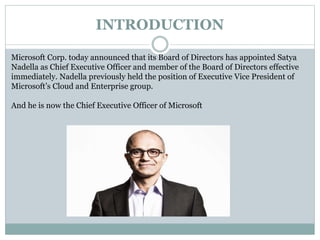
Microsoft Corp. today announced that its Board of Directors has appointed Satya 
Nadella as Chief Executive Officer and member of the Board of Directors effective 
immediately. Nadella previously held the position of Executive Vice President of 
Microsoft’s Cloud and Enterprise group. 
And he is now the Chief Executive Officer of Microsoft
Journey to the CEO 
“During this time of transformation, there is no better person to lead Microsoft 
than Satya Nadella,” said Bill Gates, Microsoft’s Founder and Member of the 
Board of Directors. “Satya is a proven leader with hard-core engineering skills, 
business vision and the ability to bring people together. His vision for how 
technology will be used and experienced around the world is exactly what 
Microsoft needs as the company enters its next chapter of expanded product 
innovation and growth.” 
“Having worked with him for more than 20 years, I know that Satya is the right 
leader at the right time for Microsoft,” said Steve Ballmer, who announced on Aug. 
23, 2013 that he would retire once a successor was named. “I’ve had the distinct 
privilege of working with the most talented employees and senior leadership team 
in the industry, and I know their passion and hunger for greatness will only grow 
stronger under Satya’s leadership.” 
Founded in 1975, Microsoft (Nasdaq “MSFT”) is the worldwide leader in software, 
services and solutions that help people and businesses realize their full potential.
Reasons for changing CEO of Microsoft 
Microsoft has not done itself or Nadella any favours by taking this long to pick a 
CEO. To outsiders, it seems that Microsoft’s board was uninspired by internal 
candidates, decided to go hunting elsewhere, couldn’t find a fit, and then 
returned home to settle on a familiar face. 
As Bloomberg News reported, there also appears to be talk of replacing Bill 
Gates as chairman with an existing board member. That’s an odd move, too. It 
represents a big break with the past and a willingness to change, for sure. But 
Microsoft’s board isn’t exactly known as the most proactive, decisive bunch. So 
trade Gates, the legend, for a lesser figure? It’s hard to imagine anyone doing 
a monkey boy dance for that.
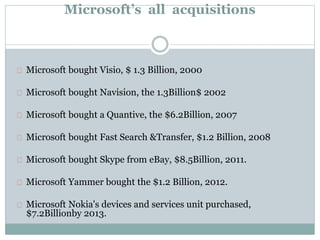
Microsoft’s all acquisitions 
Microsoft bought Visio, $ 1.3 Billion, 2000 
Microsoft bought Navision, the 1.3Billion$ 2002 
Microsoft bought a Quantive, the $6.2Billion, 2007 
Microsoft bought Fast Search &Transfer, $1.2 Billion, 2008 
Microsoft bought Skype from eBay, $8.5Billion, 2011. 
Microsoft Yammer bought the $1.2 Billion, 2012. 
Microsoft Nokia's devices and services unit purchased, 
$7.2Billionby 2013.
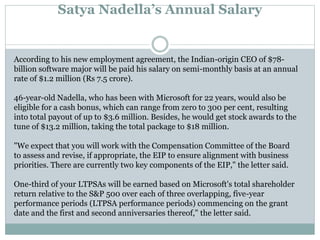
Satya Nadella’s Annual Salary 
According to his new employment agreement, the Indian-origin CEO of $78- 
billion software major will be paid his salary on semi-monthly basis at an annual 
rate of $1.2 million (Rs 7.5 crore). 
46-year-old Nadella, who has been with Microsoft for 22 years, would also be 
eligible for a cash bonus, which can range from zero to 300 per cent, resulting 
into total payout of up to $3.6 million. Besides, he would get stock awards to the 
tune of $13.2 million, taking the total package to $18 million. 
"We expect that you will work with the Compensation Committee of the Board 
to assess and revise, if appropriate, the EIP to ensure alignment with business 
priorities. There are currently two key components of the EIP," the letter said. 
One-third of your LTPSAs will be earned based on Microsoft's total shareholder 
return relative to the S&P 500 over each of three overlapping, five-year 
performance periods (LTPSA performance periods) commencing on the grant 
date and the first and second anniversaries thereof," the letter said.
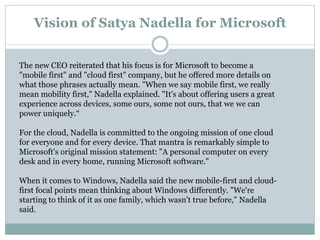
Vision of Satya Nadella for Microsoft 
The new CEO reiterated that his focus is for Microsoft to become a 
"mobile first" and "cloud first" company, but he offered more details on 
what those phrases actually mean. "When we say mobile first, we really 
mean mobility first," Nadella explained. "It's about offering users a great 
experience across devices, some ours, some not ours, that we we can 
power uniquely.“ 
For the cloud, Nadella is committed to the ongoing mission of one cloud 
for everyone and for every device. That mantra is remarkably simple to 
Microsoft's original mission statement: "A personal computer on every 
desk and in every home, running Microsoft software." 
When it comes to Windows, Nadella said the new mobile-first and cloud-first 
focal points mean thinking about Windows differently. "We're 
starting to think of it as one family, which wasn't true before," Nadella 
said.
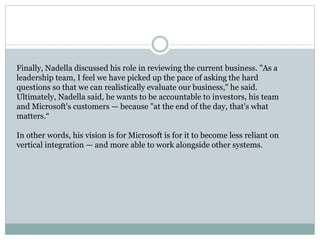
Finally, Nadella discussed his role in reviewing the current business. "As a 
leadership team, I feel we have picked up the pace of asking the hard 
questions so that we can realistically evaluate our business," he said. 
Ultimately, Nadella said, he wants to be accountable to investors, his team 
and Microsoft's customers — because "at the end of the day, that's what 
matters.“ 
In other words, his vision is for Microsoft is for it to become less reliant on 
vertical integration — and more able to work alongside other systems.
Satya Nadella’s life before Microsoft 
Nadella, 46, was born in Hyderabad, India. Growing up, playing cricket was his 
“passion,” and he played it competitively as a member of his school’s team. “I 
think playing cricket taught me more about working in teams and leadership that 
has stayed with me throughout my career.” 
Nadella “always wanted to build things,” he says. He knew that computer science 
was what he wanted to pursue. But that emphasis was not available when he 
attended Mangalore University in India, where he got a bachelor’s degree in 
electrical engineering. “And so it was a great way for me to go discover what 
turned out to become a passion,” he says. 
He went on to earn a master's degree in computer science from the University of 
Wisconsin – Milwaukee, then a master’s degree in business administration from 
the University of Chicago. 
Nadella “always wanted to build things,” he says. He knew that computer science 
was what he wanted to pursue. But that emphasis was not available when he 
attended Mangalore University in India, where he got a bachelor’s degree in 
electrical engineering. “And so it was a great way for me to go discover what 
turned out to become a passion,” he says.
He started his career as a member of the technology staff at Sun Microsystems. 
In 1992, he joined Microsoft. He was on his way to get a master’s degree in 
business when the Microsoft job offer came. The company was building an 
operating system that ultimately would be known as Windows NT, and needed 
team members who understood UNIX and 32-bit operating systems, he says. 
Nadella wanted to complete his master’s degree and take the Microsoft job 
I marvel every day at how people can excel - and that’s what really 
gets me going.
Thought of Satya Nadella 
With a perspective based on more than two decades at Microsoft as someone 
who pushed to make dynamic changes happen, both in the company’s 
products and its culture, Satya Nadella says he is both “honored and humbled” 
to succeed Bill Gates and Steve Ballmer as the third CEO of Microsoft. 
“Our industry does not respect tradition - it only respects innovation,” he says. 
“The opportunity ahead for Microsoft is vast, but to seize it, we must move 
faster, focus and continue to transform. I see a big part of my job as 
accelerating our ability to bring innovative products to our customers more 
quickly.” 
Our industry does not respect tradition - it only respects innovation
Thank you

Microsoft’s new ceo

  • 1.
    Microsoft’s new CEO SATYA NADELLA
  • 2.
    INTRODUCTION Microsoft Corp.today announced that its Board of Directors has appointed Satya Nadella as Chief Executive Officer and member of the Board of Directors effective immediately. Nadella previously held the position of Executive Vice President of Microsoft’s Cloud and Enterprise group. And he is now the Chief Executive Officer of Microsoft
  • 3.
    Journey to theCEO “During this time of transformation, there is no better person to lead Microsoft than Satya Nadella,” said Bill Gates, Microsoft’s Founder and Member of the Board of Directors. “Satya is a proven leader with hard-core engineering skills, business vision and the ability to bring people together. His vision for how technology will be used and experienced around the world is exactly what Microsoft needs as the company enters its next chapter of expanded product innovation and growth.” “Having worked with him for more than 20 years, I know that Satya is the right leader at the right time for Microsoft,” said Steve Ballmer, who announced on Aug. 23, 2013 that he would retire once a successor was named. “I’ve had the distinct privilege of working with the most talented employees and senior leadership team in the industry, and I know their passion and hunger for greatness will only grow stronger under Satya’s leadership.” Founded in 1975, Microsoft (Nasdaq “MSFT”) is the worldwide leader in software, services and solutions that help people and businesses realize their full potential.
  • 4.
    Reasons for changingCEO of Microsoft Microsoft has not done itself or Nadella any favours by taking this long to pick a CEO. To outsiders, it seems that Microsoft’s board was uninspired by internal candidates, decided to go hunting elsewhere, couldn’t find a fit, and then returned home to settle on a familiar face. As Bloomberg News reported, there also appears to be talk of replacing Bill Gates as chairman with an existing board member. That’s an odd move, too. It represents a big break with the past and a willingness to change, for sure. But Microsoft’s board isn’t exactly known as the most proactive, decisive bunch. So trade Gates, the legend, for a lesser figure? It’s hard to imagine anyone doing a monkey boy dance for that.
  • 5.
    Microsoft’s all acquisitions Microsoft bought Visio, $ 1.3 Billion, 2000 Microsoft bought Navision, the 1.3Billion$ 2002 Microsoft bought a Quantive, the $6.2Billion, 2007 Microsoft bought Fast Search &Transfer, $1.2 Billion, 2008 Microsoft bought Skype from eBay, $8.5Billion, 2011. Microsoft Yammer bought the $1.2 Billion, 2012. Microsoft Nokia's devices and services unit purchased, $7.2Billionby 2013.
  • 6.
    Satya Nadella’s AnnualSalary According to his new employment agreement, the Indian-origin CEO of $78- billion software major will be paid his salary on semi-monthly basis at an annual rate of $1.2 million (Rs 7.5 crore). 46-year-old Nadella, who has been with Microsoft for 22 years, would also be eligible for a cash bonus, which can range from zero to 300 per cent, resulting into total payout of up to $3.6 million. Besides, he would get stock awards to the tune of $13.2 million, taking the total package to $18 million. "We expect that you will work with the Compensation Committee of the Board to assess and revise, if appropriate, the EIP to ensure alignment with business priorities. There are currently two key components of the EIP," the letter said. One-third of your LTPSAs will be earned based on Microsoft's total shareholder return relative to the S&P 500 over each of three overlapping, five-year performance periods (LTPSA performance periods) commencing on the grant date and the first and second anniversaries thereof," the letter said.
  • 7.
    Vision of SatyaNadella for Microsoft The new CEO reiterated that his focus is for Microsoft to become a "mobile first" and "cloud first" company, but he offered more details on what those phrases actually mean. "When we say mobile first, we really mean mobility first," Nadella explained. "It's about offering users a great experience across devices, some ours, some not ours, that we we can power uniquely.“ For the cloud, Nadella is committed to the ongoing mission of one cloud for everyone and for every device. That mantra is remarkably simple to Microsoft's original mission statement: "A personal computer on every desk and in every home, running Microsoft software." When it comes to Windows, Nadella said the new mobile-first and cloud-first focal points mean thinking about Windows differently. "We're starting to think of it as one family, which wasn't true before," Nadella said.
  • 8.
    Finally, Nadella discussedhis role in reviewing the current business. "As a leadership team, I feel we have picked up the pace of asking the hard questions so that we can realistically evaluate our business," he said. Ultimately, Nadella said, he wants to be accountable to investors, his team and Microsoft's customers — because "at the end of the day, that's what matters.“ In other words, his vision is for Microsoft is for it to become less reliant on vertical integration — and more able to work alongside other systems.
  • 9.
    Satya Nadella’s lifebefore Microsoft Nadella, 46, was born in Hyderabad, India. Growing up, playing cricket was his “passion,” and he played it competitively as a member of his school’s team. “I think playing cricket taught me more about working in teams and leadership that has stayed with me throughout my career.” Nadella “always wanted to build things,” he says. He knew that computer science was what he wanted to pursue. But that emphasis was not available when he attended Mangalore University in India, where he got a bachelor’s degree in electrical engineering. “And so it was a great way for me to go discover what turned out to become a passion,” he says. He went on to earn a master's degree in computer science from the University of Wisconsin – Milwaukee, then a master’s degree in business administration from the University of Chicago. Nadella “always wanted to build things,” he says. He knew that computer science was what he wanted to pursue. But that emphasis was not available when he attended Mangalore University in India, where he got a bachelor’s degree in electrical engineering. “And so it was a great way for me to go discover what turned out to become a passion,” he says.
  • 10.
    He started hiscareer as a member of the technology staff at Sun Microsystems. In 1992, he joined Microsoft. He was on his way to get a master’s degree in business when the Microsoft job offer came. The company was building an operating system that ultimately would be known as Windows NT, and needed team members who understood UNIX and 32-bit operating systems, he says. Nadella wanted to complete his master’s degree and take the Microsoft job I marvel every day at how people can excel - and that’s what really gets me going.
  • 11.
    Thought of SatyaNadella With a perspective based on more than two decades at Microsoft as someone who pushed to make dynamic changes happen, both in the company’s products and its culture, Satya Nadella says he is both “honored and humbled” to succeed Bill Gates and Steve Ballmer as the third CEO of Microsoft. “Our industry does not respect tradition - it only respects innovation,” he says. “The opportunity ahead for Microsoft is vast, but to seize it, we must move faster, focus and continue to transform. I see a big part of my job as accelerating our ability to bring innovative products to our customers more quickly.” Our industry does not respect tradition - it only respects innovation
  • 12.