SEPTEMBER 2016 / REPORT ON BUSINESS  27
NINE
THINGS
WE
LEARNEDDURINGOURTW
ENTY-
O
N
E-
AND-
A-
HUMBLE,
HALF-
WORKAHOLIC,
MINUTE
VERY
CONVERSATION
BUSY
WITH
CEO
MICROSOFT’S
SATYANADELLA
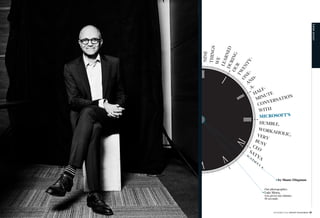
by Shane Dingman
Our photographer,
Luis Mora,
was given one minute,
50 seconds
coverstory
28  SEPTEMBER 2016 / REPORT ON BUSINESS SEPTEMBER 2016 / REPORT ON BUSINESS  29
PHOTOGRAPHS(LEFT)LUISMORA;(GATES)JOSHUAROBERTS/REUTERS;(BALLMER)KRISZTIANBOCSI/BLOOMBERG
way to look forward. Because where we
came from, the sense of pride, the learn-
ings—it’s really about, are we better
tomorrow at serving these partners and
customers, and how do we reinvent,
even? Technologies will come and go,
but as long as you have a culture that’s
being renewed, and a sense of identity
and purpose that’s constant, I think we
will be a new Microsoft every day.
Microsoft is everywhere.
Whenever I think about what it is
that Microsoft creates and how Micro-
soft operates, the partner opportunities
we create are a key part of it. To me,
that’s at the foundation for our com-
pany. It’s not just about having a bunch
of your own technology that is being
used. It’s about the technology that is
helping others create more technology.
Whenever I am in a country, I think
about, okay, how many partners are
there who are building their own busi-
nesses around our platforms? The next
thing I would look for is, what are the
start-ups? Then I think about the small
businesses, because the lifeblood of any
country is the small business. How are
they adopting technology? How are
they using cloud services? The cloud
has really reduced the barrier for small
businesses to have the same technology
the large businesses have had, now with
no friction.
Then there’s the public sector. One
of the reasons we created our data cen-
tres, and launched them this year here
in Canada, is to help transform the pub-
lic sector—you have to think about the
taxpayer dollar going a much longer
way. There is fascinating innovation I
see—in many emerging markets, and
hopefully we’ll see it in Canada too—
where the public sector organizations
are able to take advantage of that.
And of course the large multination-
als matter. Manulife—they are one of
the biggest users in the world of our
cloud-computing platform, Azure.
So it’s that broad spectrum—helping
large businesses become more globally
competitive, small businesses become
more productive, the public sector
get more efficient, the start-ups using
our infrastructure to build businesses.
We’re not just one consumer Internet
company with lots of users in Canada.
We are here providing fundamental
technology for the Canadian economy
to grow with Canadian participation.
If it weren’t for Microsoft,
Nadella would still be back in India.
It’s such a privilege for me to have a
chance to lead an organization like
Microsoft. If it were not for the democ-
ratizing force of Microsoft’s technol-
ogy reaching me growing up in India, I
would have never come to the United
States or become CEO of Microsoft, so
I’m thankful. I feel blessed to have that
opportunity. I feel like now, to have
that same platform have an impact in
the world, is just...wow, this is great. So
that’s my life and my work.
The sheer vastness of his responsi-
bilities as CEO came as a shock.
There is no such thing as looking to get
trained to become CEO. That’s not how
it works. It’s like, what if you took every
job you had and thought of it as the big-
gest, greatest job, and learned the most
and had the most expansive view of the
impact you can have? Throughout my
career, I’ve always pushed myself to do
that—learn, learn, learn. And to some
degree, that helped. Even in the role I
had before becoming CEO, I would at
least frame things as broadly as I could.
Not because I was thinking, “One day
I’m going to become CEO”—that was
the last thing I expected. I mean, the
week before it was announced, I don’t
think I knew I was going to be CEO of
Microsoft.
And believe me, I’ve learned so much
in the job. I felt I knew what a multi-
constituent world we live in, but to
know that it’s about investors, it’s about
employees, it’s about partners, it’s
about the local communities in every
country we participate in, and to know
you’ve got to keep a balance with that
all the time—I don’t think you get that
sense until you become CEO and sit in
that seat.
He might prefer hoodies to suits,
but he’s not exactly an outsider.
You have to remember, I’m a consum-
mate insider. I grew up in Microsoft
under Gates and Ballmer, and I have a
lot of respect for what they have done.
I learned a lot throughout that jour-
ney. And I’m fundamentally not about,
there’s the old Microsoft and there’s the
new Microsoft. I’m about, there is a new
Microsoft every day. We’re pushing
ourselves to question our assumptions,
to learn how we can be better. Look-
ing back is only interesting to me as a
30,100
Number of
employees Microsoft
has laid off since
2014—the bulk
of them in the wake
of the disastrous
acquisition of Nokia’s
handset division
(which happened the
year before Nadella
took over)
HE’S JUST THE
THIRD CEO IN THE
COMPANY’S
41-YEAR HISTORY
Bill Gates
1975–2000
NET WORTH
$79 BILLION
(U.S.)
Steve Ballmer
2000–2014
NET WORTH
$28 BILLION
(U.S.)
Nadella
2014–2015
COMPENSATION
$18.3 MILLION
(plus $59 million
in restricted stock
granted in 2014,
an award he is
eligible for in 2019)
his schedule regimented down
to the second. Satya Nadella is,
after all, in charge of one of the
world’s most ubiquitous tech-
nology companies, with 114,000
employees, annual revenue of
$85.3 billion (all currency in
U.S. dollars) and a market capi-
talization of $450 billion (up
49% since the Microsoft lifer
took over from Steve Ballmer in
2014). Microsoft is the dominant
name in desktop computing—
more than a billion people use
Office or Windows every day.
But the company has struggled
in the past decade, most notably
missing out on mobile almost
entirely—Ballmerlaughedatthe
iPhone back in 2007 for not hav-
ing a physical keyboard; Apple
just sold its billionth device in
July. It falls to Nadella to ensure
Microsoft doesn’t miss out on
the next big things—cloud ser-
vices (which now account for
29% of revenues), remote com-
puting, the Internet of Things,
machine learning and other
Possibly Nadella's
biggest misstep
so far came
less than a year
after he took over,
when asked
about women
asking for raises.
His answer:
“It’s not really
about asking for
the raise, but
knowing and
having faith that
the system will
actually give you
the right raises
as you go along.
Because that’s
good karma.
It’ll come back.”
Swift backlash
ensued.
He was born in
1967 in Hyderabad,
the son of a civil
servant, and
studied electrical
engineering in India
before moving to
Milwaukee to do
his master’s in
computer science.
THE
CEO
OF
MICROSOFT
IS
A
BUSY
MAN,
new, more human computing
interfaces that could someday
make the mouse and keyboard
look laughably quaint.
We sat down with Nadella in
Toronto (albeit briefly) to talk
about the LinkedIn deal that
will shape his legacy, the future
of gaming, his family life and
how he plans to steer what was
once seen—and sometimes still
is seen—as a defensive battle-
ship as it enters its fifth decade.
AS OF THE END
OF 2015, THE
NEW MICROSOFT
LOOKED A LOT LIKE
THE OLD ONE
Rank and file:
73%
MALE
59%
WHITE
Leadership:
82%
MALE
70%
WHITE
30  SEPTEMBER 2016 / REPORT ON BUSINESS
PHOTOGRAPH(CRICKET)JEKESAINJIKIZANA/AFP
He wants your kids to play even more
Minecraft than they already do.
To see how Minecraft is changing this
summer in North America, who would
have thought that a game franchise
would not only be a great, great game
franchise, but also helping introduce
STEM [science, technology, engineer-
ing and math] education to boys and
girls all over the world? That’s the kind
of company we are.
Canadian companies need to bust
outside our borders.
You’ve really got to get large businesses
here to become great multinationals.
And when you think about a multina-
tional company operating under many
different jurisdictions, they need the
right type of partners. For example, one
of the things we do is have our cloud
infrastructure not only in Canada, but
also in many other regions, like China. I
know that a lot of Canadian companies
think about what is their export orienta-
tion, what are they doing with some of
these other markets—we are very, very
helpful in making that possible.
I think it’s fundamental to how Can-
ada rides this fourth industrial revolu-
tion and participates in it. To think about
it not in any one singular dimension, but
to have a national agenda, which talks
about start-ups that are getting built out
of here. What is the small business pro-
ductivity that is being gained, because
every small business is part of some dis-
tribution or supply chain of large busi-
nesses either here or worldwide?
He’s a total workaholic.
What does balance mean? One per-
son’s balance is different from another
person’s balance. What I try to do is find
some harmony between what is consid-
ered work and what is considered life.
And quite honestly, a little bit of that is
about making work your life and your
life your work.
But again, there are practical things
one needs to do in today’s world,
because we all have finite time, and
family matters. Community matters.
Being able to harmonize those things is
super-important. So the time I’m with
my daughters and my son—those few
minutes and few hours I spend over the
weekends with them—can I be really
present? That’s hard to do, but a very
important thing that I strive to get bet-
ter at each day.
Microsoft’s newest acquisition,
LinkedIn, is about to be
everywhere, too.
We are very, very excited about the
LinkedIn deal. It’s a great—it’s the
only—professional network out there.
The world’s professionals are also
using things like Office and Windows—
we have an install base of a billion and
a half. So the most natural thing to do,
before we do one line of code of integra-
tion, is to bring the core distribution of
Microsoft to LinkedIn, to make it a daily
habit for our users.
Then, one of the real core dreams
I’ve always had is, what if we can bring
Office 365 and LinkedIn together to help
the user? To not have seams between
their everyday productivity and com-
munication and their professional net-
work? Similarly, what if we can have the
salesperson who uses LinkedIn to find
customers also use Microsoft’s Dynam-
ics CRM system? Same thing in recruit-
ing, same thing in learning.
That’s really the opportunity ahead.
And by the way, all of those integrations
can be done in a loosely coupled way—
you don’t have to go in to the code of
LinkedIn to change it. All you gotta do
is integrations. Some of those integra-
tions couldn’t have been done with a
commercial relationship, because it’s a
proprietary service in a database that
can only be integrated when you have
full ownership of that asset.
No Apple envy here.
I don’t want to do things out of envy.
I want to do things that we were born
to do, that the world expects us to do.
I think about empowering people and
organizations all over the planet to
achieve more. It’s key to keep thinking
about Microsoft as the only place where
we can not only do magical things for
people but, more importantly, for
the organizations that people build—
which, in many cases, will outlast them.
That’s paramount—for our custom-
ers and our partners and anyone else to
know and to recognize Microsoft as a
trusted partner. And for our Microsoft
team members to be mission-driven
and driven by this cultural growth
mindset. I want us to be proud of that.
I also want people to understand that
it’s not an abstract thing—it’s the daily
choices of the 100,000 people who work
here that shape it as an organic thing.
That’s the core.
One of his
favourite ways
to unwind is
watching cricket—
particularly
the days-long
spectacle of test
cricket, because of
its complexity:
“There’s so many
subplots in it,”
he has said,
“it’s like reading a
Russian novel.”
100 MILLION
Number of Minecraft
downloads across
all platforms since
its launch in 2011.
Microsoft bought the
creator of the digital
building game,
Mojang, in 2014,
and this past
summer, it launched
an Education Edition
of Minecraft—
another step on
its journey to
embed Windows
in the classroom.
See the HoloLens,
a totally different
take on the
headset/wearable
computing or VR
interfaces than
almost anyone else
in the market.
It paid
$26.2 BILLION
for LinkedIn, which
has 433 million
members and 105
million unique
visitors per month.
Microsoft’s
five biggest
pre-LinkedIn
acquisitions:
Skype
(consumer VoIP)
$8.5 BILLION
(2011)
Nokia phone unit
(handsets)
$7.2 BILLION
(2013)
aQuantive
(online advertising)
$5.9 BILLION
(2007)
Mojang
(game developer)
$2.5 BILLION
(2014)
Visio
(diagramming
software)
$1.5 BILLION
(1999)

MS layout

  • 1.
    SEPTEMBER 2016 /REPORT ON BUSINESS  27 NINE THINGS WE LEARNEDDURINGOURTW ENTY- O N E- AND- A- HUMBLE, HALF- WORKAHOLIC, MINUTE VERY CONVERSATION BUSY WITH CEO MICROSOFT’S SATYANADELLA by Shane Dingman Our photographer, Luis Mora, was given one minute, 50 seconds coverstory
  • 2.
    28  SEPTEMBER 2016/ REPORT ON BUSINESS SEPTEMBER 2016 / REPORT ON BUSINESS  29 PHOTOGRAPHS(LEFT)LUISMORA;(GATES)JOSHUAROBERTS/REUTERS;(BALLMER)KRISZTIANBOCSI/BLOOMBERG way to look forward. Because where we came from, the sense of pride, the learn- ings—it’s really about, are we better tomorrow at serving these partners and customers, and how do we reinvent, even? Technologies will come and go, but as long as you have a culture that’s being renewed, and a sense of identity and purpose that’s constant, I think we will be a new Microsoft every day. Microsoft is everywhere. Whenever I think about what it is that Microsoft creates and how Micro- soft operates, the partner opportunities we create are a key part of it. To me, that’s at the foundation for our com- pany. It’s not just about having a bunch of your own technology that is being used. It’s about the technology that is helping others create more technology. Whenever I am in a country, I think about, okay, how many partners are there who are building their own busi- nesses around our platforms? The next thing I would look for is, what are the start-ups? Then I think about the small businesses, because the lifeblood of any country is the small business. How are they adopting technology? How are they using cloud services? The cloud has really reduced the barrier for small businesses to have the same technology the large businesses have had, now with no friction. Then there’s the public sector. One of the reasons we created our data cen- tres, and launched them this year here in Canada, is to help transform the pub- lic sector—you have to think about the taxpayer dollar going a much longer way. There is fascinating innovation I see—in many emerging markets, and hopefully we’ll see it in Canada too— where the public sector organizations are able to take advantage of that. And of course the large multination- als matter. Manulife—they are one of the biggest users in the world of our cloud-computing platform, Azure. So it’s that broad spectrum—helping large businesses become more globally competitive, small businesses become more productive, the public sector get more efficient, the start-ups using our infrastructure to build businesses. We’re not just one consumer Internet company with lots of users in Canada. We are here providing fundamental technology for the Canadian economy to grow with Canadian participation. If it weren’t for Microsoft, Nadella would still be back in India. It’s such a privilege for me to have a chance to lead an organization like Microsoft. If it were not for the democ- ratizing force of Microsoft’s technol- ogy reaching me growing up in India, I would have never come to the United States or become CEO of Microsoft, so I’m thankful. I feel blessed to have that opportunity. I feel like now, to have that same platform have an impact in the world, is just...wow, this is great. So that’s my life and my work. The sheer vastness of his responsi- bilities as CEO came as a shock. There is no such thing as looking to get trained to become CEO. That’s not how it works. It’s like, what if you took every job you had and thought of it as the big- gest, greatest job, and learned the most and had the most expansive view of the impact you can have? Throughout my career, I’ve always pushed myself to do that—learn, learn, learn. And to some degree, that helped. Even in the role I had before becoming CEO, I would at least frame things as broadly as I could. Not because I was thinking, “One day I’m going to become CEO”—that was the last thing I expected. I mean, the week before it was announced, I don’t think I knew I was going to be CEO of Microsoft. And believe me, I’ve learned so much in the job. I felt I knew what a multi- constituent world we live in, but to know that it’s about investors, it’s about employees, it’s about partners, it’s about the local communities in every country we participate in, and to know you’ve got to keep a balance with that all the time—I don’t think you get that sense until you become CEO and sit in that seat. He might prefer hoodies to suits, but he’s not exactly an outsider. You have to remember, I’m a consum- mate insider. I grew up in Microsoft under Gates and Ballmer, and I have a lot of respect for what they have done. I learned a lot throughout that jour- ney. And I’m fundamentally not about, there’s the old Microsoft and there’s the new Microsoft. I’m about, there is a new Microsoft every day. We’re pushing ourselves to question our assumptions, to learn how we can be better. Look- ing back is only interesting to me as a 30,100 Number of employees Microsoft has laid off since 2014—the bulk of them in the wake of the disastrous acquisition of Nokia’s handset division (which happened the year before Nadella took over) HE’S JUST THE THIRD CEO IN THE COMPANY’S 41-YEAR HISTORY Bill Gates 1975–2000 NET WORTH $79 BILLION (U.S.) Steve Ballmer 2000–2014 NET WORTH $28 BILLION (U.S.) Nadella 2014–2015 COMPENSATION $18.3 MILLION (plus $59 million in restricted stock granted in 2014, an award he is eligible for in 2019) his schedule regimented down to the second. Satya Nadella is, after all, in charge of one of the world’s most ubiquitous tech- nology companies, with 114,000 employees, annual revenue of $85.3 billion (all currency in U.S. dollars) and a market capi- talization of $450 billion (up 49% since the Microsoft lifer took over from Steve Ballmer in 2014). Microsoft is the dominant name in desktop computing— more than a billion people use Office or Windows every day. But the company has struggled in the past decade, most notably missing out on mobile almost entirely—Ballmerlaughedatthe iPhone back in 2007 for not hav- ing a physical keyboard; Apple just sold its billionth device in July. It falls to Nadella to ensure Microsoft doesn’t miss out on the next big things—cloud ser- vices (which now account for 29% of revenues), remote com- puting, the Internet of Things, machine learning and other Possibly Nadella's biggest misstep so far came less than a year after he took over, when asked about women asking for raises. His answer: “It’s not really about asking for the raise, but knowing and having faith that the system will actually give you the right raises as you go along. Because that’s good karma. It’ll come back.” Swift backlash ensued. He was born in 1967 in Hyderabad, the son of a civil servant, and studied electrical engineering in India before moving to Milwaukee to do his master’s in computer science. THE CEO OF MICROSOFT IS A BUSY MAN, new, more human computing interfaces that could someday make the mouse and keyboard look laughably quaint. We sat down with Nadella in Toronto (albeit briefly) to talk about the LinkedIn deal that will shape his legacy, the future of gaming, his family life and how he plans to steer what was once seen—and sometimes still is seen—as a defensive battle- ship as it enters its fifth decade. AS OF THE END OF 2015, THE NEW MICROSOFT LOOKED A LOT LIKE THE OLD ONE Rank and file: 73% MALE 59% WHITE Leadership: 82% MALE 70% WHITE
  • 3.
    30  SEPTEMBER 2016/ REPORT ON BUSINESS PHOTOGRAPH(CRICKET)JEKESAINJIKIZANA/AFP He wants your kids to play even more Minecraft than they already do. To see how Minecraft is changing this summer in North America, who would have thought that a game franchise would not only be a great, great game franchise, but also helping introduce STEM [science, technology, engineer- ing and math] education to boys and girls all over the world? That’s the kind of company we are. Canadian companies need to bust outside our borders. You’ve really got to get large businesses here to become great multinationals. And when you think about a multina- tional company operating under many different jurisdictions, they need the right type of partners. For example, one of the things we do is have our cloud infrastructure not only in Canada, but also in many other regions, like China. I know that a lot of Canadian companies think about what is their export orienta- tion, what are they doing with some of these other markets—we are very, very helpful in making that possible. I think it’s fundamental to how Can- ada rides this fourth industrial revolu- tion and participates in it. To think about it not in any one singular dimension, but to have a national agenda, which talks about start-ups that are getting built out of here. What is the small business pro- ductivity that is being gained, because every small business is part of some dis- tribution or supply chain of large busi- nesses either here or worldwide? He’s a total workaholic. What does balance mean? One per- son’s balance is different from another person’s balance. What I try to do is find some harmony between what is consid- ered work and what is considered life. And quite honestly, a little bit of that is about making work your life and your life your work. But again, there are practical things one needs to do in today’s world, because we all have finite time, and family matters. Community matters. Being able to harmonize those things is super-important. So the time I’m with my daughters and my son—those few minutes and few hours I spend over the weekends with them—can I be really present? That’s hard to do, but a very important thing that I strive to get bet- ter at each day. Microsoft’s newest acquisition, LinkedIn, is about to be everywhere, too. We are very, very excited about the LinkedIn deal. It’s a great—it’s the only—professional network out there. The world’s professionals are also using things like Office and Windows— we have an install base of a billion and a half. So the most natural thing to do, before we do one line of code of integra- tion, is to bring the core distribution of Microsoft to LinkedIn, to make it a daily habit for our users. Then, one of the real core dreams I’ve always had is, what if we can bring Office 365 and LinkedIn together to help the user? To not have seams between their everyday productivity and com- munication and their professional net- work? Similarly, what if we can have the salesperson who uses LinkedIn to find customers also use Microsoft’s Dynam- ics CRM system? Same thing in recruit- ing, same thing in learning. That’s really the opportunity ahead. And by the way, all of those integrations can be done in a loosely coupled way— you don’t have to go in to the code of LinkedIn to change it. All you gotta do is integrations. Some of those integra- tions couldn’t have been done with a commercial relationship, because it’s a proprietary service in a database that can only be integrated when you have full ownership of that asset. No Apple envy here. I don’t want to do things out of envy. I want to do things that we were born to do, that the world expects us to do. I think about empowering people and organizations all over the planet to achieve more. It’s key to keep thinking about Microsoft as the only place where we can not only do magical things for people but, more importantly, for the organizations that people build— which, in many cases, will outlast them. That’s paramount—for our custom- ers and our partners and anyone else to know and to recognize Microsoft as a trusted partner. And for our Microsoft team members to be mission-driven and driven by this cultural growth mindset. I want us to be proud of that. I also want people to understand that it’s not an abstract thing—it’s the daily choices of the 100,000 people who work here that shape it as an organic thing. That’s the core. One of his favourite ways to unwind is watching cricket— particularly the days-long spectacle of test cricket, because of its complexity: “There’s so many subplots in it,” he has said, “it’s like reading a Russian novel.” 100 MILLION Number of Minecraft downloads across all platforms since its launch in 2011. Microsoft bought the creator of the digital building game, Mojang, in 2014, and this past summer, it launched an Education Edition of Minecraft— another step on its journey to embed Windows in the classroom. See the HoloLens, a totally different take on the headset/wearable computing or VR interfaces than almost anyone else in the market. It paid $26.2 BILLION for LinkedIn, which has 433 million members and 105 million unique visitors per month. Microsoft’s five biggest pre-LinkedIn acquisitions: Skype (consumer VoIP) $8.5 BILLION (2011) Nokia phone unit (handsets) $7.2 BILLION (2013) aQuantive (online advertising) $5.9 BILLION (2007) Mojang (game developer) $2.5 BILLION (2014) Visio (diagramming software) $1.5 BILLION (1999)