









Microservices With
Service Mesh
Hello!
I am Natanael Fonseca
Solution Architect at Everis.
You can find me at: @natanaelfonseca
2
Session Agenda
- Microservices Patterns;
- Spring Cloud;
- What is a Service Mesh?
- What is ISTIO?
- Before and After;
3
- Traffic Control;
- Service Resilience;
- Chaos Testing;
- Observability;
- Security.
Microservices Patterns
▷ Netflix Hystrix (Circuit Breaking)
▷ Netflix Zuul (Edge Routing)
▷ Netflix Ribbon ( Client-Side Service Discovery )
▷ Netflix Eureka (Service Discovery Registry)
▷ Brave / Zipkin (Tracing)
▷ Netflix Spectator / Atlas (Metrics)
4
Spring Cloud Projects
▷ Spring Cloud Config;
▷ Spring Cloud Netflix;
▷ Spring Cloud Bus;
▷ Spring Cloud Foundry;
▷ Spring Cloud Open Service Broker;
▷ Spring Cloud Cluster;
▷ Spring Cloud Consul;
▷ And others…..
5
https://spring.io/projects/spring-cloud
Spring Cloud Netflix
▷ Service Discovery;
▷ Circuit Breaker;
▷ Declarative REST Client with Feign;
▷ Client Side Load Balancer with Ribbon;
▷ Router and Filter with Zuul.
6
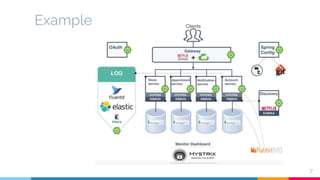
Example
7
“A service mesh is the connective tissue between your
services that adds additional capabilities like traffic
control, service discovery, load balancing, resilience,
observability, security, and so on…
8
What is a service mesh?
“Developed by a collaboration between Google, IBM, and
Lyft, Istio is an open-source service mesh that lets you
connect, monitor, and secure microservices deployed on-
premise, in the cloud, or with orchestration platforms like
Kubernetes and Mesos.
9
What is ISTIO?
What are the biggest changes
10
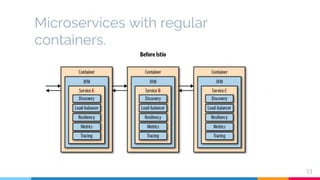
Before and After
Microservices with regular
containers.
11
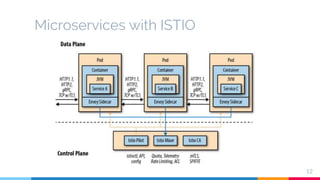
Microservices with ISTIO
12
Two areas to aim complete solution
13
Control and Data Plane
Data Plane
Comprises the primary Istio sidecar:
▷ Envoy
14
Envoy
A layer 7 load-balancer takes routing decision based on
IPs, TCP or UDP ports or any information it can get
from the application protocol (mainly HTTP). The layer
7 load-balancer acts as a proxy, which means it
maintains two TCP connections: one with the client
and one with the server.
15
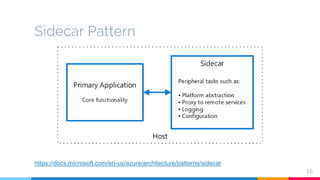
Sidecar Pattern
16
https://docs.microsoft.com/en-us/azure/architecture/patterns/sidecar
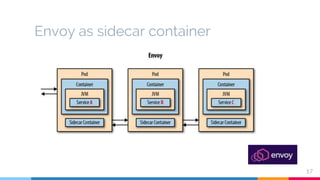
Envoy as sidecar container
17
Control Plane
Comprises three primary Istio services:
▷ Pilot
▷ Mixer
▷ Citadel
18
Pilot
Provides capabilities like service discovery as well as
support for VirtualService. The VirtualService is what
gives you fine-grained request distribution, retries,
timeouts, etc
19
Mixer
With Mixer, you can create policies, apply rate-limiting
rules, and even capture custom metrics. Mixer has a
pluggable backend architecture that is rapidly evolving
with new plug-ins and partners that are extending
Mixer’s default capabilities in many new and interesting
ways.
20
Citadel
Formerly known as Istio CA or Auth, is responsible for
certificate signing, certificate issuance, and
revocation/rotation. Istio issues X.509 certificates to
all your microservices, allowing for mutual Transport
Layer Security (mTLS) between those services,
encrypting all their traffic transparently.
21
Examine Istio patterns including smarter canaries and
dark launches
22
Traffic Control
“With a canary deployment, you deploy a new version
of your code to production but allow only a subset of
traffic to reach it
23
Canary Deployment
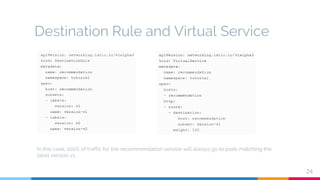
Destination Rule and Virtual Service
24
In this case, 100% of traffic for the recommendation service will always go to pods matching the
label version v1.
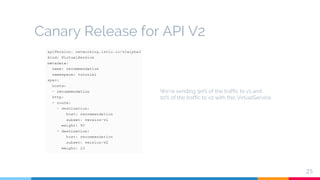
Canary Release for API V2
25
We’re sending 90% of the traffic to v1 and
10% of the traffic to v2 with this VirtualService
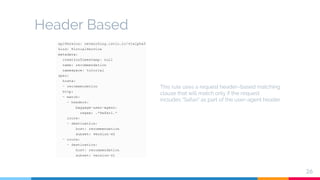
Header Based
26
This rule uses a request header–based matching
clause that will match only if the request
includes “Safari” as part of the user-agent header
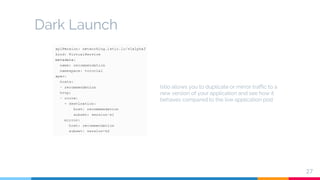
Dark Launch
27
Istio allows you to duplicate or mirror traffic to a
new version of your application and see how it
behaves compared to the live application pod
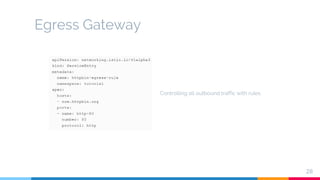
Egress Gateway
28
Controlling all outbound traffic with rules.
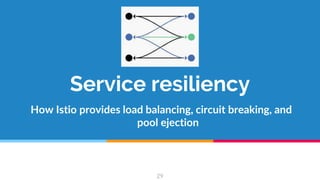
Service resiliency
How Istio provides load balancing, circuit breaking, and
pool ejection
29
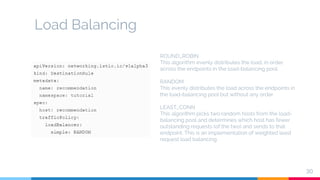
Load Balancing
30
ROUND_ROBIN
This algorithm evenly distributes the load, in order,
across the endpoints in the load-balancing pool.
RANDOM
This evenly distributes the load across the endpoints in
the load-balancing pool but without any order.
LEAST_CONN
This algorithm picks two random hosts from the load-
balancing pool and determines which host has fewer
outstanding requests (of the two) and sends to that
endpoint. This is an implementation of weighted least
request load balancing.
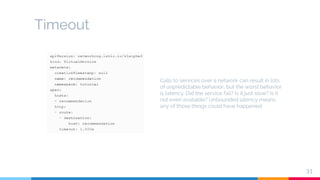
Timeout
31
Calls to services over a network can result in lots
of unpredictable behavior, but the worst behavior
is latency. Did the service fail? Is it just slow? Is it
not even available? Unbounded latency means
any of those things could have happened
Retry
32
With Istio’s retry capability, you can make a few
more attempts before having to truly deal with
the error, potentially falling back to default logic.
To forward the request to another instance just in case you get an open circuit
breaker or pool ejection
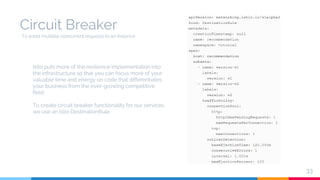
Circuit Breaker
33
Istio puts more of the resilience implementation into
the infrastructure so that you can focus more of your
valuable time and energy on code that differentiates
your business from the ever-growing competitive
field.
To create circuit breaker functionality for our services,
we use an Istio DestinationRule
To avoid multiple concurrent requests to an instance
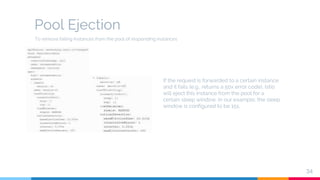
Pool Ejection
34
If the request is forwarded to a certain instance
and it fails (e.g., returns a 50x error code), Istio
will eject this instance from the pool for a
certain sleep window. In our example, the sleep
window is configured to be 15s.
To remove failing instances from the pool of responding instances
Chaos testing
Turbulent conditions through fault injection
35
“Chaos Engineering is the discipline of experimenting
on a distributed system in order to build confidence
in the system’s capability to withstand turbulent
conditions in production
36
Principles of Chaos Engineering
http://principlesofchaos.org/?lang=ENcontent
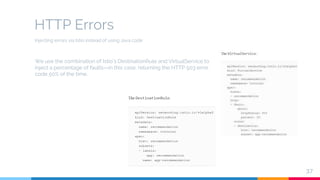
HTTP Errors
37
We use the combination of Istio’s DestinationRule and VirtualService to
inject a percentage of faults—in this case, returning the HTTP 503 error
code 50% of the time.
Injecting errors via Istio instead of using Java code
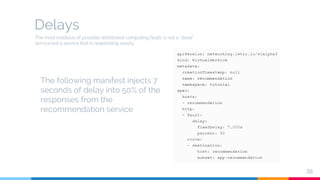
Delays
38
The following manifest injects 7
seconds of delay into 50% of the
responses from the
recommendation service
The most insidious of possible distributed computing faults is not a “dead”
service but a service that is responding slowly
Observability
Tracing and metrics
39
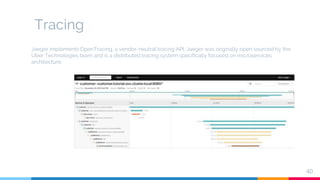
Tracing
40
Jaeger implements OpenTracing, a vendor-neutral tracing API. Jaeger was originally open sourced by the
Uber Technologies team and is a distributed tracing system specifically focused on microservices
architecture.
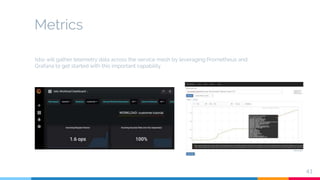
Metrics
41
Istio will gather telemetry data across the service mesh by leveraging Prometheus and
Grafana to get started with this important capability
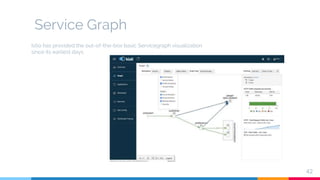
Service Graph
42
Istio has provided the out-of-the-box basic Servicegraph visualization
since its earliest days
Security
Istio’s security capabilities, such as mTLS, RBAC, and
policy enforcement
43
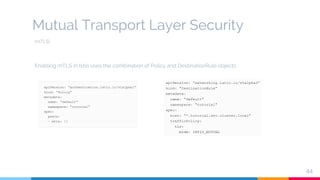
Mutual Transport Layer Security
44
Enabling mTLS in Istio uses the combination of Policy and DestinationRule objects
(mTLS)
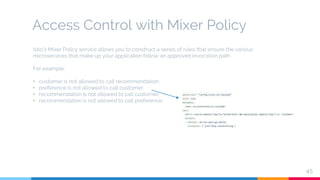
Access Control with Mixer Policy
45
Istio’s Mixer Policy service allows you to construct a series of rules that ensure the various
microservices that make up your application follow an approved invocation path
For example:
• customer is not allowed to call recommendation;
• preference is not allowed to call customer;
• recommendation is not allowed to call customer;
• recommendation is not allowed to call preference.
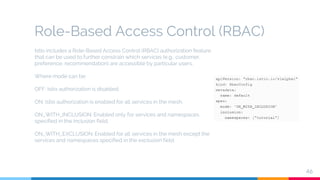
Role-Based Access Control (RBAC)
46
Istio includes a Role-Based Access Control (RBAC) authorization feature
that can be used to further constrain which services (e.g., customer,
preference, recommendation) are accessible by particular users.
Where mode can be:
OFF: Istio authorization is disabled.
ON: Istio authorization is enabled for all services in the mesh.
ON_WITH_INCLUSION: Enabled only for services and namespaces
specified in the inclusion field.
ON_WITH_EXCLUSION: Enabled for all services in the mesh except the
services and namespaces specified in the exclusion field.
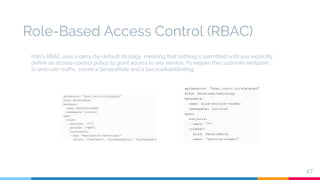
Role-Based Access Control (RBAC)
47
Istio’s RBAC uses a deny-by-default strategy, meaning that nothing is permitted until you explicitly
define an access-control policy to grant access to any service. To reopen the customer endpoint
to end-user traffic, create a ServiceRole and a ServiceRoleBinding
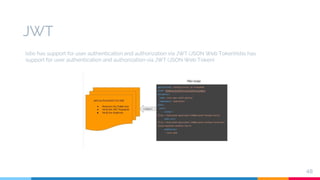
JWT
48
Istio has support for user authentication and authorization via JWT (JSON Web Token)Istio has
support for user authentication and authorization via JWT (JSON Web Token)
Thanks!
Any questions?
You can find me at:
@natanaelfonseca
natanael.vaz@gmail.com
49

Microservices With Istio Service Mesh

  • 1.
  • 2.
    Hello! I am NatanaelFonseca Solution Architect at Everis. You can find me at: @natanaelfonseca 2
  • 3.
    Session Agenda - MicroservicesPatterns; - Spring Cloud; - What is a Service Mesh? - What is ISTIO? - Before and After; 3 - Traffic Control; - Service Resilience; - Chaos Testing; - Observability; - Security.
  • 4.
    Microservices Patterns ▷ NetflixHystrix (Circuit Breaking) ▷ Netflix Zuul (Edge Routing) ▷ Netflix Ribbon ( Client-Side Service Discovery ) ▷ Netflix Eureka (Service Discovery Registry) ▷ Brave / Zipkin (Tracing) ▷ Netflix Spectator / Atlas (Metrics) 4
  • 5.
    Spring Cloud Projects ▷Spring Cloud Config; ▷ Spring Cloud Netflix; ▷ Spring Cloud Bus; ▷ Spring Cloud Foundry; ▷ Spring Cloud Open Service Broker; ▷ Spring Cloud Cluster; ▷ Spring Cloud Consul; ▷ And others….. 5 https://spring.io/projects/spring-cloud
  • 6.
    Spring Cloud Netflix ▷Service Discovery; ▷ Circuit Breaker; ▷ Declarative REST Client with Feign; ▷ Client Side Load Balancer with Ribbon; ▷ Router and Filter with Zuul. 6
  • 7.
  • 8.
    “A service meshis the connective tissue between your services that adds additional capabilities like traffic control, service discovery, load balancing, resilience, observability, security, and so on… 8 What is a service mesh?
  • 9.
    “Developed by acollaboration between Google, IBM, and Lyft, Istio is an open-source service mesh that lets you connect, monitor, and secure microservices deployed on- premise, in the cloud, or with orchestration platforms like Kubernetes and Mesos. 9 What is ISTIO?
  • 10.
    What are thebiggest changes 10 Before and After
  • 11.
  • 12.
  • 13.
    Two areas toaim complete solution 13 Control and Data Plane
  • 14.
    Data Plane Comprises theprimary Istio sidecar: ▷ Envoy 14
  • 15.
    Envoy A layer 7load-balancer takes routing decision based on IPs, TCP or UDP ports or any information it can get from the application protocol (mainly HTTP). The layer 7 load-balancer acts as a proxy, which means it maintains two TCP connections: one with the client and one with the server. 15
  • 16.
  • 17.
    Envoy as sidecarcontainer 17
  • 18.
    Control Plane Comprises threeprimary Istio services: ▷ Pilot ▷ Mixer ▷ Citadel 18
  • 19.
    Pilot Provides capabilities likeservice discovery as well as support for VirtualService. The VirtualService is what gives you fine-grained request distribution, retries, timeouts, etc 19
  • 20.
    Mixer With Mixer, youcan create policies, apply rate-limiting rules, and even capture custom metrics. Mixer has a pluggable backend architecture that is rapidly evolving with new plug-ins and partners that are extending Mixer’s default capabilities in many new and interesting ways. 20
  • 21.
    Citadel Formerly known asIstio CA or Auth, is responsible for certificate signing, certificate issuance, and revocation/rotation. Istio issues X.509 certificates to all your microservices, allowing for mutual Transport Layer Security (mTLS) between those services, encrypting all their traffic transparently. 21
  • 22.
    Examine Istio patternsincluding smarter canaries and dark launches 22 Traffic Control
  • 23.
    “With a canarydeployment, you deploy a new version of your code to production but allow only a subset of traffic to reach it 23 Canary Deployment
  • 24.
    Destination Rule andVirtual Service 24 In this case, 100% of traffic for the recommendation service will always go to pods matching the label version v1.
  • 25.
    Canary Release forAPI V2 25 We’re sending 90% of the traffic to v1 and 10% of the traffic to v2 with this VirtualService
  • 26.
    Header Based 26 This ruleuses a request header–based matching clause that will match only if the request includes “Safari” as part of the user-agent header
  • 27.
    Dark Launch 27 Istio allowsyou to duplicate or mirror traffic to a new version of your application and see how it behaves compared to the live application pod
  • 28.
    Egress Gateway 28 Controlling alloutbound traffic with rules.
  • 29.
    Service resiliency How Istioprovides load balancing, circuit breaking, and pool ejection 29
  • 30.
    Load Balancing 30 ROUND_ROBIN This algorithmevenly distributes the load, in order, across the endpoints in the load-balancing pool. RANDOM This evenly distributes the load across the endpoints in the load-balancing pool but without any order. LEAST_CONN This algorithm picks two random hosts from the load- balancing pool and determines which host has fewer outstanding requests (of the two) and sends to that endpoint. This is an implementation of weighted least request load balancing.
  • 31.
    Timeout 31 Calls to servicesover a network can result in lots of unpredictable behavior, but the worst behavior is latency. Did the service fail? Is it just slow? Is it not even available? Unbounded latency means any of those things could have happened
  • 32.
    Retry 32 With Istio’s retrycapability, you can make a few more attempts before having to truly deal with the error, potentially falling back to default logic. To forward the request to another instance just in case you get an open circuit breaker or pool ejection
  • 33.
    Circuit Breaker 33 Istio putsmore of the resilience implementation into the infrastructure so that you can focus more of your valuable time and energy on code that differentiates your business from the ever-growing competitive field. To create circuit breaker functionality for our services, we use an Istio DestinationRule To avoid multiple concurrent requests to an instance
  • 34.
    Pool Ejection 34 If therequest is forwarded to a certain instance and it fails (e.g., returns a 50x error code), Istio will eject this instance from the pool for a certain sleep window. In our example, the sleep window is configured to be 15s. To remove failing instances from the pool of responding instances
  • 35.
    Chaos testing Turbulent conditionsthrough fault injection 35
  • 36.
    “Chaos Engineering isthe discipline of experimenting on a distributed system in order to build confidence in the system’s capability to withstand turbulent conditions in production 36 Principles of Chaos Engineering http://principlesofchaos.org/?lang=ENcontent
  • 37.
    HTTP Errors 37 We usethe combination of Istio’s DestinationRule and VirtualService to inject a percentage of faults—in this case, returning the HTTP 503 error code 50% of the time. Injecting errors via Istio instead of using Java code
  • 38.
    Delays 38 The following manifestinjects 7 seconds of delay into 50% of the responses from the recommendation service The most insidious of possible distributed computing faults is not a “dead” service but a service that is responding slowly
  • 39.
  • 40.
    Tracing 40 Jaeger implements OpenTracing,a vendor-neutral tracing API. Jaeger was originally open sourced by the Uber Technologies team and is a distributed tracing system specifically focused on microservices architecture.
  • 41.
    Metrics 41 Istio will gathertelemetry data across the service mesh by leveraging Prometheus and Grafana to get started with this important capability
  • 42.
    Service Graph 42 Istio hasprovided the out-of-the-box basic Servicegraph visualization since its earliest days
  • 43.
    Security Istio’s security capabilities,such as mTLS, RBAC, and policy enforcement 43
  • 44.
    Mutual Transport LayerSecurity 44 Enabling mTLS in Istio uses the combination of Policy and DestinationRule objects (mTLS)
  • 45.
    Access Control withMixer Policy 45 Istio’s Mixer Policy service allows you to construct a series of rules that ensure the various microservices that make up your application follow an approved invocation path For example: • customer is not allowed to call recommendation; • preference is not allowed to call customer; • recommendation is not allowed to call customer; • recommendation is not allowed to call preference.
  • 46.
    Role-Based Access Control(RBAC) 46 Istio includes a Role-Based Access Control (RBAC) authorization feature that can be used to further constrain which services (e.g., customer, preference, recommendation) are accessible by particular users. Where mode can be: OFF: Istio authorization is disabled. ON: Istio authorization is enabled for all services in the mesh. ON_WITH_INCLUSION: Enabled only for services and namespaces specified in the inclusion field. ON_WITH_EXCLUSION: Enabled for all services in the mesh except the services and namespaces specified in the exclusion field.
  • 47.
    Role-Based Access Control(RBAC) 47 Istio’s RBAC uses a deny-by-default strategy, meaning that nothing is permitted until you explicitly define an access-control policy to grant access to any service. To reopen the customer endpoint to end-user traffic, create a ServiceRole and a ServiceRoleBinding
  • 48.
    JWT 48 Istio has supportfor user authentication and authorization via JWT (JSON Web Token)Istio has support for user authentication and authorization via JWT (JSON Web Token)
  • 49.
    Thanks! Any questions? You canfind me at: @natanaelfonseca natanael.vaz@gmail.com 49