Question 1
• Whichpart of the microscope regulates light
intensity?
A. Iris diaphragm
B. Condenser
C. Stage
D. Focal Length
3.
Question 2
• Whatis the function of the condenser?
A. To focus light onto the specimen
B. Heats up a liquid to produce vapor
C. Increases the pressure of a gas
D. Acts as a storage tank for liquids
4.
Question 3
• Whyis immersion oil used with the 100x objective
lens?
A. To magnify the image beyond 100x
B. To prevent the lens from getting dirty
C. To increase resolution
D. To cool down the microscope slide
5.
Question 4
• Whichlens provides the lowest magnification?
A. 5x objective
B. 10x objective
C. 40x objective
D. 4x objective
6.
Question 5
• Whatis meant by 'parfocal' lenses?
A) Lenses that remain in focus when changing
magnification
B) Lenses that automatically adjust brightness
C) Lenses that provide the highest magnification
D) Lenses that change color based on
magnification
7.
Question 6
• Whichpart moves the slide in different directions?
A) Eyepiece
B) Coarse focus knob
C) Fine focus knob
D) Stage adjustment knobs
8.
Question 7
• Whatis the function of the coarse adjustment knob?
A) Moves the stage up and down for rough
focusing
B) Controls the intensity of light
C) Moves the slide in different directions
D) Changes the magnification level
9.
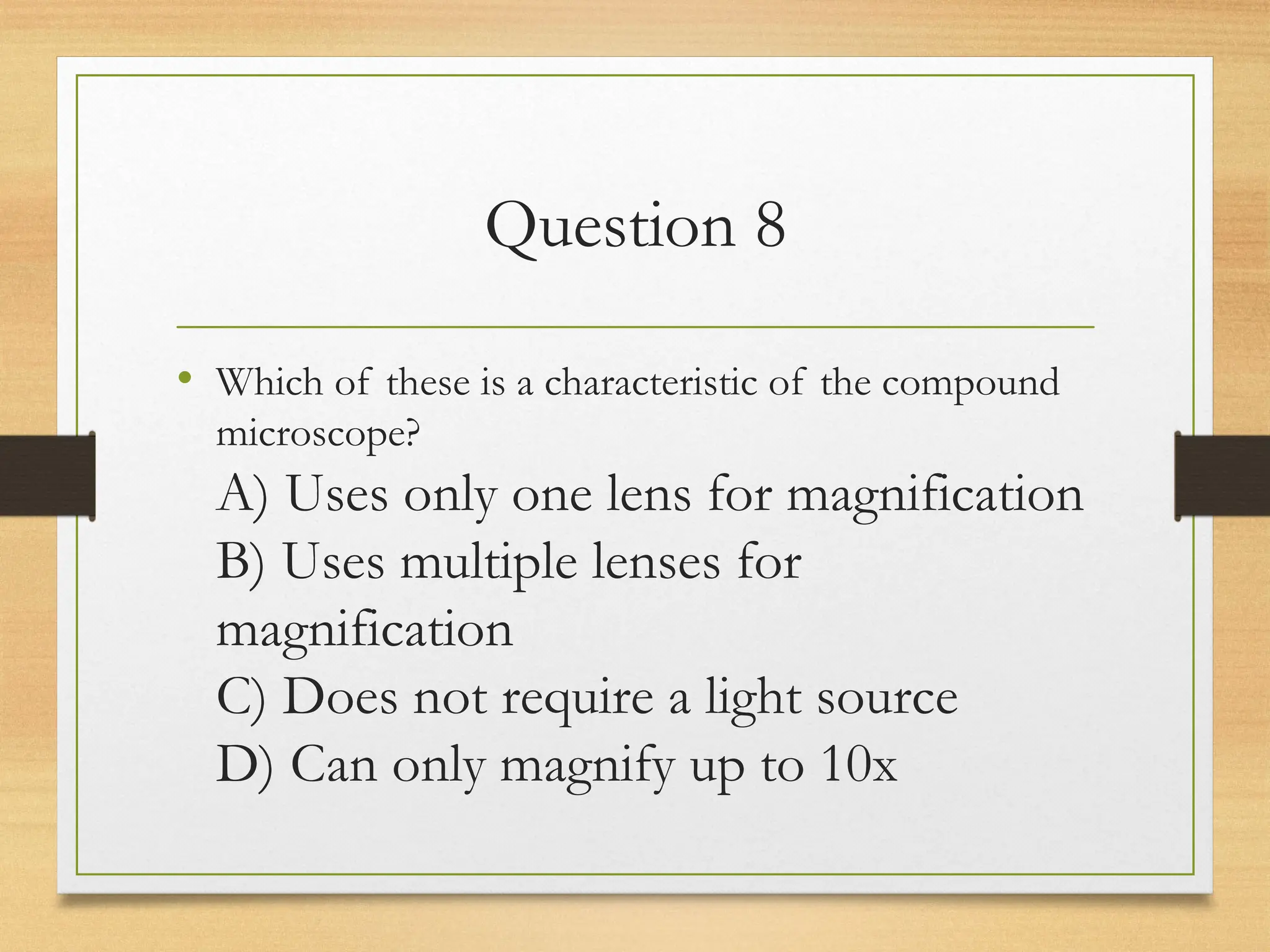
Question 8
• Whichof these is a characteristic of the compound
microscope?
A) Uses only one lens for magnification
B) Uses multiple lenses for
magnification
C) Does not require a light source
D) Can only magnify up to 10x
10.
Question 9
• Whathappens if the fine adjustment knob is over-
rotated?
A) The microscope will zoom in further
B) The stage will move rapidly up and down
C) The light source will turn off
D) The image may become blurry or go out of focus
11.
Question 10
• Whatis the total magnification when using a 40x
objective with a 10x ocular lens?
A) 400x
B) 40x
C) 100x
D) 50x
Editor's Notes
#2 Answer: A. Iris diaphragm
Rationale: The iris diaphragm controls the amount of light entering the lens.
#3 Answer: A. To focus light onto the specimen
Rationale: The condenser focuses and directs light onto the specimen.
#4 Answer: C. To increase resolution
Rationale: Immersion oil prevents light refraction and improves image clarity.
#5 Answer: D. 4x
Rationale: The 4x objective provides the lowest magnification.
#6 Answer: A. It keeps specimens in focus when changing lenses
Rationale: Parfocal lenses allow smooth transition between different magnifications.
#7 Answer: D. Stage adjustment knobs
Rationale: Stage knobs move the slide for better positioning.
#8 Answer: A. Brings object into rough focus
Rationale: The coarse adjustment is used for rough focusing before fine adjustments.
#9 Answer: B. Uses multiple lenses to magnify small objects
Rationale: A compound microscope uses multiple lenses for better magnification.
#10 Answer: D. It can jam or damage the microscope
Rationale: Over-rotating can cause mechanical issues or lens damage. The fine adjustment knob is used for precise focusing, especially at higher magnifications (40x, 100x). If over-rotated, it can blur the image or even make it impossible to refocus properly. Unlike the coarse adjustment knob, it moves the stage in very small increments and should be used carefully.
#11 Answer: 400x
Rationale: Magnification is calculated as ocular × objective (10x × 40x = 400x).
Total magnification is calculated by multiplying the ocular lens magnification by the objective lens magnification:
Total Magnification=Ocular Magnification×Objective Magnification\text{Total Magnification} = \text{Ocular Magnification} \times \text{Objective Magnification}Total Magnification=Ocular Magnification×Objective Magnification =10x×40x=400x= 10x \times 40x = 400x=10x×40x=400x