Micrometeorites
De Bron and Cité Scolaire Internationale Lyon
Sien(15) and Andreas(15)
from Belgium
Who are we?
Mathilde(15) and Flavia(15)
from France
The experiment
There are micrometeorites in space but it seems that with their
flying suits, astronauts are immune to the danger they
represent. But how is it possible?
Hypothesis , materials and operation of experiment
Materials
• Tissues
• Sand
• Golf ball
• Modelling clay
• Aluminium foil
• ruler
We dropped a ball of 100 grams onto sand. Then we observed the impact of the fall on it, which represents
the human fibre (that is the control experiment).
Then we dropped the same ball at the same height on the sand covered with a combination of 10 layers of
tissue, aluminium and modelling clay. We again observed the impact by measuring the depth in the sand.
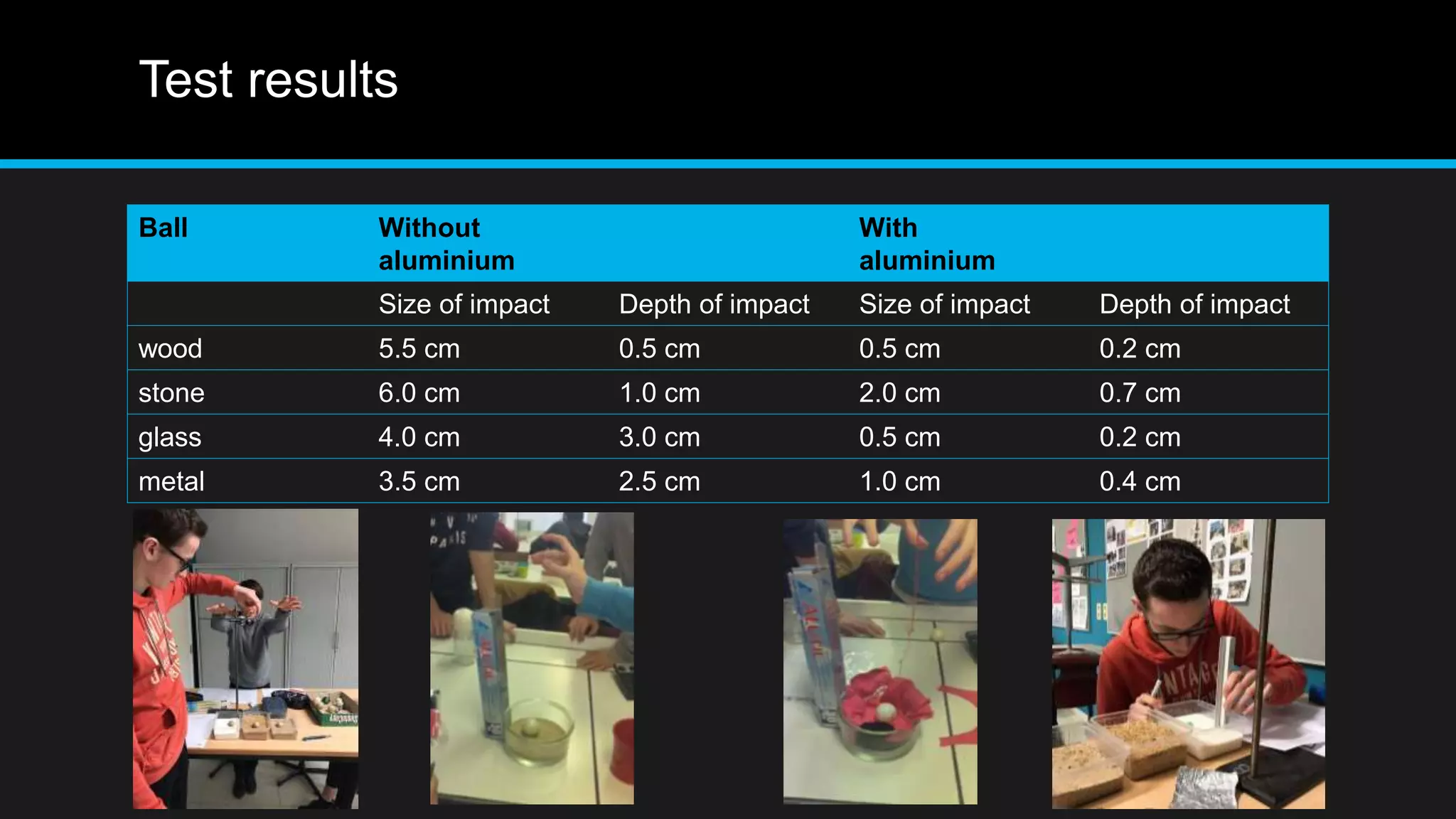
Test results
Ball Without
aluminium
With
aluminium
Size of impact Depth of impact Size of impact Depth of impact
wood 5.5 cm 0.5 cm 0.5 cm 0.2 cm
stone 6.0 cm 1.0 cm 2.0 cm 0.7 cm
glass 4.0 cm 3.0 cm 0.5 cm 0.2 cm
metal 3.5 cm 2.5 cm 1.0 cm 0.4 cm
Results in a chart.
0
1
2
3
4
5
6
7
wood stone metal glass
size without aluminium
size with aluminium
0
0.5
1
1.5
2
2.5
3
3.5
wood stone metal glass
depth with aluminium
depth without aluminium
Conclusion
• The ball of stone has the biggest impact when dropped.
• Aluminiun foil can reduce the impact.
• REMARK: Aluminiun foil can reduce a part of the impact , but it can’t reduce
the full impact. In reality the astronauts use 13 layers of aluminiun foil and
that can reduce the impact of micrometeorites.

Micrometeorites

  • 1.
    Micrometeorites De Bron andCité Scolaire Internationale Lyon
  • 2.
    Sien(15) and Andreas(15) fromBelgium Who are we? Mathilde(15) and Flavia(15) from France
  • 3.
    The experiment There aremicrometeorites in space but it seems that with their flying suits, astronauts are immune to the danger they represent. But how is it possible?
  • 4.
    Hypothesis , materialsand operation of experiment Materials • Tissues • Sand • Golf ball • Modelling clay • Aluminium foil • ruler We dropped a ball of 100 grams onto sand. Then we observed the impact of the fall on it, which represents the human fibre (that is the control experiment). Then we dropped the same ball at the same height on the sand covered with a combination of 10 layers of tissue, aluminium and modelling clay. We again observed the impact by measuring the depth in the sand.
  • 5.
    Test results Ball Without aluminium With aluminium Sizeof impact Depth of impact Size of impact Depth of impact wood 5.5 cm 0.5 cm 0.5 cm 0.2 cm stone 6.0 cm 1.0 cm 2.0 cm 0.7 cm glass 4.0 cm 3.0 cm 0.5 cm 0.2 cm metal 3.5 cm 2.5 cm 1.0 cm 0.4 cm
  • 6.
    Results in achart. 0 1 2 3 4 5 6 7 wood stone metal glass size without aluminium size with aluminium 0 0.5 1 1.5 2 2.5 3 3.5 wood stone metal glass depth with aluminium depth without aluminium
  • 7.
    Conclusion • The ballof stone has the biggest impact when dropped. • Aluminiun foil can reduce the impact. • REMARK: Aluminiun foil can reduce a part of the impact , but it can’t reduce the full impact. In reality the astronauts use 13 layers of aluminiun foil and that can reduce the impact of micrometeorites.

Editor's Notes

  • #3 Dit is de vraag die met uw experiment wordt beantwoord
  • #5 Vat uw onderzoek samen in drie tot vijf punten.