MUHAMMADABUBAKAR MH20BBA113
ATIFMEHMOODRAO MH20BBA066
DANIYALKHALID MH20BBA099
Microfinance started getting importance in Pakistan1 towards the end of 1990s. In
order to promote the MF in formal sector, the most significant step taken by the
government was the launching of Microfinance Sector Development Program
(MSDP) in 2000. The main objective of this program was to broaden and increase the
pace for the development of the sector to provide the financial services to poor on
sustainable basis. Then MFI Ordinance 2001 was put in place to provide separate
regulatory framework exclusively for MF.
Microfinance is the provision of financial services
including Credit, Savings, Insurance etc, to those
sectors of economy, which are not serviced by
traditional formal financial institutions viz.
commercial banks and non-banking financial
institutions.
1. Village Savings and Credit
Associations (VISACAs),
2. Finance Companies (FCs)
3. Fiduciary Financial Institutions (FFIs).
Three types of MFIs that can be
established under MFIs Ordinance 2001
viz.:
1. MFIs having operations on national
level, Country-wide; minimum capital
Rs.500 million.
2. MFIs operating in a Province,
Province-wide; minimum capital Rs.250
million.
3. MFIs operating in a specified
District, District-wide; minimum capital
Rs.100 million.
• Remove poverty
• Issue Loans
• Improve the economic conditions
• Services
The purpose of microfinance is to provide financial
services to people "generally excluded from traditional
banking channels because of their low, irregular and
unpredictable income“. The purpose of microfinance is
to help disadvantaged households and entrepreneurs
gain access to affordable financial services to help them
finance income-generating activities, accumulate assets
through savings, provide for family needs, and protect
themselves against the risks of daily life, such as illness,
death, theft, natural disasters, says.
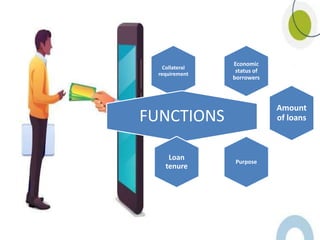
Economic
status of
borrowers
Collateral
requirement
FUNCTIONS
Amount
of loans
Purpose
Loan
tenure
ADVANTAGES
1. It allows people to better provide for their families.
2. It gives people access to credit.
3. It serves those who are often overlooked in society.
4. It offers a better overall loan repayment rate than traditional banking products.
5. It provides families with an opportunity to provide an education to their children.
6. It creates the possibility of future investments.
7. It encourages people to save.
DISADVANTAGES
1. Harsh repayment criteria
2. Small Loan amount
3. High-interest rate
A microfinance institution grants microloans and sometimes can even offer certain savings
solutions. For that reasons these institutions can seem a lot like traditional banks.
However an MFI operates in some very different ways, especially when it is registered as a
non-profit, mutual fund or cooperative.
Microfinance Banking.pptx

Microfinance Banking.pptx

  • 2.
  • 4.
    Microfinance started gettingimportance in Pakistan1 towards the end of 1990s. In order to promote the MF in formal sector, the most significant step taken by the government was the launching of Microfinance Sector Development Program (MSDP) in 2000. The main objective of this program was to broaden and increase the pace for the development of the sector to provide the financial services to poor on sustainable basis. Then MFI Ordinance 2001 was put in place to provide separate regulatory framework exclusively for MF. Microfinance is the provision of financial services including Credit, Savings, Insurance etc, to those sectors of economy, which are not serviced by traditional formal financial institutions viz. commercial banks and non-banking financial institutions.
  • 5.
    1. Village Savingsand Credit Associations (VISACAs), 2. Finance Companies (FCs) 3. Fiduciary Financial Institutions (FFIs). Three types of MFIs that can be established under MFIs Ordinance 2001 viz.: 1. MFIs having operations on national level, Country-wide; minimum capital Rs.500 million. 2. MFIs operating in a Province, Province-wide; minimum capital Rs.250 million. 3. MFIs operating in a specified District, District-wide; minimum capital Rs.100 million.
  • 6.
    • Remove poverty •Issue Loans • Improve the economic conditions • Services The purpose of microfinance is to provide financial services to people "generally excluded from traditional banking channels because of their low, irregular and unpredictable income“. The purpose of microfinance is to help disadvantaged households and entrepreneurs gain access to affordable financial services to help them finance income-generating activities, accumulate assets through savings, provide for family needs, and protect themselves against the risks of daily life, such as illness, death, theft, natural disasters, says.
  • 7.
  • 8.
    ADVANTAGES 1. It allowspeople to better provide for their families. 2. It gives people access to credit. 3. It serves those who are often overlooked in society. 4. It offers a better overall loan repayment rate than traditional banking products. 5. It provides families with an opportunity to provide an education to their children. 6. It creates the possibility of future investments. 7. It encourages people to save. DISADVANTAGES 1. Harsh repayment criteria 2. Small Loan amount 3. High-interest rate
  • 9.
    A microfinance institutiongrants microloans and sometimes can even offer certain savings solutions. For that reasons these institutions can seem a lot like traditional banks. However an MFI operates in some very different ways, especially when it is registered as a non-profit, mutual fund or cooperative.