Mirpur University Of Science And Technology (MUST),
Mirpur AJ&K
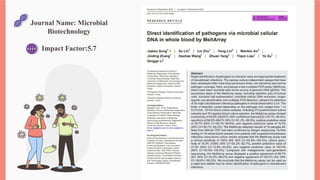
Direct identification of pathogens via microbial
cellular DNA in whole blood by MeltArray
Journal Name: Microbial
Biotechnology
Impact Factor:5.7
Introduction
Blood Stream Infections(BSIs)
 Serious and major global public health burden.
 Have high morbidity and mortality rate.
Blood Cultures
 Gold standard for identification of the BSIs.
 Take 24h or several days.
 Positivity rate no more than 20%
 Use of antibiotics
mNGS
 Implementation is controversial to time, cost and results in clinical
settings.
 use plasma microbial cell free DNA (cfDNA) .
Introduction
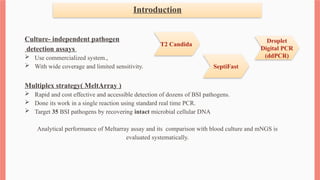
Culture- independent pathogen
detection assays
 Use commercialized system.,
 With wide coverage and limited sensitivity.
Multiplex strategy( MeltArray )
 Rapid and cost effective and accessible detection of dozens of BSI pathogens.
 Done its work in a single reaction using standard real time PCR.
 Target 35 BSI pathogens by recovering intact microbial cellular DNA
Analytical performance of Meltarray assay and its comparison with blood culture and mNGS is
evaluated systematically.
T2 Candida
Droplet
Digital PCR
(ddPCR)
SeptiFast
Methodology
Experimental
procedures
Requirements Protocol used
Patients and Samples  The inclusion criteria are one of the following
conditions: body temperature ≥37°C,
 (PCT) ≥1μg/L
 (CRP) ≥20mg/L
 (WBC) count ≥1010/L.
 Written informed consent was obtained from
all patients.
 Extraction of microbial DNA is done for
identification purposes.
 1.0mL of the culture suspension is centrifuged at
13,000g for 2min to recover the bacteria.
 After removing the supernatant by pipetting.
 the bacteria are resuspended in 100μL of 1× TE
buffer (10mM Tris–HCl, 1mM EDTA, pH8.5) and
heated at 99°C for 10min.
 After centrifugation at 13,000g for 10min.
 the supernatant was transferred into a collection tube
and stored at −80°C until need.
Blood culture It is done also for the presence of BSI pathogens. Two sets of blood cultures were collected from each
patient.
10ml of whole blood is used BACTEC™ FX blood culture
system used for incubation.
On getting a positive signal the bacterias are gram stained
and subcultured on Columbia blood agar, chocolate agar,
MacConkey lactose agar and Schaedler agar at 37°C with
5% CO2.
After overnight incubation, pathogens were identified
using MALDI–TOF MS.
Methodology
Experimental
procedures
Requirements Protocol used
Microbial cellular DNA and cfDNA
extraction from whole blood
Excteraction of two
types of DNAs
For exteraction of microbial cellular DNA
 A MolYsis complete five kit is used.
 The kit provides five types of ingredient for lysis.
 The microbial cellular DNA after lysis eluted in 100ml of the elution buffer
 For futher concentration ZYMO DNA Clean and concentrator kit is used.
 It convert the culture into 30ml of microbial cellular DNA.Stored at at −80°C
until required.
For cfDNA extraction
 extraction done with 8ml of whole blood in a preservative tube Cell-Free DNA
BCT®.
 . The extraction was performed using the Magnetic Serum/Plasma DNA Maxi
Kit.
 Blood-----centrifiuged at 22°C for 20min at 1600g
 ------transfer the supernatant that contains the cfDNA
 The eluted cfDNA stored at −80°C until required.
mNGS Identification of the
pathogen with the help
of cfDNA
Approximately 8mL of whole blood collected in CellFree DNA BCT® was analysed
by mNGS at Genoxor Medical Technology.
mNGS comprises cfDNA extraction from plasma, library preparation, sequencing,
comprehensive bioinformatics analysis for pathogen identification and report
generation.
Methodology
EXPERIMENTAL
PROCEDURES
REQUIREMENTS POROTOCOL & PROGRAM
Quantification of residual human
DNA
MolYsis complete 5 kit
to remove humen
genomic DNA in a
single-plex-real time
PCR targeting RPP30
human gene as a
reference to measure
gDNA.
Single-plex PCR was performed in 25ul’
25ul mixture must contain
15ul PCR master buffer,7mM MgCl2,0.25mM dNTPs
, 30Taq DNA Polymerase ,5ul of Template
PCR performed in SLAN real time PCR system.And
the detection chennal.
Decontamination at 50°C for 2min,
Denaturation at 95°C for 5min,45 cycles of
95°C for 30s and 55°C for 30s
Multiplex PCR target pre-
enrichment
The 35-plex PCR
target pre-
enrichment was
performed in a 25-
μL mixture.
 Tag-sequence-tailed ,target-specific primers
 0.25 Mm dNTPs
 10ul of microbial cellular DNA
 15ul of PCR master buffer
 2U Taq DNA polymerase
 4mM
The program is similar to the SLAN 96S real time PCR.
Dectection done by the ROX channel for annealing.
Methodology
EXPERIMENTAL
PROCEDURES
REQUIREMENTS POROTOCOL &
PROGRAM
MeltArray assay • 35 pathogens in 3steps.
• Reaction A (22-plex PCR)
detects 21 BSI pathogens
+lac8.
• Reaction B(14-plex PCR
detects 13 BSI pathogens +
lac8.
• Reaction C(Single-plex
realtime PCR detectss E.coli
alone)
• For reaction A and B
• 25ul PCR mixture contains:
• PCR master buffer (10mM Tris-
HCL,ph 8.0&50mM KCL),7mM
MgCl2,0.25mM dNTPs,3U Taq
DNA Polymerase ,Mixture of tag-
sequence-tailed target –specific
primers,40nM universal molecular
beacon reporters ,5ul of template.
• For reaction C
• 20ul solution contained
• 10ul of TaKaRa Taq HD Low
DNA mix ,400nM primers,60nM
probes , 5ul of gDNA template.
• Program same as SLAN 96 real-
time PCR system with slight
variation.
• Detection done by these
(FAM,ROX HEX ,CY5)
fluorescencien.
Results
1.Characteristics of Patients:
Prior to blood culture 66.4% of
patients received antibiotic therapy.
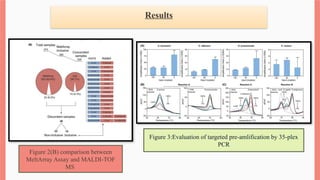
4.Efficiency of target pre-
enrichment by 35-plex PCR:
Have different identification
channels and use different amount
of templates to get the results
shown in Fig.3.
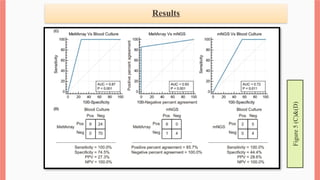
7.Comparison between
MeltArray and blood culture:
MeltArray could detect more
pathogens than blood
cultures.Shown in fig.5(C)
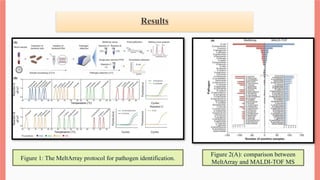
2.MeltArray protocol for
microbial cellular DNA in whole
blood:
3 step protocol identifying 35
pathogens species.
5.LOD:
The three step –plex PCR gives
different copies in reaction A,B and
C.
8.Comparison between
MeltArray and mNGS:
mNGS can identify more
pathogens than MeltArray but
results aren’t that much
potential.Shown in fig.5(C)
3.Accuracy of species
identification:
MeltArray can identify the
presence of pathogens more
accurately than other methods.
Shown in fig.1.
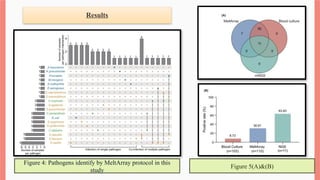
6.Clinical performance of
MeltArray:
The positivity rate of meltArray
was higher than that of blood
culture and lower than mNGS.
Shown in fig.4.
And fig.5(A)&(B)
9.Comparison between mNGS
and blood culture:
mNGS is better than blood culture
method.Shown in fig.5(C)
Results
Figure 1: The MeltArray protocol for pathogen identification.
Figure 2(A): comparison between
MeltArray and MALDI-TOF MS
Results
Figure 2(B) comparison between
MeltArray Assay and MALDI-TOF
MS
Figure 3:Evaluation of targeted pre-amlification by 35-plex
PCR
Results
Figure 4: Pathogens identify by MeltArray protocol in this
study
Figure 5(A)&(B)
Results
Figure
5
(C)&(D)
Discussion
The MeltArray protocol is a multiplex PCR assay that detects 35 common bloodstream infection
(BSI) pathogens in whole blood with high sensitivity (1 CFU/mL) and short turnaround time (5.5
hours).
1. High-performance detection: 35 BSI pathogens detected in whole blood with high
sensitivity (1 CFU/mL) and short turnaround time (5.5 hours).
2. Protocol overview: Selective recovery of microbial cellular DNA, target pre-enrichment,
and MeltArray detection.
3. Advantages: Short turnaround time, high sensitivity, and reasonable pathogen coverage.
Discussion
1. Technical challenges addressed: Wide target coverage, ultrahigh sensitivity, and short
turnaround times.
2. Verification: Evaluated 443 blood culture samples with complete concordance with MALDI-
TOF-MS results
3. Limitations: Most patients received antibiotic treatment before testing, small sample size, and
sample treatment procedure can be improved.
Conclusions
● Meltarray is a protocol rapid, sensitive, and direct diagnostic protocol for
pathogens that cause BSIs enabling optimized antibiotic treatment and
facilitate stewardship programs.
● This process is helpful in early recommendation of the therapeutic use by
direct identification of the pathogens and the life the patient could be save
on time.
CREDITS: This presentation template was created by
Slidesgo, and includes icons by Flaticon, and infographics
& images by Freepik
Thanks!
Do you have any questions?
Microbiology used in processing Meltarray

  • 1.
    Mirpur University OfScience And Technology (MUST), Mirpur AJ&K Direct identification of pathogens via microbial cellular DNA in whole blood by MeltArray
  • 2.
  • 3.
    Introduction Blood Stream Infections(BSIs) Serious and major global public health burden.  Have high morbidity and mortality rate. Blood Cultures  Gold standard for identification of the BSIs.  Take 24h or several days.  Positivity rate no more than 20%  Use of antibiotics mNGS  Implementation is controversial to time, cost and results in clinical settings.  use plasma microbial cell free DNA (cfDNA) .
  • 4.
    Introduction Culture- independent pathogen detectionassays  Use commercialized system.,  With wide coverage and limited sensitivity. Multiplex strategy( MeltArray )  Rapid and cost effective and accessible detection of dozens of BSI pathogens.  Done its work in a single reaction using standard real time PCR.  Target 35 BSI pathogens by recovering intact microbial cellular DNA Analytical performance of Meltarray assay and its comparison with blood culture and mNGS is evaluated systematically. T2 Candida Droplet Digital PCR (ddPCR) SeptiFast
  • 5.
    Methodology Experimental procedures Requirements Protocol used Patientsand Samples  The inclusion criteria are one of the following conditions: body temperature ≥37°C,  (PCT) ≥1μg/L  (CRP) ≥20mg/L  (WBC) count ≥1010/L.  Written informed consent was obtained from all patients.  Extraction of microbial DNA is done for identification purposes.  1.0mL of the culture suspension is centrifuged at 13,000g for 2min to recover the bacteria.  After removing the supernatant by pipetting.  the bacteria are resuspended in 100μL of 1× TE buffer (10mM Tris–HCl, 1mM EDTA, pH8.5) and heated at 99°C for 10min.  After centrifugation at 13,000g for 10min.  the supernatant was transferred into a collection tube and stored at −80°C until need. Blood culture It is done also for the presence of BSI pathogens. Two sets of blood cultures were collected from each patient. 10ml of whole blood is used BACTEC™ FX blood culture system used for incubation. On getting a positive signal the bacterias are gram stained and subcultured on Columbia blood agar, chocolate agar, MacConkey lactose agar and Schaedler agar at 37°C with 5% CO2. After overnight incubation, pathogens were identified using MALDI–TOF MS.
  • 6.
    Methodology Experimental procedures Requirements Protocol used Microbialcellular DNA and cfDNA extraction from whole blood Excteraction of two types of DNAs For exteraction of microbial cellular DNA  A MolYsis complete five kit is used.  The kit provides five types of ingredient for lysis.  The microbial cellular DNA after lysis eluted in 100ml of the elution buffer  For futher concentration ZYMO DNA Clean and concentrator kit is used.  It convert the culture into 30ml of microbial cellular DNA.Stored at at −80°C until required. For cfDNA extraction  extraction done with 8ml of whole blood in a preservative tube Cell-Free DNA BCT®.  . The extraction was performed using the Magnetic Serum/Plasma DNA Maxi Kit.  Blood-----centrifiuged at 22°C for 20min at 1600g  ------transfer the supernatant that contains the cfDNA  The eluted cfDNA stored at −80°C until required. mNGS Identification of the pathogen with the help of cfDNA Approximately 8mL of whole blood collected in CellFree DNA BCT® was analysed by mNGS at Genoxor Medical Technology. mNGS comprises cfDNA extraction from plasma, library preparation, sequencing, comprehensive bioinformatics analysis for pathogen identification and report generation.
  • 7.
    Methodology EXPERIMENTAL PROCEDURES REQUIREMENTS POROTOCOL &PROGRAM Quantification of residual human DNA MolYsis complete 5 kit to remove humen genomic DNA in a single-plex-real time PCR targeting RPP30 human gene as a reference to measure gDNA. Single-plex PCR was performed in 25ul’ 25ul mixture must contain 15ul PCR master buffer,7mM MgCl2,0.25mM dNTPs , 30Taq DNA Polymerase ,5ul of Template PCR performed in SLAN real time PCR system.And the detection chennal. Decontamination at 50°C for 2min, Denaturation at 95°C for 5min,45 cycles of 95°C for 30s and 55°C for 30s Multiplex PCR target pre- enrichment The 35-plex PCR target pre- enrichment was performed in a 25- μL mixture.  Tag-sequence-tailed ,target-specific primers  0.25 Mm dNTPs  10ul of microbial cellular DNA  15ul of PCR master buffer  2U Taq DNA polymerase  4mM The program is similar to the SLAN 96S real time PCR. Dectection done by the ROX channel for annealing.
  • 8.
    Methodology EXPERIMENTAL PROCEDURES REQUIREMENTS POROTOCOL & PROGRAM MeltArrayassay • 35 pathogens in 3steps. • Reaction A (22-plex PCR) detects 21 BSI pathogens +lac8. • Reaction B(14-plex PCR detects 13 BSI pathogens + lac8. • Reaction C(Single-plex realtime PCR detectss E.coli alone) • For reaction A and B • 25ul PCR mixture contains: • PCR master buffer (10mM Tris- HCL,ph 8.0&50mM KCL),7mM MgCl2,0.25mM dNTPs,3U Taq DNA Polymerase ,Mixture of tag- sequence-tailed target –specific primers,40nM universal molecular beacon reporters ,5ul of template. • For reaction C • 20ul solution contained • 10ul of TaKaRa Taq HD Low DNA mix ,400nM primers,60nM probes , 5ul of gDNA template. • Program same as SLAN 96 real- time PCR system with slight variation. • Detection done by these (FAM,ROX HEX ,CY5) fluorescencien.
  • 9.
    Results 1.Characteristics of Patients: Priorto blood culture 66.4% of patients received antibiotic therapy. 4.Efficiency of target pre- enrichment by 35-plex PCR: Have different identification channels and use different amount of templates to get the results shown in Fig.3. 7.Comparison between MeltArray and blood culture: MeltArray could detect more pathogens than blood cultures.Shown in fig.5(C) 2.MeltArray protocol for microbial cellular DNA in whole blood: 3 step protocol identifying 35 pathogens species. 5.LOD: The three step –plex PCR gives different copies in reaction A,B and C. 8.Comparison between MeltArray and mNGS: mNGS can identify more pathogens than MeltArray but results aren’t that much potential.Shown in fig.5(C) 3.Accuracy of species identification: MeltArray can identify the presence of pathogens more accurately than other methods. Shown in fig.1. 6.Clinical performance of MeltArray: The positivity rate of meltArray was higher than that of blood culture and lower than mNGS. Shown in fig.4. And fig.5(A)&(B) 9.Comparison between mNGS and blood culture: mNGS is better than blood culture method.Shown in fig.5(C)
  • 10.
    Results Figure 1: TheMeltArray protocol for pathogen identification. Figure 2(A): comparison between MeltArray and MALDI-TOF MS
  • 11.
    Results Figure 2(B) comparisonbetween MeltArray Assay and MALDI-TOF MS Figure 3:Evaluation of targeted pre-amlification by 35-plex PCR
  • 12.
    Results Figure 4: Pathogensidentify by MeltArray protocol in this study Figure 5(A)&(B)
  • 13.
  • 14.
    Discussion The MeltArray protocolis a multiplex PCR assay that detects 35 common bloodstream infection (BSI) pathogens in whole blood with high sensitivity (1 CFU/mL) and short turnaround time (5.5 hours). 1. High-performance detection: 35 BSI pathogens detected in whole blood with high sensitivity (1 CFU/mL) and short turnaround time (5.5 hours). 2. Protocol overview: Selective recovery of microbial cellular DNA, target pre-enrichment, and MeltArray detection. 3. Advantages: Short turnaround time, high sensitivity, and reasonable pathogen coverage.
  • 15.
    Discussion 1. Technical challengesaddressed: Wide target coverage, ultrahigh sensitivity, and short turnaround times. 2. Verification: Evaluated 443 blood culture samples with complete concordance with MALDI- TOF-MS results 3. Limitations: Most patients received antibiotic treatment before testing, small sample size, and sample treatment procedure can be improved.
  • 16.
    Conclusions ● Meltarray isa protocol rapid, sensitive, and direct diagnostic protocol for pathogens that cause BSIs enabling optimized antibiotic treatment and facilitate stewardship programs. ● This process is helpful in early recommendation of the therapeutic use by direct identification of the pathogens and the life the patient could be save on time.
  • 17.
    CREDITS: This presentationtemplate was created by Slidesgo, and includes icons by Flaticon, and infographics & images by Freepik Thanks! Do you have any questions?