MICROBIOLOGY II
SCT 212
LECTURE III
L. L. AFUTU MBChB, PhD.
VIRUSES-INTRODUCTION
Viruses are the smallest infectious agents (ranging from about 20
to 300 nm in diameter) and contain only one kind of nucleic acid
(RNA or DNA) as their genome.
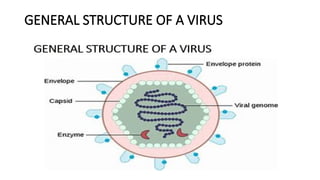
The nucleic acid is encased in a protein shell, which may be
surrounded by a lipid-containing membrane. The entire infectious
unit is termed a virion.
Viruses are parasites at the genetic level, replicating only in living
cells and are inert in the extracellular environment.
The viral nucleic acid contains information necessary to cause the
infected host cell to synthesize virus-specific macromolecules
required for the production of viral progeny
GENERAL STRUCTURE OF A VIRUS
VIRUSES-INTRODUCTION
Viruses vary greatly in structure, genome organization and
expression, and strategies of replication and transmission.
Viruses are known to infect unicellular organisms, such as
mycoplasmas, bacteria, and algae, and all higher plants and
animals
Terminologies
Capsid: The protein shell, or coat, that encloses the nucleic acid
genome.
VIRUSES-INTRODUCTION
Capsomeres: Morphologic units seen in the electron microscope
on the surface of icosahedral virus particles. Capsomeres
represent clusters of polypeptides, but the morphologic units do
not necessarily correspond to the chemically defined structural
units.
Defective virus: A virus particle that is functionally deficient in
some aspect of replication
Envelope: A lipid-containing membrane that surrounds some virus
particles. It is acquired during viral maturation by a budding
process through a cellular membrane. Virus-encoded
glycoproteins are exposed on the surface of the envelope. These
projections are called peplomers.
VIRUSES-INTRODUCTION
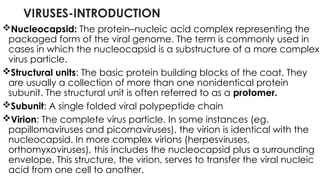
Nucleocapsid: The protein–nucleic acid complex representing the
packaged form of the viral genome. The term is commonly used in
cases in which the nucleocapsid is a substructure of a more complex
virus particle.
Structural units: The basic protein building blocks of the coat. They
are usually a collection of more than one nonidentical protein
subunit. The structural unit is often referred to as a protomer.
Subunit: A single folded viral polypeptide chain
Virion: The complete virus particle. In some instances (eg.
papillomaviruses and picornaviruses), the virion is identical with the
nucleocapsid. In more complex virions (herpesviruses,
orthomyxoviruses), this includes the nucleocapsid plus a surrounding
envelope. This structure, the virion, serves to transfer the viral nucleic
acid from one cell to another.
TYPES OF VIRUS
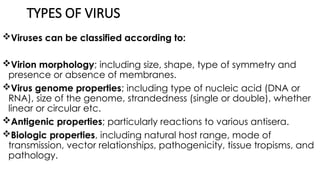
Viruses can be classified according to:
Virion morphology; including size, shape, type of symmetry and
presence or absence of membranes.
Virus genome properties; including type of nucleic acid (DNA or
RNA), size of the genome, strandedness (single or double), whether
linear or circular etc.
Antigenic properties; particularly reactions to various antisera.
Biologic properties, including natural host range, mode of
transmission, vector relationships, pathogenicity, tissue tropisms, and
pathology.
TYPES OF VIRUS
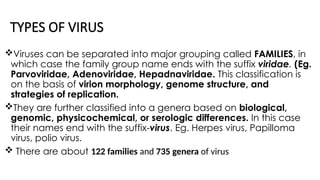
Viruses can be separated into major grouping called FAMILIES, in
which case the family group name ends with the suffix viridae. (Eg.
Parvoviridae, Adenoviridae, Hepadnaviridae. This classification is
on the basis of virion morphology, genome structure, and
strategies of replication.
They are further classified into a genera based on biological,
genomic, physicochemical, or serologic differences. In this case
their names end with the suffix-virus. Eg. Herpes virus, Papilloma
virus, polio virus.
 There are about 122 families and 735 genera of virus
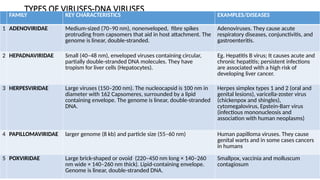
TYPES OF VIRUSES-DNA VIRUSES
FAMILY KEY CHARACTERISTICS EXAMPLES/DISEASES
1 ADENOVIRIDAE Medium-sized (70–90 nm), nonenveloped, fibre spikes
protruding from capsomers that aid in host attachment. The
genome is linear, double-stranded.
Adenoviruses. They cause acute
respiratory diseases, conjunctivitis, and
gastroenteritis.
2 HEPADNAVIRIDAE Small (40–48 nm), enveloped viruses containing circular,
partially double-stranded DNA molecules. They have
tropism for liver cells (Hepatocytes).
Eg. Hepatitis B virus; It causes acute and
chronic hepatitis; persistent infections
are associated with a high risk of
developing liver cancer.
3 HERPESVIRIDAE Large viruses (150–200 nm). The nucleocapsid is 100 nm in
diameter with 162 Capsomeres, surrounded by a lipid
containing envelope. The genome is linear, double-stranded
DNA.
Herpes simplex types 1 and 2 (oral and
genital lesions), varicella-zoster virus
(chickenpox and shingles),
cytomegalovirus, Epstein-Barr virus
(infectious mononucleosis and
association with human neoplasms)
4 PAPILLOMAVIRIDAE larger genome (8 kb) and particle size (55–60 nm) Human papilloma viruses. They cause
genital warts and in some cases cancers
in humans
5 POXVIRIDAE Large brick-shaped or ovoid (220–450 nm long × 140–260
nm wide × 140–260 nm thick). Lipid-containing envelope.
Genome is linear, double-stranded DNA.
Smallpox, vaccinia and molluscum
contagiosum
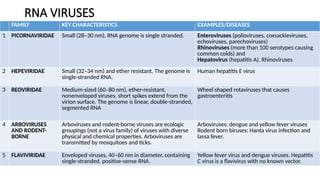
RNA VIRUSES
FAMILY KEY CHARACTERISTICS EXAMPLES/DISEASES
1 PICORNAVIRIDAE Small (28–30 nm), RNA genome is single stranded. Enteroviruses (polioviruses, coxsackieviruses,
echoviruses, parechoviruses)
Rhinoviruses (more than 100 serotypes causing
common colds) and
Hepatovirus (hepatitis A). Rhinoviruses
2 HEPEVIRIDAE Small (32–34 nm) and ether resistant. The genome is
single-stranded RNA,
Human hepatitis E virus
3 REOVIRIDAE Medium-sized (60–80 nm), ether-resistant,
nonenveloped viruses. short spikes extend from the
virion surface. The genome is linear, double-stranded,
segmented RNA
Wheel shaped rotaviruses that causes
gastroenteritis
4 ARBOVIRUSES
AND RODENT-
BORNE
Arboviruses and rodent-borne viruses are ecologic
groupings (not a virus family) of viruses with diverse
physical and chemical properties. Arboviruses are
transmitted by mosquitoes and ticks.
Arboviruses: dengue and yellow fever viruses
Rodent born biruses: Hanta virus infection and
lassa fever.
5 FLAVIVIRIDAE Enveloped viruses, 40–60 nm in diameter, containing
single-stranded, positive-sense RNA.
Yellow fever virus and dengue viruses. Hepatitis
C virus is a flavivirus with no known vector.
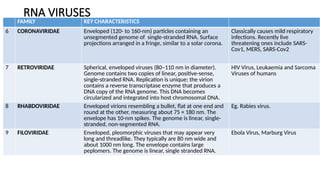
RNA VIRUSES
FAMILY KEY CHARACTERISTICS
6 CORONAVIRIDAE Enveloped (120- to 160-nm) particles containing an
unsegmented genome of single-stranded RNA. Surface
projections arranged in a fringe, similar to a solar corona.
Classically causes mild respiratory
infections. Recently live
threatening ones include SARS-
Cov1, MERS, SARS-Cov2
7 RETROVIRIDAE Spherical, enveloped viruses (80–110 nm in diameter).
Genome contains two copies of linear, positive-sense,
single-stranded RNA. Replication is unique; the virion
contains a reverse transcriptase enzyme that produces a
DNA copy of the RNA genome. This DNA becomes
circularized and integrated into host chromosomal DNA.
HIV Virus, Leukaemia and Sarcoma
Viruses of humans
8 RHABDOVIRIDAE Enveloped virions resembling a bullet, flat at one end and
round at the other, measuring about 75 × 180 nm. The
envelope has 10-nm spikes. The genome is linear, single-
stranded, non-segmented RNA.
Eg. Rabies virus.
9 FILOVIRIDAE Enveloped, pleomorphic viruses that may appear very
long and threadlike. They typically are 80 nm wide and
about 1000 nm long. The envelope contains large
peplomers. The genome is linear, single stranded RNA.
Ebola Virus, Marburg Virus
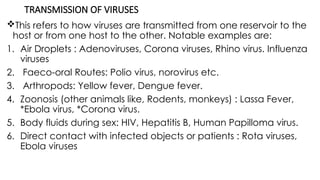
TRANSMISSION OF VIRUSES
This refers to how viruses are transmitted from one reservoir to the
host or from one host to the other. Notable examples are:
1. Air Droplets : Adenoviruses, Corona viruses, Rhino virus. Influenza
viruses
2. Faeco-oral Routes: Polio virus, norovirus etc.
3. Arthropods: Yellow fever, Dengue fever.
4. Zoonosis (other animals like, Rodents, monkeys) : Lassa Fever,
*Ebola virus, *Corona virus.
5. Body fluids during sex: HIV, Hepatitis B, Human Papilloma virus.
6. Direct contact with infected objects or patients : Rota viruses,
Ebola viruses
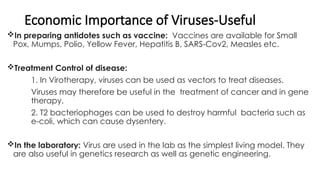
Economic Importance of Viruses-Useful
In preparing antidotes such as vaccine: Vaccines are available for Small
Pox, Mumps, Polio, Yellow Fever, Hepatitis B, SARS-Cov2, Measles etc.
Treatment Control of disease:
1. In Virotherapy, viruses can be used as vectors to treat diseases.
Viruses may therefore be useful in the treatment of cancer and in gene
therapy.
2. T2 bacteriophages can be used to destroy harmful bacteria such as
e-coli, which can cause dysentery.
In the laboratory: Virus are used in the lab as the simplest living model. They
are also useful in genetics research as well as genetic engineering.
ECONOMIC IMPORTANCE OF VIRUSES-Harmful
Virus cause diseases. Examples; common Cold, Influenza, Mumps, Measles
Polio, Yellow fever, HIV/AIDS etc. are all viral infections.
Viral epidemics/pandemics can lead to huge economic or financial losses. Eg
SARS-Cov2 pandemic, Ebola pandemic etc.
Viral diseases increases the healthcare cost and burden the healthcare system.
Some viral infections lead to mortality/death. Eg. Ebola, SARS-Cov2, HIV/AIDS
etc
Some viruses can be used for biological warfare and hence cause destruction to
human societies.

MICROBIOLOGY II LECTURE III.pptx. general knowledge

  • 1.
    MICROBIOLOGY II SCT 212 LECTUREIII L. L. AFUTU MBChB, PhD.
  • 2.
    VIRUSES-INTRODUCTION Viruses are thesmallest infectious agents (ranging from about 20 to 300 nm in diameter) and contain only one kind of nucleic acid (RNA or DNA) as their genome. The nucleic acid is encased in a protein shell, which may be surrounded by a lipid-containing membrane. The entire infectious unit is termed a virion. Viruses are parasites at the genetic level, replicating only in living cells and are inert in the extracellular environment. The viral nucleic acid contains information necessary to cause the infected host cell to synthesize virus-specific macromolecules required for the production of viral progeny
  • 3.
  • 4.
    VIRUSES-INTRODUCTION Viruses vary greatlyin structure, genome organization and expression, and strategies of replication and transmission. Viruses are known to infect unicellular organisms, such as mycoplasmas, bacteria, and algae, and all higher plants and animals Terminologies Capsid: The protein shell, or coat, that encloses the nucleic acid genome.
  • 5.
    VIRUSES-INTRODUCTION Capsomeres: Morphologic unitsseen in the electron microscope on the surface of icosahedral virus particles. Capsomeres represent clusters of polypeptides, but the morphologic units do not necessarily correspond to the chemically defined structural units. Defective virus: A virus particle that is functionally deficient in some aspect of replication Envelope: A lipid-containing membrane that surrounds some virus particles. It is acquired during viral maturation by a budding process through a cellular membrane. Virus-encoded glycoproteins are exposed on the surface of the envelope. These projections are called peplomers.
  • 6.
    VIRUSES-INTRODUCTION Nucleocapsid: The protein–nucleicacid complex representing the packaged form of the viral genome. The term is commonly used in cases in which the nucleocapsid is a substructure of a more complex virus particle. Structural units: The basic protein building blocks of the coat. They are usually a collection of more than one nonidentical protein subunit. The structural unit is often referred to as a protomer. Subunit: A single folded viral polypeptide chain Virion: The complete virus particle. In some instances (eg. papillomaviruses and picornaviruses), the virion is identical with the nucleocapsid. In more complex virions (herpesviruses, orthomyxoviruses), this includes the nucleocapsid plus a surrounding envelope. This structure, the virion, serves to transfer the viral nucleic acid from one cell to another.
  • 7.
    TYPES OF VIRUS Virusescan be classified according to: Virion morphology; including size, shape, type of symmetry and presence or absence of membranes. Virus genome properties; including type of nucleic acid (DNA or RNA), size of the genome, strandedness (single or double), whether linear or circular etc. Antigenic properties; particularly reactions to various antisera. Biologic properties, including natural host range, mode of transmission, vector relationships, pathogenicity, tissue tropisms, and pathology.
  • 8.
    TYPES OF VIRUS Virusescan be separated into major grouping called FAMILIES, in which case the family group name ends with the suffix viridae. (Eg. Parvoviridae, Adenoviridae, Hepadnaviridae. This classification is on the basis of virion morphology, genome structure, and strategies of replication. They are further classified into a genera based on biological, genomic, physicochemical, or serologic differences. In this case their names end with the suffix-virus. Eg. Herpes virus, Papilloma virus, polio virus.  There are about 122 families and 735 genera of virus
  • 9.
    TYPES OF VIRUSES-DNAVIRUSES FAMILY KEY CHARACTERISTICS EXAMPLES/DISEASES 1 ADENOVIRIDAE Medium-sized (70–90 nm), nonenveloped, fibre spikes protruding from capsomers that aid in host attachment. The genome is linear, double-stranded. Adenoviruses. They cause acute respiratory diseases, conjunctivitis, and gastroenteritis. 2 HEPADNAVIRIDAE Small (40–48 nm), enveloped viruses containing circular, partially double-stranded DNA molecules. They have tropism for liver cells (Hepatocytes). Eg. Hepatitis B virus; It causes acute and chronic hepatitis; persistent infections are associated with a high risk of developing liver cancer. 3 HERPESVIRIDAE Large viruses (150–200 nm). The nucleocapsid is 100 nm in diameter with 162 Capsomeres, surrounded by a lipid containing envelope. The genome is linear, double-stranded DNA. Herpes simplex types 1 and 2 (oral and genital lesions), varicella-zoster virus (chickenpox and shingles), cytomegalovirus, Epstein-Barr virus (infectious mononucleosis and association with human neoplasms) 4 PAPILLOMAVIRIDAE larger genome (8 kb) and particle size (55–60 nm) Human papilloma viruses. They cause genital warts and in some cases cancers in humans 5 POXVIRIDAE Large brick-shaped or ovoid (220–450 nm long × 140–260 nm wide × 140–260 nm thick). Lipid-containing envelope. Genome is linear, double-stranded DNA. Smallpox, vaccinia and molluscum contagiosum
  • 10.
    RNA VIRUSES FAMILY KEYCHARACTERISTICS EXAMPLES/DISEASES 1 PICORNAVIRIDAE Small (28–30 nm), RNA genome is single stranded. Enteroviruses (polioviruses, coxsackieviruses, echoviruses, parechoviruses) Rhinoviruses (more than 100 serotypes causing common colds) and Hepatovirus (hepatitis A). Rhinoviruses 2 HEPEVIRIDAE Small (32–34 nm) and ether resistant. The genome is single-stranded RNA, Human hepatitis E virus 3 REOVIRIDAE Medium-sized (60–80 nm), ether-resistant, nonenveloped viruses. short spikes extend from the virion surface. The genome is linear, double-stranded, segmented RNA Wheel shaped rotaviruses that causes gastroenteritis 4 ARBOVIRUSES AND RODENT- BORNE Arboviruses and rodent-borne viruses are ecologic groupings (not a virus family) of viruses with diverse physical and chemical properties. Arboviruses are transmitted by mosquitoes and ticks. Arboviruses: dengue and yellow fever viruses Rodent born biruses: Hanta virus infection and lassa fever. 5 FLAVIVIRIDAE Enveloped viruses, 40–60 nm in diameter, containing single-stranded, positive-sense RNA. Yellow fever virus and dengue viruses. Hepatitis C virus is a flavivirus with no known vector.
  • 11.
    RNA VIRUSES FAMILY KEYCHARACTERISTICS 6 CORONAVIRIDAE Enveloped (120- to 160-nm) particles containing an unsegmented genome of single-stranded RNA. Surface projections arranged in a fringe, similar to a solar corona. Classically causes mild respiratory infections. Recently live threatening ones include SARS- Cov1, MERS, SARS-Cov2 7 RETROVIRIDAE Spherical, enveloped viruses (80–110 nm in diameter). Genome contains two copies of linear, positive-sense, single-stranded RNA. Replication is unique; the virion contains a reverse transcriptase enzyme that produces a DNA copy of the RNA genome. This DNA becomes circularized and integrated into host chromosomal DNA. HIV Virus, Leukaemia and Sarcoma Viruses of humans 8 RHABDOVIRIDAE Enveloped virions resembling a bullet, flat at one end and round at the other, measuring about 75 × 180 nm. The envelope has 10-nm spikes. The genome is linear, single- stranded, non-segmented RNA. Eg. Rabies virus. 9 FILOVIRIDAE Enveloped, pleomorphic viruses that may appear very long and threadlike. They typically are 80 nm wide and about 1000 nm long. The envelope contains large peplomers. The genome is linear, single stranded RNA. Ebola Virus, Marburg Virus
  • 12.
    TRANSMISSION OF VIRUSES Thisrefers to how viruses are transmitted from one reservoir to the host or from one host to the other. Notable examples are: 1. Air Droplets : Adenoviruses, Corona viruses, Rhino virus. Influenza viruses 2. Faeco-oral Routes: Polio virus, norovirus etc. 3. Arthropods: Yellow fever, Dengue fever. 4. Zoonosis (other animals like, Rodents, monkeys) : Lassa Fever, *Ebola virus, *Corona virus. 5. Body fluids during sex: HIV, Hepatitis B, Human Papilloma virus. 6. Direct contact with infected objects or patients : Rota viruses, Ebola viruses
  • 13.
    Economic Importance ofViruses-Useful In preparing antidotes such as vaccine: Vaccines are available for Small Pox, Mumps, Polio, Yellow Fever, Hepatitis B, SARS-Cov2, Measles etc. Treatment Control of disease: 1. In Virotherapy, viruses can be used as vectors to treat diseases. Viruses may therefore be useful in the treatment of cancer and in gene therapy. 2. T2 bacteriophages can be used to destroy harmful bacteria such as e-coli, which can cause dysentery. In the laboratory: Virus are used in the lab as the simplest living model. They are also useful in genetics research as well as genetic engineering.
  • 14.
    ECONOMIC IMPORTANCE OFVIRUSES-Harmful Virus cause diseases. Examples; common Cold, Influenza, Mumps, Measles Polio, Yellow fever, HIV/AIDS etc. are all viral infections. Viral epidemics/pandemics can lead to huge economic or financial losses. Eg SARS-Cov2 pandemic, Ebola pandemic etc. Viral diseases increases the healthcare cost and burden the healthcare system. Some viral infections lead to mortality/death. Eg. Ebola, SARS-Cov2, HIV/AIDS etc Some viruses can be used for biological warfare and hence cause destruction to human societies.