Current Status of Retail Market
• Retailing in India accounts for over 10% of the country’s Gross Domestic
Product (GDP) and around 8% of the employment (Source: IBEF).
• The Indian retail market is expected to grow to US$1.1 trillion by 2020,
while the modern retail market in India is expected to double in size over
the next three years. (Source: IBEF)
• The retail sector in India is dominated by the unorganized retail trade,
where unorganised trade forms around 93% of the overall trade.
• The sector can be broadly divided into two segments:
– Value retailing, which is typically a low margin-high volume business
(primarily food and groceries) and
– Lifestyle retailing, a high margin-low volume business (apparel,
footwear, etc). The sector is further divided into various categories,
depending on the types of products offered.
• The online retail is growing at rapid pace.
• The overall retail market in India is expected to grow at 12% growth rate
per annum, Modern trade is going to expand as twice as fast at 20% per
annum and traditional trade is expected to grow at 10% (Source: IBEF).
MONETARY POLICY
 INTEREST RATE:
• Lower interest rate helps the organised retailers to expand.
• Also helps the unorganised retailers to borrow money from
micro-finance.
 INFLATION:
• Increase in inflation leads to decrease in the demand of the
goods leading to the decrease in the business of the retailers.
DEMOGRAPHICS
• Growth in the middle class.
• Growth in the young urban consumers because of rise in the
urban income.
• Growth in aspiration
• Digital influence- Search for product online
GLOBALISATION
• The demand for the trending goods produced outside India
increases leading to import of these goods that sells in the
retail stores.
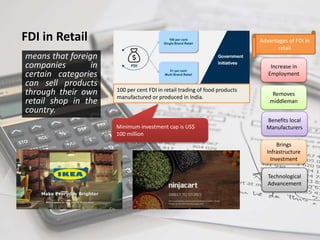
FDI in Retail
means that foreign
companies in
certain categories
can sell products
through their own
retail shop in the
country.
Increase in
Employment
Benefits local
Manufacturers
Technological
Advancement
Brings
Infrastructure
Investment
Removes
middleman
Advantages of FDI in
retail
100 per cent FDI in retail trading of food products
manufactured or produced in India.
Minimum investment cap is US$
100 million
LEGAL FACTORS
• Consumer protection
• Relaxation on rules on e-pharmacy.
• Privacy and data protection for online purchases.
MONSOON
• A good monsoon increases the demand for goods in India,
leading to increase in the business of the retailers.
EMPLOYMENT
• Entry of super-marts, malls generates employments.
• Nearly 8% of the employment comes from retail sector i.e. 4-
16 crores of people are employed in the retail related
activities.
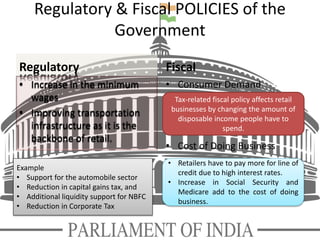
Regulatory & Fiscal POLICIES of the
Government
Regulatory
• Increase in the minimum
wages
• Improving transportation
infrastructure as it is the
backbone of retail.
Fiscal
• Consumer Demand
• Cost of Doing Business
Tax-related fiscal policy affects retail
businesses by changing the amount of
disposable income people have to
spend.
• Retailers have to pay more for line of
credit due to high interest rates.
• Increase in Social Security and
Medicare add to the cost of doing
business.
Example
• Support for the automobile sector
• Reduction in capital gains tax, and
• Additional liquidity support for NBFC
• Reduction in Corporate Tax

Micro- economic conditions in retail

  • 1.
    Current Status ofRetail Market • Retailing in India accounts for over 10% of the country’s Gross Domestic Product (GDP) and around 8% of the employment (Source: IBEF). • The Indian retail market is expected to grow to US$1.1 trillion by 2020, while the modern retail market in India is expected to double in size over the next three years. (Source: IBEF) • The retail sector in India is dominated by the unorganized retail trade, where unorganised trade forms around 93% of the overall trade. • The sector can be broadly divided into two segments: – Value retailing, which is typically a low margin-high volume business (primarily food and groceries) and – Lifestyle retailing, a high margin-low volume business (apparel, footwear, etc). The sector is further divided into various categories, depending on the types of products offered. • The online retail is growing at rapid pace. • The overall retail market in India is expected to grow at 12% growth rate per annum, Modern trade is going to expand as twice as fast at 20% per annum and traditional trade is expected to grow at 10% (Source: IBEF).
  • 2.
    MONETARY POLICY  INTERESTRATE: • Lower interest rate helps the organised retailers to expand. • Also helps the unorganised retailers to borrow money from micro-finance.  INFLATION: • Increase in inflation leads to decrease in the demand of the goods leading to the decrease in the business of the retailers.
  • 3.
    DEMOGRAPHICS • Growth inthe middle class. • Growth in the young urban consumers because of rise in the urban income. • Growth in aspiration • Digital influence- Search for product online GLOBALISATION • The demand for the trending goods produced outside India increases leading to import of these goods that sells in the retail stores.
  • 4.
    FDI in Retail meansthat foreign companies in certain categories can sell products through their own retail shop in the country. Increase in Employment Benefits local Manufacturers Technological Advancement Brings Infrastructure Investment Removes middleman Advantages of FDI in retail 100 per cent FDI in retail trading of food products manufactured or produced in India. Minimum investment cap is US$ 100 million
  • 5.
    LEGAL FACTORS • Consumerprotection • Relaxation on rules on e-pharmacy. • Privacy and data protection for online purchases. MONSOON • A good monsoon increases the demand for goods in India, leading to increase in the business of the retailers. EMPLOYMENT • Entry of super-marts, malls generates employments. • Nearly 8% of the employment comes from retail sector i.e. 4- 16 crores of people are employed in the retail related activities.
  • 7.
    Regulatory & FiscalPOLICIES of the Government Regulatory • Increase in the minimum wages • Improving transportation infrastructure as it is the backbone of retail. Fiscal • Consumer Demand • Cost of Doing Business Tax-related fiscal policy affects retail businesses by changing the amount of disposable income people have to spend. • Retailers have to pay more for line of credit due to high interest rates. • Increase in Social Security and Medicare add to the cost of doing business. Example • Support for the automobile sector • Reduction in capital gains tax, and • Additional liquidity support for NBFC • Reduction in Corporate Tax