CONFIDENTIALITY: 
UCLA AND CELEBRITY RECORDS 
EDWARD STANFORD MD 
MHA 690 
PROF DAVID COLE 
OCT 2, 2014
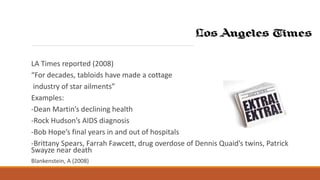
LA Times reported (2008) 
“For decades, tabloids have made a cottage 
industry of star ailments” 
Examples: 
-Dean Martin’s declining health 
-Rock Hudson’s AIDS diagnosis 
-Bob Hope’s final years in and out of hospitals 
-Brittany Spears, Farrah Fawcett, drug overdose of Dennis Quaid’s twins, Patrick 
Swayze near death 
Blankenstein, A (2008)
Serious breech of doctor-patient 
confidentiality 
127 UCLA Medical Center employees were fired, suspended, and warned for viewing Social 
Security numbers, health insurance information, and addresses from April 2003-May 2007. 
Lawanda Jackson, 50, pleads guilty to felony charges of violating federal medical privacy law for 
commercial purposes but dies prematurely (LA Times, 2009) 
California Department of Public Health cites prior occurrences (Law, 2009). 
Laws violated: 
Health Insurance Portability Accountability Act (the “Privacy Rule”) 
Confidentiality of Medical Information Act (California Civil Code -56 et seq) 
Lanterman-Petris-Short Act (California Welfare & Institutions Code – 5000 et seq) 
State information Practices Act (California Civil Code sections 1798 et seq)
UCLA Mission and Vision 
“Our mission is to deliver leading-edge patient care, research, and education” 
“Our vision is to heal humankind, one patient at a time, by improving health, 
alleviating suffering and delivering acts of kindness” (UCLAhealth.org. 2014) 
“UCLA Health System has stringent policies familiar to all employees to protect 
patient confidentiality. All staff and faculty members, contractors, volunteers 
and other workers are required to sign confidentiality agreements as a condition 
of their employment and they complete extensive training on federal Health 
Insurance Portability and Accountability Act – related privacy and security 
issues” (UCLA newsroom, 2008)
LESSONS LEARNED 
- Must restrict access to only those who MUST have patient 
information access 
- Must implement way to keep track of who 
accesses/accessed an individual’s information 
- Covered entities are responsible for the actions of their 
employees 
UCLA paid over $860,000 in fines 
(abouthipaa.com, 2011)
STAFF TRAINING OUTLINE 
All staff (physicians, nurses, ancillary staff) with access to patient information – MANDATORY 
What is HIPAA – terms and concepts 
What is health information 
What is protected health information 
What is electronic protected health information 
Conducting a fair investigation 
Zero tolerance for HIPAA patient privacy violations 
Business partners must sign confidentiality agreements 
Fines imposed for HIPAA violations
HIPAA 
The HIPAA privacy provision took effect on April 14, 2003. Key privacy provisions include the following: 
•Patients must be able to access their record and request correction of errors. 
•Patients must be informed of how their personal information will be used. 
•Patient information cannot be used for marketing purposes without the explicit consent of the involved patients. 
•Patients can ask their health insurers and providers to take reasonable steps to ensure that their 
communications with the patient are confidential. For instance, a patient can ask to be called at his or her work 
number, instead of home or cell phone number. 
•Patients can file formal privacy-related complaints to the US Department of Health and Human Services Office 
for Civil Rights. 
•Health insurers or providers must document their privacy procedures, but they have discretion on what to 
include in their privacy procedure. 
•Health insurers or providers must designate a privacy officer and train their employees. 
•Providers may use patient information without patient consent for the purposes of providing treatment, 
obtaining payment for services, and performing the non-treatment operational tasks of the provider’s business. 
Pozgar, 2012, p 295
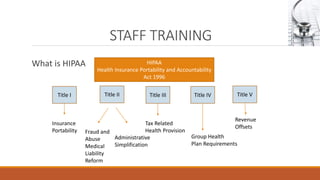
STAFF TRAINING 
What is HIPAA HIPAA 
Health Insurance Portability and Accountability 
Act 1996 
Title I Title II Title III Title IV Title V 
Insurance 
Portability 
Tax Related 
Health Provision 
Revenue 
Offsets 
Fraud and 
Abuse 
Medical 
Liability 
Reform 
Administrative 
Simplification 
Group Health 
Plan Requirements
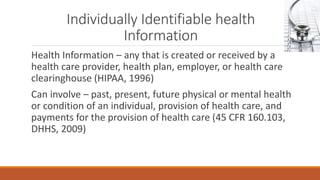
Individually Identifiable health 
Information 
Health Information – any that is created or received by a 
health care provider, health plan, employer, or health care 
clearinghouse (HIPAA, 1996) 
Can involve – past, present, future physical or mental health 
or condition of an individual, provision of health care, and 
payments for the provision of health care (45 CFR 160.103, 
DHHS, 2009)
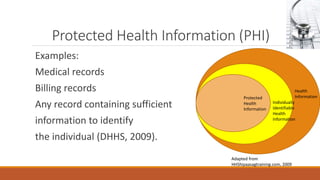
Protected Health Information (PHI) 
Examples: 
Medical records 
Billing records 
Any record containing sufficient 
information to identify 
the individual (DHHS, 2009). 
Health 
Information 
Individually 
Identifiable 
Health 
Information 
Protected 
Health 
Information 
Adapted from 
HHShipaasagtraining.com, 2009
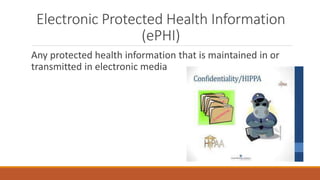
Electronic Protected Health Information 
(ePHI) 
Any protected health information that is maintained in or 
transmitted in electronic media
CONCLUSIONS 
All medical providers who have any access to a patient’s 
medical information should understand HIPAA 
All medical providers should receive MANDATORY training 
and understand a zero tolerance for violations 
Only individuals who MUST have access to PHI should be 
allowed access 
Employers are responsible for the actions of their 
employees
REFERENCES 
AboutHIPAA (2011). Specific lessions from HIPAA privacy and security case at UCLA health system. Accessed from www.abouthipaa.com 
Oct 1, 2014 
Blankenstein, A Eyes on celebrity records multiply. May 20, 2008 Accessed from www.latimes.com. Oct 1, 2014. 
DHHS (2009). Accessed from www.DHHS.org. Oct 1 2014. 
HHShipaasagtraining (2009). Accessed from www.hhshipaasagtraining.com Oct 1, 2104. 
HIPAA (1996). Accessed from www.gov.org. Oct 1, 2014. 
LA Times (2009). Ex-hospital worker convicted in patient record leaks dies. Accessed from www.articles.latimes.com. Oct 1 2014. 
Law, M. (2009). The celebrity California UCLA medical center scandal: Snooping on Celeb Records. Accessed from www.uslaw.com. Oct 1, 
2014 
Pozgar, G. D. (2012) Legal Aspects of Health Care Administration, 11th Edition. Jones & Bartlett Publishers. 
UCLA (2014). Accessed from www.uclahealth.org. Oct 1, 2014. 
UCLA Newsroom (2008). ULCA Health system statement on patient confidentiality. Accessed from www.newsroom.ucla.edu. Oct 1, 2014.

Mha 690 wk1 d2 confidentiality

  • 1.
    CONFIDENTIALITY: UCLA ANDCELEBRITY RECORDS EDWARD STANFORD MD MHA 690 PROF DAVID COLE OCT 2, 2014
  • 2.
    LA Times reported(2008) “For decades, tabloids have made a cottage industry of star ailments” Examples: -Dean Martin’s declining health -Rock Hudson’s AIDS diagnosis -Bob Hope’s final years in and out of hospitals -Brittany Spears, Farrah Fawcett, drug overdose of Dennis Quaid’s twins, Patrick Swayze near death Blankenstein, A (2008)
  • 3.
    Serious breech ofdoctor-patient confidentiality 127 UCLA Medical Center employees were fired, suspended, and warned for viewing Social Security numbers, health insurance information, and addresses from April 2003-May 2007. Lawanda Jackson, 50, pleads guilty to felony charges of violating federal medical privacy law for commercial purposes but dies prematurely (LA Times, 2009) California Department of Public Health cites prior occurrences (Law, 2009). Laws violated: Health Insurance Portability Accountability Act (the “Privacy Rule”) Confidentiality of Medical Information Act (California Civil Code -56 et seq) Lanterman-Petris-Short Act (California Welfare & Institutions Code – 5000 et seq) State information Practices Act (California Civil Code sections 1798 et seq)
  • 4.
    UCLA Mission andVision “Our mission is to deliver leading-edge patient care, research, and education” “Our vision is to heal humankind, one patient at a time, by improving health, alleviating suffering and delivering acts of kindness” (UCLAhealth.org. 2014) “UCLA Health System has stringent policies familiar to all employees to protect patient confidentiality. All staff and faculty members, contractors, volunteers and other workers are required to sign confidentiality agreements as a condition of their employment and they complete extensive training on federal Health Insurance Portability and Accountability Act – related privacy and security issues” (UCLA newsroom, 2008)
  • 5.
    LESSONS LEARNED -Must restrict access to only those who MUST have patient information access - Must implement way to keep track of who accesses/accessed an individual’s information - Covered entities are responsible for the actions of their employees UCLA paid over $860,000 in fines (abouthipaa.com, 2011)
  • 6.
    STAFF TRAINING OUTLINE All staff (physicians, nurses, ancillary staff) with access to patient information – MANDATORY What is HIPAA – terms and concepts What is health information What is protected health information What is electronic protected health information Conducting a fair investigation Zero tolerance for HIPAA patient privacy violations Business partners must sign confidentiality agreements Fines imposed for HIPAA violations
  • 7.
    HIPAA The HIPAAprivacy provision took effect on April 14, 2003. Key privacy provisions include the following: •Patients must be able to access their record and request correction of errors. •Patients must be informed of how their personal information will be used. •Patient information cannot be used for marketing purposes without the explicit consent of the involved patients. •Patients can ask their health insurers and providers to take reasonable steps to ensure that their communications with the patient are confidential. For instance, a patient can ask to be called at his or her work number, instead of home or cell phone number. •Patients can file formal privacy-related complaints to the US Department of Health and Human Services Office for Civil Rights. •Health insurers or providers must document their privacy procedures, but they have discretion on what to include in their privacy procedure. •Health insurers or providers must designate a privacy officer and train their employees. •Providers may use patient information without patient consent for the purposes of providing treatment, obtaining payment for services, and performing the non-treatment operational tasks of the provider’s business. Pozgar, 2012, p 295
  • 8.
    STAFF TRAINING Whatis HIPAA HIPAA Health Insurance Portability and Accountability Act 1996 Title I Title II Title III Title IV Title V Insurance Portability Tax Related Health Provision Revenue Offsets Fraud and Abuse Medical Liability Reform Administrative Simplification Group Health Plan Requirements
  • 9.
    Individually Identifiable health Information Health Information – any that is created or received by a health care provider, health plan, employer, or health care clearinghouse (HIPAA, 1996) Can involve – past, present, future physical or mental health or condition of an individual, provision of health care, and payments for the provision of health care (45 CFR 160.103, DHHS, 2009)
  • 10.
    Protected Health Information(PHI) Examples: Medical records Billing records Any record containing sufficient information to identify the individual (DHHS, 2009). Health Information Individually Identifiable Health Information Protected Health Information Adapted from HHShipaasagtraining.com, 2009
  • 11.
    Electronic Protected HealthInformation (ePHI) Any protected health information that is maintained in or transmitted in electronic media
  • 12.
    CONCLUSIONS All medicalproviders who have any access to a patient’s medical information should understand HIPAA All medical providers should receive MANDATORY training and understand a zero tolerance for violations Only individuals who MUST have access to PHI should be allowed access Employers are responsible for the actions of their employees
  • 13.
    REFERENCES AboutHIPAA (2011).Specific lessions from HIPAA privacy and security case at UCLA health system. Accessed from www.abouthipaa.com Oct 1, 2014 Blankenstein, A Eyes on celebrity records multiply. May 20, 2008 Accessed from www.latimes.com. Oct 1, 2014. DHHS (2009). Accessed from www.DHHS.org. Oct 1 2014. HHShipaasagtraining (2009). Accessed from www.hhshipaasagtraining.com Oct 1, 2104. HIPAA (1996). Accessed from www.gov.org. Oct 1, 2014. LA Times (2009). Ex-hospital worker convicted in patient record leaks dies. Accessed from www.articles.latimes.com. Oct 1 2014. Law, M. (2009). The celebrity California UCLA medical center scandal: Snooping on Celeb Records. Accessed from www.uslaw.com. Oct 1, 2014 Pozgar, G. D. (2012) Legal Aspects of Health Care Administration, 11th Edition. Jones & Bartlett Publishers. UCLA (2014). Accessed from www.uclahealth.org. Oct 1, 2014. UCLA Newsroom (2008). ULCA Health system statement on patient confidentiality. Accessed from www.newsroom.ucla.edu. Oct 1, 2014.