TRAINING ON SPED
CONTENT, PEDAGOGY
AND ASSESSMENT
December 6-10, 2021
MULTI-FACTORED
ASSESSMENT TOOL (MFAT)
OBJECTIVES:
 Acquire knowledge and understanding on the
Multi-Factored Assessment Tool (MFAT).
 Distinguish the 5 domains of learning and its
competencies.
 Display positivity towards the significance of
MFAT by sharing valuable ideas.
ACTIVITY
Come up with a word/single word reflecting
your understanding on MFAT.
What is MFAT?
> a screening tool intended to gather
information on learner’s strengths, needs,
learning styles, and other educational concerns
What is MFAT?
> aims to assist teachers for instructional
planning and educational placement of
learners.
When to conduct the MFAT?
 shall be conducted in a month after the beginning
of each school year
 a one-time assessment administered to Grade I
learners enrolled in the regular schools who may
exhibit developmental advancement or delays or
with manifestations of learning disability
Scope of the assessment
 covers the five domains of learning namely:
• Cognitive Domain
• Communication Domain
• Socio-Emotional Domain
• Motor Domain
• Daily Living Skills Domain
Goals and Objectives
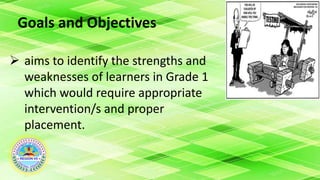
 aims to identify the strengths and
weaknesses of learners in Grade 1
which would require appropriate
intervention/s and proper
placement.
Goals and Objectives
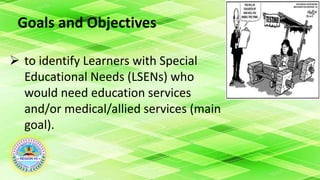
 to identify Learners with Special
Educational Needs (LSENs) who
would need education services
and/or medical/allied services (main
goal).
Result of the MFAT
 does not in any way, affect the
performance of the learner,
teacher, school, division nor
the region.
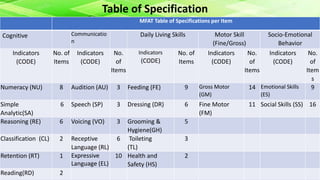
Table of Specification
MFAT Table of Specifications per Item
Cognitive Communicatio
n
Daily Living Skills Motor Skill
(Fine/Gross)
Socio-Emotional
Behavior
Indicators
(CODE)
No. of
Items
Indicators
(CODE)
No.
of
Items
Indicators
(CODE)
No. of
Items
Indicators
(CODE)
No.
of
Items
Indicators
(CODE)
No.
of
Item
s
Numeracy (NU) 8 Audition (AU) 3 Feeding (FE) 9 Gross Motor
(GM)
14 Emotional Skills
(ES)
9
Simple
Analytic(SA)
6 Speech (SP) 3 Dressing (DR) 6 Fine Motor
(FM)
11 Social Skills (SS) 16
Reasoning (RE) 6 Voicing (VO) 3 Grooming &
Hygiene(GH)
5
Classification (CL) 2 Receptive
Language (RL)
6 Toileting
(TL)
3
Retention (RT) 1 Expressive
Language (EL)
10 Health and
Safety (HS)
2
Reading(RD) 2
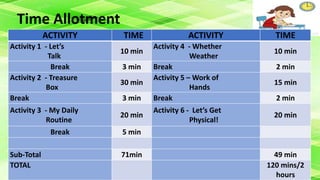
Time Allotment
ACTIVITY TIME ACTIVITY TIME
Activity 1 - Let’s
Talk
10 min
Activity 4 - Whether
Weather
10 min
Break 3 min Break 2 min
Activity 2 - Treasure
Box
30 min
Activity 5 – Work of
Hands
15 min
Break 3 min Break 2 min
Activity 3 - My Daily
Routine
20 min
Activity 6 - Let’s Get
Physical!
20 min
Break 5 min
Sub-Total 71min 49 min
TOTAL 120 mins/2
hours
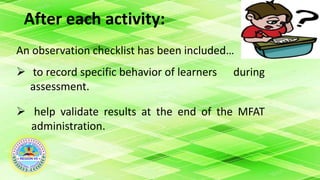
After each activity:
An observation checklist has been included…
 to record specific behavior of learners during
assessment.
 help validate results at the end of the MFAT
administration.
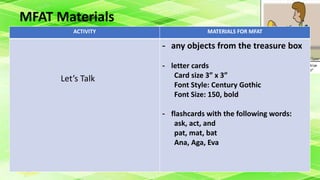
MFAT Materials
ACTIVITY MATERIALS FOR MFAT
Let’s Talk
- any objects from the treasure box
- letter cards
Card size 3” x 3”
Font Style: Century Gothic
Font Size: 150, bold
- flashcards with the following words:
ask, act, and
pat, mat, bat
Ana, Aga, Eva
MFAT Materials
ACTIVITY MATERIALS FOR MFAT
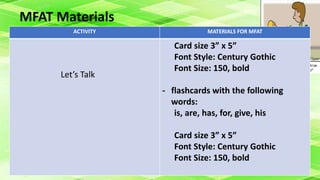
Let’s Talk
Card size 3” x 5”
Font Style: Century Gothic
Font Size: 150, bold
- flashcards with the following
words:
is, are, has, for, give, his
Card size 3” x 5”
Font Style: Century Gothic
Font Size: 150, bold
MFAT Materials
ACTIVITY MATERIALS
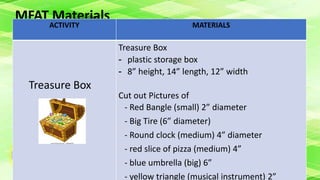
Treasure Box
Treasure Box
- plastic storage box
- 8” height, 14” length, 12” width
Cut out Pictures of
- Red Bangle (small) 2” diameter
- Big Tire (6” diameter)
- Round clock (medium) 4” diameter
- red slice of pizza (medium) 4”
- blue umbrella (big) 6”
- yellow triangle (musical instrument) 2”
MFAT Materials
ACTIVITY MATERIALS
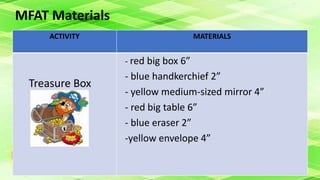
Treasure Box
- red big box 6”
- blue handkerchief 2”
- yellow medium-sized mirror 4”
- red big table 6”
- blue eraser 2”
-yellow envelope 4”
MFAT Materials
ACTIVITY MATERIALS
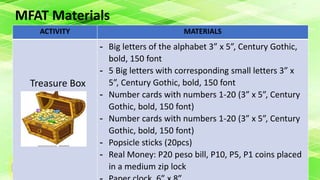
Treasure Box
- Big letters of the alphabet 3” x 5”, Century Gothic,
bold, 150 font
- 5 Big letters with corresponding small letters 3” x
5”, Century Gothic, bold, 150 font
- Number cards with numbers 1-20 (3” x 5”, Century
Gothic, bold, 150 font)
- Number cards with numbers 1-20 (3” x 5”, Century
Gothic, bold, 150 font)
- Popsicle sticks (20pcs)
- Real Money: P20 peso bill, P10, P5, P1 coins placed
in a medium zip lock
MFAT Materials
ACTIVITY MATERIALS
Treasure Box
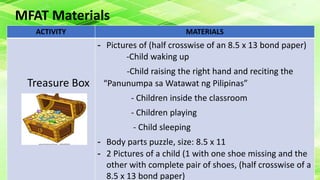
- Pictures of (half crosswise of an 8.5 x 13 bond paper)
-Child waking up
-Child raising the right hand and reciting the
“Panunumpa sa Watawat ng Pilipinas”
- Children inside the classroom
- Children playing
- Child sleeping
- Body parts puzzle, size: 8.5 x 11
- 2 Pictures of a child (1 with one shoe missing and the
other with complete pair of shoes, (half crosswise of a
8.5 x 13 bond paper)
MFAT Materials
ACTIVITY MATERIALS
My Daily Routine
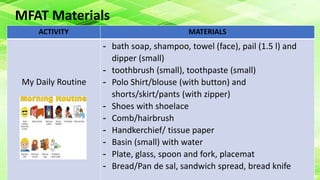
- bath soap, shampoo, towel (face), pail (1.5 l) and
dipper (small)
- toothbrush (small), toothpaste (small)
- Polo Shirt/blouse (with button) and
shorts/skirt/pants (with zipper)
- Shoes with shoelace
- Comb/hairbrush
- Handkerchief/ tissue paper
- Basin (small) with water
- Plate, glass, spoon and fork, placemat
- Bread/Pan de sal, sandwich spread, bread knife
MFAT Materials
ACTIVITY MATERIALS
My Daily Routine
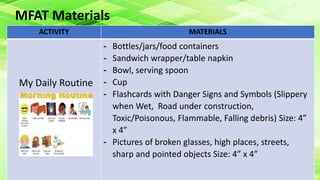
- Bottles/jars/food containers
- Sandwich wrapper/table napkin
- Bowl, serving spoon
- Cup
- Flashcards with Danger Signs and Symbols (Slippery
when Wet, Road under construction,
Toxic/Poisonous, Flammable, Falling debris) Size: 4”
x 4”
- Pictures of broken glasses, high places, streets,
sharp and pointed objects Size: 4” x 4”
MFAT Materials
ACTIVITY MATERIALS
Whether Weather
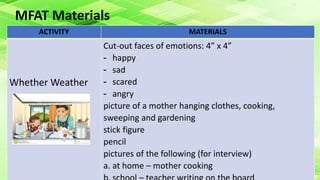
Cut-out faces of emotions: 4” x 4”
- happy
- sad
- scared
- angry
picture of a mother hanging clothes, cooking,
sweeping and gardening
stick figure
pencil
pictures of the following (for interview)
a. at home – mother cooking
MFAT Materials
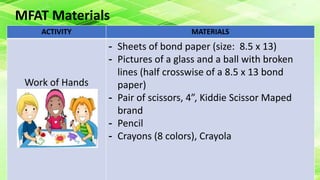
ACTIVITY MATERIALS
Work of Hands
- Sheets of bond paper (size: 8.5 x 13)
- Pictures of a glass and a ball with broken
lines (half crosswise of a 8.5 x 13 bond
paper)
- Pair of scissors, 4”, Kiddie Scissor Maped
brand
- Pencil
- Crayons (8 colors), Crayola
MFAT Materials
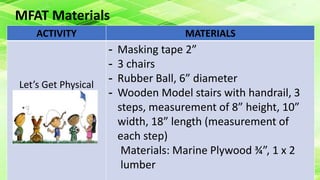
ACTIVITY MATERIALS
Let’s Get Physical
- Masking tape 2”
- 3 chairs
- Rubber Ball, 6” diameter
- Wooden Model stairs with handrail, 3
steps, measurement of 8” height, 10”
width, 18” length (measurement of
each step)
Materials: Marine Plywood ¾”, 1 x 2
lumber
Test Procedure:
A. Test Protocols
 To ensure the confidentiality of the assessment,
assessors are expected to safeguard assessment
tools, corresponding materials and results and
should be kept or deposited in the
guidance/principal’s office.
Test Procedure:
B. Preparations before the Test administration
Prior to the administration of the test, the following
should be prepared:
1.Identify learners who may exhibit developmental
advancement or delays or with manifestations of learning
disability and the Post test result of Early Childhood
Development (ECD) Checklist should be considered.
Test Procedure:
B. Preparations before the Test administration
2. Ensure that materials per activity are complete,
properly labelled and arranged; and,
3. Organize the room or space where the assessment
activity will take place.
Test Procedure:
C. During the Test Administration
During the administration of the test, assessors should:
1. Ensure that materials can be easily accessed by the
assessor but will not distract the learner;
Test Procedure:
C. During the Test Administration
2. Use English, Filipino or mother tongue depending on
the preferred language of the learner;
3. Record time started and ended per activity;
4. Make sure that the child is comfortable before every
activity;
Test Procedure:
C. During the Test Administration
5. Explain instructions properly per activity/task;
6. Give instructions twice only;
7. Record learner’s response;
Test Procedure:
C. During the Test Administration
8. Use in between breaks for proper transition to
the next activity;
9. Continue the assessment the following day if the
child is no longer responsive;
10. Thank the learner at the end of the assessment.
Script per activity and per item
The MFAT has script within each activity for easy
referral and use of assessors.
Sample script and sequence
1. Start with greetings
“Good morning/afternoon (name of the learner)! How are you today?”
(Be sure that the learner feels at ease and relaxed as he/she gives his/her
response).
2. Introduce the activity
“Today, we are going to play. We will do some activities. Don’t worry.
These are just simple activities and the result of these will not affect your
grade. In fact, it will help you improve your performance in class. Do not be
shy to ask questions in case you do not understand my instruction. I will be
here to help you.”
Sample script and sequence
3. Ask the learner if she/he has some questions or concerns
“Do you have questions before we start? (Wait for the response
of the learner. If the learner says “none”, proceed to the
assessment session. If the learner says “yes”, ask what the
concern is and provide appropriate answers. Only if there are
no more questions to answer you can proceed with the
activity.)
Sample script and sequence
4. Ensure that the learner is ready to start
“Are you ready? (Do not start until the learner is ready or has
shown any sign of approval.)
5. Read the instruction/s as stated in each activity.
6. Record time per activity
Ensure that you have a timer/watch to guide you with the
time allotment per activity. Record time started and ended per
activity on the space provided.
Sample script and sequence
7. Record learner’s responses
a.Check () YES if the child performed the task, or the
item indicated was observed. If not, check NO and
write in the LEARNER’S ACTUAL RESPONSE column
the learner’s response or reaction towards the given
task/activity.
b.Observe the learner’s behavior during the activity.
Sample script and sequence
8. Use in between breaks for proper transition to the next activity
“We are going to take a short break. Are you still comfortable? Do you
need to go to the comfort room or do you need anything?
Give a few minutes for the learner to rest; go to the comfort room
(as
needed) and, get ready for the next activity.
a.Use this time to pack materials you will no longer use.
b.Prepare the next set of assessment tools and materials you
need for the succeeding activity.
Sample script and sequence
9. Thank the learner at the end of the assessment
“Good job! We finished the activity. Thank you for
being cooperative and I hope you had fun.”
Test Procedure:
D. Pre-, During and Post- Test Forms
The DepEd Central Office through the Student
Inclusion Division - Bureau of Learning Delivery
(BLD-SID) will provide the assessment tool and
materials needed for the test administration.
Test Procedure:
D. Pre-, During and Post- Test Forms
The assessor should ensure that there are enough
forms prior to the administration of the
assessment.
MFAT TOOL
con-mfat.doc
Q and A
What can you say about MFAT tool?
Q and A
 Do you think this MFAT tool can help teachers
in identifying the different difficulties of our
learners? How?
ACTIVITY:
What are your insights and learnings about the tool?
Write your insights and learnings by completing the
statements below:
I learned that_______________________________.
I realized that ______________________________.
As a trainer, I will ___________________________.
SONG:
QUE SERA, SERA
WHATEVER WILL BE, WILL BE
THE FUTURE IS OURS TO SEE
QUE SERA, SERA
WHAT WILL BE, WILL BE
mfat-final-region.pptx

mfat-final-region.pptx

  • 1.
    TRAINING ON SPED CONTENT,PEDAGOGY AND ASSESSMENT December 6-10, 2021
  • 2.
  • 3.
    OBJECTIVES:  Acquire knowledgeand understanding on the Multi-Factored Assessment Tool (MFAT).  Distinguish the 5 domains of learning and its competencies.  Display positivity towards the significance of MFAT by sharing valuable ideas.
  • 4.
    ACTIVITY Come up witha word/single word reflecting your understanding on MFAT.
  • 5.
    What is MFAT? >a screening tool intended to gather information on learner’s strengths, needs, learning styles, and other educational concerns
  • 6.
    What is MFAT? >aims to assist teachers for instructional planning and educational placement of learners.
  • 7.
    When to conductthe MFAT?  shall be conducted in a month after the beginning of each school year  a one-time assessment administered to Grade I learners enrolled in the regular schools who may exhibit developmental advancement or delays or with manifestations of learning disability
  • 8.
    Scope of theassessment  covers the five domains of learning namely: • Cognitive Domain • Communication Domain • Socio-Emotional Domain • Motor Domain • Daily Living Skills Domain
  • 9.
    Goals and Objectives aims to identify the strengths and weaknesses of learners in Grade 1 which would require appropriate intervention/s and proper placement.
  • 10.
    Goals and Objectives to identify Learners with Special Educational Needs (LSENs) who would need education services and/or medical/allied services (main goal).
  • 11.
    Result of theMFAT  does not in any way, affect the performance of the learner, teacher, school, division nor the region.
  • 12.
    Table of Specification MFATTable of Specifications per Item Cognitive Communicatio n Daily Living Skills Motor Skill (Fine/Gross) Socio-Emotional Behavior Indicators (CODE) No. of Items Indicators (CODE) No. of Items Indicators (CODE) No. of Items Indicators (CODE) No. of Items Indicators (CODE) No. of Item s Numeracy (NU) 8 Audition (AU) 3 Feeding (FE) 9 Gross Motor (GM) 14 Emotional Skills (ES) 9 Simple Analytic(SA) 6 Speech (SP) 3 Dressing (DR) 6 Fine Motor (FM) 11 Social Skills (SS) 16 Reasoning (RE) 6 Voicing (VO) 3 Grooming & Hygiene(GH) 5 Classification (CL) 2 Receptive Language (RL) 6 Toileting (TL) 3 Retention (RT) 1 Expressive Language (EL) 10 Health and Safety (HS) 2 Reading(RD) 2
  • 13.
    Time Allotment ACTIVITY TIMEACTIVITY TIME Activity 1 - Let’s Talk 10 min Activity 4 - Whether Weather 10 min Break 3 min Break 2 min Activity 2 - Treasure Box 30 min Activity 5 – Work of Hands 15 min Break 3 min Break 2 min Activity 3 - My Daily Routine 20 min Activity 6 - Let’s Get Physical! 20 min Break 5 min Sub-Total 71min 49 min TOTAL 120 mins/2 hours
  • 14.
    After each activity: Anobservation checklist has been included…  to record specific behavior of learners during assessment.  help validate results at the end of the MFAT administration.
  • 15.
    MFAT Materials ACTIVITY MATERIALSFOR MFAT Let’s Talk - any objects from the treasure box - letter cards Card size 3” x 3” Font Style: Century Gothic Font Size: 150, bold - flashcards with the following words: ask, act, and pat, mat, bat Ana, Aga, Eva
  • 16.
    MFAT Materials ACTIVITY MATERIALSFOR MFAT Let’s Talk Card size 3” x 5” Font Style: Century Gothic Font Size: 150, bold - flashcards with the following words: is, are, has, for, give, his Card size 3” x 5” Font Style: Century Gothic Font Size: 150, bold
  • 17.
    MFAT Materials ACTIVITY MATERIALS TreasureBox Treasure Box - plastic storage box - 8” height, 14” length, 12” width Cut out Pictures of - Red Bangle (small) 2” diameter - Big Tire (6” diameter) - Round clock (medium) 4” diameter - red slice of pizza (medium) 4” - blue umbrella (big) 6” - yellow triangle (musical instrument) 2”
  • 18.
    MFAT Materials ACTIVITY MATERIALS TreasureBox - red big box 6” - blue handkerchief 2” - yellow medium-sized mirror 4” - red big table 6” - blue eraser 2” -yellow envelope 4”
  • 19.
    MFAT Materials ACTIVITY MATERIALS TreasureBox - Big letters of the alphabet 3” x 5”, Century Gothic, bold, 150 font - 5 Big letters with corresponding small letters 3” x 5”, Century Gothic, bold, 150 font - Number cards with numbers 1-20 (3” x 5”, Century Gothic, bold, 150 font) - Number cards with numbers 1-20 (3” x 5”, Century Gothic, bold, 150 font) - Popsicle sticks (20pcs) - Real Money: P20 peso bill, P10, P5, P1 coins placed in a medium zip lock
  • 20.
    MFAT Materials ACTIVITY MATERIALS TreasureBox - Pictures of (half crosswise of an 8.5 x 13 bond paper) -Child waking up -Child raising the right hand and reciting the “Panunumpa sa Watawat ng Pilipinas” - Children inside the classroom - Children playing - Child sleeping - Body parts puzzle, size: 8.5 x 11 - 2 Pictures of a child (1 with one shoe missing and the other with complete pair of shoes, (half crosswise of a 8.5 x 13 bond paper)
  • 21.
    MFAT Materials ACTIVITY MATERIALS MyDaily Routine - bath soap, shampoo, towel (face), pail (1.5 l) and dipper (small) - toothbrush (small), toothpaste (small) - Polo Shirt/blouse (with button) and shorts/skirt/pants (with zipper) - Shoes with shoelace - Comb/hairbrush - Handkerchief/ tissue paper - Basin (small) with water - Plate, glass, spoon and fork, placemat - Bread/Pan de sal, sandwich spread, bread knife
  • 22.
    MFAT Materials ACTIVITY MATERIALS MyDaily Routine - Bottles/jars/food containers - Sandwich wrapper/table napkin - Bowl, serving spoon - Cup - Flashcards with Danger Signs and Symbols (Slippery when Wet, Road under construction, Toxic/Poisonous, Flammable, Falling debris) Size: 4” x 4” - Pictures of broken glasses, high places, streets, sharp and pointed objects Size: 4” x 4”
  • 23.
    MFAT Materials ACTIVITY MATERIALS WhetherWeather Cut-out faces of emotions: 4” x 4” - happy - sad - scared - angry picture of a mother hanging clothes, cooking, sweeping and gardening stick figure pencil pictures of the following (for interview) a. at home – mother cooking
  • 24.
    MFAT Materials ACTIVITY MATERIALS Workof Hands - Sheets of bond paper (size: 8.5 x 13) - Pictures of a glass and a ball with broken lines (half crosswise of a 8.5 x 13 bond paper) - Pair of scissors, 4”, Kiddie Scissor Maped brand - Pencil - Crayons (8 colors), Crayola
  • 25.
    MFAT Materials ACTIVITY MATERIALS Let’sGet Physical - Masking tape 2” - 3 chairs - Rubber Ball, 6” diameter - Wooden Model stairs with handrail, 3 steps, measurement of 8” height, 10” width, 18” length (measurement of each step) Materials: Marine Plywood ¾”, 1 x 2 lumber
  • 26.
    Test Procedure: A. TestProtocols  To ensure the confidentiality of the assessment, assessors are expected to safeguard assessment tools, corresponding materials and results and should be kept or deposited in the guidance/principal’s office.
  • 27.
    Test Procedure: B. Preparationsbefore the Test administration Prior to the administration of the test, the following should be prepared: 1.Identify learners who may exhibit developmental advancement or delays or with manifestations of learning disability and the Post test result of Early Childhood Development (ECD) Checklist should be considered.
  • 28.
    Test Procedure: B. Preparationsbefore the Test administration 2. Ensure that materials per activity are complete, properly labelled and arranged; and, 3. Organize the room or space where the assessment activity will take place.
  • 29.
    Test Procedure: C. Duringthe Test Administration During the administration of the test, assessors should: 1. Ensure that materials can be easily accessed by the assessor but will not distract the learner;
  • 30.
    Test Procedure: C. Duringthe Test Administration 2. Use English, Filipino or mother tongue depending on the preferred language of the learner; 3. Record time started and ended per activity; 4. Make sure that the child is comfortable before every activity;
  • 31.
    Test Procedure: C. Duringthe Test Administration 5. Explain instructions properly per activity/task; 6. Give instructions twice only; 7. Record learner’s response;
  • 32.
    Test Procedure: C. Duringthe Test Administration 8. Use in between breaks for proper transition to the next activity; 9. Continue the assessment the following day if the child is no longer responsive; 10. Thank the learner at the end of the assessment.
  • 33.
    Script per activityand per item The MFAT has script within each activity for easy referral and use of assessors.
  • 34.
    Sample script andsequence 1. Start with greetings “Good morning/afternoon (name of the learner)! How are you today?” (Be sure that the learner feels at ease and relaxed as he/she gives his/her response). 2. Introduce the activity “Today, we are going to play. We will do some activities. Don’t worry. These are just simple activities and the result of these will not affect your grade. In fact, it will help you improve your performance in class. Do not be shy to ask questions in case you do not understand my instruction. I will be here to help you.”
  • 35.
    Sample script andsequence 3. Ask the learner if she/he has some questions or concerns “Do you have questions before we start? (Wait for the response of the learner. If the learner says “none”, proceed to the assessment session. If the learner says “yes”, ask what the concern is and provide appropriate answers. Only if there are no more questions to answer you can proceed with the activity.)
  • 36.
    Sample script andsequence 4. Ensure that the learner is ready to start “Are you ready? (Do not start until the learner is ready or has shown any sign of approval.) 5. Read the instruction/s as stated in each activity. 6. Record time per activity Ensure that you have a timer/watch to guide you with the time allotment per activity. Record time started and ended per activity on the space provided.
  • 37.
    Sample script andsequence 7. Record learner’s responses a.Check () YES if the child performed the task, or the item indicated was observed. If not, check NO and write in the LEARNER’S ACTUAL RESPONSE column the learner’s response or reaction towards the given task/activity. b.Observe the learner’s behavior during the activity.
  • 38.
    Sample script andsequence 8. Use in between breaks for proper transition to the next activity “We are going to take a short break. Are you still comfortable? Do you need to go to the comfort room or do you need anything? Give a few minutes for the learner to rest; go to the comfort room (as needed) and, get ready for the next activity. a.Use this time to pack materials you will no longer use. b.Prepare the next set of assessment tools and materials you need for the succeeding activity.
  • 39.
    Sample script andsequence 9. Thank the learner at the end of the assessment “Good job! We finished the activity. Thank you for being cooperative and I hope you had fun.”
  • 40.
    Test Procedure: D. Pre-,During and Post- Test Forms The DepEd Central Office through the Student Inclusion Division - Bureau of Learning Delivery (BLD-SID) will provide the assessment tool and materials needed for the test administration.
  • 41.
    Test Procedure: D. Pre-,During and Post- Test Forms The assessor should ensure that there are enough forms prior to the administration of the assessment.
  • 42.
  • 43.
    Q and A Whatcan you say about MFAT tool?
  • 44.
    Q and A Do you think this MFAT tool can help teachers in identifying the different difficulties of our learners? How?
  • 45.
    ACTIVITY: What are yourinsights and learnings about the tool? Write your insights and learnings by completing the statements below: I learned that_______________________________. I realized that ______________________________. As a trainer, I will ___________________________.
  • 46.
    SONG: QUE SERA, SERA WHATEVERWILL BE, WILL BE THE FUTURE IS OURS TO SEE QUE SERA, SERA WHAT WILL BE, WILL BE

Editor's Notes

  • #3 Multi-Factored Assessment Tool was conceptualized 5 years ago, by the experts in DEPED , central office with some selected equally expert teachers. The MFAT is a screening tool intended to gather information on learner’s strengths, needs, learning styles and other educational concerns. The first year of implementation on this was in SY: 2018-2019. This school year 2021-2022 is the 4th year of its implementation. .
  • #4 This session aims to: This session will give us an information/overview on MFAT. Separate training solely on MFAT. Participated by Grade I Teachers who will serve as trainers in the Division Level. In that training there will be a Demonstration and simulation The assessment on this MFAT will focus on: Cognitive communication DLS Motor Emotional Behavior 3. Im sure , after knowing the importance of MFAT, you’ll appreciate it and have positive attitude towards its administration..
  • #5 Ask: What words come into your minds when you hear the word MFAT or Multi-Factored Assessment Tool? You’ll be given 2 minutes. Once your name is called, give your answer orally. Call the participants…… What common words/answers are shared by the participants?
  • #6 The main reason why this MFAT be administered is to know the status of the child in terms of: strengths, weaknesses, styles of learning educational assistance Let us remember that not all Grade 1 learners will be administered with this tool. The administration shall be given to learners who are observed or found to have developmental delays after 1 month of observation in the class.
  • #7 After the assessment, the teacher shall plan for interventions / accommodations to address the gaps or weaknesses or even strengths. If there is a need to refer for further assessment by the medical professionals, you may do so. It is the basis for proper educational placement of the child.- ipahiluna ang bata. I Self-Contained Class or in a regular class
  • #8 Month after - July 1 month time to observe the children. Not all Grade I will be assessed. Given to selected pupils who have shown/manifested advancement and delay in some learning domains. Month after - July 1 month time to observe the children. Not all Grade I will be assessed. Given to selected pupils who have shown/manifested advancement and delay in some learning domains. -given to candidates to be LSEN’s. -given to candidates to be LSEN’s.
  • #9 This is an activity-based assessment covering the 5 domains of learning. Cognitive Domain – refers to mind/knowledge. Learners ability to remember, see or hear –Indicators: numeracy and reasoning Communication Domain – signifies ability to learn a systematic pattern of language thru listening and speaking. Audition, speech, language Socio-Emotional Domain- refers to learners ability to deal w/oneself, others and understand feelings. Social and emotional skills Motor Domain – pertains to coordinated movement of muscles Gross and fine Daily Living Skills Domain- Learners ability to take care of oneself in day to day activities health and grooming, feeding, dressing, toileting
  • #10 The result will be the basis for identifying intervention to identified LSENs and for further referrals to medical professionals and for their proper placement. Again, the result will be the basis for teacher to design interventions for the child.
  • #11 Allied services include medical services, social services
  • #12 The result will not be considered for the academic grades of a child. Performance of the school, district, division will not be affected.
  • #13 5 Domains Each Domain has indicators: COG-6 COM-5 DLS-5 MS-2 SEB-2 25 items per domain 125 items in all
  • #14 Each activity has a title: Lets Talk - Communication Treasure Box - Cognitive My Daily Routine - DLS Whether Weather - Emotional Behavior Work of Hands - Fine Motor Let’s Get Physical - Gross Motor what have you notice after each activity? Why do you think there is a need to have a break after each activity? -short attention span - get easily bored
  • #15 The checklist is answerable with yes or no. YES , if he can perform the task NO, if he can’t perform the task Observable behaviors to be considered.
  • #16 This Tool has a lot of materials to be prepared.
  • #27 The tool and the IMs should not be used for practice, review and/or lesson in class, Be placed in the guidance room or principal’s Office for sake-keeping
  • #28 Again , not all shall be administered with this tool. There’s a possibility that only 1 or 2 learners in a class shall be administered. Or nothing in the class shall be administered.
  • #29 If possible materials should be laminated and be placed in cellophane envelope to preserve it for future use. Dili iparada sa lamisa. If possible, the administration shall be done in a separate or vacant room. Or be done in a classroom without the presence of other learners.
  • #30 Not be displayed on the table in order not to distract the pupils. The advise is to place beside the teacher that cannot be seen by a child. Anha sa kilid sa bangko.
  • #31 There is an English and Filipino versions in this tool. For us, we have already a contextualized MFAT. It is in Sinugbuanong binisaya.
  • #32 Record in the checklist
  • #33 There’s a need to have a break every after activity. Give a chance to a child for personal necessity If a child does not cooperate or answer with the questions, let the activity be continued the next day.
  • #34 We should not deviate from the script. Dili pakapinan, dili pun an. The succeeding slides show the sample script and recommended sequence.
  • #35 The activities are in a form of a game or a play. Or it’s a play-based activities.
  • #47  A story is told about the 3 priests who live together in a convent. The 3 priests are of different nationalities. One is an American Priest, the second is a Japanese Priest and third a Filipino Priest. One night, while they are in the receiving room with the sacristan, the sacristan asked them on how they share their tithes to the LORD. The sacristan asked first the American Priest. Father, how did you share your tithes to the Lord. The American Priest answered, Oh, very easy. I draw a straight line on the floor. Then, I threw the money in the air. The money that dropped on the right side will be for me. The money that dropped on the left side will be for the Lord. Open your mic and sing…Everybody Sing…..QUE SERA, SERA Then, the sacristan asked the Japanese Priest. How about you Father. How did you share your tithes to the Lord? The Japanese Priest answered, oh very simple. I draw a small circle on the floor. Then, I threw money in the air. The money that dropped outside the circle will be for me. The money that dropped inside the circle will be for the Lord. Everybody sing…..QUE, SERA, SERA….. At last, the sacristan faced the Filipino Priest. Oh my Kababayan, how about you? How did you share your tithes to the Lord. He said, Oh, very simple, no drawing of straight line, no drawing of circle. I immediately threw the money in the air. The money that dropped on the floor will be for me. The money that left in the air will be for me. Sing…… QUE, SERA, SERA….. My dear participants, like the 3 priests in the story, each of us has different ways of sharing our talents, learnings and skills to the people in the field who are under our care. The success of the MFAT implementation lies in our hands. It depends on the percentage of dedication and commitment to service. It may be by drawing a straight line, drawing a circle or nothing will be drawn. QUE SERA, SERA…. WHATEVER WILL BE, WILL BE….THANK YOU AND GOOD MORNING EVERYONE…