MEXICO Part 1MEXICO Part 1
By: Josh KessnerBy: Josh Kessner
History 141History 141
Professor ArguelloProfessor Arguello
GeographyGeography
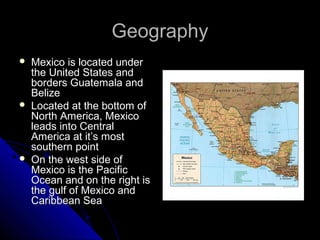
 Mexico is located underMexico is located under
the United States andthe United States and
borders Guatemala andborders Guatemala and
BelizeBelize
 Located at the bottom ofLocated at the bottom of
North America, MexicoNorth America, Mexico
leads into Centralleads into Central
America at it’s mostAmerica at it’s most
southern pointsouthern point
 On the west side ofOn the west side of
Mexico is the PacificMexico is the Pacific
Ocean and on the right isOcean and on the right is
the gulf of Mexico andthe gulf of Mexico and
Caribbean SeaCaribbean Sea
GeographyGeography
 Mexico covers almostMexico covers almost
760,000 square miles,760,000 square miles,
making it the fifth largestmaking it the fifth largest
country in the Americas.country in the Americas.
 Mexico is also theMexico is also the
thirteenth largestthirteenth largest
independent nation in theindependent nation in the
worldworld
 The population is of overThe population is of over
112 million making it the112 million making it the
eleventh most populouseleventh most populous
countrycountry
GeographyGeography
 Mexico is comprised of thirtyMexico is comprised of thirty
one states and a Federalone states and a Federal
DistrictDistrict
 It is the most populousIt is the most populous
Spanish-speaking countrySpanish-speaking country
 Mexico is crossed from northMexico is crossed from north
to south by two mountainto south by two mountain
ranges called the Sierra Madreranges called the Sierra Madre
Oriental and Sierra MadreOriental and Sierra Madre
OccidentalOccidental
 They are an extension of theThey are an extension of the
Rocky MountainsRocky Mountains
 Temperatures throughoutTemperatures throughout
Mexico remain warm and onlyMexico remain warm and only
have about a 9 degree changehave about a 9 degree change
between winter and summer inbetween winter and summer in
most placesmost places
PeoplePeople
 The national MexicanThe national Mexican
identity is a blend ofidentity is a blend of
various indigenousvarious indigenous
peoples with Europeanpeoples with European
immigrantsimmigrants
 Jose Vasconcelos andJose Vasconcelos and
Manuel Gamio helpedManuel Gamio helped
start and create thestart and create the
national identity ofnational identity of
Mexicans under theMexicans under the
concept of mestizajeconcept of mestizaje
 Mestizaje is theMestizaje is the
combinationof Europeancombinationof European
culture with theculture with the
indigenous culturesindigenous cultures
PeoplePeople
 The term mestizo thatThe term mestizo that
describes the nationaldescribes the national
identity of the Mexicansidentity of the Mexicans
carries different meaningscarries different meanings
such as racial andsuch as racial and
biological components,biological components,
socio-cultural, andsocio-cultural, and
economic.economic.
 Mexico has the largestMexico has the largest
amount of immigrantsamount of immigrants
that go into the Unitedthat go into the United
StatesStates
 Also Mexico is home toAlso Mexico is home to
the largest number ofthe largest number of
U.S. CitizensU.S. Citizens
PeoplePeople
 The MexicanThe Mexican
governmentlaunged thegovernmentlaunged the
Mexican GenomeMexican Genome
Diversity ProjectDiversity Project
 The results returned thatThe results returned that
the proportions of thethe proportions of the
European andEuropean and
indegenous ancestry areindegenous ancestry are
eveneven
 The statistics of theThe statistics of the
Mexican proportions areMexican proportions are
59% European, 5%59% European, 5%
African, and 36% AsianAfrican, and 36% Asian
HistoryHistory
 The earliest findings ofThe earliest findings of
humanity in Mexico arehumanity in Mexico are
chips of stone tools thatchips of stone tools that
were found in the Valley ofwere found in the Valley of
MexicoMexico
 They are dated all the wayThey are dated all the way
back to 21,000 BCEback to 21,000 BCE
 Around 9000 years ago,Around 9000 years ago,
corn was domesticatedcorn was domesticated
and was the catalyst toand was the catalyst to
the agricultural revolutionthe agricultural revolution
 The indigenous peopleThe indigenous people
with their complexwith their complex
civilizations were triggeredcivilizations were triggered
by the agriculturalby the agricultural
revolutionrevolution
HistoryHistory
 Between 1800 and 300 BCEBetween 1800 and 300 BCE
the civilizations advanced tothe civilizations advanced to
pre-Columbianpre-Columbian
Mesoamerican civilizations.Mesoamerican civilizations.
 This was before there wasThis was before there was
any interaction with theany interaction with the
EuropeansEuropeans
 Some of these civilizationsSome of these civilizations
were the Olmec, Izapa,were the Olmec, Izapa,
Teotihuacan, Maya, Zapotec,Teotihuacan, Maya, Zapotec,
Mixtec, Huastec, Aztec etc.Mixtec, Huastec, Aztec etc.
HistoryHistory
 These civilizations areThese civilizations are
credited with verycredited with very
intelligent creations in theintelligent creations in the
fields of architecture,fields of architecture,
mathematics, astronomy,mathematics, astronomy,
medicine, and theologymedicine, and theology
 The landing of HernanThe landing of Hernan
Cortes led to the invasionCortes led to the invasion
and conquering by theand conquering by the
Spaniards over the AztecSpaniards over the Aztec
civilization.civilization.
 After the fall ofAfter the fall of
Tenochtitlan in 1521, theTenochtitlan in 1521, the
territory became part ofterritory became part of
the Spanish Empire andthe Spanish Empire and
Mexico City was rebuiltMexico City was rebuilt
by Cortesby Cortes
SourcesSources
 Wikipedia (Wikipedia (www.wikipedia.comwww.wikipedia.com))
 University of Texas LibraryUniversity of Texas Library
(www.lib.utexas.edu)(www.lib.utexas.edu)

Mexico part 1

  • 1.
    MEXICO Part 1MEXICOPart 1 By: Josh KessnerBy: Josh Kessner History 141History 141 Professor ArguelloProfessor Arguello
  • 2.
    GeographyGeography  Mexico islocated underMexico is located under the United States andthe United States and borders Guatemala andborders Guatemala and BelizeBelize  Located at the bottom ofLocated at the bottom of North America, MexicoNorth America, Mexico leads into Centralleads into Central America at it’s mostAmerica at it’s most southern pointsouthern point  On the west side ofOn the west side of Mexico is the PacificMexico is the Pacific Ocean and on the right isOcean and on the right is the gulf of Mexico andthe gulf of Mexico and Caribbean SeaCaribbean Sea
  • 3.
    GeographyGeography  Mexico coversalmostMexico covers almost 760,000 square miles,760,000 square miles, making it the fifth largestmaking it the fifth largest country in the Americas.country in the Americas.  Mexico is also theMexico is also the thirteenth largestthirteenth largest independent nation in theindependent nation in the worldworld  The population is of overThe population is of over 112 million making it the112 million making it the eleventh most populouseleventh most populous countrycountry
  • 4.
    GeographyGeography  Mexico iscomprised of thirtyMexico is comprised of thirty one states and a Federalone states and a Federal DistrictDistrict  It is the most populousIt is the most populous Spanish-speaking countrySpanish-speaking country  Mexico is crossed from northMexico is crossed from north to south by two mountainto south by two mountain ranges called the Sierra Madreranges called the Sierra Madre Oriental and Sierra MadreOriental and Sierra Madre OccidentalOccidental  They are an extension of theThey are an extension of the Rocky MountainsRocky Mountains  Temperatures throughoutTemperatures throughout Mexico remain warm and onlyMexico remain warm and only have about a 9 degree changehave about a 9 degree change between winter and summer inbetween winter and summer in most placesmost places
  • 5.
    PeoplePeople  The nationalMexicanThe national Mexican identity is a blend ofidentity is a blend of various indigenousvarious indigenous peoples with Europeanpeoples with European immigrantsimmigrants  Jose Vasconcelos andJose Vasconcelos and Manuel Gamio helpedManuel Gamio helped start and create thestart and create the national identity ofnational identity of Mexicans under theMexicans under the concept of mestizajeconcept of mestizaje  Mestizaje is theMestizaje is the combinationof Europeancombinationof European culture with theculture with the indigenous culturesindigenous cultures
  • 6.
    PeoplePeople  The termmestizo thatThe term mestizo that describes the nationaldescribes the national identity of the Mexicansidentity of the Mexicans carries different meaningscarries different meanings such as racial andsuch as racial and biological components,biological components, socio-cultural, andsocio-cultural, and economic.economic.  Mexico has the largestMexico has the largest amount of immigrantsamount of immigrants that go into the Unitedthat go into the United StatesStates  Also Mexico is home toAlso Mexico is home to the largest number ofthe largest number of U.S. CitizensU.S. Citizens
  • 7.
    PeoplePeople  The MexicanTheMexican governmentlaunged thegovernmentlaunged the Mexican GenomeMexican Genome Diversity ProjectDiversity Project  The results returned thatThe results returned that the proportions of thethe proportions of the European andEuropean and indegenous ancestry areindegenous ancestry are eveneven  The statistics of theThe statistics of the Mexican proportions areMexican proportions are 59% European, 5%59% European, 5% African, and 36% AsianAfrican, and 36% Asian
  • 8.
    HistoryHistory  The earliestfindings ofThe earliest findings of humanity in Mexico arehumanity in Mexico are chips of stone tools thatchips of stone tools that were found in the Valley ofwere found in the Valley of MexicoMexico  They are dated all the wayThey are dated all the way back to 21,000 BCEback to 21,000 BCE  Around 9000 years ago,Around 9000 years ago, corn was domesticatedcorn was domesticated and was the catalyst toand was the catalyst to the agricultural revolutionthe agricultural revolution  The indigenous peopleThe indigenous people with their complexwith their complex civilizations were triggeredcivilizations were triggered by the agriculturalby the agricultural revolutionrevolution
  • 9.
    HistoryHistory  Between 1800and 300 BCEBetween 1800 and 300 BCE the civilizations advanced tothe civilizations advanced to pre-Columbianpre-Columbian Mesoamerican civilizations.Mesoamerican civilizations.  This was before there wasThis was before there was any interaction with theany interaction with the EuropeansEuropeans  Some of these civilizationsSome of these civilizations were the Olmec, Izapa,were the Olmec, Izapa, Teotihuacan, Maya, Zapotec,Teotihuacan, Maya, Zapotec, Mixtec, Huastec, Aztec etc.Mixtec, Huastec, Aztec etc.
  • 10.
    HistoryHistory  These civilizationsareThese civilizations are credited with verycredited with very intelligent creations in theintelligent creations in the fields of architecture,fields of architecture, mathematics, astronomy,mathematics, astronomy, medicine, and theologymedicine, and theology  The landing of HernanThe landing of Hernan Cortes led to the invasionCortes led to the invasion and conquering by theand conquering by the Spaniards over the AztecSpaniards over the Aztec civilization.civilization.  After the fall ofAfter the fall of Tenochtitlan in 1521, theTenochtitlan in 1521, the territory became part ofterritory became part of the Spanish Empire andthe Spanish Empire and Mexico City was rebuiltMexico City was rebuilt by Cortesby Cortes
  • 11.
    SourcesSources  Wikipedia (Wikipedia(www.wikipedia.comwww.wikipedia.com))  University of Texas LibraryUniversity of Texas Library (www.lib.utexas.edu)(www.lib.utexas.edu)