Julia Wester
Improvement Coach at LeanKit
@everydaykanban
www.leankit.com
Troy Magennis
Consultant at Focused Objective
@t_magennis
FocusedObjective.com
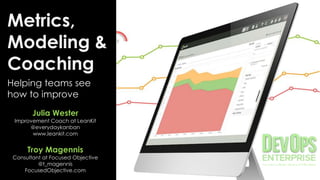
Metrics,
Modeling &
Coaching
Helping teams see
how to improve
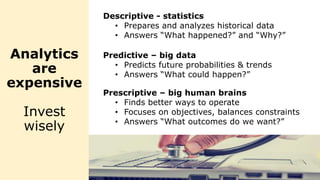
Descriptive - statistics
• Prepares and analyzes historical data
• Answers “What happened?” and “Why?”
Prescriptive – big human brains
• Finds better ways to operate
• Focuses on objectives, balances constraints
• Answers “What outcomes do we want?”
Predictive – big data
• Predicts future probabilities & trends
• Answers “What could happen?”
Analytics
are
expensive
Invest
wisely
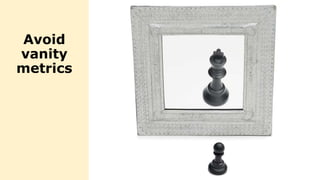
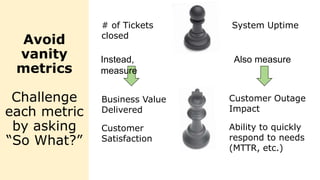
Avoid
vanity
metrics
System Uptime
Avoid
vanity
metrics
Challenge
each metric
by asking
“So What?”
Customer Outage
Impact
Ability to quickly
respond to needs
(MTTR, etc.)
Business Value
Delivered
Customer
Satisfaction
# of Tickets
closed
Instead,
measure
Also measure
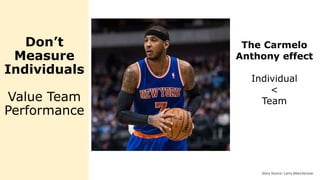
Don’t
Measure
Individuals
Value Team
Performance
The Carmelo
Anthony effect
Individual
<
Team
Story Source: Larry Maccherone
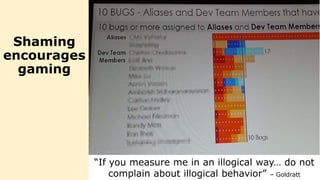
Shaming
encourages
gaming
“If you measure me in an illogical way… do not
complain about illogical behavior” – Goldratt
Shaming
encourages
gaming
Measure
team
outcomes
“Where there is fear, the figures will be wrong”
- Deming
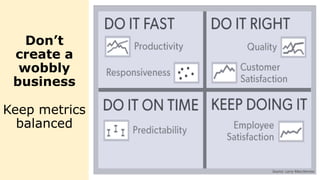
Don’t
create a
wobbly
business
Keep metrics
balanced
8Source: Larry Maccherone
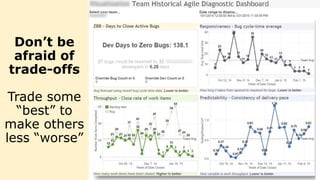
Don’t be
afraid of
trade-offs
Trade some
“best” to
make others
less “worse”
9
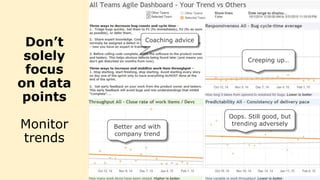
Better and with
company trend
Oops. Still good, but
trending adversely
Creeping up…
Coaching advice
Don’t
solely
focus
on data
points
Monitor
trends
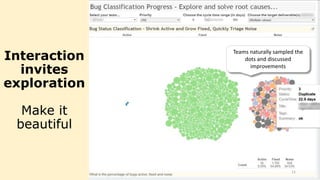
Teams naturally sampled the
dots and discussed
improvements
11
Interaction
invites
exploration
Make it
beautiful
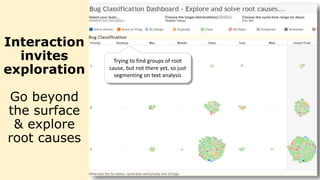
Trying to find groups of root
cause, but not there yet, so just
segmenting on text analysis
Interaction
invites
exploration
Go beyond
the surface
& explore
root causes
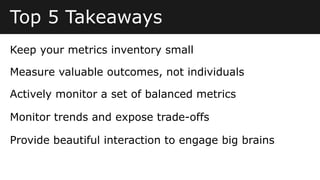
Top 5 Takeaways
Measure valuable outcomes, not individuals
Actively monitor a set of balanced metrics
Keep your metrics inventory small
Monitor trends and expose trade-offs
Provide beautiful interaction to engage big brains
Q&A
We would like help with understanding
What balance of metrics you use and
why?
What are your questions?
Thank you!
Julia Wester
Improvement Coach at LeanKit
Twitter: @everydaykanban
www.leankit.com
Troy Magennis
Consultant at Focused Objective
Twitter: @t_magennis
FocusedObjective.com

Metrics and Coaching

Editor's Notes

  • #2 Troy introduces self Julia introduces self, kicks off talk Here to talk about using metrics to help teams improve.
  • #3 TROY’s slide The value of coaching lies in defining, creating and interpreting prescriptive metrics and then translating those to action.
  • #4 JULIA’s slide Vanity = easy, interesting ... not meaningful. Like the Picture: We fool ourselves that these can proxy for important information. To avoid vanity metrics, Ask yourself 2 questions...
  • #5 JULIA’s slide * confuses activity with progress towards goals. * Treats all activity as equal Look @ what happens BECAUSE the tickets closed What value is delivered? Satisfaction derived? ============================ Five 9's = holy grail. Varied definitions + Not all downtime created equal. Recovery >= Prevention
  • #6 JULIA’s slide Whether for props or shame, rarely works out CARMELO (Larry) What you measure shows what you value. Do you care if Johnny is #1 or if the team is #1? Don't make people shoot for individual stats like carmelo. Visibly promote team performance over individual performance.
  • #7 JULIA’s slide Metrics as weapons. aka Shaming Incentivizes people to avoid future shame by any means necessary. DASHBOARD - random number 10. "naughty list" Goldratt quote - last half of the famous quote "Tell me how you'll measure me and I'll tell you how I'll behave" Troy, what did people do as a result of that dashboard?
  • #8 TROY’s slide What did people do as a result of that dashboard? Deming quote Reiterate team outcomes over individual performance
  • #9 JULIA’s slide - restaurant table. Do It Fast: are we keeping page with the business? Do It Right: are people happy with our work Do It On Time: when we promise, do we deliver? Keep Doing It: can we do the other three at the same time, consistently - WHOLE > SUM OF PARTS ** coaching comes in when you want to change one without killing another.
  • #10 TROY’s slide
  • #11 TROY’s slide
  • #12 TROY’s slide
  • #13 TROY’s slide
  • #14 JULIA’s slide Reiterate takeaways as on slide
  • #15 JULIA’s slide Tell us now or on twitter what metrics you use and why! Questions?