Methods to
Sustain the Change:
Measurement Systems, Rewards
And Reinforcement
Strategic Performance & Change Management
13-15 November 2012
Rick Hefner, PhD
Northrop Grumman Corporation
rick.hefner@ngc.com
You’ve achieved your change management goals - now what?
Many organizations experience difficulty maintaining new behaviors
• Senior management turns their attention to other challenges
• Projects regress into old habits
• The change management investment is wasted
2
Background
Rick Hefner, "Methods to Sustain the Change: Measurement Systems, Rewards And Reinforcement",
2012 Strategic Performance & Change Management
Copyright © 2012
Northrop Grumman Systems Corporation
Capability Maturity Model Integrated is registered in the U.S. Patent and
Trademark Office by Carnegie Mellon University.
• Once change has been implemented and initially embraced, how do
you sustain that feeling?
• What are the key measurements to focus on?
• How do you ensure your rewards and reinforcement system are
motivating your employees?
• How much communication with employees is required for adequate
feedback?
3
Background
Copyright © 2012
Northrop Grumman Systems Corporation
Rick Hefner, "Methods to Sustain the Change: Measurement Systems, Rewards And Reinforcement",
2012 Strategic Performance & Change Management
• Institutionalization implies that the process is ingrained in the way the
work is performed and there is commitment and consistency to
performing the process.
• An institutionalized process is more likely to be retained during times
of stress.
4
Back-Sliding:
A Failure of Institutionalization
Copyright © 2012
Northrop Grumman Systems Corporation
Institutionalization: The ingrained way of doing business
that an organization follows routinely as part of its corporate culture.
- Capability Maturity Model Integrated quality standard
Rick Hefner, "Methods to Sustain the Change: Measurement Systems, Rewards And Reinforcement",
2012 Strategic Performance & Change Management
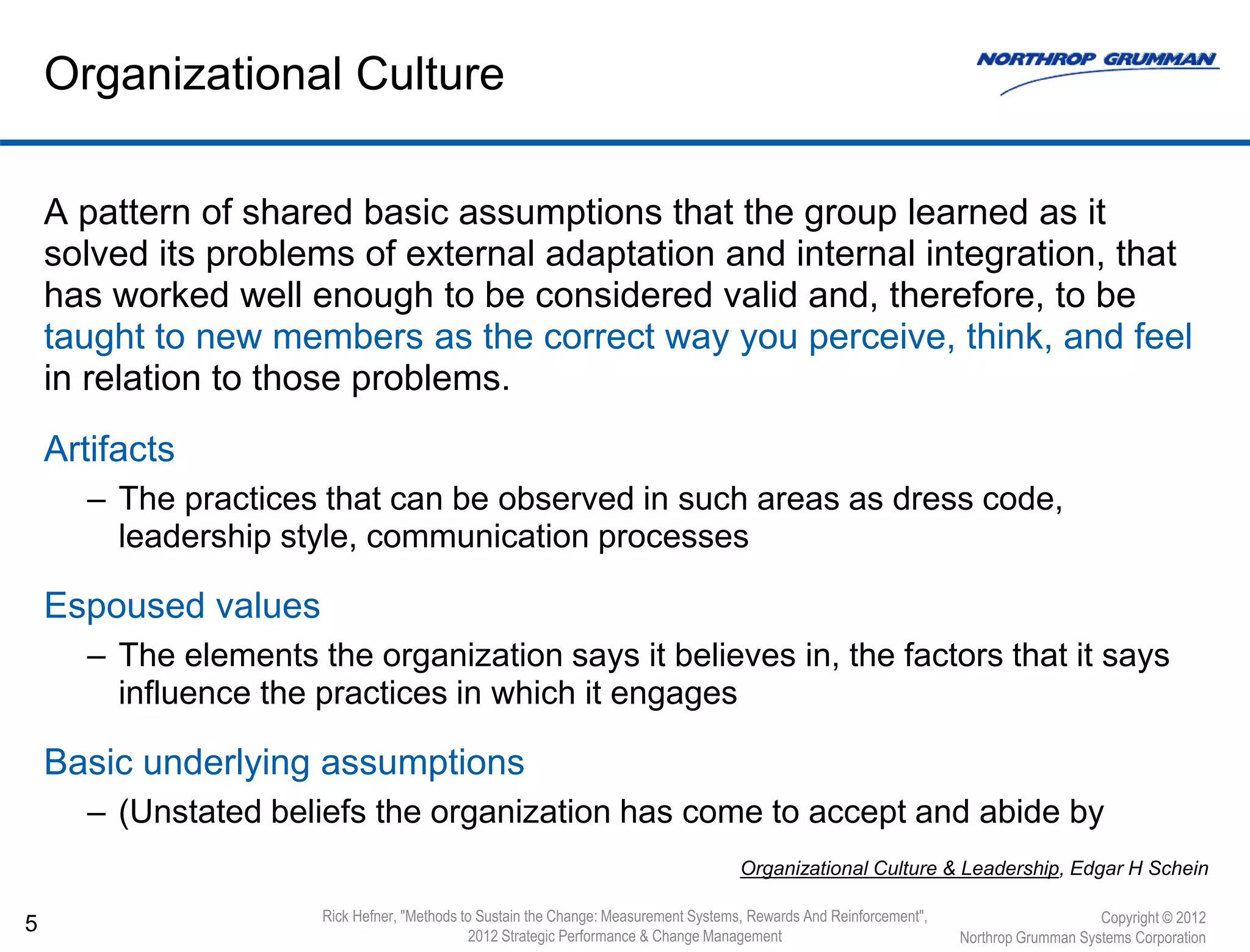
A pattern of shared basic assumptions that the group learned as it
solved its problems of external adaptation and internal integration, that
has worked well enough to be considered valid and, therefore, to be
taught to new members as the correct way you perceive, think, and feel
in relation to those problems.
Artifacts
– The practices that can be observed in such areas as dress code,
leadership style, communication processes
Espoused values
– The elements the organization says it believes in, the factors that it says
influence the practices in which it engages
Basic underlying assumptions
– (Unstated beliefs the organization has come to accept and abide by
5
Organizational Culture
Organizational Culture & Leadership, Edgar H Schein
Copyright © 2012
Northrop Grumman Systems Corporation
Rick Hefner, "Methods to Sustain the Change: Measurement Systems, Rewards And Reinforcement",
2012 Strategic Performance & Change Management
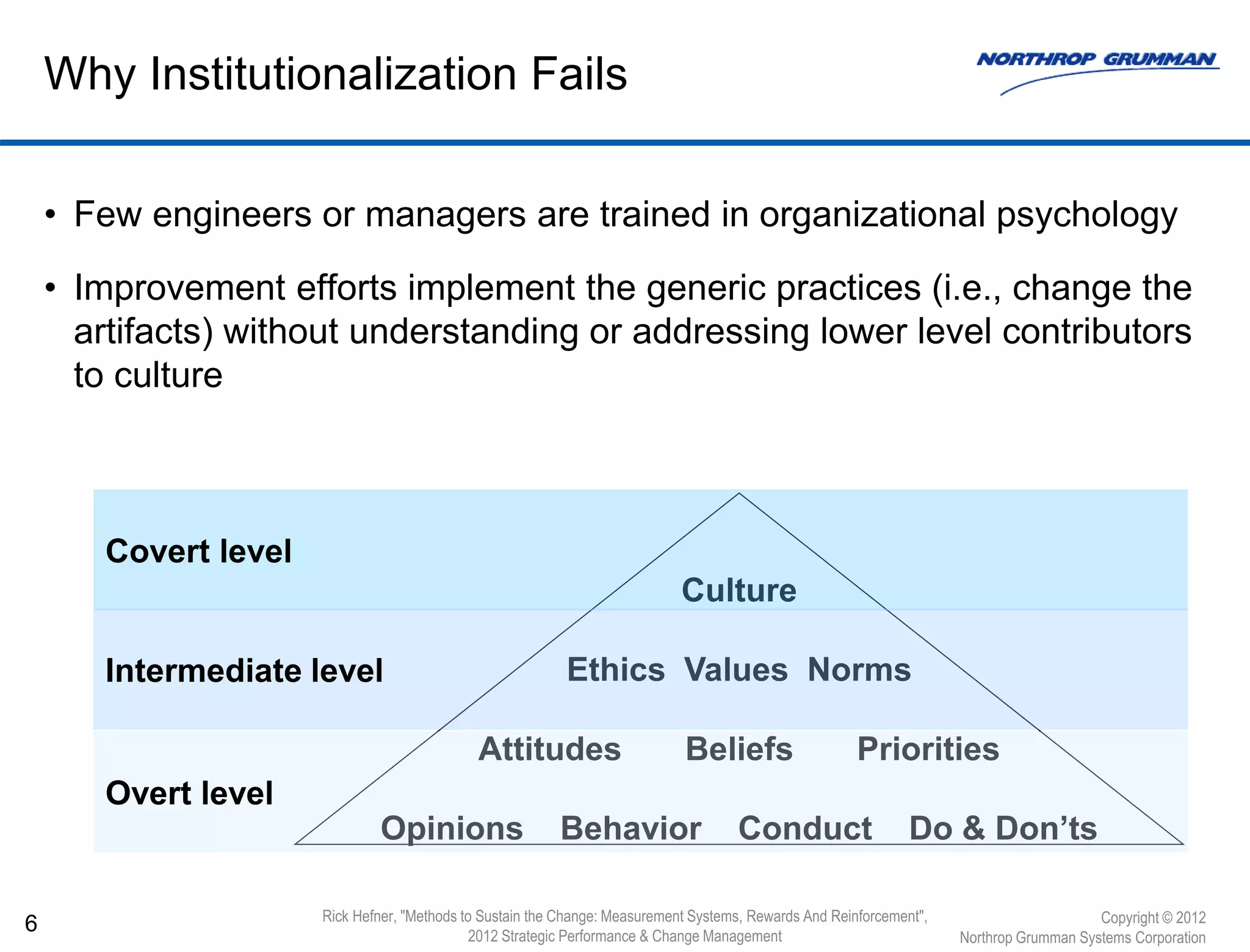
• Few engineers or managers are trained in organizational psychology
• Improvement efforts implement the generic practices (i.e., change the
artifacts) without understanding or addressing lower level contributors
to culture
6
Why Institutionalization Fails
Copyright © 2012
Northrop Grumman Systems Corporation
Culture
Ethics Values Norms
Attitudes Beliefs Priorities
Opinions Behavior Conduct Do & Don’ts
Covert level
Intermediate level
Overt level
Rick Hefner, "Methods to Sustain the Change: Measurement Systems, Rewards And Reinforcement",
2012 Strategic Performance & Change Management
7
Addressing the Underlying Beliefs
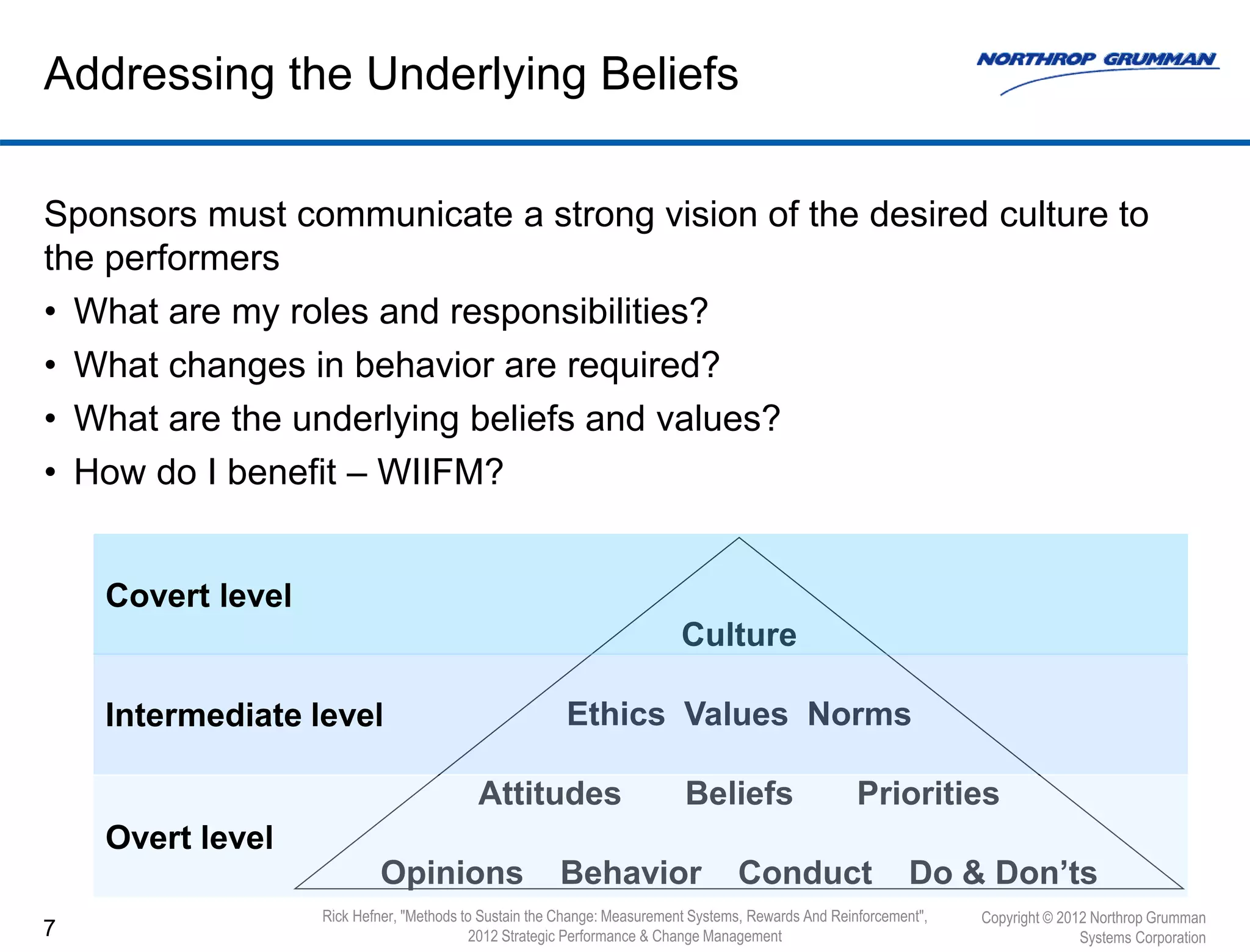
Sponsors must communicate a strong vision of the desired culture to
the performers
• What are my roles and responsibilities?
• What changes in behavior are required?
• What are the underlying beliefs and values?
• How do I benefit – WIIFM?
Copyright © 2012 Northrop Grumman
Systems Corporation
Rick Hefner, "Methods to Sustain the Change: Measurement Systems, Rewards And Reinforcement",
2012 Strategic Performance & Change Management
Culture
Ethics Values Norms
Attitudes Beliefs Priorities
Opinions Behavior Conduct Do & Don’ts
Covert level
Intermediate level
Overt level
8
Elements of Institutionalization
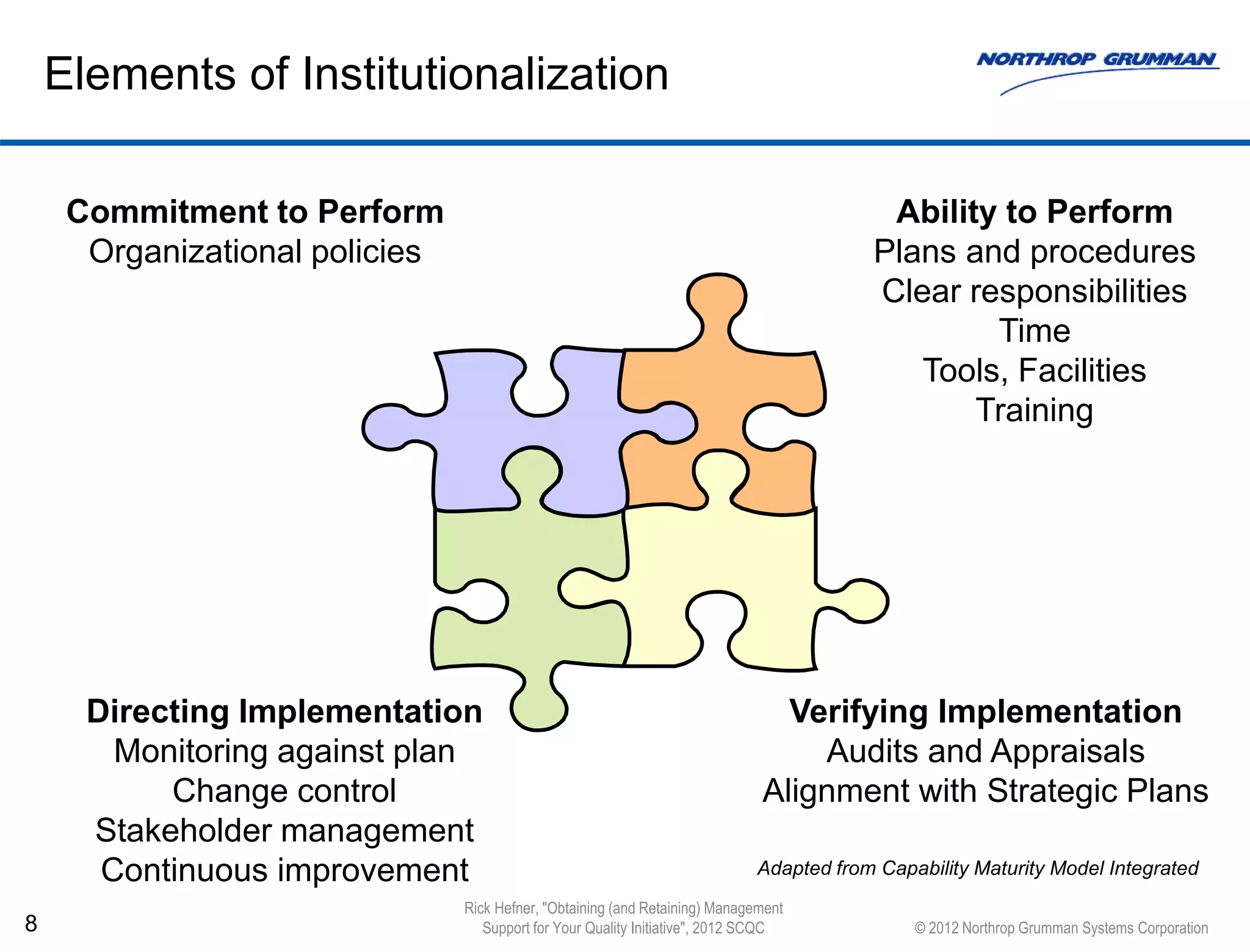
Commitment to Perform
Organizational policies
© 2012 Northrop Grumman Systems Corporation
Rick Hefner, "Obtaining (and Retaining) Management
Support for Your Quality Initiative", 2012 SCQC
Ability to Perform
Plans and procedures
Clear responsibilities
Time
Tools, Facilities
Training
Directing Implementation
Monitoring against plan
Change control
Stakeholder management
Continuous improvement
Verifying Implementation
Audits and Appraisals
Alignment with Strategic Plans
Adapted from Capability Maturity Model Integrated
Five Dimensions of Work
Reference: Richard Hackman & Greg Oldham, Work Redesign
9 Copyright © 2012 Northrop Grumman
Systems Corporation
Rick Hefner, "Methods to Sustain the Change: Measurement Systems, Rewards And Reinforcement",
2012 Strategic Performance & Change Management
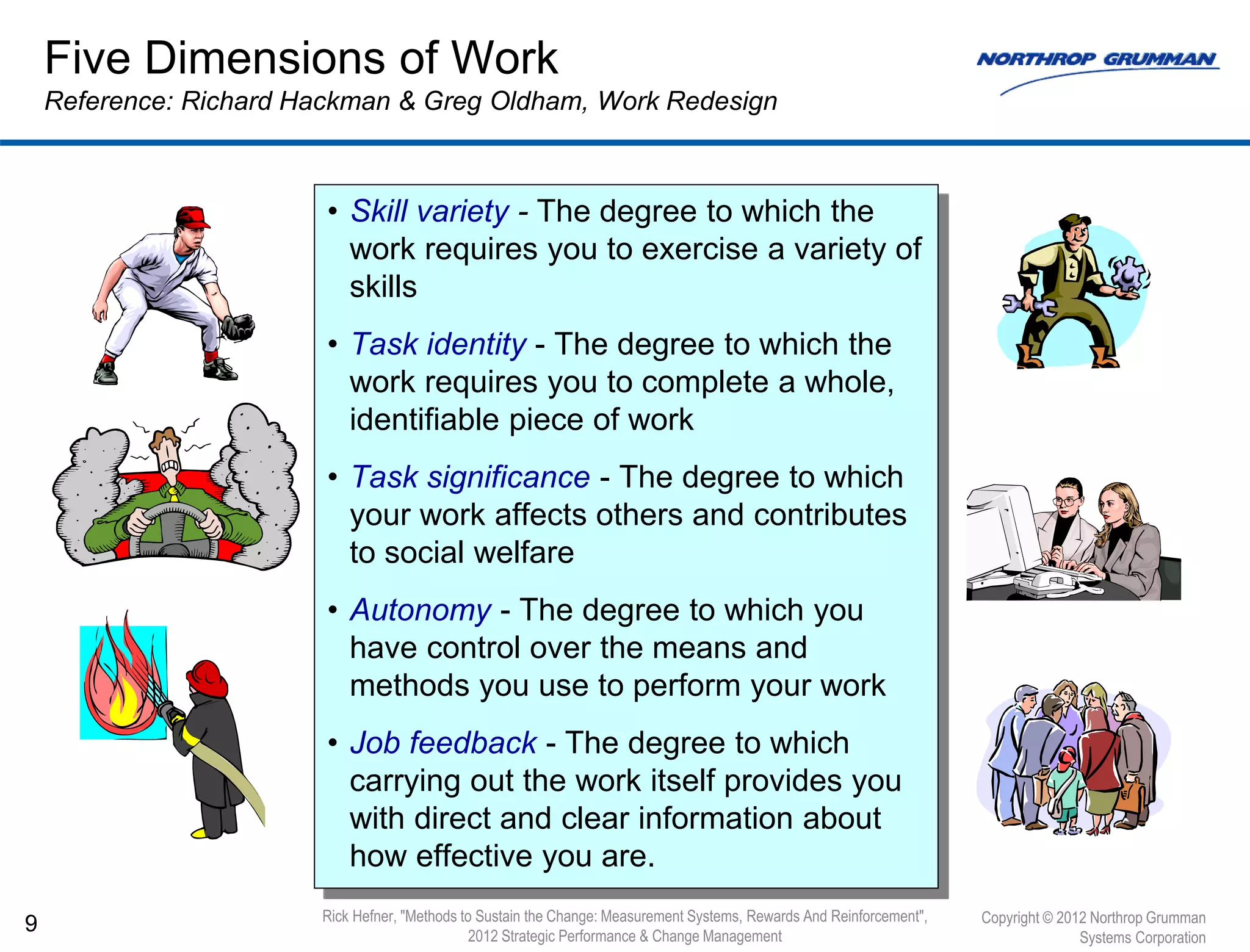
• Skill variety - The degree to which the
work requires you to exercise a variety of
skills
• Task identity - The degree to which the
work requires you to complete a whole,
identifiable piece of work
• Task significance - The degree to which
your work affects others and contributes
to social welfare
• Autonomy - The degree to which you
have control over the means and
methods you use to perform your work
• Job feedback - The degree to which
carrying out the work itself provides you
with direct and clear information about
how effective you are.
10
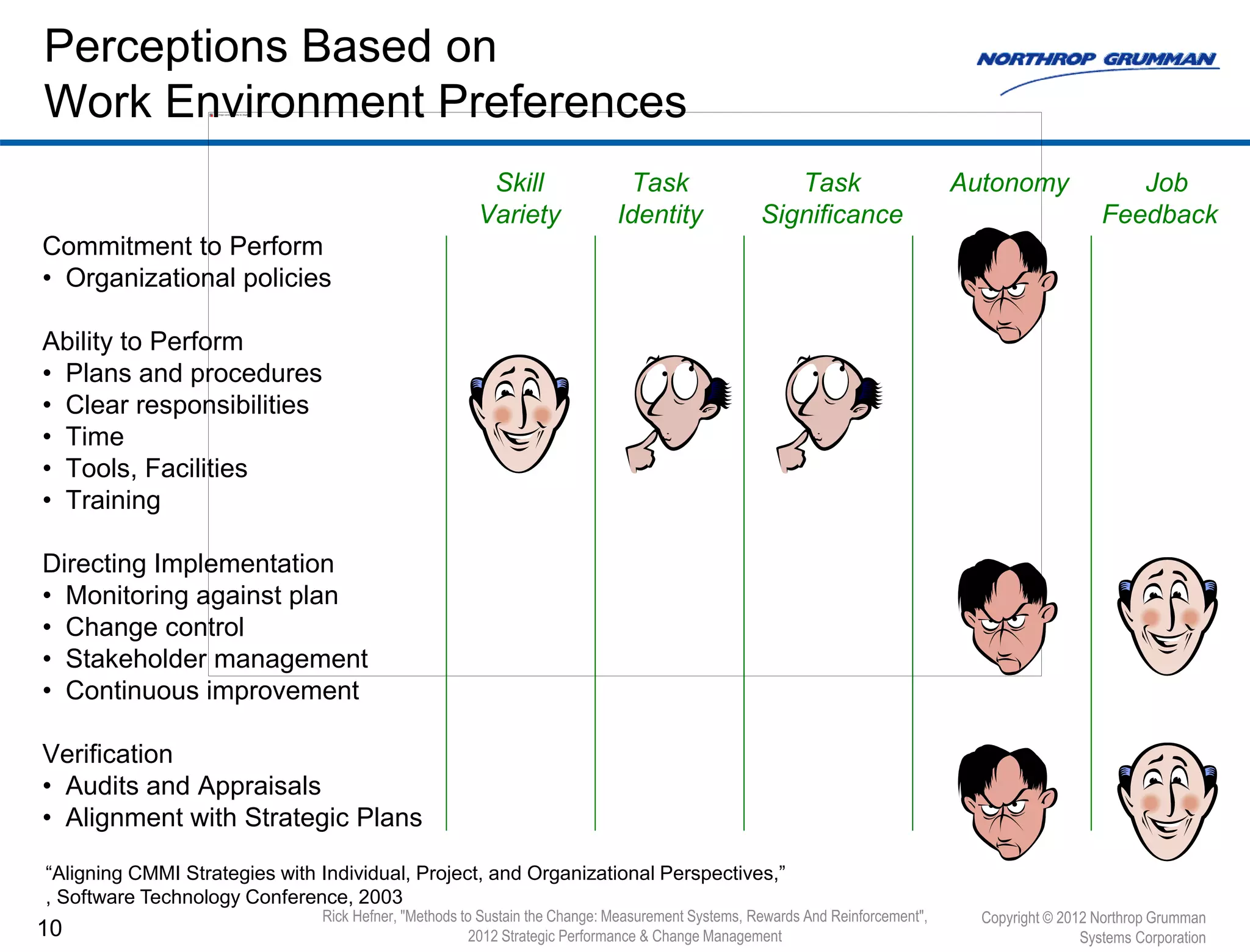
Perceptions Based on
Work Environment Preferences
Skill Task Task Autonomy Job
Variety Identity Significance Feedback
Commitment to Perform
• Organizational policies
Ability to Perform
• Plans and procedures
• Clear responsibilities
• Time
• Tools, Facilities
• Training
Directing Implementation
• Monitoring against plan
• Change control
• Stakeholder management
• Continuous improvement
Verification
• Audits and Appraisals
• Alignment with Strategic Plans
“Aligning CMMI Strategies with Individual, Project, and Organizational Perspectives,”
, Software Technology Conference, 2003
Copyright © 2012 Northrop Grumman
Systems Corporation
Rick Hefner, "Methods to Sustain the Change: Measurement Systems, Rewards And Reinforcement",
2012 Strategic Performance & Change Management
• Achieving and maintaining these new processes
is essential to meeting our business goals
– Predictability, performance, quality
• Change involves short-term investment for long-term gain
• Our new processes are an enabler (not a guarantee) of success
– Other aspects (people, technology, customer relationship, etc.)
are equally important
– Often the value is in risk reduction
• These are proven, industry best-practices
– Adoption is about learning how to apply these practices to our work
– The practices may feel awkward and have limited value until we learn
them
– It’s OK to make mistakes – we will get better over time
• Continuous improvement is a way of life
11
Communicate the Key Messages
Copyright © 2012 Northrop Grumman
Systems Corporation
Rick Hefner, "Methods to Sustain the Change: Measurement Systems, Rewards And Reinforcement",
2012 Strategic Performance & Change Management
• Adoption and sustainment is about each practitioner learning and
performing the new behaviors
• The role of management in cultural change is to hold people
accountable for the new behaviors and conduct
• Change agents can enable management by:
– Helping them have a clear vision of the new culture
– Identifying inappropriate behavior
– Providing tangible, objective
measures of adoption/sustainment
12
Ensure Accountability
Copyright © 2012 Northrop Grumman
Systems Corporation
Rick Hefner, "Methods to Sustain the Change: Measurement Systems, Rewards And Reinforcement",
2012 Strategic Performance & Change Management
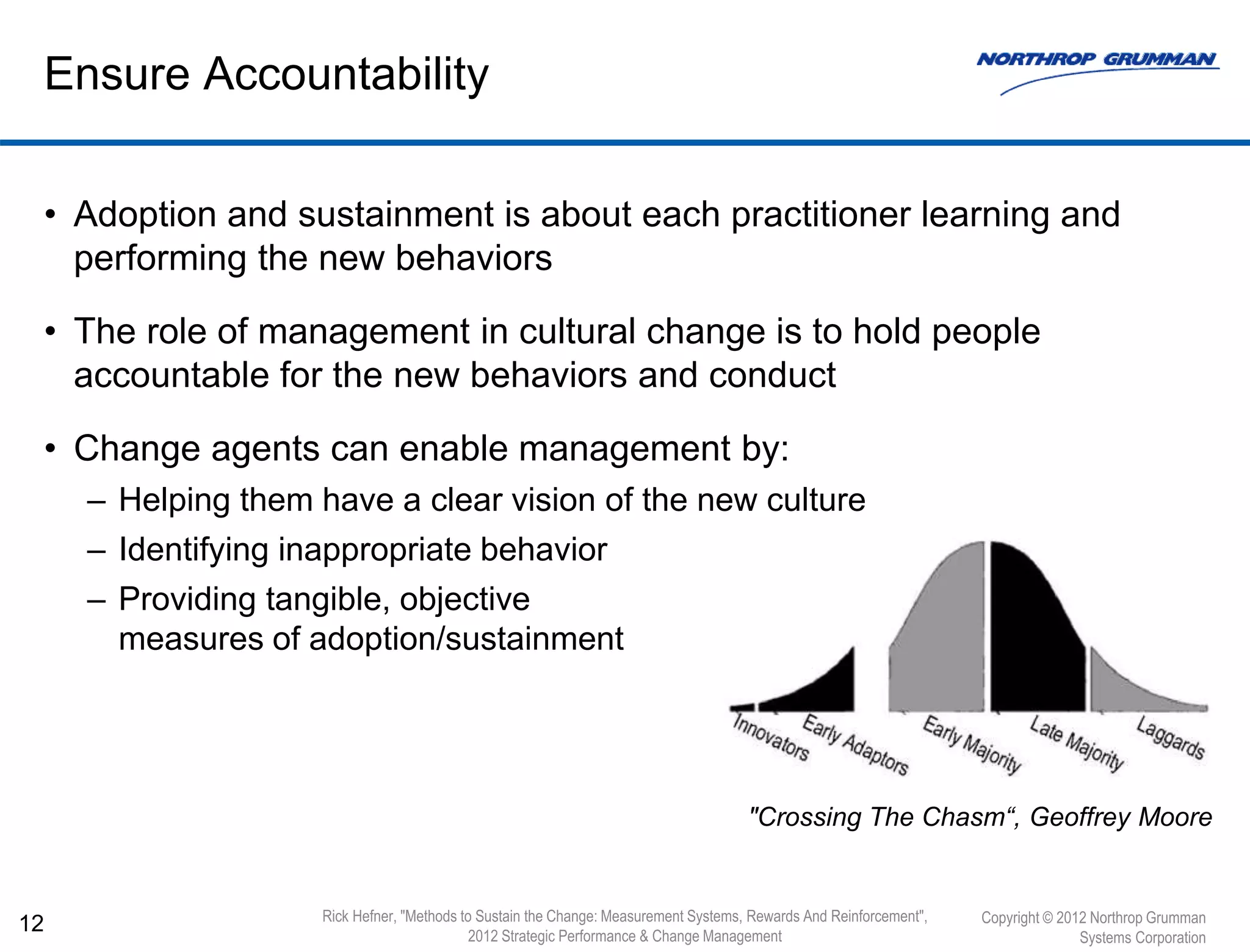
"Crossing The Chasm“, Geoffrey Moore
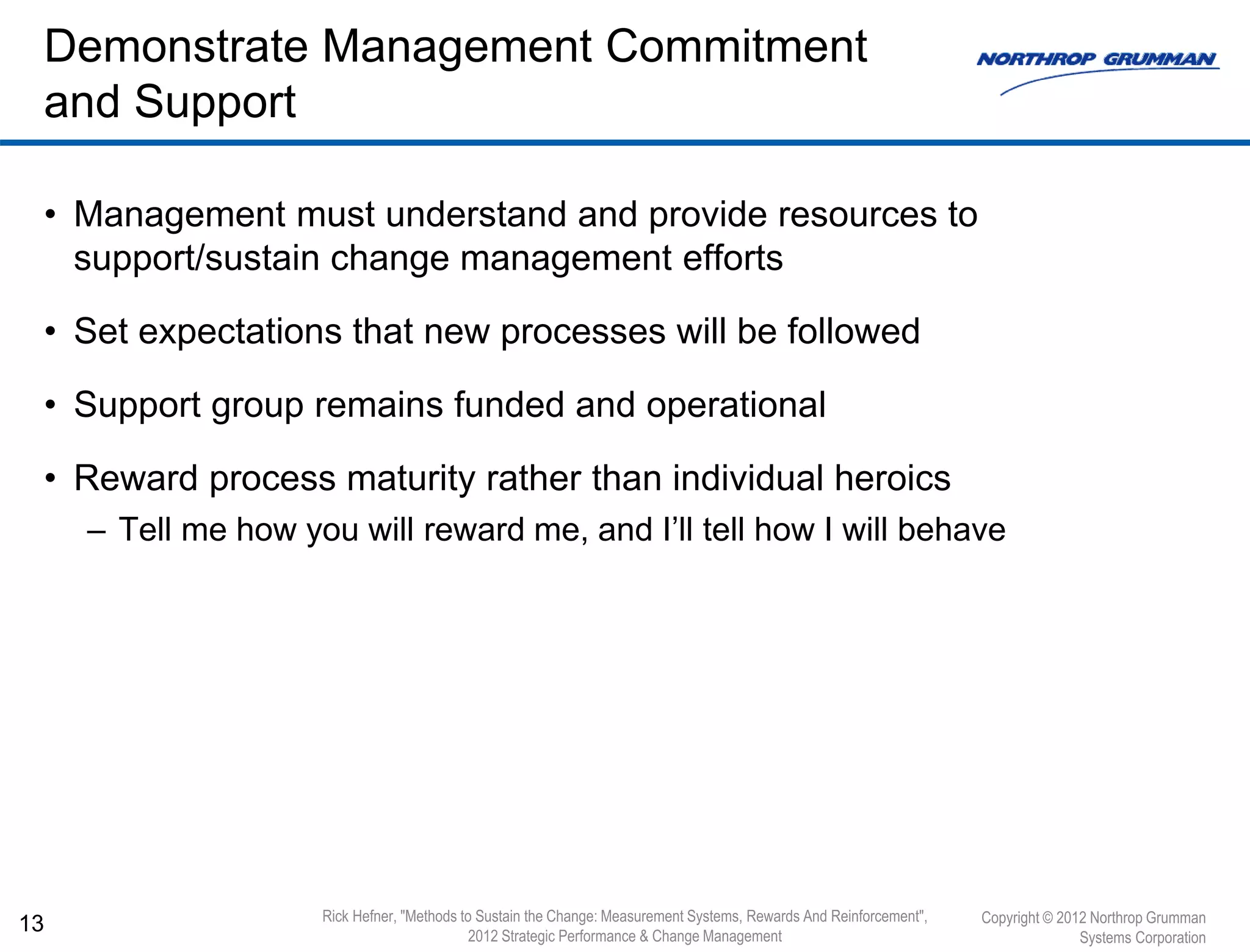
• Management must understand and provide resources to
support/sustain change management efforts
• Set expectations that new processes will be followed
• Support group remains funded and operational
• Reward process maturity rather than individual heroics
– Tell me how you will reward me, and I’ll tell how I will behave
13
Demonstrate Management Commitment
and Support
Copyright © 2012 Northrop Grumman
Systems Corporation
Rick Hefner, "Methods to Sustain the Change: Measurement Systems, Rewards And Reinforcement",
2012 Strategic Performance & Change Management
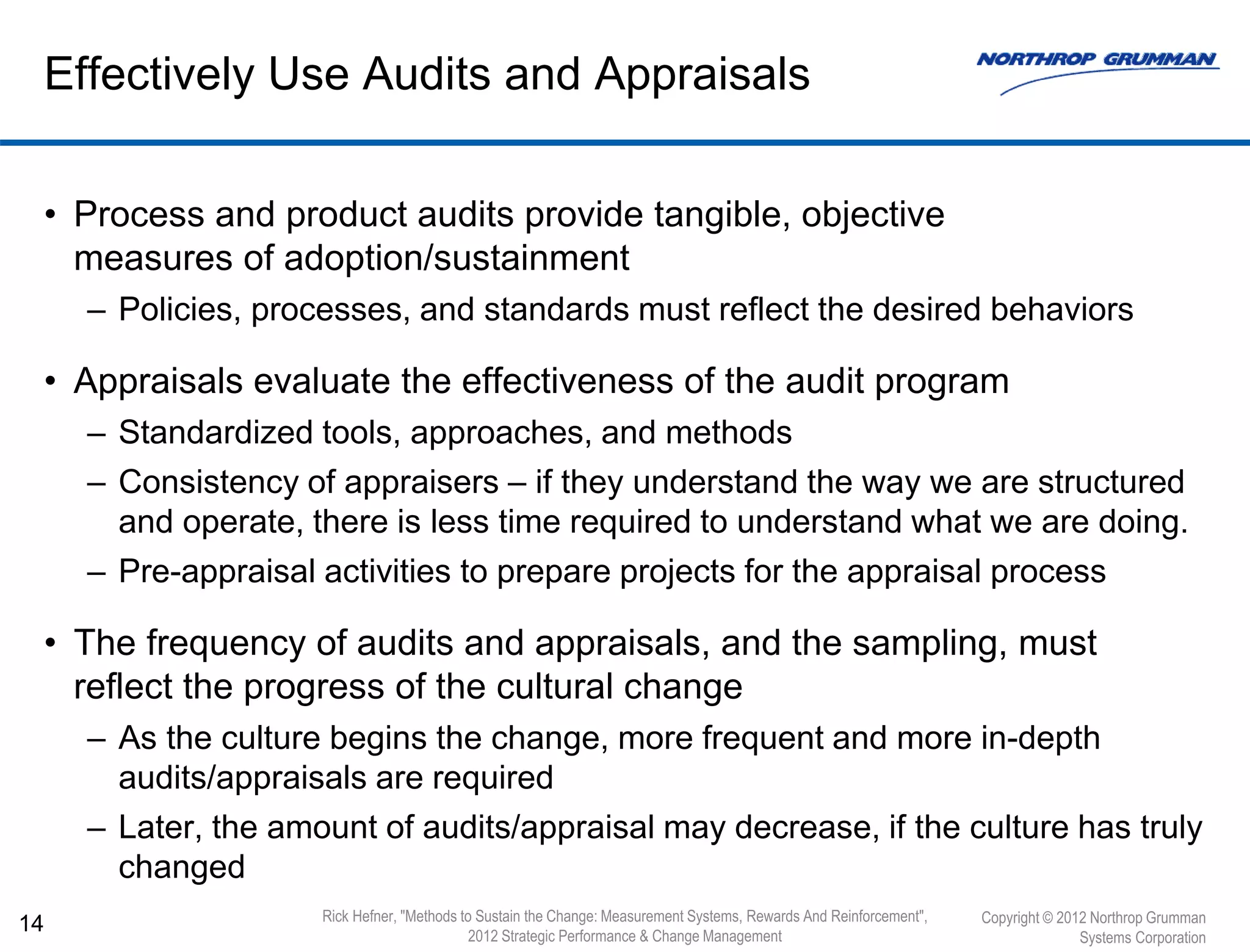
• Process and product audits provide tangible, objective
measures of adoption/sustainment
– Policies, processes, and standards must reflect the desired behaviors
• Appraisals evaluate the effectiveness of the audit program
– Standardized tools, approaches, and methods
– Consistency of appraisers – if they understand the way we are structured
and operate, there is less time required to understand what we are doing.
– Pre-appraisal activities to prepare projects for the appraisal process
• The frequency of audits and appraisals, and the sampling, must
reflect the progress of the cultural change
– As the culture begins the change, more frequent and more in-depth
audits/appraisals are required
– Later, the amount of audits/appraisal may decrease, if the culture has truly
changed
14
Effectively Use Audits and Appraisals
Copyright © 2012 Northrop Grumman
Systems Corporation
Rick Hefner, "Methods to Sustain the Change: Measurement Systems, Rewards And Reinforcement",
2012 Strategic Performance & Change Management
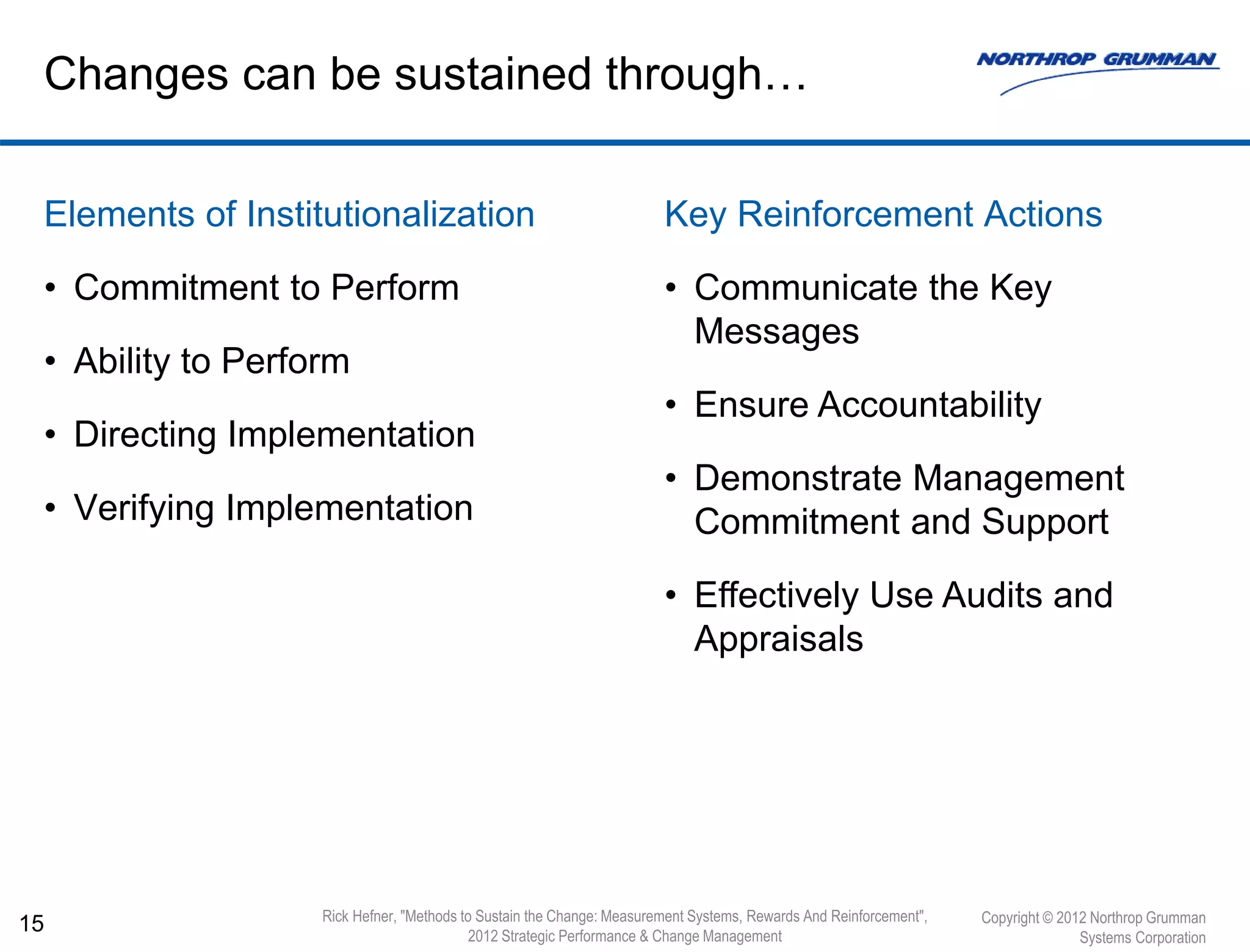
Elements of Institutionalization
• Commitment to Perform
• Ability to Perform
• Directing Implementation
• Verifying Implementation
15
Changes can be sustained through…
Copyright © 2012 Northrop Grumman
Systems Corporation
Rick Hefner, "Methods to Sustain the Change: Measurement Systems, Rewards And Reinforcement",
2012 Strategic Performance & Change Management
Key Reinforcement Actions
• Communicate the Key
Messages
• Ensure Accountability
• Demonstrate Management
Commitment and Support
• Effectively Use Audits and
Appraisals
Methods to Sustain the Change: Measurment Systems, Rewards, and Reinforcement

Methods to Sustain the Change: Measurment Systems, Rewards, and Reinforcement

  • 1.
    Methods to Sustain theChange: Measurement Systems, Rewards And Reinforcement Strategic Performance & Change Management 13-15 November 2012 Rick Hefner, PhD Northrop Grumman Corporation rick.hefner@ngc.com
  • 2.
    You’ve achieved yourchange management goals - now what? Many organizations experience difficulty maintaining new behaviors • Senior management turns their attention to other challenges • Projects regress into old habits • The change management investment is wasted 2 Background Rick Hefner, "Methods to Sustain the Change: Measurement Systems, Rewards And Reinforcement", 2012 Strategic Performance & Change Management Copyright © 2012 Northrop Grumman Systems Corporation Capability Maturity Model Integrated is registered in the U.S. Patent and Trademark Office by Carnegie Mellon University.
  • 3.
    • Once changehas been implemented and initially embraced, how do you sustain that feeling? • What are the key measurements to focus on? • How do you ensure your rewards and reinforcement system are motivating your employees? • How much communication with employees is required for adequate feedback? 3 Background Copyright © 2012 Northrop Grumman Systems Corporation Rick Hefner, "Methods to Sustain the Change: Measurement Systems, Rewards And Reinforcement", 2012 Strategic Performance & Change Management
  • 4.
    • Institutionalization impliesthat the process is ingrained in the way the work is performed and there is commitment and consistency to performing the process. • An institutionalized process is more likely to be retained during times of stress. 4 Back-Sliding: A Failure of Institutionalization Copyright © 2012 Northrop Grumman Systems Corporation Institutionalization: The ingrained way of doing business that an organization follows routinely as part of its corporate culture. - Capability Maturity Model Integrated quality standard Rick Hefner, "Methods to Sustain the Change: Measurement Systems, Rewards And Reinforcement", 2012 Strategic Performance & Change Management
  • 5.
    A pattern ofshared basic assumptions that the group learned as it solved its problems of external adaptation and internal integration, that has worked well enough to be considered valid and, therefore, to be taught to new members as the correct way you perceive, think, and feel in relation to those problems. Artifacts – The practices that can be observed in such areas as dress code, leadership style, communication processes Espoused values – The elements the organization says it believes in, the factors that it says influence the practices in which it engages Basic underlying assumptions – (Unstated beliefs the organization has come to accept and abide by 5 Organizational Culture Organizational Culture & Leadership, Edgar H Schein Copyright © 2012 Northrop Grumman Systems Corporation Rick Hefner, "Methods to Sustain the Change: Measurement Systems, Rewards And Reinforcement", 2012 Strategic Performance & Change Management
  • 6.
    • Few engineersor managers are trained in organizational psychology • Improvement efforts implement the generic practices (i.e., change the artifacts) without understanding or addressing lower level contributors to culture 6 Why Institutionalization Fails Copyright © 2012 Northrop Grumman Systems Corporation Culture Ethics Values Norms Attitudes Beliefs Priorities Opinions Behavior Conduct Do & Don’ts Covert level Intermediate level Overt level Rick Hefner, "Methods to Sustain the Change: Measurement Systems, Rewards And Reinforcement", 2012 Strategic Performance & Change Management
  • 7.
    7 Addressing the UnderlyingBeliefs Sponsors must communicate a strong vision of the desired culture to the performers • What are my roles and responsibilities? • What changes in behavior are required? • What are the underlying beliefs and values? • How do I benefit – WIIFM? Copyright © 2012 Northrop Grumman Systems Corporation Rick Hefner, "Methods to Sustain the Change: Measurement Systems, Rewards And Reinforcement", 2012 Strategic Performance & Change Management Culture Ethics Values Norms Attitudes Beliefs Priorities Opinions Behavior Conduct Do & Don’ts Covert level Intermediate level Overt level
  • 8.
    8 Elements of Institutionalization Commitmentto Perform Organizational policies © 2012 Northrop Grumman Systems Corporation Rick Hefner, "Obtaining (and Retaining) Management Support for Your Quality Initiative", 2012 SCQC Ability to Perform Plans and procedures Clear responsibilities Time Tools, Facilities Training Directing Implementation Monitoring against plan Change control Stakeholder management Continuous improvement Verifying Implementation Audits and Appraisals Alignment with Strategic Plans Adapted from Capability Maturity Model Integrated
  • 9.
    Five Dimensions ofWork Reference: Richard Hackman & Greg Oldham, Work Redesign 9 Copyright © 2012 Northrop Grumman Systems Corporation Rick Hefner, "Methods to Sustain the Change: Measurement Systems, Rewards And Reinforcement", 2012 Strategic Performance & Change Management • Skill variety - The degree to which the work requires you to exercise a variety of skills • Task identity - The degree to which the work requires you to complete a whole, identifiable piece of work • Task significance - The degree to which your work affects others and contributes to social welfare • Autonomy - The degree to which you have control over the means and methods you use to perform your work • Job feedback - The degree to which carrying out the work itself provides you with direct and clear information about how effective you are.
  • 10.
    10 Perceptions Based on WorkEnvironment Preferences Skill Task Task Autonomy Job Variety Identity Significance Feedback Commitment to Perform • Organizational policies Ability to Perform • Plans and procedures • Clear responsibilities • Time • Tools, Facilities • Training Directing Implementation • Monitoring against plan • Change control • Stakeholder management • Continuous improvement Verification • Audits and Appraisals • Alignment with Strategic Plans “Aligning CMMI Strategies with Individual, Project, and Organizational Perspectives,” , Software Technology Conference, 2003 Copyright © 2012 Northrop Grumman Systems Corporation Rick Hefner, "Methods to Sustain the Change: Measurement Systems, Rewards And Reinforcement", 2012 Strategic Performance & Change Management
  • 11.
    • Achieving andmaintaining these new processes is essential to meeting our business goals – Predictability, performance, quality • Change involves short-term investment for long-term gain • Our new processes are an enabler (not a guarantee) of success – Other aspects (people, technology, customer relationship, etc.) are equally important – Often the value is in risk reduction • These are proven, industry best-practices – Adoption is about learning how to apply these practices to our work – The practices may feel awkward and have limited value until we learn them – It’s OK to make mistakes – we will get better over time • Continuous improvement is a way of life 11 Communicate the Key Messages Copyright © 2012 Northrop Grumman Systems Corporation Rick Hefner, "Methods to Sustain the Change: Measurement Systems, Rewards And Reinforcement", 2012 Strategic Performance & Change Management
  • 12.
    • Adoption andsustainment is about each practitioner learning and performing the new behaviors • The role of management in cultural change is to hold people accountable for the new behaviors and conduct • Change agents can enable management by: – Helping them have a clear vision of the new culture – Identifying inappropriate behavior – Providing tangible, objective measures of adoption/sustainment 12 Ensure Accountability Copyright © 2012 Northrop Grumman Systems Corporation Rick Hefner, "Methods to Sustain the Change: Measurement Systems, Rewards And Reinforcement", 2012 Strategic Performance & Change Management "Crossing The Chasm“, Geoffrey Moore
  • 13.
    • Management mustunderstand and provide resources to support/sustain change management efforts • Set expectations that new processes will be followed • Support group remains funded and operational • Reward process maturity rather than individual heroics – Tell me how you will reward me, and I’ll tell how I will behave 13 Demonstrate Management Commitment and Support Copyright © 2012 Northrop Grumman Systems Corporation Rick Hefner, "Methods to Sustain the Change: Measurement Systems, Rewards And Reinforcement", 2012 Strategic Performance & Change Management
  • 14.
    • Process andproduct audits provide tangible, objective measures of adoption/sustainment – Policies, processes, and standards must reflect the desired behaviors • Appraisals evaluate the effectiveness of the audit program – Standardized tools, approaches, and methods – Consistency of appraisers – if they understand the way we are structured and operate, there is less time required to understand what we are doing. – Pre-appraisal activities to prepare projects for the appraisal process • The frequency of audits and appraisals, and the sampling, must reflect the progress of the cultural change – As the culture begins the change, more frequent and more in-depth audits/appraisals are required – Later, the amount of audits/appraisal may decrease, if the culture has truly changed 14 Effectively Use Audits and Appraisals Copyright © 2012 Northrop Grumman Systems Corporation Rick Hefner, "Methods to Sustain the Change: Measurement Systems, Rewards And Reinforcement", 2012 Strategic Performance & Change Management
  • 15.
    Elements of Institutionalization •Commitment to Perform • Ability to Perform • Directing Implementation • Verifying Implementation 15 Changes can be sustained through… Copyright © 2012 Northrop Grumman Systems Corporation Rick Hefner, "Methods to Sustain the Change: Measurement Systems, Rewards And Reinforcement", 2012 Strategic Performance & Change Management Key Reinforcement Actions • Communicate the Key Messages • Ensure Accountability • Demonstrate Management Commitment and Support • Effectively Use Audits and Appraisals