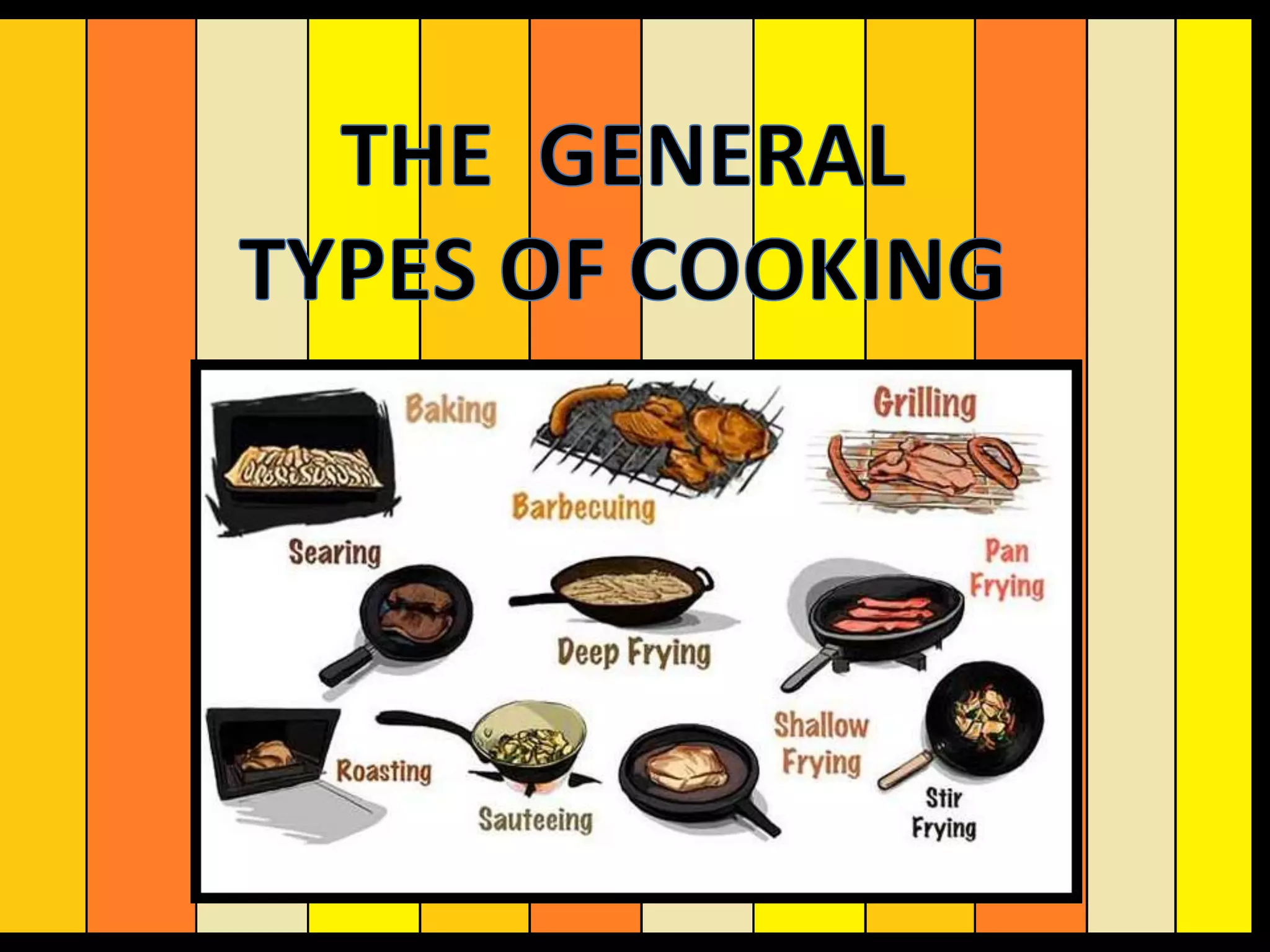
By: LOUISE MAE S. ZAPANTA
DEPED Guihulngan City
QUESTIONS:
1. Have you taken your breakfast?
2. What was your breakfast this
morning?
3. Who prepared your breakfast?
4. How was it prepared?
Objectives:
At the end of the lesson, the students are expected to:
• Enumerate the general types of cooking and
classify food according to how they are cooked
• Prepare one recipe that applies any of the methods
discussed
• Find cooking as interesting task
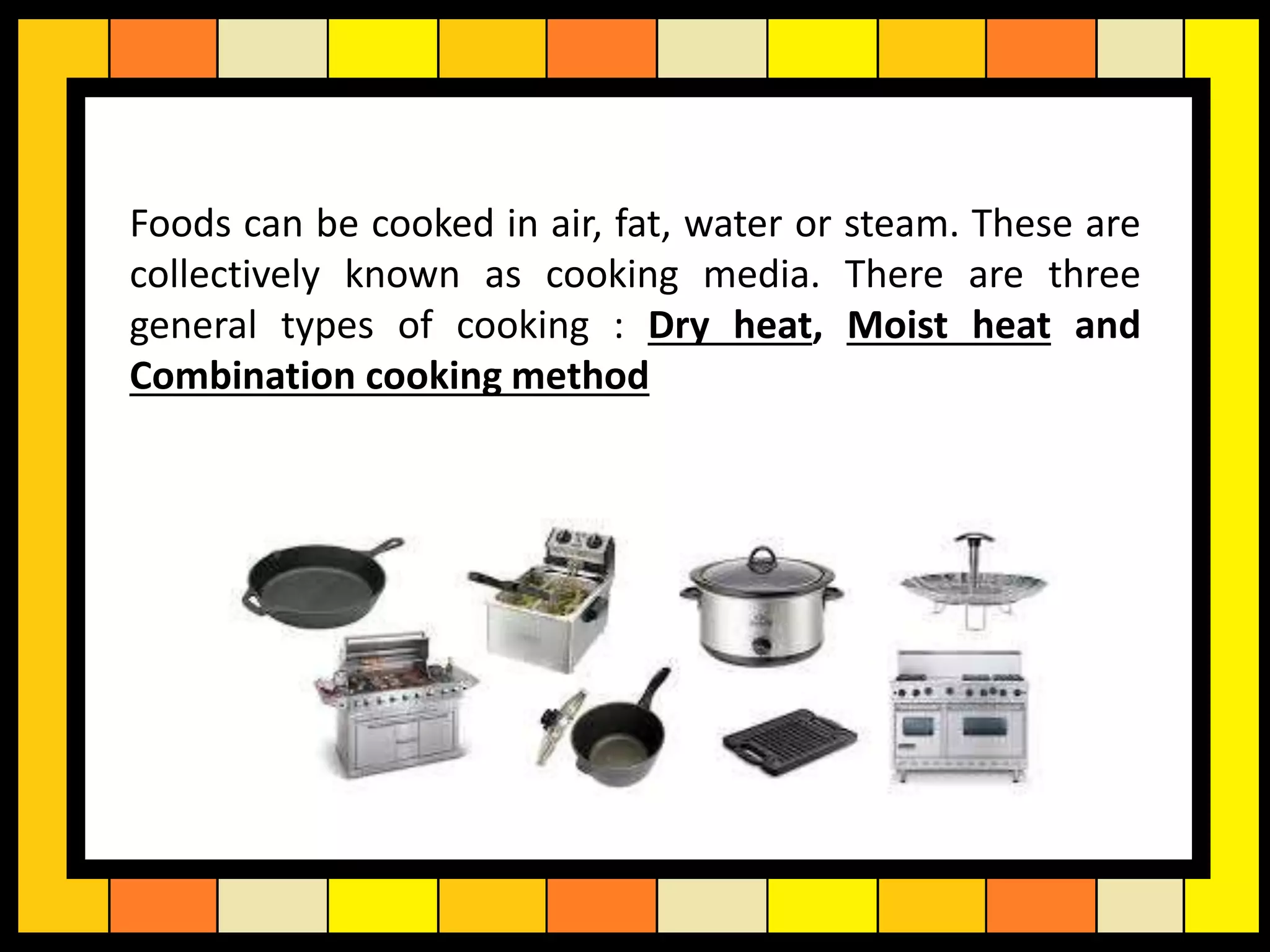
Foods can be cooked in air, fat, water or steam. These are
collectively known as cooking media. There are three
general types of cooking : Dry heat, Moist heat and
Combination cooking method
Dry-Heat Cooking Methods
In dry heat cooking methods, the food being cooked does
not use water to cook the food. The food is left dry and
heat is applied to cook the food.
When heat is applied to the food, the food cooks in its
own juice or the water added to the food during its
preparation evaporates during the heating process and
this cooks the food. Heat is applied directly to the food by
way of convection thus making the food to get cooked.
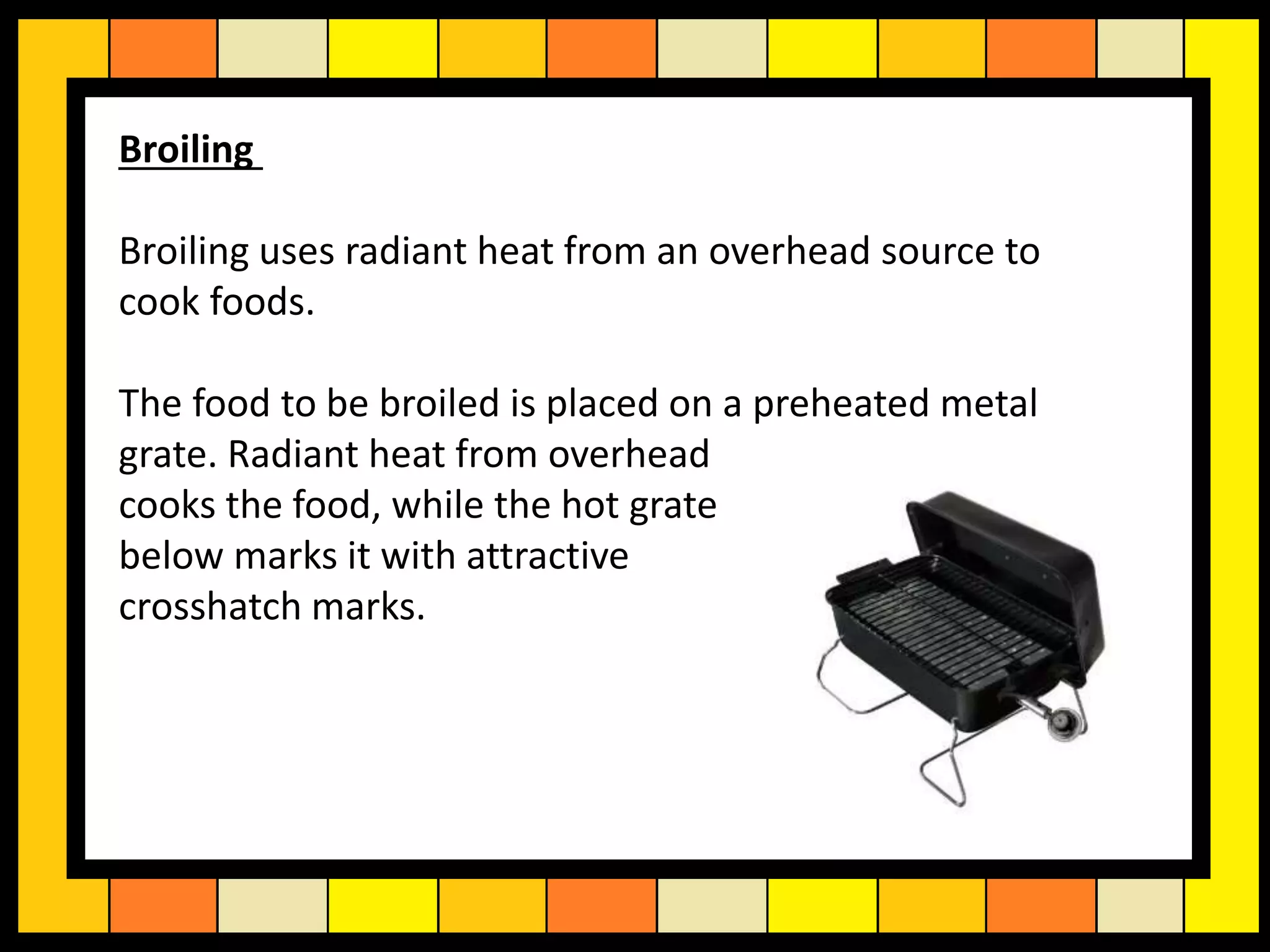
Broiling
Broiling uses radiant heat from an overhead source to
cook foods.
The food to be broiled is placed on a preheated metal
grate. Radiant heat from overhead
cooks the food, while the hot grate
below marks it with attractive
crosshatch marks.
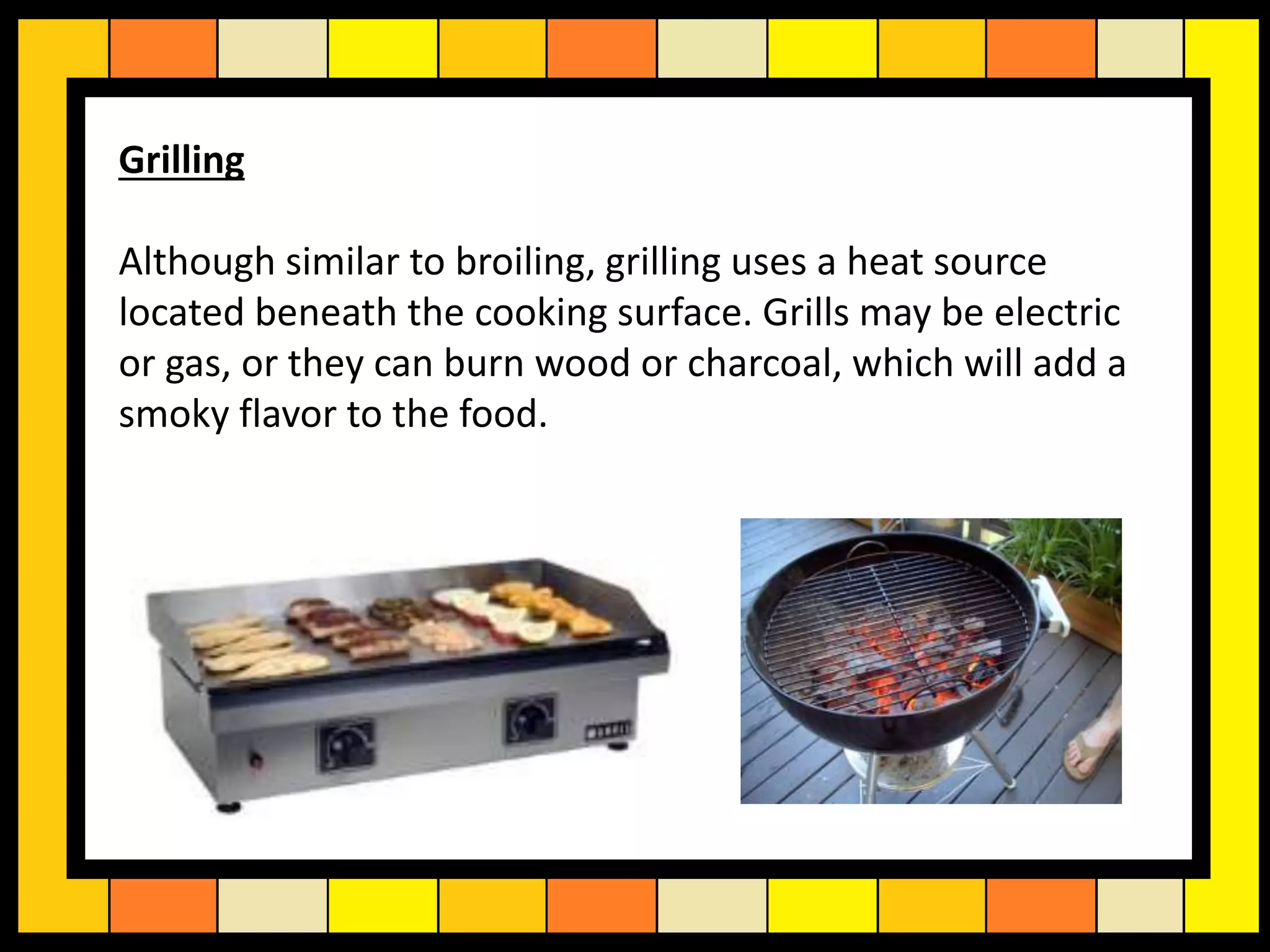
Grilling
Although similar to broiling, grilling uses a heat source
located beneath the cooking surface. Grills may be electric
or gas, or they can burn wood or charcoal, which will add a
smoky flavor to the food.
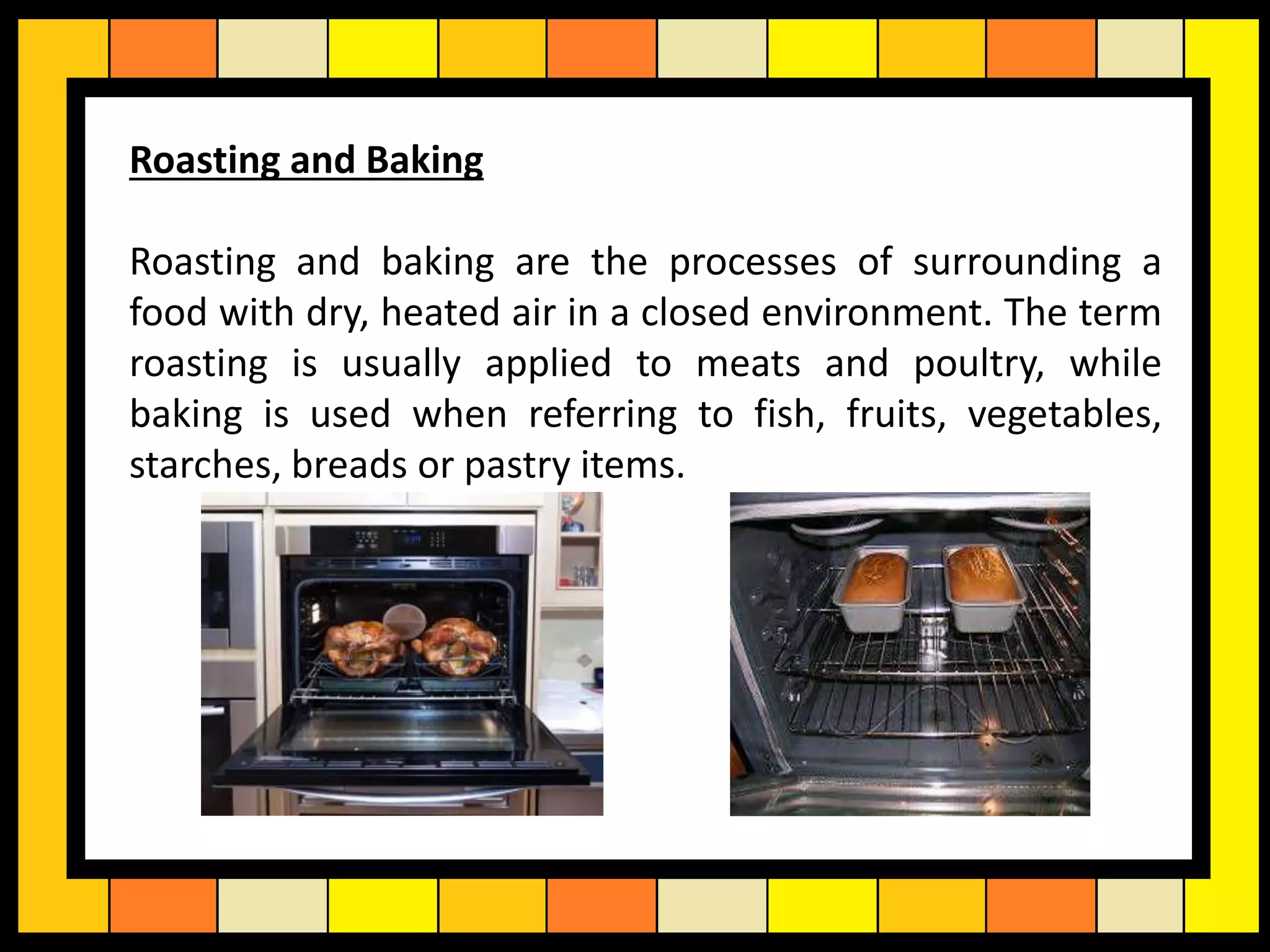
Roasting and Baking
Roasting and baking are the processes of surrounding a
food with dry, heated air in a closed environment. The term
roasting is usually applied to meats and poultry, while
baking is used when referring to fish, fruits, vegetables,
starches, breads or pastry items.
Sautéing
Sautéing is a dry-heat cooking method that uses conduction
to transfer heat from a hot sauté pan to food with the aid (if
a small amount of fat. Heat then penetrates the food
through conduction. High temperatures are used to sauté,
and the foods are usually cut
into small pieces to promote
even cooking.
Deep-Frying
Deep-frying is a dry-heat cooking method that uses
convection to transfer heat to food submerged in hot fat.
Heat then penetrates the food, cooking the in tenor
through conduction.
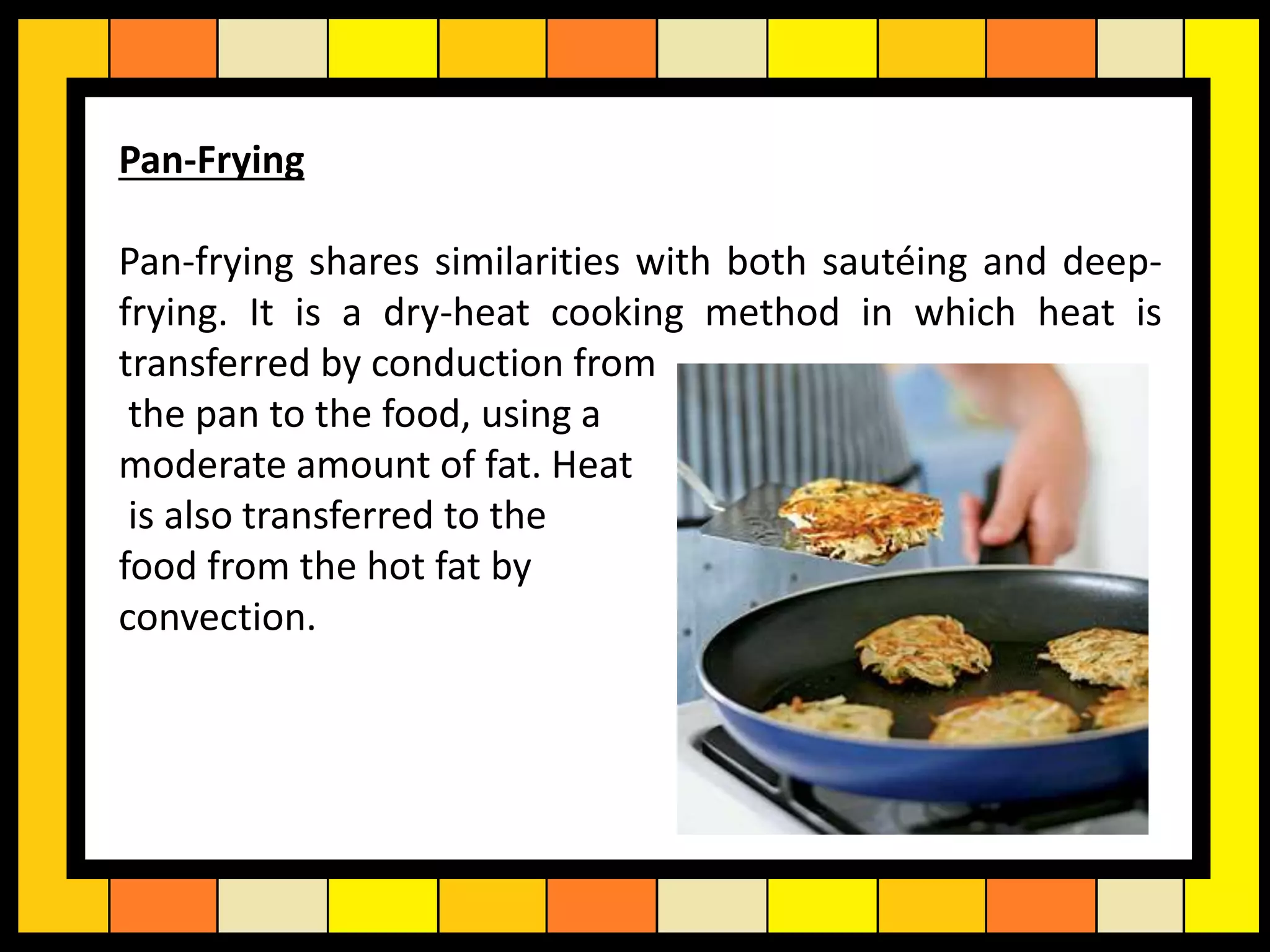
Pan-Frying
Pan-frying shares similarities with both sautéing and deep-
frying. It is a dry-heat cooking method in which heat is
transferred by conduction from
the pan to the food, using a
moderate amount of fat. Heat
is also transferred to the
food from the hot fat by
convection.
Moist-Heat Cooking Methods
In moist heat cookery methods, liquid is used as a medium
to cook the food. Such medium could be water, coconut
cream or oil. These liquids are added to the food before
heat is applied to it or sometimes heat is applied to the
liquid before the food is added into the cooking utensils to
be cooked.
Blanching
An item is cooked partially and briefly in a boiling water.
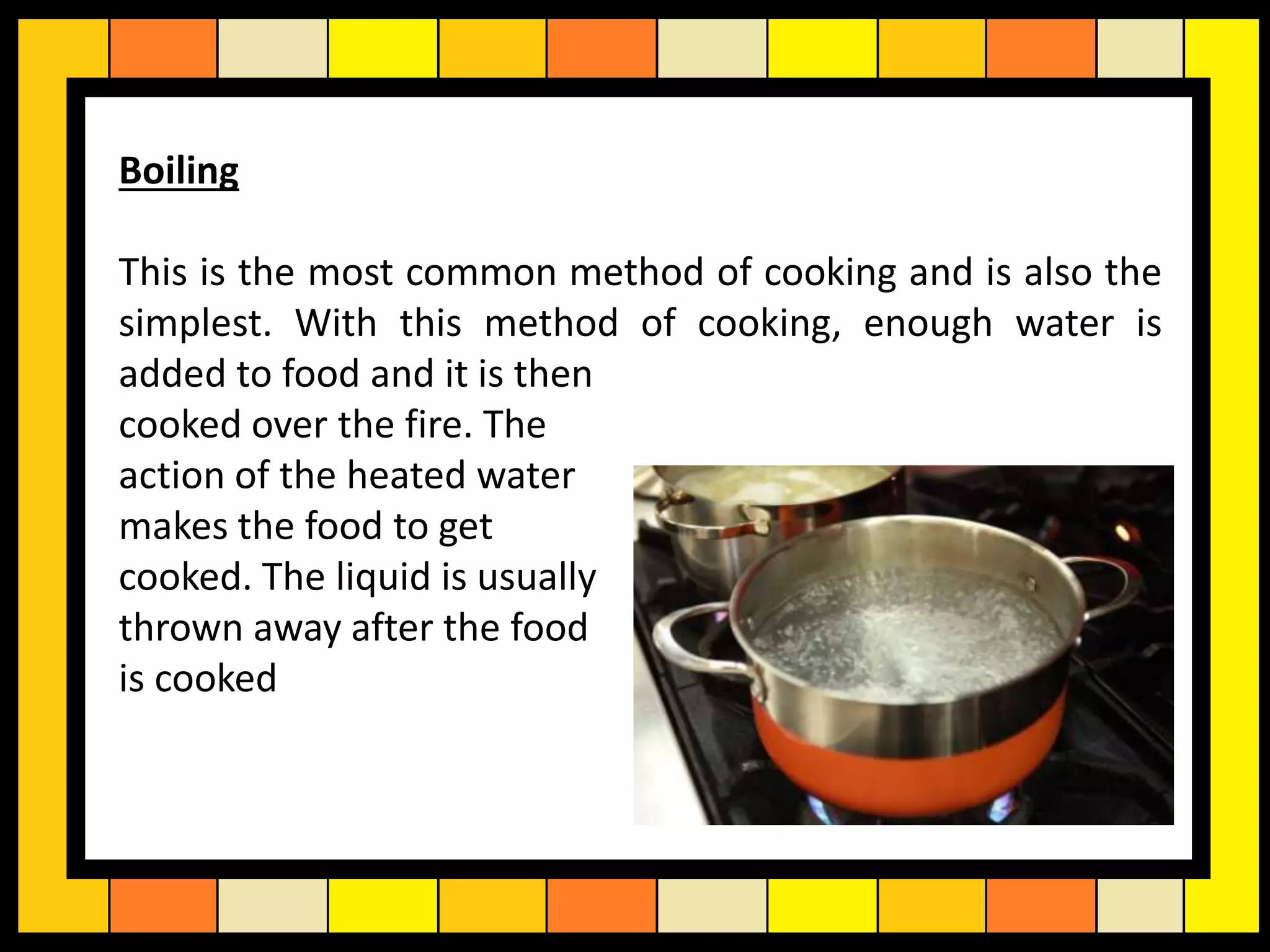
Boiling
This is the most common method of cooking and is also the
simplest. With this method of cooking, enough water is
added to food and it is then
cooked over the fire. The
action of the heated water
makes the food to get
cooked. The liquid is usually
thrown away after the food
is cooked
Poaching
Poaching is a moist-heat cooking method that uses
convection to transfer heat
from a liquid to a food. For
poaching, the food is
submerged in a liquid held
at temperatures between
160F and 180F.
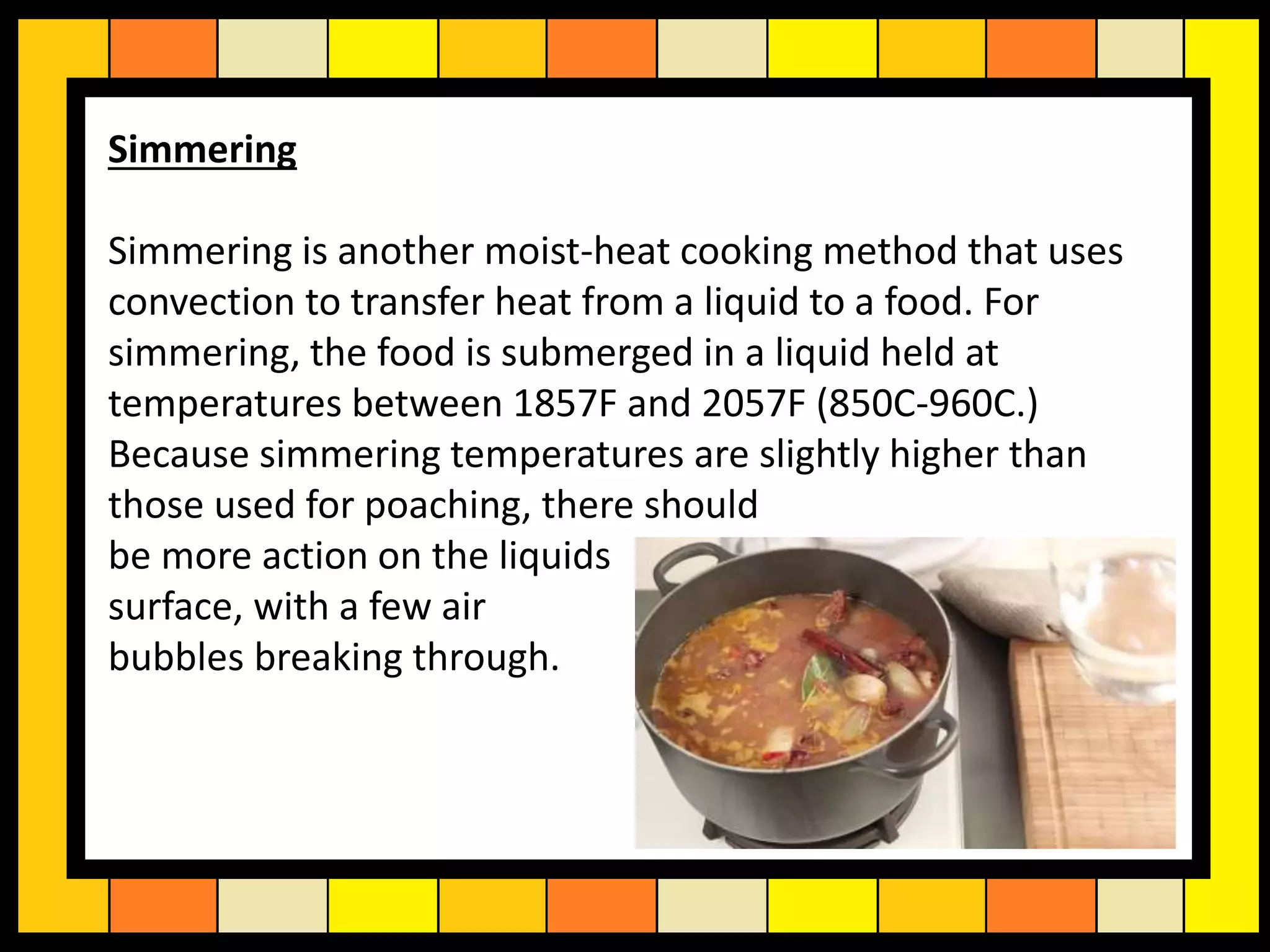
Simmering
Simmering is another moist-heat cooking method that uses
convection to transfer heat from a liquid to a food. For
simmering, the food is submerged in a liquid held at
temperatures between 1857F and 2057F (850C-960C.)
Because simmering temperatures are slightly higher than
those used for poaching, there should
be more action on the liquids
surface, with a few air
bubbles breaking through.
Steaming
To steam food, water is added to a pot and then a stand is
placed inside the pot. The water level should be under the
stand and not above it. There is no contact between the food
and the water that is added to the pot. Food is then placed on
the stand and heat is applied.
The hot steam rising from
the boiling water acts on the
food and the food gets cooked.
It is the hot steam that cooks
the food, as there is no
contact between the food and
the water inside the pot.
Combination Cooking Methods
Some cooking methods employ both dry-heat and moist-
heat cooking techniques. In this methods, the first step is
usually to brown the main item using dry heat. The second
step is to complete cooking by simmering the food in a
liquid.
Braising
Foods to be braised are usually a LARGE PIECES that are first
browned in a small amount of fat at high temperatures. As
with sautéing, heat is transferred from the pan to the food
mainly by the process of conduction. The pan is covered, and
the heat is reduced. The food
is then cooked at low heat,
using a combination of
simmering and steaming to
transfer heat from the liquid
(conduction) and the air
(convection) to the food. This
can be done on the stovetop
or in the oven.
Stewing
Stewing also uses a combination of dry- and moist-heat
cooking methods. Stewing is most often associated with
SMALLER PIECES of food that are first cooked either by
browning them in a small
amount of fat or oil, or by
blanching them in a liquid.
Cooking is then finished in
a liquid or sauce.
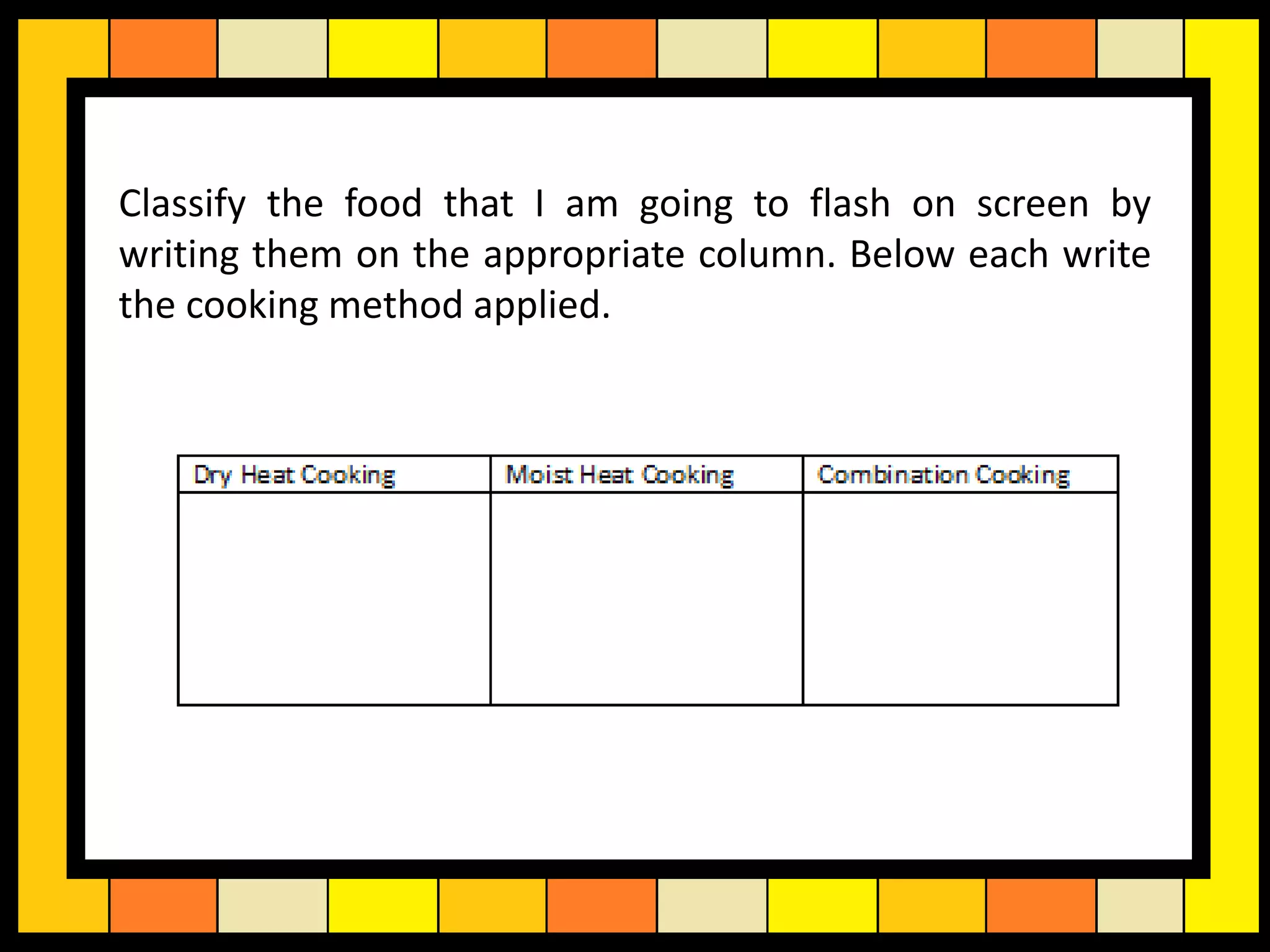
Classify the food that I am going to flash on screen by
writing them on the appropriate column. Below each write
the cooking method applied.
1. Siopao
2. Chocolate Cake
3. Escabetche
4. Roasted Chicken
5. Mashed Potato
6. Kaldereta
Assignment:
• Form groups of five.
• Each group must choose one recipe that applies any of the
methods discussed.
• Copy the recipe on a clean piece of bond paper and below
the recipe, write the cooking method applied.
• Make sure the ingredients are available and affordable

Methods of cooking

  • 1.
    By: LOUISE MAES. ZAPANTA DEPED Guihulngan City
  • 2.
    QUESTIONS: 1. Have youtaken your breakfast? 2. What was your breakfast this morning? 3. Who prepared your breakfast? 4. How was it prepared?
  • 4.
    Objectives: At the endof the lesson, the students are expected to: • Enumerate the general types of cooking and classify food according to how they are cooked • Prepare one recipe that applies any of the methods discussed • Find cooking as interesting task
  • 5.
    Foods can becooked in air, fat, water or steam. These are collectively known as cooking media. There are three general types of cooking : Dry heat, Moist heat and Combination cooking method
  • 6.
    Dry-Heat Cooking Methods Indry heat cooking methods, the food being cooked does not use water to cook the food. The food is left dry and heat is applied to cook the food. When heat is applied to the food, the food cooks in its own juice or the water added to the food during its preparation evaporates during the heating process and this cooks the food. Heat is applied directly to the food by way of convection thus making the food to get cooked.
  • 7.
    Broiling Broiling uses radiantheat from an overhead source to cook foods. The food to be broiled is placed on a preheated metal grate. Radiant heat from overhead cooks the food, while the hot grate below marks it with attractive crosshatch marks.
  • 8.
    Grilling Although similar tobroiling, grilling uses a heat source located beneath the cooking surface. Grills may be electric or gas, or they can burn wood or charcoal, which will add a smoky flavor to the food.
  • 9.
    Roasting and Baking Roastingand baking are the processes of surrounding a food with dry, heated air in a closed environment. The term roasting is usually applied to meats and poultry, while baking is used when referring to fish, fruits, vegetables, starches, breads or pastry items.
  • 10.
    Sautéing Sautéing is adry-heat cooking method that uses conduction to transfer heat from a hot sauté pan to food with the aid (if a small amount of fat. Heat then penetrates the food through conduction. High temperatures are used to sauté, and the foods are usually cut into small pieces to promote even cooking.
  • 11.
    Deep-Frying Deep-frying is adry-heat cooking method that uses convection to transfer heat to food submerged in hot fat. Heat then penetrates the food, cooking the in tenor through conduction.
  • 12.
    Pan-Frying Pan-frying shares similaritieswith both sautéing and deep- frying. It is a dry-heat cooking method in which heat is transferred by conduction from the pan to the food, using a moderate amount of fat. Heat is also transferred to the food from the hot fat by convection.
  • 13.
    Moist-Heat Cooking Methods Inmoist heat cookery methods, liquid is used as a medium to cook the food. Such medium could be water, coconut cream or oil. These liquids are added to the food before heat is applied to it or sometimes heat is applied to the liquid before the food is added into the cooking utensils to be cooked.
  • 14.
    Blanching An item iscooked partially and briefly in a boiling water.
  • 15.
    Boiling This is themost common method of cooking and is also the simplest. With this method of cooking, enough water is added to food and it is then cooked over the fire. The action of the heated water makes the food to get cooked. The liquid is usually thrown away after the food is cooked
  • 16.
    Poaching Poaching is amoist-heat cooking method that uses convection to transfer heat from a liquid to a food. For poaching, the food is submerged in a liquid held at temperatures between 160F and 180F.
  • 17.
    Simmering Simmering is anothermoist-heat cooking method that uses convection to transfer heat from a liquid to a food. For simmering, the food is submerged in a liquid held at temperatures between 1857F and 2057F (850C-960C.) Because simmering temperatures are slightly higher than those used for poaching, there should be more action on the liquids surface, with a few air bubbles breaking through.
  • 18.
    Steaming To steam food,water is added to a pot and then a stand is placed inside the pot. The water level should be under the stand and not above it. There is no contact between the food and the water that is added to the pot. Food is then placed on the stand and heat is applied. The hot steam rising from the boiling water acts on the food and the food gets cooked. It is the hot steam that cooks the food, as there is no contact between the food and the water inside the pot.
  • 19.
    Combination Cooking Methods Somecooking methods employ both dry-heat and moist- heat cooking techniques. In this methods, the first step is usually to brown the main item using dry heat. The second step is to complete cooking by simmering the food in a liquid.
  • 20.
    Braising Foods to bebraised are usually a LARGE PIECES that are first browned in a small amount of fat at high temperatures. As with sautéing, heat is transferred from the pan to the food mainly by the process of conduction. The pan is covered, and the heat is reduced. The food is then cooked at low heat, using a combination of simmering and steaming to transfer heat from the liquid (conduction) and the air (convection) to the food. This can be done on the stovetop or in the oven.
  • 21.
    Stewing Stewing also usesa combination of dry- and moist-heat cooking methods. Stewing is most often associated with SMALLER PIECES of food that are first cooked either by browning them in a small amount of fat or oil, or by blanching them in a liquid. Cooking is then finished in a liquid or sauce.
  • 22.
    Classify the foodthat I am going to flash on screen by writing them on the appropriate column. Below each write the cooking method applied.
  • 23.
  • 24.
  • 25.
  • 26.
  • 27.
  • 28.
  • 29.
    Assignment: • Form groupsof five. • Each group must choose one recipe that applies any of the methods discussed. • Copy the recipe on a clean piece of bond paper and below the recipe, write the cooking method applied. • Make sure the ingredients are available and affordable