Sorting Algorithms
Department of Computer Science
Islamia College University Peshawar

Fall 2012 Semester
BCS course: CS 00 Analysis of Algorithms
Course Instructor: Mr. Zahid
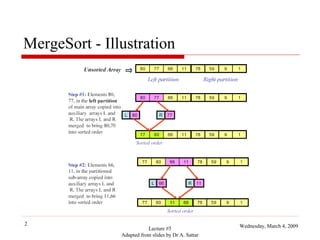
MergeSort - Illustration

2

Lecture #5
Adapted from slides by Dr A. Sattar

Wednesday, March 4, 2009
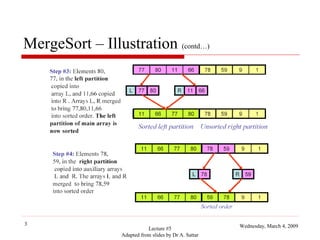
MergeSort – Illustration (contd…)

3

Lecture #5
Adapted from slides by Dr A. Sattar

Wednesday, March 4, 2009
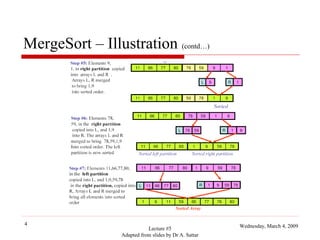
MergeSort – Illustration (contd…)

4

Lecture #5
Adapted from slides by Dr A. Sattar

Wednesday, March 4, 2009
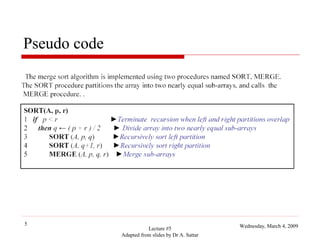
Pseudo code

5

Lecture #5
Adapted from slides by Dr A. Sattar

Wednesday, March 4, 2009
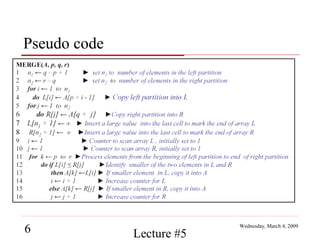
Pseudo code

6

Lecture #5

Wednesday, March 4, 2009
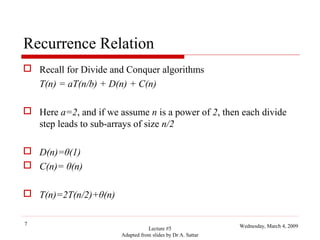
Recurrence Relation
 Recall for Divide and Conquer algorithms
T(n) = aT(n/b) + D(n) + C(n)
 Here a=2, and if we assume n is a power of 2, then each divide
step leads to sub-arrays of size n/2
 D(n)=θ(1)
 C(n)= θ(n)
 T(n)=2T(n/2)+θ(n)
7

Lecture #5
Adapted from slides by Dr A. Sattar

Wednesday, March 4, 2009
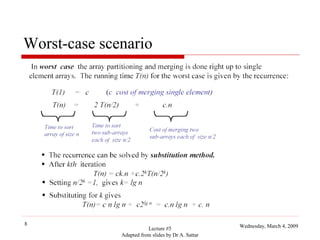
Worst-case scenario

8

Lecture #5
Adapted from slides by Dr A. Sattar

Wednesday, March 4, 2009
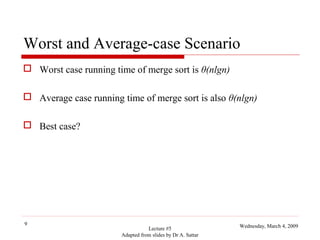
Worst and Average-case Scenario
 Worst case running time of merge sort is θ(nlgn)
 Average case running time of merge sort is also θ(nlgn)
 Best case?

9

Lecture #5
Adapted from slides by Dr A. Sattar

Wednesday, March 4, 2009
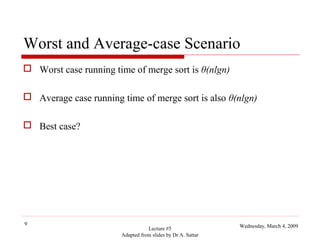
Worst and Average-case Scenario
 Worst case running time of merge sort is θ(nlgn)
 Average case running time of merge sort is also θ(nlgn)
 Best case?

9

Lecture #5
Adapted from slides by Dr A. Sattar

Wednesday, March 4, 2009

Merge sort

  • 1.
    Sorting Algorithms Department ofComputer Science Islamia College University Peshawar Fall 2012 Semester BCS course: CS 00 Analysis of Algorithms Course Instructor: Mr. Zahid
  • 2.
    MergeSort - Illustration 2 Lecture#5 Adapted from slides by Dr A. Sattar Wednesday, March 4, 2009
  • 3.
    MergeSort – Illustration(contd…) 3 Lecture #5 Adapted from slides by Dr A. Sattar Wednesday, March 4, 2009
  • 4.
    MergeSort – Illustration(contd…) 4 Lecture #5 Adapted from slides by Dr A. Sattar Wednesday, March 4, 2009
  • 5.
    Pseudo code 5 Lecture #5 Adaptedfrom slides by Dr A. Sattar Wednesday, March 4, 2009
  • 6.
  • 7.
    Recurrence Relation  Recallfor Divide and Conquer algorithms T(n) = aT(n/b) + D(n) + C(n)  Here a=2, and if we assume n is a power of 2, then each divide step leads to sub-arrays of size n/2  D(n)=θ(1)  C(n)= θ(n)  T(n)=2T(n/2)+θ(n) 7 Lecture #5 Adapted from slides by Dr A. Sattar Wednesday, March 4, 2009
  • 8.
    Worst-case scenario 8 Lecture #5 Adaptedfrom slides by Dr A. Sattar Wednesday, March 4, 2009
  • 9.
    Worst and Average-caseScenario  Worst case running time of merge sort is θ(nlgn)  Average case running time of merge sort is also θ(nlgn)  Best case? 9 Lecture #5 Adapted from slides by Dr A. Sattar Wednesday, March 4, 2009
  • 10.
    Worst and Average-caseScenario  Worst case running time of merge sort is θ(nlgn)  Average case running time of merge sort is also θ(nlgn)  Best case? 9 Lecture #5 Adapted from slides by Dr A. Sattar Wednesday, March 4, 2009