• A step-by-steppprocedure to solve
any given problem.
ALGORITHM
• Set of instruction , design to
accomplish any task
Definition:
01
4.
MERGE
SORT
Definition:
The Merge Sortalgorithm is a
divide-and-conquer algorithm that
sorts an array by first breaking it
down into smaller arrays, and then
building the array back together the
correct way so that it is sorted..
02
5.
CORE
CONCEPT
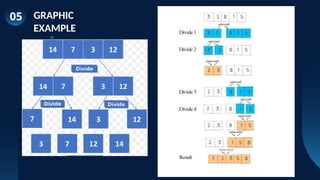
CONCEPT 1 :DIVIDE
Thealgorithm starts with breaking up the
array into smaller and smaller pieces until
one such sub-array only consists of one
element..
CONCEPT 2 : CONQUER
The algorithm merges the small pieces of
the array back together by putting the
lowest values first, resulting in a sorted
array.
CONCEPT 3 : RECURSIVENESS
The breaking down and building up of the
array to sort the array is done recursively.
03
6.
Advantages VS Disadvantages
•Merge sort can Sort large
amounts of data
• Have faster time
complexity
• Stable sorting algorithm
• Consume large space
because merge sort requires
an array as same size as the
list to sort the given data
• It is slower in case of dealing
with smaller sets to sort out
06 CODE EXAMPLE
#include<iostream>
usingnamespace std;
// Function to merge two
sorted subarrays
void merge(int arr[], int left, int
mid, int right) {
int n1 = mid - left + 1;
int n2 = right - mid;
// Temporary arrays
int L[n1], R[n2];
// Copy data to temporary
subarrays
for (int i = 0; i < n1; i++)
L[i] = arr[left + i];
for (int i = 0; i < n2; i++)
R[i] = arr[mid + 1 + i];
/
9.
CODE
EXAMPLE
// Merge thetemporary arrays back
into the original array
int i = 0, j = 0, k = left;
while (i < n1 && j < n2) {
if (L[i] <= R[j]) {
arr[k] = L[i];
i++;
} else {
arr[k] = R[j];
j++;}
k++; }
// Copy remaining elements of L, if any
while (i < n1) {
arr[k] = L[i];
i++;
k++;
}}
10.
// Recursive functionto implement merge
sort
void mergeSort(int arr[], int left, int right) {
if (left < right) {
// Find the midpoint
int mid = left + (right - left) / 2;
// Recursively sort the first and second halves
mergeSort(arr, left, mid);
mergeSort(arr, mid + 1, right);
// Merge the sorted halves
merge(arr, left, mid, right);
}
}
int main() {
// Example input array
int arr[] = {12, 11, 13, 5, 6, 7};
int n = sizeof(arr) / sizeof(arr[0]);
cout << "Original array: ";
for (int i = 0; i < n; i++)
cout << arr[i] << " ";
cout << endl;
CODE
EXAMPLE
11.
06 CODE EXAMPLE
//Perform merge sort
mergeSort(arr, 0, n - 1);
// Output the sorted array
cout << "Sorted array: ";
for (int i = 0; i < n; i++)
cout << arr[i] << " ";
cout << endl;
return 0;
}
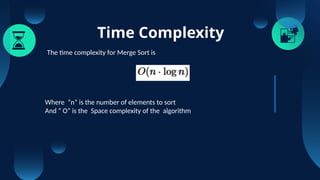
Time Complexity
The timecomplexity for Merge Sort is
Where “n” is the number of elements to sort
And “ O” is the Space complexity of the algorithm
14.
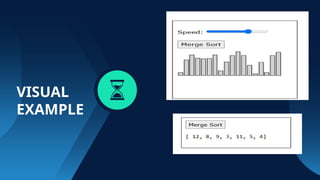
• Various Visualexamples
• Advantages Vs
Disadvantages
SUMMARY
Part 1 Part 2
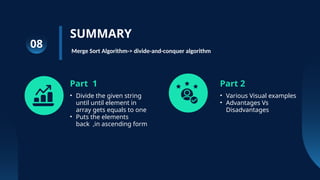
• Divide the given string
until until element in
array gets equals to one
• Puts the elements
back ,in ascending form
08 Merge Sort Algorithm-> divide-and-conquer algorithm






![06 CODE EXAMPLE
#include<iostream>
using namespace std;
// Function to merge two
sorted subarrays
void merge(int arr[], int left, int
mid, int right) {
int n1 = mid - left + 1;
int n2 = right - mid;
// Temporary arrays
int L[n1], R[n2];
// Copy data to temporary
subarrays
for (int i = 0; i < n1; i++)
L[i] = arr[left + i];
for (int i = 0; i < n2; i++)
R[i] = arr[mid + 1 + i];
/](https://image.slidesharecdn.com/dsapresentation-250528192951-8f4f124c/85/dsa-presentation-on-merge-sorting-in-C-pptx-8-320.jpg)
![CODE
EXAMPLE
// Merge the temporary arrays back
into the original array
int i = 0, j = 0, k = left;
while (i < n1 && j < n2) {
if (L[i] <= R[j]) {
arr[k] = L[i];
i++;
} else {
arr[k] = R[j];
j++;}
k++; }
// Copy remaining elements of L, if any
while (i < n1) {
arr[k] = L[i];
i++;
k++;
}}](https://image.slidesharecdn.com/dsapresentation-250528192951-8f4f124c/85/dsa-presentation-on-merge-sorting-in-C-pptx-9-320.jpg)
![// Recursive function to implement merge
sort
void mergeSort(int arr[], int left, int right) {
if (left < right) {
// Find the midpoint
int mid = left + (right - left) / 2;
// Recursively sort the first and second halves
mergeSort(arr, left, mid);
mergeSort(arr, mid + 1, right);
// Merge the sorted halves
merge(arr, left, mid, right);
}
}
int main() {
// Example input array
int arr[] = {12, 11, 13, 5, 6, 7};
int n = sizeof(arr) / sizeof(arr[0]);
cout << "Original array: ";
for (int i = 0; i < n; i++)
cout << arr[i] << " ";
cout << endl;
CODE
EXAMPLE](https://image.slidesharecdn.com/dsapresentation-250528192951-8f4f124c/85/dsa-presentation-on-merge-sorting-in-C-pptx-10-320.jpg)
![06 CODE EXAMPLE
// Perform merge sort
mergeSort(arr, 0, n - 1);
// Output the sorted array
cout << "Sorted array: ";
for (int i = 0; i < n; i++)
cout << arr[i] << " ";
cout << endl;
return 0;
}](https://image.slidesharecdn.com/dsapresentation-250528192951-8f4f124c/85/dsa-presentation-on-merge-sorting-in-C-pptx-11-320.jpg)



![DSA[1]5655566666666666666666666666666.pptx](https://cdn.slidesharecdn.com/ss_thumbnails/dsa1-251221115013-1ff1f21a-thumbnail.jpg?width=640&height=640&fit=bounds)


