MENTAL HELPERS
SUPPORT YOUR TEAM
Mental Helpers

How to support your team's mental health without losing yours.
INTRODUCTION
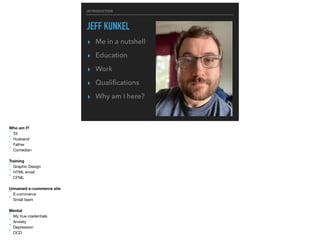
JEFF KUNKEL
▸ Me in a nutshell
▸ Education
▸ Work
▸ Qualifications
▸ Why am I here?
Who am I?
* 33

* Husband 

* Father

* Comedian

Training
* Graphic Design

* HTML email

* CFML

Unnamed e-commerce site
* E-commerce

* Small team

Mental
* My true credentials 

* Anxiety

* Depression

* OCD
Why this talk
* I want to contribute to the community 

* It’s something I know well enough to talk about

* Help each other help each other
I JUST PLAY ONE ON TV
I’M NO DOCTOR
▸ This is personal advice that has worked for me
▸ Seek further information from sources like the
American Psychiatric Association and the
American Foundation for Suicide Prevention
I’m no doctor
This is personal advice that has worked for me

Seek further information from sources like the American Psychiatric Association and the American Foundation for Suicide Prevention
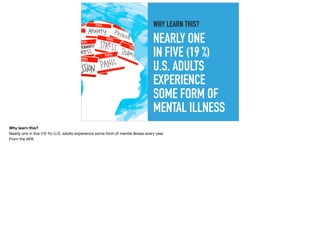
NEARLY ONE
IN FIVE (19 %)
U.S. ADULTS
EXPERIENCE
SOME FORM OF
MENTAL ILLNESS
WHY LEARN THIS?
Why learn this?
Nearly one in five (19 %) U.S. adults experience some form of mental illness every year

From the APA
INSANE IN THE MEMBRANE
WHAT EVEN IS A MENTAL ILLNESS?
Refers collectively to all diagnosable mental disorders —
health conditions involving:
▸ Significant changes in thinking, emotion and/or
behavior
▸ Distress and/or problems functioning in social, work or
family activities
The American Psychiatric Association (APA)
What is mental illness?
Mental illnesses are health conditions involving changes in emotion, thinking or behavior (or a combination of these). Mental illnesses are associated with distress and/or
problems functioning in social, work or family activities.

Mental illness is treatable. The vast majority of individuals with mental illness continue to function in their daily lives.
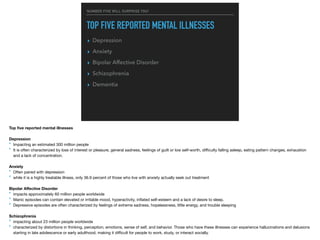
NUMBER FIVE WILL SURPRISE YOU!
TOP FIVE REPORTED MENTAL ILLNESSES
▸ Depression
▸ Anxiety
▸ Bipolar Affective Disorder
▸ Schizophrenia
▸ Dementia
Top five reported mental illnesses
Depression
‣ Impacting an estimated 300 million people

‣ It is often characterized by loss of interest or pleasure, general sadness, feelings of guilt or low self-worth, difficulty falling asleep, eating pattern changes, exhaustion
and a lack of concentration.

Anxiety
‣ Often paired with depression

‣ while it is a highly treatable illness, only 36.9 percent of those who live with anxiety actually seek out treatment

Bipolar Affective Disorder
‣ impacts approximately 60 million people worldwide

‣ Manic episodes can contain elevated or irritable mood, hyperactivity, inflated self-esteem and a lack of desire to sleep.

‣ Depressive episodes are often characterized by feelings of extreme sadness, hopelessness, little energy, and trouble sleeping

Schizophrenia
‣ impacting about 23 million people worldwide

‣ characterized by distortions in thinking, perception, emotions, sense of self, and behavior. Those who have these illnesses can experience hallucinations and delusions
starting in late adolescence or early adulthood, making it difficult for people to work, study, or interact socially.
Dementia
‣ impacting about 50 million people across the globe.

‣ From memory, orientation and thinking, to comprehension, calculation, and language, the decline in cognitive function is generally met with deterioration in emotional
and social control.
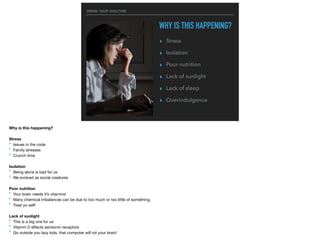
DRINK YOUR OVALTINE
WHY IS THIS HAPPENING?
▸ Stress
▸ Isolation
▸ Poor nutrition
▸ Lack of sunlight
▸ Lack of sleep
▸ Overindulgence
Why is this happening?
Stress
‣ Issues in the code

‣ Family stresses

‣ Crunch time

Isolation
‣ Being alone is bad for us

‣ We evolved as social creatures

Poor nutrition
‣ Your brain needs it’s vitamins!

‣ Many chemical imbalances can be due to too much or too little of something.

‣ Treat yo self!

Lack of sunlight
‣ This is a big one for us

‣ Vitamin D effects serotonin receptors

‣ Go outside you lazy kids, that computer will rot your brain!
Lack of sleep
‣ Sleep is what recharges your body

‣ Like a body oil change

‣ Less sleep means your body is working less well

Overindulgence
‣ I’m not yo mamma

‣ I’ll be drinking in about 40 min

‣ But chemicals can make your brain chemistry wiggy
ALWAYS WATCHING...
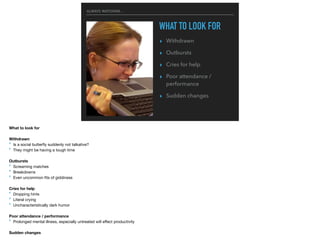
WHAT TO LOOK FOR
▸ Withdrawn
▸ Outbursts
▸ Cries for help
▸ Poor attendance /
performance
▸ Sudden changes
What to look for
Withdrawn
‣ Is a social butterfly suddenly not talkative?

‣ They might be having a tough time

Outbursts
‣ Screaming matches

‣ Breakdowns

‣ Even uncommon fits of giddiness

Cries for help
‣ Dropping hints

‣ Literal crying

‣ Uncharacteristically dark humor

Poor attendance / performance
‣ Prolonged mental illness, especially untreated will effect productivity

Sudden changes
‣ Any sudden or unexplained personality changes
LET’S TALK IT OUT
WHAT CAN I DO?
▸ Be a resource
▸ Relate personal
experience
▸ Show you care
▸ Make reasonable
accommodations
▸ Recommend professionals
What can I do?
Be a resource
‣ Be someone your coworkers can go to

‣ If you’re at this talk you’re probably already on top of this one

Relate personal experience
‣ If you understand how the person is feeling let them know!

‣ One of the biggest things that help people break out of bad cycles, or seek help is knowing they aren’t alone

Show you care
‣ Sometimes you just won’t be able to relate

‣ Let them know they matter to you, to the company

‣ Remind them of some of their recent victories

Make reasonable accommodations
‣ Allow them to alter their schedule for doctor’s appointments 

‣ Allow them to move to a less triggering area of the office

‣ Allow use of headphones to tune out distractions
Recommend professionals
‣ All in all, seeing a doctor is probably the best thing for them

‣ Many people don’t realize that your first stop is a primary care physician

‣ They often know / have a report with them already

‣ You’d go to the doctor if your arm want working, why not your mind?
HELP, I NEED SOMEBODY
FINDING A MEDICAL PROFESSIONAL
▸ Your primary care physician
▸ Your insurance company may have a list of covered
providers
▸ The website for the board of licensed professionals in
your state
▸ Ask someone how they found theirs
▸ See end of presentation for some additional links
* Primary care

* Your insurance

* Go to the website of the board of licensed professional counselors in your state.

* Ask someone you know

* See links
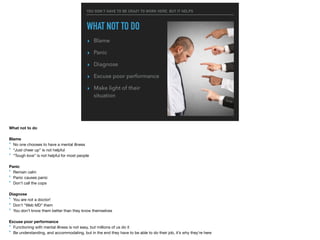
YOU DON’T HAVE TO BE CRAZY TO WORK HERE, BUT IT HELPS
WHAT NOT TO DO
▸ Blame
▸ Panic
▸ Diagnose
▸ Excuse poor performance
▸ Make light of their
situation
What not to do

Blame
‣ No one chooses to have a mental illness

‣ “Just cheer up” is not helpful

‣ “Tough love” is not helpful for most people

Panic
‣ Remain calm

‣ Panic causes panic

‣ Don’t call the cops

Diagnose
‣ You are not a doctor!

‣ Don’t “Web MD” them

‣ You don’t know them better than they know themselves

Excuse poor performance

‣ Functioning with mental illness is not easy, but millions of us do it

‣ Be understanding, and accommodating, but in the end they have to be able to do their job, it’s why they’re here
Make light of their situation
‣ Joking about mental illness is a very fine line

‣ Even if the employee jokes about it themselves

‣ Watch phrases like, “she’s crazy!”

‣ They seem innocent, but they can ostracize your emolpyee
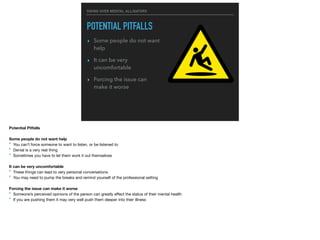
SWING OVER MENTAL ALLIGATORS
POTENTIAL PITFALLS
▸ Some people do not want
help
▸ It can be very
uncomfortable
▸ Forcing the issue can
make it worse
Potential Pitfalls
Some people do not want help
‣ You can’t force someone to want to listen, or be listened to

‣ Denial is a very real thing

‣ Sometimes you have to let them work it out themselves

It can be very uncomfortable
‣ These things can lead to very personal conversations

‣ You may need to pump the breaks and remind yourself of the professional setting

Forcing the issue can make it worse
‣ Someone’s perceived opinions of the person can greatly effect the status of their mental health

‣ If you are pushing them it may very well push them deeper into their illness
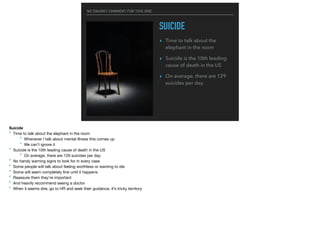
NO SNARKY COMMENT FOR THIS ONE
SUICIDE
▸ Time to talk about the
elephant in the room
▸ Suicide is the 10th leading
cause of death in the US
▸ On average, there are 129
suicides per day.
Suicide
‣ Time to talk about the elephant in the room

‣ Whenever I talk about mental illness this comes up

‣ We can’t ignore it

‣ Suicide is the 10th leading cause of death in the US

‣ On average, there are 129 suicides per day

‣ No handy warning signs to look for in every case

‣ Some people will talk about feeling worthless or wanting to die

‣ Some will seem completely fine until it happens

‣ Reassure them they’re important

‣ And heavily recommend seeing a doctor

‣ When it seems dire, go to HR and seek their guidance, it’s tricky territory
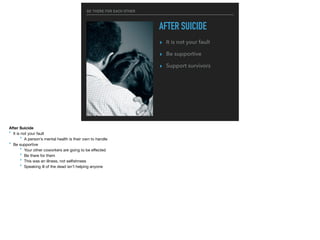
BE THERE FOR EACH OTHER
AFTER SUICIDE
▸ It is not your fault
▸ Be supportive
▸ Support survivors
After Suicide
‣ It is not your fault

‣ A person’s mental health is their own to handle

‣ Be supportive

‣ Your other coworkers are going to be effected

‣ Be there for them

‣ This was an illness, not selfishness

‣ Speaking ill of the dead isn’t helping anyone
OK, LET’S TAKE A MINUTE AND BREATHE
HOLD UP
LET’S TALK ABOUT YOU
▸ Other’s mental health is not
your personal responsibility
▸ Don’t risk your own mental
health for the sake of
others
▸ If you don’t take care of
yourself you won’t be there
to take care of others
Let’s talk about you
‣ Other’s mental health is not your personal responsibility

‣ Don’t risk your own mental health for the sake of others

‣ If you don’t take care of yourself you won’t be there to take care of others
DON’T FORGET YOURSELF
SELF CARE
▸ Practice what you preach
▸ Eat right
▸ Get some sleep
▸ Go out in the sun
▸ Accept help from others
Self care
‣ Practice what you preach

‣ Eat right

‣ Get some sleep

‣ Go out in the sun

‣ Accept help from others
HOME IS WHERE THE WORK IS
WORKING FROM HOME
▸ Get dressed
▸ Keep a schedule
▸ Have a separate work area
▸ Limit distractions
▸ Get “face time” with
colleagues
▸ Allow yourself to be bad at it
Working from home
* Get dressed, look good feel good, helps maintain normalcy

* Keep a schedule, set boundaries with work and home ‘coworkers’

* Have a separate work area. Making the same space you work and relax can muddle both

* Limit distractions

* Get “face time” with colleagues 

* Allow yourself to be bad at it
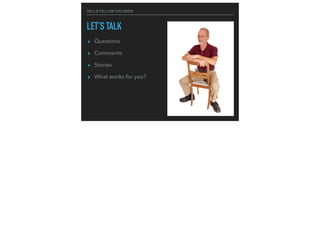
HELLO FELLOW CHILDREN
LET’S TALK
▸ Questions
▸ Comments
▸ Stories
▸ What works for you?
I CANNOT VOUCH FOR THE QUALITY OF THE CODE
HELPFUL LINKS FOR FINDING HELP
▸ http://traumahealing.com
▸ http://psychologytoday.com
▸ https://www.mhanational.org/finding-therapy

Mental Helpers 2020

  • 1.
    MENTAL HELPERS SUPPORT YOURTEAM Mental Helpers How to support your team's mental health without losing yours.
  • 2.
    INTRODUCTION JEFF KUNKEL ▸ Mein a nutshell ▸ Education ▸ Work ▸ Qualifications ▸ Why am I here? Who am I? * 33 * Husband * Father * Comedian Training * Graphic Design * HTML email * CFML Unnamed e-commerce site * E-commerce * Small team Mental * My true credentials * Anxiety * Depression * OCD
  • 3.
    Why this talk *I want to contribute to the community * It’s something I know well enough to talk about * Help each other help each other
  • 4.
    I JUST PLAYONE ON TV I’M NO DOCTOR ▸ This is personal advice that has worked for me ▸ Seek further information from sources like the American Psychiatric Association and the American Foundation for Suicide Prevention I’m no doctor This is personal advice that has worked for me Seek further information from sources like the American Psychiatric Association and the American Foundation for Suicide Prevention
  • 5.
    NEARLY ONE IN FIVE(19 %) U.S. ADULTS EXPERIENCE SOME FORM OF MENTAL ILLNESS WHY LEARN THIS? Why learn this? Nearly one in five (19 %) U.S. adults experience some form of mental illness every year From the APA
  • 6.
    INSANE IN THEMEMBRANE WHAT EVEN IS A MENTAL ILLNESS? Refers collectively to all diagnosable mental disorders — health conditions involving: ▸ Significant changes in thinking, emotion and/or behavior ▸ Distress and/or problems functioning in social, work or family activities The American Psychiatric Association (APA) What is mental illness? Mental illnesses are health conditions involving changes in emotion, thinking or behavior (or a combination of these). Mental illnesses are associated with distress and/or problems functioning in social, work or family activities. Mental illness is treatable. The vast majority of individuals with mental illness continue to function in their daily lives.
  • 7.
    NUMBER FIVE WILLSURPRISE YOU! TOP FIVE REPORTED MENTAL ILLNESSES ▸ Depression ▸ Anxiety ▸ Bipolar Affective Disorder ▸ Schizophrenia ▸ Dementia Top five reported mental illnesses Depression ‣ Impacting an estimated 300 million people ‣ It is often characterized by loss of interest or pleasure, general sadness, feelings of guilt or low self-worth, difficulty falling asleep, eating pattern changes, exhaustion and a lack of concentration. Anxiety ‣ Often paired with depression ‣ while it is a highly treatable illness, only 36.9 percent of those who live with anxiety actually seek out treatment Bipolar Affective Disorder ‣ impacts approximately 60 million people worldwide ‣ Manic episodes can contain elevated or irritable mood, hyperactivity, inflated self-esteem and a lack of desire to sleep. ‣ Depressive episodes are often characterized by feelings of extreme sadness, hopelessness, little energy, and trouble sleeping Schizophrenia ‣ impacting about 23 million people worldwide ‣ characterized by distortions in thinking, perception, emotions, sense of self, and behavior. Those who have these illnesses can experience hallucinations and delusions starting in late adolescence or early adulthood, making it difficult for people to work, study, or interact socially.
  • 8.
    Dementia ‣ impacting about50 million people across the globe. ‣ From memory, orientation and thinking, to comprehension, calculation, and language, the decline in cognitive function is generally met with deterioration in emotional and social control.
  • 9.
    DRINK YOUR OVALTINE WHYIS THIS HAPPENING? ▸ Stress ▸ Isolation ▸ Poor nutrition ▸ Lack of sunlight ▸ Lack of sleep ▸ Overindulgence Why is this happening? Stress ‣ Issues in the code ‣ Family stresses ‣ Crunch time Isolation ‣ Being alone is bad for us ‣ We evolved as social creatures Poor nutrition ‣ Your brain needs it’s vitamins! ‣ Many chemical imbalances can be due to too much or too little of something. ‣ Treat yo self! Lack of sunlight ‣ This is a big one for us ‣ Vitamin D effects serotonin receptors ‣ Go outside you lazy kids, that computer will rot your brain!
  • 10.
    Lack of sleep ‣Sleep is what recharges your body ‣ Like a body oil change ‣ Less sleep means your body is working less well Overindulgence ‣ I’m not yo mamma ‣ I’ll be drinking in about 40 min ‣ But chemicals can make your brain chemistry wiggy
  • 11.
    ALWAYS WATCHING... WHAT TOLOOK FOR ▸ Withdrawn ▸ Outbursts ▸ Cries for help ▸ Poor attendance / performance ▸ Sudden changes What to look for Withdrawn ‣ Is a social butterfly suddenly not talkative? ‣ They might be having a tough time Outbursts ‣ Screaming matches ‣ Breakdowns ‣ Even uncommon fits of giddiness Cries for help ‣ Dropping hints ‣ Literal crying ‣ Uncharacteristically dark humor Poor attendance / performance ‣ Prolonged mental illness, especially untreated will effect productivity Sudden changes
  • 12.
    ‣ Any suddenor unexplained personality changes
  • 13.
    LET’S TALK ITOUT WHAT CAN I DO? ▸ Be a resource ▸ Relate personal experience ▸ Show you care ▸ Make reasonable accommodations ▸ Recommend professionals What can I do? Be a resource ‣ Be someone your coworkers can go to ‣ If you’re at this talk you’re probably already on top of this one Relate personal experience ‣ If you understand how the person is feeling let them know! ‣ One of the biggest things that help people break out of bad cycles, or seek help is knowing they aren’t alone Show you care ‣ Sometimes you just won’t be able to relate ‣ Let them know they matter to you, to the company ‣ Remind them of some of their recent victories Make reasonable accommodations ‣ Allow them to alter their schedule for doctor’s appointments ‣ Allow them to move to a less triggering area of the office ‣ Allow use of headphones to tune out distractions
  • 14.
    Recommend professionals ‣ Allin all, seeing a doctor is probably the best thing for them ‣ Many people don’t realize that your first stop is a primary care physician ‣ They often know / have a report with them already ‣ You’d go to the doctor if your arm want working, why not your mind?
  • 15.
    HELP, I NEEDSOMEBODY FINDING A MEDICAL PROFESSIONAL ▸ Your primary care physician ▸ Your insurance company may have a list of covered providers ▸ The website for the board of licensed professionals in your state ▸ Ask someone how they found theirs ▸ See end of presentation for some additional links * Primary care * Your insurance * Go to the website of the board of licensed professional counselors in your state. * Ask someone you know * See links
  • 16.
    YOU DON’T HAVETO BE CRAZY TO WORK HERE, BUT IT HELPS WHAT NOT TO DO ▸ Blame ▸ Panic ▸ Diagnose ▸ Excuse poor performance ▸ Make light of their situation What not to do Blame ‣ No one chooses to have a mental illness ‣ “Just cheer up” is not helpful ‣ “Tough love” is not helpful for most people Panic ‣ Remain calm ‣ Panic causes panic ‣ Don’t call the cops Diagnose ‣ You are not a doctor! ‣ Don’t “Web MD” them ‣ You don’t know them better than they know themselves Excuse poor performance ‣ Functioning with mental illness is not easy, but millions of us do it ‣ Be understanding, and accommodating, but in the end they have to be able to do their job, it’s why they’re here
  • 17.
    Make light oftheir situation ‣ Joking about mental illness is a very fine line ‣ Even if the employee jokes about it themselves ‣ Watch phrases like, “she’s crazy!” ‣ They seem innocent, but they can ostracize your emolpyee
  • 18.
    SWING OVER MENTALALLIGATORS POTENTIAL PITFALLS ▸ Some people do not want help ▸ It can be very uncomfortable ▸ Forcing the issue can make it worse Potential Pitfalls Some people do not want help ‣ You can’t force someone to want to listen, or be listened to ‣ Denial is a very real thing ‣ Sometimes you have to let them work it out themselves It can be very uncomfortable ‣ These things can lead to very personal conversations ‣ You may need to pump the breaks and remind yourself of the professional setting Forcing the issue can make it worse ‣ Someone’s perceived opinions of the person can greatly effect the status of their mental health ‣ If you are pushing them it may very well push them deeper into their illness
  • 19.
    NO SNARKY COMMENTFOR THIS ONE SUICIDE ▸ Time to talk about the elephant in the room ▸ Suicide is the 10th leading cause of death in the US ▸ On average, there are 129 suicides per day. Suicide ‣ Time to talk about the elephant in the room ‣ Whenever I talk about mental illness this comes up ‣ We can’t ignore it ‣ Suicide is the 10th leading cause of death in the US ‣ On average, there are 129 suicides per day ‣ No handy warning signs to look for in every case ‣ Some people will talk about feeling worthless or wanting to die ‣ Some will seem completely fine until it happens ‣ Reassure them they’re important ‣ And heavily recommend seeing a doctor ‣ When it seems dire, go to HR and seek their guidance, it’s tricky territory
  • 20.
    BE THERE FOREACH OTHER AFTER SUICIDE ▸ It is not your fault ▸ Be supportive ▸ Support survivors After Suicide ‣ It is not your fault ‣ A person’s mental health is their own to handle ‣ Be supportive ‣ Your other coworkers are going to be effected ‣ Be there for them ‣ This was an illness, not selfishness ‣ Speaking ill of the dead isn’t helping anyone
  • 21.
    OK, LET’S TAKEA MINUTE AND BREATHE
  • 22.
    HOLD UP LET’S TALKABOUT YOU ▸ Other’s mental health is not your personal responsibility ▸ Don’t risk your own mental health for the sake of others ▸ If you don’t take care of yourself you won’t be there to take care of others Let’s talk about you ‣ Other’s mental health is not your personal responsibility ‣ Don’t risk your own mental health for the sake of others ‣ If you don’t take care of yourself you won’t be there to take care of others
  • 23.
    DON’T FORGET YOURSELF SELFCARE ▸ Practice what you preach ▸ Eat right ▸ Get some sleep ▸ Go out in the sun ▸ Accept help from others Self care ‣ Practice what you preach ‣ Eat right ‣ Get some sleep ‣ Go out in the sun ‣ Accept help from others
  • 24.
    HOME IS WHERETHE WORK IS WORKING FROM HOME ▸ Get dressed ▸ Keep a schedule ▸ Have a separate work area ▸ Limit distractions ▸ Get “face time” with colleagues ▸ Allow yourself to be bad at it Working from home * Get dressed, look good feel good, helps maintain normalcy * Keep a schedule, set boundaries with work and home ‘coworkers’ * Have a separate work area. Making the same space you work and relax can muddle both * Limit distractions * Get “face time” with colleagues * Allow yourself to be bad at it
  • 25.
    HELLO FELLOW CHILDREN LET’STALK ▸ Questions ▸ Comments ▸ Stories ▸ What works for you?
  • 26.
    I CANNOT VOUCHFOR THE QUALITY OF THE CODE HELPFUL LINKS FOR FINDING HELP ▸ http://traumahealing.com ▸ http://psychologytoday.com ▸ https://www.mhanational.org/finding-therapy