NSW Mental Health
Services Competency
Framework (Draft)
Statewide Consultation
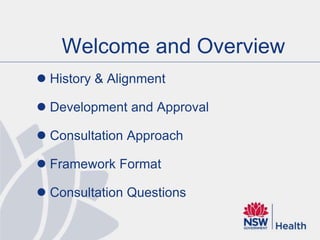
Welcome and Overview
 History & Alignment
 Development and Approval
 Consultation Approach
 Framework Format
 Consultation Questions
History & Alignment
 No overarching national competency frameworks for the
Australian mental health workforce
 NSW CAMHS Competency Framework & the NSW Core
Competencies for SMHSOP Community Clinicians
 International Activates:
– NZ, Let’s get real: Real Skills for people working in MH
and addiction
– UK, the Capable Practitioner, the Sainsbury Centre
 Professional Competencies and Codes of Practice
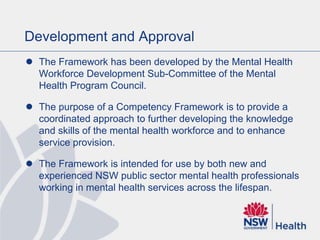
Development and Approval
 The Framework has been developed by the Mental Health
Workforce Development Sub-Committee of the Mental
Health Program Council.
 The purpose of a Competency Framework is to provide a
coordinated approach to further developing the knowledge
and skills of the mental health workforce and to enhance
service provision.
 The Framework is intended for use by both new and
experienced NSW public sector mental health professionals
working in mental health services across the lifespan.
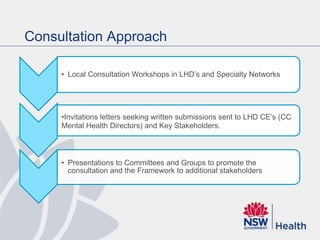
Consultation Approach
• Local Consultation Workshops in LHD’s and Specialty Networks
•Invitations letters seeking written submissions sent to LHD CE’s (CC
Mental Health Directors) and Key Stakeholders.
• Presentations to Committees and Groups to promote the
consultation and the Framework to additional stakeholders
Consultation Approach Cont.
 All consultation materials are available on the NSW Health
Website, including the Draft Framework and the Written
Submission Template
 The website allows for an open consultation process where
any staff member, consumer or carer can provide input.
 Consultation closes on the 28 November 2012.
Framework Format – Part 1 Overview
 Introduction
– Background
– Purpose
– Scope
– Alignment
– Format
 Guiding Principles
 Values and Attitudes
– Underpin the application of
knowledge & skills
 Mental Health Service Context
inc Life Stages
– Infant and Early Childhood (0 - 4 yrs)
– Child (5 - 11 yrs)
– Adolescent (12 - 17 yrs)
– Young Adulthood (18 - 25 yrs)
– Adult (26 - 40 yrs)
– Middle Years (41 - 64 yrs)
– Older People (65 - 84 yrs)
– Very Old People (85 yrs plus including
centenarians)
Part 2 - The Competencies
 Universal Competencies
1. Responsible, safe and ethical
practice
2. Working with clients, families
and carers in recovery-
focussed ways
3. Meeting diverse needs
4. Working with Aboriginal
people, families and
communities
5. Communication
6. Continuous quality
improvement
7. Partnership, collaboration and
integration
 Clinical Competencies
8. Intake
9. Assessment, formulation and
care planning
10. Interventions
11. Transfer of Care
 Population Approach
Competencies
12. Mental health promotion and
primary prevention
Part 3 – Implementation Guide &
Competency Review Tools
 Implementation guide
– Guidelines for individuals, managers, supervisors and
resource developers
– Target audience for the Framework
– Defines some of the possible uses
 Competency Review Form (CRF) (page 38)
 Competency Development Plan (CDP) (page 66)
Consultation Questions
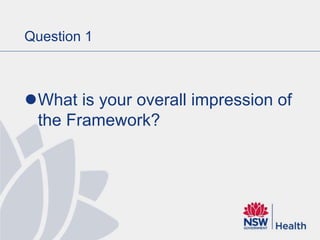
Question 1
What is your overall impression of
the Framework?
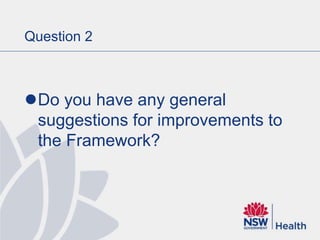
Question 2
Do you have any general
suggestions for improvements to
the Framework?
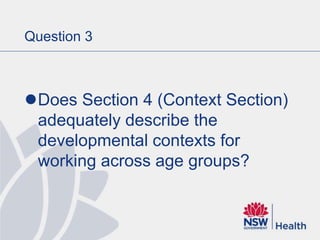
Question 3
Does Section 4 (Context Section)
adequately describe the
developmental contexts for
working across age groups?
Question 4
Are the Competencies targeted at
the right level to reflect actual
practice?
Question 5
Does the framework adequately
describe sub-specialty practice,
i.e. CAMHS and SMHSOP?
Question 6
Is there anything missing that
should be included within the
Competencies?
Question 7
Do you anticipate the
Implementation Tools will be
useful? (Part 3 of the Framework)
Do you suggest any changes?
Question 8
Do you have any suggestions that
would assist with implementing
the framework?
Question 9
What do you see as the greatest
barriers to implementing the
framework?
Question 10
Are there any other comments?
Where to from here?
 Thank you for your input
 Written Submissions
 Next step
 For any further information on the process please contact
Amy Shearden on 02 9424 5834 or email
ashea@doh.health.nsw.gov.au.

Mental Health Services Competency Framework

  • 1.
    NSW Mental Health ServicesCompetency Framework (Draft) Statewide Consultation
  • 2.
    Welcome and Overview History & Alignment  Development and Approval  Consultation Approach  Framework Format  Consultation Questions
  • 3.
    History & Alignment No overarching national competency frameworks for the Australian mental health workforce  NSW CAMHS Competency Framework & the NSW Core Competencies for SMHSOP Community Clinicians  International Activates: – NZ, Let’s get real: Real Skills for people working in MH and addiction – UK, the Capable Practitioner, the Sainsbury Centre  Professional Competencies and Codes of Practice
  • 4.
    Development and Approval The Framework has been developed by the Mental Health Workforce Development Sub-Committee of the Mental Health Program Council.  The purpose of a Competency Framework is to provide a coordinated approach to further developing the knowledge and skills of the mental health workforce and to enhance service provision.  The Framework is intended for use by both new and experienced NSW public sector mental health professionals working in mental health services across the lifespan.
  • 5.
    Consultation Approach • LocalConsultation Workshops in LHD’s and Specialty Networks •Invitations letters seeking written submissions sent to LHD CE’s (CC Mental Health Directors) and Key Stakeholders. • Presentations to Committees and Groups to promote the consultation and the Framework to additional stakeholders
  • 6.
    Consultation Approach Cont. All consultation materials are available on the NSW Health Website, including the Draft Framework and the Written Submission Template  The website allows for an open consultation process where any staff member, consumer or carer can provide input.  Consultation closes on the 28 November 2012.
  • 7.
    Framework Format –Part 1 Overview  Introduction – Background – Purpose – Scope – Alignment – Format  Guiding Principles  Values and Attitudes – Underpin the application of knowledge & skills  Mental Health Service Context inc Life Stages – Infant and Early Childhood (0 - 4 yrs) – Child (5 - 11 yrs) – Adolescent (12 - 17 yrs) – Young Adulthood (18 - 25 yrs) – Adult (26 - 40 yrs) – Middle Years (41 - 64 yrs) – Older People (65 - 84 yrs) – Very Old People (85 yrs plus including centenarians)
  • 8.
    Part 2 -The Competencies  Universal Competencies 1. Responsible, safe and ethical practice 2. Working with clients, families and carers in recovery- focussed ways 3. Meeting diverse needs 4. Working with Aboriginal people, families and communities 5. Communication 6. Continuous quality improvement 7. Partnership, collaboration and integration  Clinical Competencies 8. Intake 9. Assessment, formulation and care planning 10. Interventions 11. Transfer of Care  Population Approach Competencies 12. Mental health promotion and primary prevention
  • 9.
    Part 3 –Implementation Guide & Competency Review Tools  Implementation guide – Guidelines for individuals, managers, supervisors and resource developers – Target audience for the Framework – Defines some of the possible uses  Competency Review Form (CRF) (page 38)  Competency Development Plan (CDP) (page 66)
  • 10.
  • 11.
    Question 1 What isyour overall impression of the Framework?
  • 12.
    Question 2 Do youhave any general suggestions for improvements to the Framework?
  • 13.
    Question 3 Does Section4 (Context Section) adequately describe the developmental contexts for working across age groups?
  • 14.
    Question 4 Are theCompetencies targeted at the right level to reflect actual practice?
  • 15.
    Question 5 Does theframework adequately describe sub-specialty practice, i.e. CAMHS and SMHSOP?
  • 16.
    Question 6 Is thereanything missing that should be included within the Competencies?
  • 17.
    Question 7 Do youanticipate the Implementation Tools will be useful? (Part 3 of the Framework) Do you suggest any changes?
  • 18.
    Question 8 Do youhave any suggestions that would assist with implementing the framework?
  • 19.
    Question 9 What doyou see as the greatest barriers to implementing the framework?
  • 20.
    Question 10 Are thereany other comments?
  • 21.
    Where to fromhere?  Thank you for your input  Written Submissions  Next step  For any further information on the process please contact Amy Shearden on 02 9424 5834 or email ashea@doh.health.nsw.gov.au.