Mental FitnessA Consciousness EvolutionBy Claudia V. AlarconKaplan University, May 25 2010
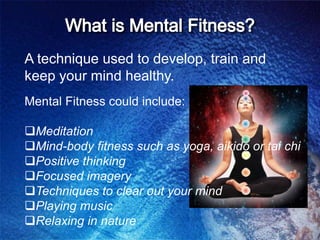
What is Mental Fitness?A technique used to develop, train and keep your mind healthy.Mental Fitness could include:Meditation
Mind-body fitness such as yoga, aikido or tai chi
Positive thinking
Focused imagery
Techniques to clear out your mind
Playing music
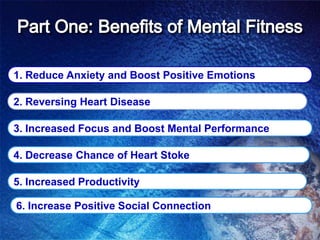
Relaxing in naturePart One: Benefits of Mental Fitness1. Reduce Anxiety and Boost Positive Emotions2. Reversing Heart Disease3. Increased Focus and Boost Mental Performance4. Decrease Chance of Heart Stoke5. Increased Productivity6. Increase Positive Social Connection
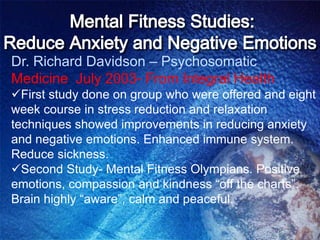
Mental Fitness Studies: Reduce Anxiety and Negative EmotionsDr. Richard Davidson – Psychosomatic Medicine  July 2003- From Integral Health First study done on group who were offered and eight week course in stress reduction and relaxation techniques showed improvements in reducing anxiety and negative emotions. Enhanced immune system. Reduce sickness.
Second Study- Mental Fitness Olympians. Positive emotions, compassion and kindness “off the charts”. Brain highly “aware”, calm and peaceful. Mental Fitness Studies: Reversing Heart DiseaseDr. Dean Ornish Study that gave heart disease patients diet, stress management, and other lifestyle changes.Group with the lifestyle changes 91% reduction in chest pains.Overall improvement in health.“Stress is not just what you do, is how you react to what you do.” - Cornish
Increased Focus and Boost Mental PerformanceCultivating a “Winner’s Brain”Harvard Mental Health Letter; May2010, Vol. 26 Issue 11, p4-5, 2pThe article discusses the nonpharmacological ways to boost mental performance. An individual can achieve a state of heightened concentration and pleasure by having a commitment to master a craft. Maintaining focus was found to improve one's ability to recall how to do a task later on. It is also considered that practicing something physically and using imagery repeatedly help individuals to gain skills and confidence.
Decrease Chance of Heart Stoke with Transcendental MeditationMeditation: Shock Absorber for the Heart.By Gelman, LaurenPrevention; Apr2010, VHeart disease patients who practiced Transcendental Meditation twice a day were 47% less likely to experience heart attack stroke, and death over a 5-year period, compared with a control group that took classes on healthy eating and exercise. TM's benefit is so powerful, it's comparable to a new class of heart disease-preventing drugs, says study author Robert Schneider, MD, director of the Institute for Natural Medicine and Prevention in Fairfield, IA.ol. 62 Issue 4, p18-18, 1/3p
Increased Productivity with Transcendental MeditationTRANSCENDENTAL MEDITATION AND PRODUCTIVITY.By Frew, David R.Academy of Management Journal; Jun74, Vol. 17 Issue 2, p362-368, 7p, 2 ChartsThe article explores the relationship between transcendental meditation and productivity at work. Using six measures of productivity, mediators reported they experienced increased job satisfaction, better performance and better relationships with supervisors and co-workers. Data support the proposition that productivity gains are an increasing function of structural level. Mediators reported that their gains in job satisfaction and performance and improved interpersonal relationships were more position than those of mediators who work at low levels of organizations.
Loving Kindness Meditation Increases Social ConnectionLoving-kindness meditation increases social connectedness.Gross, James J., Department of Psychology, Stanford University, Jordan Hall, Bldg. 420, Stanford, CA, US, 94305-2130, gross@stanford.edu In this study, the authors used a brief loving-kindness meditation exercise to examine whether social connection could be created toward strangers in a controlled laboratory context. Compared with a closely matched control task, even just a few minutes of loving-kindness meditation increased feelings of social connection and positivity toward novel individuals on both explicit and implicit levels. These results suggest that this easily implemented technique may help to increase positive social emotions and decrease social isolation. (PsycINFO Database Record (c) 2010 APA, all rights reserved)
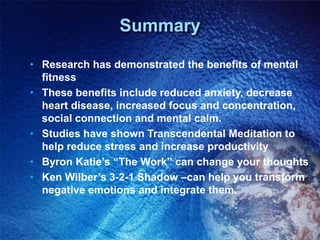
Part 2: Examples of Mental Fitness ExercisesTranscendental MeditationThe Work – by Byron Katie3-2-1 Shadow Work – by Ken Wilber
Transcendental MeditationRelax. Sit quietly with your eyes closed in a controlled environment with minimal distractions.Breathe deeply and practice allowing your mind time to calm down.Repeat your mantra over and over for 20 minutes.Focus your mind on the "oneness" of the universe. This is achieved through repetition of your mantra and by shutting out any external distractions around you.Observe, accept and move past any intrusive thoughts that pop into your mind. Simply practice repeating your mantra until you've gone 20 minutes thinking of nothing else.http://www.tm.org/
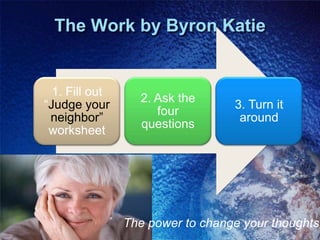
The Work by Byron KatieThe power to change your thoughts
1) Judge Your NeighborWho angers, confuses, saddens, or disappoints you, and why? What is it about them that you don’t like?How do you want them to change? What do you want them to do?What is it that they should or shouldn’t do, be, think, or feel? What advice could you offer?What do they need to do in order for you to be happy?What do you think of them? Make a list.
2) Ask the Four Questions1. Is it true?2. Can you absolutely know that it’s true?3. How do you react, what happens, when you believe that thought?4. Who would you be without the thought?
3) Turn it AroundTurn the thought around (original thought: Paul doesn’t listen to me.)a) to the opposite (Paul does listen to me.)b) to the self (I don’t listen to me.)c) to the other (I don’t listen to Paul.)And find three genuine, specific examples of how each turnaround is true in your life.http://www.thework.com/
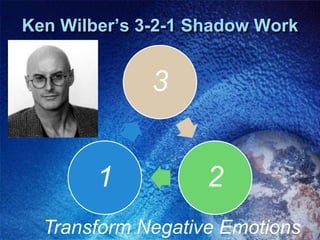
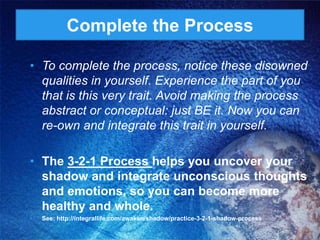
Ken Wilber’s 3-2-1 Shadow WorkTransform Negative Emotions
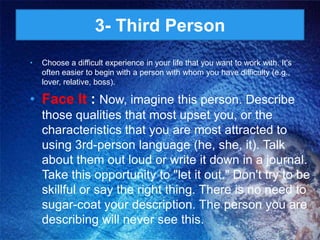
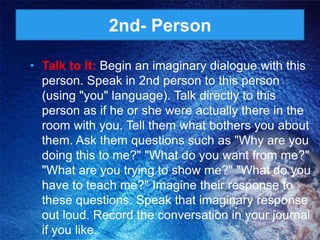
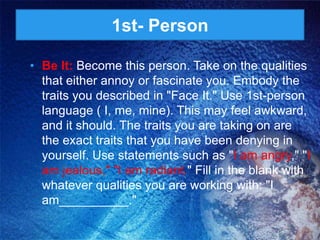
3- Third PersonChoose a difficult experience in your life that you want to work with. It's often easier to begin with a person with whom you have difficulty (e.g., lover, relative, boss).

Mental Fitness Presentation

  • 1.
    Mental FitnessA ConsciousnessEvolutionBy Claudia V. AlarconKaplan University, May 25 2010
  • 2.
    What is MentalFitness?A technique used to develop, train and keep your mind healthy.Mental Fitness could include:Meditation
  • 3.
    Mind-body fitness suchas yoga, aikido or tai chi
  • 4.
  • 5.
  • 6.
    Techniques to clearout your mind
  • 7.
  • 8.
    Relaxing in naturePartOne: Benefits of Mental Fitness1. Reduce Anxiety and Boost Positive Emotions2. Reversing Heart Disease3. Increased Focus and Boost Mental Performance4. Decrease Chance of Heart Stoke5. Increased Productivity6. Increase Positive Social Connection
  • 9.
    Mental Fitness Studies:Reduce Anxiety and Negative EmotionsDr. Richard Davidson – Psychosomatic Medicine July 2003- From Integral Health First study done on group who were offered and eight week course in stress reduction and relaxation techniques showed improvements in reducing anxiety and negative emotions. Enhanced immune system. Reduce sickness.
  • 10.
    Second Study- MentalFitness Olympians. Positive emotions, compassion and kindness “off the charts”. Brain highly “aware”, calm and peaceful. Mental Fitness Studies: Reversing Heart DiseaseDr. Dean Ornish Study that gave heart disease patients diet, stress management, and other lifestyle changes.Group with the lifestyle changes 91% reduction in chest pains.Overall improvement in health.“Stress is not just what you do, is how you react to what you do.” - Cornish
  • 11.
    Increased Focus andBoost Mental PerformanceCultivating a “Winner’s Brain”Harvard Mental Health Letter; May2010, Vol. 26 Issue 11, p4-5, 2pThe article discusses the nonpharmacological ways to boost mental performance. An individual can achieve a state of heightened concentration and pleasure by having a commitment to master a craft. Maintaining focus was found to improve one's ability to recall how to do a task later on. It is also considered that practicing something physically and using imagery repeatedly help individuals to gain skills and confidence.
  • 12.
    Decrease Chance ofHeart Stoke with Transcendental MeditationMeditation: Shock Absorber for the Heart.By Gelman, LaurenPrevention; Apr2010, VHeart disease patients who practiced Transcendental Meditation twice a day were 47% less likely to experience heart attack stroke, and death over a 5-year period, compared with a control group that took classes on healthy eating and exercise. TM's benefit is so powerful, it's comparable to a new class of heart disease-preventing drugs, says study author Robert Schneider, MD, director of the Institute for Natural Medicine and Prevention in Fairfield, IA.ol. 62 Issue 4, p18-18, 1/3p
  • 13.
    Increased Productivity withTranscendental MeditationTRANSCENDENTAL MEDITATION AND PRODUCTIVITY.By Frew, David R.Academy of Management Journal; Jun74, Vol. 17 Issue 2, p362-368, 7p, 2 ChartsThe article explores the relationship between transcendental meditation and productivity at work. Using six measures of productivity, mediators reported they experienced increased job satisfaction, better performance and better relationships with supervisors and co-workers. Data support the proposition that productivity gains are an increasing function of structural level. Mediators reported that their gains in job satisfaction and performance and improved interpersonal relationships were more position than those of mediators who work at low levels of organizations.
  • 14.
    Loving Kindness MeditationIncreases Social ConnectionLoving-kindness meditation increases social connectedness.Gross, James J., Department of Psychology, Stanford University, Jordan Hall, Bldg. 420, Stanford, CA, US, 94305-2130, gross@stanford.edu In this study, the authors used a brief loving-kindness meditation exercise to examine whether social connection could be created toward strangers in a controlled laboratory context. Compared with a closely matched control task, even just a few minutes of loving-kindness meditation increased feelings of social connection and positivity toward novel individuals on both explicit and implicit levels. These results suggest that this easily implemented technique may help to increase positive social emotions and decrease social isolation. (PsycINFO Database Record (c) 2010 APA, all rights reserved)
  • 15.
    Part 2: Examplesof Mental Fitness ExercisesTranscendental MeditationThe Work – by Byron Katie3-2-1 Shadow Work – by Ken Wilber
  • 16.
    Transcendental MeditationRelax. Sitquietly with your eyes closed in a controlled environment with minimal distractions.Breathe deeply and practice allowing your mind time to calm down.Repeat your mantra over and over for 20 minutes.Focus your mind on the "oneness" of the universe. This is achieved through repetition of your mantra and by shutting out any external distractions around you.Observe, accept and move past any intrusive thoughts that pop into your mind. Simply practice repeating your mantra until you've gone 20 minutes thinking of nothing else.http://www.tm.org/
  • 17.
    The Work byByron KatieThe power to change your thoughts
  • 18.
    1) Judge YourNeighborWho angers, confuses, saddens, or disappoints you, and why? What is it about them that you don’t like?How do you want them to change? What do you want them to do?What is it that they should or shouldn’t do, be, think, or feel? What advice could you offer?What do they need to do in order for you to be happy?What do you think of them? Make a list.
  • 19.
    2) Ask theFour Questions1. Is it true?2. Can you absolutely know that it’s true?3. How do you react, what happens, when you believe that thought?4. Who would you be without the thought?
  • 20.
    3) Turn itAroundTurn the thought around (original thought: Paul doesn’t listen to me.)a) to the opposite (Paul does listen to me.)b) to the self (I don’t listen to me.)c) to the other (I don’t listen to Paul.)And find three genuine, specific examples of how each turnaround is true in your life.http://www.thework.com/
  • 21.
    Ken Wilber’s 3-2-1Shadow WorkTransform Negative Emotions
  • 22.
    3- Third PersonChoosea difficult experience in your life that you want to work with. It's often easier to begin with a person with whom you have difficulty (e.g., lover, relative, boss).