Take a moment or two before you go to the next slide and
jot down notes about what you would say memory is.
Then we’ll see how it compares with psychologists’ answers.
Not “a memory” and not “remembering something” but the
basic process . . .
Somewhat like “What is sight?” or “What is attention?”
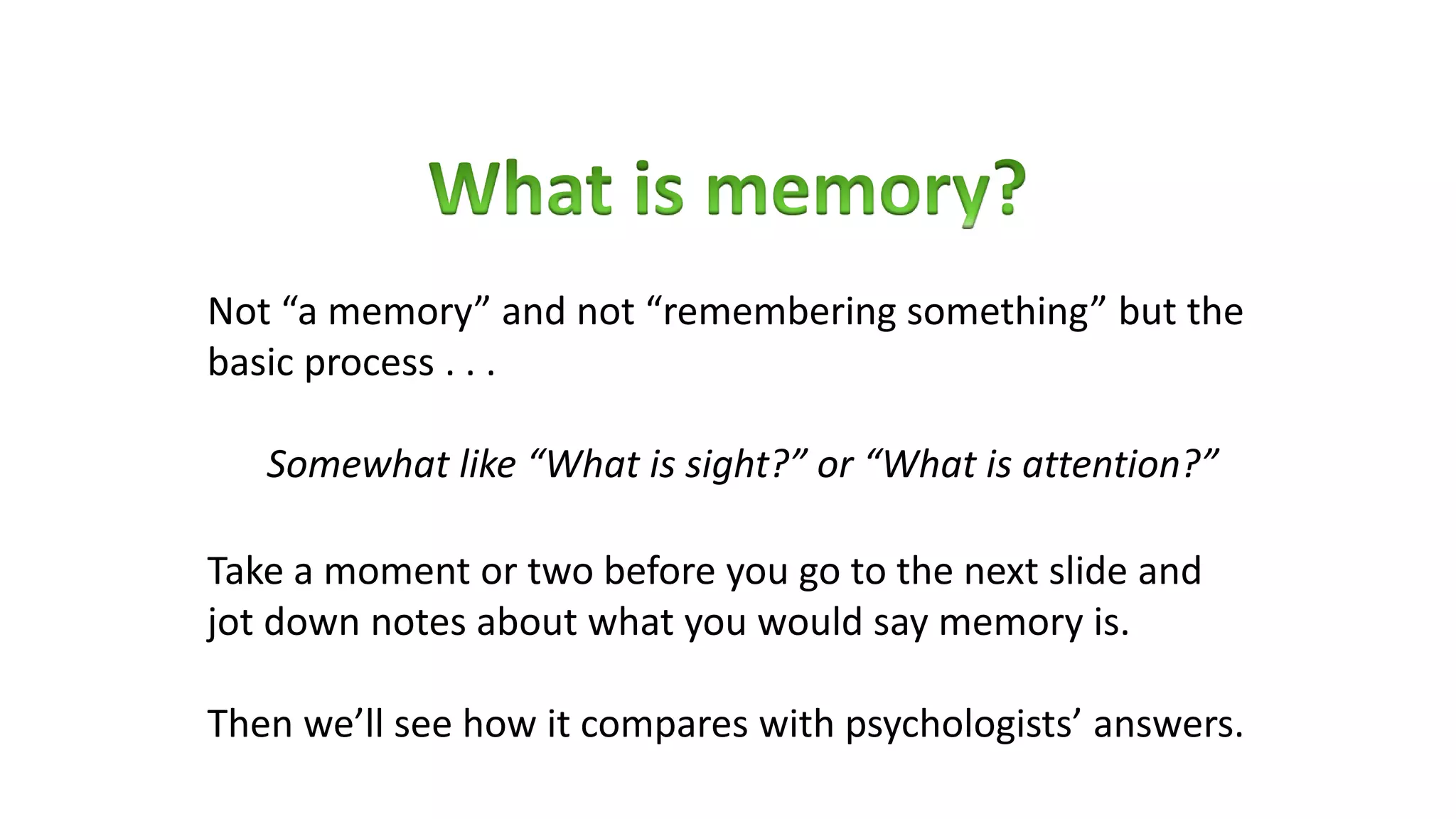
Memory is a change at Time 2 as a result of something at Time 1.
Time 1 Time 2
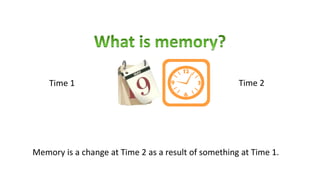
Memory is a change at Time 2 as a result of something at Time 1.
Time 1 Time 2
Experience
“something”
Difference compared
to if “something”
had not been
experienced
If you suffered from anterograde amnesia (if you did not
have memory for new events), your answer would likely
be unchanged.
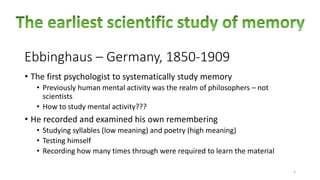
Ebbinghaus – Germany, 1850-1909
5
• The first psychologist to systematically study memory
• Previously human mental activity was the realm of philosophers – not
scientists
• How to study mental activity???
• He recorded and examined his own remembering
• Studying syllables (low meaning) and poetry (high meaning)
• Testing himself
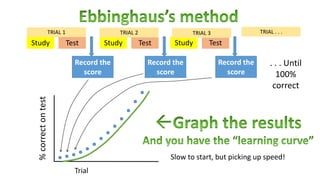
• Recording how many times through were required to learn the material
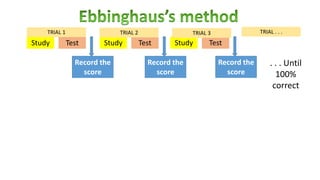
Study Test Study Test
Record the
score
Record the
score
Study Test
Record the
score
. . . Until
100%
correct
TRIAL 1 TRIAL 2 TRIAL 3 TRIAL . . .
Study Test Study Test
Record the
score
Record the
score
Study Test
Record the
score
. . . Until
100%
correct
TRIAL 1 TRIAL 2 TRIAL 3 TRIAL . . .
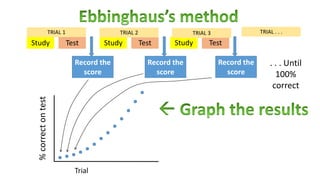
%correctontest
Trial
Study Test Study Test
Record the
score
Record the
score
Study Test
Record the
score
. . . Until
100%
correct
TRIAL 1 TRIAL 2 TRIAL 3 TRIAL . . .
%correctontest
Trial
Slow to start, but picking up speed!
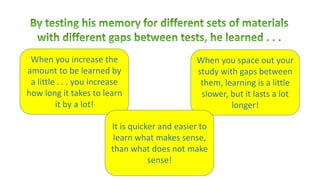
When you increase the
amount to be learned by
a little . . . you increase
how long it takes to learn
it by a lot!
When you space out your
study with gaps between
them, learning is a little
slower, but it lasts a lot
longer!
It is quicker and easier to
learn what makes sense,
than what does not make
sense!

Memory basics 1

  • 1.
    Take a momentor two before you go to the next slide and jot down notes about what you would say memory is. Then we’ll see how it compares with psychologists’ answers. Not “a memory” and not “remembering something” but the basic process . . . Somewhat like “What is sight?” or “What is attention?”
  • 2.
    Memory is achange at Time 2 as a result of something at Time 1. Time 1 Time 2
  • 3.
    Memory is achange at Time 2 as a result of something at Time 1. Time 1 Time 2 Experience “something” Difference compared to if “something” had not been experienced
  • 4.
    If you sufferedfrom anterograde amnesia (if you did not have memory for new events), your answer would likely be unchanged.
  • 5.
    Ebbinghaus – Germany,1850-1909 5 • The first psychologist to systematically study memory • Previously human mental activity was the realm of philosophers – not scientists • How to study mental activity??? • He recorded and examined his own remembering • Studying syllables (low meaning) and poetry (high meaning) • Testing himself • Recording how many times through were required to learn the material
  • 6.
    Study Test StudyTest Record the score Record the score Study Test Record the score . . . Until 100% correct TRIAL 1 TRIAL 2 TRIAL 3 TRIAL . . .
  • 7.
    Study Test StudyTest Record the score Record the score Study Test Record the score . . . Until 100% correct TRIAL 1 TRIAL 2 TRIAL 3 TRIAL . . . %correctontest Trial
  • 8.
    Study Test StudyTest Record the score Record the score Study Test Record the score . . . Until 100% correct TRIAL 1 TRIAL 2 TRIAL 3 TRIAL . . . %correctontest Trial Slow to start, but picking up speed!
  • 9.
    When you increasethe amount to be learned by a little . . . you increase how long it takes to learn it by a lot! When you space out your study with gaps between them, learning is a little slower, but it lasts a lot longer! It is quicker and easier to learn what makes sense, than what does not make sense!